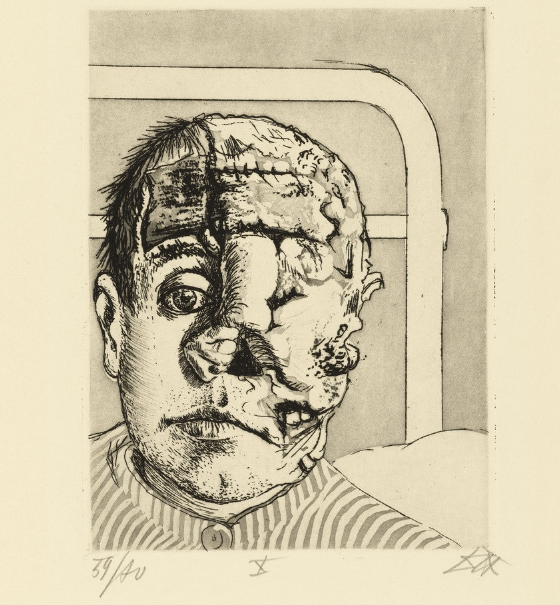
Skin Graft (Transplantation), from The War series, 1924 by Otto Dix (1891–1969)

Skin Graft (Transplantation), from The War series, 1924 by Otto Dix (1891–1969)
“A Way You’ll Never Be”
by
Ernest Hemingway
The attack had gone across the field, been held up by machine-gun fire from the sunken road and from the group of farm houses, encountered no resistance in the town, and reached the bank of the river. Coming along the road on a bicycle, getting off to push the machine when the surface of the road became too broken, Nicholas Adams saw what had happened by the position of the dead.
They lay alone or in clumps in the high grass of the field and along the road, their pockets out, and over them were flies and around each body or group of bodies were the scattered papers. Continue reading ““A Way You’ll Never Be” — Ernest Hemingway”

I brought a box of old books to my spot; I did not intend to pick up any books but then I picked up six:
I’d been looking for a handsome and/or cheap copy of Aldous Huxley’s The Devils of Loudon for a few years ago; success.
I posted something on Twitter a few days ago about how much I’ve been enjoying Steve Erickson’s Days Between Stations; one of the replies put James Crumley in his company (along with McCarthy and Joy Williams), so I picked up Dancing Bear and The Last Good Kiss:
I’ve long loved Peter Mendelsund’s cover designs, so I didn’t pass up on a used copy of What We See When We Read. It has a lot of pictures and diagrams and such.
I saw a very interesting looking person reading an actor’s edition of Philip Ridley’s play Mercury Fur on the train a few weeks ago. I had never heard of the play, but looked it up, thought it sounded pretty cool, and then looked for it in the drama section of this same book store the last time I was there. I didn’t find it. I found it yesterday mixed in with the novels. (I wasn’t actually looking for it.)
I don’t own physical copies of The Last Novel and Vanishing Point, two of the three novels collected in David Markson’s This Is Not a Novel and Other Novels, so I couldn’t pass on this omnibus. I do own a copy of Reader’s Block, which is not collected in This Is Not a Novel and Other Novels.
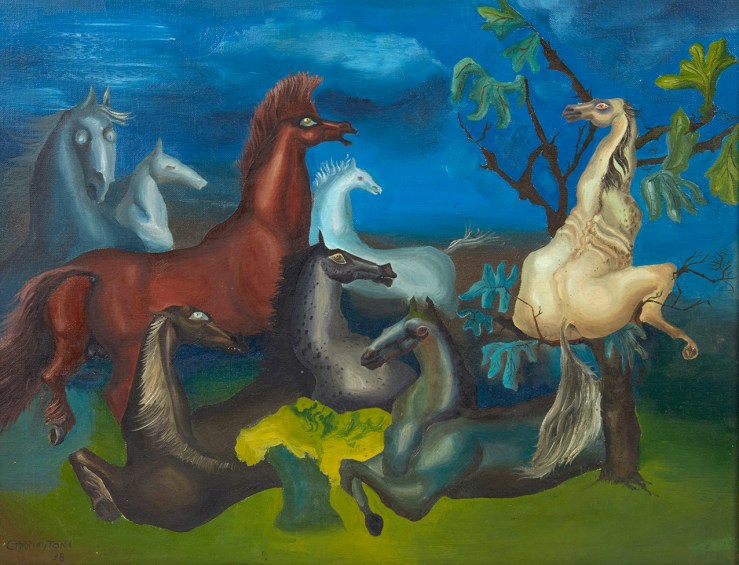
Lord Candlestick’s Horses, 1938 by Leonora Carrington (1917-2011)

Une après-midi, 2022 by Xiao Guo Hui (b. 1969)
 Penelope, 1923 by Glyn Philpot (1884-1937)

Q. It’s interesting that you say your new book is surreal but not magical realism. You’ve said that you don’t consider your earlier books to be surrealistic. Why not?
A. Surrealism was born out of a preoccupation with the irrationality and illogic of the subconscious, and a view that human relationships are fundamentally absurd. Whatever else my books may be about, they don’t express an absurd view of existence. The form of the books, and the strange juxtapositions of their narratives, may strike people as surreal, but the central concerns that drive the stories are traditional ones. I don’t think any true surrealist would consider me a surrealist, in the same way no hard-core science-fiction fan would consider me a science-fiction writer, since the basic concern of most classic science fiction is the relationship between man and technology. Philip K. Dick and Theodore Sturgeon and a few others are exceptions. Technology is a completely valid and important topic to write about, but it just doesn’t happen to interest me. And my books aren’t “experimental” because my priorities don’t involve reinventing literary forms, and they’re not fantastic because they’re not characterized by the sense of wonder that fantasy evokes. I think it’s been hard for my novels to find a niche.
Q. Do you see your books as being postmodern?
A. You know, I’ve never been entirely clear what “postmodern” means. But to at least some extent postmodernism seems to involve a cultural or aesthetic self-awareness, and an insistence on art recognizing and tweaking its own artifice. My aim isn’t to call attention to the artifice of my books but to make readers forget the artifice, to persuade them to exchange their reality for the one I’ve created. I’m aware that trying to get readers to give themselves over to another reality is always doomed to failure. On the other hand, that’s the job of the novelist, to fail and fail again. The great hope isn’t to succeed-I’m not sure what success would really mean-but to risk everything, and perhaps to fail by narrower margins, until there’s nothing left to fail with.
From a 1997 interview with novelist Steve Erickson. Larry McCaffery and Takayuki Tatsumi conducted the interview, which published in Contemporary Literature, Autumn, 1997, Vol. 38, No. 3.
“Wet”
by
Joy Williams
from 99 Stories of God
The Lord was drinking some water out of a glass. There was nothing wrong with the glass, but the water tasted terrible.
This was in a white building on a vast wasteland. The engineers within wore white uniforms and booties on their shoes and gloves on their hands. The water had traveled many hundreds of miles through wide pipes to be here.
What have you done to my water? the Lord asked. My living water…
Oh, they said, we thought that was just a metaphor.
WET

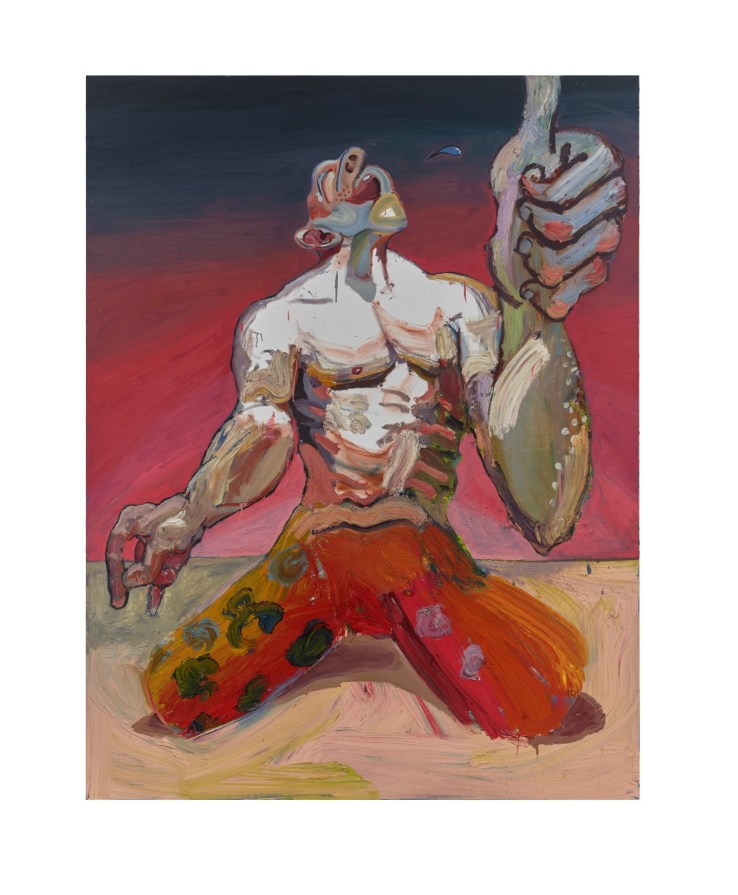
The War Crime, 2022 by Ben Quilty (b. 1973)
“The Dreadful Has Already Happened”
by
Mark Strand
The relatives are leaning over, staring expectantly.
They moisten their lips with their tongues. I can feel
them urging me on. I hold the baby in the air.
Heaps of broken bottles glitter in the sun.
A small band is playing old fashioned marches.
My mother is keeping time by stamping her foot.
My father is kissing a woman who keeps waving
to somebody else. There are palm trees.
The hills are spotted with orange flamboyants and tall
billowy clouds move behind them. “Go on, Boy,”
I hear somebody say, “Go on.”
I keep wondering if it will rain.
The sky darkens. There is thunder.
“Break his legs,” says one of my aunts,
“Now give him a kiss.” I do what I’m told.
The trees bend in the bleak tropical wind.
The baby did not scream, but I remember that sigh
when I reached inside for his tiny lungs and shook them
out in the air for the flies. The relatives cheered.
It was about that time I gave up.
Now, when I answer the phone, his lips
are in the receiver; when I sleep, his hair is gathered
around a familiar face on the pillow; wherever I search
I find his feet. He is what is left of my life.
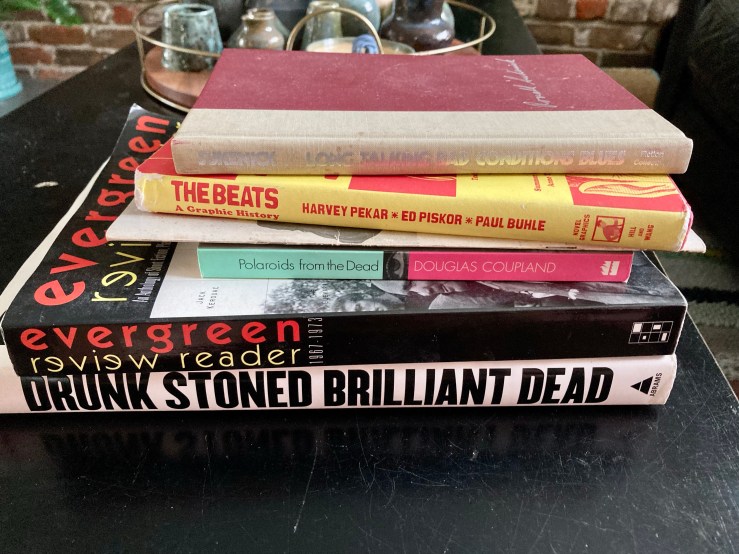
One of my oldest friends (by which I mean friend I’ve had for a long time, not, like, old, although we’re both getting up there, although by no means old, but I suppose certainly definitely no longer young, middleaged, I guess, although when we were young we would have thought ourselves now (middleaged) old)
—one of my oldest friends Patrick sent me a mystery box of books earlier this week. Highlights include The Evergreen Review Reader (begins with William S. Burroughs and ends with Kathy Acker, two writers Patrick introduced me to way back in seventh or eighth grade), a graphic history of the Beats by Harvey Pekar et al, and a signed copy of Ronald Sukenick’s Long Talking Bad Condition Blues. Thanks PT!

Morning, 1974 by Norman Stevens (1937-1988)
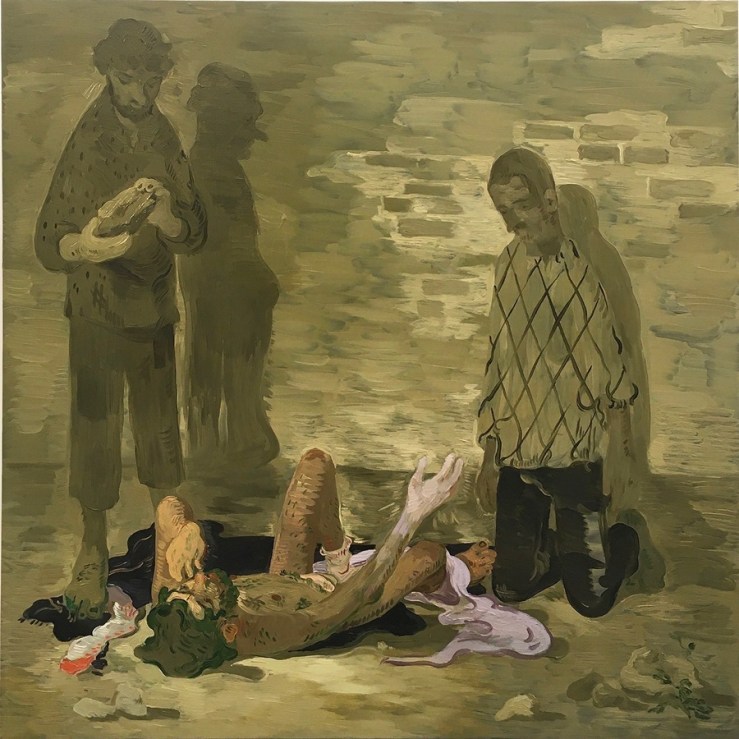
Nightmare, 2020 by Salman Toor (b. 1983)

Gary Amdahl’s 2014 novel Across My Big Brass Bed is getting a new printing from corona\samizdat. A review copy arrived at Biblioklept World Headquarters a day or two before a short vacation, and I almost tucked it into my backpack for the plane, but I knew that the novel’s paragraphless flow would not work for me if I were around other humans, let alone in a big metal plastic carbon fiber thing forty thousand feet in the etc.
So I set it aside, and then picked it up this afternoon.
The novel (subtitled “An Intellectual Autobiography in Twenty-four Hours”) begins: “I drove, aimlessly but alertly, fighting traffic.” It’s the early 1960s in the Twin Cities, and our narrator seems to be coming into consciousness, by which I might mean earliest memories, or really just new language-and-concept acquisition: “President John Fitzgerald Kennedy had just been—new word—assassinated.” A few sentences later, our narrator cracked me up with this mordant zinger:
“Whatever it meant to be human, President Kennedy could no longer manage it.”
Yikes! The first chapter ends with our hero successfully assisting a group of pedestrians in their crossing of the street in his new professional capacity of an elected Crossing Guard of Madison Elementary. I loved the pages I read today.
Girl Reading, George Clausen (1852 – 1944)
 Biblioklept