A review of Leonora Carrington’s surreal novel The Hearing Trumpet

Leonora Carrington’s novel The Hearing Trumpet begins with its nonagenarian narrator forced into a retirement home and ends in an ecstatic post-apocalyptic utopia “peopled with cats, werewolves, bees and goats.” In between all sorts of wild stuff happens. There’s a scheming New Age cult, a failed assassination attempt, a hunger strike, bee glade rituals, a witches sabbath, an angelic birth, a quest for the Holy Grail, and more, more, more.

Composed in the 1950s and first published in 1974, The Hearing Trumpet is new in print again for the first time in nearly two decades from NYRB. NYRB also published Carrington’s hallucinatory memoir Down Below a few years back, around the same time as Dorothy issued The Complete Stories of Leonora Carrington. Most people first come to know Carrington through her stunning, surreal paintings, which have been much more accessible (because of the internet) than her literature. However, Dorothy’s Complete Stories brought new attention to Carrington’s writing, a revival continued in this new edition of The Hearing Trumpet.

Readers familiar with Carrington’s surreal short stories might be surprised at the straightforward realism in the opening pages of The Hearing Trumpet. Ninety-two-year-old narrator Marian Leatherby lives a quiet life with her son and daughter-in-law and her tee-vee-loving grandson. They are English expatriates living in an unnamed Spanish-speaking country, and although the weather is pleasant, Marian dreams of the cold, “of going to Lapland to be drawn in a vehicle by dogs, woolly dogs.” She’s quite hard of hearing, but her sight is fine, and she sports “a short grey beard which conventional people would find repulsive.” Conventional people will soon be pushed to the margins in The Hearing Trumpet.

Marian’s life changes when her friend Carmella presents her with a hearing trumpet, a device “encrusted with silver and mother o’pearl motives and grandly curved like a buffalo’s horn.” At Carmella’s prompting, Marian uses the trumpet to spy on her son and daughter-in-law. To her horror, she learns they plan to send her to an old folks home. It’s not so much that she’ll miss her family—she directs the same nonchalance to them that she affords to even the most surreal events of the novel—it’s more the idea that she’ll have to conform to someone else’s rules (and, even worse, she may have to take part in organized sports!).

The old folks home is actually much, much stranger than Marian could have anticipated:

First impressions are never very clear, I can only say there seemed to be several courtyards , cloisters , stagnant fountains, trees, shrubs, lawns. The main building was in fact a castle, surrounded by various pavilions with incongruous shapes. Pixielike dwellings shaped like toadstools, Swiss chalets , railway carriages , one or two ordinary bungalows, something shaped like a boot, another like what I took to be an outsize Egyptian mummy. It was all so very strange that I for once doubted the accuracy of my observation.

The home’s rituals and procedures are even stranger. It is not a home for the aged; rather, it is “The Institute,” a cult-like operation founded on the principles of Dr. and Mrs. Gambit, two ridiculous and cruel villains who would not be out of place in a Roald Dahl novel. Dr. Gambit (possibly a parodic pastiche of George Gurdjieff and John Harvey Kellogg) represents all the avarice and hypocrisy of the twentieth century. His speech is a satire of the self-important and inflated language of commerce posing as philosophy, full of capitalized ideals: “Our Teaching,” “Inner Christianity,” “Self Remembering” and so on. Ultimately, it’s Gambit’s constricting and limited patriarchal view of psyche and spirit that the events in The Hearing Trumpet lambastes.

Marian soon finds herself entangled in the minor politics and scheming of the Institute, even as she remains something of an outsider on account of her deafness. She’s mostly concerned with getting an extra morsel of cauliflower at mealtimes—the Gambits keep the women undernourished. She eats her food quickly during the communal dinner, and obsesses over the portrait of a winking nun opposite her seat at the table:

Really it was strange how often the leering abbess occupied my thoughts. I even gave her a name, keeping it strictly to myself. I called her Doña Rosalinda Alvarez della Cueva, a nice long name, Spanish style. She was abbess, I imagined, of a huge Baroque convent on a lonely and barren mountain in Castile. The convent was called El Convento de Santa Barbara de Tartarus, the bearded patroness of Limbo said to play with unbaptised children in this nether region.

Marian’s creative invention of a “Doña Rosalinda Alvarez della Cueva” soon somehow passes into historical reality. First, she receives a letter from her trickster-aid Carmella, who has dreamed about a nun in a tower. “The winking nun could be no other than Doña Rosalinda Alvarez della Cueva,” remarks Marian. “How very mysterious that Carmella should have seen her telepathically.” Later, Christabel, another member/prisoner of the Institute helps usher Marian’s fantasy into reality. She confirms that Marian’s name for the nun is indeed true (kinda sorta): “‘That was her name during the eighteenth century,’ said Christabel. ‘But she has many many other names. She also enjoys different nationalities.'”

Christabel gives Marian a book entitled A True and Faithful Rendering of the Life of Rosalinda Alvarez and the next thirty-or-so pages gives way to this narrative. This text-within-a-text smuggles in other texts, including a lengthy letter from a bishop, as well as several ancient scrolls. There are conspiracies afoot, schemes to keep the Holy Grail out of the hands of the feminine power the Abbess embodies. There are magic potions and an immortal bard. There is cross-dressing and a strange monstrous pregnancy. There are the Knights Templar.

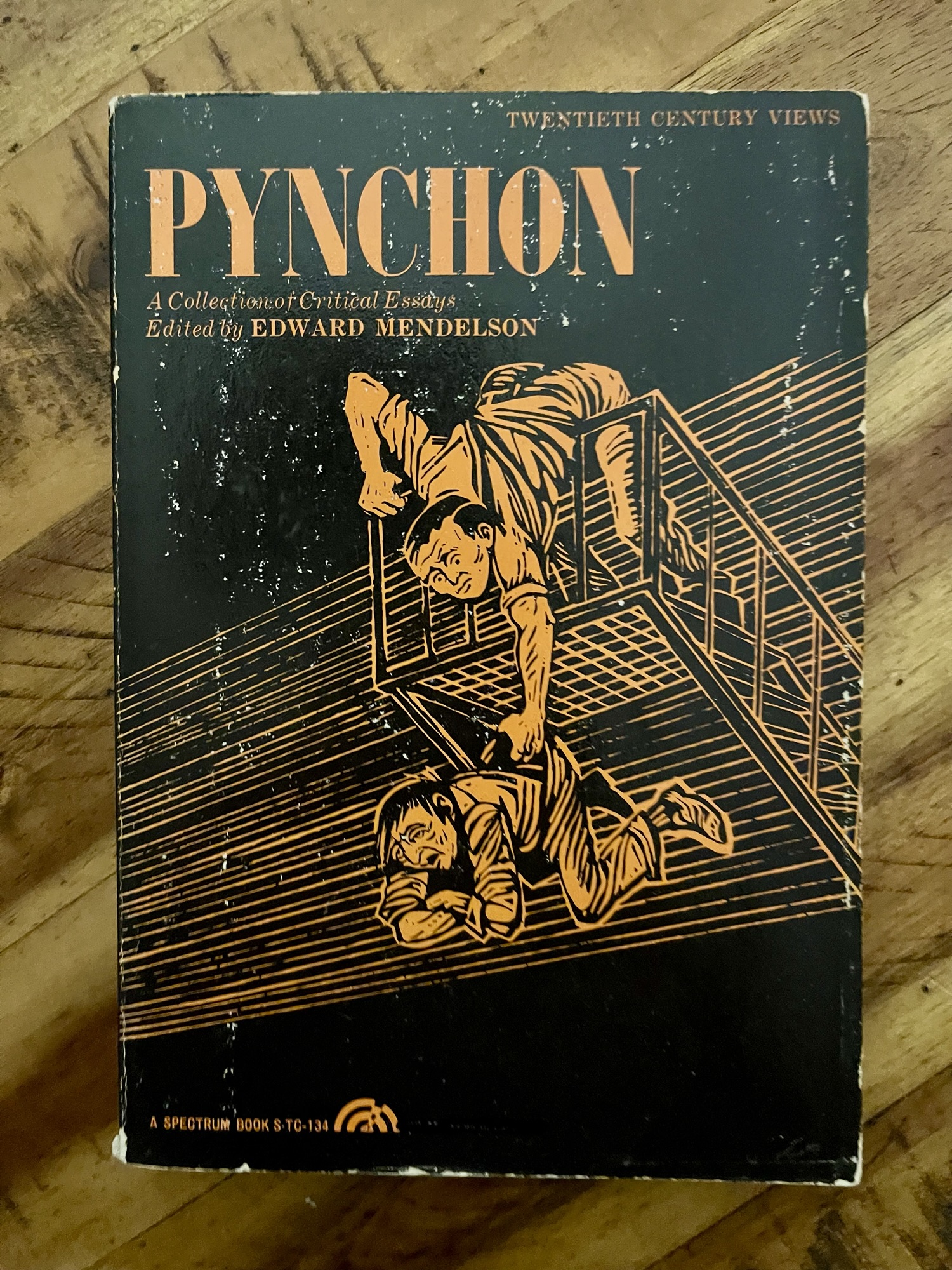
Carrington’s prose style in these texts-within-texts diverges considerably from the even, wry calm of Marian’s narration. In particular, there’s a sly control to the bishop’s letter, which reveals a bit-too-keen interest in teenage boys. These matryoshka sections showcase Carrington’s rhetorical range while also advancing the confounding plot. They recall The Courier’s Tragedy, the play nested in Thomas Pynchon’s 1965 novel The Crying of Lot 49. Both texts refer back to their metatexts, simultaneously explicating and confusing their audiences while advancing byzantine plot points and arcane themes.

Indeed, the tangled and surreal plot details of The Hearing Trumpet recall Pynchon’s oeuvre in general, but like Pynchon’s work, Carrington’s basic idea can be simplified to something like—Resistance to Them. Who is the Them? The patriarchy, the fascists, the killers. The liars, the cheaters, the ones who make war in the name of order. (One resister, the immortal traveling bard Taliesin, shows up in both the nested texts and later the metatext proper, where he arrives as a postman, recalling the Trystero of The Crying of Lot 49.)

The most overt voice of resistance is Marian’s best friend Carmella. Carmella initiates the novel by giving Marian the titular hearing trumpet, and she acts as a philosophical foil for her friend. Her constant warning that people under seventy and over seven should not be trusted becomes a refrain in the novel. Before Marian is shipped off to the Institution, Carmella already plans her escape, a scheme involving machine guns, rope, and other implements of adventure. Although she loves animals, Carmella is even willing to kill any police dogs that might guard the Institution and hamper their escape:

Police dogs are not properly speaking animals. Police dogs are perverted animals with no animal mentality. Policemen are not human beings so how can police dogs be animals?

Late in the novel, Carmella delivers perhaps the most straightforward thesis of The Hearing Trumpet:

It is impossible to understand how millions and millions of people all obey a sickly collection of gentlemen that call themselves ‘Government!’ The word, I expect, frightens people. It is a form of  planetary hypnosis, and very unhealthy. Men are very difficult to understand… Let’s hope they all freeze to death. I am sure it would be very pleasant and healthy for human beings to have no authority whatever. They would have to think for themselves, instead of always being told what to do and think by advertisements, cinemas, policemen and parliaments.

Carmella’s dream of an anarchic utopia comes to pass.

How?

Well, there’s a lot to it, and I’d hate to spoil the surrealist fun. Let’s just say that Marian’s Grail quest scores a big apocalyptic win for the Goddess, thanks to “an army of bees, wolves, seven old women, a postman, a Chinaman, a poet, an atom-driven Ark, and a werewoman.” No conventional normies who might find Marian’s beard repulsive here.

With its conspiracy theories within conspiracy theories and Templar tales, The Hearing Trumpet will likely remind many readers of Umberto Eco’s 1988 novel Foucault’s Pendulum (or one of its ripoffs). The Healing Trumpet’s surreal energy also recalls Angela Carter’s 1972 novel The Infernal Desire Machines of Doctor Hoffman. And of course, the highly-imagistic, ever-morphing language will recall Carrington’s own paintings, as well as those of her close friend Remedios Varo (who may have been the basis for Carmella), and their surrealist contemporaries (like Max Ernst) and forebears (like Hieronymus Bosch).

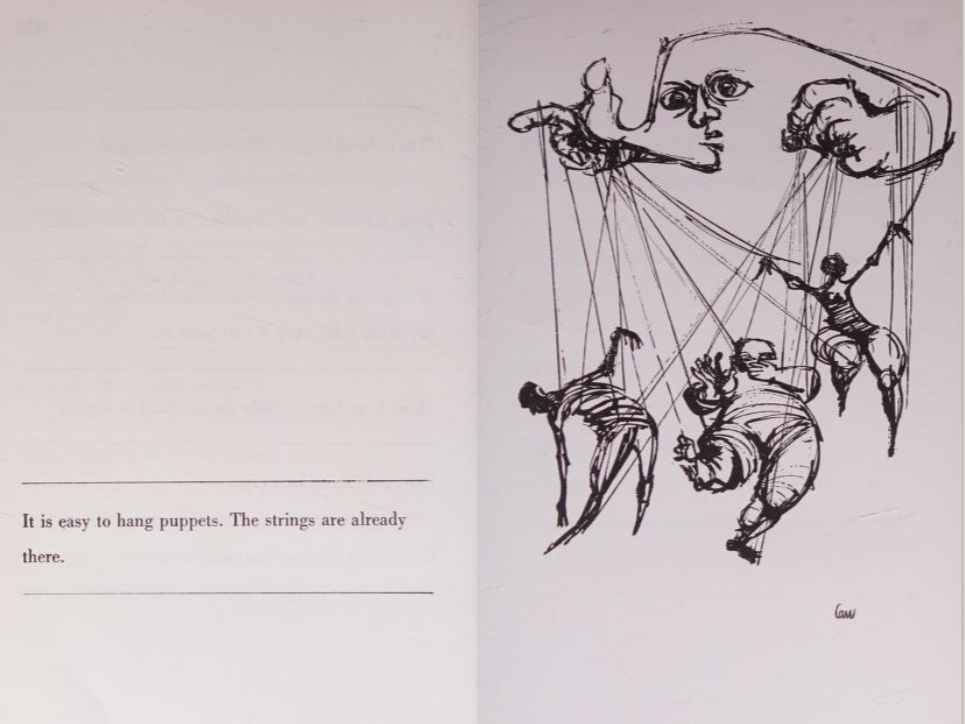
This new edition of The Hearing Trumpet includes an essay by the novelist Olga Tokarczuk (translated by Antonia Lloyd-Jones) which focuses on the novel as a feminist text. (Tokarczuk also mentions that she first read the novel without knowing who Carrington was). The new edition also includes black and white illustrations by Carrington’s son, Pablos Weisz Carrington (I’ve included a few in this review). As far as I can tell, these illustrations seem to be slightly different from the illustrations included in the 2004 edition of The Hearing Trumpet published by Exact Change. That 2004 edition has been out of print for ages and is somewhat hard (or really, expensive) to come by (I found a battered copy few years ago for forty bucks). NYRB’s new edition should reach the wider audience Carrington deserves.

Some readers will find the pacing of The Hearing Trumpet overwhelming, too frenetic. It moves like a snowball, gathering images, symbols, motifs into itself in an ever-growing, ever-speeding mass. Other readers may have difficulty with its ever-shifting plot. Nothing is stable in The Hearing Trumpet; everything is liable to mutate, morph, and transform. Those are my favorite kinds of novels though, and I loved The Hearing Trumpet—in particular, I loved its tone set against its imagery and plot. Marian’s narration is straightforward, occasionally wry, but hardly ever astonished or perplexed by the magical and wondrous events she takes part in. There’s a lot I likely missed in The Hearing Trouble—Carrington lards the novel with arcana, Jungian psychology, magical totems, and more more more—but I’m sure I’ll find more the next time I read it. Very highly recommended.

[Ed. note–Biblioklept first ran this review in December, 2020.]

Ann Quin’s novel Passages collapses hierarchies of center and margin

Ann Quin’s third novel Passages (1969) ostensibly tells the story of an unnamed woman and unnamed man traveling through an unnamed country in search of the woman’s brother, who may or may not be dead.

The adverb ostensibly is necessary in the previous sentence, because Passages does not actually tell that story—or it rather tells that story only glancingly, obliquely, and incompletely. Nevertheless, that is the apparent “plot” of Passages.

Quin is more interested in fractured/fracturing voices here. Passages pushes against the strictures of the traditional novel, eschewing character and plot development in favor of pure (and polluted) perceptions. There’s something schizophrenic about the voices in Passages. Interior monologues turn polyglossic or implode into elliptical fragments.

Quin repeatedly refuses to let her readers know where they stand. Indeed, we’re never quite sure of even the novel’s setting, which seems to be somewhere in the Mediterranean. It’s full of light and sea and sand and poverty, and the “political situation” is grim. (The woman’s brother’s disappearance may or may not have something to do with the region’s political instability.)

Passage’s content might be too slippery to stick to any traditional frame, but Quin employs a rhetorical conceit that teaches her reader how to read her novel. The book breaks into four unnamed chapters, each around twenty-five pages long. The first and third chapters find us loose in the woman’s stream of consciousness. The second and fourth chapters take the form of the man’s personal journal. These sections contain marginal annotations, which might be meant to represent actual physical annotations, or perhaps mental annotations–the man’s stream of consciousness while he rereads his journal.

Quin’s rhetorical strategy pays off, particularly in the book’s Sadean climax. This (literal) climax occurs at a carnivalesque party in a strange mansion on a small island. We see the events first through the woman’s perception, and then through the man’s. But I’ve gone too long without offering any representative language. Here’s a passage from the woman’s section, just a few paragraphs before the climax. To set the stage a bit, simply know that the woman plays voyeur to a bizarre threesome:

Mirrors faced each other. As the two turned, approached. Slower in movement in the centre, either side of him, turning back in the opposite direction to their first movement. Contours of their shadows indistinct. The first mirror reflected in the second. The second in the first. Images within images. Smaller than the last, one inside the other. She lay on the floor, wrists tied together. She bent back over the chair. He raised the whip, flung into space.

Later, the man’s perception of events at the party both clarify and cloud the woman’s account. As you can see in the excerpt above, the woman frequently refuses to qualify her pronouns in a way that might stabilize identities for her reader. Such obfuscation often happens in the course of a sentence or two:

I ran on, knowing I was being followed. She came to the edge, jumped into expanding blueness, ultra violet tilted as she went towards the beach. We walked in silence.

The woman’s becomes a She and then merges into a We. The other half of that We is a He, the follower (“He later threw the bottle against the rocks”), but we soon realize that this He is not the male protagonist, but simply another He that the woman has taken as a one-time lover.

The woman frequently takes off somewhere to have sex with another man. At times the sex seems to be part of her quest to find her brother; other times it’s simply part of the novel’s dark, erotic tone. The man is undisturbed by his lover’s faithlessness. He is passive, depressive, and analytical, while she is manic and exuberant. Late in the novel he analyzes himself:

How many hours I waste lying in bed thinking about getting up. I see myself get up, go out, move, drink, eat, smile, turn, pay attention, talk, go up, go down. I am absent from that part, yet participating at the same time. A voyeur in all senses, in my actions, non-actions. What a delight it might be actually to get up without thinking, and then when dressed look back and still see myself curled up fast asleep under the blankets.

The man longs for a kind of split persona, an active agent to walk the world who can also gaze back at himself dormant, passive.

This motif of perception and observation echoes throughout Passages. Consider one of the man’s journal entries from early in the book:

Above, I used an image instead of text to give a sense of what the journal entries and their annotations look like. Here, the man’s annotation is a form of self-observation, self-analysis.

Other annotations dwell on describing myths or artifacts (often Greek or Talmudic). In a “December” entry, the man’s annotation is far lengthier than the text proper. The main entry reads:

I am on the verge of discovering my own demoniac possibilities and because of this I am conscious I am not alone with myself.

Again, we see the fracturing of identity, consciousness as ceaseless self-perception. The annotation is far more colorful in contrast:

An ancient tribe of the Kouretes were sorcerers and magicians. They invented statuary and discovered metals, and they were amphibious and of strange varieties of shape, some like demons, some like men, some like fishes, some like serpents, and some had no hands, some no feet, some had webs between their fingers like gees. They were blue-eyed and black-tailed. They perished struck down by the thunder of Zeus or by the arrows of Apollo.

Quin’s annotations dare her reader to make meaning—to put the fragments together in a way that might satisfy the traditional expectations we bring to a novel. But the meaning is always deferred, always slips away. Passages collapses notions of center and margin. As its title suggests, this is a novel about liminal people, liminal places.

The results are wonderfully frustrating. Passages is abject, even lurid at times, but also rich and even dazzling in moments, particularly in the woman’s chapters, which read like pure perception, untethered by traditional narrative expectations like causation, sequence, and chronology.

As such, Passages will not be every reader’s cup of tea. It lacks the sharp, grotesque humor of Quin’s first novel, Berg, and seems dead set at every angle to confound and even depress its readers. And yet there’s a wild possibility in Passages. In her introduction to the new edition of Passages recently published by And Other Stories, Claire-Louise Bennett tries to capture the feeling of reading Quin’s novel:

It’s difficult to describe — it’s almost like the omnipotent curiosity one burns with as an adolescent — sexual, solipsistic, melancholic, fierce, hungry, languorous — and without limit.

Bennett, whose anti-novel Pond bears the stamp of Quin’s influence, employs the right adjectives here. We could also add disorienting, challengingabject and even distressing. While clearly influenced by Joyce and Beckett, Quin’s writing in Passages seems closer to William Burroughs’s ventriloquism and the hollowed-out alienation of Anna Kavan’s early work. Passages also points towards the writing of Kathy Acker, Alasdair Gray, and João Gilberto Noll, among others. But it’s ultimately its own weird thing, and half a century after its initial publication it still seems ahead of its time. Passages is clearly Not For Everyone but I loved it. Recommended.


[Ed. note–Biblioklept originally posted this review in May 2021.]

Caza Nocturna — Remedios Varo

Caza Nocturna, 1958 by Remedios Varo (1908-1963)

A review of Dinah Brooke’s excellent cult novel Lord Jim at Home

Dinah Brooke’s 1973 novel Lord Jim at Home had been out of print for five decades — and had never gotten a U.S. release — until McNally Editions republished in 2023 with a new foreword by the novelist Ottessa Moshfegh. I always save forewords until after I’ve finished a novel, so I missed Moshfegh’s implicit advice to go into Lord Jim at Home cold. She notes that the recommendation she received to read it “came with no introduction,” and that “I wouldn’t have wanted the effect of the novel to be mitigated in any way, so I’m reluctant to introduce it now.”

I am not reluctant to write about Brooke’s novel because I am so enthusiastic about it and I think those with tastes in literature similar to my own will find something fascinating in its plot and prose. However, l agree with Moshfegh’s advice that Lord Jim at Home is best experienced free from as much mitigating context as possible. I had never heard of the novel before lifting it from a bookseller’s shelf, attracted by the striking cover; I flipped it over to read a blurb parsed from Moshfegh’s foreword attesting that Brooke’s novel “was an instrument of torture. It’s that good.” The inside flap informed me that reviews upon its publication “described it as ‘squalid and startling,’ ‘nastily horrific,’ and a ‘monstrous parody’ of upper-middle class English life.” I was sold.

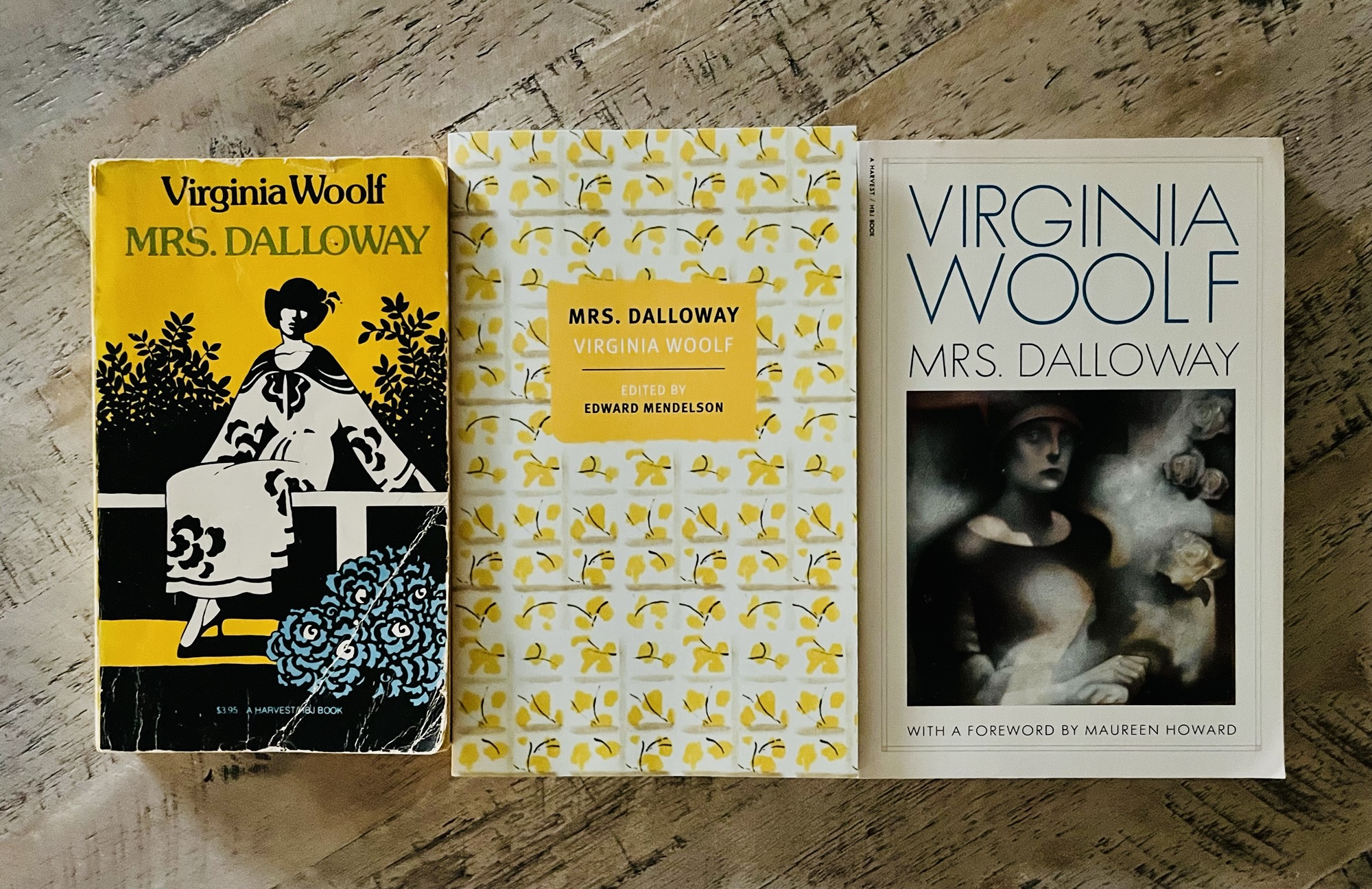
Lord Jim at Home is squalid and startling and nastily horrific. It is abject, lurid, violent, and dark. It is also sad, absurd, mythic, often very funny, and somehow very, very real for all its strangeness. The novels I would most liken Lord Jim at Home to, at least in terms of the aesthetic and emotional experience of reading it, are Ann Quin’s Berg, Anna Kavan’s Ice, Mervyn Peake’s Gormenghast novels, Virginia Woolf’s Mrs. Dalloway, and James Joyce’s Portrait (as well as bits of Ulysses). (I have not read Conrad’s Lord Jim, which Brooke has taken as something of a precursor text for Lord Jim at Home.)

After finishing Lord Jim at Home, I read it again by accident. At first I intended to take a few notes for a possible review, but after the first few pages I just kept reading. On a second reading, Brooke’s novel was just as strange—maybe even stranger—even if I was able to read it much more quickly, finding myself quicker to tune into the novel’s competing (and complementary) narrative registers. I found it far more precise, too, in the rhetorical development of its themes; Brooke’s styles and tones shift to capture the different ages of its hero. The novel begins in a mythical, archetypal mode and works its way through various registers, exploring the tropes of schoolboy novels, romances, war stories, adventure tales,  modernism, realism, and journalism. But despite its shifting modes, Lord Jim at Home is not a parodic pastiche. Rather, at its core, Lord Jim at Home skewers how aesthetic modes—primarily those derived from notions of class and manners—cover over abject cruelty. As Moshfegh puts it in her forward, Lord Jim at Home is “an accurate portrayal of how fucked-up people behave, artfully conveyed in a way that nice people are too polite to admit they understand.”

I’ve tried to be clear that I think it’s best to come to Lord Jim at Home without too much context—it’s best to just go with the novel’s strangeness. Below, however, I offer a more detailed discussion of the novel, its language, and some elements of the plot for those so inclined.

Answer, 2014 by Henrietta Harris

Continue reading “A review of Dinah Brooke’s excellent cult novel Lord Jim at Home”

Sunday Comix

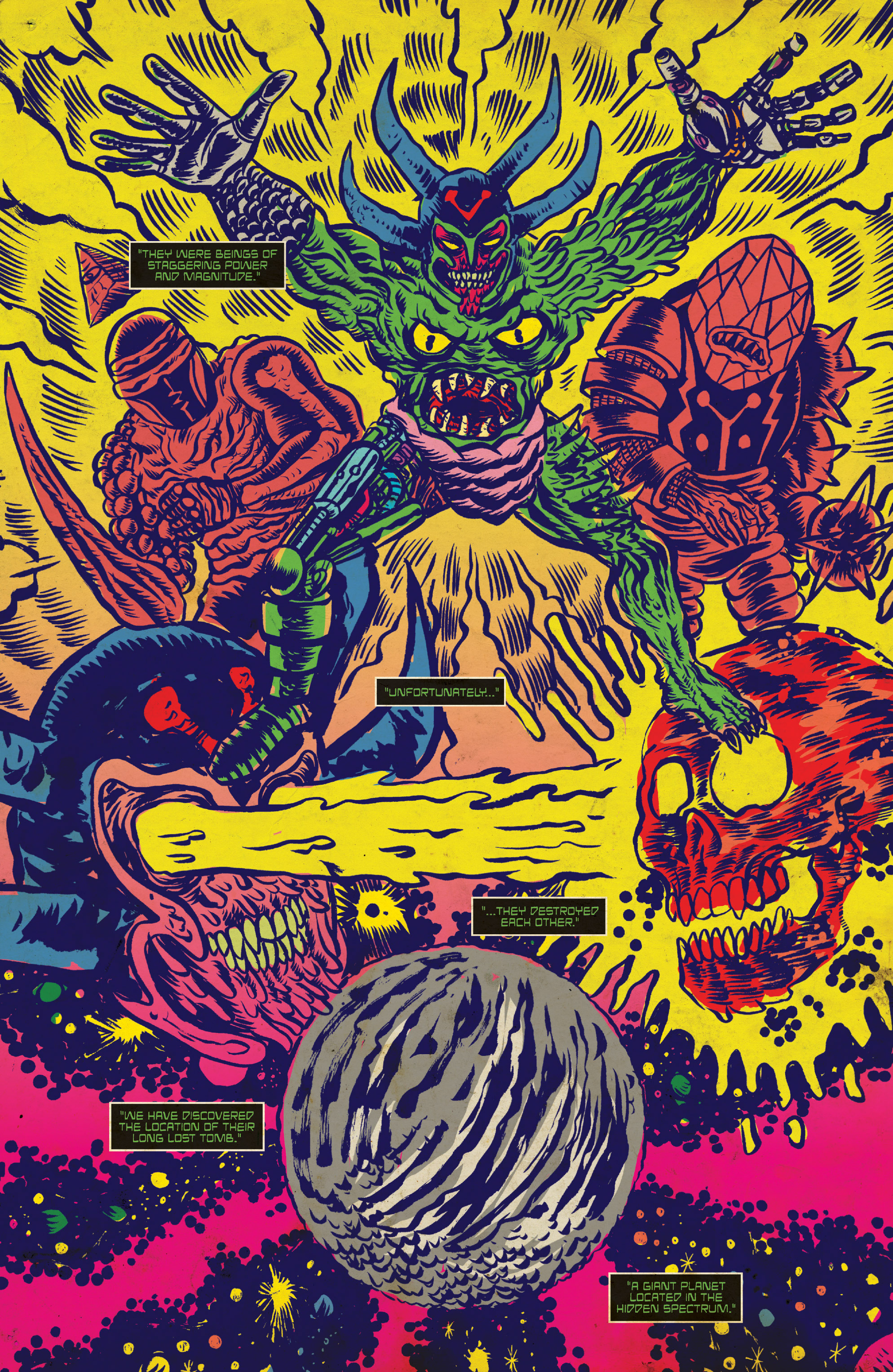
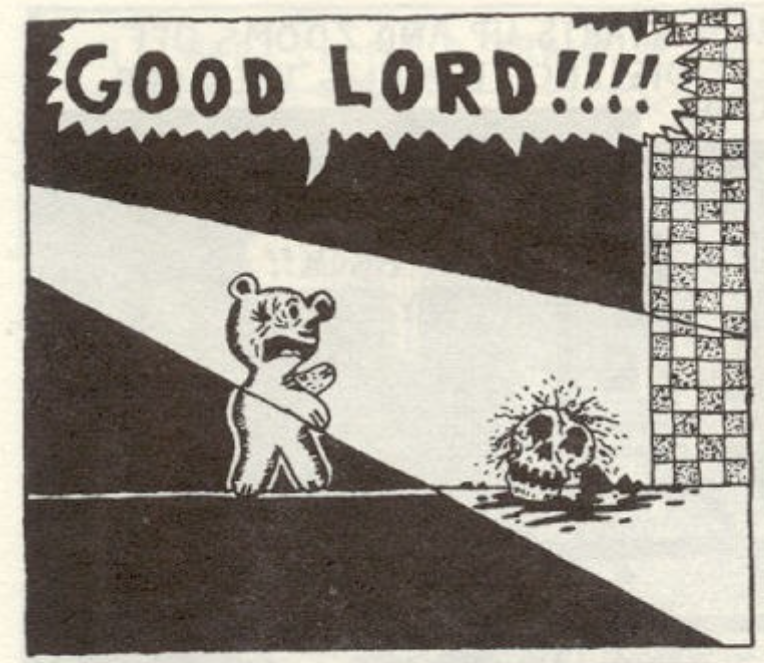
From “The Spawn of Cokethulhu” by Chris Statler, Cocaine Comix #2, 1981.

“The Story to End All Stories” — Philip K. Dick

“The Story to End All Stories”

by

Philip K. Dick


In a hydrogen war ravaged society the nubile young women go down to a futuristic zoo and have sexual intercourse with various deformed and non-human life forms in the cages. In this particular account a woman who has been patched together out of the damaged bodies of several women has intercourse with an alien female, there in the cage, and later on the woman, by means of futuristic science, conceives. The infant is born, and she and the female in the cage fight over it to see who gets it. The human young woman wins, and promptly eats the offspring, hair, teeth, toes and all. Just after she has finished she discovers that the offspring is God.

“The Charm of 5:30” — David Berman

“The Charm of 5:30”

by

David Berman


It’s too nice a day to read a novel set in England.

We’re within inches of the perfect distance from the sun,

the sky is blueberries and cream,

and the wind is as warm as air from a tire.

Even the headstones in the graveyard

           seem to stand up and say “Hello! My name is…”

It’s enough to be sitting here on my porch,

thinking about Kermit Roosevelt,

following the course of an ant,

or walking out into the yard with a cordless phone

           to find out she is going to be there tonight.

On a day like today, what looks like bad news in the distance

turns out to be something on my contact, carports and

white courtesy phones are spontaneously reappreciated

           and random “okay”s ring through the backyards.

This morning I discovered the red tints in cola

                     when I held a glass of it up to the light

and found an expensive flashlight in the pocket of a winter coat

                     I was packing away for summer.

It all reminds me of that moment when you take off your

sunglasses after a long drive and realize it’s earlier

and lighter out than you had accounted for.

You know what I’m talking about,

and that’s the kind of fellowship that’s taking place in town, out in

the public spaces. You won’t overhear anyone using the words

“dramaturgy” or “state inspection” today. We’re too busy getting along.

It occurs to me that the laws are in the regions and the regions are

in the laws, and it feels good to say this, something that I’m almost

sure is true, outside under the sun.

Then to say it again, around friends, in the resonant voice of a

nineteenth-century senator, just for a lark.

There’s a shy looking fellow on the courthouse steps, holding up

a placard that says “But, I kinda liked Clinton.” His head turns slowly

as a beautiful girl walks by, holding a refrigerated bottle up against

her flushed cheek.

She smiles at me and I allow myself to imagine her walking into

town to buy lotion at a brick pharmacy.

When she gets home she’ll apply it with great lingering care

before moving into her parlor to play 78 records and drink gin-and-tonics

beside her homemade altar to James Madison.

In a town of this size, it’s certainly possible that I’ll be invited over

one night.

In fact I’ll bet you something.

Somewhere in the future I am remembering today. I’ll bet you

I’m remembering how I walked into the park at five thirty,

my favorite time of day, and how I found two cold pitchers

of just poured beer, sitting there on the bench.

I am remembering how my friend Chip showed up

with a catcher’s mask hanging from his belt and how I said

great to see you, sit down, have a beer, how are you,

and how he turned to me with the sunset reflecting off his

contacts and said, wonderful, how are you.

Paul Kirchner’s The Bus 3 (Book acquired, early May 2025)

Paul Kirchner’s surreal cult classic strip The Bus has another sequel. The Bus 3 is new from Tanibis Editions, which published The Bus 2 a decade ago along with a collection of the original Bus strips.

From my review of The Bus 2:

Paul Kirchner’s cult classic comic strip The Bus originally ran in Heavy Metal from 1979-1985. The (anti-)story of “a hapless commuter and a demonic bus” (as Kichner put it himself in a recent memoir at The Boston Globe), The Bus, at its finest moments, transcends our expectations for what a comic strip can and should do. Sure, Kirchner delivers the set-ups, gags, japes, and jests we expect from a cartoon—but more often than not The Bus surpasses the confines of its form and medium. Its protagonist The Commuter is an allegorical everyman, a passenger tripping through an absurd world. Kirchner’s strip often shows us ways to see that absurd world—which is of course our own absurd world—with fresh eyes.

Here is the first strip in The Bus 3:

More thoughts to come.

“Titian Paints a Sick Man” — Roberto Bolaño

“Titian Paints a Sick Man”

by

Roberto Bolaño

translated by Natasha Wimmer


At the Uffizi, in Florence, is this odd painting by Titian. For a while, no one knew who the artist was. First the work was attributed to Leonardo and then to Sebastiano del Piombo. Though there’s still no absolute proof, today the critics are inclined to credit it to Titian. In the painting we see a man, still young, with long dark curly hair and a beard and mustache perhaps slightly tinged with red, who, as he poses, gazes off toward the right, probably toward a window that we can’t see, but still a window that somehow one imagines is closed, yet with curtains open or parted enough to allow a yellow light to filter into the room, a light that in time will become indistinguishable from the varnish on the painting.

1

The young man’s face is beautiful and deeply thoughtful. He’s looking toward the window, if he’s looking anywhere, though probably all he sees is what’s happening inside his head. But he’s not contemplating escape. Perhaps Titian told him to turn like that, to turn his face into the light, and the young man is simply obeying him. At the same time, one might say that all the time in the world stretches out before him. By this I don’t mean that the young man thinks he’s immortal. On the contrary. The young man knows that life renews itself and that the art of renewal is often death. Intelligence is visible in his face and his eyes, and his lips are turned down in an expression of sadness, or maybe it’s something else, maybe apathy, none of which excludes the possibility that at some point he might feel himself to be master of all the time in the world, because true as it is that man is a creature of time, theoretically (or artistically, if I can put it that way) time is also a creature of man.

2

In fact, in this painting, time — sketched in invisible strokes — is a kitten perched on the young man’s hands, his gloved hands, or rather his gloved right hand which rests on a book: and this right hand is the perfect measure of the sick man, more than his coat with a fur collar, more than his loose shirt, perhaps of silk, more than his pose for the painter and for posterity (or fragile memory), which the book promises or sells. I don’t know where his left hand is.

How would a medieval painter have painted this sick man? How would a non-figurative artist of the twentieth century have painted this sick man? Probably howling or wailing in fear. Judged under the eye of an incomprehensible God or trapped in the labyrinth of an incomprehensible society. But Titian gives him to us, the spectators of the future, clothed in the garb of compassion and understanding. That young man might be God or he might be me. The laughter of a few drunks might be my laughter or my poem. That sweet Virgin is my friend. That sad-faced Virgin is the long march of my people. The boy who runs with his eyes closed through a lonely garden is us.

From Between Parentheses.

Three books acquired, 23 May 2025

I pretty much will pick up any hardback Alasdair Gray book at this point, so I was happy to come across a pristine used copy of Mavis Belfrage last Friday. From The Complete Review’s review:

 Strong, dark stuff, and well-presented. There are no happy ends here, but it reads true-to-life, and there is a certain satisfaction to the collection. The volume, artfully designed by Gray, is also aesthetically pleasing. Recommended.

I also picked up a copy of Octavia Butler’s Dawn, which my wife promptly snapped up when I got home. And the nice dude who works at the bookstore that I always chat with sold me on Brazilian author Mário de Andrade’s 1928 novel Macunaíma (in a new translation by Katrina Dodson).

I have this Gray line printed out and taped to a mirror in my office:

“On the Job,” a very short story by Diane Williams

“On the Job”

by

Diane Williams


He looked like a man whose leader has failed him time after time, as he asked the seller awkward questions—not hostile. He was looking for a better belt buckle.

The seller said, You ought to buy yourself something beautiful! Why not this?

He paid for the buckle, which he felt was brighter and stronger than he was. His sense of sight and smell were diminishing.

He could only crudely draw something on his life and just fill it in—say a horse.

“Can I see that?” he said, “What is that?”

It was a baby porringer.

At the close of the day, the seller counted her money, went to the bank—the next step. She hates to push items she doesn’t approve of, especially in this small town, five days a week, where everything she says contains the mystery of health and salvation that preserves her customers from hurt or peril.

That much was settled, as the customer entered his home, approached his wife, and considered his chances. Hadn’t his wife been daily smacked across the mouth with lipstick and cut above the eyes with mascara?

She had an enormous bosom that anyone could feel leaping forward to afford pleasure. She was gabbing and her husband—the customer—was like a whole horse who’d fallen out of its stall—a horse that could not ever get out of its neck-high stall on its own, but then his front legs—their whole length—went over the top edge of the gate, and the customer made a suitable adjustment to get his equilibrium well outside of the stall.

“It’s so cute,” he said to his wife, “when you saw me, how excited you got.”

His wife liked him so much and she had a sweet face and the customer thought he was being perfectly insincere.

He went on talking—it was a mixed type of thing—he was lonely and he was trying to get his sheer delight out of the way.

A Scene on Mont Salève, Switzerland, after a Drinking Session — Jens Juel

A Scene on Mont Salève, Switzerland, after a Drinking Session, 1778 by Jens Juel (1745–1802)

Laura Vazquez’s novel The Endless Week (Book acquired, 24 May 2025)

Laura Vazquez’s novel The Endless Week is forthcoming this Fall in the US in English translation by Alex Niemi from publisher Dorothy. The Dorothy Project’s (enticing) description:

From the 2023 winner of the Prix Goncourt for poetry comes a debut novel unlike any other, a lyrical anti-epic about the beauty, violence, trauma, and absurdity of the internet age.

Like Beckett’s novels or Kafka’s stranger tales, The Endless Week is a work outside of time, as if novels had never existed and Laura Vazquez has suddenly invented one. And yet it could not be more contemporary, as startling and constantly new as the scrolling hyper-mediated reality it chronicles. Its characters are Salim, a young poet, and his sister Sara, who rarely leave home except virtually; their father, who is falling apart; and their grandmother, who is dying. To save their grandmother, Salim and Sara set out in search of their long-lost mother, accompanied by Salim’s online friend Jonathan, though their real quest is through the landscape of language and suffering that saturates both the real world and the virtual. The Endless Week is sharp and ever-shifting, at turns hilarious, tender, satirical, and terrifying. Not much happens, yet every moment is compulsively engaging. It is a major work by one of the most fearlessly original writers of our time.

“Not much happens, yet every moment is compulsively engaging” — I am the kind of sicko who will lap that up, maybe. I’ve had almost entirely hits with everything Dorothy has put out; even the misses were a thousand percent more interesting than most of the midlist stuff that comes through the house. Anyway.

Mass-market Monday | Muriel Spark’s Memento Mori

Memento Mori, 1954, Muriel Spark. Avon Bard (1978). No cover artist or designer credited. 191 pages.

From David Lodge’s 2010 reappraisal of the novel in The Guardian:

The fiction of the 50s was dominated by a new wave of social realism, represented by novels such as Lucky JimSaturday Night and Sunday Morning, and Room at the Top, whose originality lay in tone and attitude rather than technique. Typically they were narrated in the first person or in free indirect style, articulating the consciousness of a single character, usually a young man, whose rather ordinary but well observed life revealed new tensions and fault-lines in postwar British society. An unsympathetic character in Memento Mori called Eric has evidently written two dispiriting works of this kind. Memento Mori itself was an utterly different and virtually unprecedented kind of novel. It is a short book, but it has a huge cast of characters, to nearly all of whose minds the reader is given access. The speed and abruptness with which the narrative switches from one point of view to another, managed and commented on by an impersonal but intrusive narrator, is a distinguishing feature of nearly all Spark’s fiction, and it violated the aesthetic rules not only of the neorealist novel, but also of the modernist novel from Henry James to Virginia Woolf. Spark was a postmodernist writer before that term was known to literary criticism. She took the convention of the omniscient author familiar in classic 19th-century novels and applied it in a new, speeded-up, throwaway style to a complex plot of a kind excluded from modern literary fiction – in this case involving blackmail and intrigues over wills, multiple deaths and discoveries of secret scandals, almost a parodic update of a Victorian sensation novel. And she added to the mix an element of the uncanny, through which the existence of a transcendent, eternal and immaterial reality impinges on the lives of her ageing characters, reminding them of their mortality.

Sunday Comix

From “Mister Machine” by Jack Kirby, 2001: A Space Odyssey #10, 1977.

Untitled — Rita Kernn-Larsen

Untitled, c. 1930s by Rita Kernn-Larsen (1904–1998)

Benito Pérez Galdós’ Miaow (Book acquired, mid May 2025)

Benito Pérez Galdós’ 1888 novel Miaow is forthcoming in English translation this summer by Margaret Jull Costa, via NYRB. Their blurb:

Ramón Villaamil has been a loyal civil servant his whole life, but a change in government leaves him out of a job and still two months short of qualifying for his pension. Initially optimistic that he’ll be able to find work and pull his family out of their financial straits, he spends his days visiting the administration, pestering his ex-colleagues to put in a good word for him, and begging his friends in high places for money. At home, Villaamil’s wife, daughter, and sister-in-law—whose feline appearances earn them the nickname “the Miaows”—are unimpressed by Villaamil’s failures, and the only joy left in Villaamil’s life is his young grandson Luis. When Luis’s disgraced father, the handsome and dastardly Víctor Cadalso, reappears in their lives with promises of easing their financial burdens, Villaamil has no choice but to allow him back into their midst, even as he knows there is nothing pure about Víctor’s intentions and his return might spell their ruin.

Benito Pérez Galdós’s satire of middle-class life bears comparison with the novels of Charles Dickens and Honoré de Balzac, serving up a scathing critique of the hypocrisy and corruption of nineteenth-century Spanish society and the dehumanizing rituals of work. Margaret Jull Costa’s new translation brings out the tragedy, the comedy, and the vitality of Pérez Galdós’s prose.