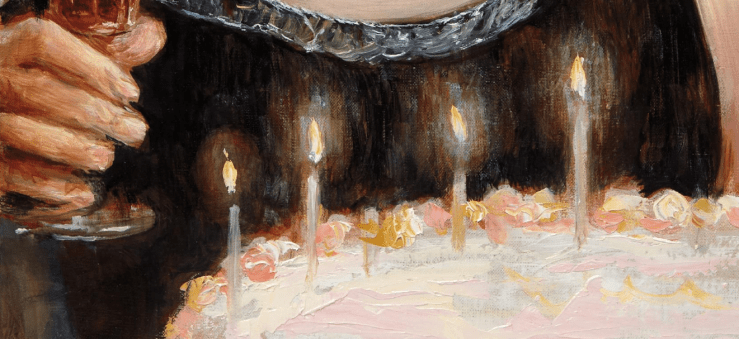
The Photographer — Christian Brandl

brandl-die-fotografin2c-20162c-135x135cm2c-occ88l-auf-leinwand

The Photographer, 2016 by Christian Brandl

Doubles — Leonor Fini

e0f4820166774b6e5f87e64f8cb32b1c

Doubles, 1955 by Leonor Fini (1908-1996)

Maypole — Wendell Gladstone

20111215101441-9

Maypole, 2010 by Wendell Gladstone (b. 1972)

“The Maypole” — Robert Herrick

Screenshot 2018-05-01 at 2.24.10 PM

May Day — Jacopo Vignali

scala_archives_103104739141

May Day, c. 1620 by Jacopo Vignali (1592–1664)

Blog about Blog about 3

  1. There are 30 days in April. On 1 April 2018—Easter Sunday and/or April Fool’s Day—I declared on my cursed blog that I would write something on the blog every day this month. I failed to write every day on the blog in the month of April; specifically, I did not post stuff on April 13, April 20, or April 24.
  2. (Not a reason for not posting on any of these dates but fun: April 13 was a Friday the 13th; April 20 is 4/20; April 24 is my cousin’s birthday).
  3. On the 1 April Blog about post I specifically hunted down the Fool card in the Rider-Waite tarot deck that I keep out for fun. I always thought tarot was foolish silliness, even if I found some of the aesthetics attractive, before a third or maybe fourth rereading of Gravity’s Rainbow prompted my buying a deck for research purposes. The deck figures heavily in Pynchon’s novel, providing a mystical and indeterminate contrast to the novel’s motif of mathematical precision. At some point I start flipping a card every day—not as some kind of superstitious soothsaying totem, but rather for fun. I don’t know. I scattered some of those cards into these posts when I photographed books; every card was a card I flipped that day, aside from The Fool.
  4. This morning I flipped the Two of Wands, a card I like. I like most of the Wands suit (and generally dislike the Swords suit; the Cups are my thing though). It’s in the pic above, which is a lazy attempt at an organizing principle for this post, which is not The Last Blog about post, but the last one for April 2018. (Tomorrow is May 2018).
  5. I mean what I mean is, Trying to blog every day was rewarding but also exhausting. I was surprised at some of what I wrote, even a little tiny small bit happy with some of it, and I still have a slim deck of ideas on deck. I think I’ll try to do one or two of these a week, and at least do one on Sundays.
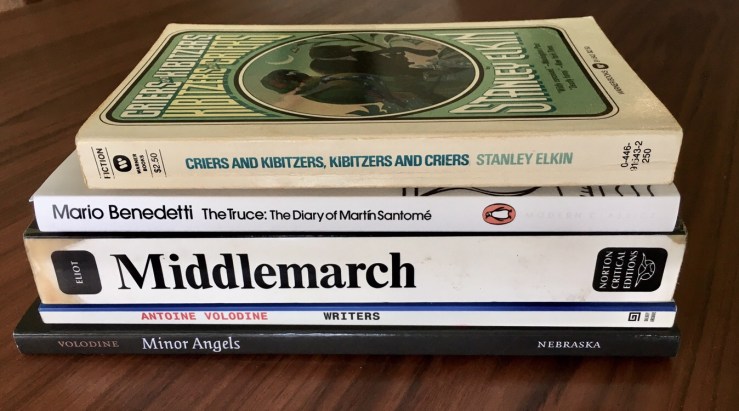
  6. So I said above (by said I mean wrote) that I used a picture as an organizing principle for this disorganized post. The pic is of a loose stack of books that I’ve read or am reading or intend to read or have maybe halfway sorta given up on. It’s a pile that needs organizing. So, from top to bottom:
  7. I reread Hawthorne’s The Blithedale Romance this month and loved it. I almost started a reread of The House of Seven Gables after reading it—and typing this out now, I realize that that’s what I’d like to read soon, actually. One of the favorite posts I did in this Blog about series was on making a cocktail Hawthorne’s narrator drinks in the novel.
  8. I picked up Players after reading DeLillo’s The Names, which I wrote about early in these Blog about posts. It’s been hanging out unattended for a few weeks and I’m sure I’ll get to it in 38 months.
  9. I said I’d finally read Middlemarch this year, but I find myself unwilling to commit after two or three chapters and am irritated with myself in my constantly transferring it from room to room without reading it or shelving it. Maybe I’m only interested in it because it is monstrous. (I love big fat monsters; make me read Middlemarch).
  10.  I wrote one of these Blog about posts about Gerald Murnane’s story “Stream System.” I have another thing sketched out for his story “Stone Quarry” which is like this wonderfully satirical take on metafiction. I’m mostly enjoying reading this book slowly. I hate the drive to read too fast.
  11. I read The Passion According to G.H. by Clarice Lispector maybe five or six years ago and I pulled it out the other day because I think I’d like to reread it, because that’s what I like—rereading—I mean, I’ d prefer to reread Middlemarch without all the hard labor of, like, reading it first. But then I realized I’d never actually finished it. So I need to read it so I can reread it.
  12. I got the Hob Broun in the mail today and I’m going to quit writing this stupid fucking blog and go read it now.
  13. I’ll do another one of these tomorrow if I feel like it, but not if I don’t feel like it, and if I don’t not feel like it, maybe.

Hob Broun’s Cardinal Numbers (Book acquired, 30 April 2018)

img_9613

I first heard of Hob Broun a few years ago from the literary critic David Winters, who is a fan of Broun’s work. I’ve had Broun on a list of writers I mean to read for a long time now (an actual physical list, by the way, which I keep in my wallet). However, I’ve yet to come across one of his books in a bookstore. Anyway so well—

The inaugural issue of the new literary magazine Egress has a feature on Broun, which reignited my interest in him. I’ve been emailing the editors of Egress, David Winters and Andrew Latimer, for an interview about Egress (which will post sometime in the next day or two), and David basically talked me into breaking down and buying the book online (I got it for five bucks). A snippet of our upcoming interview:

Biblioklept: I know David has been enthusiastic about Hob Broun’s writing for a few years. Broun is sort of a “writer’s writer’s writer,” if that makes sense. The first issue of Egress features a section titled “Remembering Hob Broun: 1950-1987”; in addition to remembrances from the novelist Sam Lipsyte and Kevin McMahon, who befriended Broun when they attended Reed College together in the late sixties, you include a full color selection from one of Broun’s journals. Can you describe some of the journal for readers, and talk a bit about how the Broun section came together? For readers unfamiliar with Broun, what’s the appeal?

David Winters: Broun is a ‘writer’s (writer’s) writer’ only in that he isn’t well-known–his work isn’t at all opaque or aloof. He published three books in his lifetime, the novels Odditorium (1983) and Inner Tube (1985), and the superb short story collection Cardinal Numbers (1988). While writing Inner Tube, Broun underwent emergency surgery to remove a spinal tumour. He was left paralysed from the neck down. Remarkably, he finished the novel–and wrote the stories in Cardinal Numbers–using a kind of writing-machine: an oral catheter (or ‘sip-and-puff device’) connected to a customised word processor, triggered by his breath whenever a letter flashed on the screen. This aspect of Broun’s life lends itself to mythologization: what better image of writerly dedication? At the same time, it risks obscuring what really matters: the work itself. I was delighted, then, when Kevin McMahon got in touch. Kevin’s essay only glances at Broun’s illness, giving us, instead, a vivid portrait of the man behind the myth. Best of all, Kevin sent us Broun’s personal journal. It’s an extraordinary artefact–a scrapbook of doctored magazine clippings and miniature, fragmentary narratives–unmistakably Brounian in its pulpy, screwball surreality. Broun’s journal is continuous with his fiction (Cardinal Numbers contains the manifesto-like statement, ‘modus operandi: montage, collage, bricolage’), but, unlike his fiction, it wasn’t created for public consumption. Not unlike the art of, say, Ray Johnson or Joseph Cornell, it gives us a glimpse of a private world, a game played for inscrutable reasons—what Don DeLillo calls “the pure game of making up”. Our celebration of Broun ends with a wonderful essay by Sam Lipsyte–a writer Andrew and I both revere–who captures his essence far better than either of us ever could.

Biblioklept: Which of Broun’s three books do you think is the best starting place for folks interested in his work after reading about him in Egress?

DWCardinal Numbers, without a doubtOpen Road recently reissued all three titles as e-books, but I’d recommend picking up the old Knopf hardbacks, which can be had for as little as a dollar. Another Broun novel–a previously unpublished manuscript–might be out in a year or two.

Contemplation (Glen Baxter)

img_9407

Petunia Parade — Jamie Adams

adams-petuniaparade-2016-2m

Petunia Parade, 2016 by Jamie Adams (b. 1961)

“May 1st Tomorrow” — William Carlos Williams

wcw

Blog about Three Books

Between the first Sunday of September 2015 and the first Sunday of September 2016 I ran a series of posts—every Sunday that year—I called “Three Books.” I would scan the covers of the books, and I generally tried to find books with interesting design elements to them; I would also try to find a thread between the books (but not always). The posts allowed me to write about the design and aesthetics of covers, as well as other elements of the books (y’know, like, what was actually between the covers). The posts also gave me a regular goal on a Sunday. After a year, I moved on to another series of Sunday posts I called Sunday Comics; before the Three Books thing, I posted pics of my bookshelves on Sundays and wrote about that; and before that, I posted images of death masks on Sundays. A themed post of some kind every Sunday seemed to give this accursed blog a sense of direction, however false. I don’t remember how or why I quit posting Sunday comics, but searching the tag shows me I stopped at the end of June in 2017. This whole paragraph seems like a long and rambling preamble to saying something like, Maybe I should do these Blog about posts on Sundays? Huh? What do you think?

But the title said “Three Books”…so—Three Books, chosen somewhat at random:

img_9605

Captain Maximus by Barry Hannah. First edition hardback by Knopf, 1985. Cover design by Fred Marcellino.

Great cover, right? Fred Marcellino popped up a few times in the Three Books series.

Last summer I visited Alias East Books East in Los Angeles, where, along with sometime-Biblioklept contributor Ryan Chang, I fondly fondled a signed first edition of Barry Hannah’s novel RayI couldn’t bring myself to pay sixty dollars for it, but one night, after a few drinks, broke down and bid on eBay for a signed Hannah—Captain Maximus. I wound up paying six dollars more than what Knopf wanted to charge folks for an unsigned edition back in ’85. This particular copy clearly has never been read. I ended up picking up the Penguin Contemporary Classics paperback version of Captain Maximus (for three dollars of used bookstore credit) and reading that instead. The signed Hannah’s spine is still pristine, and I realize that I am something awful.

The book is purple.

img_9604

The Heart of a Dog by Mikhail Bulgakov. English translation by Michael Kenny. First edition hardback, Harcourt, Brace, & World, 1968. Design by Applebaum & Curtis Inc.

The last fifty pages or so are warped from water damage, but I couldn’t pass up this oh-so-purple, oh-so-sixties Bulgakov. I ended up liking it a lot more than I liked The Master and Margarita.

The book is purple-pink.

img_9607

The World within the Word by William H. Gass. Trade paperback by Basic Books. Cover design by Rick Pracher.

Just a wonderful collection of essays. His essay on Stein is required reading, and “Carrots, Noses, Snow, Rose, Roses” is perfect metafiction posing as criticism. Lovely stuff.

The book is pink.


Devil Stealing Pictures — David Mellon

devil-stealing-pictures36x36-950x950

Devil Stealing Pictures by David Mellon

“When I Was a Boy” — Roberto Bolaño

img_9601

Young Girl of Zsdjar in Sunday Clothes — Marianne Stokes

0_1ff41e_f5744e81_orig

Young Girl of Zsdjar in Sunday Clothes,1909 by Marianne Stokes (1855-1927)

“Drugstore Library” — William Carlos Williams

Blog about Balthus’ young girls who read

three-sisters

My young girls who read in dreaming poses are escaping from fleeting, harmful time: KatiaFrederique, and The Three Sisters. Fixing them in the act of reading or dreaming prolongs a privileged, splendid, and magic glimpsed-at time. A suddenly opened curtain sheds light from a window and is seen only by those who know how. Thus a book is a key to open a mysterious trunk containing childhood scents; we rush to open it like the child with butterflies, or the young girl with a moth. It is a gold-sprinkled time that avoids worldly alteration, time nimbused by a magic halo, time fixed in terms of what the smiling, dreaming girls see. It is surreal time in the true sense of the term.

—From Balthus’ 2001 memoir Vanished Splendors, “as told to” Alain Vircondelet. English translation by Benjamin Ivry.

balthus-katia-reading

The first Balthus painting I saw was The Bedroom. I saw it in Edward Lucie-Smith’s Movements in Art since 1945. I was maybe 17, and I found the painting not so much shocking as disturbing. It upset something in me, but I also found myself enchanted by it. In the painting an aesexual woman of dwarfish proportions, scowling and stern, pulls a black curtain to its side to allow sunlight to flood over the nude body of a young woman whose posture is simultaneously sexually vibrant and alarmingly comatose. A cat perched on a book glances out the window. There’s a dark fairy tale embedded in the painting. In its color, light, staging, subject, and theme, it’s of a piece with much of Balthus’ work. I didn’t know that over 20 years ago when I first saw it, but I did know that it intrigued me. I wanted to see more.

three-sisters-1964

As a teenager, Balthus’ visions disturbed and engaged me. My response was aesthetic, but I also found a narrative even in his most static paintings. There’s an eerie peace to his reading girls that I saw then and see now. The rooms he painted were little dreams.

c81d3d4543432d4687cc181c04e2d6f8

Now that I am older I find Balthus’ depictions of girls far, far more disturbing than I did two decades ago. Or rather, I find his paintings disturbing in a different way.

(I think here of rereading Lolita as an adult. I think I first read the book at 15 or 16, and was floored by its language; I read it again in my early 20s—and then in my late twenties. It was a different book).

And yet when I look at Balthus’ paintings of girls reading what emanates most strongly for me is that “gold-sprinkled time that avoids worldly alteration, time nimbused by a magic halo.” He captures something about the private world of reading that I identify with—what I mean is that I feel the feeling of the girls who read in his paintings.

f1c814d0e9f23e6d7165d0bba4910bb3

Elsewhere in his memoir, Balthus declares—

…I completely reject the erotic interpretations that critics and other people have usually made of my paintings. I’ve accomplished my work, paintings and drawings, in which undressed young girls abound, not by exploiting an erotic vision in which I’m a voyeur and surrender unknowingly (above all, unknowingly) to some maniacal or shameful tendencies, but by examining a reality whose profound, risky, and unpredictable unreadability might be shed, revealing a fabulous nature and mythological dimension, a dream world that admits to its own machinery.

Balthus here gives us a fitting description of the “unreadability” of the visions he depicts. Key here is that both his negation (“not by”) and its parallel divergent conjunction (“but by”) frame a perfectly apt analysis of his own work—he is a voyeur, yes, and ushers in a voyeuristic eye—but he also stages a dream world that his viewers can feel.

Unfaithful Wife — Eteri Chkadua

009

Unfaithful Wife, 2004 by Eteri Chkadua