reserved for those who have been mutilated in the war

“October”

by

Tom Clark


The rain falls like dirty string
on the tomb
of the human race

The girl with the red scarf
and the sassy face throws
her flowers on the wet leaves

Her name is Marie
I met her last Tuesday
on the Métro

You know how it is in the springtime
A man just can’t say no
especially when he is sitting in the seat

reserved for those who have been mutilated in the war

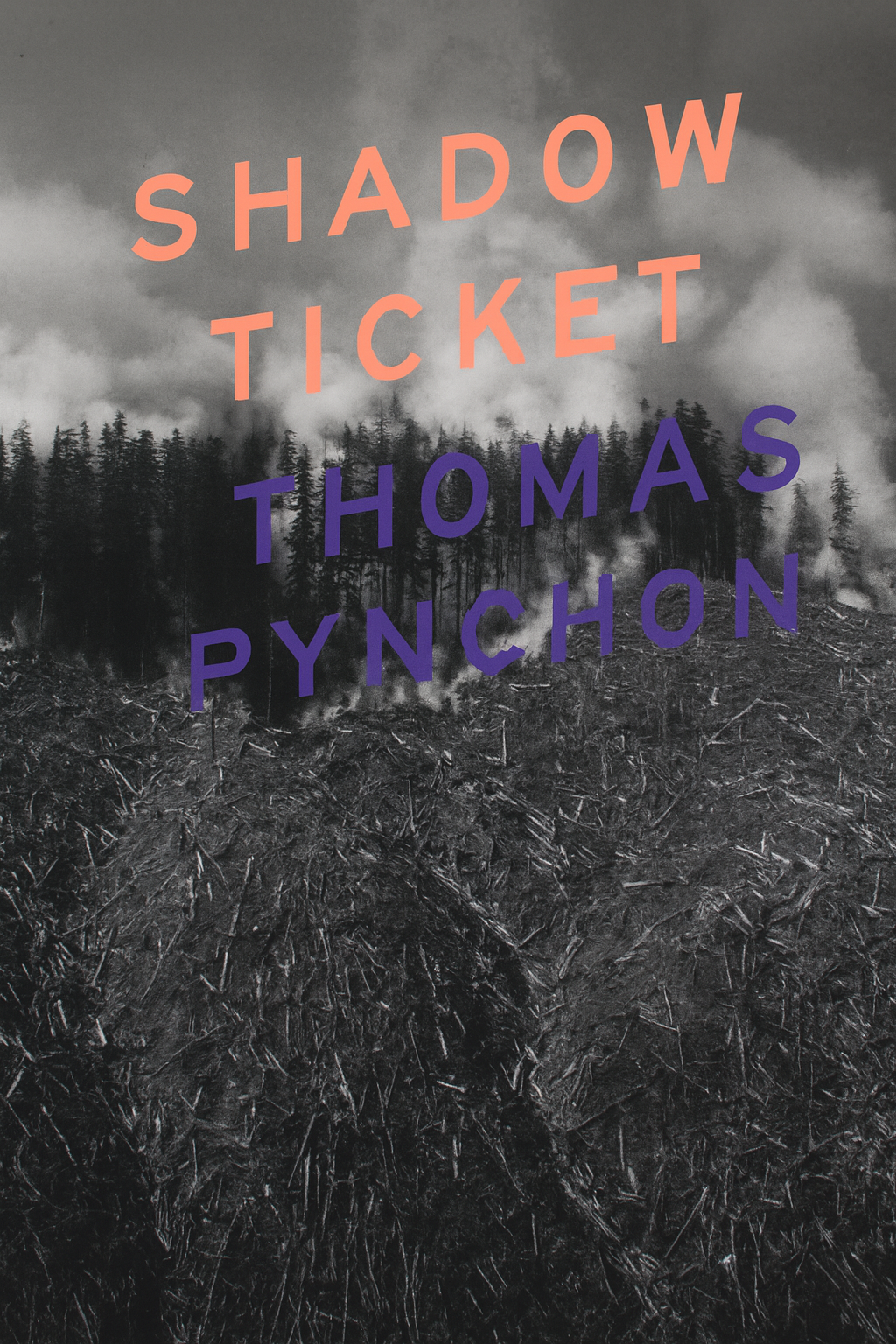
Thomas Pynchon’s Shadow Ticket (Book acquired, 30 Sept. 2025)

Here are the first four paragraphs of Thomas Pynchon’s ninth novel Shadow Ticket:

When trouble comes to town, it usually takes the North Shore Line. What with tough times down the Lake in Chicago, changes in the wind, Prohibition repeal just around the corner, Big Al in the federal pokey in Atlanta, Outfit affairs grown jumpy and unpredictable, anybody needing an excuse to get out of town in a hurry comes breezing up here to Milwaukee, where it seldom gets more serious than somebody stole somebody’s fish.

 Hicks McTaggart has been ankling around the Third Ward all day keeping an eye on a couple of tourists in Borsalinos and black camel hair overcoats up from the home office at 22nd and Wabash down the Lake, the Chicago Outfit handling whatever needs to be taken care of in Milwaukee since Vito Guardalabene cashed in his chips ten years ago, though Vito’s successor Pete Guardalabene is still considered head man in the Ward, gets his picture in the social pages smiling at weddings and so forth.

 Loitering in the alleyway in back of Pasquale’s Bella Palermo, Hicks can hear sounds of noodle-flexing sociability, smell spaghetti sauce and garlic frying and sfinciuni bagherese baking over an olive-branch fire, and it’s making him hungry, though this close to payday his lunch menu is a thermos of coffee and a buttermilk cruller stashed in a pocket someplace.

 The explosion when it comes seems to be from somewhere across the river and nearer the Lake. Forks and glassware pause between tabletop and mouth, as if everybody’s observing a moment of stillness, and nobody seems surprised.

An explosion! There we go.

Mass-market Monday | Philip K. Dick’s Dr. Bloodmoney

Dr. Bloodmoney, or, How We Got Along After the Bomb, Philip K. Dick, 1965. Dell Books (1980). Cover art by Richard Courtney (not credited; cover signed R. Courtney); no designer credited. 304 pages. Continue reading “Mass-market Monday | Philip K. Dick’s Dr. Bloodmoney”

Sunday Comix

A page from Ben Passmore’s graphic novel Black Arms to Hold You Up, Pantheon, 2025. Assata Shakur passed away on 25 Sept. 2025. She was free.


Ben Passmore’s Black Arms to Hold You Up (Book acquired, 23 Sept. 2025)

I was psyched to get an early copy of Ben Passmore’s Black Arms to Hold You Up this week. I love the dramatic vibrancy of Passmore’s cartooning, and his economic use of black, white, gray, and red throughout the book. I should have a review out around its release on 7 Oct. 2025.

Here is publisher Pantheon’s blurb:

It’s the summer of 2020, and downtown Philly is up in flames. “You’re not out in the streets with everyone else?” Ronnie asks his ambivalent son, Ben, shambling in with arms full of used books: the works of Malcom X, Robert F. Williams, Assata and Sanyika Shakur, among others. “Black liberation is your fight, too.”

So begins Black Arms to Hold You Up, a boisterous, darkly funny, and sobering march through Black militant history by political cartoonist Ben Passmore. From Robert Charles’s shootout with the police in 1900, to the Black Power movement in the 1960s, to the Los Angeles and George Floyd uprisings of the 1990s and 2020, readers will tumble through more than a century of armed resistance against the racist state alongside Ben—and meet firsthand the mothers and fathers of the movement, whose stories were as tragic as they were heroic.

What, after so many decades lost to state violence, is there left to fight for? Deeply researched, vibrantly drawn, and bracingly introspective, Black Arms to Hold You Up dares to find the answer.

You Are Very Tacky and Everyone Hates You — Sarah Theresa Lee

You Are Very Tacky and Everyone Hates You, 2025 by Sarah Theresa Lee (b. 1980)

A previously unpublished Dream Song by John Berryman

“The applause of the world comes to an empty heart”

by

John Berryman


The applause of the world comes to an empty heart,
sure the man is thinking now of something else,
something else, a fearless end
‘I have lost, of course, the fear of death’, BUT.
Messages enchant me, as from Ireland
I am an old middle-aged man about to do his best

love old men
The bartender did just call me ‘my friend’
I say the wonder is these busy caves
explored by men, & then by men, & then
by cold & dismal
engineers, are so costless

Deep in the angels let the good coat come
& I will wheedle home, who misséd you,
I can’t fix him. He’ll go down there apart,
that would be the wicked part of him that falls.
Henry has in Ireland no friend.
Alone, in the half-dark


Read five more previously-unpublished Dream Songs at Conjunctions. The poems are collected in the forthcoming volume Only Sing: 152 Uncollected Dream Songs, edited by Shane McCrae.


Voyager — Kerry James Marshall

Voyager, 1992 by Kerry James Marshall (b. 1955)

Siegfried Kracauer’s Ginster (Book acquired, 16 Sept. 2025)

Siegfried Kracauer’s 1928 novel Ginster is forthcoming in translation by Carl Skoggard from NYRB. Their blurb:

Ginster is a war novel about not going to war; about how war, far from the front, comes to warp every aspect of outer and inner life and to infect the workings of language itself. The subject is World War I, but this novel by the brilliant twentieth-century sociologist, journalist, and film critic Siegfried Kracauer, first published in 1928, has as much to say about what it means to live under the sulking great powers and blood-imbrued satrapies of today as it does about the inflamed self-righteousness of late imperial Germany. In Ginster, as in Greek tragedy, massacre occurs offstage, arriving only as “news,” but the everyday horror of a society engineered for the continual production of violence is not to be denied. Ginster, the Chaplinesque antihero, intent chiefly on saving his own skin, works hard to keep his distance from the war machine, and yet making a living, he discovers, is all about keeping it running. How different, in the end, is his dreamy self-absorption from the empty military language that has come to pervade every aspect of civilian life in the homeland?

Sunday Comix

A one-pager by Robert Crumb from Weirdo #2, Summer 1981, Last Gasp.

Combat — Taylor Schultek 

Combat, 2025 by Taylor Schultek (b. 1990)

“I Had Raised Dust,” a short vision from Daniil Kharms

“I Had Raised Dust”

by

Daniil Kharms

translated by

Neil Cornwell


I had raised dust. Children were running after, me, tearing their clothing. Old men and old women fell from roofs. I whistled, I roared, my teeth chattered and I clattered like an iron bar. Lacerated children raced after me and, falling behind, broke their thin legs in their awful haste. Old men and old women were skipping around me. I rushed on! Filthy, rachitic children, looking like toadstools, got tangled under my feet. Running was hard going. I kept remembering things and once I even almost fell into the soft mush of old men and women floundering on the ground. I jumped, snapped a few heads off toadstools and trod on the belly of a thin old woman, who at this emitted a loud crunch and softly muttered – They’ve worn me out. – Not looking back, I ran on further. Now under my feet was a clean and smooth pavement. Occasional streetlamps lit my way. I ran up to the bath-house. The welcoming bath-house flickered in front of me and the cosy but stifling bath-house steam was already in my nostrils, ears and mouth. Without undressing, I ran straight through the changing-room, then past the taps, the tubs and the planks, to the shelf. A hot white cloud surrounds me, I hear a weak but insistent sound. I seem to be lying down.

And at this point, a mighty relaxation stopped my heart.

Bialik/Rilke (Two poetry collections acquired, 13 Sept. 2025)

Two new collections from NYRB’s Poets imprint: On the Slaughter by Hayim Nahman Bialik, translated by Peter Cole, and Fifty Poems by Rainer Maria Rilke, translated by Geoffrey Lehmann. NYRB’s Bialik blurb:

Few poets in the history of Hebrew have possessed the power and prescience of Hayim Nahman Bialik. Born in 1873 in a small Ukrainian village, he spent his most productive years in Odessa and in his fifties made his way to British Mandatory Palestine. He died in Vienna in 1934. His body of work opened a path from the traditional Jewish world of Eastern Europe into a more expansive Jewish humanism. In a line that stretches back to the Bible and the Hebrew poetry of Muslim and Christian Spain, he stands out—in the words of Maxim Gorky—as “a modern Isaiah.” He remains to this day an iconic and shockingly relevant poet, essayist, and tutelary spirit.

Translated and introduced by MacArthur-winning poet Peter Cole, On the Slaughter presents Bialik for the first time in English as a masterful artist, someone far more politically and psychologically unsettling than his reputation as the national poet of the Jewish people might suggest. This compact collection offers readers a panoramic view of Bialik’s inner and outer landscapes—from his visionary “poems of wrath” that respond in startling fashion to the devastations of pogroms and revolutionary unrest to quietly sublime lyrics of longing and withering self-assessment. The volume also includes a sampling of slyly sophisticated verse for children, and a moving introduction that bridges Bialik’s moment and our own.

And “The Grown-up,” a poem from Rilke in Lehmann’s translation:

“The Grown-up”

All stood on her, all that has ever been
and was the world, and stood, its fears and grace,
as trees stand straight and rooted in one place, and solemn, like the memory of a race
or Ark of God, all-seeing and not seen.

She carried it; knowledge of who they are,
the flyers, those who flee, the distant ones,
the monsters and the awkward, diffident sons,
casually like a brimming water jar
on her calm head. Then in the midst of play,
preparing, changing slowly, cell by cell,
she did not sense the first white veil that fell
across her open face, bland as the day,

almost opaque, never to lift again.
And she forgot the answers she once knew,
leaving some vagueness she could not explain:
in you, the child who you have been, in you.

“Fladry” — Ed Skoog

“Fladry”

by

Ed Skoog


Fladry: a line of rope mounted along the top of a fence, from
which are suspended strips of fabric or colored flags that will flap
in a breeze, intended to deter wolves from crossing the fence-line.

USDA National Wildlife Research Center

I am weak and edible. Some human quality
stays weird, alien to the wild, outsiders,
bad sport with spooky habits not just fladry—
other enchantments against order, house paint,
yard art, border fences and the tunnels under borders,
the amen, the wedding ring, the flavored condom.
The wolves are back. I’ve seen them, seen the fladry
ranchers tie, red flags’ flutter to puzzle or annoy,
folk-work tendered back from wood-shadow,
more each year, abjured with clover.
What I like most about the first shot of bourbon
is how it feels like letting go of a grudge.
In the dream, I kill my friend and bury him
lime in the church basement between sump pump
and broken fireplace. On my knees I tile
red stone back to mosaic. Soldiers beat me up
and called me names in my own language,
this one, the one Whitman used to soothe
the dying, limbless, the bleeding, the infected.
Beat me with fists slight more stone
than the shape that holds this pencil.
A house is held together by shapes.
And yet in the ongoing negotiations between
the world where I hold my son and
famine, bombings, hate, prosperity—
two notes, octaves apart
attenuate what’s hidden inside your body
to the invisible. It might help remembering
shadows and not hours. Infinity
also has the contour of a children’s game.
Infants remember fladry, safe in the car seat grasping,
grasping. Some forces are enormous and move
against you, and when you pretend they aren’t
there, surge. Some swing on a hinge
which at night sounds like don’t look back,
don’t look back. Anyone can tie fladry.
See it out riding. I go out at French-horn dawn,
boots in mud, string fladry at intervals,
each tongue labeling the field, calling
beyond language. And if fladry bears
the conditions of a spell, redness of the flag,
the measure between them, it’s flapping
which charms the wolf away, for a term.
Warnings to keep the flock from the wolf’s belly.
Messages for ourselves. See it from there,
turn overall and plaid flannel; we would
tear our own fur to cross these lines.

Sunday Comix

A one-panel gag by Jay Lynch (as “Phil Space”) from Gothic Blimp Works #3, 1969, the East Village Other.

“Parents and Children,” a very short story by Alberto Savinio

“Parents and Children”

by

Alberto Savinio

translated by Richard Pevear


Today, at the table, my daughter complained to her mother and me about the antipathy that we, her parents, show towards her friends of both sexes, and had shown to her little playmates when she was still a child. She added: “I make a point of not inviting my friends to the house, knowing so well how badly you’ll treat them.”

I was about to deny it, but I didn’t. My daughter’s words had enlightened me. They had clarified a feeling in me that until now had been obscure. And what they clarified most of all was the analogy that suddenly appeared to me between this feeling of mine and an identical feeling which for some time I had recognized in my daughter: the antipathy she has for my and her mother’s friends.

We’re at the table, as a family, united in love, and behind that veil, we are mute enemies on a silent battlefield.

The reasons for this war are the same: the will to affirm yourself, the will to deny your neighbor and, if possible, to annihilate him. Whoever it may be. Even your own father, even your own child. And if the will to annihilate your own father or your own child rarely reveals itself, that is not because it isn’t there but because it is overlaid by another will: that of affirming yourself through your own father or your own child and, beyond that, through relatives, friends, through all those who are or whom we believe are part of ourselves, an extension of ourselves, a development of our own possibilities.

At the table, my daughter’s words had revealed this usually hidden and silent will at one stroke.

Nobody spoke. We all felt the pricking of conscience under our seats.

Which of us is entirely alone? Each of us has a maniple, or a cohort, or even an army of persons by means of which he reinforces himself, extends himself, expands himself. The force of association is that much greater in the young, the more recent is the discovery in themselves of this force, its usefulness, its possibilities.

Hence that most strict, most active, most fanatical jealousy that unites my children to their friends (parts of themselves), and to their teachers, and to all that constitutes their “personal” world; hence the jealousy, though more loose, that unites me to my friends—I who also know how to fight alone; I who also know not to fight; I who am also aware of the vanity of fighting.

There are four of us at the table: a family; and behind each of us a little army is drawn up—invisible.

Rarely does the presence of this militia manifest itself; rarely does this militia have occasion to manifest itself. So complex, so various, so different, so contrary are the feelings in the heart of a single family: that mess.

But any reason at all, and the most unexpected at that, can spark a clash or even a most cruel battle. And the invisible troops go into action.

The most indirect of combats. The armies, here more than elsewhere, are passive—and indifferent—instruments. But this most indirect of combats, fought by invisible armies, is in truth the most direct of combats, fought between the most visible adversaries: husband and wife, parents and children.

The combat between parents and children is more bitter, because the children bring to it an enormous load of personal interests, a whole future of them; and the parents for their part have to defend themselves, defend the field against the threat of dispossession, against the “humiliating” danger of substitution.

And if the war between parents and children almost never ends in a fatal way, that is because at a certain point, when the battle is about to get rough, the parents and children separate; the children abandon the parents and go their own way; they understand the uselessness, the absurdity of combat with adversaries with whom, at bottom, they have nothing in common.

The battle between parents and children—the not always silent battle between parents and children—though ended not by the victory of one of the parties, but by a peaceful abandoning of the field, has its epinicium in a closer, more profound, more passionate union of the parents.

If silver anniversaries and golden anniversaries are celebrated, with even greater reason we should celebrate the new and more solemn anniversary once the children, having become adult, having left their training period behind, having become conscious of the need for a different strategy, abandon the parents and set out on their own way, towards the only true and fruitful battles, which are those that are fought between people of the same generation.

Because matrimony, that poetic song of generation (if the pun be permitted), is a pact bound with sacred ties between a man and a woman of the same generation, against other generations, against other people, all of them, including their own children. Once the children leave, the
union between husband and wife is purified of its practical reason (procreation); it withdraws into its own pure reason; it enters into the condition of poetry.

One point remained obscure to me. Why this antipathy of mine for my daughter’s friends, little men and women whom I do not know and have almost never seen; why this antipathy of my daughter’s for her mother’s friends and mine, men and women whom my daughter rarely sees, and with whom she has no common affections, feelings, tastes, interests?

I understood.

Friends, in this case, are a way of playing off the cushions (a term from billiards).

The empire of the good, in spite of so many transmutations of values, and though the reasons that first established that empire have weakened greatly and are becoming more and more confused—the empire of the good still has so much force, so much authority, that it does not allow a son to say, or even think, “I dislike my father,” nor a father to say, or even think, “I dislike my son.” But there is antipathy between fathers and sons. And even hatred. All the more antipathy, all the more hatred, insofar as the conditions for antipathy and hatred are much more frequent between those who love each other and who are united not only by love but by a common life, by common means, by a common affection for people and things, by common habits. Antipathy and hatred do not exclude sympathy and love, just as sympathy and love do not exclude antipathy and hatred. On the contrary. A strange cohabitation, but cohabitation all the same. And they either alternate, or one gains the upper hand over the other, or one hides the other—hides behind the other, as most often happens, despite the will to the good that we put into it, that we know we should put into it, that we feel a duty to put into it—that we sense the convenience of putting into it. And there is antipathy and hatred—there is “even” antipathy and hatred—of children for parents and parents for children behind love, behind great love, behind the greatest love; but since this antipathy and hatred cannot be given directly and openly to those it is destined for, the antipathy and hatred go, by an automatic transfer, and unbeknownst to the interested parties, to those who represent the “continuation” of the children, the continuation of the parents: to the friends of the children, to the friends of the parents.

The deepest ground of the drama of passion.

Sept. 11 — Nicola Verlato 

Sept. 11 by Nicola Verlato (b. 1965)