Snow — Francine van Hove

francine-van-hove-neiges

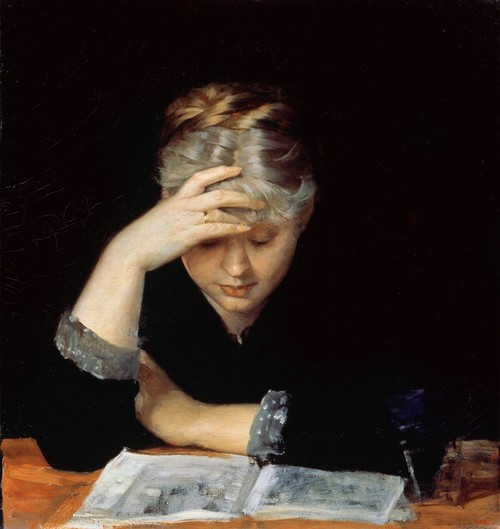
At a Book — Marie Bashkirtseff

at a book

Reading/Have Read/Should Write About

IMG_3050.JPG

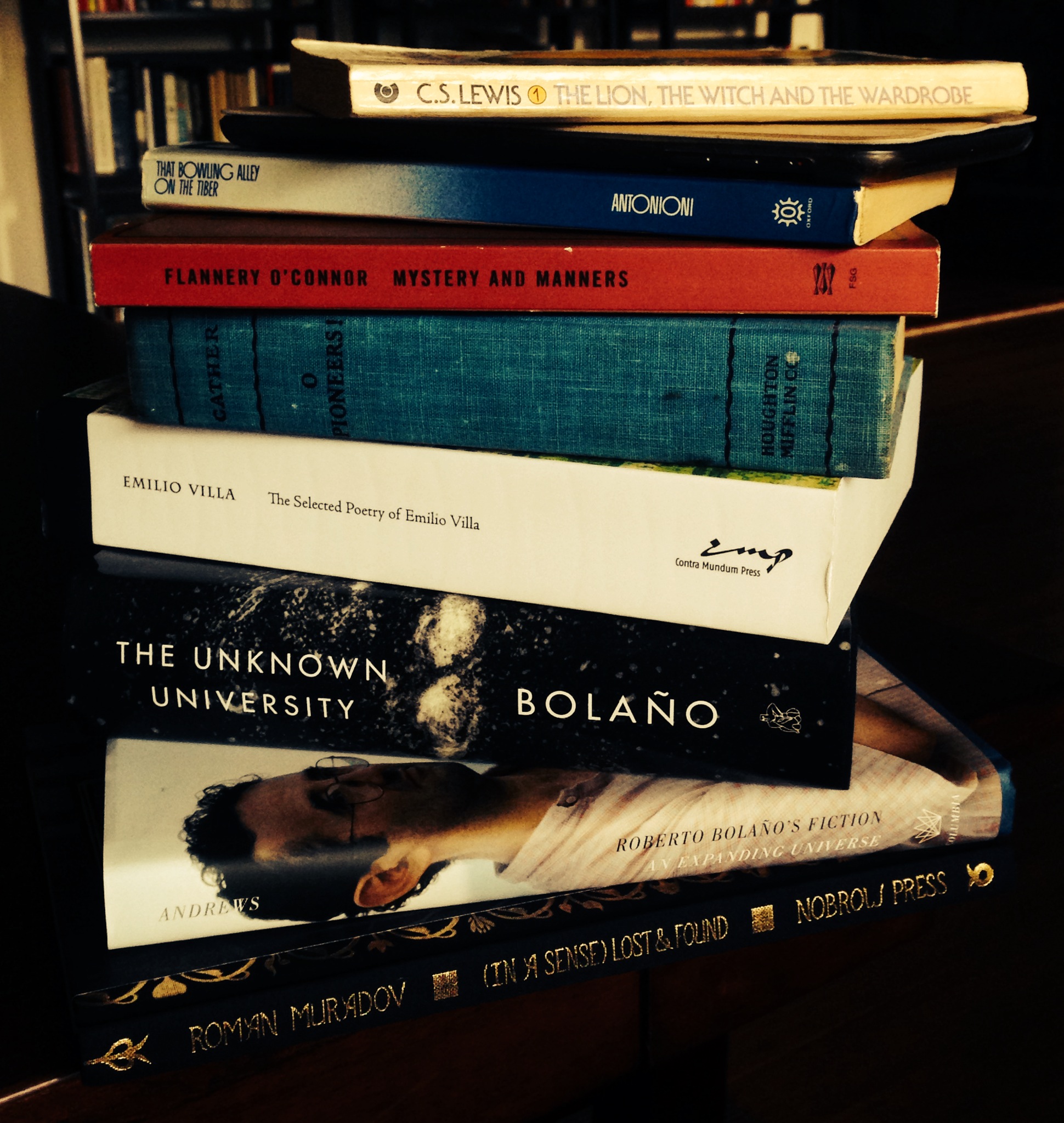
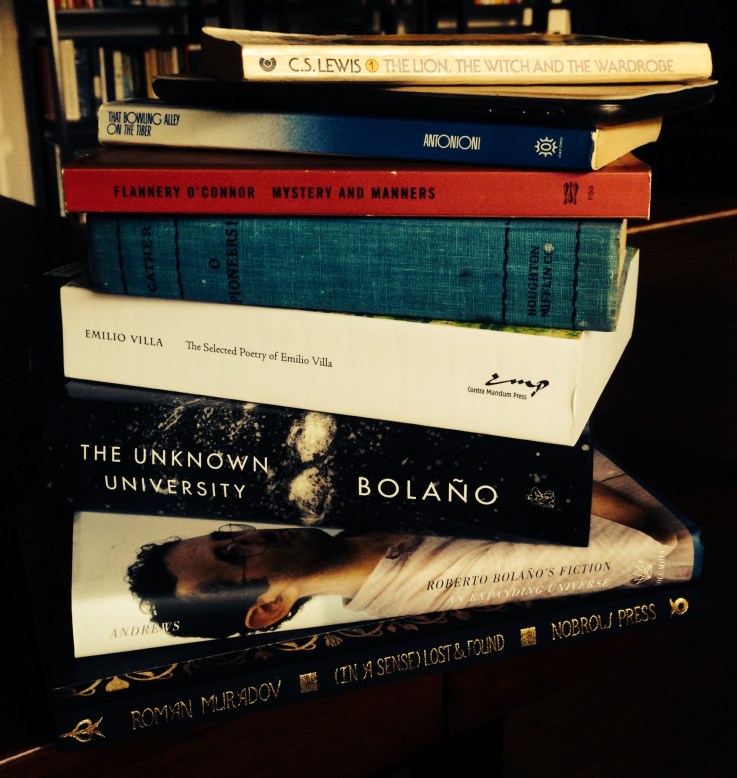
Ran out of time this week before I could write about anything I’ve been reading. So a quick riff, from top to bottom, in the pic above:

The Lion, the Witch, and the Wardrobe, C.S. Lewis

I’ve been reading this at night with my seven-year-old daughter. I’ve read it maybe a thousand times now. Lewis is not the best prose stylist, but he fuses together bits of pagan and Christian myth better than the best.

On the iPad:

The Possibility of an Island, Michel Houellebecq

My least-favorite Houellebecq so far—has some wonderful rants at times, but Houellebecq keeps embedding these terrible pop culture references (following his hero Bret Easton Ellis’s lead?) that usually dull the edge he’s been sharpening. And the narrator’s spite at this point is almost unbearable—reading it makes me feel like Gandalfdore drinking that poisonous potion in Harry Potter and the League of Bad Mentorsjust sucking down venom.

The Golden Notebook, Doris Lessing

Great stuff. A little over two-thirds finished. Wrote about is some here.

Lanark, Alasdair Gray

I might regret that I never wrote a Big Fat Review of Lanark, Gray’s bizarre cult novel. The book is a weird chimera: It starts as a weird sci-fi/fantasy trip—closer to Kafka’s The Castle than genre-conventional fare though, to be clear. Then it shifts into this modernist Künstlerroman that seems to want to be a Scottish answer to Joyce’s Portrait. Then there’s a short story inserted in the middle, a return to the dystopian fantasy (heavy streaks of Logan’s Run and Zardoz and Soylent Green—very ’70s!), and, right before its (purposefully) dissatisfying conclusion, an essay by a version of the author, who defensively critiques his novel for characters and readers alike. Gray wants to have written the Great Scottish Epic. I’m not sure if he did, but Lanark has moments that are better than anything I’ve read all year—even if the end result doesn’t hang together so well.

The Bowling Alley on the Tiber, Michelangelo Antonioni

Sketches and figments that Antonioni never turned into films. Not sure if he intended to.

Mystery and Manners, Flannery O’Connor

Good lord.

O Pioneers!, Willa Cather

There’s a tendency in American fiction to posit the American Dream as a masculine escapist fantasy. This version of the Dream is perhaps best expressed in the last lines of The Adventures of Huckleberry Finn, when Huck declares: “But I reckon I got to light out for the territory ahead of the rest, because Aunt Sally she’s going to adopt me and sivilize me, and I can’t stand it. I been there before.” Always more territory, always more space outside of the (maternal) civilizing body. Cather answers to that version of the Dream in her character Alexandra Bergson, who cultivates the land and claims her own agency through commerce and agriculture.

The Selected Poetry of Emilio Villa, translated by Dominic Siracusa

What a strange and wonderful book! I wrote about it here. Confounding.

The Unknown University, Roberto Bolaño

Okay, so I wrote about the first section in detail here. More or less finished it. Bolaño’s best poems are basically prose (that’s not a knock).

Roberto Bolaño’s Fiction: An Expanding Universe, Chris Andrews

Wrote about it a bit here; will write more when I finish. Makes me want to reread Bolaño (although I almost always want to reread Bolaño).

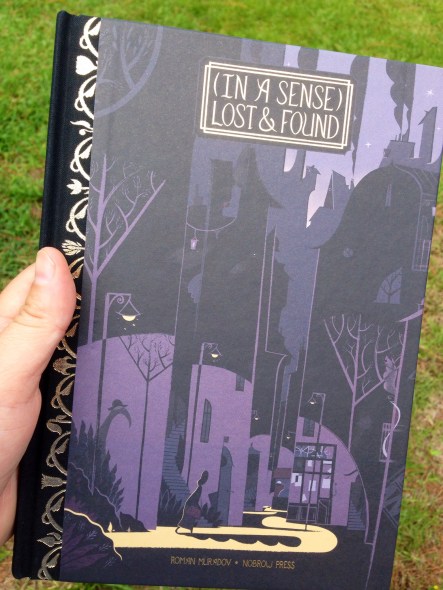
(In a Sense) Lost & Found, Roman Muradov

The plot of Muradov’s debut graphic novel floats like a dream-fog in surreal, rich art as the ludic dialogue refuses to direct the reader to a stable referent. Great stuff.


Lost in Dreams — Friedrich von Amerling

2aFriedrich von Amerling (Austrian-born artist, 1803-1887) In Traumen Versunken, 1835.

“The Undertaker’s Chat” — Mark Twain

“Now that corpse,” said the undertaker, patting the folded hands of deceased approvingly, “was a brick—every way you took him he was a brick. He was so real accommodating, and so modest-like and simple in his last moments. Friends wanted metallic burial-case—nothing else would do. I couldn’t get it. There warn’t going to be time—anybody could see that.

“Corpse said never mind, shake him up some kind of a box he could stretch out in comfortable, he warn’t particular ’bout the general style of it. Said he went more on room than style, anyway in a last final container.

“Friends wanted a silver door-plate on the coffin, signifying who he was and wher’ he was from. Now you know a fellow couldn’t roust out such a gaily thing as that in a little country-town like this. What did corpse say?

“Corpse said, whitewash his old canoe and dob his address and general destination onto it with a blacking-brush and a stencil-plate, ‘long with a verse from some likely hymn or other, and p’int him for the tomb, and mark him C. O. D., and just let him flicker. He warn’t distressed any more than you be—on the contrary, just as ca’m and collected as a hearse-horse; said he judged that wher’ he was going to a body would find it considerable better to attract attention by a picturesque moral character than a natty burial-case with a swell door-plate on it.

“Splendid man, he was. I’d druther do for a corpse like that ‘n any I’ve tackled in seven year. There’s some satisfaction in buryin’ a man like that. You feel that what you’re doing is appreciated. Lord bless you, so’s he got planted before he sp’iled, he was perfectly satisfied; said his relations meant well, perfectly well, but all them preparations was bound to delay the thing more or less, and he didn’t wish to be kept layin’ around. You never see such a clear head as what he had—and so ca’m and so cool. Jist a hunk of brains—that is what he was. Perfectly awful. It was a ripping distance from one end of that man’s head to t’other. Often and over again he’s had brain-fever a-raging in one place, and the rest of the pile didn’t know anything about it—didn’t affect it any more than an Injun Insurrection in Arizona affects the Atlantic States. Well, the relations they wanted a big funeral, but corpse said he was down on flummery—didn’t want any procession—fill the hearse full of mourners, and get out a stern line and tow him behind. He was the most down on style of any remains I ever struck. A beautiful, simpleminded creature—it was what he was, you can depend on that. He was just set on having things the way he wanted them, and he took a solid comfort in laying his little plans. He had me measure him and take a whole raft of directions; then he had the minister stand up behind a long box with a table-cloth over it, to represent the coffin, and read his funeral sermon, saying ‘Angcore, angcore!’ at the good places, and making him scratch out every bit of brag about him, and all the hifalutin; and then he made them trot out the choir, so’s he could help them pick out the tunes for the occasion, and he got them to sing ‘Pop Goes the Weasel,’ because he’d always liked that tune when he was downhearted, and solemn music made him sad; and when they sung that with tears in their eyes (because they all loved him), and his relations grieving around, he just laid there as happy as a bug, and trying to beat time and showing all over how much he enjoyed it; and presently he got worked up and excited, and tried to join in, for, mind you, he was pretty proud of his abilities in the singing line; but the first time he opened his mouth and was just going to spread himself his breath took a walk.

“I never see a man snuffed out so sudden. Ah, it was a great loss—a powerful loss to this poor little one-horse town. Well, well, well, I hain’t got time to be palavering along here—got to nail on the lid and mosey along with him; and if you’ll just give me a lift we’ll skeet him into the hearse and meander along. Relations bound to have it so—don’t pay no attention to dying injunctions, minute a corpse’s gone; but, if I had my way, if I didn’t respect his last wishes and tow him behind the hearse I’ll be cuss’d. I consider that whatever a corpse wants done for his comfort is little enough matter, and a man hain’t got no right to deceive him or take advantage of him; and whatever a corpse trusts me to do I’m a-going to do, you know, even if it’s to stuff him and paint him yaller and keep him for a keepsake—you hear me!”

He cracked his whip and went lumbering away with his ancient ruin of a hearse, and I continued my walk with a valuable lesson learned—that a healthy and wholesome cheerfulness is not necessarily impossible to any occupation. The lesson is likely to be lasting, for it will take many months to obliterate the memory of the remarks and circumstances that impressed it.

By Mark Twain. From Sketches New and Old.

The Reader — Harold Knight

(c) John Croft; Supplied by The Public Catalogue Foundation

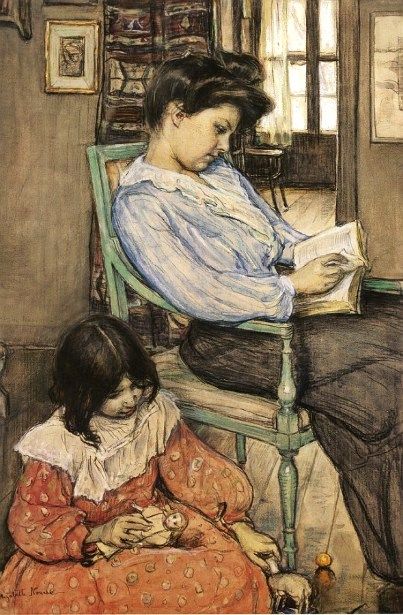
An Hour of Leisure — Elisabeth Nourse

woman reading

Summer Reading — Charlie Mackesy

Mackesy, Charlie - summer reading

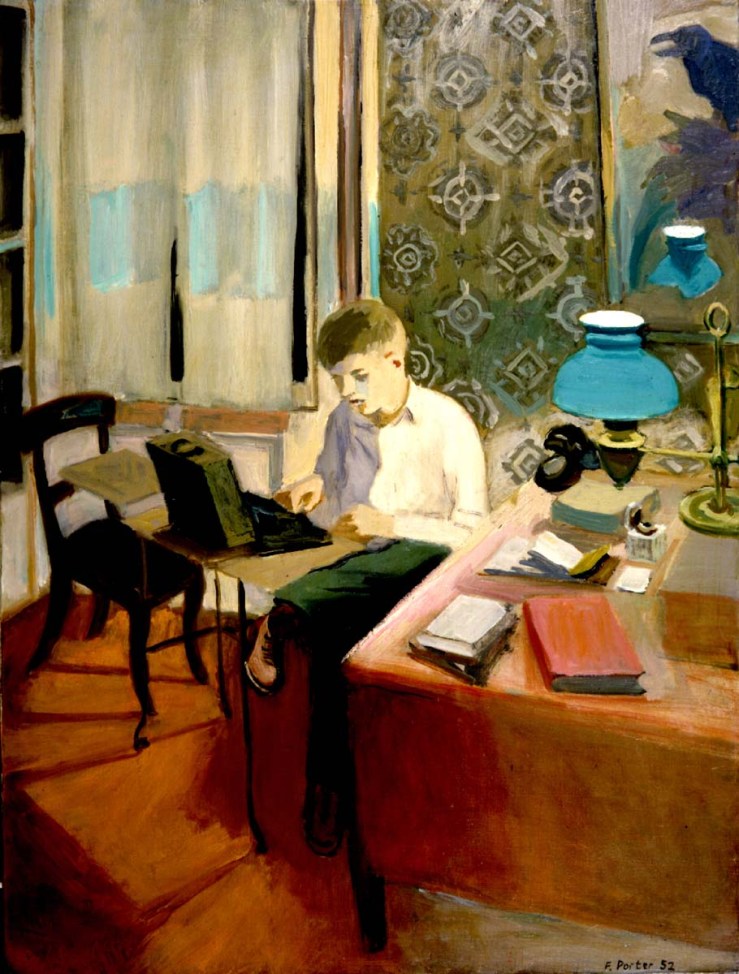
Laurence Typing — Fairfield Porter

fp

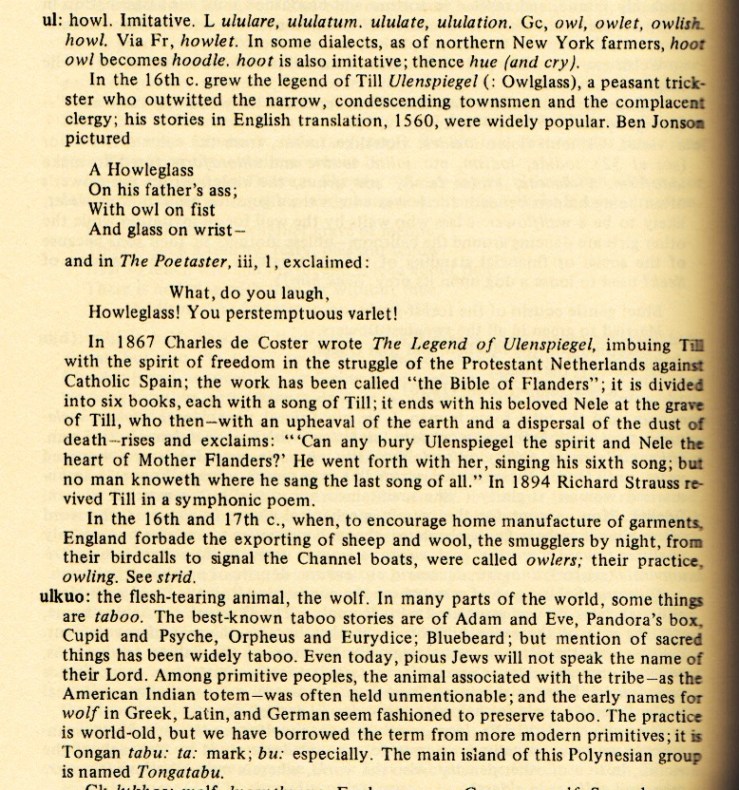
ul: howl. Imitative / ulkuo: the flesh-tearing animal, the wolf.

IMG_3027.JPG

From Joseph T. Shipley’s The Origin of English Words: A Discursive Dictionary of Indo-European Roots.

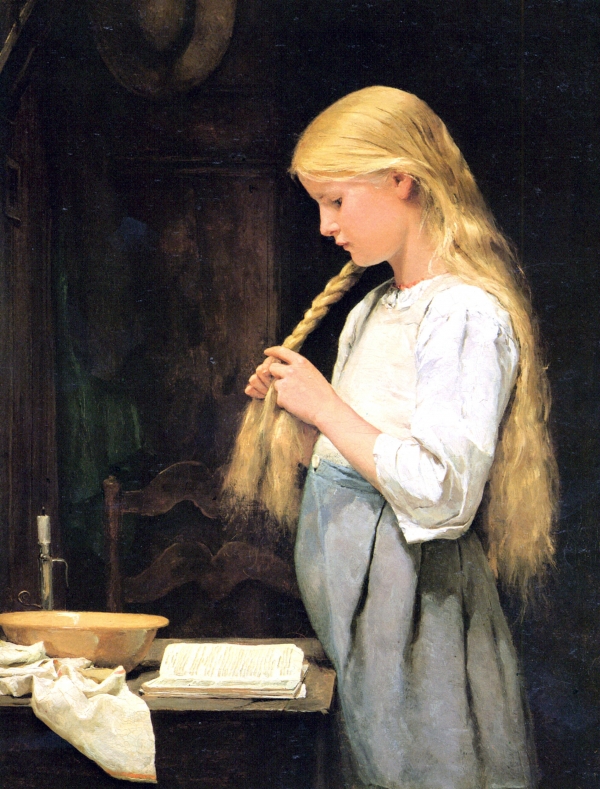
Girl Twisting Her Hair — Albert Samuel Anker

mue

The Reading — George Henry

(In a Sense) Lost & Found (Book Acquired, 7.26.2014)

IMG_2935

I’ve read Roman Muradov’s debut graphic novella (In a Sense) Lost & Found a few times now and it’s great—hits the trifecta of strange, beautiful, and smart. It’s new from Nobrow Press. Here’s their blurb:

(In a Sense) Lost and Found, the first graphic novel by rising star Roman Muradov, explores the theme of innocence by treating it as a tangible object; something that can be used, lost, and mistreated. Muradov’s crisp, delicate style conjures a world of strange bookstores, absurd conspiracies, and charming wordplay. A surreal tale in the mold of the best American alternative comics, In a Sense retains its distinctly Eastern perspective.

Muradov lets the art tell this surreal story of a girl looking for something that the narrative refuses to reveal to us. There is no exposition, and readers looking for dialogue that explains everything to them will likely be perplexed. The book is gorgeous, rich, dark—I would include some panels here but the pages are so thick and dark that my iPhone simply can’t handle them. (The picture I took of the cover, above, does no justice to the book’s aesthetics). I’ll get some hi-res images for the full review I plan to post next week though. Great stuff.

The thinning of language (Doris Lessing)

I am in a mood that gets more and more familiar: words lose their meaning suddenly. I find myself listening to a sentence, a phrase, a group of words, as if they are in a foreign language—the gap between what they are supposed to mean, and what in fact they say seems unbridgeable. I have been thinking of the novels about the breakdown of language, like Finnegans Wake. And the preoccupation with semantics. The fact that Stalin bothers to write a pamphlet on this subject at all is just a sign of a general uneasiness about language. But what right have I to criticize anything when sentences from the most beautiful novel can seem idiotic to me? 

… I made tea, and then I remembered a story that was sent to me last week. By a comrade living somewhere near Leeds. When I first read it, I thought it was an exercise in irony. Then a very skilful parody of a certain attitude. Then I realized it was serious—it was at the moment I searched my memory and rooted out certain fantasies of my own. But what seemed to me important was that it could be read as parody, irony or seriously. It seems to me this fact is another expression of the fragmentation of everything, the painful disintegration of something that is linked with what I feel to be true about language, the thinning of language against the density of our experience.

From Doris Lessing’s novel The Golden Notebook.

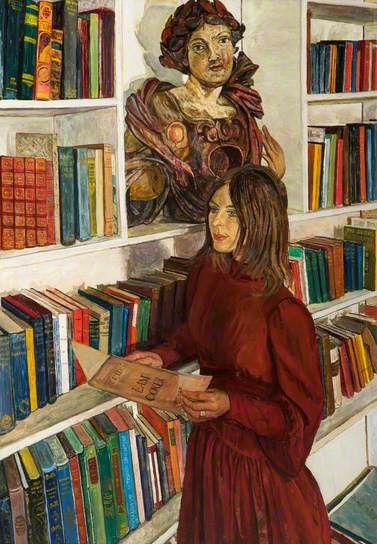
The Library — Carel Victor Morlais

Bridgeman; (c) Bridgeman; Supplied by The Public Catalogue Foundation

Franz Marc and Maria in the Studio — August Macke

The Inhumanity Museum


Scissors, Richard Diebenkorn

Near the end of the first cycle-section of Doris Lessing’s novel The Golden Notebook, protagonist Anna Wulf abandons the pretense of personal narrative in favor of pastiche, collage, clipping. Our heroine cuts and pastes material directly from the newspapers she’s been reading into her blue notebook:

[At this point the diary stopped, as a personal document. It continued in the form of newspaper cuttings, carefully pasted in and dated.]

March, 50

The modeller calls this the ‘H-Bomb Style’, explaining that the ‘H’ is for peroxide of hydrogen, used for colouring. The hair is dressed to rise in waves as from a bomb-burst, at the nape of the neck. Daily Telegraph.

July 13th, 50

There were cheers in Congress today when Mr Lloyd Bentsen, Democrat, urged that President Truman should tell the North Koreans to withdraw within a week or their towns would be atom-bombed. Express.

July 29th, 50

Britain’s decision to spend £100 million more on Defence means, as Mr Attlee has made clear, that hoped-for improvements in living standards and social services must be postponed. New Statesman.

Aug. 3, 50

America is to go right ahead with the H Bomb, expected to be hundreds of times more powerful than the atom bombs. Express.

The passages continue for pages in the same vein until:

30th March 2nd H-BOMB EXPLODED. Express.

This section of The Golden Notebook fits neatly into what I’ve come to think of as the Inhumanity Museum. The writer clips from the newspaper and passes those fragments to the author, who tosses them to the speaker, the narrator, a character, perhaps—and asks: What to do with these? Can you believe this? Are there even words for this? 

Which is the appeal to the writer, I think, of clippings that belong to the Inhumanity Museum: That the journalist telegraphs (plainly, simply, succinctly) what the novelist may deem ineffable.

I’ve appropriated the term the Inhumanity Museum from William H. Gass’s novel Middle C:

The gothic house he and his mother shared had several attic rooms, and Joseph Skizzen had decided to devote one of them to the books and clippings that composed his other hobby: the Inhumanity Museum. He had painstakingly lettered a large white card with that name and fastened it to the door. It did not embarrass him to do this, since only he was ever audience to the announcement. Sometimes he changed the placard to an announcement that called it the Apocalypse Museum instead. The stairs to the third floor were too many and too steep for his mother now. Daily, he would escape his sentence in order to enter yesterday’s clippings into the scrapbooks that constituted the continuing record:

Friday June 18, 1999

Sri Lanka. Municipal workers dug up more bones from a site believed to contain the bodies of hundreds of Tamils murdered by the military. Poklek, Jugoslavia. 62 Kosovars are packed into a room into which a grenade is tossed. Pristina, Jugoslavia. It is now estimated that 10,000 people were killed in the Serbian ethnic-cleansing pogram..

There is more

Tomato and Knife, Richard Diebenkorn

I’m still not sure exactly how the Inhumanity Museum fits into Middle C’s tale of fraud and music. Maybe it’s just Gass’s excuse to unload some of the material he’s been clipping for years. (Maybe I need to reread Middle C).

Here is Gass, in a 2009 interview, discussing William Gaddis (the emphasis is mine): 

We were very close, even though we spent most of our time apart. I really had the warmest… We had great times. We both had the same views: Mankind, augh hsdgahahga!!!!. And he would read the paper and make clippings out of it. He was always saying, “Did you read…!?” We would both exalt in our gloom.

“Mankind [unintelligible]!” Ha! Continue reading “The Inhumanity Museum”