Handsome Devil William S. Burroughs, Smiling

William Burroughs in his flat, London, 1971. Photo by Baron Wolman

(Via).

Carl Shuker’s Anti Lebanon Reviewed

al

I’m tempted to say that Carl Shuker’s novel Anti Lebanon is full of twists, but twists isn’t the right word—it’s more like the novel’s trajectory repeatedly escapes the reader’s expectations, driving into increasingly alien terrain.

Anti Lebanon begins as a somewhat traditional novel focused on Leon Elias, “thirty years old, East Beiruti Greek Orthodox.” Leon has dropped out of university, leaving his degree in hydrogeology unfinished. Leon has since taken a job as the security guard of an abandoned amusement park, a symbolic stand-in for Lebanon’s tourist economy. The Arab Spring has destabilized Lebanon, leaving its Christian population in a precarious position as Hezbollah dominates the government—and the streets. After dropping out of school, Leon creates an experimental short film, In the anti Lebanon,  a film “about his family and his sister and their history” — a history of mixed cultures (Leon’s mother is Japanese) and pain (his sister, a soldier, was assassinated).

The early parts of Anti Lebanon seem to set the stage for a fairly conventional novel with strong political overtones, one that explores Leon’s guilt over his sister’s violent death and his conflicted place as a sensitive and artistic soul who’s the son an infamous warrior, all set against the backdrop of Christian Lebanon in the tumult of the Arab Spring. But then Shuker takes us other places. Lots of other places.

The crucible for this change comes after a night of drinking ends in violence and theft. I don’t want to spoil too much—this is a novel that constantly had me rereading entire passages, asking, Wait, what?—but let’s just say Leon, complicit in a crime, ends up moving a body by motorcycle. Let me share some of Shuker’s prose in a passage that reveals the novel’s major metaphysical gambit:

This time there was no crash and it probably was the alcohol but the pain of the thing’s biting was gristly and sharp and also distant and allied with the shock of the fall so he rode though it for it seemed several dozen feet— the most important thing was not to fall again. He came to a controlled halt, stopped the bike, and then over his shoulder punched the thing’s face several times, his knuckle hitting soft then hitting helmet, and it bit again and this time harder and it stung and went deeper, a popping sound or feeling in his neck that suddenly got desperately deep and he punched again and then he rolled violently and writhed in the grasp of the thing they had created and he fell over deliberately, twisting so as to topple over sideways upon and hurt and stop the thing, and he hit the ground landing on its arm and this dislodged the biting helmeted head and he pulled up its hands and wriggled away over the concrete like his sister palming herself away from her disappeared foot and he scrambled up, and the thing just lay there inert and still, wired to the scooter in a position absurd, all tied up and crooked and ruined and wrong. He stood and held his hot neck looking at the fallen boy and then knew that someone else was there.

Is Leon now a vampire? The novel answers this question clearly even as it refuses to explain or define what, exactly, being a vampire means.  Anti Lebanon at times threatens to become an allegory of Mideast politics and history, using vampirism as its major trope, but then Shuker shifts us into new, weird territory. An appropriately Borgesian chapter titled “Labyrinth” moves Leon and the reader into a propulsive engine of dream logic; we’re never quite sure exactly what is happening as Leon gives over to dark, primal violence.

Such violence inheres from history and geography and mythology. It’s worth sharing another passage at length to see how Shuker traces these contours, plunging character and reader into history’s strange tangles. Here, vampire Leon drinks a guard’s lifeblood—the beginning of an oblique spree—and tunnels into mythos, plumbing the history of his land to arrive at his sister’s murder:

Semi-unhinged single Christian men, living alone in brutalist concrete boxes on the borderlands with their rage and a shrieking TV, a simonized gun and a cross on the wall, were approached and made use of. Aries, Andromeda, and Perseus slowly wheeled across the dead guard’s sunglasses. Christian snipers took positions around Mar Mikhael overlooking Electricité du Liban. A secret. Leon, labyrinthine, tunneled from shadow to shadow. The criminal and the victim alike return to the scene of the crime. Would the Israelis come? The taste of blood was hot: There was juniper, vetyver, and chypres too, copper drying down to a powder, wealth and breadth of deathless rivers in endless cycle, over centuries, aeons, untouched and untouchable: Nahr al Kalb, the dog river, collecting on its rock walls the signatures of dead empires: the steles of Ramses II, Nebuchadnezzar, Napoleon III and Caracalla, General Gouraud and The XXI British Army Corps with Le Détachement Français de Palestine et Syrie occupied Beirut and Tripoli: October 1918 AD; and Nahr Ibrahim, the blood river, which flows red: iron-rich soil rusting, seeding red anemones of the rebirth along its banks. The land still bearing the imprint of its creator, still running with the blood of Adonis in cascades; cataracts of rust. The march crossed the exact point on the Green Line where the Black Saturday ID checkpoints were erected once upon a time and to cross was to have your ID checked for religion and your throat cut in the passenger seat, watched over by Phalange HQ, past Makhlouf’s sandwich store— his weakness, his frailty. He told her about the last shot, what he alone saw: that the assassin didn’t even look as he ruined her; as he ruined him.

From here—well, let’s just say that Leon goes, and that the book moves into a picaresque rhythm, erupting with Bolañoesque moments of horror and strange shifts into the unreal (there’s a moment at the end of an episode in Israel that confounded everything I’d read so far in the book, the effect approaching alterity). It would spoil too much of Anti Lebanon to delineate all its movements; suffice to say its unsettling shifts are grounded in motifs of dogs, water, film, art, crashes, the peri, the vampire.

Shuker’s book isn’t for everyone. Those looking for a classic Gothic horror or a sexy vampire romp will likely be disappointed (and probably confused). Shuker also throws his reader into the metaphorical deep end of Mideast politics and history, offering little exposition that might help explain some of the complexity. There’s a trust in the reader there that I admire (even as I often headed to Wikipedia to learn about Lebanon’s civil wars, the Druze, its relationship to Syria, Palestine, Israel…). That trust is best returned to the author—a trust to follow him where he goes, because frankly you won’t be able to see ahead. Anti Lebanon is unpredictable, strange, and very rewarding.

Anti Lebanon is new from Counterpoint Press.

Joseph Heller’s Handwritten Outline for Catch-22

heller

(Via/more).

A Dwarf Holding a Tome in His Lap — Diego Velazquez

Plagiarism

Criminal man has lost all enterprise and originality.

And this same progeny of evils comes
From our debate, from our dissension;
We are their parents and original.

Those with no memory insist on their originality.

Books serve to show a man that those original thoughts of his aren’t very new after all.

Great poets steal.

The one and the only.

All my best thoughts!

Stolen by the ancients.

Ah! Gooblazqruk brukarchkrasht!

Truth! stark, naked truth, is the word; and I will not so much as take the pains to bestow the strip of a gauze wrapper on it, but paint situations such as they actually rose to me in nature, careless of violating those laws of decency that were never made for such unreserved intimacies as ours; and you have too much sense, too much knowledge of the originals, to sniff prudishly and out of character at the pictures of them.

Tear him for his bad verses, tear him for his bad verses.

Mature poets steal.

Nothing new except what has been forgotten.

It’s not a real leg, only a false leg.

And there’s a mighty difference between a living thump and a dead thump.

O! Weeshwashtkissinapooisthnapoohuck?

An original artist is unable to copy. So he has only to copy in order to be original.

Let a splinter swerve.

It hath it original from much grief, from study, and perturbation of the brain.

Great artists steal.

The original papers, together with the scarlet letter itself—a most curious relic—are still in my possession, and shall be freely exhibited to whomsoever, induced by the great interest of the narrative, may desire a sight of them. I must not be understood affirming that, in the dressing up of the tale, and imagining the motives and modes of passion that influenced the characters who figure in it, I have invariably confined myself within the limits of the old Surveyor’s half-a-dozen sheets of foolscap. On the contrary, I have allowed myself, as to such points, nearly, or altogether, as much license as if the facts had been entirely of my own invention. What I contend for is the authenticity of the outline.

Necessary to any originality: the courage to be an amateur.

It is all for the taking.

Great artists.

We have always been shameless about stealing great ideas.

The great artist who is truly schizophrenic will break the wall, reaching the unknown country where he does not belong to any age, any environment, any school.

And all that poets feign of bliss and joy.

Now, do you doubt that your bird was true?

Read “The Dark Arts,” A New Story by Ben Marcus

On a dark winter morning at the Müllerhaus men’s hostel, Julian Bledstein reached for his Dopp kit. At home, he could medicate himself blindfolded, but here, across the ocean, it wasn’t so easy. The room stank, and more than one young man was snoring. The beds in the old gymnasium were singles, which didn’t keep certain of the guests from coupling when the lights went out. Sometimes Julian could hear them going at it, fornicating as if with silencers on. He studied the sounds when he couldn’t sleep, picturing the worst: animals strapped to breathing machines, children smothered under blankets. In the morning he could never tell just who had been making love. The men dressed and left for the day, avoiding eye contact, mesmerized in the glow of their cell phones.

Julian held his breath and squeezed the syringe, draining untold dollars’ worth of questionable medicine into the flesh of his thigh. He clipped a bag holding the last of his money to the metal underside of his bed. His father’s hard-earned money. Not enough euros left. Not nearly enough. He’d have to make a call, poor-mouth into the phone until his father’s wallet spit out more bills.

Read the rest of Ben Marcus’s “The Dark Arts” at The New Yorker.

Don Quixote, Sancho Panza and the Dead Mule — Honore Daumier

A Creole Bovary — Willa Cather Reviews Kate Chopin’s Novella The Awakening

A Creole “Bovary” is this little novel of Miss Chopin’s. Not that the heroine is a creole exactly, or that Miss Chopin is a Flaubert—save the mark!—but the theme is similar to that which occupied Flaubert. There was, indeed, no need that a second “Madame Bovary” should be written, but an author’s choice of themes is frequently as inexplicable as his choice of a wife. It is governed by some innate temperamental bias that cannot be diagrammed. This is particularly so in women who write, and I shall not attempt to say why Miss Chopin has devoted so exquisite and sensitive, well-governed a style to so trite and sordid a theme. She writes much better than it is ever given to most people to write, and hers is a genuinely literary style; of no great elegance or solidity; but light, flexible, subtle and capable of producing telling effects directly and simply. The story she has to tell in the present instance is new neither in matter nor treatment. “Edna Pontellier,” a Kentucky girl, who, like “Emma Bovary,” had been in love with innumerable dream heroes before she was out of short skirts, married “Leonce Pontellier” as a sort of reaction from a vague and visionary passion for a tragedian whose unresponsive picture she used to kiss. She acquired the habit of liking her husband in time, and even of liking her children. Though we are not justified in presuming that she ever threw articles from her dressing table at them, as the charming “Emma” had a winsome habit of doing, we are told that “she would sometimes gather them passionately to her heart, she would sometimes forget them.” At a creole watering place, which is admirably and deftly sketched by Miss Chopin, “Edna” met “Robert Lebrun,” son of the landlady, who dreamed of a fortune awaiting him in Mexico while he occupied a petty clerical position in New Orleans. “Robert” made it his business to be agreeable to his mother’s boarders, and “Edna,” not being a creole, much against his wish and will, took him seriously. “Robert” went to Mexico but found that  fortunes were no easier to make there than in New Orleans. He returns and does not even call to pay his respects to her. She encounters him at the home of a friend and takes him home with her. She wheedles him into staying for dinner, and we are told she sent the maid off “in search of some delicacy she had not thought of for herself, and she recommended great care in the dripping of the coffee and having the omelet done to a turn.”

Only a few pages back we were informed that the husband, “M. Pontellier,” had cold soup and burnt fish for his dinner. Such is life. The lover of course disappointed her, was a coward and ran away from his responsibilities before they began. He was afraid to begin a chapter with so serious and limited a woman. She remembered the sea where she had first met “Robert.” Perhaps from the same motive which threw “Anna Keraninna” under the engine wheels, she threw herself into the sea, swam until she was tired and then let go.

“She looked into the distance, and for a moment the old terror flamed up, then sank again. She heard her father’s voice, and her sister Margaret’s. She heard the barking of an old dog that was chained to the sycamore tree. The spurs of the cavalry officer clanged as he walked across the porch. There was a hum of bees, and the musky odor of pinks filled the air.”

“Edna Pontellier” and “Emma Bovary” are studies in the same feminine type; one a finished and complete portrayal, the other a hasty sketch, but the theme is essentially the same. Both women belong to a class, not large, but forever clamoring in our ears, that demands more romance out of life than God put into it. Mr. G. Barnard Shaw would say that they are the victims of the over-idealization of love. They are the spoil of the poets, the Iphigenias of sentiment. The unfortunate feature of their disease is that it attacks only women of brains, at least of rudimentary brains, but whose development is one-sided; women of strong and fine intuitions, but without the faculty of observation, comparison, reasoning about things. Probably, for emotional people, the most convenient thing about being able to think is that it occasionally gives them a rest from feeling. Now with women of the “Bovary” type,  this relaxation and recreation is impossible. They are not critics of life, but, in the most personal sense, partakers of life. They receive impressions through the fancy. With them everything begins with fancy, and passions rise in the brain rather than in the blood, the poor, neglected, limited one-sided brain that might do so much better things than badgering itself into frantic endeavors to love. For these are the people who pay with their blood for the fine ideals of the poets, as Marie Delclasse paid for Dumas’ great creation, “Marguerite Gauthier.” These people really expect the passion of love to fill and gratify every need of life, whereas nature only intended that it should meet one of many demands. They insist upon making it stand for all the emotional pleasures of life and art, expecting an individual and self-limited passion to yield infinite variety, pleasure and distraction, to contribute to their lives what the arts and the pleasurable exercise of the intellect gives to less limited and less intense idealists. So this passion, when set up against Shakespeare, Balzac, Wagner, Raphael, fails them. They have staked everything on one hand, and they lose. They have driven the blood until it will drive no further, they have played their nerves up to the point where any relaxation short of absolute annihilation is impossible. Every idealist abuses his nerves, and every sentimentalist brutally abuses them. And in the end, the nerves get even. Nobody ever cheats them, really. Then “the awakening” comes. Sometimes it comes in the form of arsenic, as it came to “Emma Bovary,” sometimes it is carbolic acid taken covertly in the police station, a goal to which unbalanced idealism not infrequently leads. “Edna Pontellier,” fanciful and romantic to the last, chose the sea on a summer night and went down with the sound of her first lover’s spurs in her ears, and the scent of pinks about her. And next time I hope that Miss Chopin will devote that flexible, iridescent style of hers to a better cause.

Pittsburg Leader, July 8, 1899

Essentia Exaltata — Madeline von Foerster

essentiaexaltata

The Trailer for James Franco’s Film Adaptation of As I Lay Dying Is Pretty Unremarkable

All of this seems so terribly ill-advised. The book is great—not Faulkner’s greatest, but it has a linear trajectory that I do think is filmable—but this trailer seems to portray a pale imitation of someone else’s vision of what a Faulkner film might look like (no, I don’t know what that sentence means exactly, other than this film looks like a bad riff on Faulkner).

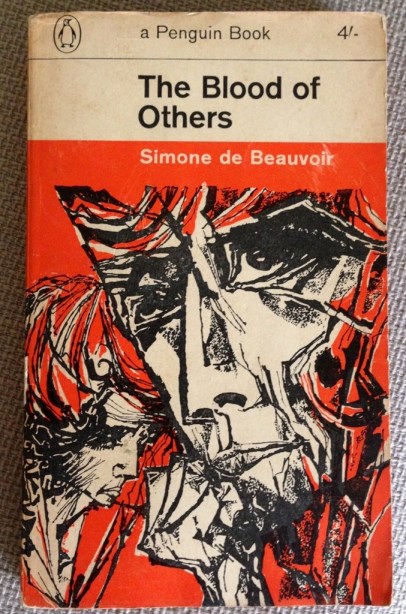
Simone de Beauvoir/Flann O’Brien (Books Acquired, 5.10.2013)

20130511-140615.jpg

I read Simone de Beauvoir’s The Blood of Others years ago in an undergraduate class called existential literature or something like that.

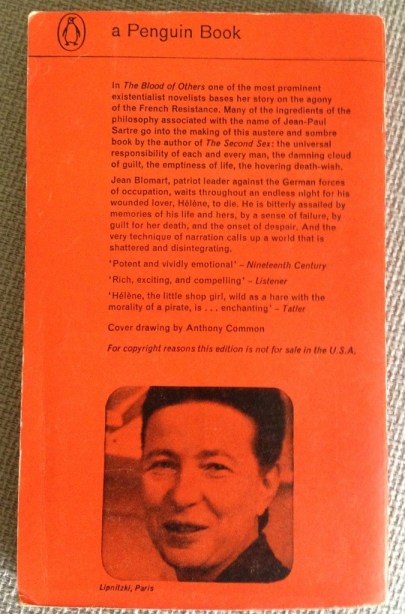
Had to have this Penguin edition. Here’s the back:

20130511-140620.jpg

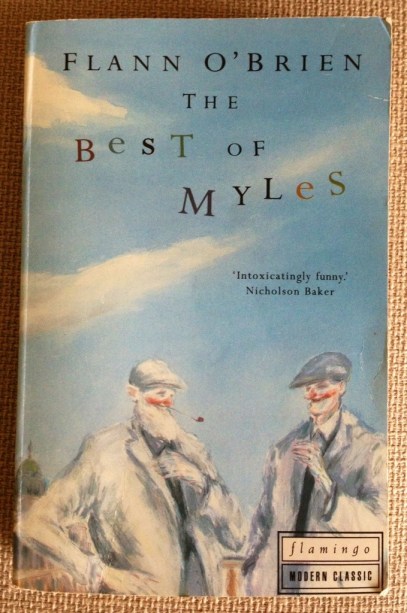
Flann O’Brien’s The Best of Myles collects material from his column Cruiskeen Lawn:

20130511-140625.jpg

Excerpt:

20130511-140645.jpg

“The Debt” — Edith Wharton

“The Debt” by Edith Wharton

I

YOU remember—it’s not so long ago—the talk there was about Dredge’s “Arrival of the Fittest”? The talk has subsided, but the book of course remains: stands up, in fact, as the tallest thing of its kind since—well, I’d almost said since “The Origin of Species.”

I’m not wrong, at any rate, in calling it the most important contribution yet made to the development of the Darwinian theory, or rather to the solution of the awkward problem about which that theory has had to make such a circuit. Dredge’s hypothesis will be contested, may one day be disproved; but at least it has swept out of the way all previous conjectures, including of course Lanfear’s magnificent attempt; and for our generation of scientific investigators it will serve as the first safe bridge across a murderous black whirlpool.

It’s all very interesting—there are few things more stirring to the imagination than that sudden projection of the new hypothesis, light as a cobweb and strong as steel, across the intellectual abyss; but, for an idle observer of human motives, the other, the personal, side of Dredge’s case is even more interesting and arresting.

Personal side? You didn’t know there was one? Pictured him simply as a thinking machine, a highly specialized instrument of precision, the result of a long series of “adaptations,” as his own jargon would put it? Well, I don’t wonder—if you’ve met him. He does give the impression of being something out of his own laboratory: a delicate scientific instrument that reveals wonders to the initiated, and is absolutely useless in an ordinary hand.

In his youth it was just the other way. I knew him twenty years ago, as an awkward lout whom young Archie Lanfear had picked up at college, and brought home for a visit. I happened to be staying at the Lanfears’ when the boys arrived, and I shall never forget Dredge’s first appearance on the scene. You know the Lanfears always lived very simply. That summer they had gone to Buzzard’s Bay, in order that Professor Lanfear might be near the Biological Station at Wood’s Holl, and they were picnicking in a kind of sketchy bungalow without any attempt at elegance. But Galen Dredge couldn’t have been more awe-struck if he’d been suddenly plunged into a Fifth Avenue ball-room. He nearly knocked his shock head against the low doorway, and in dodging this peril trod heavily on Mabel Lanfear’s foot, and became hopelessly entangled in her mother’s draperies—though how he managed it I never knew, for Mrs. Lanfear’s dowdy muslins ran to no excess of train.

When the Professor himself came in it was ten times worse, and I saw then that Dredge’s emotion was a tribute to the great man’s proximity. That made the boy interesting, and I began to watch. Archie, always enthusiastic but vague, had said: “Oh, he’s a tremendous chap—you’ll see—” but I hadn’t expected to see quite so clearly. Lanfear’s vision, of course, was sharper than mine; and the next morning he had carried Dredge off to the Biological Station. And that was the way it began.

Dredge is the son of a Baptist minister. He comes from East Lethe, New York State, and was working his way through college—waiting at White Mountain hotels in summer—when Archie Lanfear ran across him. There were eight children in the family, and the mother was an invalid. Dredge never had a penny from his father after he was fourteen; but his mother wanted him to be a scholar, and “kept at him,” as he put it, in the hope of his going back to “teach school” at East Lethe. He developed slowly, as the scientific mind generally does, and was still adrift about himself and his tendencies when Archie took him down to Buzzard’s Bay. But he had read Lanfear’s “Utility and Variation,” and had always been a patient and curious observer of nature. And his first meeting with Lanfear explained him to himself. It didn’t, however, enable him to explain himself to others, and for a long time he remained, to all but Lanfear, an object of incredulity and conjecture. Continue reading ““The Debt” — Edith Wharton”

Marlene Deller — Jack Bush

“Mothers” — William Gaddis

“Mothers” by William Gaddis

When Ralph Waldo Emerson informed—or rather, perhaps, warned us—that we are what our mothers made us, we might dismiss it as received opinion and let it go at that, like the broken clock which is right twice a day, like the self-evident answer contained in Freud’s oft-quoted query “What do women want?” when, as nature’s handmaid, she must want what nature wants which is, quite simply, More. But which woman? Whose mother, Emerson’s? A woman so in thrall to religion that we confront another dead end; or Freud’s? or even one’s own, even mine, offering an opportune bit of wisdom to those of us engaged in the creative arts, where paranoia is almost an occupational hazard: “Bill, just try to remember,” she said, “there is much more stupidity than there is malice in the world,” an observation lavish with possibilities recalling Anatole France finding the fool more dangerous than the rogue because “the rogue does at least take a rest sometimes, the fool never.”

This is hardly to see stupidity and malice as mutually exclusive: look at your morning paper, where their combined forces explode exponentially (women and children first) from Bosnia to Belfast, unlike the international “intelligence community” so self-contained in its malice-free exercises that it generally ensnares only its own dubious cast of players. Of further importance is the distinction between stupidity and ignorance, since ignorance is educable, while stupidity’s self-serving mission is the cultivation and exploitation of ignorance, as politicians are keenly aware.

How, then, might Emerson’s mother have seen herself stumbling upon Thomas Carlyle’s vision of her son as a “hoary-headed and toothless baboon”? Or Freud’s, in the gross unlikelihood of her reading the Catholic World’s review of her son’s book Moses and Monotheism as “poorly written, full of repetitions . . . and spoiled by the author’s atheistic bias and his flimsy psychoanalytic fancies”? Goethe’s Wilhelm Meister dismissed as “sheer nonsense” by the Edinburgh Review and, a good century later, the hero of Saul Bellow’s Dangling Man ridiculed as a “pharisaical stinker” in Time magazine, John Barth’s The End of the Road recommended by Kirkus Reviews “for those schooled in the waste matter of the body and the mind,” and William Faulkner’s Absalom, Absalom! shrugged off as the “final blowup of what was once a remarkable, if minor, talent” by The New Yorker magazine where, just forty years later, “a group of avant-garde critics has put forward the idea that books should be made unreadable. This movement has manifest advantages. Being unreadable, the text repels reviewers, critics, anthologists, academic literati, and other parasitical forms of life,” indicting the author of the novel J R wherein “to produce an unreadable text, to sustain this foxy purpose over 726 pages, demands rare powers. Mr. Gaddis has them.” “You’re a fool, a fool!” the distraught mother of Dostoevski’s ill-fated hero Nikolay Stavrogin cries out at the “parasitical forms of life” surrounding her. “You’re all ungrateful fools. Give me my umbrella!”

(“Mothers” is collected in The Rush to Second Place).

The Two Mothers — Dante Gabriel Rossetti

Patricio Pron Novel (Book Acquired, 5.08.2013)

pron

I got a review copy of My Father’s Ghost Is Climbing in the Rain, the first novel from Patricio Pron a few days ago and wandered into it a bit yesterday afternoon but then got distracted by something else. Anybody read this one—or anything by Pron? Curious what you think…

From a Granta interview:

Name the five writers you most admire at the moment (any period, language or genre).

David Foster Wallace, Vladimir Nabokov, Flannery O’Connor, W. G. Sebald, Roberto Bolaño.

Here is publisher Knopf’s blurb for My Father’s Ghost Is Climbing in the Rain:

The anticipated American debut of one of Granta’s Best Young Spanish-Language Novelists: a daring, deeply affecting novel about the secrets buried in the past of an Argentine family.

A young writer, living abroad, makes the journey home to South America to say good-bye to his dying father. In his parents’ house, he finds a cache of documents—articles, maps, photographs—and unwittingly begins to unearth his father’s obsession with the disappearance of a local man. Suddenly he comes face-to-face with the ghosts of Argentina’s dark political past and with the long-hidden memories of his family’s underground resistance against an oppressive military regime. As the fragments of the narrator’s investigation fall into place—revealing not only a part of his father’s life he had tried to forget but also the legacy of an entire generation—this audacious novel tells a completely original story of corruption and responsibility, history and remembrance.

You can also read “Ideas,” a story by Pron published in The Paris Review, which I think is an excerpt from the book. First paragraph:

On April 16, 1981, at approximately three P.M., little Peter Möhlendorf, whom everyone called der schwarze Peter, “black Peter,” went home from the village school. His house was on the eastern edge of Sterberode, a town of some five thousand inhabitants outside the East German town of Magdeburg whose main economic activity is farming—asparagus, mostly. His father, who was in the basement of the house when little Möhlendorf arrived, would later say that he heard him come in and then could infer from the sounds in the kitchen, which was above the basement, what he was doing: he flung his backpack beneath the staircase landing, went to the kitchen, took a carton of milk out of the refrigerator, and poured himself a glass, which he drank standing; then he put the carton back in the refrigerator and went out into the backyard. Anyway, that was what he did every day when he came home from school and it could be that his father hadn’t really heard the noises he later would say he heard but rather had heard Peter come home and from that had guessed the rest of the series of actions. However, what his father did not know, as he listened or thought he listened to the noises his son was making above his head, was that little Peter was not going to return home that night or the nights that would follow, and that something incomprehensible and frightening was going to open up before him and the rest of the townspeople, and it would swallow everything up.

Partial Cast List, Ulysses

(He hurries out through the hall. The whores point. Florry follows, spilling water from her tilted tumbler. On the doorstep all the whores clustered talk volubly, pointing to the right where the fog has cleared off. From the left arrives a jingling hackney car. It slows to in front of the house. Bloom at the halldoor perceives Corny Kelleher who is about to dismount from the car with two silent lechers. He averts his face. Bella from within the hall urges on her whores. They blow ickylickysticky yumyum kisses. Corny Kelleher replies with a ghastly lewd smile. The silent lechers turn to pay the jarvey. Zoe and Kitty still point right. Bloom, parting them swiftly, draws his caliph’s hood and poncho and hurries down the steps with sideways face. Incog Haroun al Raschid he flits behind the silent lechers and hastens on by the railings with fleet step of a pard strewing the drag behind him, torn envelopes drenched in aniseed. The ashplant marks his stride. A pack of bloodhounds, led by Hornblower of Trinity brandishing a dogwhip in tallyho cap and an old pair of grey trousers, follow from fir, picking up the scent, nearer, baying, panting, at fault, breaking away, throwing their tongues, biting his heels, leaping at his tail. He walks, runs, zigzags, gallops, lugs laid back. He is pelted with gravel, cabbagestumps, biscuitboxes, eggs, potatoes, dead codfish, woman’s slipperslappers. After him freshfound the hue and cry zigzag gallops in hot pursuit of follow my leader: 65 C, 66 C, night watch, John Henry Menton, Wisdom Hely, V. B. Dillon, Councillor Nannetti, Alexander Keyes, Larry O’rourke, Joe Cuffe Mrs O’dowd, Pisser Burke, The Nameless One, Mrs Riordan, The Citizen, Garryowen, Whodoyoucallhim, Strangeface, Fellowthatsolike, Sawhimbefore, Chapwithawen, Chris Callinan, Sir Charles Cameron, Benjamin Dollard, Lenehan, Bartell d’Arcy, Joe Hynes, red Murray, editor Brayden, T. M. Healy, Mr Justice Fitzgibbon, John Howard Parnell, the reverend Tinned Salmon, Professor Joly, Mrs Breen, Denis Breen, Theodore Purefoy, Mina Purefoy, the Westland Row postmistress, C. P. M’Coy, friend of Lyons, Hoppy Holohan, maninthestreet, othermaninthestreet, Footballboots, pugnosed driver, rich protestant lady, Davy Byrne, Mrs Ellen M’Guinness, Mrs Joe Gallaher, George Lidwell, Jimmy Henry on corns, Superintendent Laracy, Father Cowley, Crofton out of the Collector-general’s, Dan Dawson, dental surgeon Bloom with tweezers, Mrs Bob Doran, Mrs Kennefick, Mrs Wyse Nolan, John Wyse Nolan, handsomemarriedwomanrubbedagainstwide behindinClonskeatram, the bookseller of Sweets of Sin, Miss Dubedatandshedidbedad, Mesdames Gerald and Stanislaus Moran of Roebuck, the managing clerk of Drimmie’s, Wetherup, colonel Hayes, Mastiansky, Citron, Penrose, Aaron Figatner, Moses Herzog, Michael E Geraghty, Inspector Troy, Mrs Galbraith, the constable off Eccles Street corner, old doctor Brady with stethoscope, the mystery man on the beach, a retriever, Mrs Miriam Dandrade and all her lovers.)