I picked up Harry Crews’s novel The Knockout Artist, which I hadn’t read, after his recent death. I was not the only person to pick up Crews books: the Crews section of my favorite used bookstore, once swollen is now depleted (the omnibus and collections all snapped up).
William Gaddis’s last novel Agapē Agape was my occasion (as if I needed one) for visiting said store; I ordered it after finishing The Recognitions. I managed to bend the cover badly in the first five minutes of ownership. I started it over the weekend and then got distracted by a friend calling me to meet at a bar. I started it again last night and got about a third of the way in. Full review on the horizon.
I have no idea why I picked up Lish’s novel other than the fact that Lish is awesome; it’s a first edition paperback and the cover is awesome. Maybe that’s why. I have no idea when I’ll get around to reading it. Compulsive behaviors.
The Mutis novel, or collection of novellas, is half of the book that Dave Cianci aka Noquar reviewed on this blog a few months ago. I wanted the full version, which collects six novellas, but I’ll settle for this (it’s used; I have store credit, etc.). Anyway, Noquar’s review made me want to read it, so I’ve slated it for summer reading (May?).
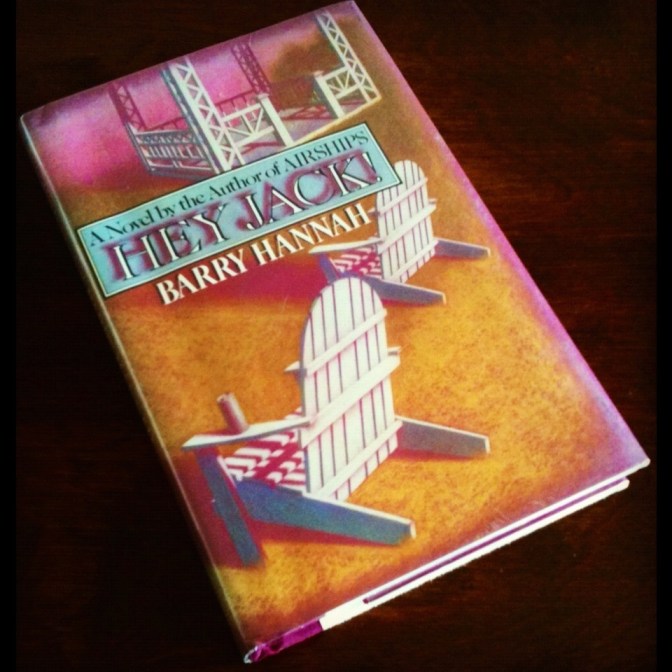
The loose, brief breeziness of Barry Hannah’s 1987 novella Hey Jack! belies the terror and rage at the heart of this hilarious tragedy. It’s a slim volume—133 pages in my hardback copy—with the same rambling flightiness that characterizes Hannah’s better known 1980 novel-in-vignettes, Ray.
Hey Jack! bears many comparisons with Ray: Like Ray, this novel is told from the perspective of a war vet (Korea this time, not ‘Nam); like the eponymous speaker of Ray, the narrator of Hey Jack!, Homer, finds himself frequently besotted, binged out, or horny; like Ray, Homer tries to make a marriage work; like Ray, Homer comes into conflict with a poor white trash family.
And like Ray, Hey Jack! tests the boundaries of what is and is not a “novel.” Hey Jack! is discontinuous and meandering; there’s a plot, sure, but Hannah’s apt to jump over place and time freely, tripping over months at a time, sparing not even a sentence to cue his readers in the right direction. No exposition here, folks. I suppose I should summarize the plot though: Homer, passing middle age, takes up a friendship with Jack, an older man, a former sheriff and fellow Korean War vet who runs a coffee shop popular with the college kids. Together, the pair (sort of) face off against Ronnie Foot, a local boy turned rock star who has the gall to begin an affair with Jack’s forty-year old daughter:
Ronnie Foot, the rock star had her. Or Jack thought he had her, he was sure he had her. Jack was mumbling. Jack was talking about ingratitude and pride and scum hanging on meat, things of that nature. It was astonishing to see him creep and rise suddenly, like a crazy old man. . . . “Nobody ever had a daughter like me. You want me to just her go, like a fart?” He was fingering the gun again.
Jack, once the lone bastion of sanity and order in Homer’s small, chaotic Mississippi town, begins to slide into the insanity and violence that marks the rest of the populace. Jack’s stability is the closest thing Hey Jack! offers as a slice of normalcy (to be clear though, Hannah’s characters skew grotesque, not quirky).
What unites the volume isn’t Jack’s slow slide to the dark side, but rather the narrative’s distinctive, ornery voice. It’s worth quoting Homer at length; here he condenses several of the novel’s themes in the sort of crazy-or-wise? rant indicative of the novella’s tone and rhythm:
In love, in love, in love. A mule can climb a tree if it’s in love. A man like me can look himself in the mirror and say, I’m all right, everything is beloved, I’m no stranger to anywhere any more. I’m a man full of life and a lot of time to kill, shoot every minute down with a straight blast of his eye across the bountiful landscape, from the minnow to the Alps. Something looks back at you with an eye of insane approval. Something looks back at you; out of belligerent ignorance of you it has come to a delighted focus on you and your love, together, sending up gasses of collision that make a rainbow over the poor masses who are changing a tire on the side of the road on a hot Saturday afternoon, felling like niggers. There is a law that every nigger spends a quarter of every weekend changing tires, my friend George, the biochemist, says. What do we know? What do we mere earthlings, unpublished and heaving out farts like puzzled sighs, know, but what is in our blood? I had broken up once with a woman who was in Europe, and coming out of the mall movie (I don’t even remember the movie) I gave out this private marvelous fart that was equal to a paragraph of Henry James, so churned were my guts and so lingering. And I was free. Free to discuss it. Delighted in the boundless ignorance and destruction that lay out there under the dumb lit cold moon. Enough about me and my poetry.
There’s so many shifts here. Hannah’s Homer comes off like a besotted barstool philosopher, gazing at his navel through an empty tumbler and finding both gut and abyss. We see the casual racism that so many of Hannah’s characters dip into; we see the conflation of art, spirit, and expulsion. Need I comment on the fart joke? It’s worth just repeating: “I gave out this private marvelous fart that was equal to a paragraph of Henry James” — if you don’t like that you’re not going to like Hey Jack!
Beyond that voice, there’s little to organize Hey Jack!—it’s a riff, sometimes a howl, often a jape, a joke, sometimes a verbal slap. This isn’t to say there isn’t a trajectory to the novella or a payoff at the end. Hannah seems unable to resist a tragic arc, the same one he pulls through the whiskey haze of Ray. Perhaps he takes his cues from Edgar Allan Poe’s essay “The Philosophy of Composition“: ” . . . the death, then, of a beautiful woman is, unquestionably, the most poetical topic in the world.” (To be fair Poe is hardly the first fella to find a dead beauty such a worthy topic; also, I’ve never really been sure how to measure the tone of his essay—I can’t help but think he’s being somehow simultaneously tongue-in-cheek and deadly earnest. But enough about Poe).
But arcs be damned. The best bits of Hey Jack! are the stray little paragraphs that erupt from nowhere either to fizzle out or burn up in a bang. At its best, the novella offers bizarre little stories piecemeal that read equally absurd and true. To wit:
I began hollering at my wife for her shortcomings. She left the house, 11 P.M. I’d quit drinking and smoking. She brought me back a bottle of rye and a pack of Luckies, too. I hadn’t smoked for two weeks. I must have been a horrible nuisance.
I took a drink and a smoke.
Then I was normal. My lungs and my liver cried out: At last, again! The old abuse! I am a confessed major organ beater. I should turn myself in on the hotline to normalcy.
I hope by now that you have a sense of whether or not Hey Jack! is for you. It’s probably not going to gel with most readers: Too ugly, too loose, too nihilistic, perhaps; at heart a sloppy affair . . . but I loved it—it was the perfect book to riffle through over a few Saturday or Sunday afternoons on my back porch, its pages blotting up the condensation from a glass of sangria or can of beer, Homer’s consciousness as loose and discontinuous as my own. Not the best starting place for those interested in Hannah—that might be Airships—but great stuff.
I began hollering at my wife for her shortcomings. She left the house, 11 P.M. I’d quit drinking and smoking. She brought me back a bottle of rye and a pack of Luckies, too. I hadn’t smoked for two weeks. I must have been a horrible nuisance.
I took a drink and a smoke.
Then I was normal. My lungs and my liver cried out: At last, again! The old abuse! I am a confessed major organ beater. I should turn myself in on the hotline to normalcy.
How many brothers, sisters, uncles, aunts, and cousins of all degrees a little story has! And how few of the tales we listen to can lay any claim to originality! There is scarcely a story which I hear which I cannot connect with some family of myths, and whose pedigree I cannot ascertain with more or less precision.
Shakespeare drew the plots of his plays from Boccaccio or Straparola; but these Italians did not invent the tales they lent to the English dramatist. King Lear does not originate with Geofry of Monmouth, but comes from early Indian stores of fable, whence also are derived the Merchant of Venice and the pound of flesh, ay, and the very incident of the three caskets. But who would credit it, were it not proved by conclusive facts, that Johnny Sands is the inheritance of the whole Aryan family of nations, and that Peeping Tom of Coventry peeped in India and on the Tartar steppes ages before Lady Godiva was born?
If you listen to Traviata at the opera, you have set before you a tale which has lasted for centuries, and which was perhaps born in India. If you read in classic fable of Orpheus charming woods and meadows, beasts and birds, with his magic lyre, you remember to have seen the same fable related in the Kalewala of the Finnish Wainomainen, and in the Kaleopoeg of the Esthonian Kalewa. If you take up English history, and read of William the Conqueror slipping as he landed on British soil, and kissing the earth, saying he had come to greet and claim his own, you remember that the same story is told of Napoleon in Egypt, of King Olaf Harold’s son in Norway, and in classic history of Junius Brutus on his return from the oracle . . .
From Sabine Baring-Gould’s indispensable work Curious Myths of the Middle Ages (1866).
153. A Good Book Needs Time. —Every good book tastes bitter when it first comes out, for it has the defect of newness. Moreover, it suffers damage from its living author, if he is well known and much talked about. For all the world is accustomed to confuse the author with his work. Whatever of profundity, sweetness, and brilliance the work may contain must be developed as the years go by, under the care of growing, then old, and lastly traditional reverence. Many hours must pass, many a spider must have woven its web about the book. A book is made better by good readers and clearer by good opponents.
—Friedrich Nietzsche, Human, All Too Human, Part II.
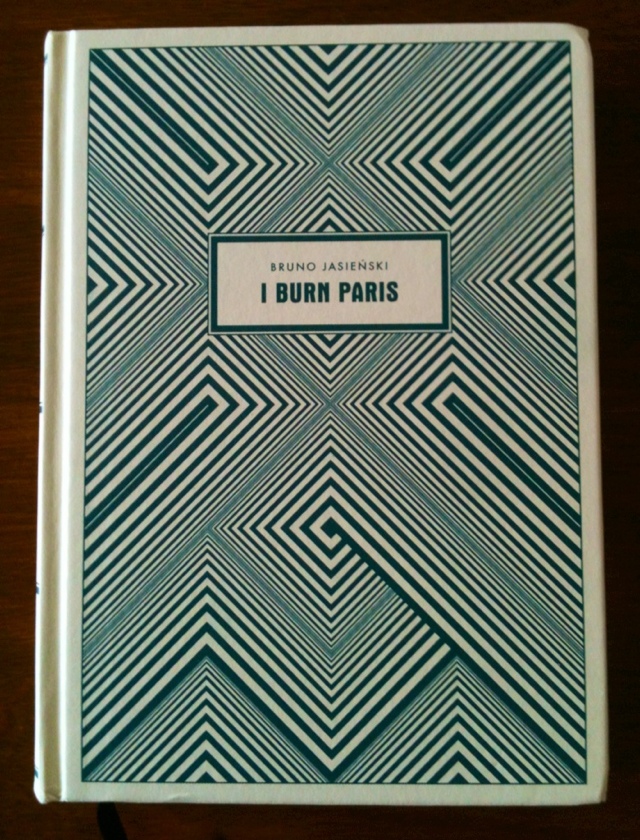
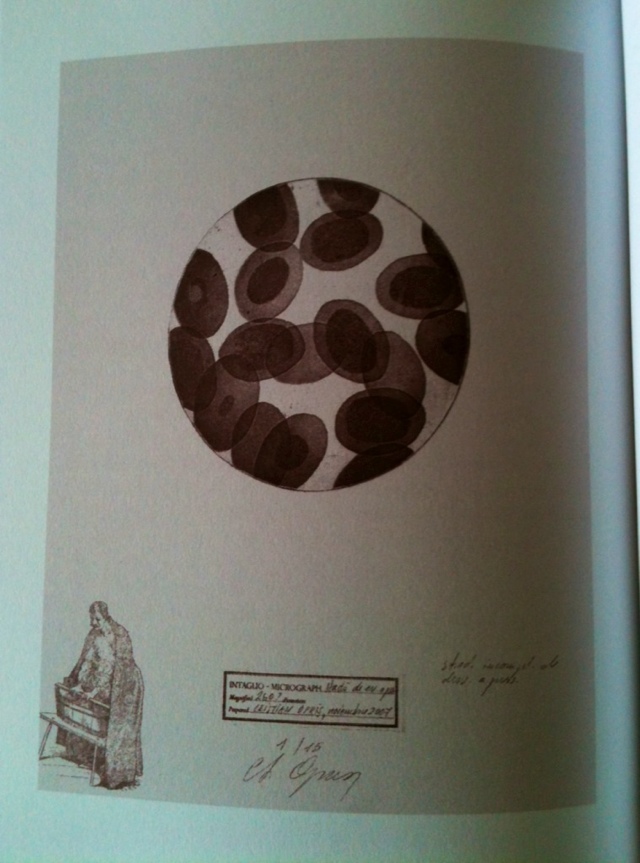
Bruno Jasieński was one of the leaders of the Polish Futurist movement, and his novel I Burn Paris looks fascinating. It’s also a beautiful looking book — publisher Twisted Spoon has done a lovely job here — an embossed hardback with no superfluous jacket, and even a nice lace bookmark (doesn’t show up in my photo). There are also illustrations by Cristian Opris.
I’m hoping to get into this this weekend, but for now, here’s publisher Twisted Spoon’s description:
I Burn Paris has remained one of Poland’s most uncomfortable masterstrokes of literature since its initial and controversial serialization by Henri Barbusse in 1928 inL’Humanité (for which Jasienski was deported for disseminating subversive literature). It tells the story of a disgruntled factory worker who, finding himself on the streets, takes the opportunity to poison Paris’s water supply. With the deaths piling up, we encounter Chinese communists, rabbis, disillusioned scientists, embittered Russian émigrés, French communards and royalists, American millionaires and a host of others as the city sections off into ethnic enclaves and everyone plots their route of escape. At the heart of the cosmopolitan city is a deep-rooted xenophobia and hatred — the one thread that binds all these groups together. As Paris is brought to ruin, Jasienski issues a rallying cry to the downtrodden of the world, mixing strains of “The Internationale” with a broadcast of popular music.
With its montage strategies reminiscent of early avant-garde cinema and fist-to-the-gut metaphors, I Burn Parishas lost none of its vitality and vigor. Ruthlessly dissecting various utopian fantasies, Jasienski is out to disorient, and he has a seemingly limitless ability to transform the Parisian landscape into the product of disease-addled minds. An exquisite example of literary Futurism and Catastrophism, the novel presents a filthy, degenerated world where factories and machines have replaced the human and economic relationships have turned just about everyone into a prostitute. Yet rather than cliché and simplistic propaganda, there is an immediacy to the writing, and the modern metropolis is starkly depicted as only superficially cosmopolitan, as hostile and animalistic at its core.
This English translation of I Burn Paris fills a major gap in the availability of works from the interwar Polish avant-garde, an artistic phenomenon receiving growing attention with recent publications such as Caviar and Ashes.
1st Gent. How class your man? – as better than the most,
Or, seeming better, worse beneath that cloak?
As saint or knave, pilgrim or hypocrite?
2nd Gent. Nay, tell me how you class your wealth of books
The drifted relics of all time.
As well sort them at once by size and livery:
Vellum, tall copies, and the common calf
Will hardly cover more diversity
Than all your labels cunningly devised
To class your unread authors.
—George Eliot, Middlemarch, epigraph to Chapter 13
Book shelves series #15, fifteenth Sunday of 2012
A new book-case this week; the shorter triplet of the twin ladders seen here. What do the volumes on this top shelf hold in common? They are hardback. That’s about it. Yes, I actually go through The Riverside Shakespeare every now and then, especially when sparking new ideas for class lectures. The Balthus memoir is pretty good. No, I never finished Godel, Escher, Bach. It’s not hardback, come to think of it. The Fallada books are good stuff. Will Dylan ever finish up the Chronicles? Probably not. Maybe so. Who knows? We all love Shel Silverstein, of course.
So the wife and I went to see The Hunger Games last night. By way of readerly context: she ate up the trilogy in a spare week; I listened to the first audiobook last summer, and wrote about it here, including these sentences which loosely sum up my feelings:
Look, I get that these books are for kids, and that they’re probably a sight better than Twilight, but sheesh, exposition exposition exposition. There’s nothing wrong with letting readers fill in the gaps (especially when your book is ripping off The Running Man + a dozen other books). Also, there’s a character in this book who I think is named after pita bread.
However, I was prepared to accept that the plot of The Hunger Games could make for a fine film—I mean, it’s basically “The Most Dangerous Game,” or Lord of the Flies, or The Running Man, or Logan’s Run or whatever—so I went with an open mind.
By way of context/citation, here’s a trailer that gives a fairly accurate visual sense of the film—up to a point (I will belabor that point momentarily):
Short review:
Plot—fine.
Dialogue—fine.
Pacing—not bad.
Acting—better than average, especially Jennifer Lawrence as lead Katniss. (Lawrence stars in a better film called Winter’s Bone, which is like the real hunger games, by the bye). Woody Harrelson brought more to his character, drunken mentor Haymitch, than Collins’s cardboard book allowed, so kudos, bro.
Music/score—surprisingly good and rarely overused. I think T-Bone Burnett supervised. Also, no forced obtrusive pop songs from the “soundtrack.”
Set design—fine, I guess, although who knew the dystopian future would look like Coal Miner’s Daughter (for the plebes) and future-Vegas/Logan’s Run (for the aristocrats). The scenes in the capital city will look incredibly dated in ten years, but whatever. The thunderdome itself where the kids fight it out was underdeveloped, but this had more to do with plotting and pacing. But hey, the movie was already almost two and a half hours long, which is long, so, fine, I guess.
Editing/camera work: Not fine. Horrible. I’m probably referring more to the director’s choices than to the acutal work of the DP and cinematographer here—I mean the lighting was good — what I’m talking about was the shoddiness of the framing of each shot, of the camera’s faux-unsteadiness, as if a shaky-cam in someway connotes realism or drama. The shaky cam connotes headache and nausea — especially when used so liberally. The camera seemed unable to ever simply rest on an image, particularly during the first 30 minutes. The shots—from bizarre and disparate angles—jump-cut around, refusing to actually show the audience the staging and action.
Particularly frustrating is an opening scene where Katniss hunts a deer in a lush green forest. There’s the potential here for an excellent introduction to the character—to her seriousness, her gravity, her skill, her keen attenuation to environment (all extremely relevant later, of course) — the camera could simply show the audience the hunt, linger a bit even — I’m not talking about Malickian nature-gazing, but simply taking the time to attune character to setting. Instead, the camera whips around frenetically with a nervous energy that seems to have nothing to do with Katniss’s calm, steady bowhand. It’s as if the director does not trust the audience to attend to a specific shot or angle for more than 2 seconds.
My frustration grew after this initial scene, as the director seemed determined to withhold any simple shot that would establish place or character. This frustration culminated in a climactic scene at the beginning of the Battle Royale—excuse me, Hunger Games tournament—where the contestants, admitted to the arena, either run for weapons or cover. There’s a bloodbath here, one that highlights the intense Darwinian stakes in play—only, again, we don’t really get to see it. The camera whirls around as if it were in the hands of someone’s dad at a birthday party, two beers in, as he tries to capture everything all at once on his cheap Sony — and therefore misses everything. Sure, the conceit might be that this shaky unsteady whirling is how Katniss experiences the scene, but the Hunger Games tourney is televised, so obviously we could see what the home audience could see, right? I’m not asking for gore or explicit violence here, to be clear: I simply don’t understand why the camera refused to show the basic action that was happening on the screen. Repeat this criticism for every single fight scene.
The clunky, clumsy fight scenes reminded me of Christopher Nolan’s shoddy work in the Batman films or even the sheer incomprehensibility of Michael Bay’sstuff : is this what audiences will accept? Are these what pass for action films? I’m not arguing that these Hollywood blockbusters need to adhere to the precision that we can find in Hong Kong martial arts films (or even Ang Lee’s arty take on such films, Crouching Tiger, Hidden Dragon)—but, c’mon, even the Jason Bourne movies and recent James Bond movies respected their audiences enough to adhere to a modicum of verisimilitude.
Verdict: The Hunger Games, like any dystopia, succeeds or fails by how well it synthesizes—and then surpasses—its myriad sources. The film, in this case, is simply okay. Dystopia has so assimilated our culture’s collective imagination (from the aforementioned Batman films to political ads to the wild financial success of Collins’s HG trilogy) that its tropes are overly-familiar, to the point that they have become comfortable, well-worn. A more successful dystopian vision—let’s take Cormac McCarthy’s The Road or Alfonso Cuarón’s film Children of Men or Margaret Atwood’s Year of the Flood as ready recent examples—offers familiarity with one hand and utter strangeness with the other. Successful dystopian visions are strange, disruptive, and uncanny—they allow us to project ourselves into worlds we pray are impossible. The Hunger Games feels, dare I say, dull, predictable, and somehow awfully normal. Catch it on cable in two years.
A passage Sir James George Frazer’s The Golden Bough:
The Easter Fires
ANOTHER occasion on which these fire-festivals are held is Easter Eve, the Saturday before Easter Sunday. On that day it has been customary in Catholic countries to extinguish all the lights in the churches, and then to make a new fire, sometimes with flint and steel, sometimes with a burning-glass. At this fire is lit the great Paschal or Easter candle, which is then used to rekindle all the extinguished lights in the church. In many parts of Germany a bonfire is also kindled, by means of the new fire, on some open space near the church. It is consecrated, and the people bring sticks of oak, walnut, and beech, which they char in the fire, and then take home with them. Some of these charred sticks are thereupon burned at home in a newly-kindled fire, with a prayer that God will preserve the homestead from fire, lightning, and hail. Thus every house receives “new fire.” Some of the sticks are kept throughout the year and laid on the hearth-fire during heavy thunder-storms to prevent the house from being struck by lightning, or they are inserted in the roof with the like intention. Others are placed in the fields, gardens, and meadows, with a prayer that God will keep them from blight and hail. Such fields and gardens are thought to thrive more than others; the corn and the plants that grow in them are not beaten down by hail, nor devoured by mice, vermin, and beetles; no witch harms them, and the ears of corn stand close and full. The charred sticks are also applied to the plough. The ashes of the Easter bonfire, together with the ashes of the consecrated palm-branches, are mixed with the seed at sowing. A wooden figure called Judas is sometimes burned in the consecrated bonfire, and even where this custom has been abolished the bonfire itself in some places goes by the name of “the burning of Judas.” The essentially pagan character of the Easter fire festival appears plainly both from the mode in which it is celebrated by the peasants and from the superstitious beliefs which they associate with it. All over Northern and Central Germany, from Altmark and Anhalt on the east, through Brunswick, Hanover, Oldenburg, the Harz district, and Hesse to Westphalia the Easter bonfires still blaze simultaneously on the hill-tops. As many as forty may sometimes be counted within sight at once. Long before Easter the young people have been busy collecting firewood; every farmer contributes, and tar-barrels, petroleum cases, and so forth go to swell the pile. Neighbouring villages vie with each other as to which shall send up the greatest blaze. The fires are always kindled, year after year, on the same hill, which accordingly often takes the name of Easter Mountain. It is a fine spectacle to watch from some eminence the bonfires flaring up one after another on the neighbouring heights. As far as their light reaches, so far, in the belief of the peasants, the fields will be fruitful, and the houses on which they shine will be safe from conflagration or sickness.
At Volkmarsen and other places in Hesse the people used to observe which way the wind blew the flames, and then they sowed flax seed in that direction, confident that it would grow well. Brands taken from the bonfires preserve houses from being struck by lightning; and the ashes increase the fertility of the fields, protect them from mice, and mixed with the drinking-water of cattle make the animals thrive and ensure them against plague. As the flames die down, young and old leap over them, and cattle are sometimes driven through the smouldering embers. In some places tar-barrels or wheels wrapt in straw used to be set on fire, and then sent rolling down the hillside. In others the boys light torches and wisps of straw at the bonfires and rush about brandishing them in their hands. In Munsterland these Easter fires are always kindled upon certain definite hills, which are hence known as Easter or Paschal Mountains. The whole community assembles about the fire. The young men and maidens, singing Easter hymns, march round and round the fire, till the blaze dies down. Then the girls jump over the fire in a line, one after the other, each supported by two young men who hold her hands and run beside her. In the twilight boys with blazing bundles of straw run over the fields to make them fruitful.
At Delmenhorst, in Oldenburg, it used to be the custom to cut down two trees, plant them in the ground side by side, and pile twelve tar-barrels against each. Brush-wood was then heaped about the trees, and on the evening of Easter Saturday the boys, after rushing about with blazing bean-poles in their hands, set fire to the whole. At the end of the ceremony the urchins tried to blacken each other and the clothes of grown-up people. In the Altmark it is believed that as far as the blaze of the Easter bonfire is visible, the corn will grow well throughout the year, and no conflagration will break out. At Braunrude, in the Harz Mountains, it was the custom to burn squirrels in the Easter bonfire. In the Altmark, bones were burned in it. Near Forchheim, in Upper Franken, a straw-man called the Judas used to be burned in the churchyards on Easter Saturday. The whole village contributed wood to the pyre on which he perished, and the charred sticks were afterwards kept and planted in the fields on Walpurgis Day (the first of May) to preserve the wheat from blight and mildew. About a hundred years ago or more the custom at Althenneberg, in Upper Bavaria, used to be as follows. On the afternoon of Easter Saturday the lads collected wood, which they piled in a cornfield, while in the middle of the pile they set up a tall wooden cross all swathed in straw. After the evening service they lighted their lanterns at the consecrated candle in the church, and ran with them at full speed to the pyre, each striving to get there first. The first to arrive set fire to the heap. No woman or girl might come near the bonfire, but they were allowed to watch it from a distance. As the flames rose the men and lads rejoiced and made merry, shouting, “We are burning the Judas!” The man who had been the first to reach the pyre and to kindle it was rewarded on Easter Sunday by the women, who gave him coloured eggs at the church door. The object of the whole ceremony was to keep off the hail.
At other villages of Upper Bavaria the ceremony, which took place between nine and ten at night on Easter Saturday, was called “burning the Easter Man.” On a height about mile from the village the young fellows set up a tall cross enveloped in straw, so that it looked like a man with his arms stretched out. This was the Easter Man. No lad under eighteen years of age might take part in the ceremony. One of the young men stationed himself beside the Easter Man, holding in his hand a consecrated taper which he had brought from the church and lighted. The rest stood at equal intervals in a great circle round the cross. At a given signal they raced thrice round the circle, and then at a second signal ran straight at the cross and at the lad with the lighted taper beside it; the one who reached the goal first had the right of setting fire to the Easter Man. Great was the jubilation while he was burning. When he had been consumed in the flames, three lads were chosen from among the rest, and each of the three drew a circle on the ground with a stick thrice round the ashes. Then they all left the spot. On Easter Monday the villagers gathered the ashes and strewed them on their fields; also they planted in the fields palmbranches which had been consecrated on Palm Sunday, and sticks which had been charred and hallowed on Good Friday, all for the purpose of protecting their fields against showers of hail. In some parts of Swabia the Easter fires might not be kindled with iron or steel or flint, but only by the friction of wood. The custom of the Easter fires appears to have prevailed all over Central and Western Germany from north to south. We find it also in Holland, where the fires were kindled on the highest eminences, and the people danced round them and leaped through the flames or over the glowing embers. Here too, as often in Germany, the materials for the bonfire were collected by the young folk from door to door. In many parts of Sweden firearms are discharged in all directions on Easter Eve, and huge bonfires are lighted on hills and eminences. Some people think that the intention is to keep off the Troll and other evil spirits.
From Thomas Firminger Thiselton-Dyer’s indispensable volume Folk-lore in Shakespeare:
Easter. According to a popular superstition, it is considered unlucky to omit wearing new clothes on Easter Day, to which Shakespeare no doubt alludes in “Romeo and Juliet” (iii. 1), when he makes Mercutio ask Benvolio whether he did “not fall out with a tailor for wearing his new doublet before Easter.” In East Yorkshire, on Easter Eve, young folks go to the nearest market-town to buy some new article of dress or personal adornment to wear for the first time on Easter Day, as otherwise they believe that birds—notably rooks or “crakes”—will spoil their clothes. In “Poor Robin’s Almanac” we are told: “At Easter let your clothes be new, Or else be sure you will it rue.” Some think that the custom of “clacking” at Easter—which is not quite obsolete in some counties—is incidentally alluded to in “Measure for Measure” (iii. 2) by Lucio: “his use was, to put a ducat in her clack-dish.” [649] The clack or clap dish was a wooden dish with a movable cover, formerly carried by beggars, which they clacked and clattered to show that it was empty. In this they received the alms. Lepers and other paupers deemed infectious originally used it, that the sound might give warning not to approach too near, and alms be given without touching the person. A popular name for Easter Monday was Black Monday, so called, says Stow, because “in the 34th of Edward III. (1360), the 14th of April, and the morrow after Easter Day, King Edward, with his host, lay before the city of Paris; which day was full dark of mist and hail, and so bitter cold, that many men died on their horses’ backs with the cold. Wherefore unto this day it hath been call’d the Blacke Monday.” Thus, in the “Merchant of Venice” (ii. 5), Launcelot says, “it was not for nothing that my nose fell a-bleeding on Black Monday last at six o’clock i’ the morning.”
It’s 1972 and I can see V.S. Naipaul strolling through the streets of Buenos Aires. Well, sometimes he’s strolling, but sometimes, when he’s on his way to meetings or keeping appointments, his gait is quick and his eyes take in only what he needs to see in order to reach his destination with a minimum of bother, whether it’s a private dwelling or, more often, a restaurant or a café, since many of those who’ve agreed to meet him have chosen a public place, as if they were intimidated by this peculiar Englishman, or as if they’d been disconcerted by the author of Miguel Street and A House for Mr. Biswas when they met him in the flesh and had thought: Well, I didn’t think it would be like this, or: This isn’t the man I’d imagined, or: Nobody told me.
So there he is, Naipaul, and it seems that all he can notice are outward movements, but in fact he’s noticing inward movements too, although he interprets them in his own way, sometimes arbitrarily, and he’s moving through Buenos Aires in the year 1972 and writing as he moves or perhaps only wanting to write as his legs move through that strange city, and he’s still young, forty years old, but he already has a considerable body of work behind him, a body of work that doesn’t weigh him down or prevent him from moving briskly through Buenos Aires when he has an appointment to keep—the weight of the work, that’s something to which we shall have to return, the weight and the pride that he takes in his work, the weight and the responsibility, which don’t prevent his legs from moving nimbly or his hand from rising to hail a taxi, as he acts in character, like the man he is, a man who keeps his appointments punctually—but he is weighed down by the work when he goes strolling through Buenos Aires without appointments to exercise his British punctuality, without any pressing obligations, just walking along those strange avenues and streets, through that city in the southern hemisphere, so like the cities of the northern hemisphere, and yet nothing like them at all, a hole, a void that someone has suddenly inflated, a show that is strictly for local consumption; that’s when he feels the weight of the work, and it’s tiring to carry that weight as he walks, it exhausts him, it’s irritating and shameful.
Read the rest of the essay at NRYB. From The Secret of Evil by Roberto Bolaño, translated by Chris Andrews, new from New Directions this month.


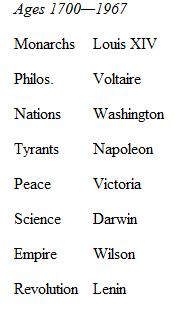 From F. Scott Fitzgerald’s Notebooks.


 Biblioklept