
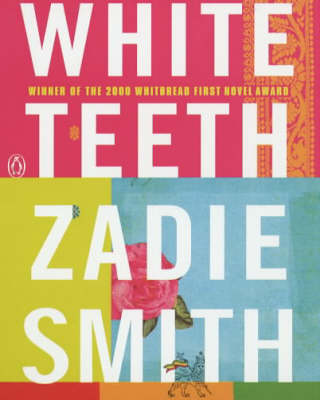
And so well with the help of Jenny Sterlin’s narration and my handy-dandy portable mp3-playing device, I finally made it through Zadie Smith‘s 2000 novel White Teeth, and, having digested all of it, am now fit to declare it hilarious in places, larded with moments of intensely brilliant prose, wildly ambitious, and ultimately hollow, overstuffed with flat characters who, despite Smith’s best efforts, do not manage to earn the Big Important Climax she shoves them toward. Smith succeeds in communicating the multicultural problematics of late-twentieth-century London, but her massive scope (the audiobook is 23 hours and my unfinished paperback runs to nearly 500 pages) is just too massive. Smith seems to think that loads of concrete detail will automatically conjure emotional force, but what we get instead verges on soap opera at times–more bathos than pathos.It doesn’t help reader expectations of course that White Teeth was wildly overpraised after its debut. While White Teeth‘s attempt to reconcile the personal traumas of a postcolonial world with the demands of family, tradition, and personal worth is admirable, its aim exceeds its grasp, and the end disappoints. Still, I enjoyed it as an audiobook–Jenny Sterlin mugs enthusiastically through the various accents and argots of a melting pot London, and Smith’s concrete emphasis on detail makes it an ideal listen for a few summer afternoons of gardening or housework. Not the Great Book we’ve been told it is, but a fine listen nonetheless.
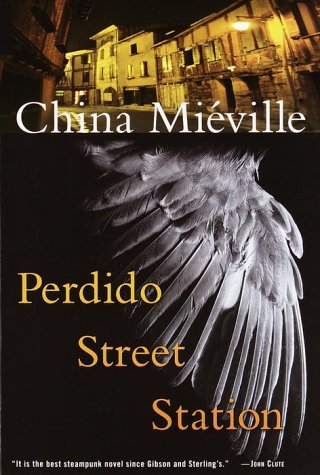
Summer is, of course, a great time for audiobooks, and I’m thrilled that China Miéville‘s breakthrough second novel Perdido Street Station is finally available on mp3. I’ve been wanting to read Miéville for quite some time now, but the length of his dystopian tomes has made it difficult until now (I am a very busy, important man, with busy, important things to do). Perdido Street Station, set in a bizarre, gross world of humans, Re-mades, and other sundry races, is weird fiction at its finest (so far)–a great hybrid of Charles Dickens and PK Dick, HP Lovecraft and JG Ballard. It trawls the line between real and surreal, art and science, grime and enlightenment, in lovely, if dense prose, that could never be mistaken as genre fiction. Great stuff, so far.
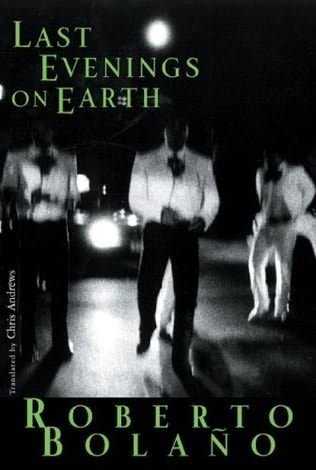
Also great stuff, so far, is Roberto Bolaño‘s collection of short stories, Last Evenings on Earth. I read the first three tales in succession last night, unable to put the book down although it was well-past my well-established “you must go to bed now or your toddler daughter will wreak havoc on you in the AM” bedtime. The first three stories are about, get this, (big surprise if you’ve read Bolaño), writers–good, bad, indifferent writers, failed, semi-failed, miserable writers. Sad writers, mad writers. The opener “Sensini” tells the story of an epistolary relationship between a young writer and an aging, uncelebrated writer. It’s sad yet measured in its pathos, and it earns its happy ending by loading that ending with the seed of potential disaster. The next story, “Henri Simon Leprince,” is the hilarious (and sad) tale of a miserable writer, a hack who teams up with the Resistance in WWII France. Despite his best intentions, he’s roundly despised by all those he helps. And he’s a terrible writer. The third story, “Enrique Martín,” literally made me laugh out loud, several times, to the point of tears. Narrated by Arturo Belano, Bolaño’s literary stand-in, it tells the desperate story of the titular failed poet, a would-be artist and sometime UFO hunter who slowly watches his dreams disintegrate.
All of Bolaño’s stories so far have extended past the mad force of his own strong voice(s) and implanted themselves into my mind, reaching into my own past; his characters, in hashing out their strange young lives (from a bit of distance, now) repeatedly evoked my own youthful memories, stuff I hadn’t thought about in years. There’s a sad brilliance under all of Bolaño’s stuff, like bright noon sun perceived through an ambiguous tear resting on your eye. Reading the beginning of Last Evenings on Earth last night, it occurred to me for the first time that Bolaño had died, and he’d died really young, and there weren’t going to be anymore books from him. But that’s a bummer note to end on. Let’s leave it at this–Last Evenings on Earth is some seriously great stuff.

 Okrent, after explaining her fascination with invented languages, or “conlangs,” more or less uses Wilkins as a starting place, using his massive project as a measuring stick for all the invented languages that followed it. While detailing the history and implementation of Esperanto, Charles Bliss’s language of symbols, and the logical logjammin’ of Lojban, Okrent balances the erudition of complex linguistics with a humorous, human tone. In the Land of Invented Languages is filled with tree diagrams and symbol charts that will not be wholly unfamiliar to those who studied a little linguistics back in college (or even those who, like the Biblioklept, changed their major from linguistics to English when they discovered they’d have to take, gasp!, statistics). These visuals are both fun and stimulating, and help to explicate what can be pretty heady stuff at times.
 We’re big advocates of audiobooks here at Biblioklept. A good audiobook helps the most mundane of chores zip by, making you a more educated, conscientious, and cultured person in the process (probably). Audiobooks are also essential to any road trip, and the good folks at Random House’s Listening Library labs have a new contest to help encourage parents and their kids to listen to audiobooks this summer. The contest, open to teens ages 13 to 18, is to create a video that addresses the following prompt: “If you could go on a road trip with a character from your favorite audio series, where would you go? What would you do along the way? How would you travel?” The winner will get an 8GB iPod Touch, as well as signed copies of audiobooks by the contest judges authors Libba Bray, Tamora Pierce, and Rick Riordan, all accomplished writers of young adult fantasy series. Get full details of the contest at
 More
More 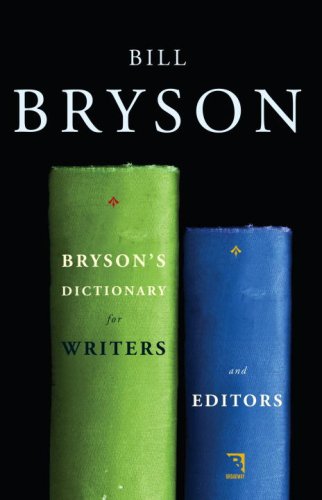 Bryson’s title here is pretty honest; he’s made a dictionary of hard-to-remember/easy-to-forget words, including plenty of commonly misspelled words. In the age of spell-check, it’s not so much Bryson’s spellings that are essential as it is the context in which he puts his words. For instance, do you know the difference between “gabardine” and “gaberdine”? (“The first is a type of worsted cloth, the second a long cloak”). Bryson goes further (not farther!) than mere distinctions between words like “creole” and “pidgin” or “bravado” and “bravery”: he actually gets into the fray of how one ought to use words. Consider the entry on “past”:

 Nice gear shift…
 Love the enthusiasm there…




 Biblioklept