Mass-market Monday | Angela Carter’s Heroes and Villains

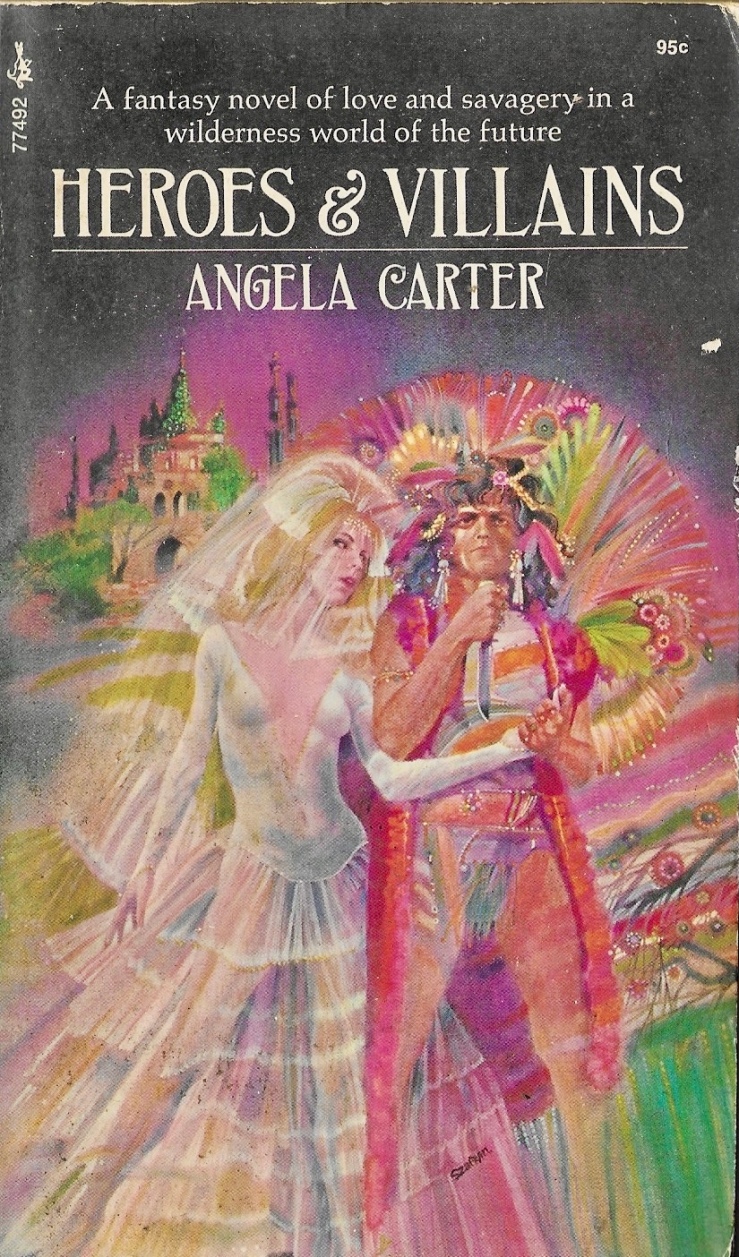
Heroes and Villains, Angela Carver. Pocket Books Edition (1972). No cover artist credited. 176 pages.

While no cover designer or artist for this edition of Angela Carter’s 1969 novel Heroes and Villains, I’m pretty certain that the work is by Gene Szafran.

I wrote briefly on the novel in 2020:

One of Carter’s earlier novels, Heroes and Villains takes place in a post-apocalyptic world where caste lines divide the Professors, the Barbarians, and the mutant Out People. After her Professor stronghold is raided, Marianne is…willingly abducted?…by the barbarian Jewel. Marianne goes to live with the Barbarians, and ends up in a weird toxic relationship with Jewel, marked by rape and violence. Heroes and Villains throws a lot in its pot—what is consent? what is civilization? what is language?—but it’s a muddled, psychedelic mess in the end.

We have the right to convey the fictive of any reality at all | Gil Orlovitz

We have the right to convey the fictive of any reality at all–and there is nothing that is not real—by any method we wish, and to have as our goal, if we so opt, only that we maintain the reader’s tension, the solitary indication, itself mercurial, of a work-of-art event.

Syntax being nothing more nor less than the codification of selected usages, we may alter syntax or reject it wholly.

We may compose the fictive in such a manner that the result is ambiguous, baffling and sometimes altogether impossible significantly to paraphrase-but so long as the piece seizes and holds the reader, a basic meaning, impossible to state in language as we know it, has been established, a meaning that belongs to a time series of seizing-and-holding.

The notion, we submit, of clarity, remains simply a notion, real enough, of course, under whatever category it is sub-sumed, but of no universal vigor, necessarily, nor marked by socalled objective truth; clarity is a notion identifying a particular social agreement in a one-to-one sense as to what construct evokes similarity of analysis.

Empirically all that is demonstrable is that we experience as creator or audience a series of perceptions. Now, if we set forth that demonstration in the fictive in such a fashion as to generate and sustain tension in the reader whether or not he is mystified by the significs, we have met the sole possible criterion.

We are not of course here in any way concerned with the alleged scalar values of a given fiction-the notion of value belongs to ad hominen pleaders usually involved in depressing or elevating a status for economic reasons—just as we cannot in any way be concerned with the alleged scalar values of the given reader. Fiction and reader are conjoined, and may not with any sense be disjunct if we are trying to penetrate the nature of the esthetic.

Such being the case, I believe we can with some innocence look at the choices of the contemporary avant-garde herein, and digest them according to our lights or chiaroscuras.

We need remember only how much more we usually discern if we take the trouble, to begin with, to clean our own canvasses-within reason.

—Gil Orlovitz


Gil Orlovitz’s introduction to The Award Avant-Garde Reader (1965).

Mass-market Monday | Robert Coover’s The Public Burning

The Public Burning, Robert Coover. Banatm Books Edition (1978). No cover designer credited. 661 pages.

A 1977 Book Ends column in The New York Times offers a fairly succinct blurb for The Public Burning:

The Public Burning is a blend of fact and fantasy, using dozens of real and fictional names. Among the real persons named in this “metafiction” are President Eisenhower, Senator Joseph McCarthy, J. Edgar Hoover, Billy Graham, Norman Vincent Peale, Edward Teller, Walt Disney, Cecil B. DeMille, former prosecuting attorney Irving Saypol and Judge Irving Kaufman. About one‐half of the novel narrated by Vice President Richard M. Nixon…

The Book Ends piece, which appeared a few months before the book’s publication (and notes the difficulties the book found securing a publisher brave enough to put it out), includes a brief interview with Coover about The Public Burning:

“I had the idea for the book 11 years ago. I thought it would be a novella and not a book of over 500 pages. I felt that the event was something that had been repressed. If you mentioned the Rosenberg case, people were turned off or young persons didn’t know what it had been all about.

“Their execution — plus the prevalence of old‐fashioned American hoopla—gave me the central metaphor for the book. In 1968, I was looking for a narrator. After Nixon was elected President, he served that purpose. He had been a participant in the background of the Rosenberg case. As President, he was powerful, pious and pompous. I needed a clown act to intersperse with the circus act. And so Nixon became the clown. Clowns are sympathetic when you get to know them.”

The Public Burning was the first book I read by Coover, and I read it when I was too young to fully appreciate it; I think I simply wasn’t soaked enough in its history. Revisiting it, even in brief today, reminded me that it’s likely as relevant as ever, and that its diagnoses of the first half of America’s twentieth century is up there with Gravity’s Rainbow or J. R.

Man is doomed to constantly fabricate new agonies for himself | On Dino Buzzati’s novella The Singularity

Two years after it was first published in Italy, Dino Buzzati’s 1960 novella Il grande ritratto got its first English translation by Henry Reed under the title Larger Than Life. This year, NRYB issued a new translation of Il grande ritratto by Anne Milano Appel under the title The Singularity. This is the second new English translation of a Buzzati book from NYRB; last year saw the publication of Lawrence Venuti’s translation of Buzzati’s most famous novel, Il deserto dei Tartari, published as The Stronghold (in lieu of the more recognizable title The Tartar Steppe).

It makes sense, from both a cultural and a marketing stance, that Il grande ritratto would find new life as The Singularity, a term that refers to the hypothetical point where artificial intelligence surpasses human intelligence, which in turn triggers a dramatic existential change for humanity. AI slop abounds on the internet; misinformation replicates and mutates; we are told that the chatbots that frustrate us so frequently are an inevitable part of a future that no one seems to want. A sci-fi novel called The Singularity is pretty zeitgeisty.

The scant plot of The Singularity builds to the revelation of an artificial intelligence, part of a military science project perched high in the Italian Alps. I don’t think I’ve necessarily spoiled the grand reveal; both its title and its publisher’s blurb declare The Singularity “a startlingly prescient parable of artificial intelligence.”

Perhaps it’s this prescience that makes the central sci-fi conceit of The Singularity seem a bit dated. There’s a creakiness to Buzzati’s staging of his grand portrait of an artificial intelligence. The novella is more compelling in its initial chapters, which ignite a mood of slow-burning dread, the kind of Kafkaesque foreboding he served up in his superior novel Il deserto dei Tartari.

That slow-burn starts with a certain Professor Ismani, “who had always had an inferiority complex with respect to figures.” He and his much younger wife, the archetypal innocent Elisa (who “had not gone beyond middle school”) agree to undertake a mysterious journey up the mountain to “Experimental Camp of Military Zone 36,” where Ismani will join a scientific project he knows nothing about. As they zig and zag up the mountain, chauffeured by their military liaison, Ismani and Elisa (and the reader) gather crumbs about their destination. “So many mysteries,” a soldier tells them, at a penultimate stop. “If they at least told us what it is we’re guarding. I mean, let’s call it what it is, a kind of prison.”

In response to all this anxious foreboding, we are told that “Ismani felt the return of apprehension and dismay, the feeling of being insignificant in the face of immense, threatening things, a panic that he had once experienced in the war.” None of Ismani’s time in the war comes to bear on the narrative itself. Indeed, Ismani is thrown to the reader as a decoy; initially presented to the audience as the potential big-brain hero of a sci-fi thriller, he ends up a background ghost.

We eventually achieve the summit, where the natural splendor is overrun by the enormous complex that houses the titular singularity:

But the cliffs were no longer visible, nor could any vegetation be seen, or land, or flowing waters. Everything had been invaded and overwhelmed by a tangled succession of buildings similar to silos, towers, mastabas, retaining walls, slender bridges, barbicans, fortifications, blockhouses, and bastions, which plunged in dizzying geometries. As though a city had crashed down the sides of a ravine.

But there was an exceedingly abnormal element that gave those structures an air of enigma. There were no windows. Everything seemed hermetically sealed and blank.

From this moment, more or less, the best bits of The Singularity come not from sci-fi plotting but rather philosophical asides that add weight to the pulp narrative. Most of these are delivered by the handful of scientists who haunt the experimental camp. One of these scientists repeats the mantra, “Language is the worst enemy of mental clarity.” In their attempt to author an artificial consciousness, these scientists decreed that their singularity would have “No language,” for “Every language is a trap for the mind.”

Here in their “little kingdom, hermetically closed off and apart from the rest of the world,” the scientists have created a “machine made in our likeness” which “will read our thoughts, create masterpieces, reveal the most hidden mysteries.” Through hints, intimations, weird noises, and other creaky trappings of pulp horror, we come to learn that the singularity might not be, like, sane. As one of our (maybe not like exactly sane either) scientists declares, “before we knew it we had lost the reins, and all that was left for us to do was to record the machine’s behavior.”

In a move that would surprise no one familiar with the tropes of Gothic romance, we come to learn that the singularity’s consciousness is based on a beautiful dead woman. The whole operation is powered by a mysterious glowing egg. Indeed, The Singularity is perhaps most interesting if approached through a feminist lens. As it rushes to its climax, Elisa the innocent takes over the role of hero. She somehow learns to speak the strange “language” of the pre-lingual singularity, and through conversation, comes to understand that the singularity views herself as a desiring machine. The singularity wants a body; specifically a female body; specifically a body that can be desired by a male body and bear offspring.

Ultimately, The Singularity feels less like a novella than it does a short story stretched a bit too thin. Buzzati adroitly crafts an atmosphere of suspense and foreboding, but the characters are underdeveloped. Like a lot of pulp fiction, Buzzati’s book often reads as if it were written very quickly (and written expressly for money). Still, Buzzati’s intellect gives the book a philosophical heft, even if it sometimes comes through awkwardly in forced dialogue. Anne Milano Appel’s translation is smooth and nimble; it’s a page turner, for sure, and if it seems like I’ve been a bit rough on it in this paragraph in particular, I should be clear: I enjoyed The Singularity.

Like many of the modernist writers of the twentieth century, Buzzati intuited a future in which technology would become increasingly self-propelled, mutating unchecked in the notion of a progress wholly divorced from the needs of the human spirit. In our own era, we see con artists and hucksters banging the drum for “artificial intelligences” to “read our thoughts, create masterpieces, reveal the most hidden mysteries” for us. The results have been utter shit. Buzzati’s mad scientist isn’t so much prescient as he is simply describing the human condition then, when he declares that “man is doomed to torment himself, he doesn’t see the consolations offered to him, right there, within reach, he has to constantly fabricate new agonies for himself.” We can fabricate the agonies, but we can fight them too.

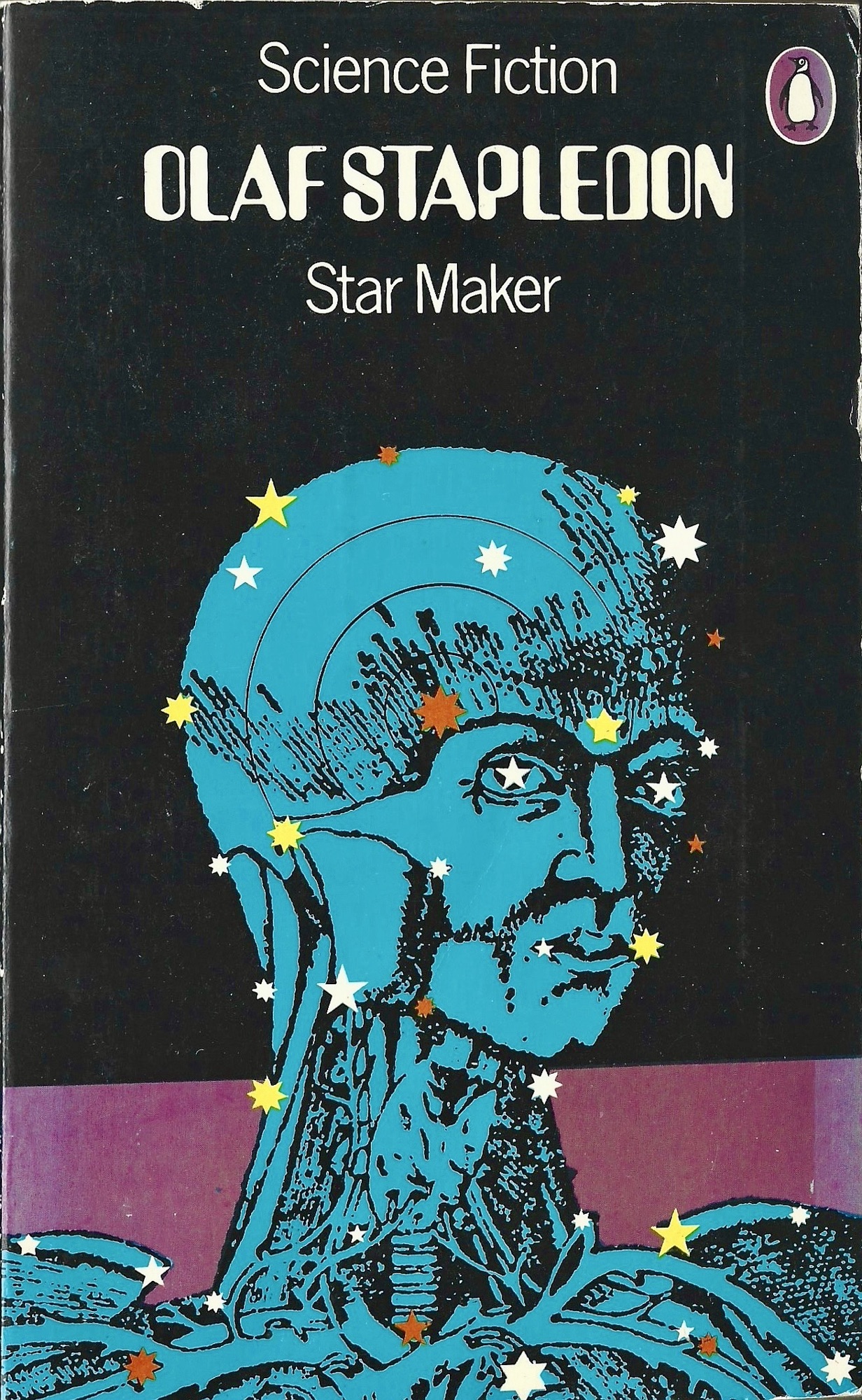
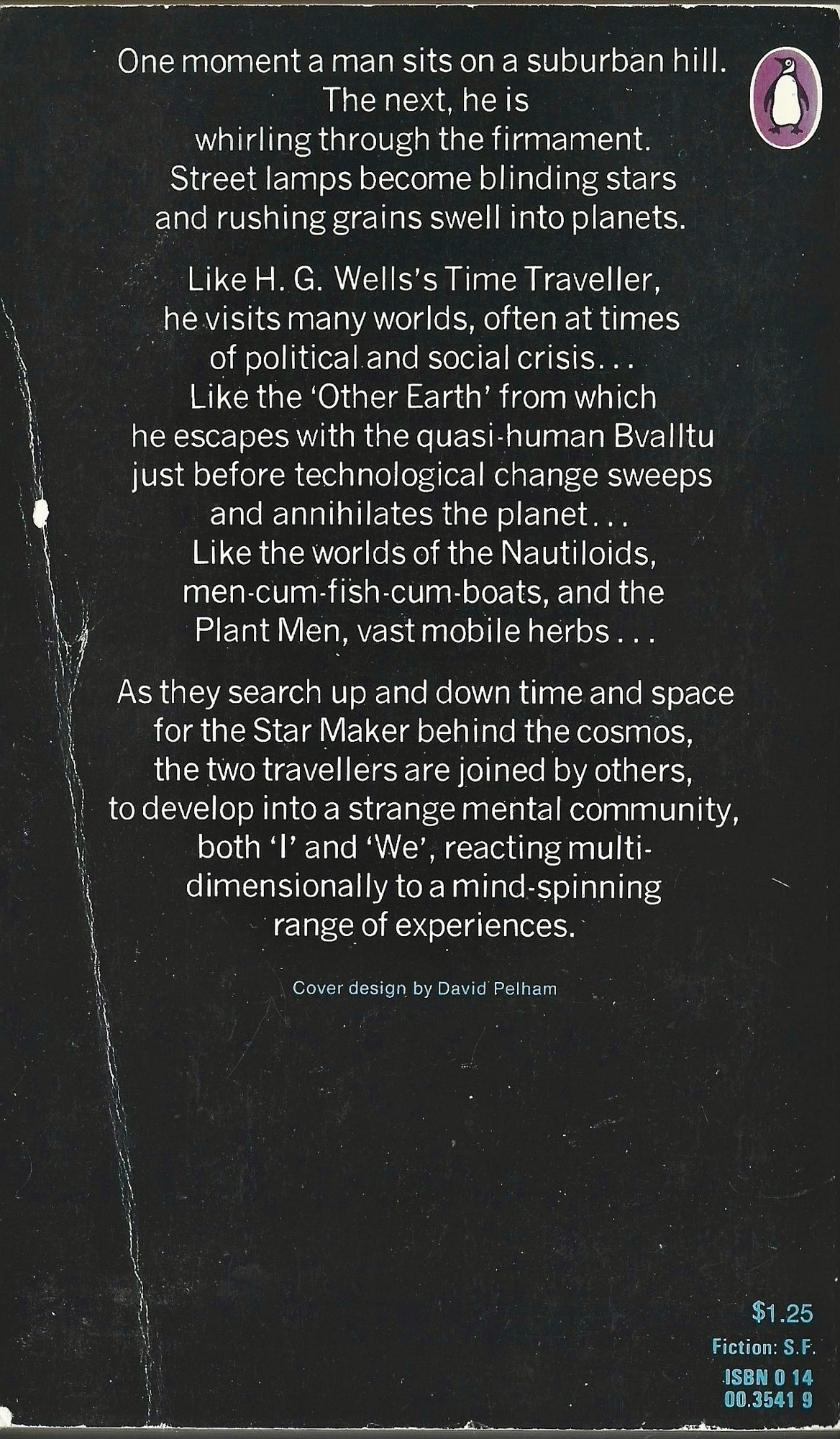
Mass-market Monday | Olaf Stapledon’s Star Maker

Star Maker, Olaf Stapledon. Penguin Books (1973). Cover design by David Pelham. 268 pages.

Here is the first paragraph of Star Maker:

ONE night when I had tasted bitterness I went out on to the hill. Dark heather checked my feet. Below marched the suburban lamps. Windows, their curtains drawn, were shut eyes, inwardly watching the lives of dreams. Beyond the sea’s level darkness a lighthouse pulsed. Overhead, obscurity. I distinguished our own house, our islet in the tumultuous and bitter currents of the world. There, for a decade and a half, we two, so different in quality, had grown in and in to one another, for mutual support and nourishment, in intricate symbiosis. There daily we planned our several undertakings, and recounted the day’s oddities and vexations. There letters piled up to be answered, socks to be darned. There the children were born, those sudden new lives. There, under that roof, our own two lives, recalcitrant sometimes to one another, were all the while thankfully one, one larger, more conscious life than either alone.

More David Pelham covers here.

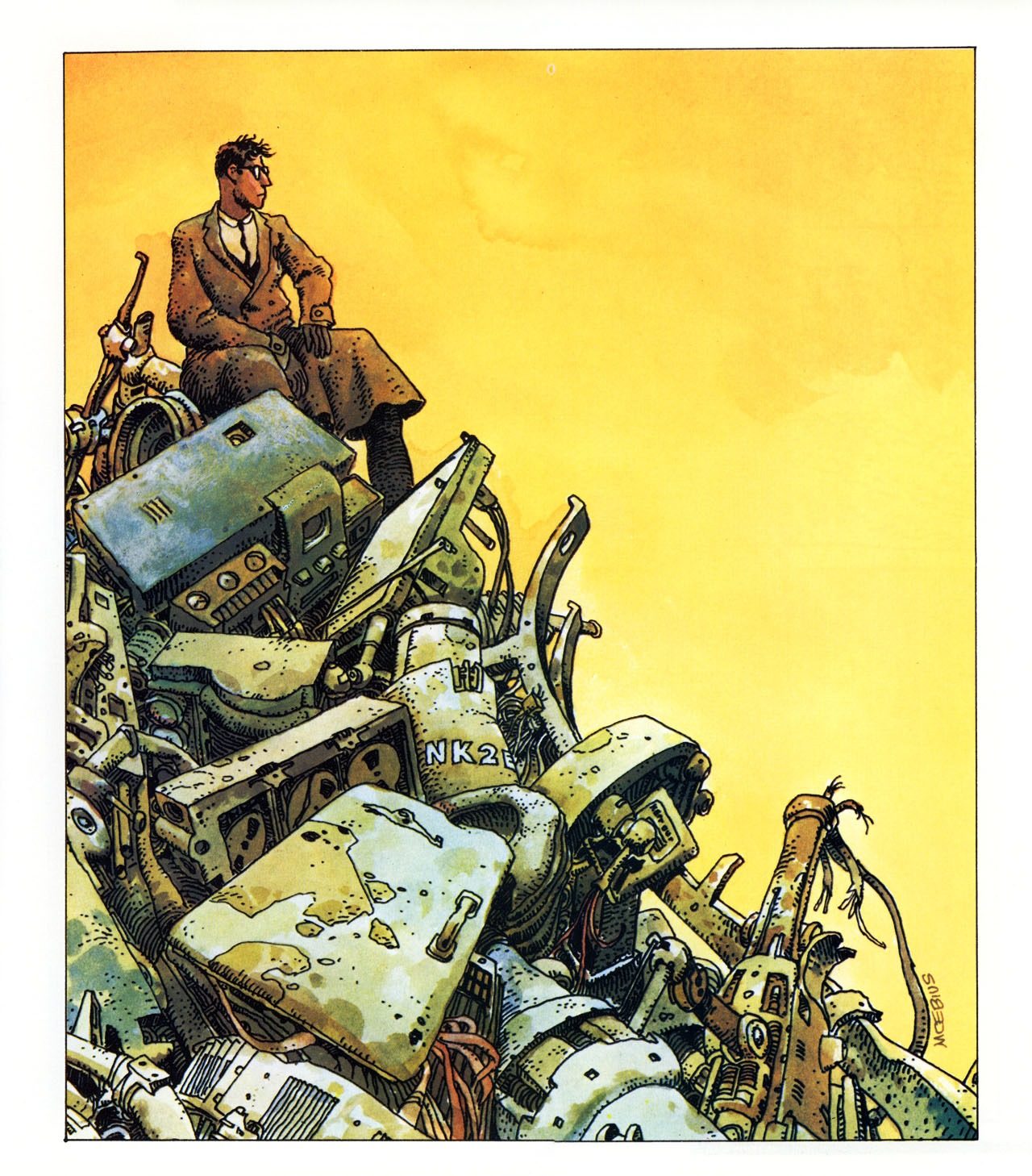
Moebius’s cover illustration for Kurt Vonnegut’s novel Player Piano

Cover illustration for the French translation of Kurt Vonnegut’s novel Player Piano, 1975 by Moebius (Jean Giraud, 1938–2012)

Illustrated manuscript page from Alasdair Gray’s Lanark

An illustrated manuscript page from Alasdair Gray’s novel Lanark. From the Glasgow University Library Special Collections Department.

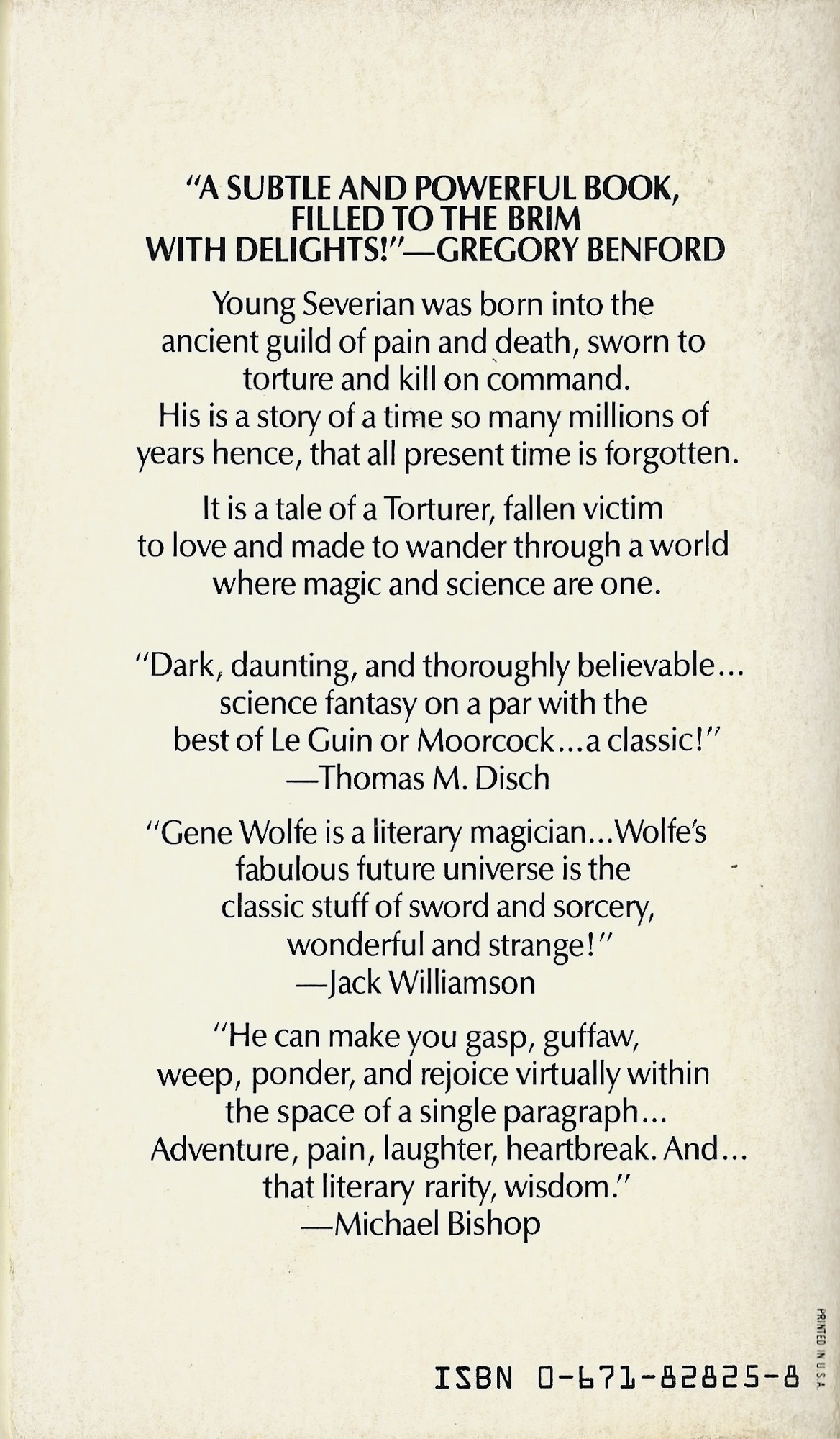
Mass-market Monday | Gene Wolfe’s The Shadow of the Torturer

The Shadow of the Torturer, Gene Wolfe. Timescape/Pocket Books (1981). No cover designer or artist credited. 262 pages.

While no cover artist is credited, Don Maitz is the artist for this edition of The Shadow of the Torturer, as well as for the other three books in Wolfe’s Book of the New Sun tetralogy. Maitz is credited on the dust jackets of the original hardback first editions (Simon & Schuster) of the series.

The Book of the New Sun is absolutely astounding.

From Peter Bebergal’s 2015 New Yorker profile on Wolfe, “Sci-Fi’s Difficult Genius”:

For science-fiction readers, “The Book of the New Sun” is roughly what “Ulysses” is to fans of the modern novel: far more people own a copy than have read it all the way through. A surreal bildungsroman, the book centers on a character named Severian. Trained as a torturer on the planet Urth, where torturers are a feared and powerful guild, Severian betrays his order by showing mercy, allowing a prisoner to kill herself rather than be subjected to his terrible ministrations. He then wanders the land encountering giants, anarchists, and members of religious cults. He eventually meets and supplants the ruler of Urth, the Autarch.

The four books that make up the series are sometimes vexing. A wise reader will keep a dictionary nearby, but it won’t always prove useful. Though Wolfe relies merely on the strangeness of English—rather than creating a new language, like Elven or Klingon—he nonetheless dredges up some truly obscure words: cataphract, fuligin, metamynodon, cacogens. The setting appears medieval, but slowly we tease out that what is ancient to these characters was once our own possible future. A desert’s sands are the glass of a great city, and the creaking steel walls that make up Severian’s cell in the guild dormitory is likely an ancient spaceship. Reading “The Book of the New Sun” is dizzying; at times, you become convinced that you have cracked a riddle, and yet the answer fails to illuminate the rest of the story. Wolfe doesn’t reveal the truth behind any of the central mysteries explicitly, but lets them carry the narrative along. At first, one hopes that they will eventually be resolved. Ultimately, they become less important than Severian’s quest for his own truth.

Mass-market Monday | William Faulkner’s Go Down, Moses

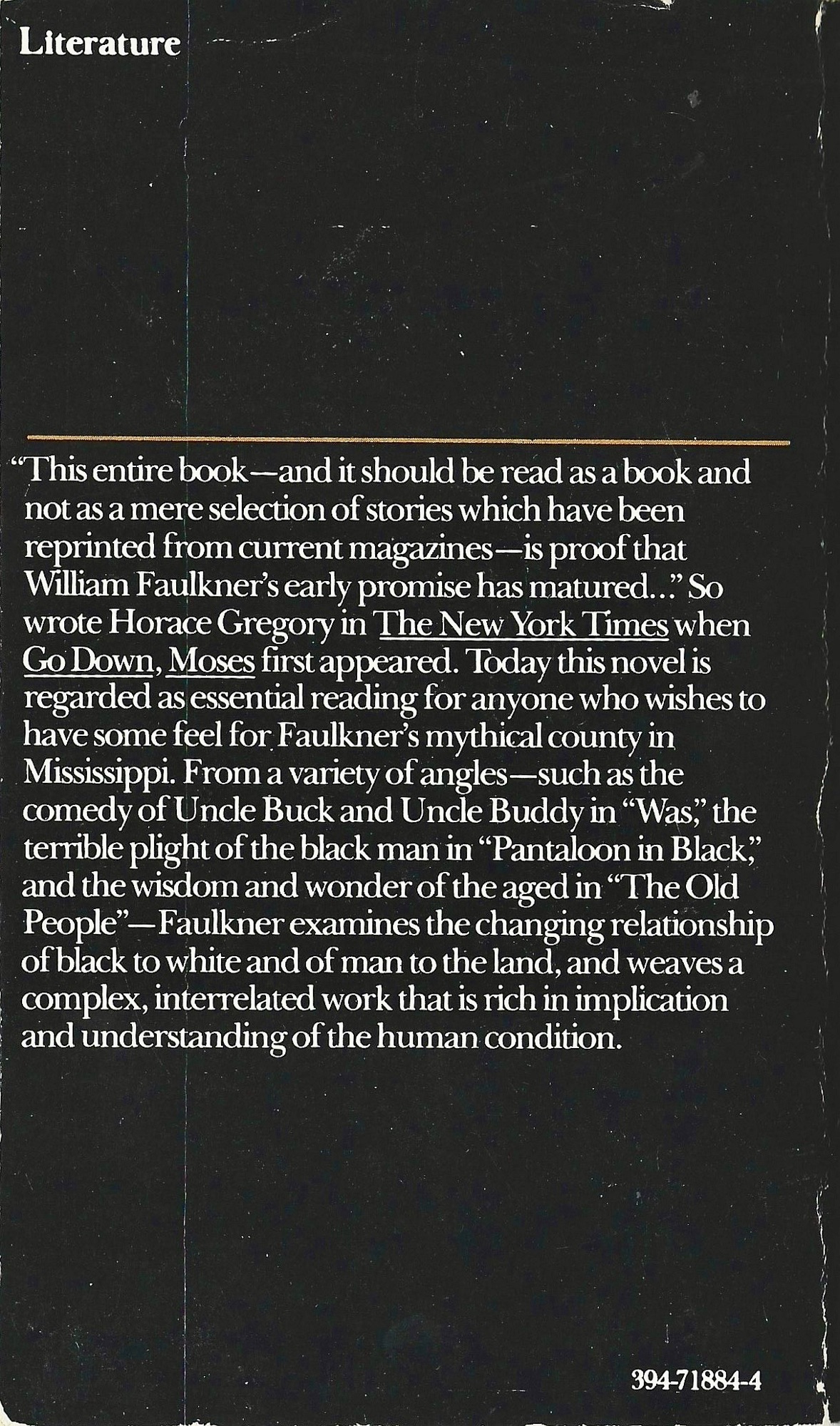
Go Down, Moses, William Faulkner. Vintage Books Edition (1971). Cover photo by Robert Wenkham. 383 pages.

Go Down, Moses is my favorite William Faulkner text (some say it’s a collection of stories, but I think it’s a novel). “The Bear” might be the best thing he wrote. Read the opener, “Was.” 

From “Was”:


Isaac McCaslin, ‘Uncle Ike’, past seventy and nearer eighty than he ever corroborated any more, a widower now and uncle to half a county and father to no one

this was not something participated in or even seen by himself, but by his elder cousin, McCaslin Edmonds, grandson of Isaac’s father’s sister and so descended by the distaff, yet notwithstanding the inheritor, and in his time the bequestor, of that which some had thought then and some still thought should have been Isaac’s, since his was the name in which the title to the land had first been granted from the Indian patent and which some of the descendants of his father’s slaves still bore in the land. But Isaac was not one of these:-a widower these twenty years, who in all his life had owned but one object more than he could wear and carry in his pockets and his hands at one time, and this was the narrow iron cot and the stained lean mattress which he used camping in the woods for deer and bear or for fishing or simply because he loved the woods; who owned no property and never desired te since the earth was no man’s but all men’s, as light and air and weather were; who lived still in the cheap frame bungalow in Jefferson which his wife’s father gave them on their marriage and which his wife had willed to him at her death and which he had pretended to accept, acquiesce to, to humor her, ease her going but which was not his, will or not, chancery dying wishes mortmain possession or whatever, himself merely holding it for his wife’s sister and her children who had lived in it with him since his wife’s death, holding himself welcome to live in one room of it as he had during his wife’s time or she during her time or the sister-in-law and her children during the rest of his and after not something he had participated in or even remembered except from the hearing, the listening, come to him through and from his cousin McCaslin born in 1850 and sixteen years his senior and hence, his own father being near seventy when Isaac, an only child, was born. rather his brother than cousin and rather his father than either, out of the old time, the old days.

When he and Uncle Buck ran back to the house from discovering that Tomey’s Turl had run again, they heard Uncle Buddy cursing and bellowing in the kitchen, then the fox and the dogs came out of the kitchen and crossed the hall into the dogs’ room and they heard them run through the dogs’ room into his and Uncle Buck’s room then they saw them cross the hall again into Uncle Buddy’s room and heard them run through Uncle Buddy’s room into the kitchen. Where Uncle Buddy was picking the breakfast up out of the ashes and wiping it off with his apron. “What in damn’s hell do you mean,” he said “turning that damn fox out with the dogs all loose in the house?”

“Damn the fox” Uncle Buck said. “Tomey’s Turl has broke out again. Give me and Cass some breakfast quick we might just barely catch him before he gets there.”

Mass-market Monday | Paulo Emílio Sales Gomes’s P’s Three Women

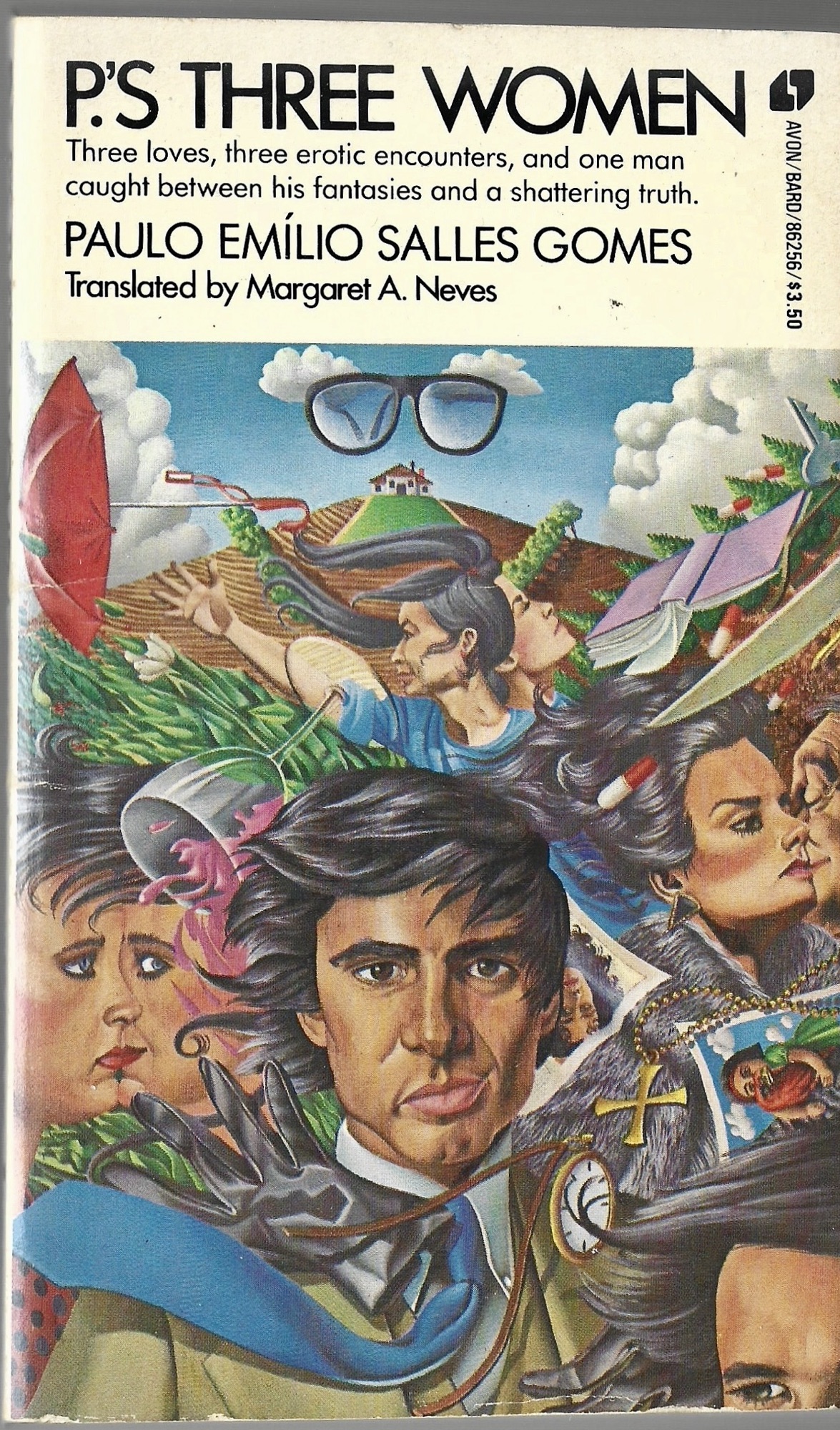
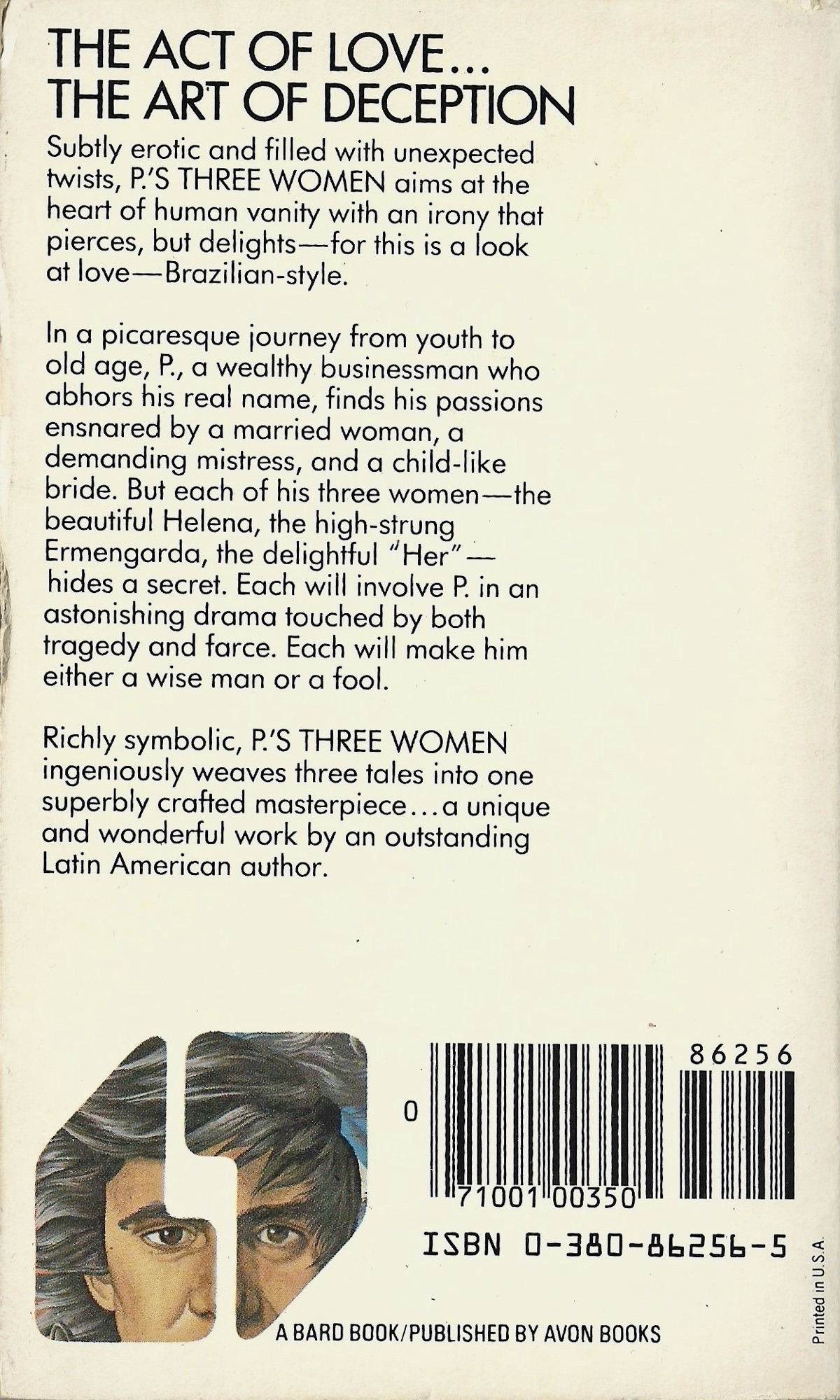
P’s Three Women, Paulo Emílio Sales Gomes. Translation by Margaret A. Neves. Avon Bard (1984). No cover artist credited. 136 pages.

Gomes’s only novel got a reprint from Dalkey Archive back in 2012 with a new introduction by translator Margaret Neves, who notes that in “Portuguese, the title of this book is Trés Mulheres de trés PPPés. The expression “p-p-p” means chitchat, bla-bla-bla. Hence, three women and their chitchats. In addition to echoing the narrator’s first initial, the term is lightly condescending to the women, just like P himself.”

Selections from One-Star Amazon Reviews of Iain Bank’s novel The Wasp Factory

[Editorial note: The following citations come from one-star Amazon reviews of Iain Bank’s novel The Wasp Factory (which I thought was great). More one-star Amazon reviews.]


Crap

drivel

childish

twaddle

well written

I am baffled

absolute tosh

talented author

load of rubbish

Science function.

an unusual story

Distastful content

mild teenage drivel

making me feel sick

positively disgusting

This book is diseased.

potential to be terrific

supposed great author

had to delete this book

I am missing something

is self indulgent and nasty

I had not hear of Iain Banks

I read this almost to the end

sticking their heads on poles

making me feel physically sick

sitting in a a bar with half drunks

I am a high school English teacher

Deeply distasteful dystopian drivel

an ugly Freudian post-modern sack

I hated this book and wish I never read it

soul destroying book makes me feel icky

Woof ! Creepy ! I read 2 pages … no more.

a skilled writer delivering pointless awfulness

At the top of the list of worst books I’ve ever read.

The characters had absolutely no redeeming features

I thought it would be a horror tale that would be great for Halloween

I couldn’t relate to any of the characters in the story. As a matter of fact, I didn’t like any of them.

well written, well constructed and kept me gripped page by page – but it was a loathsome experience

a sordid study of a grubby psychopathic personality of no merit or interest at all

I ordered this product and ended up with a Cuban poetry book. :(

I would burn my copy if I could. Unfortunately, it is electronic,

I bought it because it’s a story about psychopath. Well its not!

Miserable characters, childish writing, and pointless violence

Perhaps reading should expose us to such things but

I like mysteries, including murder mysteries, but

I’ve rarely had this negative reaction to a book

there are enough crazies in the real world

easily the worst book I have ever read

gratuitous tripe sweeps nation

I’m stupider for having read it

why am I reading this horror

I absolutely hated this book.

Found it a thoroughly book

violent, mad and depraved

Misogynistic, pretentious

This book is simply BAD

im glas i only bought one

I ploughed diligently

difficult to empathise

lacklustre last chapter

don’t waist your time

contains sick cruelty

blowing up animals

vulgar and uncouth

our book group

our Book Group

excellent prose

Drunks beware!

Poorly written

straight fiction

twisted mind

Well written

book club

unpleasant

I feel used.

I hate it!

Enjoy.

Mass-market Monday | Stanley Elkin’s The Living End

The Living End, Stanley Elkin. First Warner Books printing (1980). Cover art by Don Ivan Punchatz; cover design by Gene Light; cover type by Richard Nebiola. 141 pages.

An excerpt from The Living End:

God gave a gala, a levee at the Lord’s.

All Heaven turned out.

“Gimme,” He said, that old time religion.” His audience beamed. They cheered, they ate it up. They nudged each other in Paradise.

“What did I tell you?” He demanded over their enthusiasm.

“It’s terrific, isn’t it? I told you it would be terrific. All you ever had to do was play nice. Are you disappointed? Is this Heaven? Is this God’s country? In your wildest dreams-let Me hear it. Good-in your wildest dreams, did you dream such a Treasury, this museum Paradise? Did you dream My thrones and dominions, My angels in fly-over? My seraphim disporting like dolphins, tumbling God’s sky in high Heaven’s high acrobacy? Did you imagine the miracles casual as card tricks, or ever suspect free lunch could taste so good? They should see you now, eh? They should see you now, trembling in rapture like neurological rut. Delicious, correct? Piety a la mode! That’s it, that’s right. Sing hallelujah! Sing Hizzoner’s hosannas, Jehovah’s gee whiz! Well,” God said, .1 that’s enough, that will do.” He looked toward the Holy Family, studying them for a moment.

“Not like the creche, eh?” He said.

“Well is it? Is it?” He demanded of Jesus.

“No,” Christ said softly.

“No,” God said, “not like the creche. just look
at this place- the dancing waters and indirect lighting. I could put gambling in here, off-track betting. Oh, oh, My costume jewelry ways, My game show vision.

Well, it’s the public. You’ve got to give it what it wants. Yes, Jesus?”

“Yes,” Jesus said.

“It just doesn’t look lived in, is that what you think

“Call on someone else,” Christ said.

“Sure,” God said.

“I’m Hero of Heaven. I call on Myself.”

That was when He began His explanations. He revealed the secrets of books, of pictures and music, telling them all manner of things-why marches were more selfish than anthems, lieder less stirring than scat, why landscapes were to be preferred over portraits, how statues of women were superior to statues of men but less impressive than engravings on postage. He explained why dentistry was a purer science than astronomy, biography a higher form than dance. He told them how to choose wines and why solos were more acceptable to Him than duets. He told them the secret causes of inflation-“It’s the markup,” He said-and which was the best color and how many angels could dance on the head of a pin. He explained why English was the first language at Miss Universe pageants and recited highlights from the eighteen-minute gap.

Mary, wondering if she showed yet, was glad Joseph was seated next to her. Determined to look proud, she deliberately took her husband’s hand. So rough, she thought, such stubby fingers. He explained why children suffered and showed them how to do the latest disco steps. He showed them how to square the circle, cautioning afterwards that it would be wrong.

He revealed the name of Kennedy’s assassin and told how to shop for used cars.

Gravity’s Rainbow annotations (so far)

img_4025

I’ll be adding to these and then doing more the next time (?!) I read Gravity’s Rainbow.*

Pages 82-83: The White Visitation, etc.

Page 103: Black Markets, King Kong, etc.

Pages 148-49: Preterite/Elect, Lurianic Kabbalah, Uncanny X-Men, etc.

Page 203: Rainbows, Fuck-yous, Plastic Man, etc.

Pages 204-05: Paper, mise en abyme, a silkenness of girls, etc.

Page 256: “Real America,” Hughes contra Whitman, BANZAI!, etc.

Pages 257-58: The War, nimbus clouds, Zoot Suit Riot!, etc.

Page 299: Tannhäuser, horny expectations, etc.

Page 364: Knights and fools, dendrites and axons, etc.

Pages 412-13:  Ouroboros, organic chemistry, tarot, etc.

Page 419: Innocence, experience, Wm Blake, Wagner’s Ring cycle, etc.

Page 539: Critical Mass, Weismann’s tarot reading, Rilke, hymns, etc.

Pages 627-28: Optimum time, barrage balloons, Wall of Death, etc.

Pages 712-13: The Man has a branch office in each of our brains. We might be freaks, but We are not doomed and We are not Their pets.

A(nother) completely subjective and thoroughly unnecessary ranking of Thomas Pynchon’s novels


In 2018—six years ago—on Thomas Pynchon’s 81st birthday, I put together a thoroughly unnecessary ranking of his eight novels. I’m somewhat ashamed of the post, as I included two novels I had abandoned a few times—Vineland and Bleeding Edge. Three years ago, on Pynchon’s 84th birthday, I wrote a few sentences on each of Pynchon’s novels, having, at that point, made my way through all of them. The first post, perhaps because it contains the word “ranking” in its title gets far more traffic to this day than the more thoughtful and finished post from 2021. Indeed, the “ranking” post regularly shows up in the top ten percentile of my weekly and monthly stats on Biblioklept, which, I guess, has bothered me enough to write this (thoroughly unnecessary still) “ranking.”

I know that if I were to approach Pynchon’s eight novels on eight different days, I’d likely end up with a consistent #1, #2, #3, and #8—but the other spots would shift depending on my memory or fancy or whatever spell I’d fallen under, chemical, metaphysical or otherwise. But here’s the list I came up with today.

8. Vineland (1990)

In my 2018 post (where I ranked Vineland at number 7) I noted that “Vineland seems to have a strange status for Pynchon cultists—its a cult novel in an oeuvre of cult novels,” and I’ve found that intuition confirmed over the years. I stick by my assertion in my 2021 post in which I asserted that “Vineland is ultimately depressing and easily my least-favorite Pynchon novel, but it does have some exquisite prose moments.” I’m sure I’ll revisit it before seeing Paul Thomas Anderson’s film adaptation though.

7. Inherent Vice (2009)

Speaking of Paul Thomas Anderson—I think I like his film adaptation of Inherent Vice more than I like the novel. And I love Inherent Vice. But I think PTA provides an emotional ballast that gives the narrative a center that’s missing from Pynchon’s novel (which is, likely, the point, or at least the byproduct of Pynchon’s shaggy dogging it). (I originally ranked Inherent Vice at number 6).

6. Bleeding Edge (2013)

So I finally found my way into Bleeding Edge in the earliest weeks of the COVID-19 lockdown. I’d stuck the book at the bottom of my 2018 list. I’m not really sure why I stalled out on—maybe it feels the closest to my own timeline of any Pynchon novel. Anyway, it’s one I want to revisit again soon. I riffed on it some in 2020, writing “Pynchon captures a time in America during which I was, at least theoretically, becoming an adult (a becoming which may or may not have happened yet). Reading Bleeding Edge helped evoke all the weirdness the 2000s were about to lay out for us. It made me angry again, or reminded me of the anger that I’d sustain for most of the decade. It reminded me of our huge ideological failure after 9/11, an ideological failure we are watching somehow fail even more today.  But I also loved the novel’s unexpectedly sweet domestic plot, and found a kind of solace even in its affirmation of family, even as its final image pointed to the kind of radical inconclusiveness at the heart of being a parent.”

5. V. (1963)

So from here on out my rankings are identical to my stupid 2018 list, with that big caveat that I would easily swap, say, V. and 49 here. I’ll repeat my endorsement that “V. makes a good starting place for anyone new to Pynchon” and recommend that anyone interested in Pynchon but daunted by the scope check out the book from their library and read the ninth chapter, the story of of Kurt Mondaugen.

4. The Crying of Lot 49 (1966)

The Crying of Lot 49 is probably a better novel than V. but I think I like V. better. 49 is very funny and showcases Pynchon’s tonality of paranoia/hope wrapped up in zaniness/horror. It’s an excellent sophomore novel, but also dense, claustrophobic even. I guess I like the Pynchon sprawl a bit better.

3. Against the Day  (2006)

Speaking of sprawl: Against the Day is Pynchon’s biggest novel, just fat and giddy and overstuffed with goodies. I think this novel would make an excellent American history textbook. Its thesis: resist the military-industrial-entertainment-complex. Start here!

2. Mason & Dixon (1997)

A measurement of the world and a story about friendship. It would be Pynchon’s best novel if he hadn’t written—

1. Gravity’s Rainbow (1973)

The best book. I reread it earlier this summer and it’s roomier and stranger and more rewarding each time.

Mass-market Monday | Philip K. Dick’s A Maze of Death

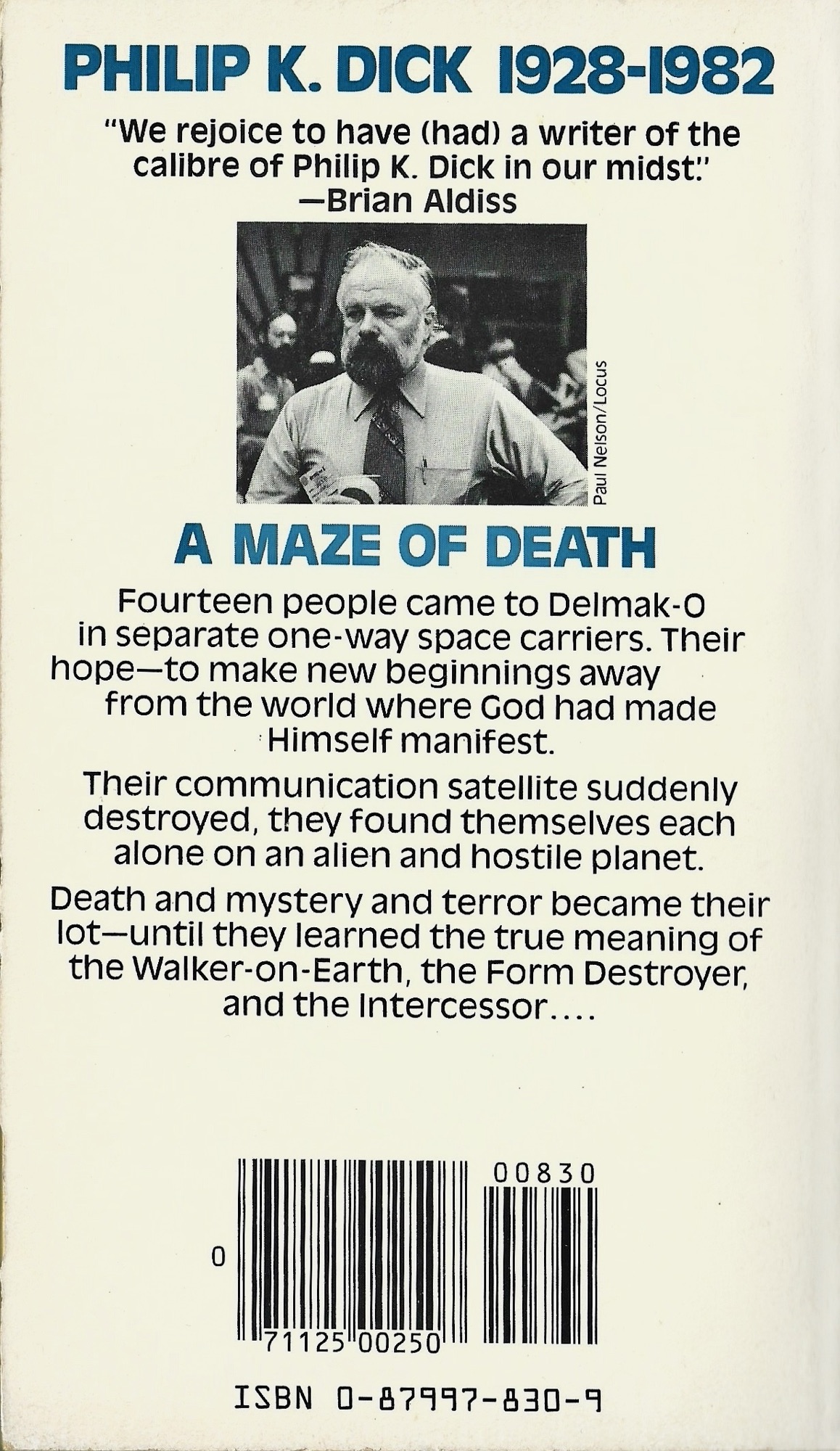
A Maze of Death, Philip K. Dick. Dawn Books, first Daw printing (1983). Cover art by Bob Pepper. 191 pages.

In my review of Philip K. Dick’s 1970 novel, I wrote that A Maze of Death is

…a mishmash of metaphysical mumbo jumbo, filtered through touches of space opera and good old fashioned haunted housery. A Maze of Death is a messy space horror that threatens to leave its readers unsatisfied right up until the final moments wherein it rings its sad coda, a reverberation that nullifies all its previous twists and turns in a soothing wash of emptiness. Not the best starting place for PKD, but I’m very glad I read it.

On top of stolen books behind the Life Magazine picture of Bertrand Russell like a baby eagle | From Katherine Dunn’s first novel Attic

In the five-and-dime can’t see over the counters with her—see
the red thimble—plastic knobby—just fits—put it on and tap things with it—lips and teeth and wish I had two to click against each other—wander out with her—why where did you get that you little thief march right back in there and give it to the man and apologize—penny thimble—I didn’t even notice I’d taken it—big noise and hits—the shame…

Drugstore book racks—need a book a day at least—three thin ones—too far to the library—heavy—always overdue—little ladies in pale green uniforms inventory hair spray—perfume—Kotex while I’m putting books in my purse—in my armpits—Agatha Christie—Nero Wolfe—James Bond—candy bars in pockets—have to lay off M & Ms—they rattle too much—an extra eyebrow pencil up my sweater sleeve and buy a deodorant—go out to the car and drop the stuff—back into the supermarket for cookies and cigarettes and chocolate-covered cherries—buy milk and then tool back home to turn the heat up and sit with the rain outside—with my feet up reading trash—eating trash—drinking milk straight from the carton only pouring it into a glass when I want to dunk cookies in it…

Girls League Cake Sale—high school cakes by girls in coordinated sweaters and skirts—ribbons holding their hair—dozens of pairs of shoes—their proud bras and girdles mocking my brother’s cast-off tee shirts in the locker room—they study typing with old Birdsing and wear ribbons in their hair—bake cakes for the cake sale from scratch with boiled frosting that slump in the middle and cave on the side—patch it up with frosting and candy drops—hide them on mother’s best cake plates behind screens in the cafeteria—I ducking class as usual—hiding stink bombs behind the encyclopedias in the library—sneaking through the halls with my five-button Levi’s swishing between my legs a cake under each arm—stacking them carefully in my locker on top of stolen books behind the Life Magazine picture of Bertrand Russell like a baby eagle his fierce fuzzy face on the scrawny neck—hide for the rest of the afternoon in the conference rooms in the library listening to Jake in his chemistry room gas mask searching for the stink bombs and cursing—thinking of him fumbling with the pear-assed librarian from the grade school—all the time rehearsing my lines for if I’m caught—when the final bell rings parading down to the boys’ locker room with a dozen cakes on a book cart to wait for the wrestling team to finish weighing in and come out famished after a month of making weight…

From Katherine Dunn’s first novel Attic. 

A review of Dinah Brooke’s excellent cult novel Lord Jim at Home

Dinah Brooke’s 1973 novel Lord Jim at Home had been out of print for five decades — and had never gotten a U.S. release — until McNally Editions republished in 2023 with a new foreword by the novelist Ottessa Moshfegh. I always save forewords until after I’ve finished a novel, so I missed Moshfegh’s implicit advice to go into Lord Jim at Home cold. She notes that the recommendation she received to read it “came with no introduction,” and that “I wouldn’t have wanted the effect of the novel to be mitigated in any way, so I’m reluctant to introduce it now.”

I am not reluctant to write about Brooke’s novel because I am so enthusiastic about it and I think those with tastes in literature similar to my own will find something fascinating in its plot and prose. However, l agree with Moshfegh’s advice that Lord Jim at Home is best experienced free from as much mitigating context as possible. I had never heard of the novel before lifting it from a bookseller’s shelf, attracted by the striking cover; I flipped it over to read a blurb parsed from Moshfegh’s foreword attesting that Brooke’s novel “was an instrument of torture. It’s that good.” The inside flap informed me that reviews upon its publication “described it as ‘squalid and startling,’ ‘nastily horrific,’ and a ‘monstrous parody’ of upper-middle class English life.” I was sold.

Lord Jim at Home is squalid and startling and nastily horrific. It is abject, lurid, violent, and dark. It is also sad, absurd, mythic, often very funny, and somehow very, very real for all its strangeness. The novels I would most liken Lord Jim at Home to, at least in terms of the aesthetic and emotional experience of reading it, are Ann Quin’s Berg, Anna Kavan’s Ice, Mervyn Peake’s Gormenghast novels, Virginia Woolf’s Mrs. Dalloway, and James Joyce’s Portrait (as well as bits of Ulysses). (I have not read Conrad’s Lord Jim, which Brooke has taken as something of a precursor text for Lord Jim at Home.)

After finishing Lord Jim at Home, I read it again by accident. At first I intended to take a few notes for a possible review, but after the first few pages I just kept reading. On a second reading, Brooke’s novel was just as strange—maybe even stranger—even if I was able to read it much more quickly, finding myself quicker to tune into the novel’s competing (and complementary) narrative registers. I found it far more precise, too, in the rhetorical development of its themes; Brooke’s styles and tones shift to capture the different ages of its hero. The novel begins in a mythical, archetypal mode and works its way through various registers, exploring the tropes of schoolboy novels, romances, war stories, adventure tales,  modernism, realism, and journalism. But despite its shifting modes, Lord Jim at Home is not a parodic pastiche. Rather, at its core, Lord Jim at Home skewers how aesthetic modes—primarily those derived from notions of class and manners—cover over abject cruelty. As Moshfegh puts it in her forward, Lord Jim at Home is “an accurate portrayal of how fucked-up people behave, artfully conveyed in a way that nice people are too polite to admit they understand.”

I’ve tried to be clear that I think it’s best to come to Lord Jim at Home without too much context—it’s best to just go with the novel’s strangeness. Below, however, I offer a more detailed discussion of the novel, its language, and some elements of the plot for those so inclined.

Answer, 2014 by Henrietta Harris

Continue reading “A review of Dinah Brooke’s excellent cult novel Lord Jim at Home”