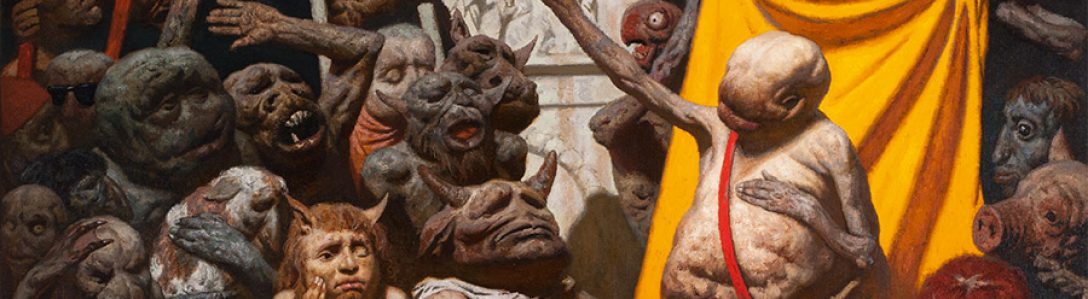
“The Story of a Stick (With Some Additional Comments by Mrs. Campbell),” a chapter from Three Trapped Tigers by G. Cabrera Infante

“The Story of a Stick (With Some Additional Comments by Mrs. Campbell)”

a chapter from Three Trapped Tigers

by G. Cabrera Infante

translated by Donald Gardner and Suzanne Jill Levine with collaboration by Infante


The Story

We arrived in Havana one Friday around three in the afternoon. The heat was oppressive. There was a low ceiling of dense gray, or blackish, clouds. As the boat entered the harbor the breeze that had cooled us off during the crossing suddenly died down. My leg was bothering me again and it was very painful going down the gangplank. Mrs. Campbell followed behind me talking the whole damned time and she found everything, but everything, enchanting: the enchanting little city, the enchanting bay, the enchanting avenue facing the enchanting dock. All I knew was that there was a humidity of 90 or 95 percent and that I was sure my leg was going to bother me the whole weekend. It was, of course, Mrs. Campbell’s brilliant idea to come to such a hot and humid island. I told her so as soon as I was on deck and saw the ceiling of rain clouds over the city. She protested, saying they had sworn to her in the travel agency that it was always, but always, spring in Cuba. Spring my aching foot! We were in the Torrid Zone. That’s what I told her and she answered, “Honey, this is the tropics!”

On the edge of the dock there was this group of enchanting natives playing a guitar and rattling some gourds and shouting infernal noises, the sort of thing that passes for music here. In the background, behind this aboriginal orchestra, there was an open-air tent where they sold the many fruits of the tropical tree of tourism: castanets, brightly painted fans, wooden rattlers, musical sticks, shell necklaces, earthenware pots, hats made of a brittle yellow straw and stuff like that. Mrs. Campbell bought one or two articles of every kind. She was simply enchanted. I told her she should wait till the day we left before making purchases. “Honey,” she said, “they are souvenirs.” She didn’t understand that souvenirs are what you buy when you leave a country. Nor was there any point in explaining. Luckily they were very quick in Customs, which was surprising. They were also very friendly, although they did lay it on a bit thick, if you know what I mean.

I regretted not bringing the car. What’s the point of going by ferry if you don’t take a car? But Mrs. Campbell thought we would waste too much time learning foreign traffic regulations. Actually she was afraid we would have another accident. Now there was one more argument she could throw in for good measure. “Honey, with your leg in this state you simply cannot drive,” she said. “Let’s get a cab.”

We waved down a taxi and a group of natives—more than we needed—helped us with our suitcases. Mrs. Campbell was enchanted by the proverbial Latin courtesy. It was useless to tell her that it was a courtesy you also pay for through your proverbial nose. She would always find them wonderful, even before we landed she knew everything would be just wonderful. When all our baggage and the thousand and one other things Mrs. Campbell had just bought were in the taxi, I helped her in, closed the door in keen competition with the driver and went around to the o
ther door because I could get in there more easily. As a rule I get in first and then Mrs. Campbell gets in, because it’s easier for her that way, but this impractical gesture of courtesy which delighted Mrs. Campbell and which she found “very Latin” gave me the chance to make a mistake I will never forget. It was then that I saw the walking stick.

It wasn’t an ordinary walking stick and this alone should have convinced me not to buy it. It was flashy, meticulously carved and expensive. It’s true that it was made of a rare wood that looked like ebony or something of that sort and that it had been worked with lavish care—exquisite, Mrs. Campbell called it—and translated into dollars it wasn’t really that expensive. All around it there were grotesque carvings of nothing in particular. The stick had a handle shaped like the head of a Negro, male or female—you can never tell with artists—with very ugly features. The whole effect was repulsive. However, I was tempted by it even though I have no taste for knickknacks and I think I would have bought it even if my leg hadn’t been hurting. (Perhaps Mrs. Campbell, when she noticed my curiosity, would have pushed me into buying it.) Needless to say Mrs. Campbell found it beautiful and original and—I have to take a deep breath before I say it—exciting. Women, good God!

We got to the hotel and checked in, congratulating ourselves that our reservations were in order, and went up to our room and took a shower. Ordered a snack from room service and lay down to take a siesta—when in Rome, etc. . . . No, it’s just that it was too hot and there was too much sun and noise outside, and our room was very clean and comfortable and cool, almost cold, with the air-conditioning. It was a good hotel. It’s true it was expensive, but it was worth it. If the Cubans have learned something from us it’s a feeling for comfort and the Nacional is a very comfortable hotel, and what’s even better, it’s efficient. When we woke up it was already dark and we went out to tour the neighborhood.

Outside the hotel we found a cab driver who offered to be our guide. He said his name was Raymond something and showed us a faded and dirty ID card to prove it. Then he took us around that stretch of street Cubans call La Rampa, with its shops and neon signs and people walking every which way. It wasn’t too bad. We wanted to see the Tropicana, which is advertised everywhere as “the most fabulous cabaret in the world,” and Mrs. Campbell had made the journey almost especially to go there. To kill time we went to see a movie we wanted to see in Miami and missed. The theater was near the hotel and it was new and air-conditioned.

We went back to the hotel and changed. Mrs. Campbell insisted I wear my tuxedo. She was going to put on an evening gown. As we were leaving, my leg started hurting again—probably because of the cold air in the theater and the hotel—and I took my walking stick. Mrs. Campbell made no objection. On the contrary, she seemed to find it funny.

The Tropicana is in a place on the outskirts of town. It is a cabaret almost in the jungle. It has gardens full of trees and climbing plants and fountains and colored lights along all the road leading to it. The cabaret has every right to advertise itself as fabulous physically, but the show consists—like all Latin cabarets, I guess—of half-naked women dancing rumbas and singers shouting their stupid songs and crooners in the style of Bing Crosby, but in Spanish. The national drink of Cuba is the daiquiri, a sort of cocktail with ice and rum, which is very good because it is so hot in Cuba—in the street I mean, because the cabaret had the “typical Cuban air-conditioning” as they call it, which means the North Pole encapsuled in a tropical saloon. There’s a twin cabaret in the open air but it wasn’t functioning that night because they were expecting rain. The Cubans proved good meteorologists. We’d only just begun to eat one of those meals they call international cuisine in Cuba, which consist of things that are too salty or full of fat or fried in oil which they follow with a dessert that is much too sweet, when a shower started pouring down with a greater noise than one of those typical bands at full blast. I say this to give some idea of the violence of the rainfall as there are very few things that make more noise than a Cuban band. For Mrs. Campbell this was the high point of sophisticated savagery: the rain, the music, the food, and she was simply enchanted. Everything would have been fine—or at any rate passable; when we switched to drinking whiskey and soda I began to feel almost at home—but for the fact that this stupid maricón of an emcee of the cabaret, not content with introducing the show to the public, started introducing the public to the show, and it even occurred to this fellow to ask our names—I mean all the Americans who were there—and he started introducing us in some godawful travesty of the English language. Not only did he mix me up with the soup people, which is a common enough mistake and one that doesn’t bother me anymore, but he also introduced me as an international playboy. Mrs. Campbell, of course, was on the verge of ecstasy! Continue reading ““The Story of a Stick (With Some Additional Comments by Mrs. Campbell),” a chapter from Three Trapped Tigers by G. Cabrera Infante”
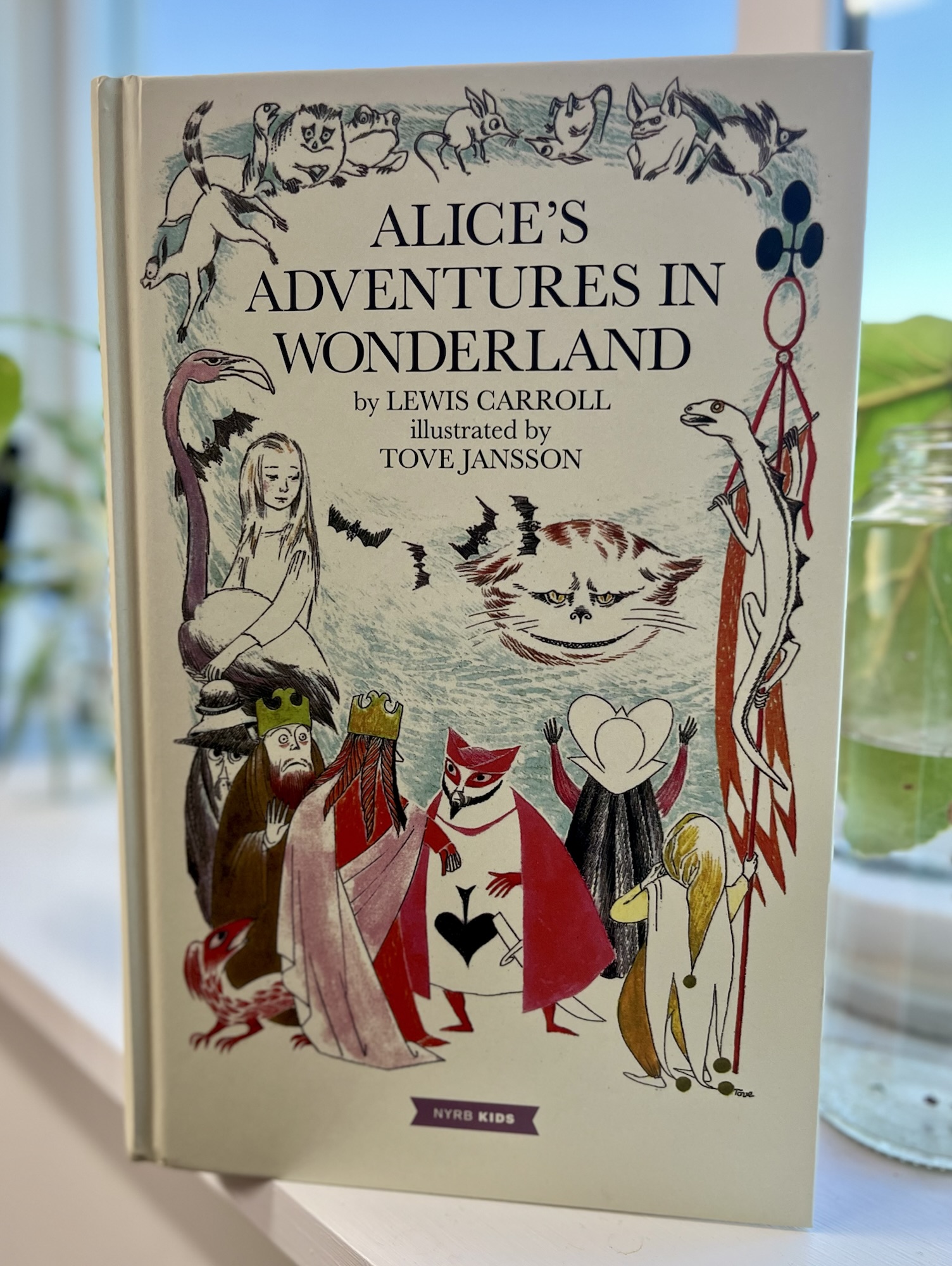
On Tove Jansson’s odd and touching illustrations for Alice’s Adventures in Wonderland

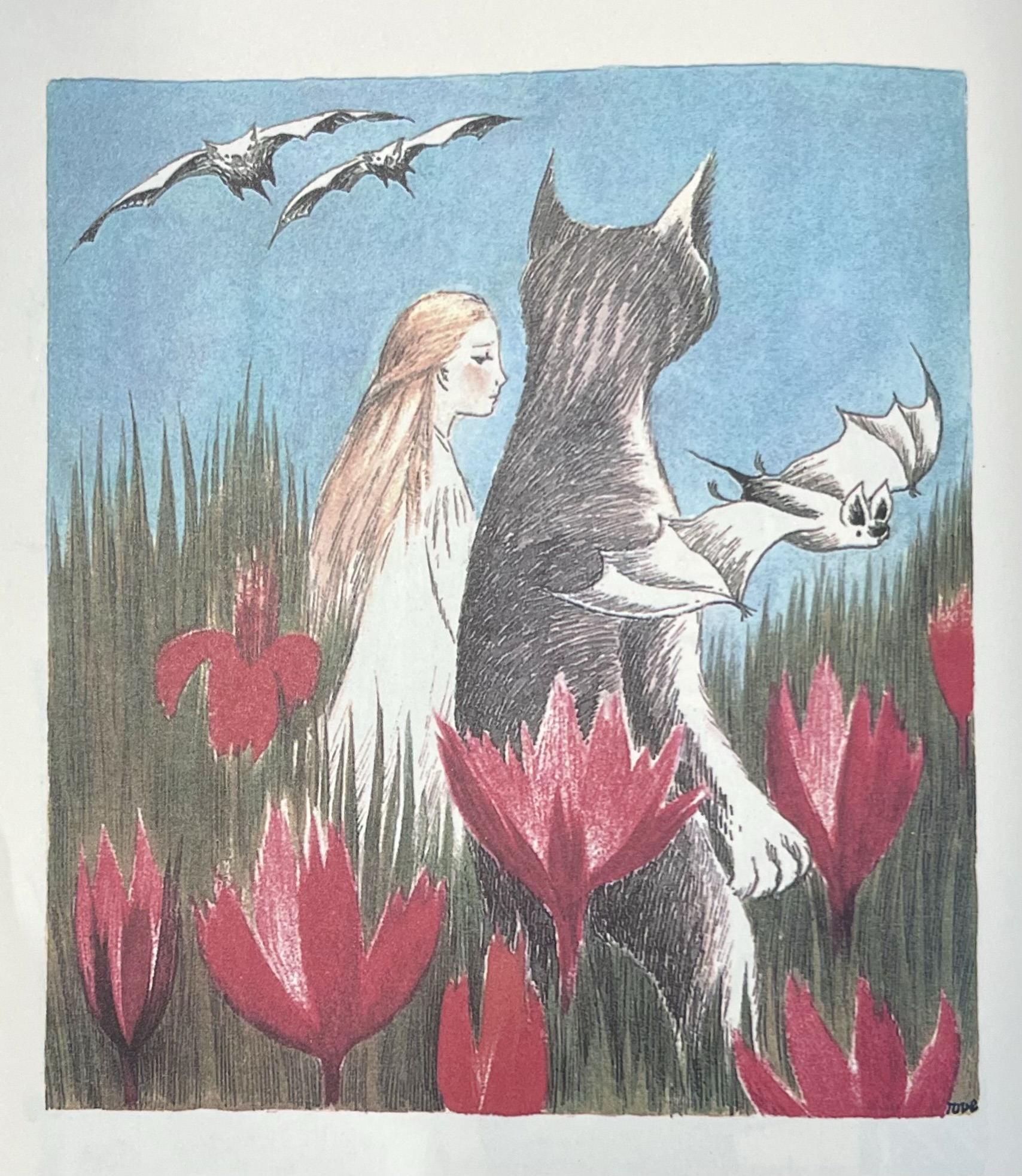
This fall–just in time for the holiday season–the NYRB Kids imprint has published an edition of Lewis Carroll’s classic Alice’s Adventures in Wonderland illustrated by the Finnish author and artist Tove Jansson. Jansson is most famous for her Moomin books, which remain an influential cult favorite with kids and adults alike. She illustrated Carroll’s Alice in 1966 for a Finnish audience; this NRYB edition is the first English-language version of the book. There are illustrations on almost every page of the book; most are black and white sketches — doodles, portraits, marginalia — but there are also many full-color full-pagers, like this odd image about a dozen pages in:

Here we have Alice and her cat Dinah, transformed into a shadowy, even sinister figure, large, bipedal. Bats float in the background, echoing Goya’s famous print El sueño de la razón produce monstruos. The image accompanies Alice’s initial descent into her underland wonderland:  “Down, down, down. There was nothing else to do, so Alice soon began talking again,” addressing Dinah, who will “miss me very much to-night, I should think!” Wonderlanding if Dinah might catch a bat, which is something like a mouse, maybe, “Alice began to get rather sleepy, and went on saying to herself, in a dreamy sort of way, ‘Do cats eat bats? Do cats eat bats?’ and sometimes, ‘Do bats eat cats?; for, you see, as she couldn’t answer either question, it didn’t much matter which way she put it.” Jansson’s red flowers suggest poppies, contributing to the scene’s slightly-menacing yet dreamlike vibe. The image ultimately echoes the myth of Hades and Persephone.

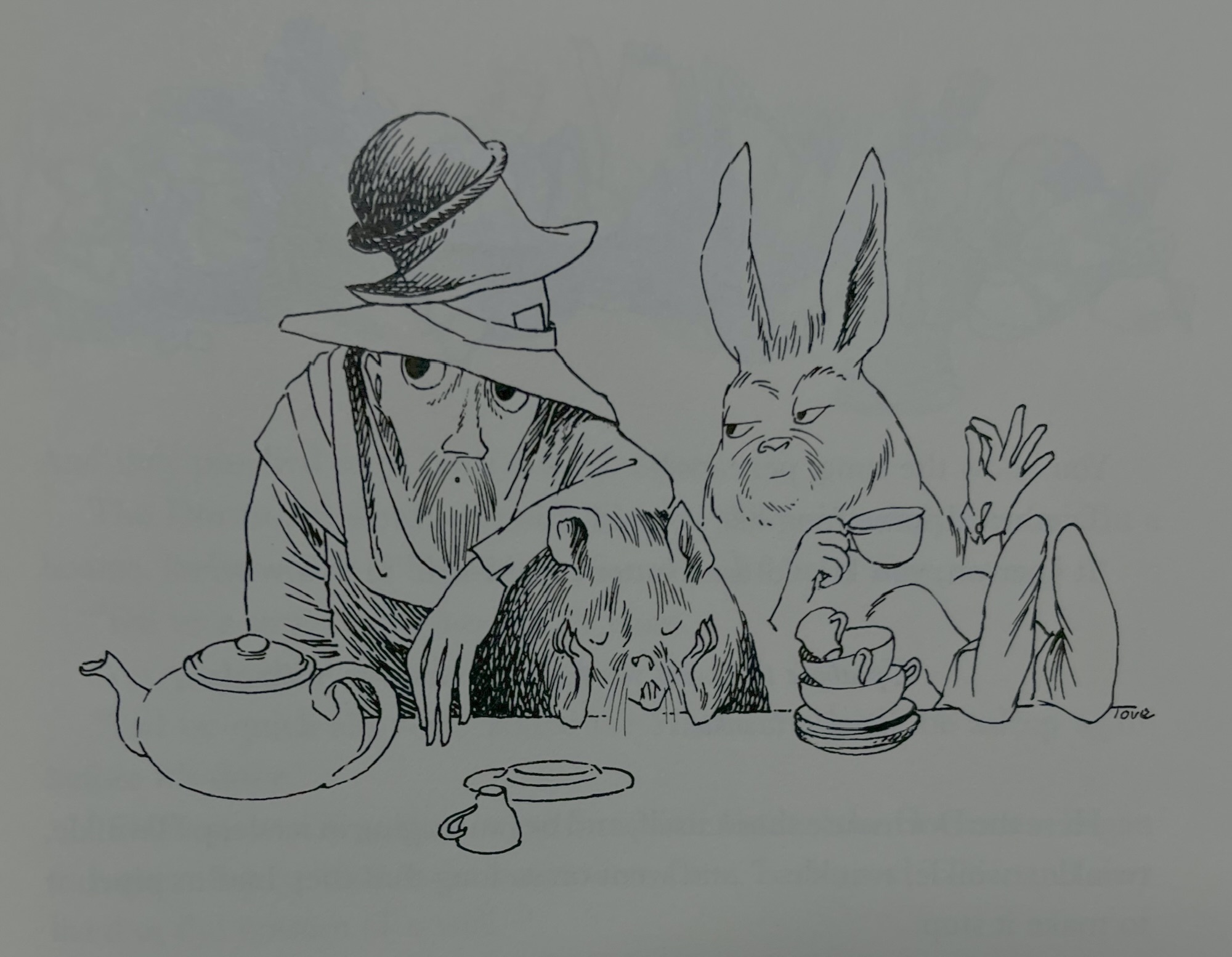
All the classic characters are here, of course, rendered in Jansson’s sensitive ink. Consider this infamous trio —

There was a table set out under a tree in front of the house, and the March Hare and the Hatter were having tea at it: a Dormouse was sitting between them, fast asleep, and the other two were using it as a cushion, resting their elbows on it, and talking over its head.

I love Jansson’s take on the Hatter; he’s not the outright clown we often see in post-Disneyfied takes on the character, but rather a creature rendered in subtle pathos. The March Hare is smug; the Dormouse is miserable.

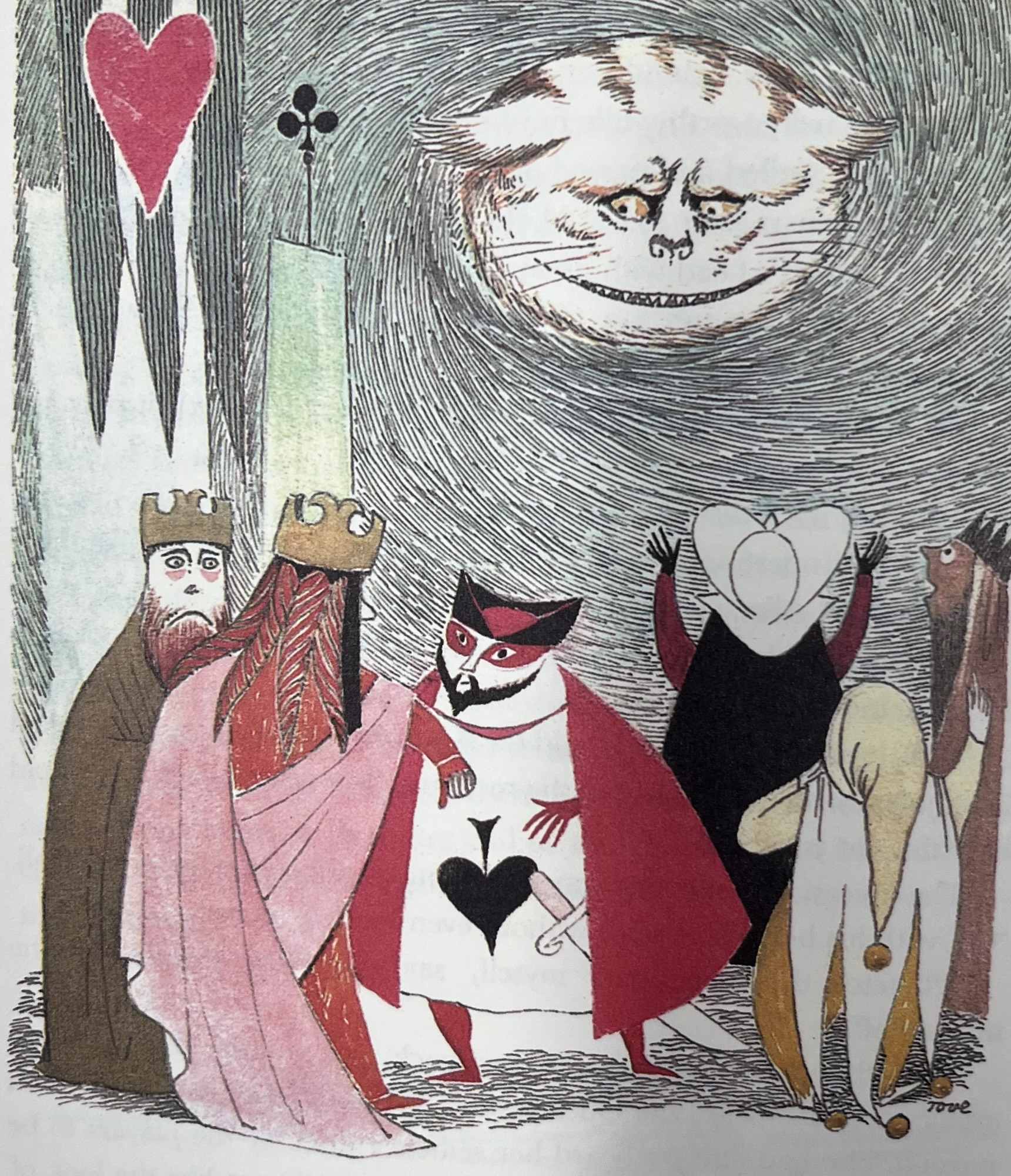
And you’ll want a glimpse of the famous Cheshire cat who appears (and disappears) during the Queen’s croquet match:

Jansson’s figures here remind one of the surrealist Remedios Varo’s strange, even ominous characters. Like Varo and fellow surrealist Leonora Carrington, Jansson’s art treads a thin line between whimsical and sinister — a perfect reflection of Carroll’s Alice, which we might remember fondly as a story of magical adventures, when really it is much closer to a horror story, a tale of being sucked into an underworld devoid of reason and logic, ruled by menacing, capricious, and ultimately invisible forces. It is, in short, a true reflection of childhood,m. Great stuff.

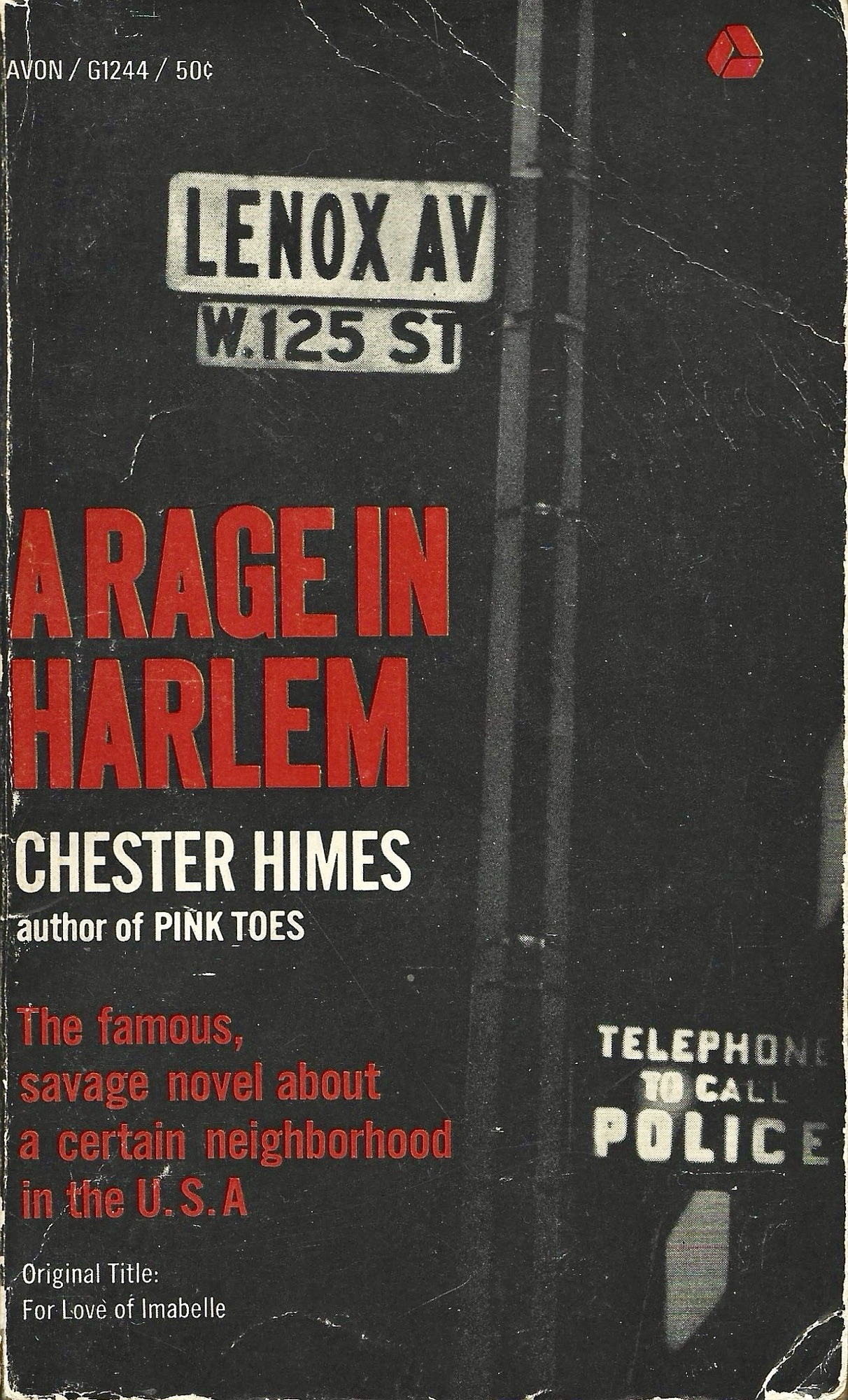
Mass-market Monday | Chester Himes’ A Rage in Harlem

A Rage in Harlem, Chester Himes. Avon Books (1965). No cover artist or designer credited. 192 pages.

Himes’ A Rage in Harlem is a quick, mean, sharp read. I came to Himes via Ishmael Reed, who wrote of the author in a 1991 LA Times review of Himes’ Collected Stories,

James Baldwin, another proud and temperamental genius, said that if he hadn’t left the United States he would have killed someone. The same could be said of Chester Himes, the intellectual and gangster who left the United States for Europe in the 1950s. He achieved fame abroad with his Harlem detective series, which are remarkable for their macabre comic sense and wicked and nasty wit so brilliantly captured in Bill Duke’s A Rage in Harlem.

Mass-market Monday | Guillermo Cabrera Infante’s Three Trapped Tigers

Three Trapped Tigers, G. Cabrera Infante. Translated by Donald Gardner and Suzanne Jill Levine with Guillermo Cabrera Infante. Avon Bard (1985). No cover artist or designer credited. 473 pages.

A busy buzzy book honking and howling and hooting, I am loving loving loving Three Trapped Tigers—it sings and shouts and hollers. The novel starts with a  polyglossic emcee announcing the parade of honorable horribles who will strut through the novel (if it is indeed a “novel”). Very funny, very engrossing, grand stuff, love it.

Here’s Salman Rushdie, reviewing the novel in the LRB back in 1981 (he’s just fumbled around answering “What is this crazy book actually about?”:

So much for the plot. (Warning: this review is about to go out of control.) What actually matters in Three Trapped Tigers is words, language, literature, words. Take the title. Originally, in the Cuban, they were three sad tigers, Tres tristes tigres, the beginning of a tongue-twister. For Cabrera, phonetics always come before meaning (correction: meaning is to be found in phonetic associations), and so the English title twists the sense in order to continue twisting the tongue. Very right and improper. Then there is the matter of the huge number of other writers whose influence must be acknowledged: Cabrera Infante calls them, reverently, Fuckner and Shame’s Choice. (He is less kind to Stephen Spent and Green Grams, who wrote, as of course you know, Travels with my Cant.) Which brings us to the novel’s most significant character, a sort of genius at torturing language called Bustrofedon, who scarcely appears in the story at all, of whom we first hear when he’s dying, but who largely dominates the thoughts of all the Silvestres and Arsenios and Codacs he leaves behind him. This Bustromaniac (who is keen on the bustrofication of words) gives us the Death of Trotsky as described by seven Cuban writers – a set of parodies whose point is that all the writers described are so pickled in Literature that they can’t take up their pens without trying to wow us with their erudition. Three Trapped Tigers, like Bustrofedon’s whole life, is dedicated to a full frontal assault on the notion of Literature as Art. It gives us nonsense verses, a black page, a page which says nothing but blen blen blen, a page which has to be read in the mirror: Sterne stuff. But it also gives us Bustrolists of ‘words that read differently in the mirror’: Live/evil, drab/bard, Dog/God; and the Confessions of a Cuban Opinion Eater; and How to kill an elephant: aboriginal method ... the reviewer is beginning to cackle hysterically at this point, and has decided to present his opinion in the form of puns, thus: ‘The Havana night may be dark and full of Zorro’s but Joyce cometh in the morning.’ Or: ‘Despite the myriad influences, Cabrera Infante certainly paddles his own Queneau.’

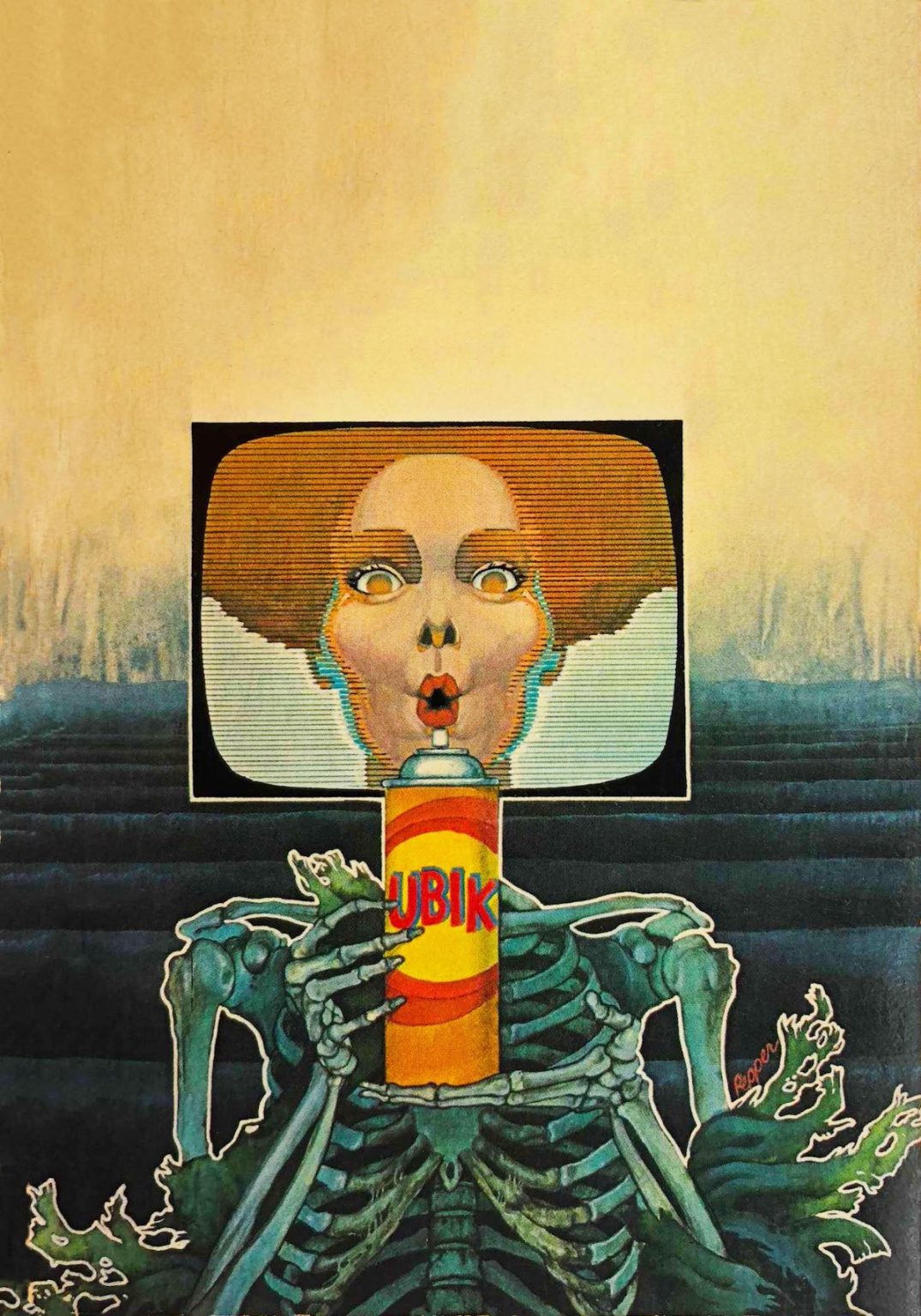
Ubik — Bob Pepper

Cover art for Philip K. Dick’s Ubik, 1982 by Bob Pepper (1938-2019). Via/more.

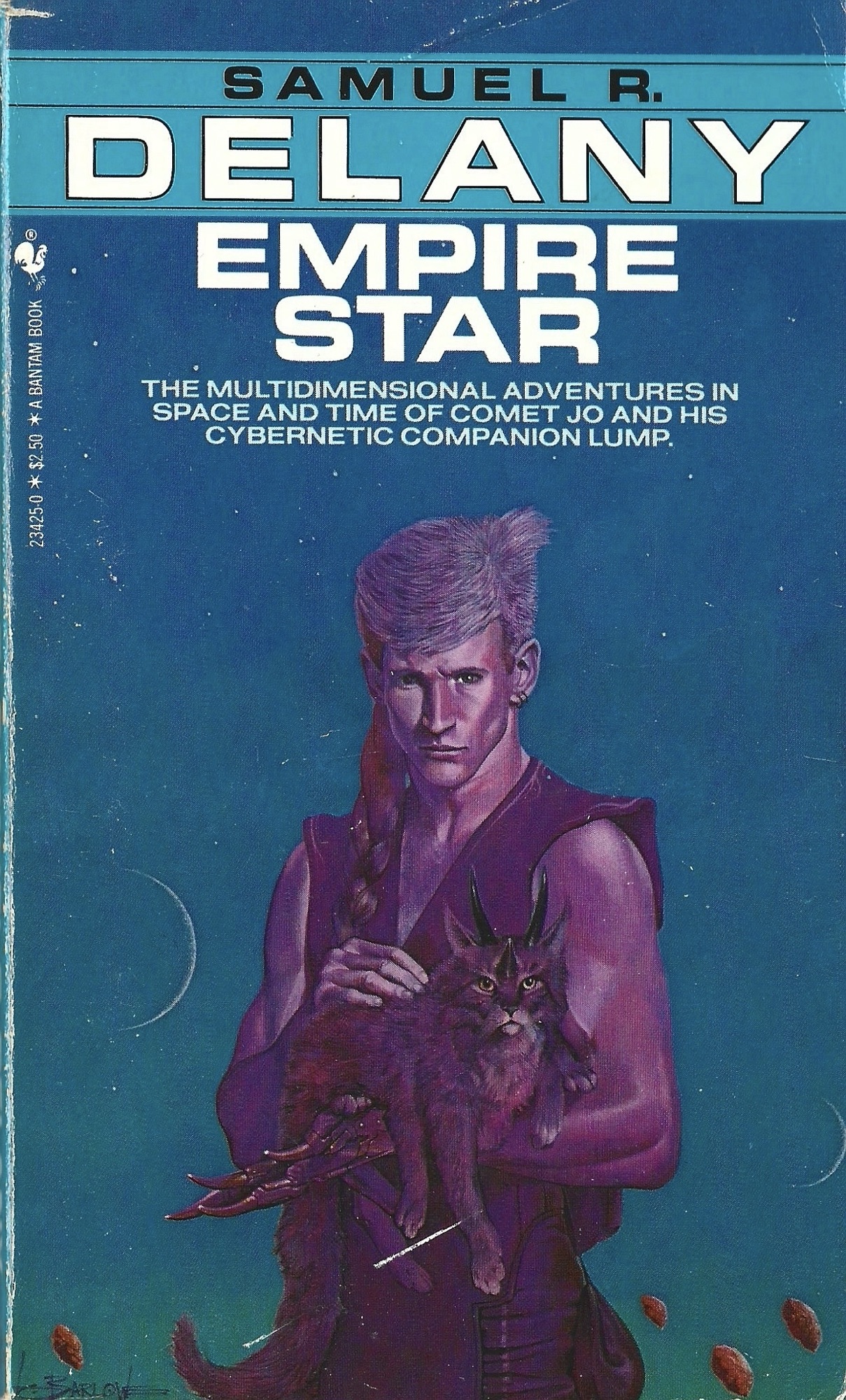
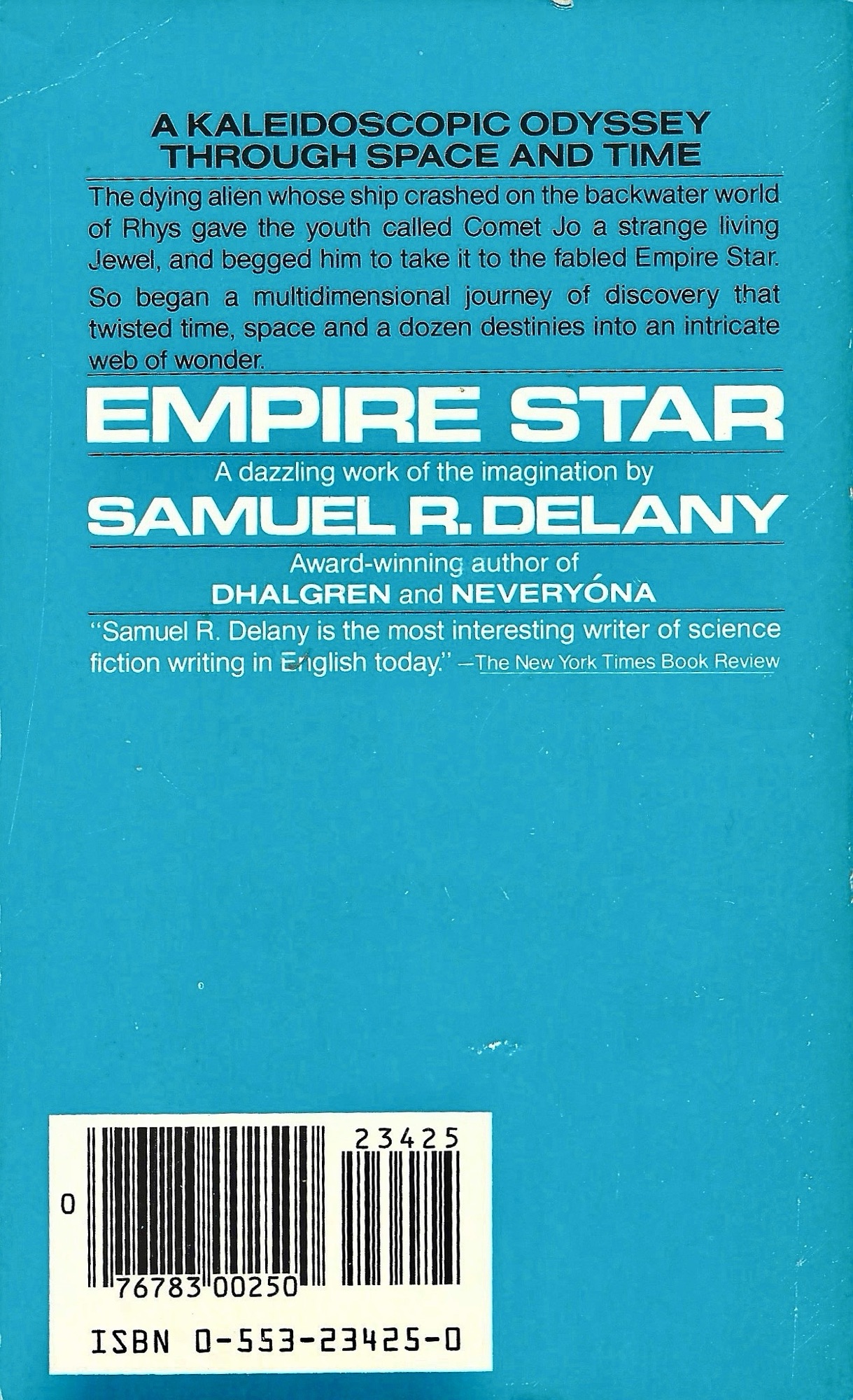
Mass-market Monday | Samuel R. Delany’s Empire Star

Empire Star, Samuel R. Delany. Bantam Books (1983). No cover artist credited. 132 pages.

Although he is not formally credited, the cover artist is Wayne Barlowe. I still haven’t read Delany’s 1966 novella, but I think I might read it this weekend.

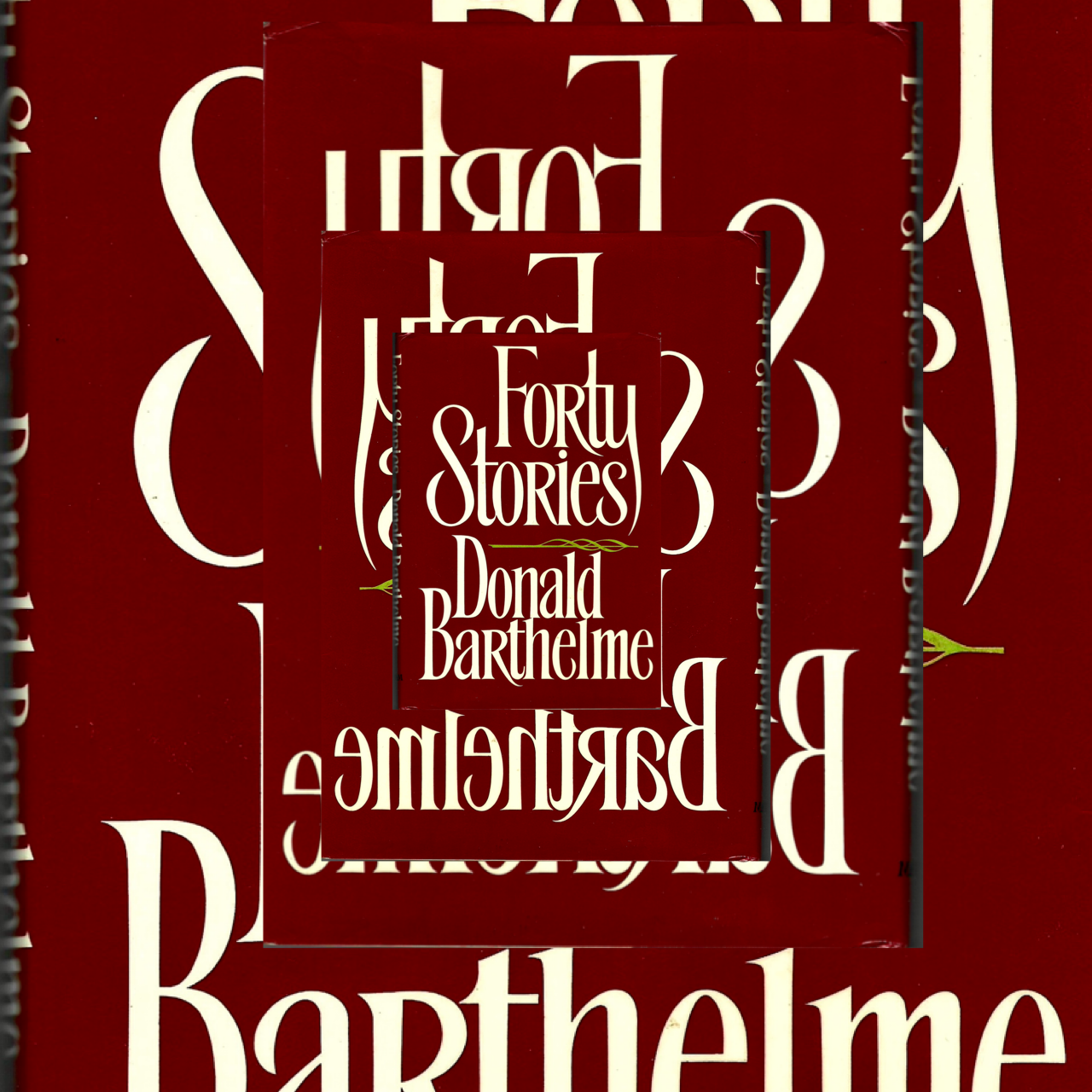
Donald Barthelme’s Forty Stories in reverse, Part III

Previously,

Stories 40-36

Stories 35-32

31. “Sakrete” (first published in The New Yorker, 25 Sep. 1983)

“Sakrete” is a silly little domestic riff about garbage can theft, rats, and an alcoholic trying to work with concrete. It’s not a very good story and I have no idea why it was included in Forty Stories. I do like that it shows a general respect for garbage cans and garbage collection (very interested parties should check out Stephen Dixon’s excellent novel Garbage). Here is the last paragraph, the highlight of the story:

 There are now no garbage cans on our street—no garbage cans left to steal. A committee of rats has joined with the Special Provisional committee in order to deal with the situation, which, the rats have made known, is attracting unwelcome rat elements from other areas of the city. Members of the two committees exchange secret grips, grips that I know not of. My wife drives groups of rats here and there in her yellow Pontiac convertible, attending important meetings. The crisis, she says, will be a long one. She has never been happier.

30. “Porcupines At The University” (Amateurs, 1976)

Another trifle—am I regretting this project, this rereading of Forty Stories? The stories in Sixty Stories are so, so much stronger—and those stories were organized chronologically. Going backwards through these is not really going backwards through time, through the artist’s anti-maturation, but rather just, like, making it more difficult to find one’s place in a book. “Porcupines” is a goof on academia that — and I say this as a compliment — at best reads like an alcoholic’s surrealist riff on a college film. Skip it!

29. “The Catechist” (Sadness , 1972)

This is a good story, “The Catechist.” But also a very Catholic one, without being, like, small-c catholic. There’s a bit of narrativizing here that Barthelme would eventually dispense with in his dialogues, the form that he would eventually settle on for his short stories. I say “settle on” but Barthelme died quite young, or, it seems to me, at 45, quite young—dying at 58. Barthelme died from throat cancer, probably a result of his alcoholism (pure conjecture on my part, this last clause):

The catechist reads from his book. “The candidate should be questioned as to his motives for becoming a Christian.”
I think: My motives?
He says: “Tell me about yourself.”
I say: “I’m forty. I have bad eyes. An enlarged liver.”
“That’s the alcohol,” he says.
“Yes,” I say.
“You’re very much like your father, there.”
“A shade more avid.”

28. “Lightning” (Overnight to Many Distant Cities, 1983)

This is a great story. Or at least a very good story, unexpectedly so, written a mode approaching near-realism or even near-dirty-realism. Was Barthelme flexing his muscles in the mirror after having read a story by Raymond Carver? Probably not, but I like to imagine it (I imagine his muscles beefier and musclier than they likely were). “Lightning” has a fairly straightforward ( and unBarthelemesque) plot:

Edward Connors, on assignment for Folks, set out to interview nine people who had been struck by lightning. “Nine?” he said to his editor, Penfield. “Nine, ten,” said Penfield, “doesn’t matter, but it has to be more than eight.” “Why?” asked Connors, and Penfield said that the layout was scheduled for five pages and they wanted at least two people who had been struck by lightning per page plus somebody pretty sensational for the opening page. “Slightly wonderful,” said Penfield, “nice body, I don’t have to tell you, somebody with a special face. Also, struck by lightning.”

The story is ultimately a romantic comedy, with reporter Edward finally finding his “face”:

People would dig slant wells for this woman, go out into a producing field with a tank truck in the dead of night and take off five thousand gallons of somebody else’s crude, write fanciful checks, establish Pyramid Clubs with tony marble-and-gold headquarters on Zurich’s Bahnhofstrasse. What did he have to offer?

He finds something to offer. This is probably the best one yet in Forty Stories (in reverse, anyway).

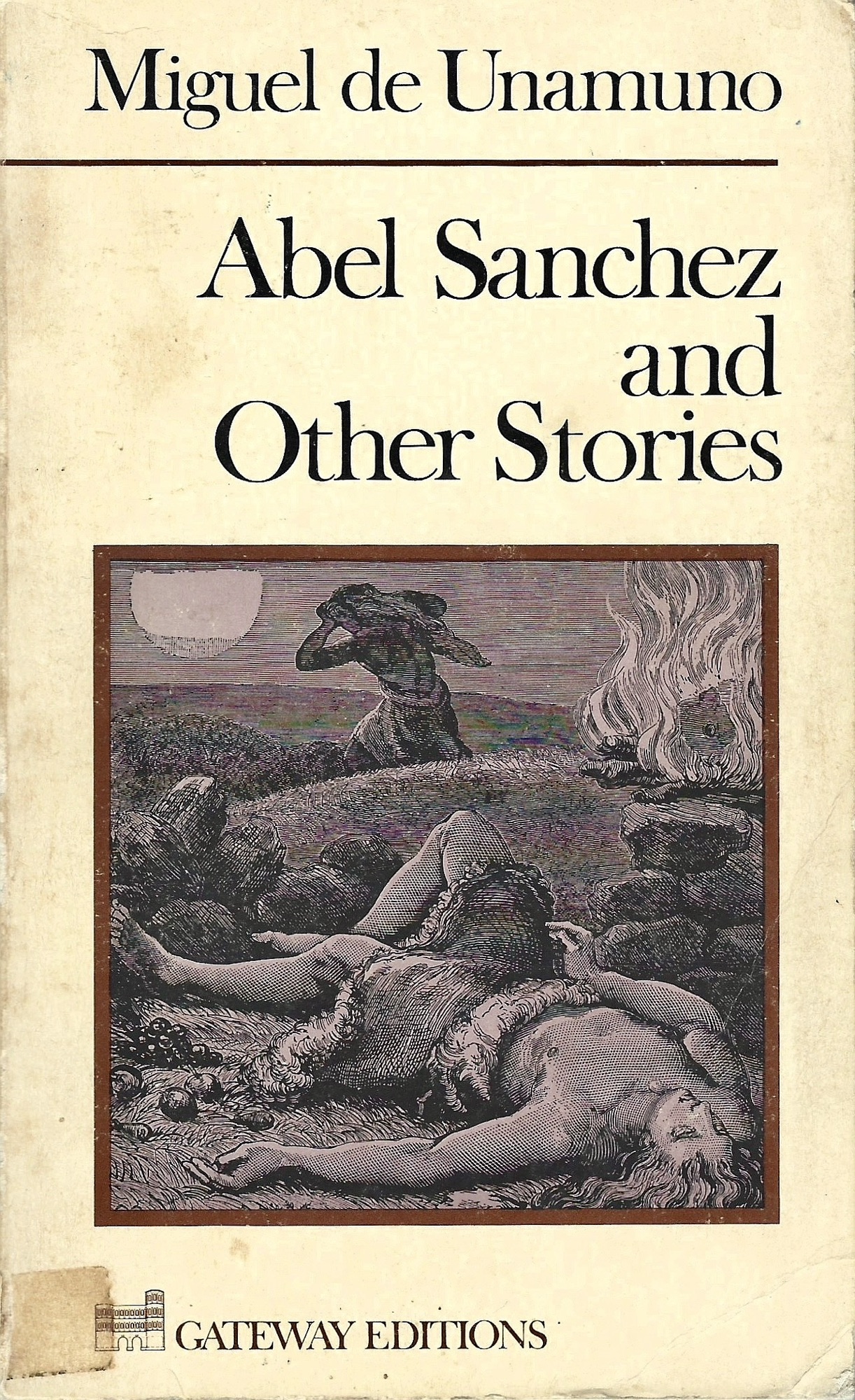
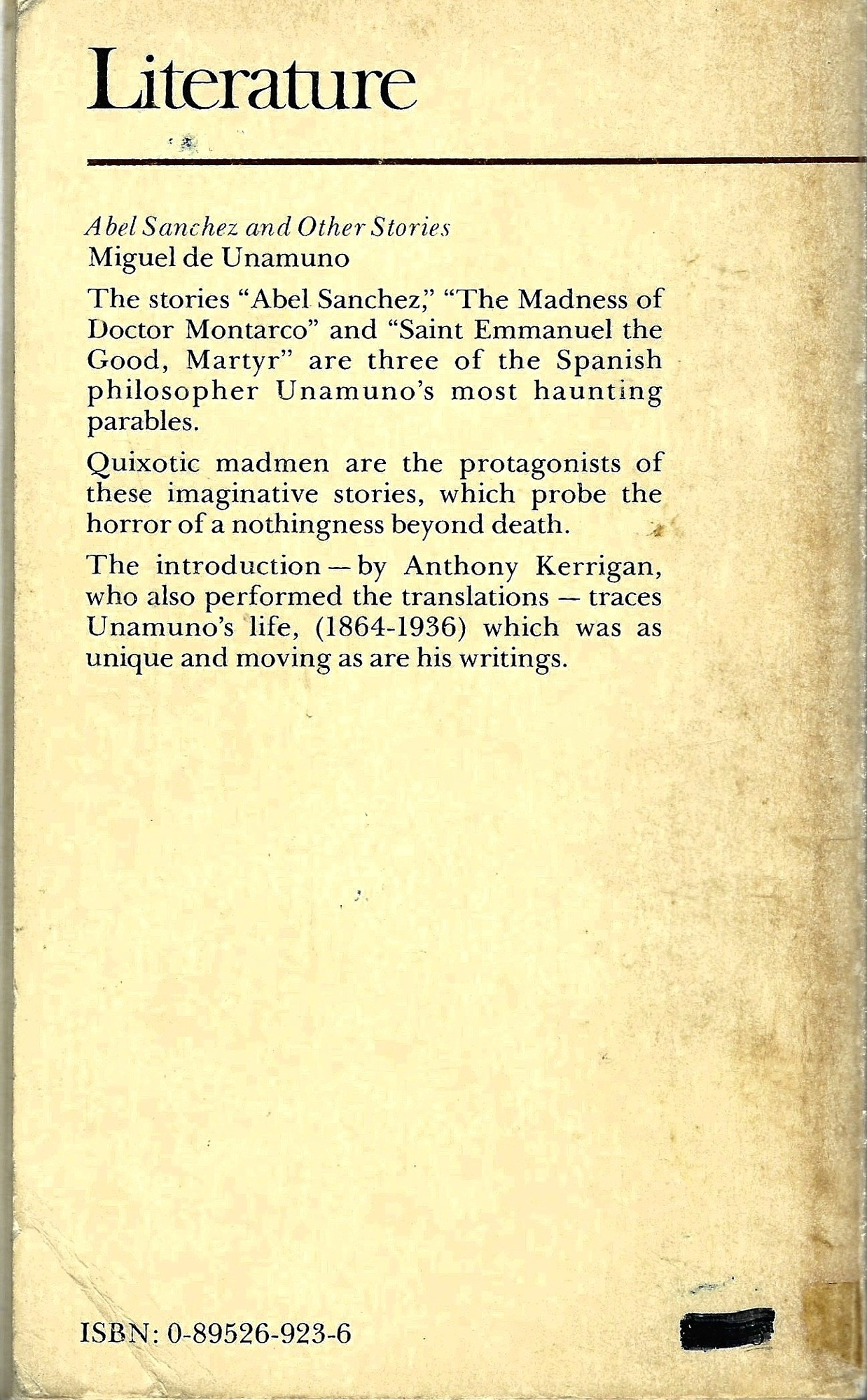
Mass-market Monday | Miguel de Unamuno’s Abel Sanchez and Other Stories

Abel Sanchez and Other Stories, Miguel de Unamuno. Translated by Anthony Kerrigan. Regnery Gateway (1956). No cover designer or artist credited; cover image credited to the Bettman Archive. 267 pages.

I wrote a bit about the collection back in February:

A few weeks ago, I picked up Anthony Kerrigan’s translation of Miguel de Unamuno’s Abel Sanchez and Other Stories based on its cover and the blurb on its back. I wound up reading the shortest of the three tales, “The Madness of Dr. Montarco,” that night. The story’s plot is somewhat simple: A doctor moves to a new town and resumes his bad habit of writing fiction. He slowly goes insane as his readers (and patients) query him about the meaning of his stories, and he’s eventually committed to an asylum. The tale’s style evokes Edgar Allan Poe’s paranoia and finds an echo in Roberto Bolaño’s horror/comedy fits. The novella that makes up the bulk of the collection is Abel Sanchez, a Cain-Abel story that features one of literature’s greatest haters, a doctor named Joaquin who grows to hate his figurative brother, the painter Abel. Sad and funny, this 1917 novella feels contemporary with Kafka and points towards the existentialist novels of Albert Camus. (I’m saving the last tale, “Saint Manuel Bueno, Martyr,” for a later day.)

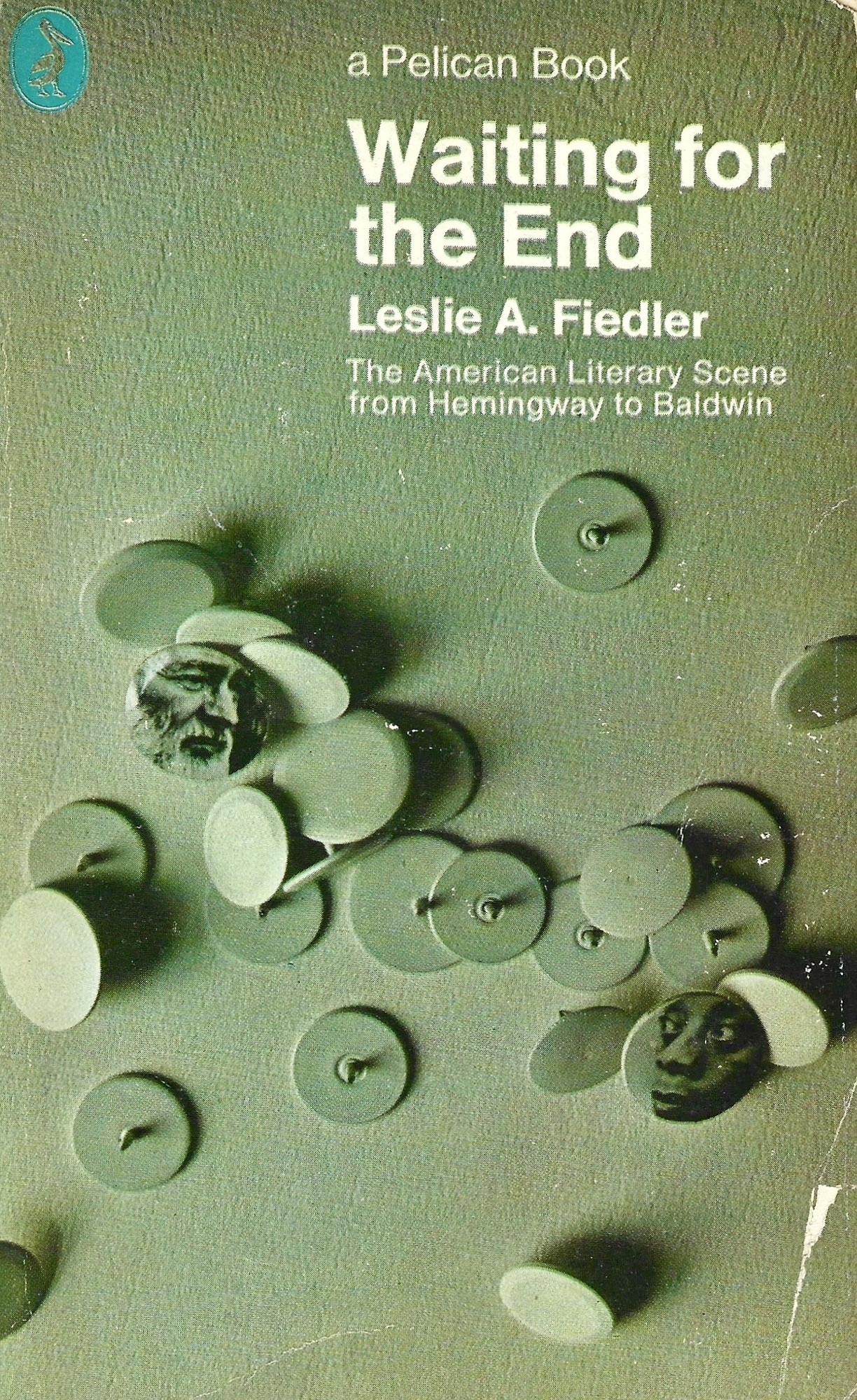
Mass-market Monday | Leslie A. Fiedler’s Waiting for the End

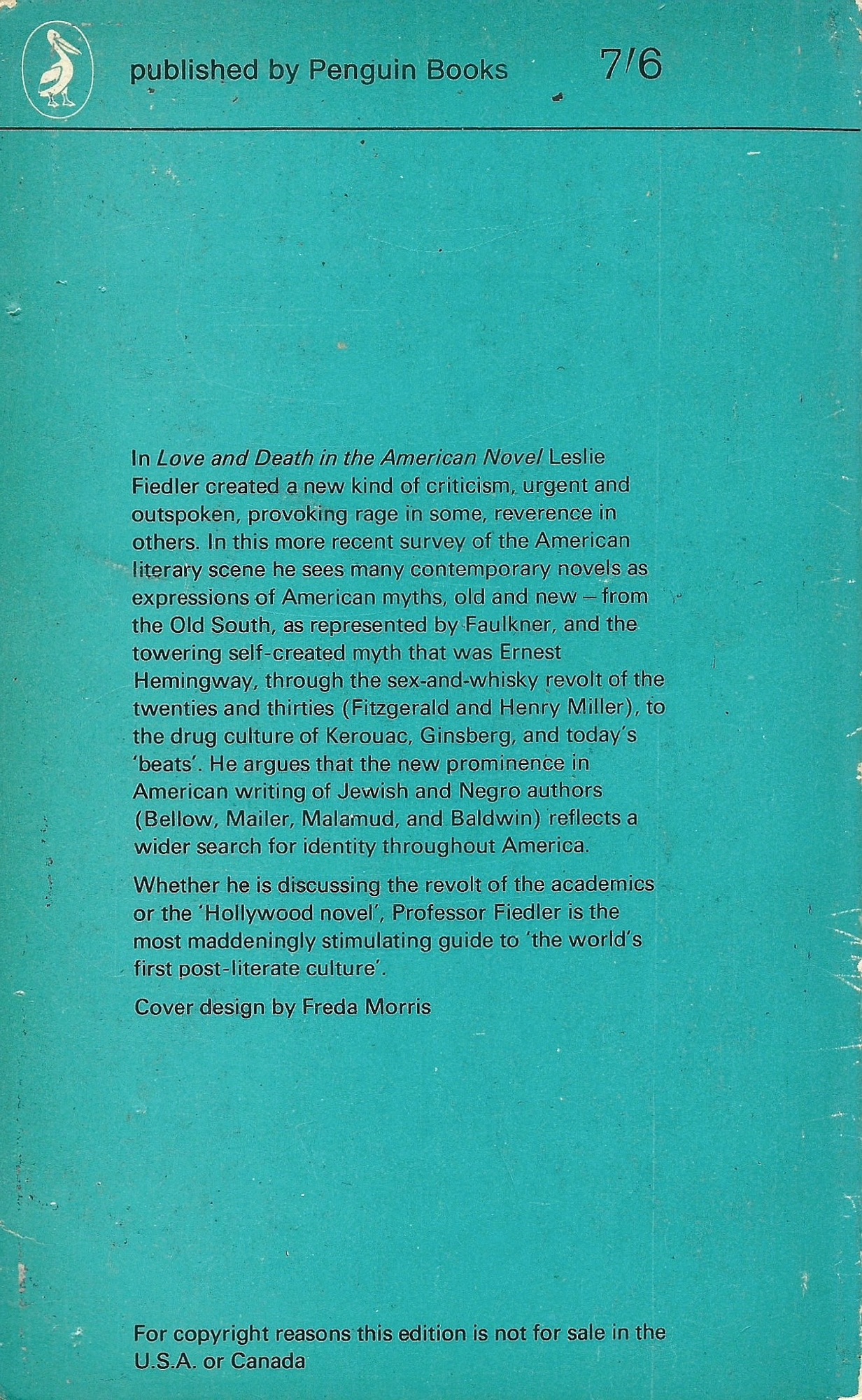
Waiting for the End, Leslie A. Fiedler. Penguin Books, Pelican imprint (1967). Cover design by Freda Morris. 274 pages.

From a riff a few years back:

Fiedler begins with the (then-recent) deaths of Hemingway and Faulkner. Fiedler uses the deaths of these “old men” to riff on the end of Modernism, although he never evokes the term. Neither does he use the term “postmodernism” in his book, although he edges towards it in his critiques of kitsch and middlebrow culture, and especially in his essay “The End of the Novel.” In parts of the book, he gets close to describing, or nearing a description of, an emergent postmodernist literature (John Barth and John Hawkes are favorite examples for Fiedler), but ultimately seems more resigned to writing an elegy for the avant garde. Other aspects of Waiting for the End, while well-intentioned, might strike contemporary ears as problematic, as the kids say, but Fiedler’s sharp and loose style are welcome over stodgy scholarship. Ultimately, I find the book compelling because of its middle position in its take on American literature. It’s the work of a critic seeing the beginnings of something that hasn’t quite emerged yet—but his eye is trained more closely on what’s disappearing into the past.

Donald Barthelme’s Forty Stories in reverse, Part II

Previously,

Stories 40-36

35. ” Overnight to Many Distant Cities” (Overnight to Many Distant Cities, 1983)

In Hiding Man, his 2010 Barthelme biography, Tracy Daugherty notes that Barthelme’s collection Overnight to Many Distant Cities was not particularly well-received by critics. Reviews were a mix of bafflement and derision, as Daugherty has it, which fits the tone near the end of Hiding Man: a career winding-down—Barthelme a happy father, content with a teaching gig, and committed to a new form for his stories, now pared down to spare and often oblique dialogues. Daugherty relays a detail from a rejection letter from Barthelme’s (one-time) champion at the New Yorker, Roger Angell: “Well, maybe we’ll learn to read you. It won’t be the first time that happened.”

In my estimation, Barthelme’s later stories do not diverge too radically from his earlier work. The techniques may have evolved (or devolved, if you like), but collage and pastiche are still a major mode, domestic themes prevail, and Our Bard is ever the ironist.

Barthelme sprinkles vignettes throughout Overnight to Many Distant Cities (like Hemingway’s In Our Time); its title track, coming at the end of the collection, is a travelogue in vignettes with our narrator and his family visiting places like Paris, London, Copenhagen… The story is essentially a series of anecdotes and arch asides (“Asked her opinion of Versailles, my daughter said she thought it was overdecorated”), and, as Barthelme’s wife Marion disclosed in Daugherty’s book, some of the material was directly drawn from their honeymoon in Barcelona (“In Barcelona the lights went out”). A taste:

In Stockholm we ate reindeer steak and I told the Prime Minister… That the price of booze was too high. Twenty dollars for a bottle of J&B! He (Olof Palme) agreed, most politely, and said that they financed the Army that way. The conference we were attending was held at a workers’ vacation center somewhat outside the city. Shamelessly, I asked for a double bed, there were none, we pushed two single beds together. An Israeli journalist sat on the two single beds drinking our costly whiskey and explaining the devilish policies of the Likud. Then it was time to go play with the Africans. A poet who had been for a time a Minister of Culture explained why he had burned a grand piano on the lawn in front of the Ministry. “The piano,” he said, “is not the national instrument of Uganda.”

Is it essential Barthelme? Of course not. But it’s nice enough.

34. ” The Film” (first published as “A Film” in the The New Yorker, September 26, 1970)

A nice little story that never quite transcends it’s marvelous opening lines:

Things have never been better, except that the child, one of the stars of our film, has just been stolen by vandals, and this will slow down the progress of the film somewhat, if not bring it to a halt. But might not this incident, which is not without its own human drama, be made part of the story line?

I just went back and read the last lines though, and they are also very good:

Truth! That is another thing they said our film wouldn’t contain. I had simply forgotten about it, in contemplating the series of triumphs that is my private life.

33. “110 West Sixty-First Street” (Amateurs, 1976)

An ugly tragic domestic comedy in just over a dozen paragraphs: Paul and Eugenie are trying to get over the death of their infant by going to erotic films. It doesn’t work; they take up cruelty–

“You are extremely self-righteous,” Eugenie said to Paul. “That is the one thing I can’t stand in a man. Sometimes I want to scream.”

“You are a slut without the courage to go out and be one,” Paul replied. “Why don’t you go to one of those bars and pick up somebody, for God’s sake?”

“It wouldn’t do any good,” Eugenie said.

32. “Captain Blood” (Overnight to Many Distant Cities, 1983)

So like one of my favorite things that Melville does in Moby-Dick is turn the whole thing into a drama, a play that is taking place in the narrator-cum-Ishmael’s consciousness, with Starbuck and Stubb milling and mulling on various decks, soliloquizing. And while the Captain Blood of “Captain Blood” is no Ahab, he’s still a compellingly goofy brooder:

Blood, at dawn, a solitary figure pacing the foredeck. The world of piracy is wide, and at the same time, narrow. One can be gallant all day long, and still end up with a spider monkey for a wife. And what does his mother think of him?

This isn’t Barthelme at his best—that stock was poured into Sixty Stories—but it’s still the jaunty, boyish fun flavor that I want when I dip into his stuff.

Mass-market Monday | Ignácio de Loyola Brandão’s Zero

Zero, Ignácio de Loyola Brandão. Translated by Ellen Watson. Avon Bard (1983). No cover artist or designer credited. 317 pages.

A very strange fragmentary hallucinatory novel. A few pages:

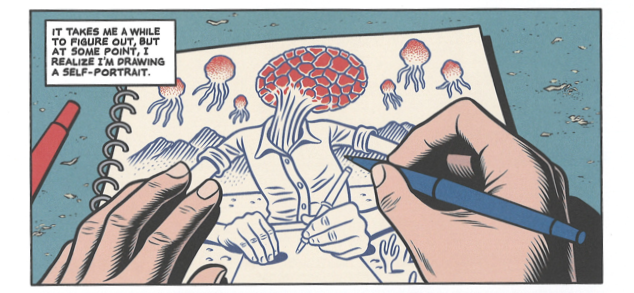
Charles Burns’ Final Cut explores the irreal reality of artistic ambition

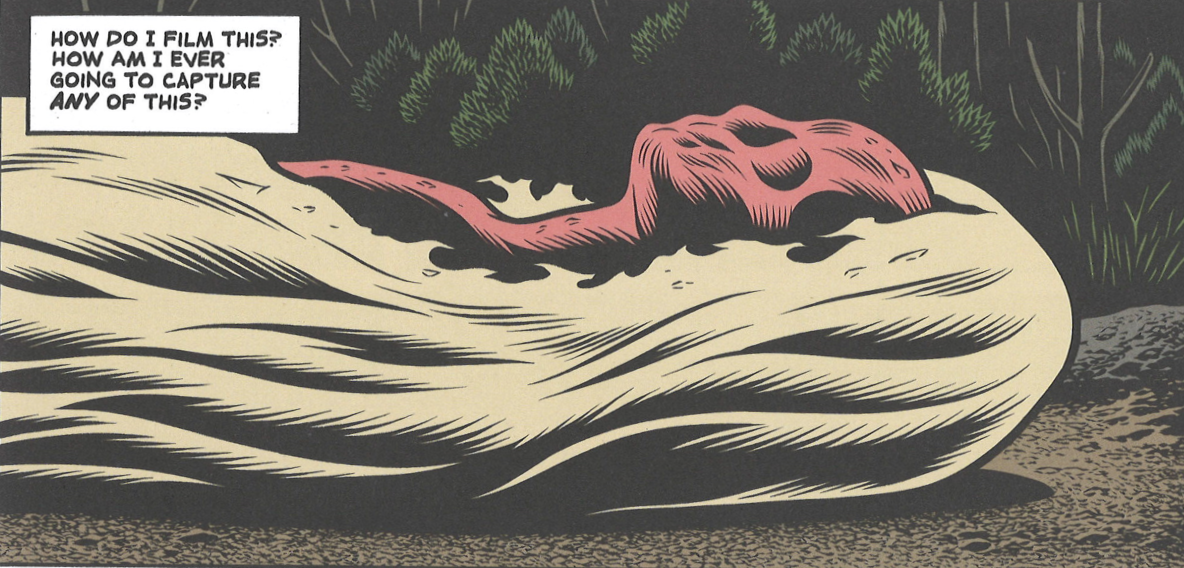
Charles Burns’ latest graphic novel Final Cut tells the story of Brian, an obsessive would-be auteur grappling with an unrealized film project. Brian hopes to assemble his film — also titled Final Cut — from footage he shoots with friends on a weekend camping trip, but the messiness of reality impinges the weird glories of his vibrant imagination. He cannot bring his vision to the screen. He cannot capture all the “fucked-up shit going on inside my head.”
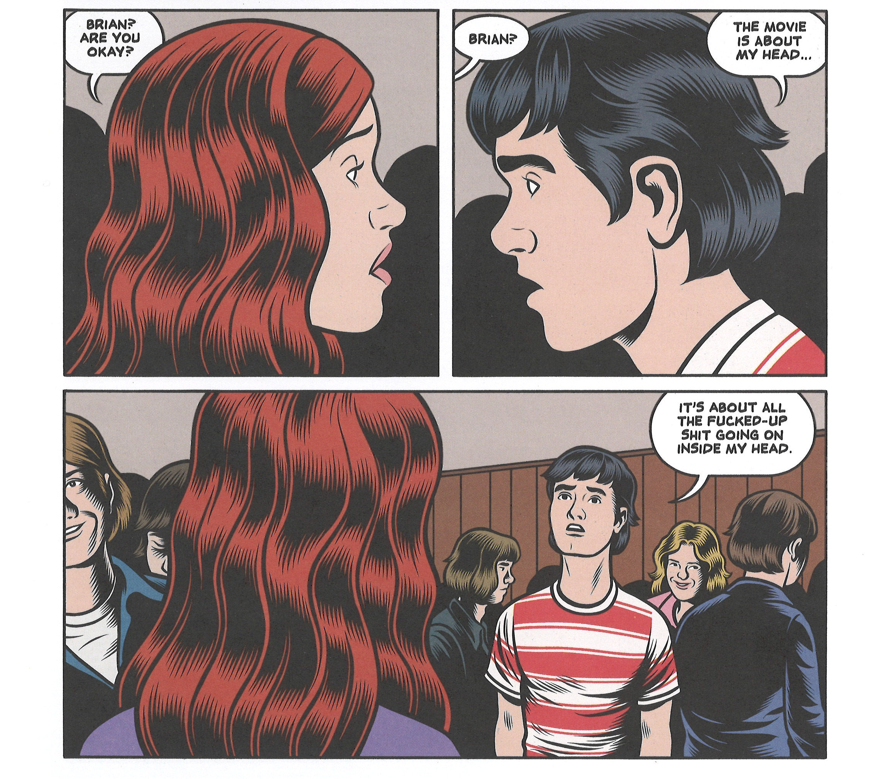
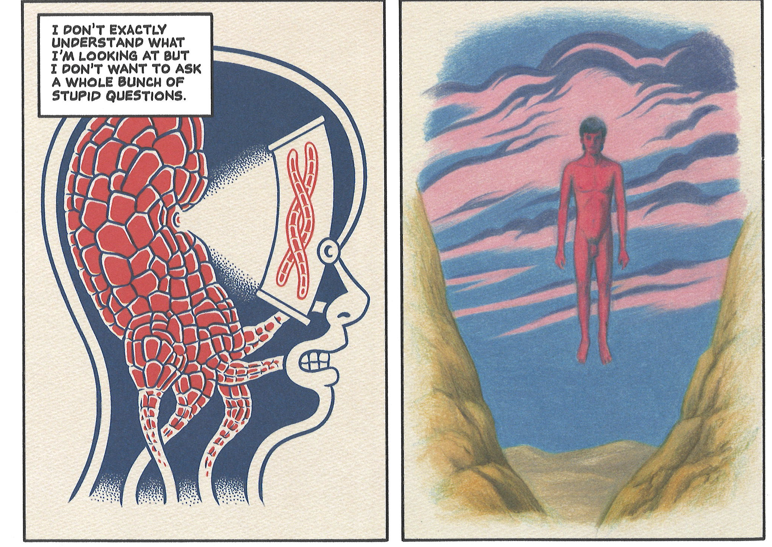
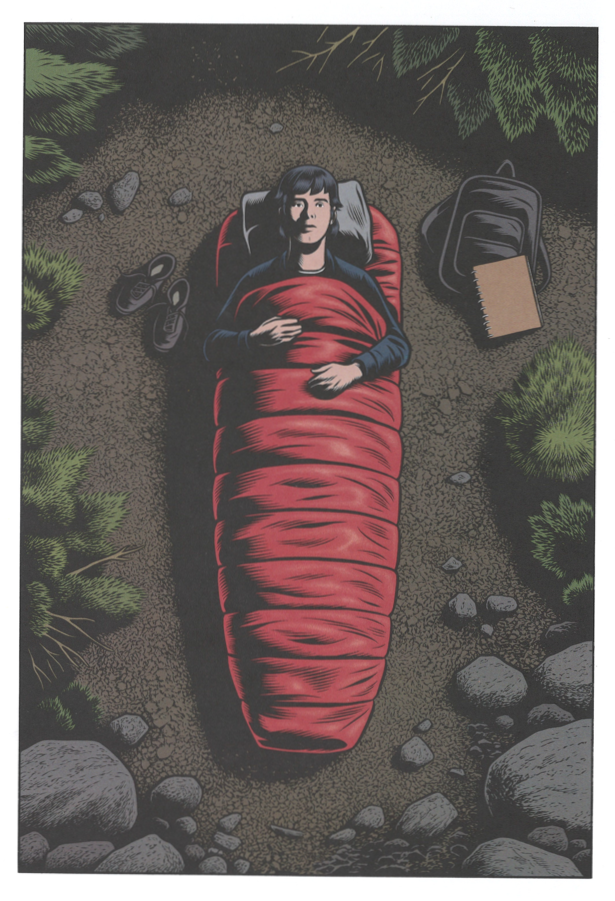
Capturing all the fucked-up shit going on inside my head is a neat encapsulation of the Artistic Problem in general. It’s not that Brian doesn’t try; if anything, he tries too hard. His best friend and erstwhile cameraman Chris is there to help him, along with his crush Laurie and their friend Tina—but ultimately, these are still kids at play. They indulge Brian’s artistic whims, but at a certain point they’d rather swim, drink, and smoke than shoot yet another scene they can’t comprehend.

Eschewing straightforward narrative conventions, Final Cut unfolds in a blend of flashbacks, dreamscapes, and flights into Brian’s imagination. The book also gives over to Laurie’s consciousness, providing an essential ballast of realism to anchor Brian’s (and Burns’, I suppose) surrealism. Brian would have Laurie as his muse, trying to capture her in his sketchbook, in his film, and in the intense gaze of his mind’s eye. And while Laurie is fascinated by Brian’s visions, she doesn’t understand them.

The last member of Brian’s would-be acting troupe is Tina, an earthy, funny gal who drinks a bit too much. She plays foil to Brian’s ambitions; her animated spirit punctures the seriousness of his film shoot. Again, these are just kids in the woods with a camera and camping gear.

And the film itself? Well, it’s about kids camping in the woods. And an alien invasion. And pod people.

The pod-people motif dominates Final Cut. We get the teens in their larval sleeping bags, transformed into aliens in their cocoons (echoed again in Brian’s imagination and in his sketches). The motif looms larger: Can we really know who a person is? Could they be someone else entirely? Can we really ever know all the fucked-up shit going on inside their head?

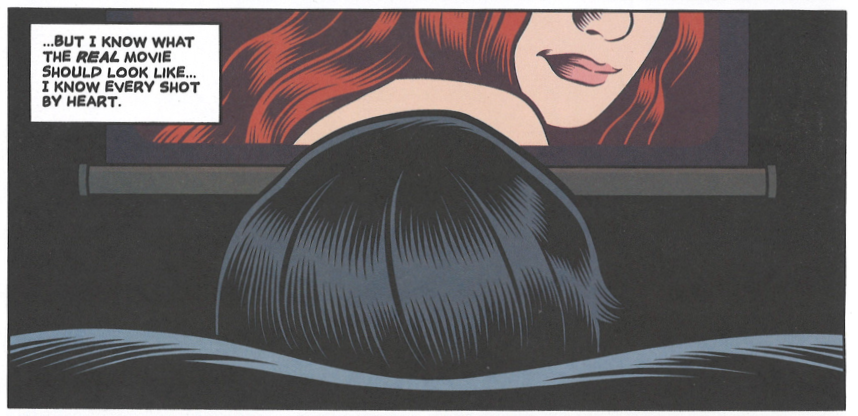
Indeed, Don Siegel’s 1956 film Invasion of the Body Snatchers is a major progenitor text for Final Cut. Brian even takes Laurie on a date to a screening of Invasion; he’s so mesmerized by the film that he weeps. Burns renders stills from the film in heavy chiaroscuro black and white, contrasting with the vibrant reds, maroons, and pinks that reverberate through the novel.

Burns recreates stills from another black and white film, Peter Bogdanovich’s 1971 coming-of-age heartbreaker The Last Picture Show. Again, Brian is obsessed with the film—or by the film, perhaps. In particular, he’s infatuated with Cybill Shepherd’s Jacy, whose character he imaginatively merges with his conception of Laurie.

While Invasion of the Body Snatchers is a science-fiction horror film, a deep sense of reality-soaked dread underpins it; The Last Picture Show is utterly real in its evocations of the emotional and physical lives of teenagers. Both films convey a maturity and balance of the fantastic with the real that Brian has not yet purchased via his own experiences, his own failures and heartbreaks. 

The maturity and balance that Brian can imagine but not execute in his Final Cut is precisely the maturity and balance that Burns achieves in his Final Cut. Simply put, Final Cut is the effort of a master performing at the heights of his power, rendered with inspired technical proficiency. It delivers on themes Burns has been exploring from the earliest days of his career.

There’s the paranoia and alienation of adolescence Burns crafted in Black Hole, here delivered in a more vibrant, cohesive, and frankly wiser book. There’s the hallucinatory trauma and repression he conveyed in the X’ed Out trilogy (collected a decade ago as Last Look, the title of which prefigures Final Cut). There’s also an absence of parental authority here, a trope that Burns has deployed since 1991’s Curse of the Molemen. (In Final Cut, Brian’s mentally-unstable mother is a dead-ringer for Mrs. Pinkster, the domestic abuse victim rescued by the child-hero of Curse of the Molemen). There’s all the sinister dread and awful beauty that anyone following Burns’ career would expect, synthesized into his most lucid exploration of the inherent problems of artistic expression.

Ultimately, in Final Cut Charles Burns crafts a portrait of the artist as a weird young man. Brian wrestles with the friction sparked from his vital imagination butting up against cold reality. His ambitious unfinished film mirrors his own incomplete journey as an artist, highlighting the clash between youthful creative fervor and the inevitable constraints of life, experience, and maturity. Burns’ themes of alienation and artistic ambition may be familiar, but Final Cut feels fresh and vibrant, the culmination of the artist’s own entanglements with the irreality of reality. Highly recommended.

Stevenson’s The Strange Case of Dr. Jekyll and Mr. Hyde, but just the punctuation

. ; , ; ; , , , . , , ; , – , . ; , ; , . ; , , ; . ” ‘ , ” : ” . ” , . , , . . ; , – . – ; ‘ . ; , , , . , . , , – . , , . , , . , , , , , . – . , . , , ; , . , , , ; , – , , . , ; . ; , ; , . , , . ; ; ; , . . – ; , . ” ? ” ; , ” , ” , ” . ” ” ? ” . , , ” ? ” ” , , ” . : ” , ‘ , . — — , — — . , : , . , , ; ; ‘ . , . ‘ ; . , , , . , , . ‘ ; , , . , , , ; . . . ‘ , . ‘ . , , . , , ; , . , ; , . . , . , , . ; , — — , — — , , . ‘ , ‘ , ‘ . , ‘ . ‘ . ‘ , ‘ ; ; , . ; ? — — , , ‘ , ‘ , ‘ , . ; . , , , ‘ . . ‘ , ‘ , ‘ . ‘ , , ‘ , , ; , , . , . . . ” ” – ! ” . . ” , ” . . ” , ‘ . , ; , , ( ) . , ; . , . , , , ” , . . : ” ‘ ? ” ” , ‘ ? ” . . ” ; . ” ” — — ? ” . . ” , ; , ” . ” ; . , ‘ . ; , ; ( ) . , : , . ” ” , , ” . ” , ” . . ” . , , , . ; ; ‘ . ; . ‘ ; , ‘ . ” ; ” , ” . , ” ‘ . ” ” , , ” . ” , ” , ” ‘ . . ” ” , ” . , ” ‘ . . ” ” , ” . . ” ? ” ” . ; , – . , . ; , ‘ . ‘ , . , ; ; ‘ . ‘ ; . ” . . ” ? ” . ” . . . ” , . ” , , ” ; ” . , , . , , . . ” ” , ” . ” , . ; ‘ , . . ” . ; . ” , ” . ” . . ” ” , ” . ” , . ” . . . , , , , , . , , . , . ‘ . , . , ; , , . . , . . . , . . . , . . . , . , ” , ” . ‘ ” , ” ‘ ‘ . ‘ . , . . ; , , . . ; , , , . ” , ” , , ” . ” , , , , , . , . ” , , ” . ; , – . . , , , – , , . . , . , , ; . , , , , ‘ . , . ” , , ” , ” ? ” ” , ” . . ” . ? . ” ” ? ” . ” . ” ” , ” . ” . , ; ‘ , , . , ” , , ” . ” . . ” , ” ; ( ) , : ” ! ” , . ” — — ? ” . ” ? ” . ” . . . ” , , . , . ‘ . ‘ , . ; , ; , . ‘ . ; ; ‘ ; , . , , ; , , , ! , , . ; , , , , , . ; , , ; ‘ , , . . , , . ‘ ( ) . : : , , . , . – . , , , , . ” . , ” , ” . . ” . ; ; ; , , . ‘ , , – , , . ; ; . . , . , , , . ; , . , . , , . , , ‘ . , ; , . . . ” . , ? ” . . ; , : ” . ? ” ” , ” . ” . ‘ — — . — — ; , . ” ” . ; , ” . , . , , ” ? ” . ” , ” . ” ? ” ” , ” . ” ? ” ” ? ” . . , , , ; . ” , ” . . ” . ” ” , ” . , ” ; , . ” . ” ! ” . , ” , , ? ” . ” , ” , ” ? ” ” , ” . ” ? ” ” , ” . . ” , ” . , . ” ? ” ” , , ” . ” , ” . , . ” . ” ” , ” . , ” . ” ; , , . . , . , . , . . , , , , , ; , , . . ” , ” . ” , . , ! , ? . ? , , ? , ; , , ‘ , . ” – , , , ; – , , . , , , ; , , , . . – , . ” . , ? ” . ” , . , ” , , , , – , , ( ) , , . ” , ? – ? ” ” , , ” , . , , ‘ ; . ; ; ( ) ; , . , . . ” . , , ” . ” , . ? ” ” , . , , ” . ” . . ” ” , , ” . ” , , , ” . ” . ” ” . ? ” . ” , , . , ” . ” ; . ” ” , – , . ” ” – , . . ” . ” , ” , ” ! ; ; , . , ; , : , , – . ” , , , , – – – . ; ; , . , . ” , , ” , ” ; , ; ‘ . . ‘ ; , ! ; , . , — — , ” , ” . ” ‘ , , . . , , , , ; . . , . , . , – – ; , , ‘ . , . ; — — , – , – , , — — . . ” , , ” . ” ? ” ; . ” , ” , ” . ; – , , . , ‘ — — ‘ — — , ; – ; , . . ” ” , ” , . ” ? , , , ” , . ” . ” ” , , ” . ” . ” . , . ” , ” . ” . ” ” , ” . ” . , ” , . ” , ; — — . . ” ” , ” , ” : . ; . ” ” , ” , ” , , . ; , , , ; ‘ ; ; , : , . . ; ; , , ‘ ‘ : , . ” , . ” , ” , . ” , , , ” , ” . . ; ; . , ; , , . , ; . ” ” ‘ , ” . ” ‘ , ” , ‘ ; ” ; , . ” . ” , ” , ” . ” , , — — , . . , . , , , ‘ , . , , , . ( , , ) , . , ; , , . ( ‘ ) . ; , , ; , , – , , – – . , . , . , ; , – . , , , ( ) . , ; . . , – , , . , . ‘ . ; , . , , ; — — , , . : , , , . . , ; , . ” , ” ; ” . . ” , . , . ” , ” , ” . . ” ” , , ” , ” ? ” . ” , ” . ” . ” , . . ; , ; , . ” . ? ” . ” – , , ” . . ; , , ” , ” , ” . ” , . – , ; , . ; – ; , , ; , , , . , , , , , , ‘ , . , , ; , ‘ , . , , , , , , , , ; , , . ‘ ; . – – . , : . , , . ‘ , ; , ; ; , ; , . ” , , , ” ; , ” , ” . ” . ” ‘ . ” ! ” , ” ! ? ” . . ” ‘ , ” . ” , , . ” , , . ; . ; , ; , ( ) , ; . , , ; , ; – ; , . , ; ; , . , ‘ , . ” , , ” . : ” . , , , . , ‘ . , . ” , , ; . — — ; ; ; , . ; . , . . ‘ , , , . ; , . ‘ ; , , , , , , . , ; , . ‘ . , , , – , . ; , ; , , . , . , . ” , ” . , , ” ? ” . ” , ” . ” – . ” ” , ” . ” , , . ? ” ” , , ” , ” . . . ; ; , ; , . ” ; ‘ . ” , ” ; ” , . , . ” ” , ” ; ” . . — — ; . , ; , ; . ” ” , , ? ” . ” , ” . ” ; . , . ” ; ‘ , . ” , ” , , ” . ” , ” ” : , , ‘ , . , , , . ; ; . ” ? ” . ” , ” , ” . . . ” ” ? ” . ” , ” . ” . ” ” , , ” . ” : ? ” ; . ” , ” . ” . . ” ” , ” : ” — — , , ! ” . , . ” , ” , ” – : ? ” ; ” , ” . . ; , , ; , , . , , : ” . . . ” ; . , , ; – , . ; , , . , , . , , , , , . , ; , ‘ . . ; , ; , . . . ; . ‘ ; ; . ‘ ; : , , ? , , ? , , ; ; . . ” , ” . ” , , . , ” . ” , , . ” ” , ” . ” ; , ; . ; : ‘ . ” ‘ , . ” , ” : ” ; . ” ” , ” . . ” . , ? ” . ” . , . ? ” ” . ? ? ” ” . , ; ” . ” , , ” , ; ” ‘ . ” , . . ” , ? ” . ” , , ” , ” ‘ ; : . ” ” , ” . ” , , , ” . ” ‘ , , ” . ” , , ” . ” . ” . , , . ” ! ” . ” ! ” . . ; , ; . . , , : ‘ , ; , , ; , . , ; , , . , . , , . . , . . , , ; , . , , ; , ; , . ‘ ; ; . , , . ” , ” , ” . ” , , ; , . ; . ‘ . ; , ‘ . – . ; ; ; ‘ , – . ; . ” , ” ; ” , ; . ” , . ” , ” , ” . . , ; ; , , . , . ” ” , , ” . ” ? ” ‘ , . ” . , ” , . ” ; . ” ” , ! ” . ; , ” ‘ ? ” . ” , ; . ” ” , ” ; ” . ” ” , ” . ” , ” . ” , , , . . , , ‘ , ; , ‘ , , . ” , , , ; , , . . ” , ” , ” . ; , , . . . , . ; , , , . ” ; , ; , ; , , , . ; ‘ , . . , . , , , , . ” : . . , , ” ; . ” – , ” : ” ? ” , . , , ” . . ” . , ; , , . , ; . , ? , ; ; . , ; , , . ; . ; ; , , , , . , , . , , , ; , , ; . , . , . . , – ; , . ” , ” , ” ‘ . . . ” ” , ” . ” , ? ” ” , ” . ” , , . ‘ ! , . ” ” , ? ” . ” , . , ; , . ” , , , , . – ; , , , . . ” ! ! ” . ” . ” ” , , ” , ” . , . ” ” , ” . ” , . . ( — — . — — . . ) ; . ” ” , ” . ” ; , , , ; . , , ; ; . , . ” ” , , ” , – , ” . ” ” , ” . , , . ; , . , , – ; , , . . ; . ” , , ” . . . , . . , . ” , , ? ” ; , ” ? ” ; ” ? ” ” . , ” , ” . ” ” , , ” . ” , , . ” ” ‘ , , ” , ” . , ‘ ; ‘ , — — . . , , ‘ . ” ” , , ” , ” . ? ” ” ‘ , ” , , ” . ” ‘ ; ; , . , , . ” , ” . ” , ” , ” , ; . . ” ” ‘ , ” , . ” ! ” , . ” ! ? ” ” ‘ , , ” ; ” ? ” . ‘ ; ‘ , , . , , , , , . , . , ; . . ; – ; , . , , , . , , , , – . , , ; , , . ” , , ” , ” , . ” ” , , ” . ; ; , ” , ? ” ” ‘ , ” . ” . ” , , ; ; , , . . , ; , ” ! ‘ . , ” . ” , ? ? ” . ” , ; . ” ” ‘ , ” . , ; . ” ! ” , ; , , . ” , ” , – , ” , ‘ . ” . , . ” , , ” , ” . , ‘ . , , , ‘ . ” . ‘ , – , ; , , . ; , , . ” . , , , ” ; , . : ” , ” . ” , , ” , ; , . , . ” , ” , . , ” ‘ ? ” ” , ” , , . ” ? , , , ” . ” ‘ , ? , ; ‘ ; , ; ‘ , , , . ! ” ” , ; , ” . , . ” , . — — , , ? ‘ ; ‘ . ” ” , . , , ‘ , ” . ” ( ) , , , . — — ‘ , — — . ‘ ; , , . , , , , , , . , , , . , , . ” ” ? ” . . , , , . : ” . . . . — — , . . . . , , . . . . . ” , , ‘ . ” ‘ , ” , ” . ” ” , ” . ; , ” ? ” ” ‘ , , , ” . ” ‘ , ? ” . ” , ” ; , , ” ? ” . ” ‘ ! ” ” ? ” . . ” ? ” ” ‘ ! ” . ” . . ; , . , , . , . , , ? , , ? . . . . ” . ” , ” . , ” . , , ; , , ; ; , — — ! ; , , , ; , , . ” ” , ” , , ” , ‘ . ” — — — — ” , , . ” . ” , , ” , ” ? , ? , , . — — , . ; . ” ” , ” , ” , . ‘ , , . ” ” , . , ‘ ! ” . ” , ” : ” ? ” ” , , , ” . ” ‘ , ” ; ” , . ” ” , ” ; ” . ” , . ” , , ” , , ” ? ” ” , , , ” . ” , , ” . ” ; . , ? ” ” , , , , , ” . ” , . ? — — , , ! , ; , ; ? , , ? ‘ . ‘ , . , . ? ” ” , ” , ” . ” ” — — — — ‘ , , : . ” ” , ” . . ” , , ” . ” , , . , ‘ , . ; ‘ – ; , – . ! ” ” , , ” . ” . , , — — — — . , ; ; ( , ) ‘ . , . . ” , . ” , , ” . ” , , ; . , , . , . , , , . . ” , . ” , , , ” ; , . , . , , , , . ; , . ” , , ” ; ” , . , ‘ . , ‘ ‘ ! , , ‘ ! , — — , . , , ‘ ? ” , , ; . . ” ? ” . . ” , ” . ” ! ” ” ? ? ” , . ” , ” . ” , . ” . ; ; , , . ” , ” , , ” . ” , . ” , , , ” ; ” , — — , ! ” ” , ” , ” ‘ , ! ” ” , ‘ ‘ — — ‘ ‘ ! ” . ” , ! ” ; , . , , . , ; ; ; , . , , . , , , , , , ; , , , , . . , . , ‘ ; , ; , – . ” , ” , ” . ; . ” , , , . – ; . . . , , , , . , , , ‘ ; , . , . . ” , ” , . ” , ” , – . ; , , . ” , ” . ” ! ” . ” , , ? . ” ” , ” , ” , , . ” . ” , , ” . ” . ” , , . , , , . ” , ” ; , . , – , ‘ , . ; , , , , . , , – , . , , . ” , , ” . ” , ” . ” ” — — , — — ” ? ” . ” ! ” . . , , , , ‘ , . . , . , , ; , , . , , . ” , ” . ” ; ; ; . ” ; ‘ . ” ! ” , ” . ; , ! , ? ? , ? , . . ” ” ‘ , ? ” . ” , ” . ” ! ” : ” , — — , , , . , ; , ” , ” . ” ” ? ” . ” , , ” , . . ” . , . ; ; , . ” , ; , , . . ‘ , , , , . ; ; , , , ; . ; : ” , — — . ” , — — ; , , , . , , ‘ , , , , , ‘ . , , , , ; – , . , , . . ” – — — , ; , ; , . , , ; . ; ; ( ) , ; , , ( ) . , ; , : , . . ” : . , , ; , , . , , , , . . , , ; , , . ” , . , , , , , . , ” , ” . . ” . . — — . – , – . , , ; . ; , . ” , ; , . , ; . , , ‘ . ; , . ; . ‘ , ( ) ‘ . , ; , ; . , ‘ , . ; , , . . , ; ‘ ; . , , – , . . . , . , : ” ” ; , ” ! ! ! ” , , . , ( ‘ ) . , , ? , ? , ? ; , , – . ‘ , . , . ” . ? ” . ” ” ; , . , ‘ ; , . , , ; , . , , . , . , ; , , — — — — , . , . , , , ; , . ( , , ) ; , , , — — , , . , . , — — , — — ; ‘ , , , . , , . , , . ” ? ” . ” ? ” . , . ” , , ” . ” . , . ” , , , , , . ” , . , ” . ” ; . , . , ; . . . ” , , , — — ” , . . . ” ‘ , . ” , , ” , , . , , ; ; . ” , ” . , , . , . , , ” ? ” . . , . , , , , , , . , , . , , , , . ” , ” , ” . ? ? ? ? , . , , , . , , , , , ; . ” ” , ” , , ” , . . ” ” , ” . ” , : . , , , — — ! ” . ; , , , , ; , , — — — — — — , , , . ” ! ” , ” ! ” ; — — , , , — — ! , . , , ; , , . ; ; ; , ; . , , , , . , , ( ) . , ‘ , . . ‘ — — , , , , , , . , , , . ; , , . ; , . , , , , ‘ . , , . – , ; ; , , , . , , . , , , , : , . , . , ; , . , , , . , , ; , , , ; , , , , . , , , ; , ; , , . — — , . , ? , , . , , , . , . , . , ‘ , , . , , , ! , . , , , , , . . ; , , , . . ; , , , , ; , , , , , . : , , . , . , , , . , , ; , , , . , , , , ; , , . , ; , . , , ; , . , — — , , — — ; , , . , , , , ; , ; , . , , . , , . , , , , , , . , , , . , . ( ) . , , . , , . . , , . . , . , , , , : , , . : ; ; , , , , . – . , , , , . ; ; ; , . ; , , ; . , , , , . . , . ; ( ) , , , . . , , , , . ; ; . , ; . , . ( ) ; , , . ; . , . , , , . , . . , , , . , , . — — ! , ; , ; , , , , . , , ; . , . , . , , ; ; ; . ; , . , , , . ; ; , , . . ( ) ; . , , . – , ; ‘ ; ; , , , . , ; , , , . , , , . ; ; ; , , . , , , , , . , , . ( ) ; , , . , , – , , , , , . . , , ; . , . , , . ? ; , — — ? ; ; — — , , , – . ; , ? , . , , : , . ; , . , , . . , , , , ; . , ; , ( ) ; , , , , . . , , ; , , , ; . , , ‘ , , , , . ; , . , . , . ( ) , , ; , . ‘ ; ‘ . , . , , , , . ; ; , . , ; ; , , . , , ; , , , , . , , , . , , ; , , . ; ; , ; , , . , , , ; , , , . . , . , , , . , , ; , , , ; . ; , , , . . , , ; , , , . ; ; , , , . , ( ) ; , , , – , . , , . , , , . – . : , ‘ , – , , , . ; ; , , . , . . ; , ; , ! ! , ! , , , . , . ; . ; , . ; . , , ; , , . ; ; ; , , , , . ; : , ; . ; ; . ; , . , , , , ; ‘ . ; ; , , . , , ; , , – . , , . , ; , , , , . ; ; . . ‘ , , — — – ; , , , , . , . , ; , , . ; ? ( ) . . , . , . ? ? , ? , , , . ? , : ; , . , , , , . ( , ) . ; — — — — , . , , ; ; , , . ; , , . ; ; , ; , . , , ; , , ; , , , . , — — , . ; . , , , , , , . , , , , . , , , . , . ‘ , : ; . . , . ‘ ; . , . , , . , ; , ; . , , ; , . ; ! , , , – . , , , . , ; , , , . , , , , , , , : . , , ( ) , , . . . , . , – : , , , , . ; ; ; , , . , , ; , ; , , , . . , ; , , . – , , ; , , . ; : , , , , . , , ; , ; , — — , — — , ; , , . , , . ; , , ; . ; ; , . , . , , , , ( ! ) . ; , . , ; , – . . , , , , , ( ) . ? ? ; ; , . , , .

Robert Louis Stevenson’s The Strange Case of Dr. Jekyll and Mr. Hyde—but just the punctuation.

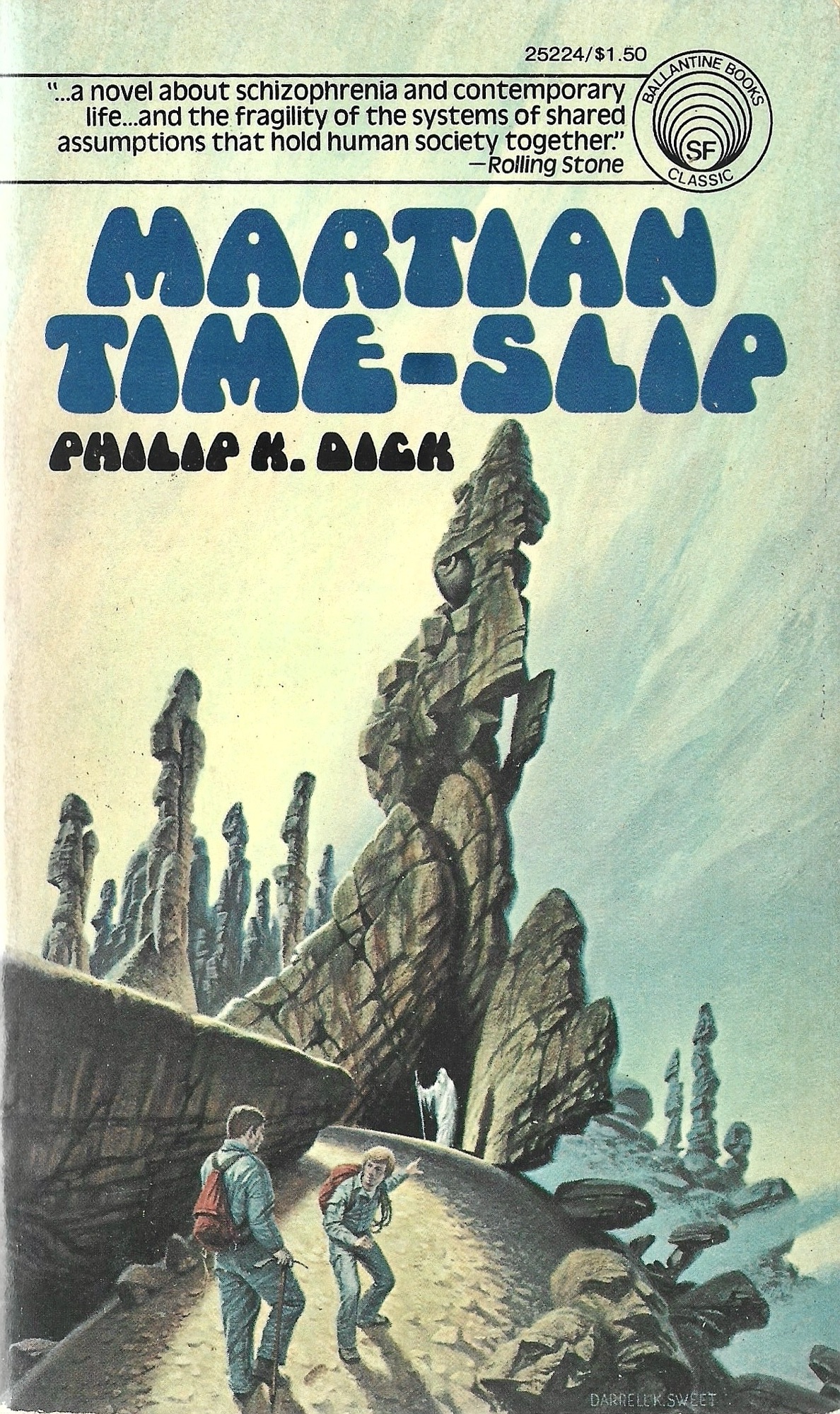
Mass-market Monday | Philip K. Dick’s Martian Time-Slip

Martian Time-Slip, Philip K. Dick. Ballantine Books, second printing (1976). Cover art by Darrell K. Sweet. 220 pages.
I riffed on the novel a decade ago, writing,

Time-Slip rockets into rhetorical reverberation, cycling its final chapters into a strange decay. The timeslips jar the reader’s narrative perception—Hey wait, didn’t I already read this?—unsettling expectations, and ultimately suggesting that this Martian Time-Slip is just one version of Martian Time-Slip. That there are other timelines, distorted, slipped.


Riff on some books I’m reading, have read, and should really review

Hurricane Milton passed far enough south last night to leave our city relatively untroubled. There were power outages here but not the expected flooding. Most of my anxiety was focused on my family in the Tampa Bay area, all of whom are safe; we’re just not sure about the material conditions of the things they left behind.

Milton seemed to suck the summer air out of Northeast Florida; when I got out of bed and went outside to investigate the loud THUNK that woke me up at four a.m., I was shocked at how cold the air felt. It was only about 66°, but all the humidity seemed gone, even in the cold sprinkling rain. (The THUNK was our portable basketball hoop toppling over.)

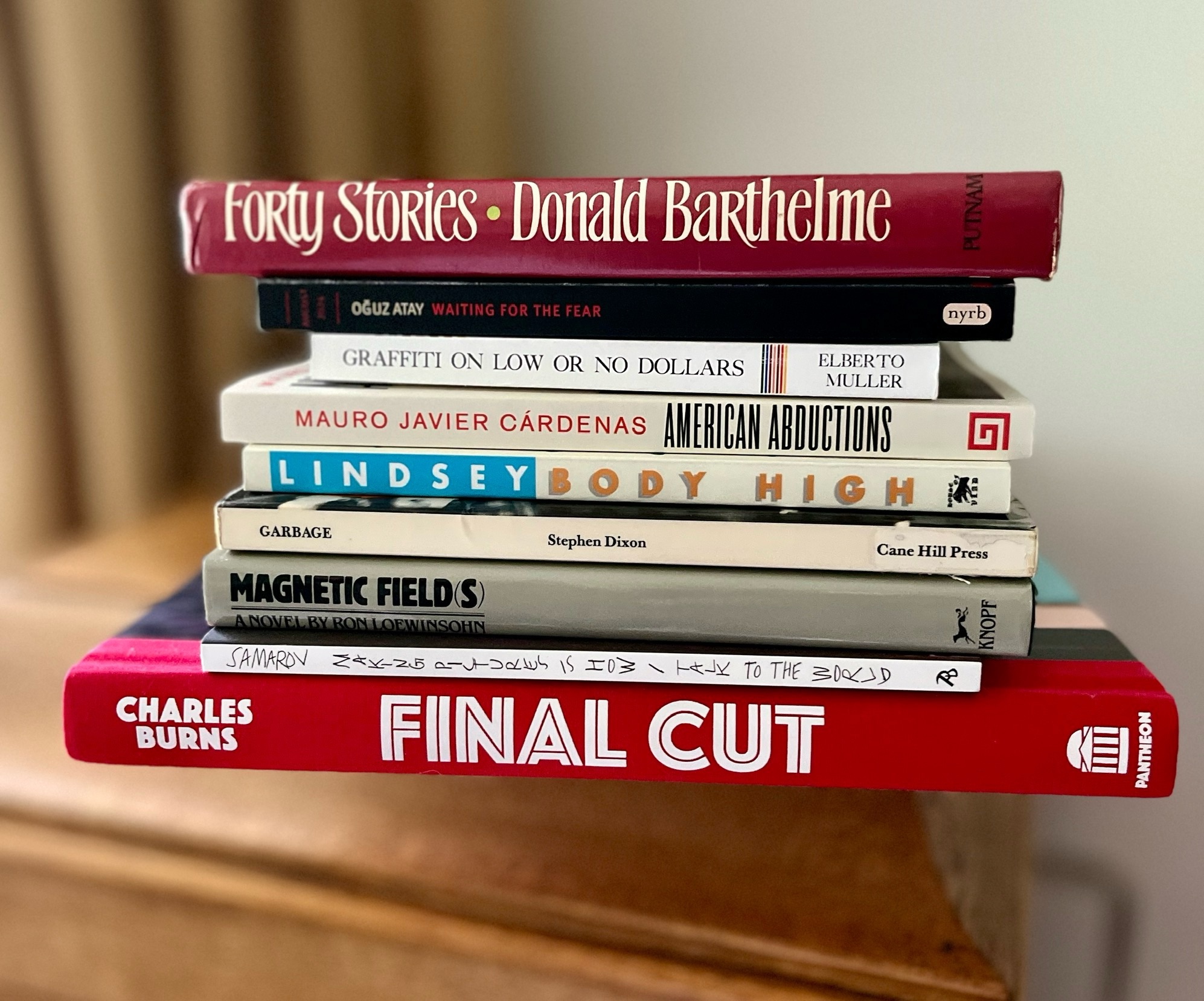
I thought I might try to knock out a review or a write-up of one of the many books I’ve finished that have stacked up as the summer has slowly transitioned to autumn. College classes have been canceled through to Tuesday. I have, ostensibly a “free” week; maybe some words, harder to cobble together for me these days, would come together, no? For the past few years I’ve focused more on reading literature with the attempt to suspend analysis in favor of, like, simply enjoying it. I realized I’d gotten into the habit of reading everything through the lens of this blog: What was I going to say about the book after reading it? I’ve been happier and read more sense freeing myself from the notion that I need to write about every fucking book I read. But the good books stack up (quite literally in a little place I have for such books); I find myself simply wanting to recommend, at some level, however facile, some of the stuff I’ve read. So forgive this lazy post, organized around a picture of a stack of books. From the top down:

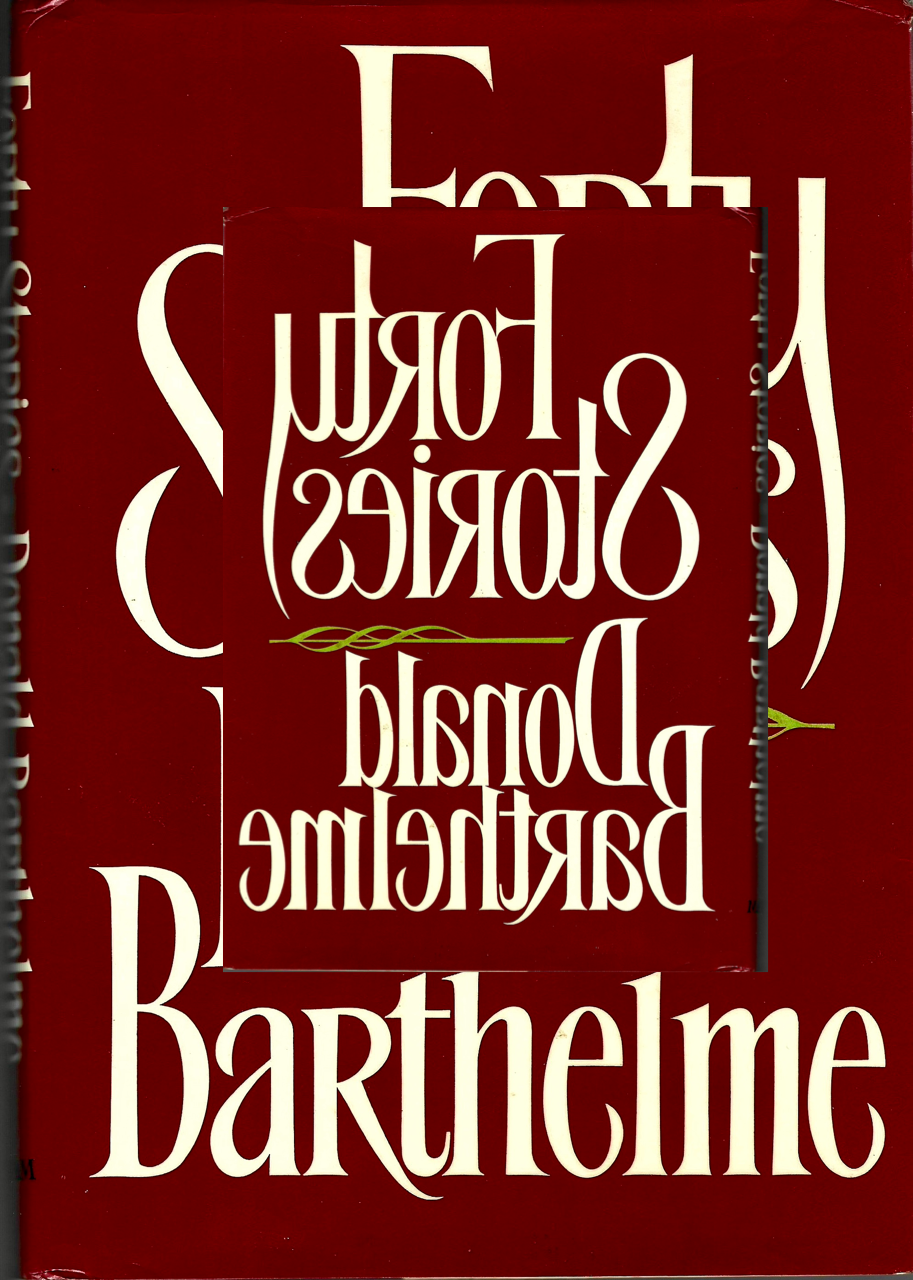
Forty Stories, Donald Barthelme

A few years ago, I read Donald Barthelme’s collection Sixty Stories in reverse order. A few days ago, a commenter left me a short message on the final installment of that series of blogs: “Now do Forty Stories.” I think I have agreed–over the past week I’ve read stories forty through thirty-five in the collection. More to come.

Waiting for the Fear, Oğuz Atay; translation by Ralph Hubbell

A book of cramped, anxious stories. Atay, via Hubbell’s sticky translation, creates little worlds that seem a few reverberations off from reality. These are the kind of stories that one enjoys being allowed to leave, even if the protagonists are doomed to remain in the text (this is a compliment). Standouts include “Man in a White Overcoat,” “The Forgotten,” and “Letter to My Father.”

Graffiti on Low or No Dollars, Elberto Muller

Subtitled An Alternative Guide to Aesthetics and Grifting throughout the United States and Canada, Elberto Muller unfolds as a series of not-that-loosely connected vignettes, sketches, and fully-developed stories, each titled after the state or promise of their setting. The main character seems a loose approximation of Muller himself, a bohemian hobo hopping freights, scoring drugs, and working odd jobs—but mostly interacting with people. It kinda recalls Fuckhead at the end of Denis Johnson’s Jesus’ Son (a book Graffiti spiritually resembles) praising “All these weirdos, and me getting a little better every day right in the midst of them.” Muller’s storytelling chops are excellent—he’s economical, dry, sometimes sour, and most of all a gifted imagist.

American Abductions, Mauro Javier Cárdenas

If I were to tell you that Mauro Javier Cárdenas’s third novel is about Latin American families being separated by racist, government-mandated (and wholly fascist, really) mass deportations, you might think American Abductions is a dour, solemn read. And yes, Cárdenas conjures a horrifying dystopian surveillance in this novel, and yes, things are grim, but his labyrinthine layering of consciousnesses adds up to something more than just the novel’s horrific premise on its own. Like Bernhard, Krasznahorkao, and Sebald, Cárdenas uses the long sentence to great effect. Each chapter of American Abductions is a wieldy comma splice that terminates only when his chapter concludes—only each chapter sails into the next, or layers on it, really. It’s fugue-like, dreamlike, sometimes nightmarish. It’s also very funny. But most of all, it’s a fascinating exercise in consciousness and language—an attempt, perhaps, to borrow a phrase from one of its many characters, to make a grand “statement of missingnessness.”

Body High, Jon Lindsey

I liked Jon Lindsey’s debut Body High, a brief, even breezy drug novel that tries to do a bit too much too quickly, but is often very funny, gross, and abject. The narrator, who telegraphs his thoughts in short, clipped sentences (or fragments cobbled together) is a fuck-up whose main income derives from submitting to medical experiments. He dreams of scripting professional wrestling storylines though, perhaps one involving his almost-best friend/dealer/protector/enabler. When his underage-aunt shows up in his life, activating odd lusts, things get even more fucked up. Body High is at its best when it’s at its grimiest, and while it’s grimy, I wish it were grimier still.

Garbage, Stephen Dixon

I don’t know if Dixon’s Garbage is the best novel I’ve read so far this year, but it’s certainly the one that has most wrapped itself up in my brain pan, in my ear, throbbed a little behind my temple. The novel’s opening line sounds like an uninspired set up for a joke: “Two men come in and sit at the bar.” Everything that unfolds after is a brutal punchline, reminiscent of the Book of Job or pretty much any of Kafka’s major works. These two men come into Shaney’s bar—this is, or at least seems to be, NYC in the gritty seventies—and try to shake him down to switch up garbage collection services. A man of principle, Shaney rejects their “offer,” setting off an escalating nightmare, a world of shit, or, really, a world of garbage. I don’t think typing this description out does any justice to how engrossing and strange (and, strangely normalGarbage is. Dixon’s control of Shaney’s voice is precise and so utterly real that the effect is frankly cinematic, even though there are no spectacular pyrotechnics going on; hell, at times Dixon’s Shaney gives us only the barest visual details to a scene, and yet the book still throbs with uncanny lifeforce. I could’ve kept reading and reading and reading this short novel; it’s final line serves as the real ecstatic punchline. Fantastic stuff.

Magnetic Field(s), Ron Loewinsohn

I ate up Loewinshohn’s Magnetic Field(s) over a weekend. It’s a hypnotic triptych, a fugue, really, with phrases sliding across and through sections. We meet first a burglar breaking into a family’s home and learn that “Killing the animals was the hard”; then a composer, working with a filmmaker; then finally a novelist. Magnetic Field(s) posits crime and art as overlapping intimacies, and extends these intimacies through imagining another life as a taboo, too-intimate trespass.

Making Pictures Is How I Talk to the World, Dmitry Samarov

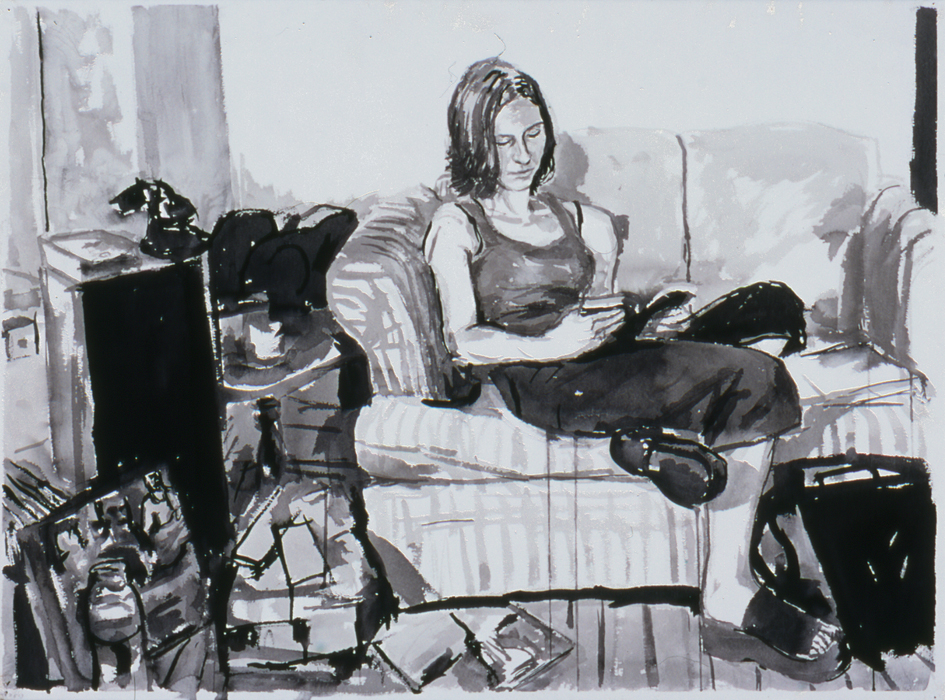
Making Pictures spans four decades of Samarov’s artistic career. Printed on high-quality color pages, the collection is thematically organized, showcasing Samarov’s different styles and genres. There are sketches, ink drawings, oils, charcoals, gouache, mixed media and more—but what most comes through is an intense narrativity. Samarov’s art is similar to his writing; there isn’t adornment so much as perspective. We get in Making Pictures a world of bars and coffee shops, cheap eateries and indie clubs. Samarov depicts his city Chicago with a thickness of life that is better seen than written about. Some of my favorite works include interiors of kitchens, portraits of women reading, and scribbly but energetic sketches of indie bands playing live. What I most appreciate about this collection though is that it showcases how outside of the so-called “art world” Samarov’s work is–and yet this is hardly the work of a so-called “outsider” artist. Samarov trained at the School of the Art Institute of Chicago, and yet through his career he has remained an independent, “not associated with an institution such as an art gallery, college, or museum,” as he writes in his book.

Beth, Dmitry Samarov, 2000

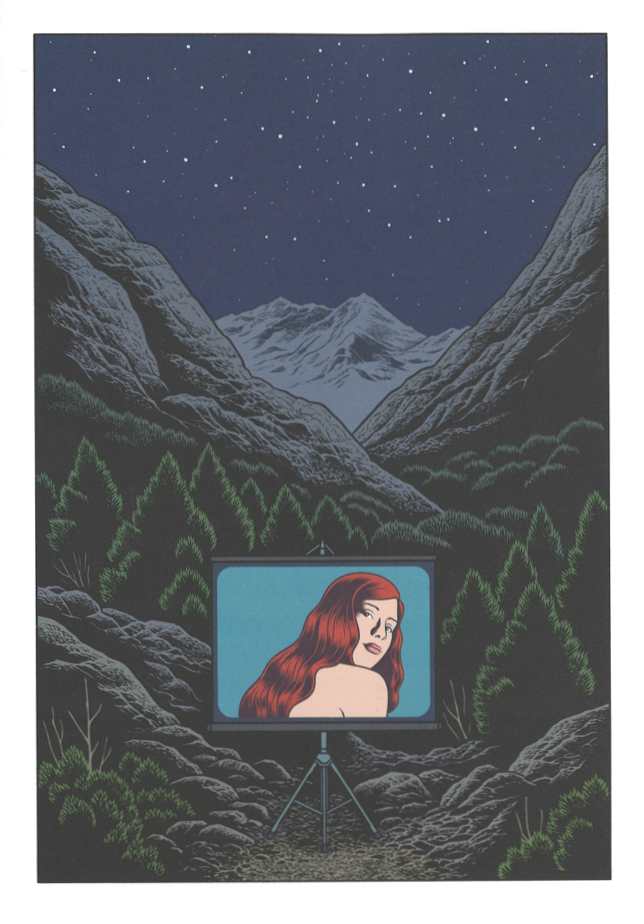
Final Cut, Charles Burns

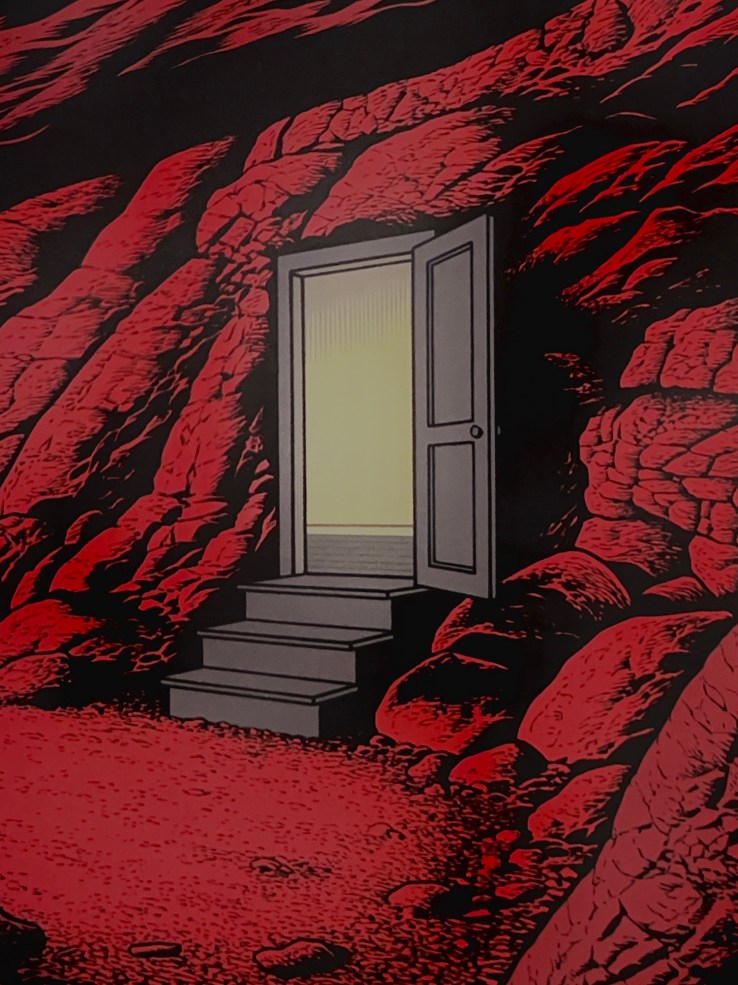
I don’t know anything about Charles Burns’s upbringing, his youth, his personal life, and I don’t mean to speculate. However, it’s impossible not to approach Final Cut without pointing out that for several decades he’s been telling the same story over and over again—a sensitive, odd, artistic boy who is out of place even among others out of place. This is in no way a complaint—he tells the story with difference each time. And with more coherence. Final Cut is beautiful and sad and also weird enough to fit in neatly to Burns’s oeuvre. But it’s also more mature, a mature reflection on youth really, intense, still, but without the claustrophobia of Black Hole or the mania of his Last Look trilogy. There’s something melancholy here. It’s fitting that Burns employs the heartbreaking 1971 film The Last Picture Show as a significant motif in Final Cut.

Image from Final Cut, Charles Burns, 2024

RIP Robert Coover, Prince of American Metafiction

RIP Robert Coover, 1932-2024

Robert Coover passed away a few days ago at ninety-two years old. In his decades-spanning career, Coover published twenty-one novels, four plays, and four short story collections. He also published dozens of (as-yet) uncollected stories, essays, and a host of so-called “electronic fiction.” A fifth short story collection, 2018’s Going for a Beer, collected some of Coover’s greatest hits, and is generally an excellent starting place for those interested in Coover’s metatextual fabulism.

Coover didn’t start out as a metatextual fabulist. His first novel, 1966’s The Origin of the Brunists, is vivid, humanist realism with the slightest tinges of magic brightening its edges. 1968’s follow-up, The Universal Baseball Association, Inc., J. Henry Waugh, Prop., strays much deeper into the pop-myth fantasies that Coover would perfect in his mature career.

Coover’s 1969 collection Pricksongs & Descants shows a remarkable shift into postmodern metafiction. Pricksongs features some of his better stories, like “The Brother” (told from the point of view of the biblical Noah’s brother), “The Elevator,” and “The Magic Poker,” which begins with the sentence “I wander the island, inventing it” — a tidy encapsulation of Coover’s growing motif of the self-creating story. At times, this metatextual motif can exhaust the reader, as in Pricksongs’ capper “The Hat Act.” However, the collection features one of Coover’s best stories, “The Babysitter,” in which the titular character serves as a locus for a mundane suburban community’s collective repressed anxieties of sex and violence.

Coover would continue to explore such themes throughout his career, refining and sharpening his metatextual hat act in standout novels like Spanking the Maid (1982), Gerald’s Party (1986), and 1977’s The Public Burning—arguably Coover’s most important novel. It’s easy to think of The Public Burning as the last part of a loose postmodern American trilogy of large daring novels, the first two parts comprised of Pynchon’s Gravity’s Rainbow (1973) and William Gaddis’s J R (1975).

Indeed, Coover was regularly grouped with a (very white, very male) clique of postmodern American writers. In his 1980 essay “The Literature of Replenishment,” John Barth halfheartedly counted up the members: “By my count, the American fictionists most commonly included in the canon, besides the three of us at Tubingen [William H. Gass, John Hawkes and Barth himself], are Donald Barthelme, Robert Coover, Stanley Elkin, Thomas Pynchon, and Kurt Vonnegut, Jr.”

There was some chatter on social media that Coover’s passing left just Pynchon–and maybe Don DeLillo and Joseph McElroy–as the last living luminaries of twentieth-century US American postmodernist fiction. Of course, Pynchon really wasn’t a member of this or any other clique (he declined an invitation to Donald Barthelme’s so-called “postmodernists dinner“), and, as is too often the case with such groupings, Ishmael Reed’s contribution to American postmodernist fiction continues to be marginalized.

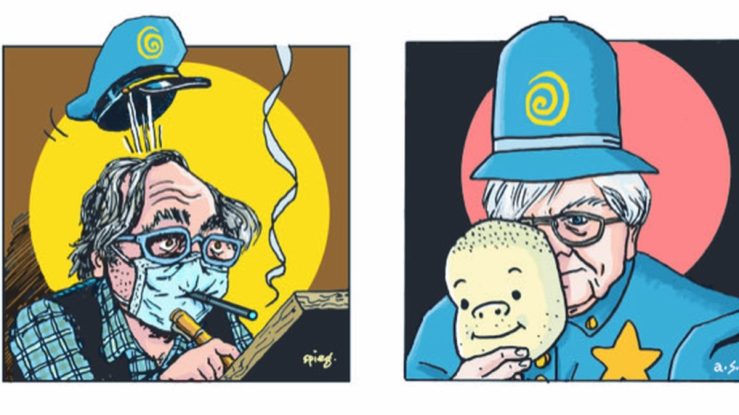
Let it stand then that Robert Coover, despite whatever connections and friendships he held with other writers and artists, was his own special self-made creation. He was prolific, especially later in life, publishing nine novels in the twenty-first century. One of these was The Brunist Day of Wrath (2014), a sequel to his debut; he also collaborated with comix artist Art Spiegelman on the graphic novelette Street Cop (2021) and even found a sliver of mainstream readers with Huck Out West, his wonderful 2017 “sequel” to Adventures of Huckleberry Finn. Coover’s latest novel Open House was published just over a year ago.

Clearly, Coover leaves behind a large body of work, and we’ll likely see more of his work collected and published over the next decade. I won’t pretend to have read most of what he’s written, but I’ve loved a lot of it—particularly Pricksongs & DescantsHuck Out WestSpanking the Maid, and Briar Rose, which, as far as I can recall, is likely the first thing I read of his (my girlfriend at the time’s sister had to read it in college; she professed that she hated it but thought I’d like it). The aforementioned 2018 collection Going for a Beer is a nice starting place for Coover; those more interested in novels might like Spanking the Maid. Or jump into one of his later short novels, like 2004’s Stepmother or 2018’s The Enchanted Prince, both of which exemplify his metamagicianist mode. Or hell, just go for the big boy, The Public Burning. Ultimately, Coover leaves behind a trove of trembling, writhing, vividly-living words, an oeuvre that will continue to engage readers fascinated by a certain stamp of so-called experimental literature–and for that I thank him.


Mass-market Monday | Robert Coover’s The Origin of the Brunists

The Origin of the Brunists, Robert Coover. Banatm Books Edition (1978). No cover designer credited. 534 pages.

This Bantam reprint of Coover’s first novel coincided with their mass-market paperback publication of The Public Burning.

I wrote a bit on The Origin of the Brunists a few years back. From that riff:

Coover’s metafiction always points back at its own origin, its own creation, a move that can at times take on a winking tone, a nudging elbow to the reader’s metaphorical ribs—Hey bub, see what I’m doing here? Coover’s metafictional techniques often lead him and his reader into cartoon landscapes, where postmodernly-plastic characters bounce manically off realistic contours. The best of Coover’s metafictions (like “The Babysitter,” 1969) tease their postmodern plastic into a synthesis of character, plot, and theme. However, in  large doses Coover’s metafictions can tax the reader’s patience and will—the simplest example that comes to mind is “The Hat Act” (from Pricksongs & Descants, 1969), a seemingly-interminable  Möbius loop that riffs on performance, trickery, and imagination. (And horniness).

I’m dwelling on Coover’s metafictional myth-making because I think of it as his calling card. And yet Origin of the Brunists bears only the faintest traces of Coover’s trademark metafictionalist moves (mostly, so far anyway, by way of its erstwhile hero, the journalist Tiger Miller). Coover’s debut reads rather as a work of highly-detailed, highly-descriptive realism, a realism that pushes its satirical edges up against the absurdity of modern American life. It reminds me very much of William Gass’s first novel Omensetter’s Luck (1966) and John Barth’s first two novels, The Floating Opera (1956) and The End of the Road (1958). (Barth heavily revised both of the novels in 1967). There’s a post-Faulknerian style here, something that can’t rightly be described as modern or postmodern. These novels distort reality without rupturing it in the way that the authors’ later works do. Later works like Barth’s Chimera (1973), Gass’s The Tunnel (1995), and Coover’s The Public Burning (1977) dismantle genre structures and tropes and rebuild them in new forms.