“Books Which Have Influenced Me” — Robert Louis Stevenson

“Books Which Have Influenced Me” by Robert Louis Stevenson


The editor has somewhat insidiously laid a trap for his correspondents, the question put appearing at first so innocent, truly cutting so deep.  It is not, indeed, until after some reconnaissance and review that the writer awakes to find himself engaged upon something in the nature of autobiography, or, perhaps worse, upon a chapter in the life of that little, beautiful brother whom we once all had, and whom we have all lost and mourned, the man we ought to have been, the man we hoped to be.  But when word has been passed (even to an editor), it should, if possible, be kept; and if sometimes I am wise and say too little, and sometimes weak and say too much, the blame must lie at the door of the person who entrapped me.

The most influential books, and the truest in their influence, are works of fiction.  They do not pin the reader to a dogma, which he must afterwards discover to be inexact; they do not teach him a lesson, which he must afterwards unlearn.  They repeat, they rearrange, they clarify the lessons of life; they disengage us from ourselves, they constrain us to the acquaintance of others; and they show us the web of experience, not as we can see it for ourselves, but with a singular change—that monstrous, consuming ego of ours being, for the nonce, struck out.  To be so, they must be reasonably true to the human comedy; and any work that is so serves the turn of instruction.  But the course of our education is answered best by those poems and romances where we breathe a magnanimous atmosphere of thought and meet generous and pious characters.  Shakespeare has served me best.  Few living friends have had upon me an influence so strong for good as Hamlet or Rosalind.  The last character, already well beloved in the reading, I had the good fortune to see, I must think, in an impressionable hour, played by Mrs. Scott Siddons.  Nothing has ever more moved, more delighted, more refreshed me; nor has the influence quite passed away.  Kent’s brief speech over the dying Lear had a great effect upon my mind, and was the burthen of my reflections for long, so profoundly, so touchingly generous did it appear in sense, so overpowering in expression.  Perhaps my dearest and best friend outside of Shakespeare is D’Artagnan—the elderly D’Artagnan of the Vicomte de Bragelonne.  I know not a more human soul, nor, in his way, a finer; I shall be very sorry for the man who is so much of a pedant in morals that he cannot learn from the Captain of Musketeers.  Lastly, I must name the Pilgrim’s Progress, a book that breathes of every beautiful and valuable emotion. Continue reading ““Books Which Have Influenced Me” — Robert Louis Stevenson”

“Gifts” — Ralph Waldo Emerson

“Gifts”

by

Ralph Waldo Emerson


“Gifts of one who loved me,—
Twas high time they came;
When he ceased to love me,
Time they stopped for shame.”

IT is said that the world is in a state of bankruptcy, that the world owes the world more than the world can pay, and ought to go into chancery, and be sold. I do not think this general insolvency, which involves in some sort all the population, to be the reason of the difficulty experienced at Christmas and New Year, and other times, in bestowing gifts; since it is always so pleasant to be generous, though very vexatious to pay debts. But the impediment lies in the choosing. If, at any time, it comes into my head that a present is due from me to somebody, I am puzzled what to give until the opportunity is gone. Flowers and fruits are always fit presents; flowers, because they are a proud assertion that a ray of beauty outvalues all the utilities of the world. These gay natures contrast with the somewhat stern countenance of ordinary nature; they are like music heard out of a workhouse. Nature does not cocker us: we are children, not pets: she is not fond: everything is dealt to us without fear or favor, after severe universal laws. Yet these delicate flowers look like the frolic and interference of love and beauty. Men used to tell us that we love flattery, even though we are not deceived by it, because it shows that we are of importance enough to be courted. Something like that pleasure the flowers give us: what am I to whom these sweet hints are addressed? Fruits are acceptable gifts because they are the flower of commodities, and admit of fantastic values being attached to them. If a man should send to me to come a hundred miles to visit him, and should set before me a basket of fine summer fruit, I should think there was some proportion between the labor and the reward.

For common gifts, necessity makes pertinences and beauty every day, and one is glad when an imperative leaves him no option, since if the man at the door have no shoes, you have not to consider whether you could procure him a paint-box. And as it is always pleasing to see a man eat bread, or drink water, in the house or out of doors, so it is always a great satisfaction to supply these first wants. Necessity does everything well. In our condition of universal dependence, it seems heroic to let the petitioner be the judge of his necessity, and to give all that is asked, though at great inconvenience. If it be a fantastic desire, it is better to leave to others the office of punishing him. I can think of many parts I should prefer playing to that of the Furies. Next to things of necessity, the rule for a gift which one of my friends prescribed is, that we might convey to some person that which properly belonged to his character, and was easily associated with him in thought. But our tokens of compliment and love are for the most part barbarous. Rings and other jewels are not gifts, but apologies for gifts. The only gift is a portion of thyself. Thou must bleed for me. Therefore the poet brings his poem; the shepherd, his lamb; the farmer, corn; the miner, a gem; the sailor, coral and shells; the painter, his picture; the girl, a handkerchief of her own sewing. This is right and pleasing, for it restores society in so far to the primary basis, when a man’s biography is conveyed in his gift, and every man’s wealth is an index of his merit. But it is a cold, lifeless business when you go to the shops to buy me something, which does not represent your life and talent, but a goldsmith’s. This is fit for kings, and rich men who represent kings, and a false state of property, to make presents of gold and silver stuffs, as a kind of symbolical sin-offering, or payment of blackmail. Continue reading ““Gifts” — Ralph Waldo Emerson”

Untitled (Reader) — José Sobral de Almada Negreiros

untitled

“Dialogue Between Franklin and the Gout” — Benjamin Franklin

“Dialogue Between Franklin and the Gout”

by

Benjamin Franklin


Midnight, 22 October, 1780.

FRANKLIN. Eh! Oh! eh! What have I done to merit these cruel sufferings?

GOUT. Many things; you have ate and drank too freely, and too much indulged those legs of yours in their indolence.

FRANKLIN. Who is it that accuses me?

GOUT. It is I, even I, the Gout.

FRANKLIN. What! my enemy in person?

GOUT. No, not your enemy.

FRANKLIN. I repeat it, my enemy; for you would not only torment my body to death, but ruin my good name; you reproach me as a glutton and a tippler; now all the world, that knows me, will allow that I am neither the one nor the other.

GOUT. The world may think as it pleases; it is always very complaisant to itself, and sometimes to its friends; but I very well know that the quantity of meat and drink proper for a man, who takes a reasonable degree of exercise, would be too much for another, who never takes any.

FRANKLIN. I take—eh! oh!—as much exercise—eh!—as I can, Madam Gout. You know my sedentary state, and on that account, it would seem, Madam Gout, as if you might spare me a little, seeing it is not altogether my own fault. Continue reading ““Dialogue Between Franklin and the Gout” — Benjamin Franklin”

Irony-free zone (Infinite Jest)

The thing is it has to be the truth to really go over, here. It can’t be a calculated crowd-pleaser, and it has to be the truth unslanted, unfortified. And maximally unironic. An ironist in a Boston AA meeting is a witch in church. Irony-free zone. Same with sly disingenuous manipulative pseudo-sincerity. Sincerity with an ulterior motive is something these tough ravaged people know and fear, all of them trained to remember the coyly sincere, ironic, self-presenting fortifications they’d had to construct in order to carry on Out There, under the ceaseless neon bottle.


From David Foster Wallace’s novel Infinite Jest

“After the Race” — James Joyce

“After the Race” by James Joyce


THE cars came scudding in towards Dublin, running evenly like pellets in the groove of the Naas Road. At the crest of the hill at Inchicore sightseers had gathered in clumps to watch the cars careering homeward and through this channel of poverty and inaction the Continent sped its wealth and industry. Now and again the clumps of people raised the cheer of the gratefully oppressed. Their sympathy, however, was for the blue cars—the cars of their friends, the French.

The French, moreover, were virtual victors. Their team had finished solidly; they had been placed second and third and the driver of the winning German car was reported a Belgian. Each blue car, therefore, received a double measure of welcome as it topped the crest of the hill and each cheer of welcome was acknowledged with smiles and nods by those in the car. In one of these trimly built cars was a party of four young men whose spirits seemed to be at present well above the level of successful Gallicism: in fact, these four young men were almost hilarious. They were Charles Segouin, the owner of the car; Andre Riviere, a young electrician of Canadian birth; a huge Hungarian named Villona and a neatly groomed young man named Doyle. Segouin was in good humour because he had unexpectedly received some orders in advance (he was about to start a motor establishment in Paris) and Riviere was in good humour because he was to be appointed manager of the establishment; these two young men (who were cousins) were also in good humour because of the success of the French cars. Villona was in good humour because he had had a very satisfactory luncheon; and besides he was an optimist by nature. The fourth member of the party, however, was too excited to be genuinely happy. Continue reading ““After the Race” — James Joyce”

On further inquiry, the snake is described as plaided with brown and black (Hawthorne’s diary, June 9, 1853)

June 9th.–Cleaning the attic to-day, here at the Wayside, the woman found an immense snake, flat and outrageously fierce, thrusting out its tongue. Ellen, the cook, killed it. She called it an adder, but it appears to have been a striped snake. It seems a fiend, haunting the house. On further inquiry, the snake is described as plaided with brown and black.

From Nathaniel Hawthorne’s American Note-Books.

A U.S.A. that would die for the so-called perfect Entertainment (Infinite Jest)


The sky of U.S.A.’s desert was clotted with blue stars. Now it was deep at night. Only above the U.S.A. city was the sky blank of stars; its color was pearly and blank. Marathe shrugged. ‘Perhaps in you is the sense that citizens of Canada are not involved in the real root of the threat.’

Steeply shook the head in seeming annoyance. ‘What’s that supposed to mean?’ he said. The lurid wig of him slipped when he moved the head with any abrupt force.

The first way Marathe betrayed anything of emotion was to smooth rather too fussily at the blanket on his lap. ‘It is meaning that it will not of finality be Québecers making this kick to l’aine des Etats Unis. Look: the facts of the situation speak loudly. What is known. This is a U.S.A. production, this Entertainment cartridge. Made by an American man in the U.S.A. The appetite for the appeal of it: this also is U.S.A. The U.S.A. drive for spectation, which your culture teaches. This I was saying: this is why choosing is everything. When I say to you choose with great care in loving and you make ridicule it is why I look and say: can I believe this man is saying this thing of ridicule?’ Marathe leaned slightly forward on his stumps, leaving the machine pistol to use both his hands in saying. Steeply could tell this was important to Marathe; he really believed it.

Marathe made small emphatic circles and cuts in the air while he spoke: ‘These facts of situation, which speak so loudly of your Bureau’s fear of this samizdat: now is what has happened when a people choose nothing over themselves to love, each one. A U.S.A. that would die — and let its children die, each one — for the so-called perfect Entertainment, this film. Who would die for this chance to be fed this death of pleasure with spoons, in their warm homes, alone, unmoving: Hugh Steeply, in complete seriousness as a citizen of your neighbor I say to you: forget for a moment the Entertainment, and think instead about a U.S.A. where such a thing could be possible enough for your Office to fear: can such a U.S.A. hope to survive for a much longer time? To survive as a nation of peoples? To much less exercise dominion over other nations of other peoples? If these are other peoples who still know what it is to choose? who will die for something larger? who will sacrifice the warm home, the loved woman at home, their legs, their life even, for something more than their own wishes of sentiment? who would choose not to die for pleasure, alone?’

From David Foster Wallace’s novel Infinite Jest.


Silent Interior — Carlos Schwabe

The artist must not become a storyteller (Balthus)

…the artist must not become a storyteller. The anecdote should not exist in painting. A picture or subject imposes itself, and it alone knows how profound and vertiginous it is. Nothing happens in a picture, it simply is; it exists by essence or does not exist at all. Baudelaire said a poem is there before it is there. Otherwise, it would be akin to something narrative, something inflected, willed into being by the artist. A picture or poem escapes these contingencies, with terrifying freedom and fiercely self-sufficient violence. In this sense, the artists is a mere link in a chain that began long ago. At Lascaux, for example, and even before Lascaux. There is no hierarchy, and Chardin is not better than Lascaux. All these creative connections belong to the same earthly song, from the ancient source of the world that I know nothing about, but which sends me a few messages by flashes of sun—or starlight. The artist constantly seeks to rediscover the illuminating fire, the hearth where sparks are made.

From Balthus’ memoir Vanished Splendors.

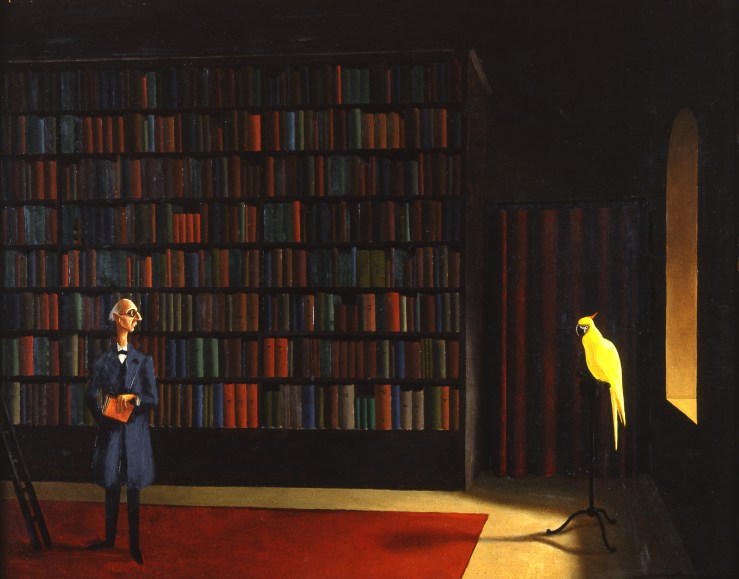
Library — Franz Sedlacek

U_60_978524610017_Franz_Sedlacek_Bibliothek_01

Some notes from 299 pages into a rereading of Infinite Jest

IMG_6547

A note on the context of the first reading, subsequent ventures, and this rereading

I bought David Foster Wallace’s novel Infinite Jest in 1997 when I was a freshman in college, as required by law. I attempted reading it a few times without really getting to page 100. (I did read and reread the short stories and the essays and Wallace’s first novel in that time though. None were assigned readings. The DFW Academic Industry was not a Thing yet).

The first time I read the book the whole way through was in the weird fall of 2001, the first fall I hadn’t returned to school because I had graduated from school, the fall of 9/11, the fall I moved to Tokyo the week after 9/11, packing the book in a smallish suitcase that the airport security guy had to take everything out of with his latex-gloved hands, removing every item, all the clothes and books, because I was traveling on a one-way ticket to a foreign land. It was in that weird fall that I finally read the book, reading mostly in the very very early a.m., sometimes reading for hours, reading too late, becoming addicted.

In years since, I’ve poked at rereadings, often looking for very specific passages/sections, and always meaning to do a full reread, but there are all those other big books that need to get read (and then reread).

Well so and anyway: This reread has been prompted by back-to-back readings of Gravity’s Rainbow, which I take to be the most obvious precursor text for Infinite Jest (and likely the greatest source of Wallace’s Oedipal anxiety if we want to get all Bloomian). I thought about Infinite Jest a lot while reading GR.

So far, like any rereading of a big encyclopedic novelInfinite Jest seems much, much easier than my initial go through (although coming off GR almost anything would probably seem much, much easier). With the contours of the “big plot” in place (and the rhetorical dazzle of some of Wallace’s embedded-essays not as blinding as before), focusing on details, patterns, and motifs becomes simply more possible. (I don’t think I connected Hal’s clipping his toenails in Ch. 18 to the toenails Gately finds in Ennet House in Ch. 19 before, f’r’instance). (There are no actual chapter numbers in IJ, although there are circles separating chapters which can be counted).

A note to readers new to Infinite Jest

Infinite Jest is very long but it’s not nearly as difficult as its reputation suggests. There is a compelling plot behind the erudite essaying and sesquipedalian vocabulary. That plot develops around three major strands which the reader must tie together, with both the aid of—and the challenge of—the novel’s discursive style. Those three major plot strands are the tragic saga of the Incandenzas (familial); the redemptive narrative of Ennet House Drug and Alcohol Recovery House, with Don Gately as the primary hero (socicultural); and the the schemes of the Québécois separatists (national/international/political). An addictive and thus deadly film called Infinite Jest links these three plots (through discursive and byzantine subplots).

Wallace often obscures the links between these plot strands, and many of the major plot connections have to be intuited or outright guessed. Furthermore, while there are clear, explicit connections between the plot strands made for the reader, Wallace seems to withhold explicating these connections until after the 200-page mark. Arguably, the real contours of the Big Plot come into (incomplete) focus in a discussion between Hal Incandenza and his brother Orin in pages 242-58. While that scene by no means telegraphs what happens in IJ, it nonetheless offers some promise that the set pieces, riffs, scenes, lists, and vignettes shall add up to Something Bigger.  Continue reading “Some notes from 299 pages into a rereading of Infinite Jest”

Nathaniel Hawthorne’s journal entry, June 6th, 1844

Concord, June 6th.–. . . Mr. F—- arrived yesterday, and appeared to be in most excellent health, and as happy as the sunshine. About the first thing he did was to wash the dishes; and he is really indefatigable in the kitchen, so that I am quite a gentleman of leisure. Previous to his arrival, I had kindled no fire for four entire days, and had lived all that time on the corned beef, except one day, when Ellery and I went down the river on a fishing excursion. Yesterday, we boiled some lamb, which we shall have cold for dinner to-day. This morning, Mr. F—- fried a sumptuous dish of eels for breakfast. Mrs. P. —- continues to be the instrument of Providence, and yesterday sent us a very nice plum-pudding.

I have told Mr. F—- that I shall be engaged in the forenoons, and he is to manage his own occupations and amusements during that time, . . .

Leo, I regret to say, has fallen under suspicion of a very great crime,–nothing less than murder,–a fowl crime it may well be called, for it is the slaughter of one of Mr. Hayward’s hens. He has been seen to chase the hens, several times, and the other day one of them was found dead. Possibly he may be innocent, and, as there is nothing but circumstantial evidence, it must be left with his own conscience.

Meantime, Mr. Hayward, or somebody else, seems to have given him such a whipping that he is absolutely stiff, and walks about like a rheumatic old gentleman. I am afraid, too, that he is an incorrigible thief. Ellery says he has seen him coming up the avenue with a calf’s whole head in his mouth. How he came by it is best known to Leo himself. If he were a dog of fair character, it would be no more than charity to conclude that he had either bought it, or had it given to him; but with the other charges against him, it inclines me to great distrust of his moral principles. Be that as it may, he managed his stock of provisions very thriftily, burying it in the earth, and eating a portion of it whenever he felt an appetite. If he insists upon living by highway robbery, it would be well to make him share his booty with us. . . .

From Nathaniel Hawthorne’s American Note-Books.

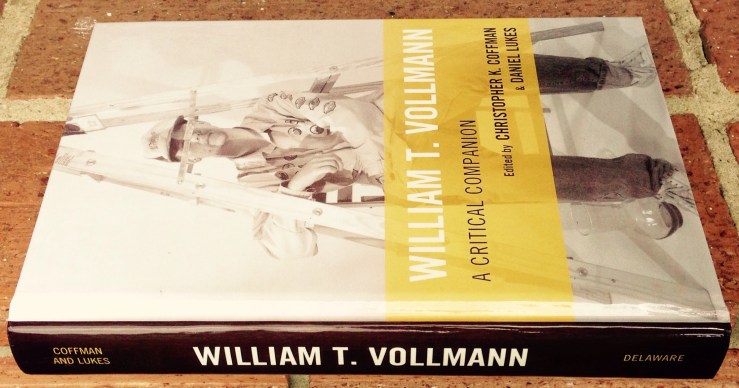
An Interview with Christopher K. Coffman and Daniel Lukes, Editors of William T. Vollmann: A Critical Companion (Part 2)

William T. Vollmann: A Critical Companion, newish from University of Delaware Press, collects academic essays and memoir-vignettes by a range of critics and authors to make the case that Vollmann is, as the blurb claims, the “most ambitious, productive, and important living author in the US.” I interviewed the book’s editors, Christopher K. Coffman and Daniel Lukes, over a series of emails in a two-part interview. You can read the first part here. A few days after the first part of the interview posted, Lukes and Coffman hosted a book launch party in NYC for WTV: ACC; the pics in this interview are from that event (check out the Facebook page for more, including Jonathan Franzen reading from his piece on Vollmann).

IMG_6524


Biblioklept: Let’s talk about the formal elements of William T. Vollmann: A Critical Companion. The collection seems to balance essays of a more academic flavor with memoir-vignettes, personal accounts, and riffs.

Christopher K. Coffman: We decided early on to intersperse among the academic essays pieces by non-scholars, or by scholars writing in a non-scholarly mode. The goal here was at least two-fold. We wanted to offer something a bit more accessible to WTV readers who were not in academia (although I think the average WTV fan can follow scholarly arguments as well as many of us in academia can). Also, we realized that some people with a privileged view on WTV’s work–such as those of WTV’s book designers who contributed (Bolte and Speaker Austin)–could add something of interest and great value to audiences in and out of academia, and we wanted to make space for that. I would have to look back through the e-mail log to be sure, but I think Daniel first came up with the idea of soliciting shorter pieces from non-scholars, and that I then conceived the structural component. I am a huge fan of Hemingway’s In Our Time, and the contrapuntal play between the stories and the very short inter-chapters in that book served for me as a paradigm of what Daniel and I have tried to do in this regard. Of course, as soon as we brought up the example of Hemingway, we recalled that WTV does something similar in Thirteen Stories and Thirteen Epitaphs, so he beat us to the punch even there. At any rate, my hope is that our readers find in the short chapterlets material that serves as a response to or as an extension of ideas presented in the more properly scholarly readings that surround those shorter pieces.

The second question of arrangement was the placement of essays and interchapters, and we here grouped according to subject matter as well as we could, without merely replicating what McCaffery and Hemmingson had done for Expelled from Eden. We also, obviously, made space for both Larry and Michael as the authors of the Preface and Afterword. Our intention there, insofar as I can speak for both of us, is to make it clear that we are trying to situate our contribution to scholarship on WTV in relation to the work that Larry and Michael have already done. Finally, I wrote the Introduction not only because one of us had to, but also because Daniel was spoken for in the sense that he already had material that formed the basis for the really great chapter that he contributed. Also, I found the chance to frame the book’s material via an introduction that dealt with WTV’s place in the landscape of post-1945 American fiction appealing. That said, while the introduction bears my byline, my ongoing conversation with Daniel during the past few years shaped my thinking about WTV as much as any original ideas of my own, so he deserves a lot of credit for the introduction as well.

Daniel Lukes: I’ve been going back over the timeline to see if Samuel Cohen and Lee Konstantinou’s edited volume The Legacy of David Foster Wallace, which also features some shorter pieces, was an influence on that, but it looks like we took our approach independently. Though I will say their book did serve as a model in some ways of what ours could be. Dealing with the “non-scholarly” pieces has been for me one of the most exciting parts of putting this book together (the distinction between “scholarlies” and “non-scholarlies” itself being one of the various amusing frameworks that Chris and I have been carrying around throughout the process). From the beginning I thought it would be very helpful to have some of Vollmann’s literary peers chime in: you just don’t hear too much from them about him. So we reached out to writers we thought might be Vollmann readers: some just weren’t (I’d love to know if Cormac McCarthy reads Vollmann: the letter I mailed to a presumed representative of his returned unopened). Some were Vollmann fans/friends, but couldn’t make it for another reason; when Jonathan Franzen came through and expressed his enthusiasm for the project and willingness to contribute a piece, I felt some relief. And James Franco was a pleasure to work with. That said I think the primary value of the non-scholarlies is in the insights they offer into Vollmann’s world and writing practices, from those who have worked closely with him, in particular Carla Bolte, Mary Austin Speaker, and Mariya Gusev’s excellent and vivid pieces. Continue reading “An Interview with Christopher K. Coffman and Daniel Lukes, Editors of William T. Vollmann: A Critical Companion (Part 2)”

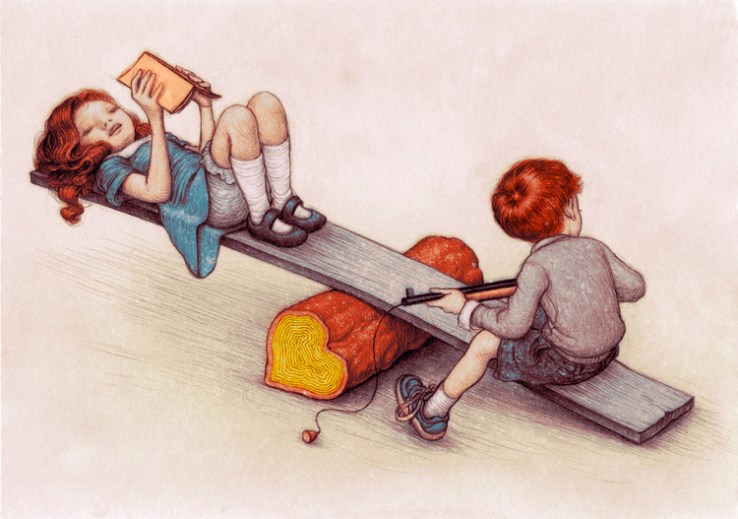
See-Saw — James Jean

seesaw-web

No Zen-type One, always rather Two (Infinite Jest)

How many sub-rosa twins are there, out there, really? What if heredity, instead of linear, is branching? What if it’s not arousal that’s so finitely circumscribed? What if in fact there were ever only like two really distinct individual people walking around back there in history’s mist? That all difference descends from this difference? The whole and the partial. The damaged and the intact. The deformed and the paralyzingly beautiful. The insane and the attendant. The hidden and the blindingly open. The performer and the audience. No Zen-type One, always rather Two, one upside-down in a convex lens.

A passage from David Foster Wallace’s novel Infinite Jest. Thoughts are Joelle Van Dyne’s for those keeping score. The riff reminds me of all the binaries in Gravity’s Rainbow, but maybe only because I just read Gravity’s Rainbow.

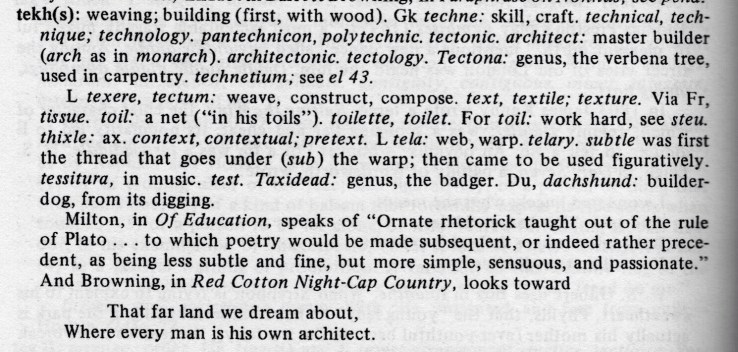
tekh(s): weaving; building (first, with wood).

IMG_6502

From Joseph T. Shipley’s The Origin of English Words: A Discursive Dictionary of Indo-European Roots.