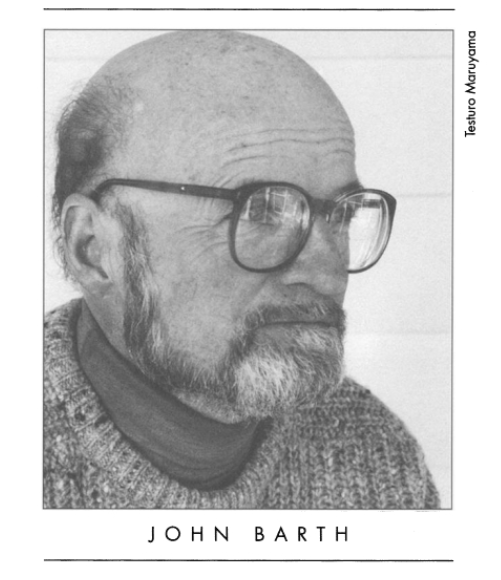
Q: You don’t consciously see yourself as John Barth, the postmodernist?
JOHN BARTH: Oh no, no, and the term now has become so stretched out of shape. I did a good deal of reading on the subject for a postmodernist conference in Stuttgart back in 1991, and I think I had a fairly solid grasp of the term then. At the time, there seemed to be a general agreement that, whatever postmodernism was, it was made in America and studied in Europe. At my end, I would say the definitions advanced by such European intellectuals as Jean Baudrillard and Jean- Francois Lyotard have only a kind of a grand overlap with what I think I mean when I am talking about it.g about it. They apply the term to disciplines and fields other than art-their thoughts about postmodern science, for instance, are very interesting-but when the subject is postmodern American fiction, things get murkier. So often we’re told, “You know, it’s Coover, Pynchon, Barth, and Barthelme,” but that’s just pointing at writers. Perhaps that’s all you can do. It led me to say once, “If postmodern is what I am, then postmodernism is whatever I do.” You get a bit wary about these terms. When The Floating Opera came out, Leslie Fiedler called it “provincial American existentialism.” With End of the Road, I was most often described as a black humorist, and with The Sot-Weed Factor, Giles Goat-Boy, and Lost in the Funhouse, I became a fabulist. Bill Gass resists the term “postmodernist,” and I understand his resistance. But we need common words to talk about anything. “Impressionism” is a very useful term which helps describe the achievements of a number of important artists. But when you begin to look at individual impressionist painters, the term becomes less meaningful. You find yourself contemplating a group of artists who probably have as many differences as similarities. I recall a wonderful old philosophy professor of mine who used to talk about the difference between the synthetic temperament and the analytical temperament. With the synthetic, the similarities between things are more impressive than the differences; with the analytical, the differences are more impressive than the similarities. We need them both; you can’t do without either. In that context, once you’ve come up with some criteria that describe what has been going on in a certain type of fiction composed during the sixties, seventies, eighties, and nineties, I think the differences among Donald Barthelme, Angela Carter, and Italo Calvino are probably more interesting than the similarities.
From an interview with Barth conducted by Charlie Reilly in the journal Contemporary Literature, Vol. 41, No. 4 (Winter, 2000).
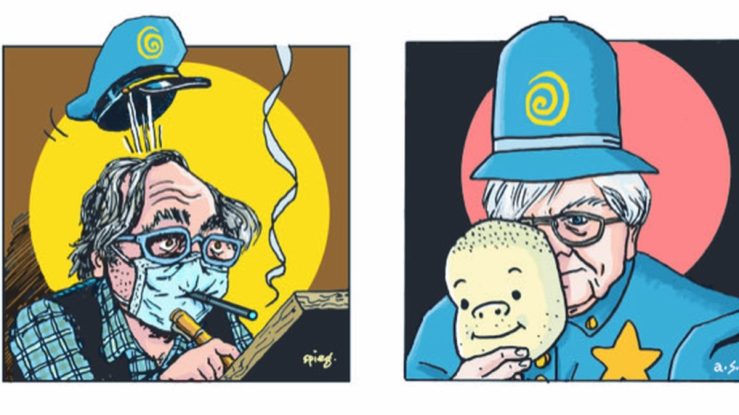
Their discussion begins with Street Cop but expands much further, touching on postmodernism, realism (“Our Zeitgeist has left us mostly with shards of media as our reality,” says Spiegelman; “When people ask me, I say that I learned my realism from Kafka,” replies Coover”), time and space, the desire for happy endings, and more. But like I said, it begins with Street Cop:
ART SPIEGELMAN: So first: why a street cop?
ROBERT COOVER:Well, I wrote Street Cop in 2019. It emerged, like everything I write, from anxieties about the present. I had written about private eyes, but the dumb street cop was something new. I liked the idea of a guy who would be technologically inept. It’s about a bumbler who began his career as a crook and drug dealer, before accidentally becoming a cop who stumbles his way through a techno-city where the landscape changes daily thanks to 3D printing—blurring past, present and future. His job is to convict suspects rather than solve crimes, but all he wants, really, is to return to the old part of town, a seamy noir-like zone where his urges, and their many flaws, are permissible.
AS:When I first read and signed on to illustrate your story early in 2020’s quarantine, I was grateful to dive into a Dystopia Next Door and escape the one that surrounded us even in the bucolic bunker in the woods we’d retreated to from NYC. Choking on an overdose of toxic news, and compulsively “doom-scrolling”—I really love that phrase—I found the Covid-free air of Street Cop breathable because at least it didn’t have the twin viruses of the Covid pandemic and Trump directly confronting me. Still, the very first picture I drew had Covids in it—it was inevitable that they found their way into the prescient present of the story.
JA Tyler: Since Motorman was first published by Knopf in 1972, you’ve written two more novels and two novellas based on the world of the character Moldenke, and this year, we’ll see another two: The Blast in July and The Old Reactor in late 2014. Why are you so drawn to this landscape—this future ruin of flood and famine and oppression?
David Ohle: What draws me to this landscape/dreamscape again and again is probably very much like what attracts a gamer to his game world. It’s a gnarly place where anything can happen, but you’re in control of what does. Getting there for me as a writer and reporting about it is accomplished with a simple formula: take current trends and add time. The more time I add, the more ruin I see. But it isn’t total ruin in my novels. Transportation is available in one form or another. There’s food, drugs, and beverages around, however crappy they may be. People don’t starve. And they get high on williwhack, stonepicks, and maximine to ease oppression in general, whether religious (Reverend Hooker in Pisstown Chaos) or governmental (President Michael Ratt in The Age of Sinatra). Once I venture to these landscapes, I become a documentarian, recording what I see. My narrative style is camera-eye, almost entirely visual. I “see” what goes on in these bleak places and times, and I like being there just long enough to write it down.
The interview includes a number of scans of The City Moon, a dadaesque “newspaper” Ohle made with his friend Roger Martin:
The City Moon was a satirical print “newspaper” that a friend, Roger Martin, and I produced back in the early-to-mid ’70s. Other friends became involved from time to time, too. It was mainly a cut-and-paste operation. We had a vast collection of old—and sometimes new—newspapers and magazines from which we mined headlines and stories that we “processed” into better and more interesting stories and headlines. This mix of current and old news gave the paper a steampunk aspect. The University of Kansas libraries at the time were tossing out collections of newspapers dating back to the turn of the century, papers like The New York Herald, which still featured articles about horse and motorcar collisions, The Rock City Daily Rocket, and many foreign papers as well. The library tossed them after they were microfilmed. We harvested them from a dumpster behind the library. We also invented stories and characters, many of which found their way into my later fiction in different form. Not long ago, the University of Kansas’s Spencer Research Library undertook to digitize all eighteen issues of the Moon and was generous enough to allow them to be put online where anyone can view them.
This is the meat locker, where Dolores’s parts are. When the electrician wired it up, he asked, “What do you use this for?” I said, “Oh, that’s just where I keep my victims.” There was a long silence….She’s got her dresses here and I have my bulletproof helmet and various stuff from my journalism in there.
Have you taken many reporting trips recently?
No, that seems to being drying up. It seems that the magazines have less and less money. They’re mostly interested in domestic stuff. I don’t know whether it’s to save costs or if they really think Americans are only interested in America. I get sort of sick of it. So there are the wig heads. Whatever woman comes in here, I always say, “Now, those are your rivals.” They kind of freak out.
Do you have many visitors or is this mostly a solitary space?
I have the occasional visitor, yeah. And then let’s see. [Opens the door to the bathrooms.] I figure the men’s room and the women’s room ought to connect.
Why is that?
Well, you know male and female should always get together wherever possible. The men’s room is the toilet. The women’s room is the shower. They didn’t used to connect. It was really, really gross when I bought the place. This old restaurant—everything was all rotted out with pee.
[Bill takes me into another small room.] And then this is the books and bullets room. I put my phone in the closet most of the time, so I never have to hear it. I got all the extra copies of my books and all the bullets I’ll need for my various pistols.
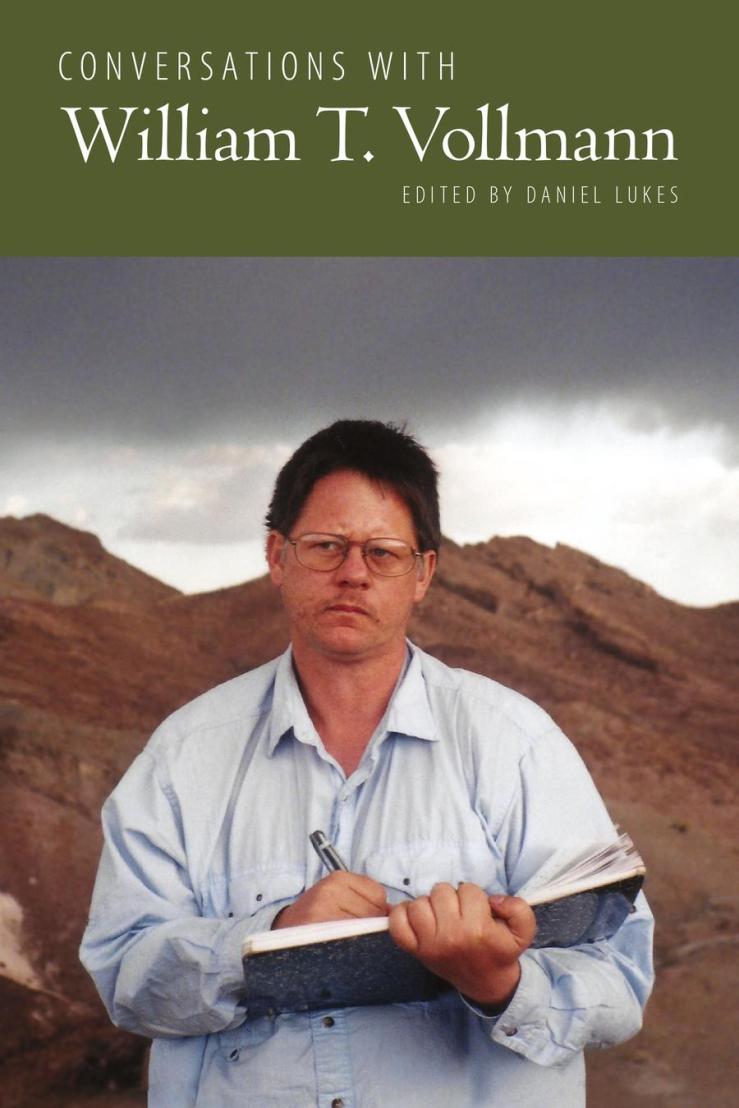
If you’re able, check out the book launch for Conversations with William T. Vollmann tonight (8 Feb. 2020) at 6:00pm at Unnameable Books, 600 Vanderbilt Ave., Brooklyn, NY 11238.
There’s a little bit of terror to almost all the good stuff I recall in literature, a little bit of terror, like Heart o f Darkness. I love the ghost story. I love to go after mysteries. I think all the best stories I have ever read are very close to ghost stories. I have no interest, by the way, in Poltergeist. But I am interested in the mysterious X, the big force behind something perceived. We’re usually not privy to too many of those things ourselves. But our friends have lived them. Of course I grew up in the Vietnam era. My classmates fought the war, came back with their tales— it still works on the heads of people my age, because it was a fantastic zone, that some of the veterans can’t even acknowledge happened nowadays, you know? But there are other places you’ve been that are—Denis Johnson examines these things-zones of irreality that had not only horror, but some sweetness. The writer ought to go into these other zones and come back like a spy, and tell us something exciting. And move us. And sometimes disgust us. There’s not enough of that now.
There’s a “new” video interview with Barry Hannah and his wife Susan at Southwest Review. The interview was conducted by Southwest Review editor-in-chief Greg Brownderville some time in “the late aughts” in Hannah’s back yard, under his muscadine arbor. Brownderville and his friend Luke Duncan (both grad students at Ole Miss at the time) were trying to put together a film about muscadine grapes, and interviewed the Hannahs about the project. Hannah’s extemporaneous responses veer all over the place though, using muscadines as kind of kernels of memories from which to riff on: dead pets, boyhood oyster shell fights, and “the wonderful time my dad and I had at Arkansas drinking wine and watching the University of Arkansas, who was number one in the nation, whoop Texas, both of us high on wine from Altus.” The whole interview approaches something close to one of Hannah’s looser short stories, and is definitely worth the 20 minutes.
(Thanks to Patrick for sending me the link.)
(Tangential note: My wife’s grandmother makes her own muscadine wine. We get a bottle of it for Christmas every now and then. It’s pretty sweet stuff.)
As a huge fan of Remedios Varo’s art, I was thrilled last year when Wakefield Press published Margaret Carson’s Letters, Dreams and Other Writings.I reached out to Margaret, who was kind enough to talk to me about her translation in detail over a series of emails.
In addition to Letters, Dreams and Other Writings Margaret Carson’s translations include Sergio Chejfec’s Baroni, A Journeyand My Two Worlds. She is Assistant Professor in the Modern Languages Department at Borough of Manhattan Community College, The City University of New York.
Margaret Carson
Biblioklept: When did you first see Remedios Varo’s art?
Margaret Carson: I first heard of Remedios Varo in the mid-80s, when I was living in Madrid. But it was by reading Janet Kaplan’s biography, Remedios Varo: Unexpected Journeys, that I learned more about her life and first saw many images of her paintings. That was in the 90s. On a trip to Mexico City at that same time, I was surprised to find in a bookstore a small collection of her writings, Cartas, sueños y otros textos, and I brought it home with me. I started translating parts of it and later heard about an exhibit of her paintings at the National Museum of Women in the Arts in Washington D.C., in 2000: The Magic of Remedios Varo. That was my first experience seeing her paintings up close, and it blew me away. Nothing compares to standing in front of one of her paintings to see the meticulous details, the true color, and the actual scale (her artworks can be much smaller than you imagine). Since then, I’ve seen other paintings, includingMimetismo/Mimicry andLa creación de las aves/The Creation of the Birds, at theMuseo de Arte Moderno in Mexico City, which has over thirty of her paintings—the largest collection in the world.
Creation of the Birds, 1957
Exciting news for Varo fans in the New York area: MoMA has acquired one of her most extraordinary works,The Juggler, which will be put on display when the museum re-opens in October 2019. Can’t wait to see it!
Biblioklept: I’ve yet to see one of Varo’s pieces in a museum, unfortunately—just reproductions in books and online. But I love them. I think the first time I saw one of her works was in Women, Art, and Society by Whitney Chadwick, sometime in the late 1990s. There’s a tiny black and white reproduction of Celestial Pablum in there, next to a reproduction of a Dorothea Tanning painting. Leonor Fini also gets a black and white reproduction in that chapter, while Leonora Carrington’s Self-Portrait gets a larger, full-color reproduction. All of these painters, with the notable exception of Varo, also show up in another of Thames & Hudson’s World of Art series that was important to me when I was younger, Sarane Alexandrian’s Surrealist Art. While internet archives have made images of Varo’s works easily available to those who search for them, she is still something of a comparatively obscure figure, at least next to other Mexican artists like Frida Kahlo or Leonora Carrington. Have you noticed any change in her prominence as an artist since you first encountered her work?
MC: You brought up Whitney Chadwick, which reminds me of her essential book, Women Artists and the Surrealist Movement, first published in 1985 and still in print. If you don’t know it, take a look. That’s where many readers have had their first encounter with women surrealists. Chadwick devotes several pages to Varo and includes three color reproductions and many black and white images of her work. As to how well known Varo is, it’s hard to tell what causes an artist to move up or down in the fame game. Varo seems to have a solid core of admirers who had an encounter with her work, almost always in reproduction, and the images stick. Why is that? What is it about her paintings? Their inherent narrative quality, their mystical elements, their humor? The simple pleasure of looking at her meticulously composed scenes? I think she’s still fairly unknown, but did you know that in the first chapter of Pynchon’s The Crying of Lot 49 there’s a fascinating description of Varo’s Embroidering the Earth’s Mantle? I just met a young bookseller who told me that that’s how she first heard of Varo. And did you know that in chapter 9 of Amulet, Roberto Bolaño imagines that the main character, Auxilio Lacouture, visits Remedios Varo in her house? So Varo has already popped up in ways that go beyond her artwork.
Embroidering the Earth’s Mantle, 1961
Biblioklept: I’m a huge fan of Bolaño, and I read Amulet eight or nine years ago, but I’d honestly forgotten about the Varo episode! I just went back and reread the chapter, and there’s this wonderful strange moment where Varo shows Auxilio a landscape painting, the “last one,” or maybe the “second-to-last one” she’ll paint, and the painting causes an anxiety in Auxilio that manifests in the vision of “a man made of ice cubes, who will come and kiss” her on the mouth. I love the line because it’s so strange; it shows a kind of poetic rivalry on Bolaño’s part with Varo’s own imagery.
I’m also a huge Pynchon fan. I remember that I wasn’t able to find a reproduction of Embroidering the first time I read The Crying of Lot 49—like in the late nineties—but when I reread it a few years ago it was as easy as a simple internet search. So I think the internet is making her work more accessible. Pynchon apparently actually got to see Emboidering at a retrospective of Varo’s work in Mexico City in 1964, and, as Bill Brown notes, Pynchon essentially reinterprets the painting’s details from memory. He probably didn’t have a reproduction of it. Again, the author enters into a kind of rivalry with the poet.
Letters, Dreams & Other Writings contains a section that features Varo’s own descriptions of her paintings, comments intended for her family back in Spain. She describes Embroidering the Earth’s Mantle like this: “Under the orders of the Great Master, they’re embroidering the earth’s mantle, seas, mountains, and living things. Only the girl has woven a ruse in which she is seen beside her beloved.”
I’m curious about your translation here, particularly of the word “Only,” and the singular “girl,” which seems to contrast the “they” referenced in the previous sentence. Varo seems to describe two parts of the triptych, the second and the third panels. Can you talk a little bit about translating this description?
Toward the Tower, 1960
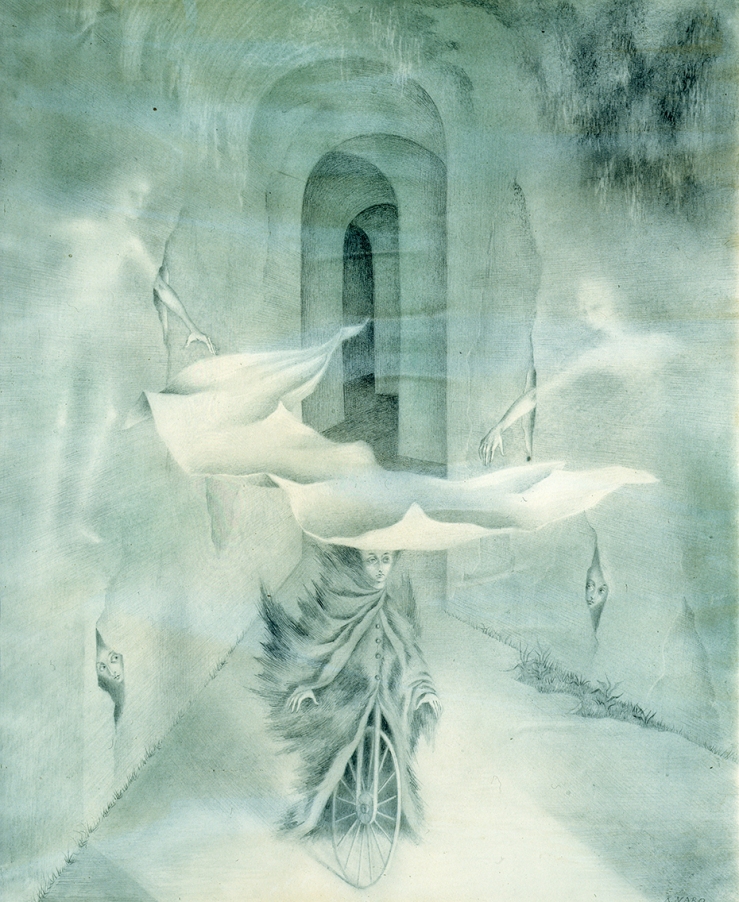
MC: Varo has a description for each of the paintings in the triptych (her descriptions, of course, shouldn’t close off other interpretations). That singular “girl” is introduced in the first painting,Toward the Tower, which shows a group of convent school girls riding fanciful bicycles made in part from their capes. Varo writes that while the eyes of the other girls are “as if hypnotized,” only the girl in front “resists the hypnosis.” (Sólo la muchacha del primer término se resiste a la hipnosis.) The girl clearly has a mind of her own. Varo follows her into the second painting, Embroidering the Earth’s Mantle. The original is: “Bajo las órdenes del Gran Maestro, bordan el manto terrestre, mares, montañas y seres vivos. Sólo la muchacha ha tejido una trampa en la que se le ve junto a su bienamado.” There’s a repetition in the Spanish, “Sólo la muchacha….” that I picked up in the translation “Only the girl has woven a ruse….” She’s the exception—she stands out from the other girls (“they”) who are under the influence and control of the Great Master and are embroidering what he commands. I could have said “Except that the girl has woven a ruse in which she is seen beside her beloved.” to underscore her act of rebellion more clearly, but then the parallelism would have been lost.
Getting back to the Bolaño, I’d like to re-read Amulet and think about how he works Varo into the narrative and whether he’s referencing any of her paintings or making them up — from your description, I suspect the latter. But more importantly, what did Varo represent to Bolaño? How did he come to know about her work? Did she have some sort of underground fame in Mexico City while he was living there?
I’m also fascinated by the fact that Auxilio visits Varo at her house, which I always make a point of passing by when I’m in Mexico City. (Again, Bolaño’s description is not based on reality.) Varo lived in Colonia Roma on Avenida Álvaro Obregón in a four-story building that’s now boarded up—someone told me it was damaged in an earthquake. But lights are on at night behind windows covered with newspapers, so someone’s living there. Is there any memory in the neighborhood that Varo lived there? It’s where she painted her most famous works. To me, it has a special aura, even in its dilapidated and boarded-up state.
Biblioklept: I’m pretty sure Bolaño made the painting up, although I did spend quite a bit of time looking for a real-world corollary for it. He definitely had a penchant for invention, often taking cult or outsider artists and then attributing works to them that don’t always exist. It seems possible that he could’ve been aware of the location of her house, but I’m guessing he was living in Spain and had been away from Mexico for ages when he wrote Amulet.
On of my favorite pieces in Letters, Dreams & Other Writings is “On Homo rodans,” a Borgesian send-up of scientific monographs. (Varo attributes the monograph to one “Hälikcio von Fuhrängschmidt”). While its style isn’t a huge departure from that of the letters or even fragments in the collection, it stands out a bit. Can you tell us a bit about translating “On Homo rodans,” and a bit about the piece itself?
Facsimile manuscript of “On Homo radans“
MC: Homo rodans is one of Varo’s oddest creations. It has two parts: first, the “fossil find” of the humanoid figure with one big wheel instead of legs, which she crafted out of chicken and turkey neck bones and fish vertebrae. The second part is a pseudo-scientific treatise she wrote to accompany the “fossil,” which purports to explain its origin and the great significance it has—it’s basically a missing chapter in human evolution, a predecessor to Homo sapiens that depicts a road not taken: before evolving into a biped, humans were creatures on a monowheel. (That sort of figure is a recurring leitmotiv in her work—seeTransmisión ciclista con cristales from 1943,Caminos tortuosos from 1957.) I’d now like to clear up a misunderstanding that’s arisen with the English translation. To an English-speaking reader, “rodans” might look like a corrupted version of “rodents.” It’s a similarity that exists only in English. To Varo, rodans was a creative spin on rota, the Latin word for wheel, from which the Spanish rueda descends (in English we have rotate, rotary, rodeo). Varo wasn’t suggesting humankind descended from rats; she was imagining a wheeled ancestor and giving it a suitably Latinate name.
The “fossil” in question
Varo wrote “On Homo rodans” by hand, in the style of an old illuminated manuscript (see attached photo), and gave its narrator the farfetched but seemingly authoritative name of Hälikcio von Fuhrängschmidt, an anthropologist who sets out to correct a colleague’s error about bones discovered on the southern slopes of the Carpathians. I think this was all for the sake of fun, like a lot of her writings. She probably never imagined that anyone would be interested in buying the sculpture and the treatise. It was just by accident, apparently, that someone happened to see it when she was showing it at a bookstore and acquired it for his boss, who was none other than the President of the Republic, Adolfo López Mateos. That was in 1959.
On an investigative level, I’d love to find out who owns Homo rodans now—the sculpture and original manuscript (does the López Mateos family still own it?). I’d also like to do some sleuthing to discover how it was that a small facsimile edition of the treatise was published a few years after Varo’s death. What called that into existence? Who read it? Was it reviewed? It’s because of that edition that we have the text in Spanish.
As to the translation itself, something that helped me catch the antiquated tones of the pedantic von Fuhrängschmidt were nineteenth-century bulletins on scientific expeditions and fossil excavations you can easily find using Google Books. But on the whole it was a wild ride. You’ll notice that the Homo rodans itself only comes up once, toward the end of the piece, after countless disquisitions on unrelated subjects (Babylonian wet nurses, the universal tendency toward hardening and softening (wink-wink), the transcendence of canes, the pterodactyl-turned-first-umbrella…), interspersed with quotes by ancient sages in nonsense Latin. Before I translated it, I thought “On Homo rodans” would mostly be about the one-wheeled fossil. It was only after I got into the translation that I realized the fossil find was just one stop on an extended absurdist romp.
Biblioklept: It’s interesting to me that you used old pieces of science writing as reference points. Was this to help convey the flavor of Varo’s prose, and to give an aural sense of what she’s parodying? Did you use similar techniques elsewhere in this translation, or in other translations of yours?
MC: The Edinburgh Encylopaedia, published in 1832, was an excellent resource to mine for old-fashioned scientific prose. Some of it rubbed off on the translation. “Osseous,” for example, referring to bones, was a word that peaked in the nineteenth century, according to Google Ngram, and it fit in perfectly.
For Varo’s recipes “To Induce Erotic Dreams” and “To Dream You Are King of England,” I consulted cookbooks such as Julia Child’s Mastering the Art of French Cooking to see how the instructions were worded. As strange as the recipes are, I had to keep to the conventions of the cookbook genre: “Set hens to boil.” “Reserve feathers.” “Take the four kilos of honey and with a spatula spread on the bedsheets.” It’s one example of how translators often look at companion texts in the language they’re translating into—some text that shares some stylistic feature with whatever is being translated, or that treats a similar topic. In a previous translation I did, Sergio Chejfec’s Baroni, a Journey, there’s a scene in which a cockfight takes place. Knowing nothing about cockfighting, I looked at Nathaniel West’s The Day of the Locust, where there’s a play-by-play of a cockfight in progress. I pilfered some of the language and phrasing there to help make the translation ring true in English.
The Lovers, 1963
Biblioklept: Varo’s “recipes” are a great example the tension between a conventional form and a kind of, I don’t know, absurd pivot in the language that creates a surreal image. Her letters, too, are infused with vivid and surreal images. She describes raising a “supernatural puppy,” details enclosing a “small volcano” and turning it into a kitchen, and tells one unidentified painter that he may be interested in her “residence in a piece of quartz.” Can you tell us a little bit about translating the letters? Were there letters of Varo’s that were perhaps more conventional that aren’t collected in Letters, Dreams & Other Writings?
MC: The original Cartas, sueños y otros textos contains only eight letters, but I’m sure Varo wrote many more. She had a genius for letter-writing, too—it was simply another medium she excelled at. As you say, the letters are infused with all sorts of surreal images and absurd scenarios, such as the “small volcano” that begins to rise on its own in the courtyard of someone’s house, throwing off lava that her friend Leonor Carrington is allergic to. That’s in my favorite letter, no. 7, “To Mr. Gardner,” i.e. Gerald Gardner, the great British popularizer of Wicca in the 1950s. It’s completely over-the-top! The most notorious is Letter 5, a kind of Surrealist prank, in which she picks a person’s name from the phone book and invites him to a New Year’s Eve party. (See Varo’s “Letter to a Stranger”). What comes next is left to your imagination: did the stranger show up, and if so, what happened?
As to other letters being published elsewhere, I’m aware of a few additional ones, to her mother and to some friends from her schooldays back in Spain, which were included in a personal memoir written by her niece, Beatriz Varo. I suppose you could call those letters more conventional, but they’re equally amusing to read, even when she’s telling her friends about her arduous ocean journey to Mexico in 1941, when she sailed from Europe on the Serpa Pinta with many other refugees who had been granted asylum in Mexico.
I was enchanted by all the letters and I’m hoping more of her correspondence turns up. I’d be especially interested in her side of the correspondence with Benjamin Péret after he returned to France in 1948. His letters to Varo are collected in his Oeuvres complètes, but no one seems to know where hers are…
Biblioklept: It’s a shame that we don’t have Varo’s letters to Péret. It seems like a lot of the work by the women surrealists of the twentieth century was perhaps at the time not seen as important as the work by the men. (I think of The New York Times’s obituary for Frida Kahlo, which opened with this line: “Frida Kahlo, wife of Diego Rivera, the noted painter, was found dead in her home today”). I think that your work, the work of Wakefield Press in general, and the work of other independent publishers is helping to bring the work of people like Varo, Leonora Carrington, Gisèle Prassinos, Unica Zürn and others to a wider audience though. What other women writers and artists would you like to see gain a wider audience?
MC: What writings are out there, out of print, or unknown, hidden in archives, uncatalogued, untranslated? The French poet and artist Alice Rahon, who also lived in Mexico City and moved in the same artistic circles as Varo, should be better known. She published a few books of poetry during her lifetime, and there’s an archive of unpublished work in Mexico City in both French and Spanish to be explored. A few poems in translation appear in Mary Ann Caws’s The Milk Bowl of Feathers, an anthology of surrealist writing published last year by New Directions, and I believe Mary Ann has been translating more of Rahon’s work. The Spanish artist Maruja Mallo, who was slightly older than Remedios Varo, also deserves more attention. Like Varo, she graduated from the prestigious Academia de Bellas Artes in Madrid and also lived in exile, in her case in Uruguay and Argentina, before returning to Spain in the 1960s. They both spent time in Paris in the 1930s, and I’m fairly sure they knew one another. Mallo has gotten some renewed interest lately—there was a recent gallery show in New York—and she has a short text “Surrealism as Manifest in My Work” in Penelope Rosemont’sSurrealist Women: An International Anthology. The artworks clearly take the lead for all three women, but their writings give a window into their strange art (and vice-versa), or maybe, can even stand independently, as do Leonora Carrington’s writings.
Biblioklept: Thanks for that list! I’m curious if you know how much of Carrington’s fiction Varo might have read. Was Carrington a stylistic influence? I’m also curious about other influences you detect in her writing, which seems so strange and original. “On Homo rodans” is definitely Borgesian, and Varo mentions reading Borges’s story “Deutsches Requiem” in one of the “Dreams” in the collection…who and what was Varo reading? How might it have influenced her writing?
The Street of Hidden Presences, 1956
MC:It’s hard to talk about influence because there must have always been a back-and-forth between Varo and Carrington and an intense sharing of mutual passions. They collaborated on a play, El santo cuerpo grasoso (“The Holy Oily Body”), written in the late 1940s and as far as I know, never performed for the general public. The original manuscript shows that they composed it in alternating lines, one hand followed by the other and back again, somewhat like a cadaver exquisit. They appear to have written it as a private amusement, to be performed by a small circle of friends. Carrington has a Varo-like character in The Hearing Trumpet, Carmella Velazquez, who, just as Varo did in the letter mentioned above, wrote letters to complete strangers she picked out of the phone book. She was the one who introduced Varo to Gerald Gardner, the Wicca popularizer. She may also have introduced her friend to Frank Sherwood Taylor, the British author of The Alchemists. A Spanish translation of this book was in Varo’s library.The heroine of Varo’s story “Mistress Thrompston Discovers by Accident the Source of the Tremendous Humidity that Reigns in the County of Kent” seems to be modeled on Carrington. There are other appearances by Carrington in the translation. Varo’sMimicry (Mimesis) makes an obvious nod to Carrington’sSelf-Portrait.
Mimicry, 1960
About their writings, keep in mind that Varo, unlike Carrington, never published her work during her lifetime, and it’s not clear she would have done so if offered the chance. Most of the texts I translated were found in Varo’s notebooks after her death. And don’t forget her long relationship with Benjamin Péret. A comparison of Varo’s and Péret’s writings would also be interesting. Her automatic writings probably date back to the time they were together. In Letters, Dreams Péret appears in the Felina Caprino-Mandrágora story as Benjamin Pérez, an avid bicyclist and the owner of a carrier-pigeon business. It’s a funny little scene, perhaps Péret-like in how it unfolds. All speculation, because I don’t know his work that well.
At a recent exhibition at the Museo de Arte Moderno in Mexico City of items from Remedios Varo’s archive, there were a few shelves of books from her library. I saw titles (in the original French, Spanish or English or in translation) by Jean Ray, H. P. Lovecraft, Rodney Collin (a British writer influenced by the mystics Pyotr Ouspensky and Gurdjieff), Orwell, Aldous Huxley, Katherine Mansfield, Simone Weil. That gives you an idea of other directions her reading took besides Borges. No way of knowing, though, all the books she read, or what her earliest reading was like growing up.
Some titles from Varo’s shelves
Biblioklept: Varo clearly read works of literature both in translation as well as in their original languages. In our own era, it’s very easy to quickly access all kinds of media from around the globe, including media that might not be as challenging to understand as literature might be. Why is reading literature in translation still important?
MC: You’re right—there’s more “content” than ever before and you can find it in a split second via Google. But if you’re asking, is there still a place for literature given the glut of writing, etc. on the Internet, I’d say yes, because it’s not an either/or. At the same time, I don’t think reading literature in translation is something meritorious in itself. It’s simply a natural consequence of being curious about what’s being written in other places: fiction, poetry, essays, plays, graphic novels, comics. It’s inevitable: a lot of it has to come to you in translation.
Biblioklept: One of the longer pieces in Letters, Dreams & Other Writings is titled “Project for a Theater Piece,” which you note was likely to be a collaboration with Leonora Carrington. For me, “Project for a Theater Piece” is simultaneously rich and frustrating. It opens with a character list that includes characters that we never get to meet (and omits characters we actually do meet), and has like a dozen plot openings that remain unresolved. This is what we might expect from a surrealist text: aporia, incongruity, dream logic (and some wonderful humor). At the same time, Varo’s writing strikes me as not bound to any kind of genre expectations.
MC: “Project for a Theater Piece” is indeed fragmentary and puzzling. Leonora (Carrington) and Eva (Sulzer) are inspirations for the Ellen Ramsbottom character. Daphne Fitz is inspired by Edward James, the eccentric Scottish arts patron who was a close friend of Leonora Carrington’s. He also seems to be the inspiration for the Poltergeist, who appears in the story wearing a short plaid skirt, sneakers and ankle socks, and is mistaken at first for a woman. I have no idea why it’s called “Project for a Theater Piece,” since it’s basically a cast of characters followed by two unconnected short stories. I’m assuming the editor of the original book, Isabel Castells, gave it that name. All the texts are said to be from Varo’s notebooks, so everything needed to be transcribed: in her introduction, Castells says that Varo’s last partner, Walter Gruen, did the transcription. I’m not sure if Castells saw the original; she may have been working only with Gruen’s transcription. Did the order in the book follow the order of the texts in Varo’s notebooks? Or was there some editorial intervention by Gruen and/or Castells linking them together? I don’t know. Castells also suggests that Leonora Carrington may have written parts that are missing, in a kind of surrealist chain story. If that’s true, it would be interesting to read “Project for a Theater Piece” against the collaborative play I mentioned above, El santo cuerpo grasoso/The Holy Oily Body, for stylistic similarities. Whatever the case, I wouldn’t read it as a finished text. It’s open to all sorts of speculations about the context in which it was written and about the editorial interventions that occurred later on in preparing the original edition of Cartas, sueños y otros textos for publication.
The Call, 1961
Biblioklept: I’m curious about the samples of automatic writing in the collection—specifically, I’m curious about how you approached translating them. Translating strikes me as a hyper-conscious art, a practice that involves a precision and command of tone, diction, rhythm, etc.—but automatic writing is, ostensibly, writing without consciousness.
MC: These texts seemed like prose poems to me, wonderful bizarre and disconnected, which led to some head scratching, and yes, a hyper-conscious translation. The text starts off with what seems to be a list of ingredients, like a recipe… or is it for some kind of magical spell? Each “ingredient” then becomes the lead word for a short sequence of images that often evoke Varo’s art: the egg, the crevice that widens (Harmony/Armonía), the raw silk being spun, which reminded me of the delicate lines crisscrossingFellow Feeling/Simpatía). The sequences in themselves don’t make much sense, but the words themselves are very clear and simple. Sometimes there’s some wordplay, such as “trasto trastorno, torno” in Incense (literally, “dish upset/overturned, turned”) which I translated as “dish depraved, lathe” to get some of the sound effects of the original and suggest the spindle in the next line. We don’t, unfortunately, have Varo’s description of the conditions under which she wrote these texts, or anything that tells us how she understood “automatic writing.” (Also, remember that she didn’t label these writings as such— it was the book’s editor.) She may not have been a purist. Whatever the case, this section is one of my favorites in the book. I love her random scattering of images and the lack of narrative direction. For me, the more nonsensical, the better.
Biblioklept: The issue of the editor’s hand is of course interesting. The “Automatic Writings” do feel…I don’t know, more automatic than some of the project ideas and fragments, which have narrative properties. There’s something wildly imagistic about the “Automatic Writings,” something cinematic really, mental imagery that seems like it couldn’t be painted. But then you read Varo’s descriptions of her own paintings, and you realize that her imaginative vision could realize seemingly impossible images in both paint and words.
MC: Yes, you wonder what her jumping-off points were. There are a couple of clues. In her “Unpublished Interview” at the beginning of the book, for example, she talks about how a painting develops: “I visualize it before I begin painting, and try to make it conform to the image I’ve already fashioned” (“lo visualizo antes de comenzar a pintar y trato de ajustarlo a la imagen que me he formado”). That’s about as close as she comes to describing her process explicitly. (By the way, it’s very possible that she created this interview herself. It was in one of her notebooks, undated, with both the questions and answers in her handwriting. A published version has never been found.)
Varo’s manuscript notebook
I read the comments she made on her paintings a bit differently, though. She wrote these on the back of photos she sent to family in Spain after the paintings were finished, so she had her brother, mother and other family members in mind as she wrote. The wild creative impulses that went into the act of painting them have calmed down now. Still, she’s not giving away any of their secrets. Of course, when you’re reading the descriptions, you should also be looking at the images, just as her family was. She talks about things you notice in the paintings, but not about all of them.Her descriptions of Harmony and Talleur pour dames (p. 102) are little gems, in my opinion.
Varo’s manuscript description of Woman Leaving the PsychoanalystWoman Leaving the Psychoanalyst, 1960
Biblioklept: Can you tell us anything about your next possible translation project?
MC: No projects at the moment and I’m not sure when I’ll pick up a new translation. Right now I’m doing some investigations around Remedios Varo and her circle of friends. I want to put her writings more in context, for example, that play she collaborated on with Leonora Carrington, or the Homo rodans piece. Or widen the lens to write about the “Surrealists of Calle Gabino Barreda,” the street in Mexico City where Varo and Péret lived in the 1940s. It seems to have been the center for a lot of creative and collaborative activity among the European surrealists in exile.
Biblioklept: Have you ever stolen a book?
MC: I’ve taken books people leave in laundry rooms or out on their front stoops, which happens a lot in brownstone neighborhoods in New York City. I also pass by a “Little Free Library” box on my way to work. I’m usually not tempted to take anything, but one day I saw a volume of Virginia Woolf’s Diaries and grabbed it!
AV: Yes, what’s important in post-exoticism is that it does away with exoticism. You suggested anti-exoticism, and it could just as well have been anti-exoticism, in as much as what characterizes exoticism is the absolute distinction between the metropolis and the margin, between the center and the periphery. With exoticism, there is an interest in the margins–the writer lives on the margins–but it’s all for the sake of the center. In exoticism, one describes the margins with ideas that come from the center, whereas in our books, the characters—who are dying, or perhaps already dead, who are birds, or animals, or insane—have no center, or rather it is their margin that is the center—the center no longer exists. For us, mental derangement doesn’t refer to a discourse of normality outside of it. In the books, it is present, and it is the center, it is what’s creating the world. In Lisbon, Last Frontier, it’s Ingrid Vogel who creates the world. The reader might think she’s completely mad, schizophrenic, paranoid, but, in fact, the book never refers to an outside normality, from which one could judge Ingrid’s experience. Yes, the book enters her imaginary; yes, it creates imaginary spaces for her to inhabit, but it never refers to a normality outside of her. And it’s through this precise mechanism that the books are on the margins, in the dustbin (to borrow an expression from Lisbon, Last Frontier); it’s in this way that they are dustbin literature, a literature from elsewhere, and that’s what comes into being with post-exoticism. That’s what’s important I think: a literature that doesn’t refer to normality, that doesn’t refer to the center. In that sense it’s more anti-exoticism… but of course I’m not going to change it now. It’s too late; it’s post-exoticism until the end!
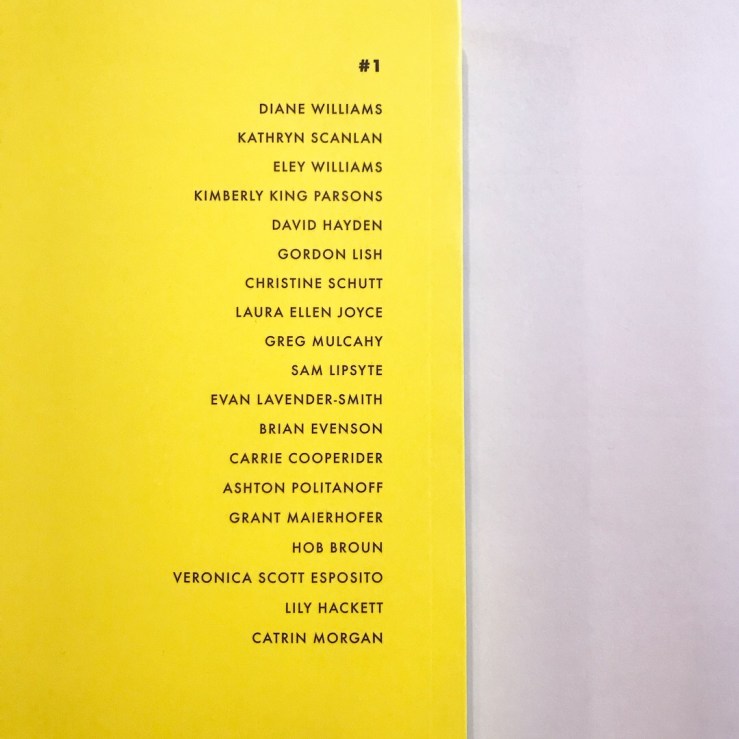
David Winters: Literally: the act or way of leaving a place; an emergence, opening or exit. Egress is also a biannual literary magazine devoted to showcasing the most innovative writers on both sides of the Atlantic today. Our first issue features, among others, Gordon Lish, Diane Williams, Sam Lipsyte, Kathryn Scanlan, David Hayden and Kimberly King Parsons.
Biblioklept: How long has Egress been incubating? How did the magazine come about?
DW: Incubation began in May 2017, over a lunch of okonomiyaki in Bloomsbury, London. We met through Gordon Lish. Little Island had published Lish’s White Plains, as well as books by his students Russell Perrson and Jason Schwartz. I’d also alerted Andrew to the work of David Hayden, author of Darker with the Lights On, who has two new stories in Egress #1. So, there was a sense of shared tastes. A sense, too, that UK literary magazines–despite the efforts of a few pioneers—lacked the avant-garde spirit of US publications like NOON and New York Tyrant. We both saw a space for something new. Okonomiyaki, for the benefit of your readers, are a type of savoury Japanese pancake.
Andrew Latimer: Through David and Gordon Lish, I’d discovered writers like Christine Schutt and Sam Lipsyte (both in Egress #1) and desperately wanted a vehicle for engaging this type of work here, in the UK. Egress – the name, the style, the design – all came about quite naturally from a desire to bring writing like this into one place.
Biblioklept: For readers unfamiliar, can you describe the Lishian aesthetic, at least as you see it?
DW: Well, in a sense, there’s no such thing. Journalists in the eighties harped on about ‘minimalism’—a stupid label, with little purchase on the writers in question. Sven Birkerts once claimed there was a ‘School of Gordon Lish’. But Lish’s influence can’t be reduced in that way. Over the decades, hundreds of very different writers have worked with him, learned from him, bounced off him, swerved away from him. What the best of them have in common is an acute sensitivity to the power of language, and a commitment to creating new and lasting art—art that stands apart from the marketplace. Those are also the qualities we prize at Egress. But they are hardly restricted to “Lishian” fiction.
Biblioklept: That “acute sensitivity to the power of language” is on display in the two fictions from Lish in Egress #1, “Jawbone” and “Court of the Kangaroo.” The first Lish story, “Jawbone,” is about this seemingly unimportant minuscule moment, but Lish turns the whole thing into a drama about language itself. There’s this line in “Jawbone” that I kept tripping over, rereading and rereading: “Like lucky thing for the local citizenry someone on your side was there in there on duty on the nightbeat last night in the crapper last night.” The line is simultaneously gorgeous and ugly, elegant and clunky—rapturous really.
AL: Rereading is the key here. We’re familiar with rereading whole stories that we like or ones with endings that puzzle us. But what Lish, and writers of this ilk, ask us to do is to reread sentences in the course of making our first reading. This assumes a reader, a listener even, with the patience to linger over the page, its construction. (Gary Lutz prefers a “page-hugging” to a page-turning reader.)
DW: “Gorgeous and ugly” — exactly, yes. Donald Barthelme once said, “every writer in the country can write a beautiful sentence, or a hundred. What I am interested in is the ugly sentence that is also somehow beautiful.” Lish, when he was teaching, called this “burnt tongue”: “God only listens to those whose tongues are burnt, twisted, crippled.” Writers of fiction can achieve extraordinary power by attending to everything wrong, skewed, erratic in their natural speech — and, rather than being afraid of that wrongness, amplifying it on the page. But power of this kind needn’t be purely spontaneous; it can also be elicited by editing. The sentence you mention went through multiple revisions; Lish reworks his stories obsessively, right up to the final proof stage. When I edit fiction, in my lesser way, I often look out for those off-kilter sentences, isolate them, tweak them, try to increase their tension and pressure.
Biblioklept: How much and what kind of editing did you guys do with Egress #1. I mean, were the authors submitting finished pieces, or were you working with them through the process?
DW: It varies. Some stories are, with the authors’ approval, heavily edited. Some authors come to us in such command of their material that no editing is necessary. Sometimes, editing is simply about discovery: finding the new. Sometimes it’s about reinvention: getting stuck in and making it new. Between these extremes, there’s a whole spectrum of interventions.
Biblioklept: I’ll admit that I opened Egress with the idea that I’d probably go straight to Lish and then maybe read Christine Schutt or Evan Lavender-Smith—some of the writers I’d already read before—before reading ones that were new to me. However, the first story in Egress #1, which is by Kimberly King Parsons had a title that grabbed my attention: “Mr. Corpulent Wants Polaroid Proof.” So I started there, and all the sentences made me want to keep reading, and then read into her second story. Then I read the next story, Grant Maierhofer’s “Everybody’s Darling.” (The opening line “I suppose I took to mother’s unders when the end became too sure” sort of insisted Keep going). How important is sequencing the stories (and essays) of Egress and what was that process like? How much of your editorial mission involves opening up a place for newer voices?
DW: Openings are important. Andrew and I share the view that stories should command attention from their very first sentence–what some would call the ‘attack’. Again, though, an attack doesn’t have to be nailed down straight away; it can emerge in the process of revision. However they’re made, the best openings astonish, seduce, compel us, as you say, to ‘keep going’.
And if literary art is about attention, so too is the art of the literary magazine. Drawing attention to unknown writers has long been the mission of little magazines, ever since the heyday of modernism. Incidentally, this has also been my mission as a critic. When I started writing about Christine Schutt, Evan Lavender-Smith and others, they were largely overlooked and unpublished in the UK. Both in mainstream literary journalism and in the academy, critical attention often fixates on the famous and commercially successful. This is especially true of prose fiction, which inhabits a different institutional ecosystem to, say, poetry. With the current renaissance of small presses, the pendulum is starting to swing the other way. Even so, the writers who make the Booker Prize shortlist or get reviewed in The Guardian are not, by and large, the writers who’ll be remembered decades from now. The market exerts a powerful pull on our collective attention. Good publishing, like good criticism, resists that pull. The task is to look away from what everyone else is looking at–look at what they’re not looking at–and then make them see.
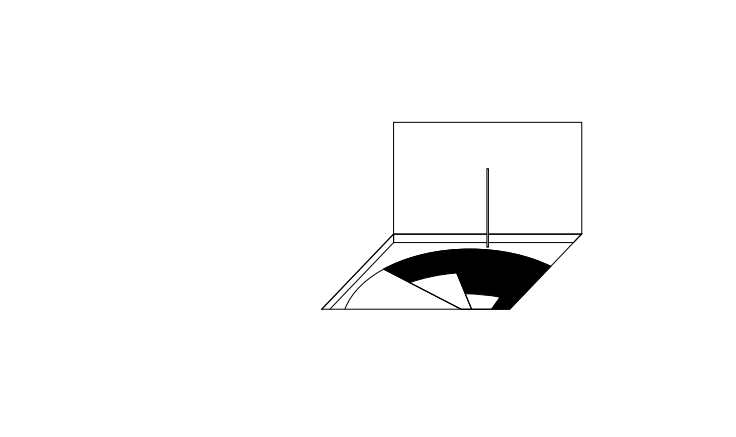
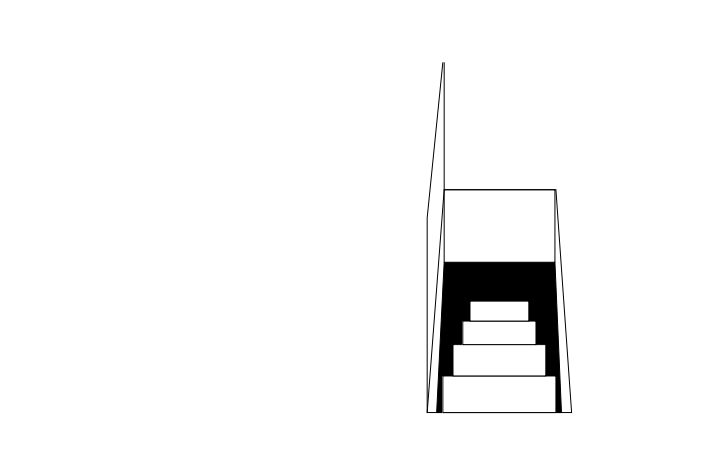
AL: Absolutely – and the sequencing of the stories and essays plays a huge part in showcasing those new voices. As a reader, there is always that pull to go to the names you know and love first. (It’s part of why you pick up a magazine.) But, as an editor, you can’t just rely on the big names; you’ve got to be in the business of making new ones. You have a responsibility to disrupt the reader’s expectations, to put things in their way. Beyond names and reputations, there’s also a careful and deliberate counterpointing of the work in Egress. David and I think about how one story or essay speaks to another, how it’s placement can enrich another’s meaning, its rhythms. This kind of editorial work, the imposition of an overarching rhythm to the issue, wills the reader to ‘keep going’. Catrin Morgan’s illustrations (of various egresses – trapdoors and staircases) are a neat visual cue to the reader to push on, to explore what’s round the corner.
Illustration for Egress #1 by Catrin Morgan
Biblioklept: Some of this blog’s readers might know Catrin Morgan from her illustrated version of Ben Marcus’s The Age of Wire and String. How did you get her involved with Egress? Do you plan for each issue to have a different artist?
AL: Originally we asked her for an image for the front cover, but she ended up drawing all these bizarre stairs and exits that were so compelling I just had to use them. I’d like to continue using her illustrations throughout the text for the future, but there will be a new artist featured in the colour plates each issue. The “artist” for this issue is Hob Broun.
Biblioklept: I know David has been enthusiastic about Hob Broun’s writing for a few years. Broun is sort of a “writer’s writer’s writer,” if that makes sense. The first issue of Egress features a section titled “Remembering Hob Broun: 1950-1987”; in addition to remembrances from the novelist Sam Lipsyte and Kevin McMahon, who befriended Broun when they attended Reed College together in the late sixties, you include a full color selection from one of Broun’s journals. Can you describe some of the journal for readers, and talk a bit about how the Broun section came together? For readers unfamiliar with Broun, what’s the appeal?
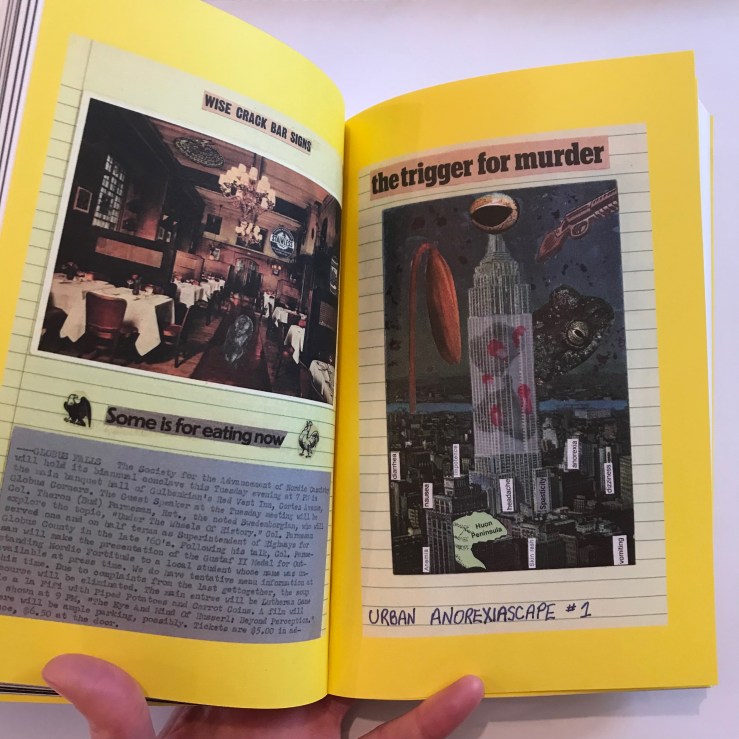
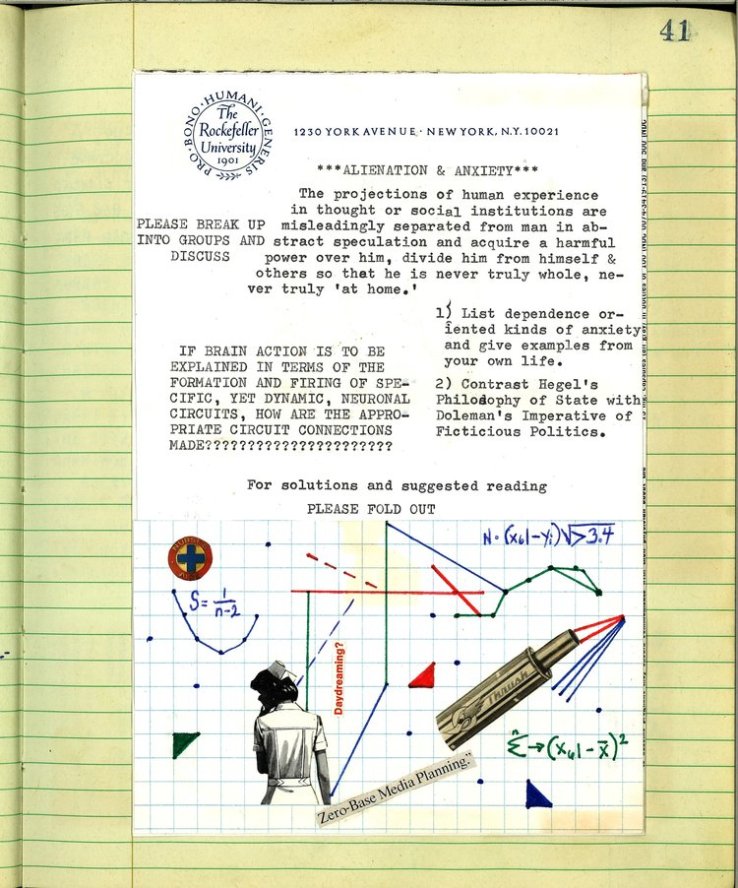
DW: Broun is a ‘writer’s (writer’s) writer’ only in that he isn’t well-known–his work isn’t at all opaque or aloof. He published three books in his lifetime, the novels Odditorium (1983) and Inner Tube (1985), and the superb short story collection Cardinal Numbers (1988). While writing Inner Tube, Broun underwent emergency surgery to remove a spinal tumour. He was left paralysed from the neck down. Remarkably, he finished the novel–and wrote the stories in Cardinal Numbers–using a kind of writing-machine: an oral catheter (or ‘sip-and-puff device’) connected to a customised word processor, triggered by his breath whenever a letter flashed on the screen. This aspect of Broun’s life lends itself to mythologization: what better image of writerly dedication? At the same time, it risks obscuring what really matters: the work itself. I was delighted, then, when Kevin McMahon got in touch. Kevin’s essay only glances at Broun’s illness, giving us, instead, a vivid portrait of the man behind the myth. Best of all, Kevin sent us Broun’s personal journal. It’s an extraordinary artefact–a scrapbook of doctored magazine clippings and miniature, fragmentary narratives–unmistakably Brounian in its pulpy, screwball surreality. Broun’s journal is continuous with his fiction (Cardinal Numbers contains the manifesto-like statement, ‘modus operandi: montage, collage, bricolage’), but, unlike his fiction, it wasn’t created for public consumption. Not unlike the art of, say, Ray Johnson or Joseph Cornell, it gives us a glimpse of a private world, a game played for inscrutable reasons—what Don DeLillo calls “the pure game of making up”. Our celebration of Broun ends with a wonderful essay by Sam Lipsyte–a writer Andrew and I both revere–who captures his essence far better than either of us ever could.
Biblioklept: Which of Broun’s three books do you think is the best starting place for folks interested in his work after reading about him in Egress?
DW: Cardinal Numbers, without a doubt. Open Road recently reissued all three titles as e-books, but I’d recommend picking up the old Knopf hardbacks, which can be had for as little as a dollar. Another Broun novel–a previously unpublished manuscript–might be out in a year or two.
Biblioklept: Maybe Egress could get a hold of a few pages.
DW: We’ve been looking at some of his unpublished work, yes.
Biblioklept: Why is it necessary to publish Egress in a physical, print form?
AL: Why is Egress in print? There are so many reasons, but I’ll focus on one. The role of curation has never been more important as it is now. We are distracted: information, entertainment, stuff causes our attention to bleed from one thing to the next. Egress, like all the best journals and mags, is a highly curated affair. David and I wanted there to be a palpable sensation derived from receiving and reading each issue of the magazine. The style of writing, the artwork, the design. Much of that effect relies on all the pieces being enclosed between covers – simultaneously held together and also cut off, if only briefly, from everything else that’s going on. It’s hard, likely impossible, to get that same sense of quietude, to enforce focus, when reading on a screen as infinite worlds suggest themselves merely clicks away. As well as this, there’s an indispensable sense of occasion one gets from a print magazine: ‘when is it out?’ The magazine, as a format, craves temporality.
Biblioklept: Do you envision future issues of Egress publishing some of the authors featured in the first issue?
AL: Yes, definitely.
Biblioklept: There’s an obvious aesthetic value to a literary journal or magazine publishing the same authors frequently, but are there any risks?
DW: There are risks and rewards. Magazines like Egress serve two roles in the culture. Our primary role is to discover and promote new writers. Often unpublished, unagented, and lacking industry connections, these writers reside at the margins. But we believe in them, fervently, and we believe they deserve to be heard. This gives rise to a second role. You might even call it a moral responsibility. Newness needs to be nurtured, protected, given a space in which it can grow. One contributor to Egress #1 only began writing fiction six months ago. She’d published nothing before she came to us. But what she’s doing is truly unique. Will we publish her again? You bet. We’ll do everything in our power to support her work. The same goes for any writer we believe in. If you do that and keep doing it–if you keep bringing new writers together–you become something more than a magazine. You become a community. Look at the best literary magazines of recent decades–from The Quarterly through to elimae, NOON, Tyrant and Unsaid–and that’s what you’ll see: artistic communities. Temporary autonomous zones; bubbles in which innovation can flourish. The risk, of course–and here I could name several lesser litmags–is that such communities can solidify into coteries, stables, ‘closed shops’. We’ll champion writers as long as they need us, but we’ll never close ourselves off in that way. After all, the real thrill is when someone comes to you from out of nowhere–no publications, no social media accounts, no ‘platform’, fuck, even no cover letter–just power on the page.
Biblioklept: Have you ever stolen a book?
DW: Sure, when they’re overpriced or out of print. Worse, I’ve had others steal them for me. Years ago, a friend went to great lengths to liberate Ilya Prigogine and Isabelle Stengers’ Order Out of Chaos from a university library for me. And a contributor to Egress #2 once smuggled an exorbitantly priced theology monograph out of a bookshop on my behalf. (Sorry Julie—see you in prison!)
AL: I’m bad for stealing books from places I’m staying at — friends’, hostels, BnBs — especially if I think I’d appreciate the book more myself. My favourite steal so far has been Epitaph of a Small Winner by Machado de Assis, which I’ve read the covers off so can’t return that now (not that I would).
Illustration for Egress #1 by Catrin Morgan
The first issue of Egressis out now in the UK. It will be available in the US on 21 June 2018.
David Winters is a literary critic. He has written for the Times Literary Supplement, the Los Angeles Review of Books, Bookforum, The Brooklyn Rail and elsewhere. He currently holds a postdoctoral research fellowship at the University of Cambridge, where he is writing a book about Gordon Lish. He co-edits both Egress and 3:AM Magazine, and can be found online at www.davidwinters.uk.
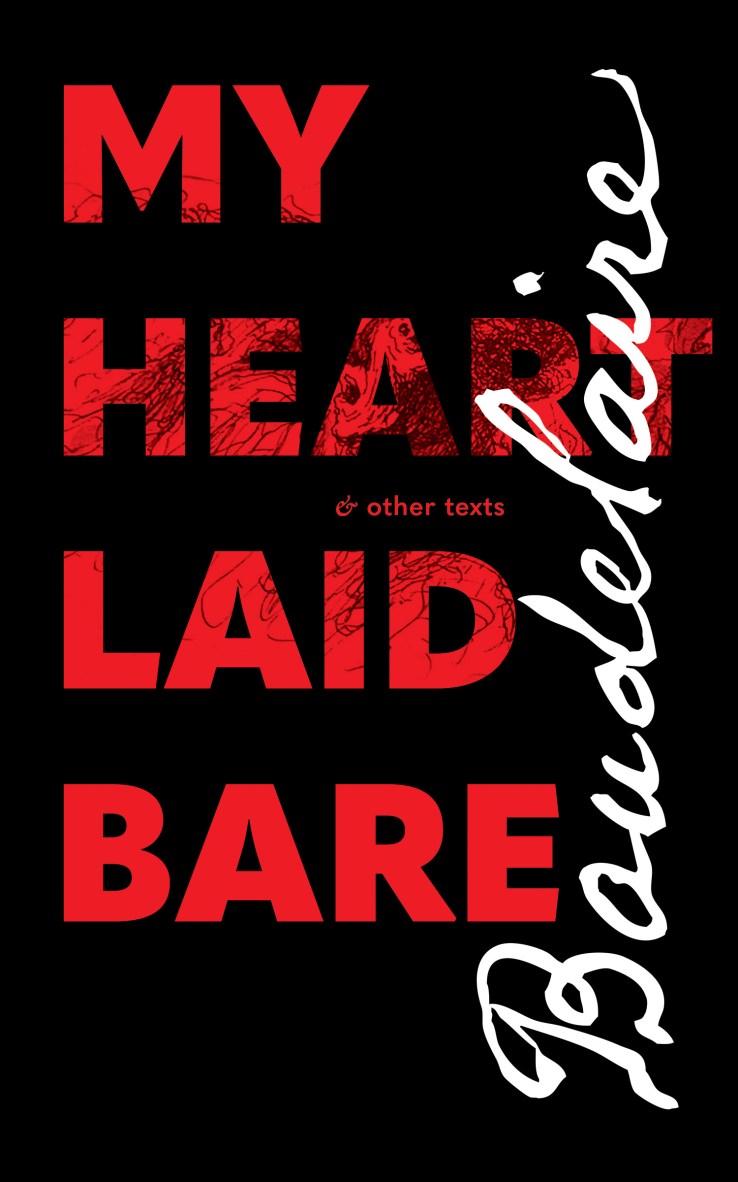
Rainer J. Hanshe is the translator of My Heart Laid Bare & Other Texts, a collection of writings by Charles Baudelaire, new from Contra Mundum Press. Over a series of emails, Hanshe was kind enough to talk to me about My Heart Laid Bare, Baudelaire, dandyism, translation, art, stealing books, and all other manner of topics.
Biblioklept: What is My Heart Laid Bare? Did Baudelaire envision its publication in his lifetime?
Rainer J. Hanshe: The title My Heart Laid Bare is Edgar Allan Poe’s, and it’s he who conceives of a book that, if daring enough, if ‘bare’ enough, could revolutionize human thought, opinion, and sentiment. This could be achieved, Poe said, “by writing and publishing a very little book. Its title should be simple — a few plain words — ‘My Heart Laid Bare.’ But this little book must be true to its title.” Baudelaire took up Poe’s provocation and his Mon cœur mis à nu is one of a number of different books that he dreamt up and hoped to write “without lassitude — in a word to be in good heart day after day.” Others Baudelaire mentioned along with it in an 1864 letter included Histoires grotesques et sérieuses, Les fleurs du Mal, Le spleen de Paris, Les paradis artificiels, Contemporaines, and Pauvre Belgium! The first notes for Mon cœur mis à nu begin in 1859, two years after the initial publication of The flowers of Evil, if not possibly somewhat earlier, and continue until 1865, ceasing only due to Baudelaire’s severe health condition (he would die in 1867 at just 46 years of age), hence they comprise the final decade of his writing life.
Aside from the more direct root of Poe, Rousseau was another of Baudelaire’s models, albeit a negative one to surpass. Baudelaire said that “all the targets of [his] rage” would be collected in Mon cœur mis à nu. “Ah! if ever that sees the light of day, J-J’s Confessions will seem pale.” As I describe in the synopsis, it is an apodictic work of aphorism, maxim, note, and extended reflection. It is not however some memoir-like spewing of Baudelaire’s bios; rather, it is the baring of his l’esprit, and as a crystallization of such, it isn’t some kind of ‘tell-all exposé’ (Rousseau’s notion of absolute transparency, an indulgence we could well do without, especially considering its pernicious ramifications), but to me a much higher form of ‘confession,’ for it is the arc of thought, the play of the mind in its every breadth that is bared. It contains Baudelaire’s exhortations on work, faith, religion, and politics, excoriating sociological analyses, diatribes on literature, the arts (George Sand receives some choice malicious arrows), and love (women, prostitution, sadomasochism, erotics en générale), and outlines of his conception of the dandy and the Poet.
The Poet for Baudelaire is I would say a figure similar in kind to Nietzsche’s untimely personage, the posthumous human, a kind of philosophical anthropologist who hovers over the earth, examining the human species both from within and externally, from a sub species aeternitatis perspective, diagnosing it like a physician (much of the book’s terminology is medical taxonomy).
In 1861, two years after beginning Mon cœur mis à nu, sieged by resignation, calumny, and ill health (nervous disorders, vomiting, insomnia, fainting fits, recurrent syphilitic outbreaks), Baudelaire expresses doubt that he will ever complete his various projects. “My situation as regards my honor, frightful — and that’s the greatest evil. Never any rest. Insults, outrages, affronts you can’t imagine, which corrupt the imagination and paralyze it.” Three years later, it was against the continuing extremities of an exacerbated solitude, frayed nerves, self-described terrors, and constant hounding by creditors that Baudelaire implored himself to remain stalwart (“I must pull myself together, take heart! This may well bring rewards.”) and write.
Clearly, he did envision publishing the book in his lifetime, and he diligently worked at it, steeling himself against his trials to the degree within his power, but it was never completed. The obstructions he faced were abundant; the somatic afflictions inordinately taxing. The threat of his impending decline or decay is sharply articulated in one passage wherein he speaks of “feeling the wind of the wing of imbecility” passing over him. Various translators have rendered that as “the wing of madness,” but Baudelaire says “imbécillité,” not folie or démence. The notion of “the wing of madness” has greater Gothico-Romantic cache, but it’s not what Baudelaire says, and in this case, there’s a relatively exact equivalence of terms. It was more physical weakness and feebleness that he feared, and experienced, and believed would finally incapacitate him, as it did, not madness. His aphasia and heart attacks led to his losing his ability to speak and thereafter, his ability to read and write — the death of the writer.
We have only the existing fragments then, which have been translated in full, but they were published posthumously. Despite no such title existing in the text, or any related material, French editors originally published the work as “Journaux intime” (Intimate Journals), which included two other sections, “Fusées” and “Hygiène.” Translations into English followed suite, and they adopted the false title, which must at last be discarded. If Baudelaire hadn’t been besieged by illnesses as he was, he would have imaginably given us a definitive version of Mon cœur mis à nu considering that he did complete other books he began around the same period (Le spleen de Paris, Les paradis artificiels, et cetera). It remains a fragmentary work then, in both senses, yet one that is substantive enough to merit our continued attention.
Biblioklept: For me, the fragmentary nature of My Heart Laid Bare is in some ways more appealing than the cohesion of a more polished philosophical or poetic text. It’s a discursive read, and there’s joy in tying (or failing to tie) the fragments together. This reading experience is perhaps as close as we can get to seeing Baudelaire thinking (and feeling). At the same time, there’s perhaps a risk of the average reader’s misreading or misinterpreting some of Baudelaire’s riffs, quips, and jabs here. How tempting was it to footnote the hell out of My Heart Laid Bare?
Hanshe: In his poet’s notebook, Paul Valéry said that “a work is never necessarily finished, for he who has made it is never complete, and the power and agility he has drawn from it confer on him just the power to improve it […]. He draws from it what is needed to efface and remake it. This is how a free artist, at least, should regard things.” Similarly, he says elsewhere that, “in the eyes of lovers of anxiety and perfection, a work is never finished but abandoned.” Since Baudelaire never prepared a definitive version of the book, we cannot know what he would have changed, or not, yet as a work closely aligned with his self, it’s something that could never have been completed, only abandoned. Hence, it would always remain fragmentary. Think of Schlegel’s poetics of the fragment where even ‘incompleteness’ is exceptionally refined, an architecturally precise aesthetic form (sculpturally, this calls to mind Giacometti). In his essay on German Romanticism, Walter Benjamin pointed out that aphoristic writing is not proof against systematic intentions (an accurate insight made about Nietzsche’s work in fact, albeit one lost on many of his later readers…), that one can write aphoristically and still think through one’s philosophy or writing “in a comprehensive and unitary manner in keeping with one’s guiding ideas.” In this way, it’s not that Baudelaire’s book lacks cohesiveness; it’s deliberately fragmentary to eschew finality, and because the self, the ‘heart’ being laid bare, is never complete. That Baudelaire worked on it for nearly ten years though makes it probable that its character was quite well defined before illness permanently disrupted his voluntarily abandoning it.
There are certainly unities, or thoughts that overlap and intertwine within the book, as there are with other books of Baudelaire’s, and when I began translating it, I kept track of those I was aware of while also benefitting from the extensive and exemplary notes that the French editors amassed. The critical addendum was therefore unfurling like an infinite papyrus, threatening to end in it being as long, if not longer, than the book itself. In a way, that kind of critical gesture is an act of usurpation and domination, just as overly lengthy introductions can be (consider the grand effrontery of Foucault’s introduction to Binswanger’s Dream & Existence, which is twice the length of the book). At a certain point, I felt that continuing to amass notes would have made the book extremely cumbersome, one unpleasant to read, merely due to sheer volume. There’s also something about a massive critical addendum that’s imposing, if not intrusive, to many readers. Additionally, it was a question of elegance: I didn’t want to litter the book with footnote numbers; alternative methods to that could have easily been devised but, ultimately, I opted against including extensive notes. While as readers we can disavow them altogether, not having them makes for a more comfortable book to wield. Finally, encountering it would be more like coming upon Baudelaire’s own notebook, free of editorial invasiveness, thereby leaving the reader to his or her own rapturous encounter with it, however intractable it may be. As for misreading or misinterpreting, I don’t think such can ever be definitively foreclosed. While errant and contentious readings exist, to fear risking them is to argue that we can fathom authorial intention, or that there are definitive and absolute interpretations. Reading should be dangerous, risky, volatile, something that threatens to undermine, overwhelm, and mutate us, if not put the world into metamorphosis, as books can and have done, though hardly as much in our depleted and toothless epoch. Otherwise, reading is just entertainment, a diversionary narcotic, and we have to be willing to be shattered by books, to undergo both subtle and emphatic shocks.
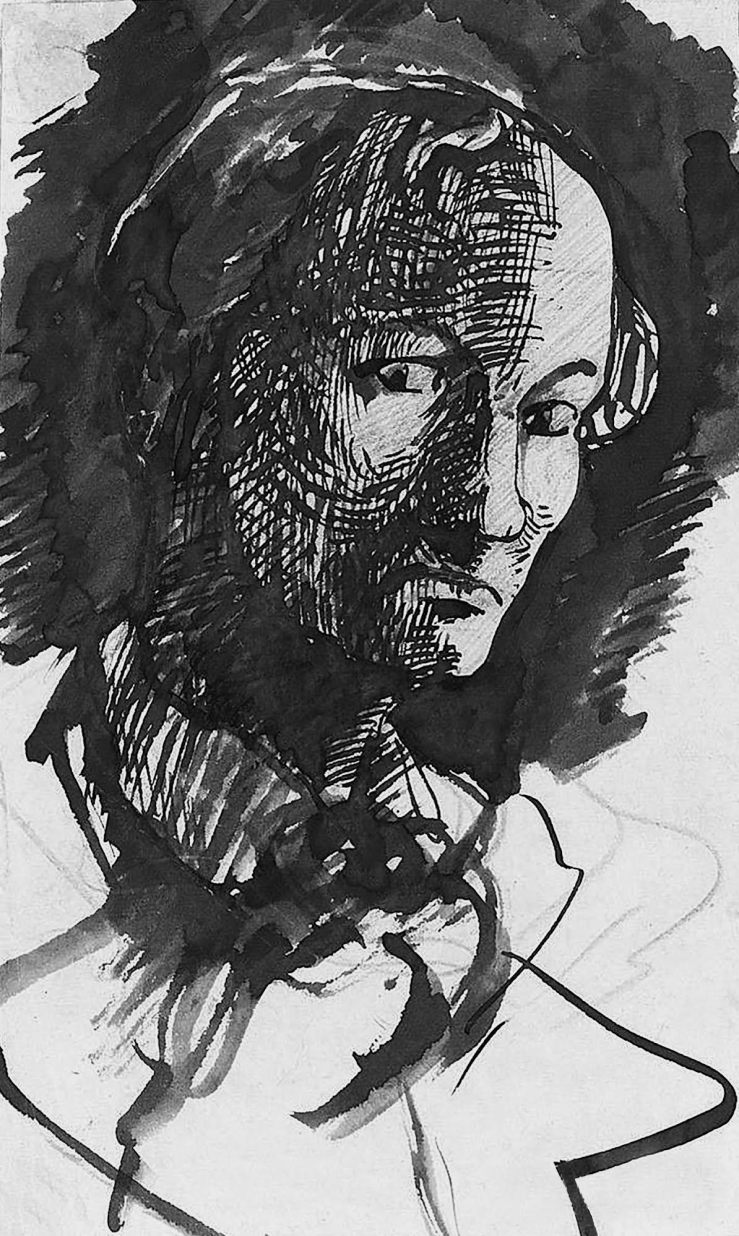
Self-Portrait by Charles Baudelaire, 1863-64
Biblioklept: What is Flares?
Hanshe: Quite simply, it’s a writer’s notebook; as such, it doesn’t have a single focus but is more motley, something of a hybrid entity. To paraphrase, we could call it The Poet Laid Bare (of poetic form). Nonetheless, I believe it has two principal nerve centers: critique and meditation.
The critique is many-tendrilled, with its points of observation being the craft of the writer, art and aesthetics, love, pleasure, and intoxication (numerous types), religion and theology, politics, etc. The writer’s smelting room and sometimes place of furious venting. As with Mon cœur mis à nu, there is a root in Poe, who in his Marginalia spoke of “a peculiar type of criticism” that “can only be designated by the ‘German ‘Schwarmerei’ — not exactly ‘humbug’ but ‘sky-rocketing’…” Baudelaire took up this idea, naming his work fusées, which is an expansive translation of the English skyrockets. A fusée is a pyrotechnical device (rocket, flare, or firework), musket, or heraldic emblem, hence the title corresponds well with the work’s variegated character. It is something incendiary, combative, and elegant. The manifold subtitles peppered throughout “Flares” offer us a provisional overview of its character, too: Plans, Projects, Suggestions, Notes, Hygiene, Morality, Conduct, Method. Here we see the writer’s notebook, the critique, and the meditation.
In speaking of intellectual gymnastics, the altar of the will, moral dynamics, the great deed, perfect health, the hygiene of the soul, political harmony of character, eurhythmy of character and faculties, self-purification, mastery of time, and accomplishing one’s duties, Baudelaire enumerates a concentration of terms and concepts related to self-cultivation. The book thus contains a kind of technology of the self, the outline of Baudelaire’s martial praxis for the artist — intellectual gymnastics and the sanctification of the will both bespeak an agonistic sensibility, as does his paean to greatness and his call to achieve it in contradistinction to the tremendous oppositional force of nothing less than an entire nation. What is this but Baudelaire’s Miltonic-Satanic typology. “The man of letters rends foundations…” (Flares §6) Such terminology, and the repeated invocations to himself to master his will and to work diligently to become who he is, are part of a regimen of poetic self-shaping. “Want every day to be the greatest of men!!!” (My Heart… §70) The references to Emerson and his Conduct of Life further reinforce that, which is but one reason why in the book’s synopsis I made a parallel to Marcus Aurelius, characterizing the book as Baudelaire’s meditations, which I see as its second nerve center. The poet is clearly concerned with self-government, and this shaping or cultivation of the self is meant to strengthen him, thereby aiding his accomplishing his artistic tasks, of which the book is in part a record.
These notions can be woven together with other parts of the work, i.e. §16 of “Flares,” where Baudelaire speaks of the most perfect type of virile Beauty (the Miltonic Satan), or the Emersonian hero (he who is immovably centered), giving us the supreme artistic model of Satan, that is, Satan as the light-bringer, the visionary, he who is anti-human (“Let us defy the people, common sense, the heart, inspiration, and evidence.” §47; “The man of letters is the enemy of the world.” §53). In §21 of ”Flares” Baudelaire asks, “To give oneself to Satan, what is it?” The book provides us with some answers, as does his poetry (the “Litanies of Satan” et alia), and his Dandy (a superior figure) is another type with similarly sublime aspirations. It is the onset of the anti-Christian hyperanthropos. “The poet, the priest, and the soldier are the only great men among men: … the rest are made for the whip” (§47). Continue reading ““Translation is an act of risk” | An interview with Rainer J. Hanshe on translating Baudelaire’s My Heart Laid Bare”→







 War, 1915 by Patrick William Adam (1854–1929)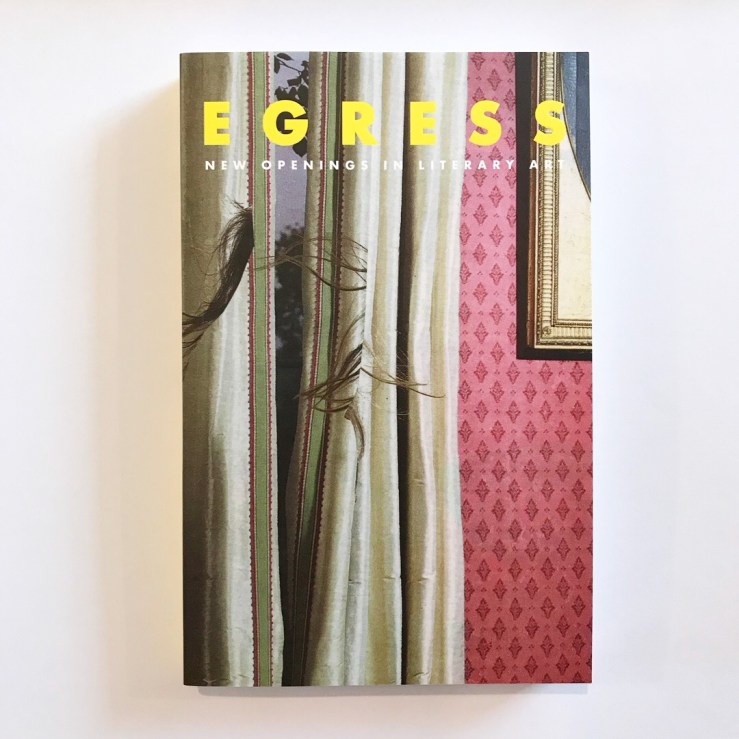
 Biblioklept