“Game” – Octavio Paz

I’ll plunder seasons.
I’ll play with months and years.
Winter days with the red faces of summer.

And down the gray road,
in the silent parade
of hard, unmoving days,
I’ll organize the blues and gymnastics.

A rippling morning
of painted lips,
cool, as though just bathed,
with an autumn dawn.

And I’ll catch the clouds–
red, blue, purple–
and throw them against the inexpressive paper
of the black and blue sky,
so that they’ll write a letter
in the universal language
to their good friend the wind.

To help the shopkeepers,
I’ll make luminous billboards,
with spotlights of stars.

Maybe I’ll assassinate a dawn
so that, bleeding,
it will stain a white cloud purple.

In the shop of the seasons,
I’ll sell ripe autumn apples
wrapped in the paper of winter mists.

I’ll kidnap Spring,
to have her in my house,
like a ballerina.

The wind will change its schedule.
Unpredictable crossings of the clouds.

And down the highway of the Future, I’ll rush toward Winter,
for the surprise of meeting it later,
mixed with Summer.

On the green felt of space,
I’ll bet on days
that will roll like dice.

I’ll play with months and years.


Octavio Paz’s first unpublished poem, 1931. Translated by Eliot Weinberger.

Watch Rembrandt’s J’Accuse, Peter Greenaway’s Film-Essay on Visual Illiteracy


“Beckett’s Theory of Tragedy” — Anne Carson

Capture

World of Pains and Troubles (John Keats)

—The common cognomen of this world among the misguided and superstitious is ‘a vale of tears’ from which we are to be redeemed by a certain arbitrary interposition of God and taken to Heaven–What a little circumscribed straightened notion! call the world if you Please ‘The vale of Soul-making’ Then you will find out the use of the world (I am speaking now in the highest terms for human nature admitting it to be immortal which I will here take for granted for the purpose of showing a thought which has struck me concerning it) I say “Soul making” Soul as distinguished from an Intelligence– There may be intelligences or sparks of the divinity in millions–but they are not Souls till they acquire identities, till each one is personally itself. Intelligences are atoms of perception–they know and they see and they are pure, in short they are God–how then are Souls to be made? How then are these sparks which are God to have identity given them–so as ever to possess a bliss peculiar to each ones individual existence? How, but by the medium of a world like this? This point I sincerely wish to consider because I think it a grander system of salvation than the chrystain religion–or rather it is a system of Spirit-creation–This is effected by three grand materials acting the one upon the other for a series of years–These Materials are the Intelligence–the human heart (as distinguished from intelligence or Mind) and the World or Elemental space suited for the proper action of Mind and Heart on each other for the purpose of forming the Soul or Intelligence destined to possess the sense of Identity. I can scarcely express what I but dimly perceive–and yet I think I perceive it–that you may judge the more clearly I will put it in the most homely form possible–I will call the world a School instituted for the purpose of teaching little children to read–I will call the Child able to read, the Soul made from that school and its hornbook. Do you not see how necessary a World of Pains and troubles is to school an Intelligence and make it a soul? A Place where the heart must feel and suffer in a thousand diverse ways! Not merely is the Heart a Hornbook, it is the Minds Bible, it is the Minds experience, it is the teat from which the Mind or intelligence sucks its identity–As various as the Lives of Men are–so various become their Souls, and thus does God make individual beings, Souls, Identical Souls of the sparks of his own essence–“

—From a letter John Keats wrote to his brother George, dated April 21, 1810. (More excerpts from Keats’s letters with commentary).

Susan Sontag’s List of Novels with Cinematic Structure

Novels with cinematic structure:

Hemingway, In Our Time

Faulkner,

[Horace] McCoy, They Shoot Horses, Don’t They?

Robbe-Grillet, Les Gommes [The Erasers]

[Georges] Bernanos, M. Ouine

I[vy] Compton-Burnett,

V Woolf, Between the Acts

Philip Toynbee, Tea with Mrs. Goodman

des Forêts, Les Mendiants

his first novel—multiple pov [points of view]

[Barnes,] Nightwood

Reverzy, Le Passage

Burroughs,

[John] Dos Passos

Firbank, CapriceVainglory; and [Inclinations] (trilogy)

Jap[anese] writer [Yasunari Kawabata] (N.B. visual sense, suppleness of changing scenes)—Snow Country, etc.

Dickens (cf. Eisenstein)—

There are people who thought with camera eye (a unified p-o-v that displaces itself) before the camera

N[athaniel] West,

Blechman

“new novelists”: Claude Simon, Le Palace

Claude Ollier, La Mis-en-Scène

(all based on organization of a decor (N[orth] Africa)

–From an entry dated 6/26/66 Paris in Susan Sontag’s notebook, published as part of As Consciousness Is Harnessed to Flesh. (I’ve maintained the bracketed editorial intrusions of the published text, even with they did not seem necessary).

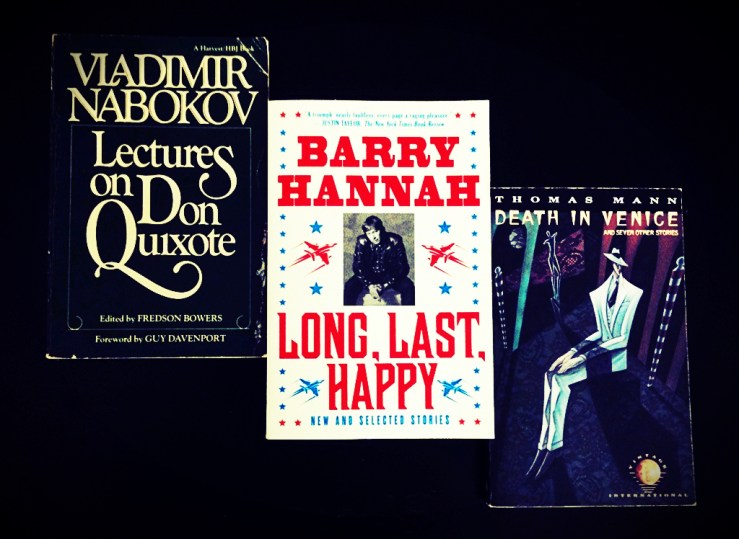
Hannah/Nabokov/Mann (Books Acquired, 8.30.2013)

20130905-153520

“The Men Running Past” — Franz Kafka

kafka

Watch This Terrible Book Trailer for Thomas Pynchon’s New Novel Bleeding Edge (Or Don’t)

I don’t know, I’m guessing this is intentionally awful. I mean, book trailers are supposed to be awful, right?

“Why I Am Not a Painter” — Frank O’Hara

“Why I Am Not a Painter” by Frank O’Hara

I am not a painter, I am a poet.
Why? I think I would rather be
a painter, but I am not. Well,

for instance, Mike Goldberg
is starting a painting. I drop in.
“Sit down and have a drink” he
says. I drink; we drink. I look
up. “You have SARDINES in it.”
“Yes, it needed something there.”
“Oh.” I go and the days go by
and I drop in again. The painting
is going on, and I go, and the days
go by. I drop in. The painting is
finished. “Where’s SARDINES?”
All that’s left is just
letters, “It was too much,” Mike says.

But me? One day I am thinking of
a color: orange. I write a line
about orange. Pretty soon it is a
whole page of words, not lines.
Then another page. There should be
so much more, not of orange, of
words, of how terrible orange is
and life. Days go by. It is even in
prose, I am a real poet. My poem
is finished and I haven’t mentioned
orange yet. It’s twelve poems, I call
it ORANGES. And one day in a gallery
I see Mike’s painting, called SARDINES.


“Bernhard is an architect of consciousness” — Ben Marcus on Thomas Bernhard

Bernhard is an architect of consciousness more than a narrative storyteller. His project is not to reference the known world, stuffing it with fully rounded characters who commence to discover their conflicts with one another, but to erect complex states of mind-usually self-loathing, obsessive ones-and then set about destroying them. Bernhard’s characters are thorough accomplices in their own destruction, and they are bestowed with a language that is dementedly repetitive and besotted with the appurtenances of logical thinking. The devious rationality of Bernhard’s language strives for a severe authority, and it tends to make his characters seem believable, no matter how unhinged their claims. Phrases don’t get repeated so much as needled until they yield graver meanings, with incremental changes introduced as though a deranged scientist were adding and removing substances in the performance of an experiment. “You wake up, and you feel molested,” Strauch says:

In fact: the hideous thing. You open your chest of drawers :a further molestation. Washing and dressing are molestations. Having to get dressed! Having to eat breakfast! When you go out on the street you are subject to the gravest possible molestations. You are unable to shield yourself. You lay about yourself, but it’s no use. The blows you dole out are returned a hundred fold. What are streets, anyway? Wendings of molestation, up and down. Squares? Bundled together molestations.

Without a story to drive it, Frost builds not through unfolding events but by telemarking around Strauch’s bitter cosmology while the narrator follows him through the woods, fattening himself on the rage of his new mentor. A chart of Strauch’s worldview would produce a splotchy Rorschach of points and counterpoints, contradictions, reversals, and the occasional backflip, none of which could really hold up to a logician’s scrutiny, which adds to his mystery. Strauch, a failed artist who only painted in total darkness, is opposed to nearly everything, and lest you think he’s a humanist at the core, with a fondness for the arts (that classic virtue of the misanthrope), he claims that “artists are the sons and daughters of loathsomeness, of paradisiac shamelessness, the original sons and daughters of lewdness; artists, painters, writers and musicians are the compulsive masturbators on the planet.”

From Ben Marcus’s 2011 essay “Misery Loves Nothing,” first published in Harper’s and available in full for free at Marcus’s site. I’m about halfway through Bernhard’s early novel Frost, a book that is very dark, bitter, intriguing, and funny. Very very funny.

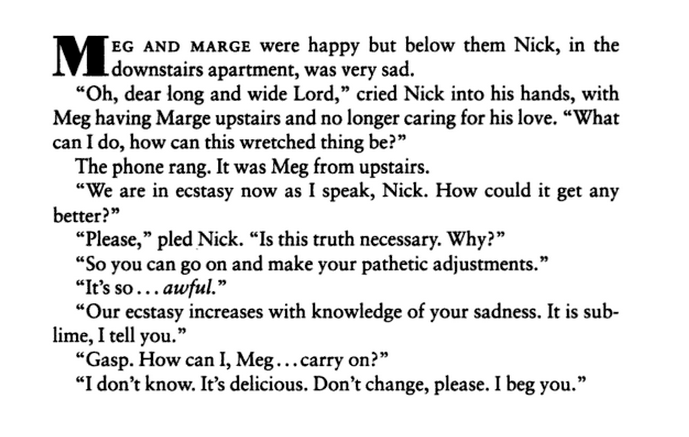
“Dear Awful Diary” — Barry Hannah

dadbh

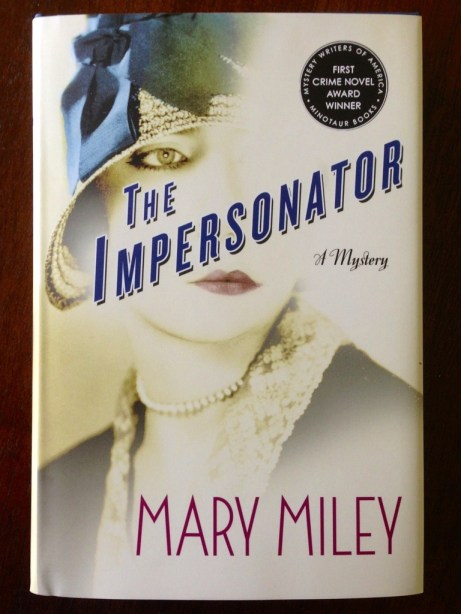
The Impersonator (Book Acquired, 8.26.2013)

20130830-074003.jpg

The Impersonator, a mystery by Mary Miley. Publisher Macmillan/Minotaur’s blurb:

In 1917, Jessie Carr, fourteen years old and sole heiress to her family’s vast fortune, disappeared without a trace. Now, years later, her uncle Oliver Beckett thinks he’s found her: a young actress in a vaudeville playhouse is a dead ringer for his missing niece. But when Oliver confronts the girl, he learns he’s wrong. Orphaned young, Leah’s been acting since she was a toddler.

Oliver, never one to miss an opportunity, makes a proposition—with his coaching, Leah can impersonate Jessie, claim the fortune, and split it with him. The role of a lifetime, he says. A one-way ticket to Sing Sing, she hears. But when she’s let go from her job, Oliver’s offer looks a lot more appealing. Leah agrees to the con, but secretly promises herself to try and find out what happened to the real Jessie. There’s only one problem: Leah’s act won’t fool the one person who knows the truth about Jessie’s disappearance.

Set against a Prohibition-era backdrop of speakeasies and vaudeville houses, Mary Miley’s Minotaur Books/Mystery Writers of America First Crime Novel Competition winner The Impersonator will delight readers with its elaborate mystery and lively prose.

Walt Kelly’s NO!

WaltKelly_NO-1_cover_100

Read all of Walt Kelly’s NO! at Whirled of Kelly.

“Perhaps the universe is suspended on the tooth of some monster” (Thoughts from Anton Chekhov’s Note-Books)

* * * * *

A scholar, without talent, a blockhead, worked for twenty-four years and produced nothing good, gave the world only scholars as untalented and as narrow-minded as himself. At night he secretly bound books—that was his true vocation: in that he was an artist and felt the joy of it. There came to him a bookbinder, who loved learning and studied secretly at night.

* * * * *

But perhaps the universe is suspended on the tooth of some monster.

* * * * *

Keep to the right, you of the yellow eye!

* * * * *

Do you want to eat? No, on the contrary.

* * * * *

A pregnant woman with short arms and a long neck, like a kangaroo.

* * * * *

How pleasant it is to respect people! When I see books, I am not concerned with how the authors loved or played cards; I see only their marvelous works.

* * * * *

To demand that the woman one loves should be pure is egotistical: to look for that in a woman which I have not got myself is not love, but worship, since one ought to love one’s equals.

* * * * *

The so-called pure childlike joy of life is animal joy.

* * * * *

—From Anton Chekhov’s Note-Books.

The Mystery at the Middle of Ordinary Life — Don DeLillo

The Mystery at the Middle of Ordinary Life, a one-act play by Don DeLillo

A MAN and a WOMAN in a room.

WOMAN: I was thinking how strange it is.

MAN: What?

WOMAN: That people are able to live together. Days and nights and years. Five years go by. How do they do it? Ten, eleven, twelve years. Two people making one life. Sharing ten thousand meals. Talking to each other face to face, open face, like hot sandwiches. All the words that fill the house. What do people say over a lifetime? Trapped in each other’s syntax. The same voice. The droning tonal repetition. I’ll tell you something.

MAN: You’ll tell me something.

WOMAN: There’s a mystery here. The people behind the walls of the brown house next door. What do they say and how do they survive it? All that idle dialogue. The nasality. The banality. I was thinking how strange it is. How do they do it, night after night, all those nights, those words, those few who do it and survive?

MAN: They make love. They make salads.

WOMAN: But sooner or later they have to speak. This is what shatters the world. I mean isn’t it gradually shattering to sit and listen to the same person all the time, without reason or rhyme. Words that trail away. The pauses. The clauses. How many thousands of times can you look at the same drained face and watch the mouth begin to open? Everything’s been fine up to now. It is when they open their mouths. It is when they speak.

[Pause.]

MAN: I’m still not over this cold of mine.

WOMAN: Take those things you take.

MAN: The tablets.

WOMAN: The caplets.

[Pause.]

MAN: Long day.

WOMAN: Long day.

MAN: A good night’s sleep.

WOMAN: Long slow day.

[Lights slowly down.]

CURTAIN
“The Unknown Citizen” — W.H. Auden

“The Unknown Citizen” by W.H. Auden—

(To JS/07 M 378
This Marble Monument
Is Erected by the State)

He was found by the Bureau of Statistics to be
One against whom there was no official complaint,
And all the reports on his conduct agree
That, in the modern sense of an old-fashioned word, he was a
saint,
For in everything he did he served the Greater Community.
Except for the War till the day he retired
He worked in a factory and never got fired,
But satisfied his employers, Fudge Motors Inc.
Yet he wasn’t a scab or odd in his views,
For his Union reports that he paid his dues,
(Our report on his Union shows it was sound)
And our Social Psychology workers found
That he was popular with his mates and liked a drink.
The Press are convinced that he bought a paper every day
And that his reactions to advertisements were normal in every way.
Policies taken out in his name prove that he was fully insured,
And his Health-card shows he was once in a hospital but left it cured.
Both Producers Research and High-Grade Living declare
He was fully sensible to the advantages of the Instalment Plan
And had everything necessary to the Modern Man,
A phonograph, a radio, a car and a frigidaire.
Our researchers into Public Opinion are content
That he held the proper opinions for the time of year;
When there was peace, he was for peace: when there was war, he went.
He was married and added five children to the population,
Which our Eugenist says was the right number for a parent of his
generation.
And our teachers report that he never interfered with their
education.
Was he free? Was he happy? The question is absurd:
Had anything been wrong, we should certainly have heard.


List of Possible Descriptors for Thomas Pynchon’s Novel Against the Day

  1. Study of light and non-light
  2. Byzantine mosaic
  3. Codex of visible and invisible
  4. Musical comedy
  5. Daffy
  6. Anarchist golf
  7. Photograph—the posing of, the taking of, the development of, the product of, the negative of, the future of, the past of, the continuous present of, the potential of…
  8. Revenge story
  9. Spy game
  10. Study of physical and metaphysical
  11. Likely too long for most readers
  12. Advent of modernity
  13. Kaleidoscopic
  14. Alternate history of labor unions
  15. Math discussion
  16. Alternate reality exercises
  17. Invisible portraits, invisible landscapes
  18. Epic romance
  19. Flight log
  20. Hat fetishes
  21. Overstuffed
  22. Hallucinogenic
  23. Endless digression
  24. Maps and legends
  25. Underappreciated
  26. Flaneur’s game
  27. International intrigue
  28. Love story
  29. Lust story
  30. Series of ever-changing vectors
  31. Polyglossic carnival
  32. Sprawling
  33. Doppelgangers and the women who love them
  34. Vaudeville routine
  35. Infinite jest
  36. Over the sky, under the desert, into the center of the earth
  37. Boys’ adventure story
  38. Girls’ adventure story
  39. Post-Victorian sci-fi
  40. Acronyms!
  41. Zingers
  42. Mayonnaise history
  43. Magic trick
  44. Exiles
  45. Time travel calisthenics
  46. Art history
  47. Stamp collection
  48. Lumpy
  49. Like a surreal version of the game of Risk
  50. Genre mash-up
  51. Dream factory
  52. Gilded Age fallout
  53. Unwieldy
  54. Sentimental
  55. Ironic
  56. Holy Grail quest
  57. Whatever word is the most intense and accurate opposite of sparse
  58. Robber barons and the men who hate them
  59. Ever bilocating plot lines unfolding and retangling in the direction of increasing entropy
  60. Pulp fiction
  61. Invisible ink
  62. Flip side of a tapestry, its ragged threads exposed
  63. Salad of utopian visions
  64. Confusing
  65. Vision through Iceland spar
  66. Critique of capitalism
  67. Disappearing act
  68. Polyphonic spree
  69. Moving pictures
  70. Deconstruction of family values
  71. Drunken cavalcade of dick jokes
  72. Rage against the machine
  73. Time travelogue
  74. All-you-can-think
  75. Anti-war tract
  76. Explosions!
  77. Seance
  78. Shaggy ______________
  79. Critique of oligarchy
  80. Jazz improvisation
  81. Polyamory-positive
  82. Coffee-positive
  83. Meta-something-or-other
  84. Cricket with no scorekeeper
  85. 1,085 pages in hardback
  86. Often fuzzy, bilocated, discursive—full of flashforwards and flashbacks and side flashes
  87. Sexy sex sex
  88. Funhouse maze with smoke and mirrors
  89. High adventure
  90. Dictionary of mysticism
  91. Scathing analysis of Manifest Destiny
  92. Simultaneously heavy and light, profound and sophomoric
  93. “What It Means to Be an American”
  94. Goofy
  95. Drug manual
  96. Positive visions of the possibilities for human coexistence
  97. Index of wonderfully bad puns
  98. Perpetual motion machine
  99. Spiralling and unspiralling riffage
  100. A zillion dime novels turned on their ears and spines and just spinning
  101. Flight toward grace