Suttree, Cormac McCarthy’s Grand Synthesis of American Literature

In his 1992 interview with The New York Times, Cormac McCarthy said, “The ugly fact is books are made out of books. The novel depends for its life on the novels that have been written.” McCarthy’s fourth novel, 1979’s Suttree is such a book, a masterful synthesis of the great literature — particularly American literature — that came before it. And like any masterful synthesis, Suttree points to something new, even as it borrows, lifts, and outright steals from the past. But before we plumb its allusions and tropes and patterns, perhaps we should overview the plot, no?

The novel rambles over several years in the life of Cornelius Suttree. It is the early 1950s in Knoxville, Tennessee, and Suttree ekes out a mean existence on the Tennessee River as a fisherman, living in a ramshackle houseboat on the edge of a shantytown. This indigent life is in fact a choice: Suttree is the college-educated son of an established, wealthy family. His choice is a choice for freedom and self-reliance, those virtues we like to think of, in our prejudicial manner, as wholly and intrinsically American. Suttree then is both Emersonian and Huck Finnian, a reflective and insightful man who finds his soul via a claim to agency over his own individuality, an individuality poised in quiet, defiant rebellion against the conforming forces of civilization. These forces manifest most pointedly in the Knoxville police, a brutal, racist organization, but we also see social constraint in the form of familial duty. One thinks of the final lines of Huckleberry Finn: “I reckon I got to light out for the Territory ahead of the rest, because Aunt Sally she’s going to adopt me and sivilize me and I can’t stand it. I been there before.”

Like Huck, Suttree aims to resist all forces that would “sivilize” him. His time on the river and in the low haunts of Tennessee (particularly the vice-ridden borough of McAnally) brings him into close contact with plenty of other outcasts, but also his conscience, which routinely mulls over its place in the world. Suttree is punctuated by–perhaps even organized by–several scenes of hallucination. Some of these psychotrips result from drunkeness, one comes from accidentally ingesting the wrong kind of mushrooms (or, the right kind, if that’s your thing), and the final one, late in the novel, sets in as Suttree suffers from a terrible illness. In his fever dream, a small nun–surely a manifestation of the guilt that would civilize us–accuses him–

Mr. Suttree it is our understanding that at curfew rightly decreed by law in that hour wherein night draws to its proper close and the new day commences and contrary to conduct befitting a person of your station you betook yourself to various low places within the shire of McAnally and there did squander several ensuing years in the company of thieves, derelicts, miscreants, pariahs, poltroons, spalpeens, curmudgeons, clotpolls, murderers, gamblers, bawds, whores, trulls, brigands, topers, tosspots, sots and archsots, lobcocks, smellsmocks, runagates, rakes, and other assorted and felonious debauchees.

The passage is a marvelous example of McCarthy’s stream-of-consciousness technique in Suttree, moving through the various voices that would ventriloquize Suttree, into the edges of madness, strangeness, and the sublimity of language. The tone moves from somber and portentous into bizarre imagery that blends humor and pathos. This is the tone of Suttree, a language that gives voice to transients and miscreants, affirming the dignity of their humanity even as it details the squalor of their circumstance.

It is among these criminals and whores, transvestites and gamblers that Suttree affirms his own freedom and humanity, a process aided by his comic foil, Gene Harrogate. Suttree meets Harrogate on a work farm; the young hillbilly is sent there for screwing watermelons. After his release, Harrogate moves to a shantytown in Knoxville. He’s the country mouse determined to become the city rat, the would-be Tom Sawyer to Suttree’s older and wiser Huck Finn. Through Harrogate’s endless get-rich-quick schemes, McCarthy parodies that most-American of tales, the Horatio Alger story. Simply put, the boy is doomed, on his  “way up to the penitentiary” as Suttree constantly admonishes. In one episode, Harrogate tries to buy arsenic from “a grayhaired and avuncular apothecary” to poison bats he hopes to sell to a hospital (don’t ask)–

May I help you? said the scientist, his hands holding each other.

I need me some strychnine, said Harrogate.

You need some what?

Strychnine. You know what it is dont ye?

Yes, said the chemist.

I need me about a good cupful I reckon.

Are you going to drink it here or take it with you?

Shit fire I aint goin to drink it. It’s poisoner’n hell.

It’s for your grandmother.

No, said Harrogate, craning his neck suspectly. She’s done dead

Suttree, unwilling father-figure, eventually buys the arsenic for the boy against his better judgment. The scene plays out as a wonderful comic inversion of William Faulkner’s “A Rose for Emily,” from which it is so transparently lifted. McCarthy borrows liberally from Faulkner here, of course, most notably in the language and style of the novel, but also in scenes like this one, or a later episode that plays off Faulkner’s comic-romantic story of a man and a woman navigating the aftermath of a flood, “Old Man.” Unpacking the allusions in Suttree surpasses my literary knowledge or skill, but McCarthy is generous, if oblique, with his breadcrumb trail. Take, for example, the following sentence: “Suttree with his miles to go kept his eyes to the ground, maudlin and muttersome in the bitter chill, under the lonely lamplight.” The forced phrase “miles to go” does not immediately present itself as a reference to Robert Frost’s famous poem, yet the direction of the sentence retreats into the history of American poetry; with its dense alliteration and haunted vowels, it leads us into Edgar Allan Poe territory. Only a few dozen pages later, McCarthy boldly begins a chapter with theft: “In just spring the goatman came over the bridge . . .” The reference to e.e. cummings explicitly signifies McCarthy’s intentions to play with literature. Later in the book, while tripping on mushrooms in the mountains, Suttree is haunted by “elves,” the would-be culprits in Frost’s poem “Mending Wall.” The callback is purposeful, but tellingly, McCarthy’s allusions are not nearly as fanciful as their surface rhetoric might suggest: the goatman does not belong in Knoxville–he’s an archaic relic, forced out of town by the police; the elves are not playful spirits but dark manifestations of a tortured psyche.

Once one spots the line-lifting in Suttree it’s hard to not see it. What’s marvelous is McCarthy’s power to convert these lines, these riffs, these stories, into his own tragicomic beast. An early brawl at a roadhouse recalls the “Golden Day” episode of Ralph Ellison’s Invisible Man; a rape victim’s plight echoes Hubert Selby’s “Tralala”; we find the comic hobos of John Steinbeck’s Cannery Row–we even get the road-crossing turtle from The Grapes of Wrath. A later roadhouse chapter replays the “Circe/Nighttown” nightmare in James Joyce’s Ulysses. Ulysses is an easy point of comparison for Suttree, which does for Knoxville what Joyce did for Dublin. Suttree echoes Ulysses’s language, both in its musicality and appropriation of varied voices, as well as its ambulatory structure, its stream-of-consciousness technique, its rude earthiness, and its size (nearly 600 pages). But, as I argued earlier, there’s something uniquely American about Suttree, and its literary appropriations tend to reflect that. Hence, we find Mark Twain, Herman Melville, Ernest Hemingway, Walt Whitman, Emerson and Thoreau, Emily Dickinson, and William Carlos Williams, to name just a few writers whose blood courses through this novel (even elegant F. Scott Fitzgerald is here, in an unexpected Gatsbyish episode late in the novel).

Making a laundry list of writers is weak criticism though, and these sources–all guilty of their own proud plagiarisms–are mentioned only as a means to an end, to an argument that what McCarthy does in Suttree is to synthesize the American literary tradition with grace and humor, while never glossing over its inherent dangers and violence. So, while it appropriates and plays with the tropes of the past, Suttree is still pure McCarthy. Consider the following passage, which arrives at the end of a drunken, awful spree, Suttree locked up for the night–

He closed his eyes. The gray water that dripped from him was rank with caustic. By the side of a dark dream road he’d seen a hawk nailed to a barn door. But what loomed was a flayed man with his brisket tacked open like a cooling beef and his skull peeled, blue and bulbous and palely luminescent, black grots his eyeholes and bloody mouth gaped tonguless. The traveler had seized his fingers in his jaws, but it was not alone this horror that he cried. Beyond the flayed man dimly adumbrate another figure paled, for his surgeons move about the world even as you and I.

Suttree’s dark vision points directly toward the language of McCarthy’s next novel, 1985’s Blood Meridian, roundly considered his masterpiece. Critics who disagree tend to point to Suttree as the pinnacle of McCarthy’s writing. I have no interest at this time in weighing the books against each other, nor do I think that doing so would be especially enlightening. For all of their sameness, they are very different animals: Suttree provides us intense access to its hero’s consciousness, where Blood Meridian always keeps the reader on the outside of its principals’ souls (if those grotesques could be said to have souls). And while Blood Meridian does display some humor, it is the blackest and driest humor I’ve ever read. Suttree is broader and more compassionate; it even has a fart joke. Blood Meridian, at least in my estimation (and many critics will contend this notion) has no flawed episodes; much of this results from the book’s own internal program–it resists love, compassion, and even human dignity. In contrast, Suttree is punctuated by two deaths the audience is meant to read as tragic, yet I found it impossible to do so. The first is the death of Suttree’s child, whom he has abandoned, along with its mother. As such, he is not permitted to take part in the funeral, observing the process rather from its edges. The second tragedy is the death of Suttree’s young lover in a landslide. The book begs us to empathize with Suttree, just as he often empathizes with the marginal figures in the novel, but ultimately these tragedies are a failed ploy. They underwrite a sublime encounter with death for Suttree, an encounter that deepens and enriches his character while paradoxically freeing him from the burdens of social duty and familial order. McCarthy is hardly alone in such a move; indeed, it seems like the signature trope of American masculine literature to me. It’s the move that Huck Finn wishes to make when he promises to light out for the Territory to escape the civilizing body of Aunt Sally; it’s the ending that Hemingway was compelled to give to Frederic Henry at the end of A Farewell to Arms; it’s all of Faulkner, with his mortification of fatherhood and the dramatic responsibility fatherhood entails. It is a cost analysis that neglects any potential benefits.

But these are small criticisms of a large, beautiful, benevolent novel, a book that begs to be reread, a rambling picaresque of comic and tragic proportions. “I learned that there is one Suttree and one Suttree only,” our hero realizes, but this epiphany is set against a larger claim. Near the end of the novel, Suttree goes to check on an old ragman who he keeps a watchful eye on. He finds the man dead, his shack robbed, his body looted. Despairing over the spectacle’s abject lack of humanity, Suttree cries, “You have no right to represent people this way,” for “A man is all men. You have no right to your wretchedness.” Here, Suttree’s painful epiphany is real and true, an Emersonian insight coded in the darkest of Whitman’s language. If there is one Suttree and one Suttree only, he is still beholden to all men; to be anti-social or an outcast is not to be anti-human. Self-hood is ultimately conditional on others and otherness. To experience the other’s wretchedness is harrowing; to understand the other’s wretchedness and thus convert it to dignity is life-affirming and glorious. Suttree is a brilliant, bold, marvelous book. Very highly recommended.

[Ed. note—Biblioklept originally published a version of this review on November 27, 2010].
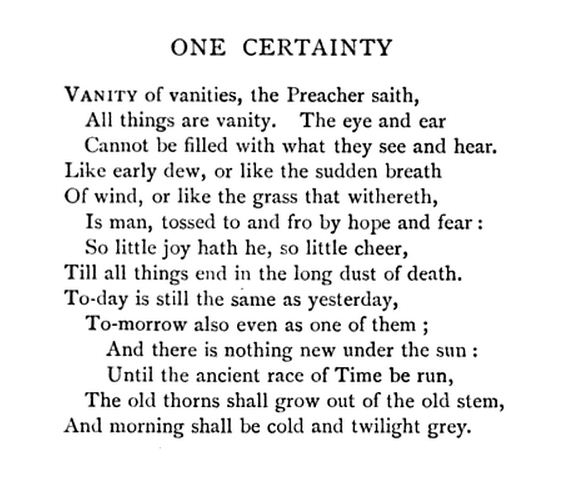
 

“One Certainty” — Christina Rossetti

3cr

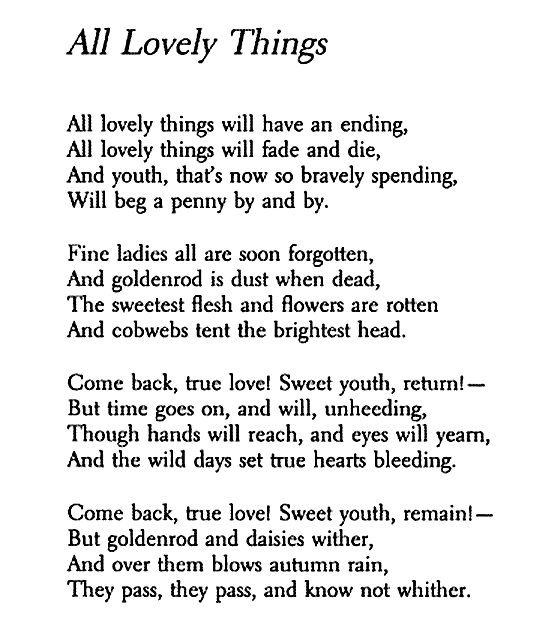
“All Lovely Things” — Conrad Aiken

aiken

Airships, Barry Hannah’s Cult Classic of Violent Humor

In his 1978 collection Airships, Barry Hannah sets stories in disparate milieux, from the northern front of the Civil War, to an apocalyptic future, to the Vietnam War, to strange pockets of the late-twentieth century South. Despite the shifts in time and place, Airships is one of those collections of short stories that feels somehow like an elliptical, fragmentary novel. There are the stories that correspond directly to each other — the opener “Water Liars,” for instance, features (presumably, anyway), the same group of old men as “All the Old Harkening Faces at the Rail.” The old men love to crony up, gossip, tell tall tales. An outsider spoils the fun in “Water Liars” by telling a truth more terrible than any lie; in “Harkening,” an old man shows off his new (much younger) bride. These stories are perhaps the simplest in the collection, the homiest, anyway, or at least the most “normal” (whatever that means), yet they are both girded by a strange darkness, both humorous and violent, that informs all of Airships.

We find that humor and violence in an outstanding trio of Civil War stories (or, more accurately, stories set during the Civil War). The narrator of “Dragged Fighting from His Tomb,” a Confederate infantryman relates a tale of heroic slaughter with a hypberbolic, phallic force. Observe—

I knew the blueboys thought they had me down and were about ready to come in. I was in that position at Chancelorsville. There should be about six fools, I thought. I made the repeater, I killed four, and the other two limped off. Some histrionic plumehead was raising his saber up and down on the top of a pyramid of crossties. I shot him just for fun. Then I brought up another repeater and sprayed the yard.

Later, the narrator defects, switches to the Union, and claims he kills Jeb Stuart, a figure that towers over the Civil War tales. The narrator of “Dragged Fighting” hates Stuart; the narrator of “Knowing He Was Not My Kind Yet I Followed” is literally in love with the General. In contrast to the narrator of “Dragged Fighting,” the speaker in “Knowing” — an avowed “sissy” whom the other soldiers openly detest — hates the violence and madness of war—

We’re too far from home. We are not defending our beloved Dixie anymore. We’re just bandits and maniacal. The gleam in the men’s eyes tells this. Everyone is getting crazier on the craziness of being simply too far from home for decent return. It is like Ruth in the alien corn, or a troop of men given wings over the terrain they cherished and taken by the wind to trees they do not know.

He despairs when he learns of Jeb Stuart’s death. In the final Civil War story, “Behold the Husband in His Perfect Agony,” a Union spy is given the task to communicate news of Stuart’s death through enemy lines. Rather than offering further explication, let me instead point you, dear reader, to more of Hannah’s beautiful prose, of which I have not remarked upon nearly enough. From “Behold the Husband” —

Isaacs False Corn, the Indian, the spy, saw Edison, the Negro, the contact, on the column of an inn. His coat was made of stitched newspapers. Near his bare feet, two dogs failed earnestly at mating. Pigeons snatched at the pieces of things in the rushing gutter. The rains had been hard.

The short, descriptive passage rests on my ears like a poem. Hannah, who worked with Gordon Lish, evinces in his writing again and again that great editor’s mantra that writing is putting one sentence after another.

Although set in the Vietnam War, “Midnight and I’m not Famous Yet” seems an extension of the Civil War stories. In it, an officer from a small Southern town goes slowly crazy from all the killing, yet, like the narrator of “Dragged Fighting,” he presents himself as a warrior. Above all though, he laments that the war has robbed him of some key, intermediary phase of his late youth, a phase he can’t even name—

The tears were out of my jaws then. Here we shot each other up. All we had going was the pursuit of horror. It seemed to me my life had gone straight from teen-age giggling to horror. I had never had time to be but two things, a giggler and a killer.

This ironic sense of a “pursuit of horror” pervades Airships, particularly in the collection’s most apocalyptic visions. “Eating Wife and Friends” posits an America where food shortages and material scarcity leads people to eating leaves and grass — and then each other. In “Escape to Newark,” the environment is wildly out of balance—

In August it’s a hundred fifty degrees. In December it’s minus twenty-five and three feet of snow in Mississippi. In April the big trees explode.

A plan is made to “escape” these conditions via a rocket, but of course there’s not enough fuel to get past Newark. In Airships, modes of flight are transcendent but ultimately transient. Gravity’s pull is heavy stuff.

Just as Hannah’s war stories are not really war stories, his apocalypse tales are really about human relationships, which he draws in humor, pathos, and dark cynicism. In “Green Gets It,” an old man repeatedly attempts his suicide, only to fail again and again. His suicide note, written to his daughter, is scathing and shocking and sad and hilarious and wise–

My Beloved Daughter,

Thanks to you for being one of the few who never blamed me for your petty, cheerless and malign personality. But perhaps you were too busy being awful to ever think of the cause. I hear you take self-defense classes now. Don’t you understand nobody could take anything from you without leaving you richer? If I thought rape would change you, I’d hire a randy cad myself. I leave a few dollars to your husband. Bother him about them and suffer the curse of this old pair of eyes spying blind at the minnows in the Hudson.

Your Dad,

Crabfood

Although Hannah explores the darkest gaps of the soul in Airships, he also finds there a shining kernel of love in the face of waste, depravity, violence, and indifference. This love evinces most strongly perhaps in Airships trio of long stories. These tales, which hover around 30 pages, feel positively epic set against the other stories in the collection, which tend to clock in between five and ten pages. The first long story, “Testimony of Pilot,” details the development of a boyhood friendship over a few decades. It captures the strange affections and rivalries and unnameable bonds and distances that connect and disconnect any two close friends. The second of the long tales is “Return to Return,” a tragicomic Southern drama in the Oedipal vein (with plenty of tennis and alcoholism to boot). As in “Testimony of Pilot,” Hannah finds some measure of redemption, or at least solace, for his characters in their loving friendship, yet nothing could be more unsentimental. The final long story, which closes the collection, is “Mother Rooney Unscrolls the Hurt,” a daring work of stream of consciousness that seems to both respond to — and revise — Katherine Anne Porter’s “The Jilting of Granny Weatherall.” The story concludes (and of course concludes the volume) with a vision of love that corresponds to the imagery of The Pietà, a kind of selflessness that ironically confirms the self as an entity that exists in relation to the pain of others.

I could keep writing of course — I’ve barely touched on Hannah’s surrealism, a comic weirdness that I’ve never seen elsewhere; it is Hannahesque, I suppose. Nor have I detailed Hannah’s evocations of regular working class folk, fighting and drinking and divorcing and raising children (not necessarily in that order). Airships is a world too rich and fertile to unpack in just one review, and I’ve already been blathering too long, I fear, when what I really want  to do is just outright implore you, kind reader, to find it and start reading it immediately. Very highly recommended.

[Editorial note: Biblioklept published a version of this review on March 20th, 2011]

“The Romance of an Ugly Policeman” — P.G. Wodehouse

“The Romance of an Ugly Policeman” by P.G. Wodehouse

Crossing the Thames by Chelsea Bridge, the wanderer through London finds himself in pleasant Battersea. Rounding the Park, where the female of the species wanders with its young by the ornamental water where the wild-fowl are, he comes upon a vast road. One side of this is given up to Nature, the other to Intellect. On the right, green trees stretch into the middle distance; on the left, endless blocks of residential flats. It is Battersea Park Road, the home of the cliff-dwellers.

Police-constable Plimmer’s beat embraced the first quarter of a mile of the cliffs. It was his duty to pace in the measured fashion of the London policeman along the front of them, turn to the right, turn to the left, and come back along the road which ran behind them. In this way he was enabled to keep the king’s peace over no fewer than four blocks of mansions.

It did not require a deal of keeping. Battersea may have its tough citizens, but they do not live in Battersea Park Road. Battersea Park Road’s speciality is Brain, not Crime. Authors, musicians, newspaper men, actors, and artists are the inhabitants of these mansions. A child could control them. They assault and batter nothing but pianos; they steal nothing but ideas; they murder nobody except Chopin and Beethoven. Not through these shall an ambitious young constable achieve promotion.

At this conclusion Edward Plimmer arrived within forty-eight hours of his installation. He recognized the flats for what they were—just so many layers of big-brained blamelessness. And there was not even the chance of a burglary. No burglar wastes his time burgling authors. Constable Plimmer reconciled his mind to the fact that his term in Battersea must be looked on as something in the nature of a vacation.

Continue reading ““The Romance of an Ugly Policeman” — P.G. Wodehouse”

Borges Citation(s)

20130729-102011.jpg

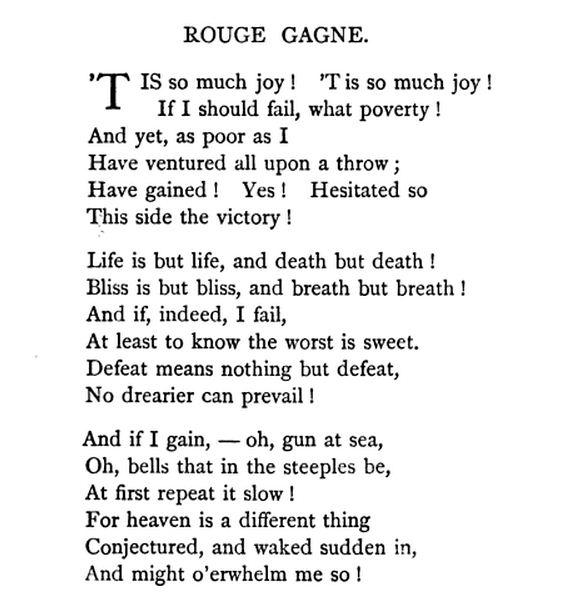
“Tis so much joy!” — Emily Dickinson

1

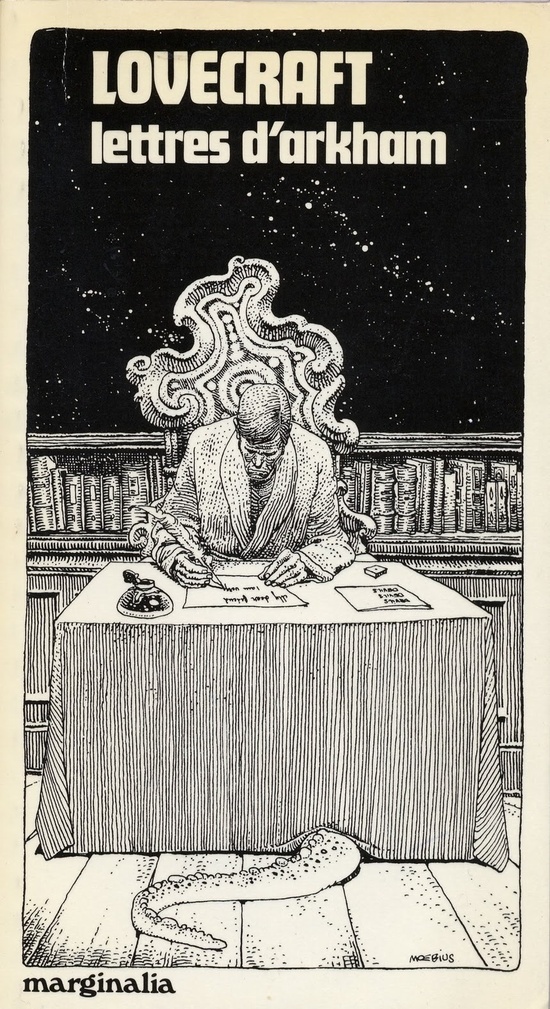
H.P. Lovecraft — Moebius

lovecraft moebius

“The Ambitious Guest” — Nathaniel Hawthorne

“The Ambitious Guest” by Nathaniel Hawthorne

One September night a family had gathered round their hearth and piled it high with the driftwood of mountain-streams, the dry cones of the pine, and the splintered ruins of great trees that had come crashing down the precipice. Up the chimney roared the fire, and brightened the room with its broad blaze. The faces of the father and mother had a sober gladness; the children laughed. The eldest daughter was the image of Happiness at seventeen, and the aged grandmother, who sat knitting in the warmest place, was the image of Happiness grown old. They had found the “herb heart’s-ease” in the bleakest spot of all New England. This family were situated in the Notch of the White Hills, where the wind was sharp throughout the year and pitilessly cold in the winter, giving their cottage all its fresh inclemency before it descended on the valley of the Saco. They dwelt in a cold spot and a dangerous one, for a mountain towered above their heads so steep that the stones would often rumble down its sides and startle them at midnight.

The daughter had just uttered some simple jest that filled them all with mirth, when the wind came through the Notch and seemed to pause before their cottage, rattling the door with a sound of wailing and lamentation before it passed into the valley. For a moment it saddened them, though there was nothing unusual in the tones. But the family were glad again when they perceived that the latch was lifted by some traveller whose footsteps had been unheard amid the dreary blast which heralded his approach and wailed as he was entering and went moaning away from the door.

Though they dwelt in such a solitude, these people held daily converse with the world. The romantic pass of the Notch is a great artery through which the life-blood of internal commerce is continually throbbing between Maine on one side and the Green Mountains and the shores of the St. Lawrence on the other. The stage-coach always drew up before the door of the cottage. The wayfarer with no companion but his staff paused here to exchange a word, that the sense of loneliness might not utterly overcome him ere he could pass through the cleft of the mountain or reach the first house in the valley. And here the teamster on his way to Portland market would put up for the night, and, if a bachelor, might sit an hour beyond the usual bedtime and steal a kiss from the mountain-maid at parting. It was one of those primitive taverns where the traveller pays only for food and lodging, but meets with a homely kindness beyond all price. When the footsteps were heard, therefore, between the outer door and the inner one, the whole family rose up, grandmother, children and all, as if about to welcome some one who belonged to them, and whose fate was linked with theirs. Continue reading ““The Ambitious Guest” — Nathaniel Hawthorne”

Milky Way Gold — Marlene Yu

l_milky_way_gold

“Standing on the bare ground, my head bathed by the blithe air, and uplifted into infinite space, all mean egotism vanishes. I become a transparent eyeball-I am nothing; I see all; the currents of the Universal Being circulate through me-I am part or particle of God” — Ralph Waldo Emerson, Nature

“Je t’adore” — Robert Walser

rw

Five Scenes from Anton Chekhov’s Note-Books

* * * * *

Daughter: “Felt boots are not the correct thing.”

Father: “Yes they are clumsy, I’ll have to get leather ones.” The father fell ill and his deportation to Siberia was postponed.

Daughter: “You are not at all ill, father. Look, you have your coat and boots on….”

Father: “I long to be exiled to Siberia. One could sit somewhere by the Yenissey or Obi river and fish, and on the ferry there would be nice little convicts, emigrants…. Here I hate everything: this lilac tree in front of the window, these gravel paths….”

* * * * *

A bedroom. The light of the moon shines so brightly through the window that even the buttons on his night shirt are visible.

* * * * *

A nice man would feel ashamed even before a dog….

* * * * *

A certain Councillor of State, looking at a beautiful landscape, said:
“What a marvelous function of nature!” From the note-book of an old
dog: “People don’t eat slops and bones which the cooks throw away.
Fools!”

* * * * *

He had nothing in his soul except recollections of his schooldays.

* * * * *

–From Anton Chekhov’s Note-Books.

Books Acquired, 7.26.2013

20130726-150353.jpg

20130726-150358.jpg

20130726-150402.jpg

20130726-150415.jpg

20130726-150421.jpg

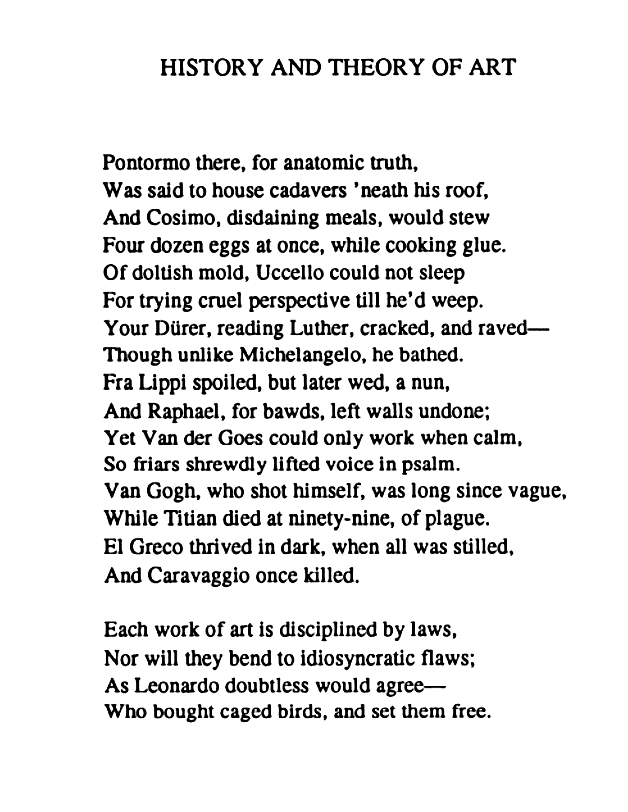
“History and Theory of Art” — David Markson

dm

(Via).

“Hawthorne” — Charles Ives

“Hawthorne” by Charles Ives

from Essays Before a Sonata

The substance of Hawthorne is so dripping wet with the supernatural, the phantasmal, the mystical—so surcharged with adventures, from the deeper picturesque to the illusive fantastic, one unconsciously finds oneself thinking of him as a poet of greater imaginative impulse than Emerson or Thoreau. He was not a greater poet possibly than they—but a greater artist. Not only the character of his substance, but the care in his manner throws his workmanship, in contrast to theirs, into a kind of bas-relief. Like Poe he quite naturally and unconsciously reaches out over his subject to his reader. His mesmerism seeks to mesmerize us—beyond Zenobia’s sister. But he is too great an artist to show his hand “in getting his audience,” as Poe and Tschaikowsky occasionally do. His intellectual muscles are too strong to let him become over-influenced, as Ravel and Stravinsky seem to be by the morbidly fascinating—a kind of false beauty obtained by artistic monotony. However, we cannot but feel that he would weave his spell over us—as would the Grimms and Aesop. We feel as much under magic as the “Enchanted Frog.” This is part of the artist’s business. The effect is a part of his art-effort in its inception. Emerson’s substance and even his manner has little to do with a designed effect—his thunderbolts or delicate fragments are flashed out regardless—they may knock us down or just spatter us—it matters little to him—but Hawthorne is more considerate; that is, he is more artistic, as men say.

Hawthorne may be more noticeably indigenous or may have more local color, perhaps more national color than his Concord contemporaries. But the work of anyone who is somewhat more interested in psychology than in transcendental philosophy, will weave itself around individuals and their personalities. If the same anyone happens to live in Salem, his work is likely to be colored by the Salem wharves and Salem witches. If the same anyone happens to live in the “Old Manse” near the Concord Battle Bridge, he is likely “of a rainy day to betake himself to the huge garret,” the secrets of which he wonders at, “but is too reverent of their dust and cobwebs to disturb.” He is likely to “bow below the shriveled canvas of an old (Puritan) clergyman in wig and gown—the parish priest of a century ago—a friend of Whitefield.” He is likely to come under the spell of this reverend Ghost who haunts the “Manse” and as it rains and darkens and the sky glooms through the dusty attic windows, he is likely “to muse deeply and wonderingly upon the humiliating fact that the works of man’s intellect decay like those of his hands” … “that thought grows moldy,” and as the garret is in Massachusetts, the “thought” and the “mold” are likely to be quite native. When the same anyone puts his poetry into novels rather than essays, he is likely to have more to say about the life around him—about the inherited mystery of the town—than a poet of philosophy is. Continue reading ““Hawthorne” — Charles Ives”

Barry Hannah Visits a Louisiana Leper Colony

Barry Hannah visits a Louisiana leper colony in “Old Terror, New Hearts,” republished this week in Oxford Americans; the piece originally ran in the October/November 1995 issue of the magazine. Opening paragraphs:

It was a massive Federalist plantation, lazy and handsome among two-century oaks and palm trees. You could imagine FDR had just visited to cut a ribbon last week. I had heard throughout my life the curious rumor of a leper “colony” down in south Louisiana. This news reached me when I was a boy in Clinton, Mississippi, and one did not know quite what to do with it. Colony evoked folks lost in an exotic fastness. Leper of course was as bad as it got, poor devils. I had a sense of these creatures execrated and driven onto some isle in a vicious swamp. In that, my young imagination was not far wrong. Louisiana was alarming and peculiar anyway. There were plenty of Catholics, many seemed touched by at least mild cases of voodoo, and adults went public with their gaudiest dreams.

Nothing at the time was more peculiar to me than the armored mammal of Louisiana, the armadillo, which I had seen dead on the road as I traveled to relatives in Baton Rouge. It was a thing aggressively obsolete in animal history but still mucking its way along, its stupid ranks torn to flat bits by modern autos on pavement laid down through the bogs. I could not know how closely related these creatures were to the poor lepers themselves. Among animals, only armadillos have leprosy. Among mankind, nobody has suffered opprobrium for six thousand years like the leper. At Carville, where I finally got over forty years of mildly curious ignorance, I saw the doubloons from last year’s Mardi Gras at Carville were imprinted on one side with an armadillo. On the other was the Federalist infirmary building: Gillis W.Long Hansen’s Disease Center1921. Hansen was the Norwegian doctor who first isolated the leprosy bacillus in the late nineteenth century. In 1921 the state leprosarium was taken over by the Public Health Service.

Now it is the Service’s last remaining hospital. In that state of advanced idiocy that has made me a living so far and may be the birthright of a Mississippi writer, I asked a therapist working with two Asian-American patients after their hand surgery if he was a flight surgeon, his uniform so naval and all. He explained, as further did Captain Jim Birke, most formidable pedorthist, that the Public Health Service originated after the Revolutionary War as a naval medical branch. Thus the costume of the Surgeon General, which has baffled others too tactful to ask.

Read the rest of Hannah’s essay “Old Terror, New Hearts.”

“The Skull” — Philip K. Dick

“The Skull” by Philip K. Dick

“WHAT is this opportunity?” Conger asked. “Go on. I’m interested.”

The room was silent; all faces were fixed on Conger—still in the drab prison uniform. The Speaker leaned forward slowly.

“Before you went to prison your trading business was paying well—all illegal—all very profitable. Now you have nothing, except the prospect of another six years in a cell.”

Conger scowled.

“There is a certain situation, very important to this Council, that requires your peculiar abilities. Also, it is a situation you might find interesting. You were a hunter, were you not? You’ve done a great deal of trapping, hiding in the bushes, waiting at night for the game? I imagine hunting must be a source of satisfaction to you, the chase, the stalking—”

Conger sighed. His lips twisted. “All right,” he said. “Leave that out. Get to the point. Who do you want me to kill?”

The Speaker smiled. “All in proper sequence,” he said softly.


THE car slid to a stop. It was night; there was no light anywhere along the street. Conger looked out. “Where are we? What is this place?”

The hand of the guard pressed into his arm. “Come. Through that door.”

Conger stepped down, onto the damp sidewalk. The guard came swiftly after him, and then the Speaker. Conger took a deep breath of the cold air. He studied the dim outline of the building rising up before them.

“I know this place. I’ve seen it before.” He squinted, his eyes growing accustomed to the dark. Suddenly he became alert. “This is—”

“Yes. The First Church.” The Speaker walked toward the steps. “We’re expected.”

“Expected? Here?

“Yes.” The Speaker mounted the stairs. “You know we’re not allowed in their Churches, especially with guns!” He stopped. Two armed soldiers loomed up ahead, one on each side.

“All right?” The Speaker looked up at them. They nodded. The door of the Church was open. Conger could see other soldiers inside, standing about, young soldiers with large eyes, gazing at the ikons and holy images.

“I see,” he said.

“It was necessary,” the Speaker said. “As you know, we have been singularly unfortunate in the past in our relations with the First Church.”

“This won’t help.”

“But it’s worth it. You will see.” Continue reading ““The Skull” — Philip K. Dick”