“Art” — Ralph Waldo Emerson

“Art” by Ralph Waldo Emerson

Because the soul is progressive, it never quite repeats itself, but in every act attempts the production of a new and fairer whole. This appears in works both of the useful and the fine arts, if we employ the popular distinction of works according to their aim either at use or beauty. Thus in our fine arts, not imitation but creation is the aim. In landscapes the painter should give the suggestion of a fairer creation than we know. The details, the prose of nature he should omit and give us only the spirit and splendor. He should know that the landscape has beauty for his eye because it expresses a thought which is to him good; and this because the same power which sees through his eyes is seen in that spectacle; and he will come to value the expression of nature and not nature itself, and so exalt in his copy the features that please him. He will give the gloom of gloom and the sunshine of sunshine. In a portrait he must inscribe the character and not the features, and must esteem the man who sits to him as himself only an imperfect picture or likeness of the aspiring original within.

What is that abridgment and selection we observe in all spiritual activity, but itself the creative impulse? for it is the inlet of that higher illumination which teaches to convey a larger sense by simpler symbols. What is a man but nature’s finer success in self-explication? What is a man but a finer and compacter landscape than the horizon figures,—nature’s eclecticism? and what is his speech, his love of painting, love of nature, but a still finer success,—all the weary miles and tons of space and bulk left out, and the spirit or moral of it contracted into a musical word, or the most cunning stroke of the pencil?

But the artist must employ the symbols in use in his day and nation to convey his enlarged sense to his fellow-men. Thus the new in art is always formed out of the old. The Genius of the Hour sets his ineffaceable seal on the work and gives it an inexpressible charm for the imagination. As far as the spiritual character of the period overpowers the artist and finds expression in his work, so far it will retain a certain grandeur, and will represent to future beholders the Unknown, the Inevitable, the Divine. No man can quite exclude this element of Necessity from his labor. No man can quite emancipate himself from his age and country, or produce a model in which the education, the religion, the politics, usages and arts of his times shall have no share. Though he were never so original, never so wilful and fantastic, he cannot wipe out of his work every trace of the thoughts amidst which it grew. The very avoidance betrays the usage he avoids. Above his will and out of his sight he is necessitated by the air he breathes and the idea on which he and his contemporaries live and toil, to share the manner of his times, without knowing what that manner is. Now that which is inevitable in the work has a higher charm than individual talent can ever give, inasmuch as the artist’s pen or chisel seems to have been held and guided by a gigantic hand to inscribe a line in the history of the human race. This circumstance gives a value to the Egyptian hieroglyphics, to the Indian, Chinese and Mexican idols, however gross and shapeless. They denote the height of the human soul in that hour, and were not fantastic, but sprung from a necessity as deep as the world. Shall I now add that the whole extant product of the plastic arts has herein its highest value, as history; as a stroke drawn in the portrait of that fate, perfect and beautiful, according to whose ordinations all beings advance to their beatitude? Continue reading ““Art” — Ralph Waldo Emerson” →

“In Honor of Friendship” — Nietzsche

Capture

Benjamin Black’s Vengeance (Book Acquired, 3.06.2013)

20130308-110039.jpg

Vengeance, the latest in Benjamin Black’s Quirke series. From Janet Maslin’s New York Times review last year:

Vengeance” once again leads Quirke into his favorite kind of trouble: “yet another morass of human cupidity and deceit,” involving the deaths of powerful men and the foxy insolence of their glamorous widows. It breaks no new ground.

But why should Benjamin Black tamper with a winning formula? The crimes aren’t graphic or even terribly central. And the detecting questions don’t count for much. The books are far more notable for malaise, atmospherics, sexual chemistry and vast amounts of swirling tobacco smoke and mind-muddling alcohol, without which justice could apparently never prevail.

Vengeance is new in trade paperback from Picador.


“On Being Idle” — Jerome K. Jerome

“On Being Idle” by Jerome K. Jerome

Now, this is a subject on which I flatter myself I really am au fait. The gentleman who, when I was young, bathed me at wisdom’s font for nine guineas a term—no extras—used to say he never knew a boy who could do less work in more time; and I remember my poor grandmother once incidentally observing, in the course of an instruction upon the use of the Prayer-book, that it was highly improbable that I should ever do much that I ought not to do, but that she felt convinced beyond a doubt that I should leave undone pretty well everything that I ought to do.

I am afraid I have somewhat belied half the dear old lady’s prophecy. Heaven help me! I have done a good many things that I ought not to have done, in spite of my laziness. But I have fully confirmed the accuracy of her judgment so far as neglecting much that I ought not to have neglected is concerned. Idling always has been my strong point. I take no credit to myself in the matter—it is a gift. Few possess it. There are plenty of lazy people and plenty of slow-coaches, but a genuine idler is a rarity. He is not a man who slouches about with his hands in his pockets. On the contrary, his most startling characteristic is that he is always intensely busy.

It is impossible to enjoy idling thoroughly unless one has plenty of work to do. There is no fun in doing nothing when you have nothing to do. Wasting time is merely an occupation then, and a most exhausting one. Idleness, like kisses, to be sweet must be stolen. Continue reading ““On Being Idle” — Jerome K. Jerome” →

“Witch Wife” — Edna St. Vincent Millay

witchwife

“The Return” — Joseph Conrad

“The Return” by Joseph Conrad

The inner circle train from the City rushed impetuously out of a black hole and pulled up with a discordant, grinding racket in the smirched twilight of a West-End station. A line of doors flew open and a lot of men stepped out headlong. They had high hats, healthy pale faces, dark overcoats and shiny boots; they held in their gloved hands thin umbrellas and hastily folded evening papers that resembled stiff, dirty rags of greenish, pinkish, or whitish colour. Alvan Hervey stepped out with the rest, a smouldering cigar between his teeth. A disregarded little woman in rusty black, with both arms full of parcels, ran along in distress, bolted suddenly into a third-class compartment and the train went on. The slamming of carriage doors burst out sharp and spiteful like a fusillade; an icy draught mingled with acrid fumes swept the whole length of the platform and made a tottering old man, wrapped up to his ears in a woollen comforter, stop short in the moving throng to cough violently over his stick. No one spared him a glance.

Alvan Hervey passed through the ticket gate. Between the bare walls of a sordid staircase men clambered rapidly; their backs appeared alike—almost as if they had been wearing a uniform; their indifferent faces were varied but somehow suggested kinship, like the faces of a band of brothers who through prudence, dignity, disgust, or foresight would resolutely ignore each other; and their eyes, quick or slow; their eyes gazing up the dusty steps; their eyes brown, black, gray, blue, had all the same stare, concentrated and empty, satisfied and unthinking.

Outside the big doorway of the street they scattered in all directions, walking away fast from one another with the hurried air of men fleeing from something compromising; from familiarity or confidences; from something suspected and concealed—like truth or pestilence. Alvan Hervey hesitated, standing alone in the doorway for a moment; then decided to walk home. Continue reading ““The Return” — Joseph Conrad” →

“Other Seas” — Kahlil Gibran

Capture

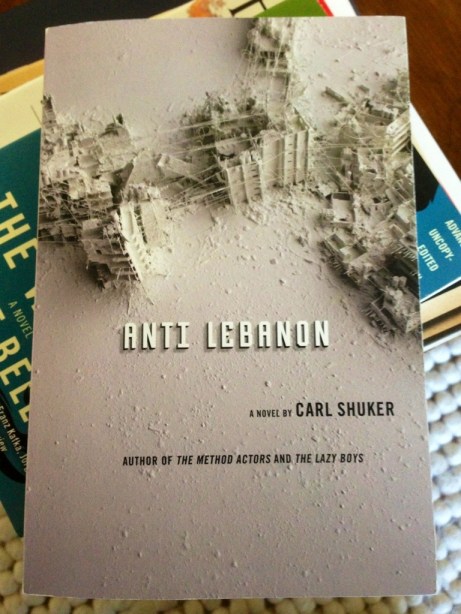
Anti Lebanon (Book Acquired, 3.07.2013)

20130308-110219.jpg

Dipped into this one this morning—first chapter—and so far so good: Carl Shuker’s Anti Lebanon is simultaneously weird and very readable, a mix that reminds me very much of William Gibson. Great cover too. Full review to come, but for now, here’s publisher Counterpoint Press’s blurb:

It is the Arab Spring and the fate of the Christians of the Middle East is uncertain. The many Christians of Lebanon are walking a knife-edge, their very survival in their ancestral refuge in doubt, as the Lebanese government becomes Hezbollah-dominated, while Syria convulses with warring religious factions. Anti Lebanon is a cross-genre political thriller and horror story embedded within these recent events, featuring a multiethnic Christian family living out the lingering after-effects of Lebanon’s civil war as it struggles to deal with its phantoms, its ghosts, and its vampires.

Leon Elias is a young and impoverished Lebanese man whose older sister had joined a Christian militia and has been killed. He becomes caught up in the recent “little war” in Beirut, when the Shi’a resistance/militia Hezbollah takes over most of the city. In this milieu—the emptied streets of Christian east Beirut, the old shell-scarred sandstone villas, the echoing gunfire—he becomes involved, only partly by choice, in the theft of a seriously valuable piece of artisanal jewelry, and is bitten—like a vampire—by its Armenian maker.

Events take a ghostly and mysterious turn as the factions jostling for power in Beirut begin to align against him and his family, and he is forced to flee the sullied beauty of that wonderful and pitiful country, in this story of love and loss, of the civil war and the Arabization of the “Switzerland of the Middle East,” and of contemporary vampires—beings addicted to violence, lies, and baser primal drives.

Carl Shuker is a remarkable writer. A storyteller in the tradition of Celine and J. G. Ballard, no one alive writes better sentences. Anti Lebanon will delight his fans and entrance anyone new to his fine work.


“Unhappiness” — Franz Kafka

“Unhappiness” by Franz Kafka

WHEN it was becoming unbearable – once toward evening in November – and I ran along the narrow strip of carpet in my room as on a racetrack, shrank from the sight of the lit-up street, then turning to the interior of the room found a new goal in the depths of the looking glass and screamed aloud, to hear only my own scream which met no answer nor anything that could draw its force away, so that it rose up without check and could not stop even when it ceased being audible, the door in the wall opened toward me, how swiftly, because swiftness was needed and even the cart horses down below on the paving stones were rising in the air like horses driven wild in a battle, their throats bare to the enemy.

Like a small ghost a child blew in from the pitch-dark corridor, where the lamp was not yet lit, and stood a-tiptoe on a floor board that quivered imperceptibly. At once dazzled by the twilight in my room she made to cover her face quickly with her hands, but contented herself unexpectedly with a glance at the window, where the mounting vapor of the street lighting had at last settled under its cover of darkness behind the crossbars. With her right elbow she supported herself against the wall in the open doorway and let the draught from outside play along her ankles, her throat, and her temples.

I gave her a brief glance, then said ‘Good day,’ and took my jacket from the hood of the stove, since I didn’t want to stand there half-undressed. For a little while I let my mouth hang open, so that my agitation could find a way out. I had a bad taste in my mouth, my eyelashes were fluttering on my cheeks, in short this visit, though I had expected it, was the one thing needful.

The child was still standing by the wall on the same spot, she had pressed her right hand against the plaster and was quite taken up with finding, her cheeks all pink, that the whitewashed walls had a rough surface and chafed her finger tips. I said: ‘Are you really looking for me? Isn’t there some mistake? Nothing easier than to make a mistake in this big building. I’m called So-and-so and I live on the third floor. Am I the person you want to find? Continue reading ““Unhappiness” — Franz Kafka” →

“Chippings with a Chisel” — Nathaniel Hawthorne

“Chippings with a Chisel” by Nathaniel Hawthorne

Passing a summer several years since at Edgartown, on the island of Martha’s Vineyard, I became acquainted with a certain carver of tombstones who had travelled and voyaged thither from the interior of Massachusetts in search of professional employment. The speculation had turned out so successful that my friend expected to transmute slate and marble into silver and gold to the amount of at least a thousand dollars during the few months of his sojourn at Nantucket and the Vineyard. The secluded life and the simple and primitive spirit which still characterizes the inhabitants of those islands, especially of Martha’s Vineyard, insure their dead friends a longer and dearer remembrance than the daily novelty and revolving bustle of the world can elsewhere afford to beings of the past. Yet, while every family is anxious to erect a memorial to its departed members, the untainted breath of Ocean bestows such health and length of days upon the people of the isles as would cause a melancholy dearth of business to a resident artist in that line. His own monument, recording his decease by starvation, would probably be an early specimen of his skill. Gravestones, therefore, have generally been an article of imported merchandise.

In my walks through the burial-ground of Edgartown—where the dead have lain so long that the soil, once enriched by their decay, has returned to its original barrenness—in that ancient burial-ground I noticed much variety of monumental sculpture. The elder stones, dated a century back or more, have borders elaborately carved with flowers and are adorned with a multiplicity of death’s-heads, crossbones, scythes, hour-glasses, and other lugubrious emblems of mortality, with here and there a winged cherub to direct the mourner’s spirit upward. These productions of Gothic taste must have been quite beyond the colonial skill of the day, and were probably carved in London and brought across the ocean to commemorate the defunct worthies of this lonely isle. The more recent monuments are mere slabs of slate in the ordinary style, without any superfluous flourishes to set off the bald inscriptions. But others—and those far the most impressive both to my taste and feelings—were roughly hewn from the gray rocks of the island, evidently by the unskilled hands of surviving friends and relatives. On some there were merely the initials of a name; some were inscribed with misspelt prose or rhyme, in deep letters which the moss and wintry rain of many years had not been able to obliterate. These, these were graves where loved ones slept. It is an old theme of satire, the falsehood and vanity of monumental eulogies; but when affection and sorrow grave the letters with their own painful labor, then we may be sure that they copy from the record on their hearts. Continue reading ““Chippings with a Chisel” — Nathaniel Hawthorne” →

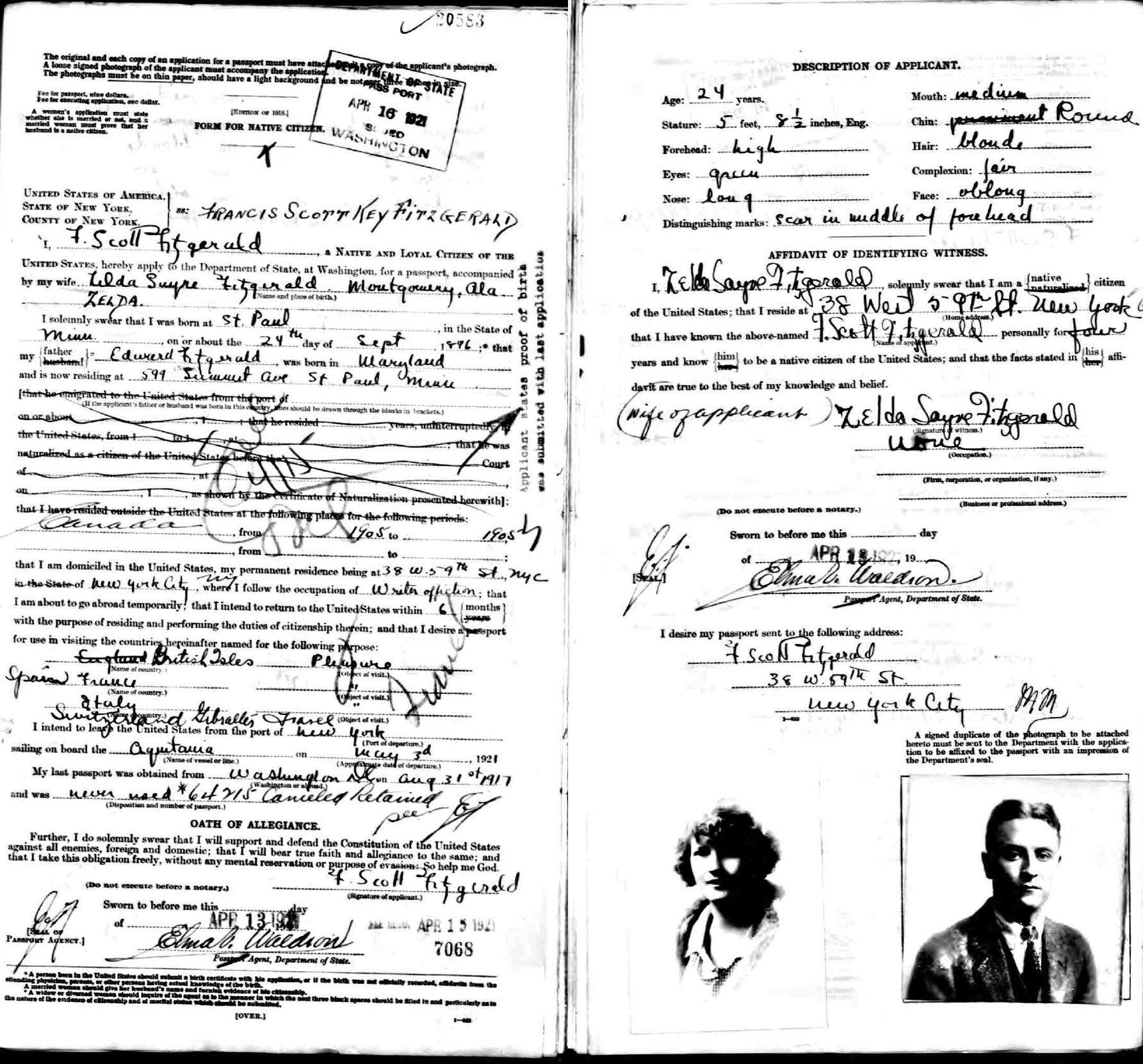
Scott and Zelda Fitzgerald Apply for a Passport

f-scott-fitzgerald

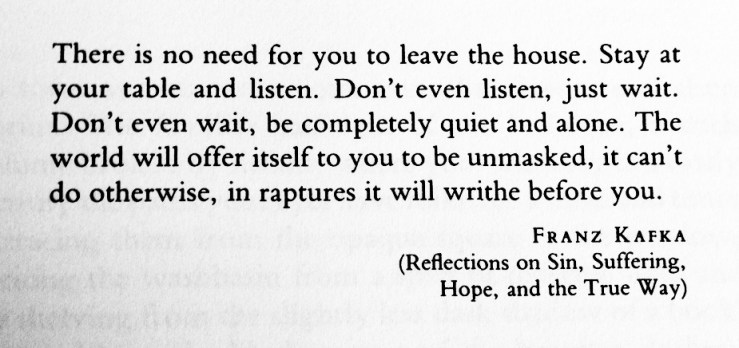
No Need (Kafka)

kafka

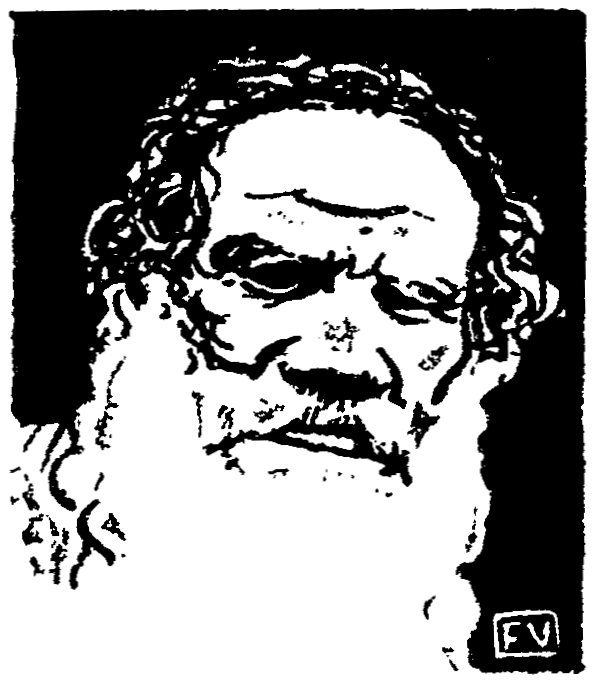
Leo Tolstoy — Felix Vallotton

leo-tolstoy-1895

“A Defence of Ugly Things” — G.K. Chesterton

“A Defence of Ugly Things” by G.K. Chesterton

There are some people who state that the exterior, sex, or physique of another person is indifferent to them, that they care only for the communion of mind with mind; but these people need not detain us. There are some statements that no one ever thinks of believing, however often they are made.

But while nothing in this world would persuade us that a great friend of Mr. Forbes Robertson, let us say, would experience no surprise or discomfort at seeing him enter the room in the bodily form of Mr. Chaplin, there is a confusion constantly made between being attracted by exterior, which is natural and universal, and being attracted by what is called physical beauty, which is not entirely natural and not in the least universal. Or rather, to speak more strictly, the conception of physical beauty has been narrowed to mean a certain kind of physical beauty which no more exhausts the possibilities of external attractiveness than the respectability of a Clapham builder exhausts the possibilities of moral attractiveness.

The tyrants and deceivers of mankind in this matter have been the Greeks. All their splendid work for civilization ought not to have wholly blinded us to the fact of their great and terrible sin against the variety of life. It is a remarkable fact that while the Jews have long ago been rebelled against and accused of blighting the world with a stringent and one-sided ethical standard, nobody has noticed that the Greeks have committed us to an infinitely more horrible asceticism—an asceticism of the fancy, a worship of one aesthetic type alone. Jewish severity had at least common-sense as its basis; it recognised that men lived in a world of fact, and that if a man married within the degrees of blood certain consequences might follow. But they did not starve their instinct for contrasts and combinations; their prophets gave two wings to the ox and any number of eyes to the cherubim with all the riotous ingenuity of Lewis Carroll. But the Greeks carried their police regulation into elfland; they vetoed not the actual adulteries of the earth but the wild weddings of ideas, and forbade the banns of thought.

It is extraordinary to watch the gradual emasculation of the monsters of Greek myth under the pestilent influence of the Apollo Belvedere. The chimaera was a creature of whom any healthy-minded people would have been proud; but when we see it in Greek pictures we feel inclined to tie a ribbon round its neck and give it a saucer of milk. Who ever feels that the giants in Greek art and poetry were really big—big as some folk-lore giants have been? In some Scandinavian story a hero walks for miles along a mountain ridge, which eventually turns out to be the bridge of the giant’s nose. That is what we should call, with a calm conscience, a large giant. But this earthquake fancy terrified the Greeks, and their terror has terrified all mankind out of their natural love of size, vitality, variety, energy, ugliness. Nature intended every human face, so long as it was forcible, individual, and expressive, to be regarded as distinct from all others, as a poplar is distinct from an oak, and an apple-tree from a willow. But what the Dutch gardeners did for trees the Greeks did for the human form; they lopped away its living and sprawling features to give it a certain academic shape; they hacked off noses and pared down chins with a ghastly horticultural calm. And they have really succeeded so far as to make us call some of the most powerful and endearing faces ugly, and some of the most silly and repulsive faces beautiful. This disgraceful via media, this pitiful sense of dignity, has bitten far deeper into the soul of modern civilization than the external and practical Puritanism of Israel. The Jew at the worst told a man to dance in fetters; the Greek put an exquisite vase upon his head and told him not to move. Continue reading ““A Defence of Ugly Things” — G.K. Chesterton” →

“There are in English often long trains of words allied by their meaning and derivation” (Samuel Johnson)

There are in English often long trains of words allied by their meaning and derivation; as, to beat, a bat, batoon, a battle, a beetle, a battledore, to batter, batter, a kind of glutinous composition for food, made by beating different bodies into one mass. All these are of similar signification, and perhaps derived from the Latin batuo. Thus take, touch, tickle, tack, tackle; all imply a local conjunction from the Latin tango, tetigi, tactum.

From two are formed twain, twice, twenty, twelve, twins, twine, twist, twirl, twig, twitch, twinge, between, betwixt, twilight, twibil.

The following remarks, extracted from Wallis, are ingenious but of more subtlety than solidity, and such as perhaps might in every language be enlarged without end.

Sn usually imply the nose, and what relates to it. From the Latin nasus are derived the French nez and the English nose; and nesse, a promontory, as projecting like a nose. But as if from the consonants ns taken from nasus, and transposed that they may the better correspond, sn denote nasus; and thence are derived many words that relate to the nose, as snout, sneeze, snore, snort,snear, snicker, snot, snivel, snite, snuff, snuffle, snaffle, snarl, snudge.

There is another sn which may perhaps be derived from the Latin sinuo, as snake, sneak, snail, snare; so likewise snap and snatch, snib, snub. Bl imply a blast; as blow, blast, to blast, to blight, and, metaphorically, to blast one’s reputation;bleat, bleak, a bleak place, to look bleak, or weather-beaten, black, blay, bleach, bluster, blurt, blister, blab, bladder, blew, blabber lip’t, blubber-cheek’t, bloted, blote-herrings, blast, blaze, to blow, that is, blossom, bloom; and perhapsblood and blush.

In the native words of our tongue is to be found a great agreement between the letters and the thing signified; and therefore the sounds of the letters smaller, sharper, louder, closer, softer, stronger, clearer, more obscure, and more stridulous, do very often intimate the like effects in the things signified.

Thus words that begin with str intimate the force and effect of the thing signified, as if probably derived from στρωννυμι, or strenuous; as strong, strength, strew, strike, streak, stroke, stripe, strive, strife, struggle, strout, strut, stretch, strait,strict, streight, that is, narrow, distrain, stress, distress, string, strap, stream, streamer, strand, strip, stray, struggle, strange, stride, stradale.

St in like manner imply strength, but in a less degree, so much only as is sufficient to preserve what has been already communicated, rather than acquire any new degree; as if it were derived from the Latin sto; for example, stand, stay, that is, to remain, or to prop; staff, stay, that is, to oppose; stop, to stuff, stifle, to stay, that is, to stop; a stay, that is, an obstacle; stick, stut, stutter, stammer, stagger, stickle, stick, stake, a sharp, pale, and any thing deposited at play; stock, stem,sting, to sting, stink, stitch, stud, stuncheon, stub, stubble, to stub up, stump, whence stumble, stalk, to stalk, step, to stamp with the feet, whence to stamp, that is, to make an impression and a stamp; stow, to stow, to bestow, steward, orstoward; stead, steady, stedfast, stable, a stable, a stall, to stall, stool, stall, still, stall, stallage, stage, still, adjective, and still, adverb: stale, stout, sturdy, stead, stoat, stallion, stiff, stark-dead, to starve with hunger or cold; stone, steel,stern, stanch, to stanch blood, to stare, steep, steeple, stair, standard, a stated measure, stately. In all these, and perhaps some others, st denote something firm and fixed.

Thr imply a more violent degree of motion, as throw, thrust, throng, throb, through, threat, threaten, thrall, throws.

Wr imply some sort of obliquity or distortion, as wry, to wreathe, wrest, wrestle, wring, wrong, wrinch, wrench, wrangle, wrinkle, wrath, wreak, wrack, wretch, wrist, wrap.

Sw imply a silent agitation, or a softer kind of lateral motion; as sway, swag, to sway, swagger, swerve, sweat, sweep, swill, swim, swing, swift, sweet, switch, swinge.

Nor is there much difference of sm in smooth, smug, smile, smirk, smite; which signifies the same as to strike, but is a softer word; small, smell, smack, smother, smart, a smart blow properly signifies such a kind of stroke as with an originally silent motion, implied in sm, proceeds to a quick violence, denoted by ar suddenly ended, as is shown by t.

Cl denote a kind of adhesion or tenacity, as in cleave, clay, cling, climb, clamber, clammy, clasp, to clasp, to clip, to clinch, cloak, clog, close, to close, a clod, a clot, as a clot of blood, clouted cream, a clutter, a cluster.

Sp imply a kind of dissipation or expansion, especially a quick one, particularly if there be an r, as if it were from spargo or separo: for example, spread, spring, sprig, sprout, sprinkle, split, splinter, spill, spit, sputter, spatter.

Sl denote a kind of silent fall, or a less observable motion; as in slime, slide, slip, slipper, sly, sleight, slit, slow, slack, slight, sling, slap.

And so likewise ash, in crash, rash, gash, flash, clash, lash, slash, plash, trash, indicate something acting more nimbly and sharply. But ush, in crush, rush, gush, flush, blush, brush, hush, push, imply something as acting more obtusely and dully. Yet in both there is indicated a swift and sudden motion not instantaneous, but gradual, by the continued sound, sh.

Thus in fling, sling, ding, swing, cling, sing, wring, sting, the tingling of the termination ng, and the sharpness of the vowel i, imply the continuation of a very slender motion or tremor, at length indeed vanishing, but not suddenly interrupted. [31]But in tink, wink, sink, clink, chink, think, that end in a mute consonant, there is also indicated a sudden ending.

If there be an l, as in jingle, tingle, tinkle, mingle, sprinkle, twinkle, there is implied a frequency, or iteration of small acts. And the same frequency of acts, but less subtile by reason of the clearer vowel a, is indicated in jangle, tangle,spangle, mangle, wrangle, brangle, dangle; as also in mumble, grumble, jumble. But at the same time the close u implies something obscure or obtunded; and a congeries of consonants mbl, denotes a confused kind of rolling or tumbling, as in ramble, scamble, scramble, wamble, amble; but in these there is something acute.

In nimble, the acuteness of the vowel denotes celerity. In sparkle, sp denotes dissipation, ar an acute crackling, k a sudden interruption, l a frequent iteration; and in like manner in sprinkle, unless in may imply the subtilty of the dissipated guttules. Thick and thin differ in that the former ends with an obtuse consonant, and the latter with an acute.

In like manner, in squeek, squeak, squeal, squall, brawl, wraul, yaul, spaul, screek, shriek, shrill, sharp, shrivel, wrinkle, crack, crash, clash, gnash, plash, crush, hush, hisse,  fisse,  whist, soft,  jar,  hurl,  curl,  whirl,  buz,  bustle, spindle, dwindle, twine, twist, and in many more, we may observe the agreement of such sort of sounds with the things signified; and this so frequently happens, that scarce any language which I know can be compared with ours. So that one monosyllable word, of which kind are almost all ours, emphatically expresses what in other languages can scarce be explained but by compounds, or decompounds, or sometimes a tedious circumlocution.

(From Samuel Johnson’s A Grammar of the English Tongue).
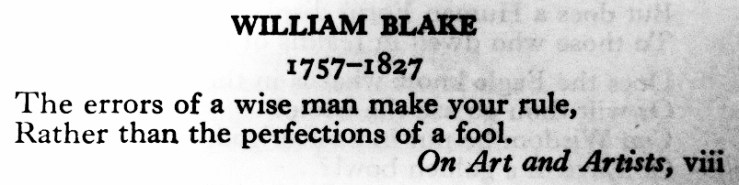
Perfections of a Fool (Blake)

blake

Fox And Rabbit — Yuri Norstein (Short Animated Film)