Ulysses (1967 Film Adaptation)

“The Birth of Bran” — An Irish Fairy Tale, Retold James Stephens

“The Birth of Bran”

An Irish Fairy Tale, Retold James Stephens

CHAPTER I

There are people who do not like dogs a bit—they are usually women—but in this story there is a man who did not like dogs. In fact, he hated them. When he saw one he used to go black in the face, and he threw rocks at it until it got out of sight. But the Power that protects all creatures had put a squint into this man’s eye, so that he always threw crooked.

This gentleman’s name was Fergus Fionnliath, and his stronghold was near the harbour of Galway. Whenever a dog barked he would leap out of his seat, and he would throw everything that he owned out of the window in the direction of the bark. He gave prizes to servants who disliked dogs, and when he heard that a man had drowned a litter of pups he used to visit that person and try to marry his daughter.

Now Fionn, the son of Uail, was the reverse of Fergus Fionnliath in this matter, for he delighted in dogs, and he knew everything about them from the setting of the first little white tooth to the rocking of the last long yellow one. He knew the affections and antipathies which are proper in a dog; the degree of obedience to which dogs may be trained without losing their honourable qualities or becoming servile and suspicious; he knew the hopes that animate them, the apprehensions which tingle in their blood, and all that is to be demanded from, or forgiven in, a paw, an ear, a nose, an eye, or a tooth; and he understood these things because he loved dogs, for it is by love alone that we understand anything.

Among the three hundred dogs which Fionn owned there were two to whom he gave an especial tenderness, and who were his daily and nightly companions. These two were Bran and Sceo’lan, but if a person were to guess for twenty years he would not find out why Fionn loved these two dogs and why he would never be separated from them.

Fionn’s mother, Muirne, went to wide Allen of Leinster to visit her son, and she brought her young sister Tuiren with her. The mother and aunt of the great captain were well treated among the Fianna, first, because they were parents to Fionn, and second, because they were beautiful and noble women.

No words can describe how delightful Muirne was—she took the branch; and as to Tuiren, a man could not look at her without becoming angry or dejected. Her face was fresh as a spring morning; her voice more cheerful than the cuckoo calling from the branch that is highest in the hedge; and her form swayed like a reed and flowed like a river, so that each person thought she would surely flow to him.

Men who had wives of their own grew moody and downcast because they could not hope to marry her, while the bachelors of the Fianna stared at each other with truculent, bloodshot eyes, and then they gazed on Tuiren so gently that she may have imagined she was being beamed on by the mild eyes of the dawn.

It was to an Ulster gentleman, Iollan Eachtach, that she gave her love, and this chief stated his rights and qualities and asked for her in marriage.

Now Fionn did not dislike the man of Ulster, but either he did not know them well or else he knew them too well, for he made a curious stipulation before consenting to the marriage. He bound Iollan to return the lady if there should be occasion to think her unhappy, and Iollan agreed to do so. The sureties to this bargain were Caelte mac Ronan, Goll mac Morna, and Lugaidh. Lugaidh himself gave the bride away, but it was not a pleasant ceremony for him, because he also was in love with the lady, and he would have preferred keeping her to giving her away. When she had gone he made a poem about her, beginning:

       "There is no more light in the sky—"

And hundreds of sad people learned the poem by heart. Continue reading ““The Birth of Bran” — An Irish Fairy Tale, Retold James Stephens” →

In the House Upon the Dirt Between the Lake and the Woods (Book Acquired 3.08.2013)

20130308-110107.jpg

I was happy to get an advance copy of Matt Bell’s forthcoming novel In the House upon the Dirt Between the Lake and the Woods, because I like titles with lots of prepositions. No, actually, Bell’s novella-in-vignette’s Cataclysm Baby was one of my favorite new books of 2012. Here’s the pub blurb for House:

In this epic, mythical debut novel, a newly-wed couple escapes the busy confusion of their homeland for a distant and almost-uninhabited lakeshore. They plan to live there simply, to fish the lake, to trap the nearby woods, and build a house upon the dirt between where they can raise a family. But as their every pregnancy fails, the child-obsessed husband begins to rage at this new world: the song-spun objects somehow created by his wife’s beautiful singing voice, the giant and sentient bear that rules the beasts of the woods, the second moon weighing down the fabric of their starless sky, and the labyrinth of memory dug into the earth beneath their house.

This novel, from one of our most exciting young writers, is a powerful exploration of the limits of parenthood and marriage—and of what happens when a marriage’s success is measured solely by the children it produces, or else the sorrow that marks their absence.

You can read my interview with Matt here and excerpts from House at Matt’s site.

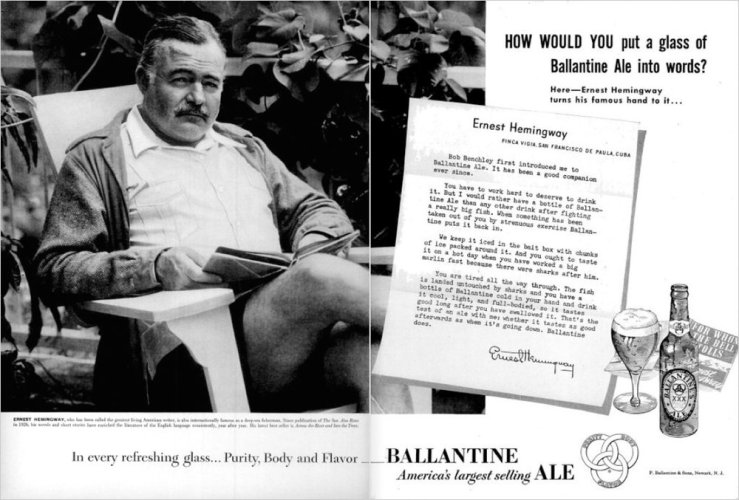
Hemingway Shilling for Ballantine Ale

Ernest Hemingway - Advertisement From P. Ballantine & Sons, Newark (1951)

(Via/about).

“Darwinism” — Walt Whitman

“Darwinism” by Walt Whitman

Running through prehistoric ages—coming down from them into the daybreak of our records, founding theology, suffusing literature, and so brought onward—(a sort of verteber and marrow to all the antique races and lands, Egypt, India, Greece, Rome, the Chinese, the Jews, &c., and giving cast and complexion to their art, poems, and their politics as well as ecclesiasticism, all of which we more or less inherit,) appear those venerable claims to origin from God himself, or from gods and goddesses—ancestry from divine beings of vaster beauty, size, and power than ours. But in current and latest times, the theory of human origin that seems to have most made its mark, (curiously reversing the antique,) is that we have come on, originated, developt, from monkeys, baboons—a theory more significant perhaps in its indirections, or what it necessitates, than it is even in itself. (Of the twain, far apart as they seem, and angrily as their conflicting advocates to-day oppose each other, are not both theories to be possibly reconcil’d, and even blended? Can we, indeed, spare either of them? Better still, out of them is not a third theory, the real one, or suggesting the real one, to arise?)

Of this old theory, evolution, as broach’d anew, trebled, with indeed all-devouring claims, by Darwin, it has so much in it, and is so needed as a counterpoise to yet widely prevailing and unspeakably tenacious, enfeebling superstitions—is fused, by the new man, into such grand, modest, truly scientific accompaniments—that the world of erudition, both moral and physical, cannot but be eventually better’d and broaden’d in its speculations, from the advent of Darwinism. Nevertheless, the problem of origins, human and other, is not the least whit nearer its solution. In due time the Evolution theory will have to abate its vehemence, cannot be allow’d to dominate every thing else, and will have to take its place as a segment of the circle, the cluster—as but one of many theories, many thoughts, of profoundest value—and re-adjusting and differentiating much, yet leaving the divine secrets just as inexplicable and unreachable as before—maybe more so.

Then furthermore—What is finally to be done by priest or poet—and by priest or poet only—amid all the stupendous and dazzling novelties of our century, with the advent of America, and of science and democracy—remains just as indispensable, after all the work of the grand astronomers, chemists, linguists, historians, and explorers of the last hundred years—and the wondrous German and other metaphysicians of that time—and will continue to remain, needed, America and here, just the same as in the world of Europe, or Asia, of a hundred, or a thousand, or several thousand years ago. I think indeed more needed, to furnish statements from the present points, the added arriere, and the unspeakably immenser vistas of to-day. Only, the priests and poets of the modern, at least as exalted as any in the past, fully absorbing and appreciating the results of the past, in the commonalty of all humanity, all time, (the main results already, for there is perhaps nothing more, or at any rate not much, strictly new, only more important modern combinations, and new relative adjustments,) must indeed recast the old metal, the already achiev’d material, into and through new moulds, current forms.

Meantime, the highest and subtlest and broadest truths of modern science wait for their true assignment and last vivid flashes of light—as Democracy waits for it’s—through first-class metaphysicians and speculative philosophs—laying the basements and foundations for those new, more expanded, more harmonious, more melodious, freer American poems.

Lydia Davis: “I don’t want to be bored by someone’s imagination”

I’m not tired of all good books, I’m just tired of novels and stories, even good ones, or ones that are supposed to be good. These days, I prefer books that contain something real. I don’t want to be bored by someone’s imagination. Most people’s imaginations just aren’t very interesting—you can guess where the author got this idea and that idea. You can predict what will come next before you finish reading the sentence. It all seems so arbitrary.

From Lydia Davis’s story “Not Interested,” published in this month’s Harper’s and originally published in NOON.


George Saunders on Jangly Sentences and the Intentional Fallacy

Beware

beware

“The Lightning-Rod Man” — Herman Melville

What grand irregular thunder, thought I, standing on my hearth-stone among the Acroceraunian hills, as the scattered bolts boomed overhead, and crashed down among the valleys, every bolt followed by zigzag irradiations, and swift slants of sharp rain, which audibly rang, like a charge of spear-points, on my low shingled roof. I suppose, though, that the mountains hereabouts break and churn up the thunder, so that it is far more glorious here than on the plain. Hark!–someone at the door. Who is this that chooses a time of thunder for making calls? And why don’t he, man-fashion, use the knocker, instead of making that doleful undertaker’s clatter with his fist against the hollow panel? But let him in. Ah, here he comes. “Good day, sir:” an entire stranger. “Pray be seated.” What is that strange-looking walking-stick he carries: “A fine thunder-storm, sir.”

“Fine?–Awful!”

“You are wet. Stand here on the hearth before the fire.”

“Not for worlds!”

The stranger still stood in the exact middle of the cottage, where he had first planted himself. His singularity impelled a closer scrutiny. A lean, gloomy figure. Hair dark and lank, mattedly streaked over his brow. His sunken pitfalls of eyes were ringed by indigo halos, and played with an innocuous sort of lightning: the gleam without the bolt. The whole man was dripping. He stood in a puddle on the bare oak floor: his strange walking-stick vertically resting at his side. Continue reading ““The Lightning-Rod Man” — Herman Melville” →

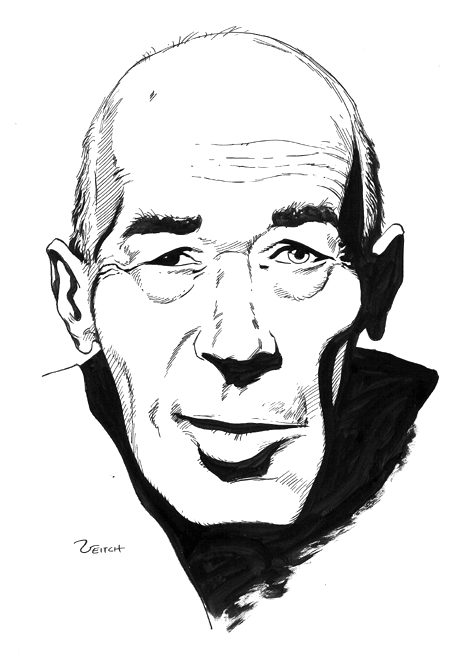
Henry Miller Portrait — Rick Veitch

miller

(Via Hey Oscar Wilde!)

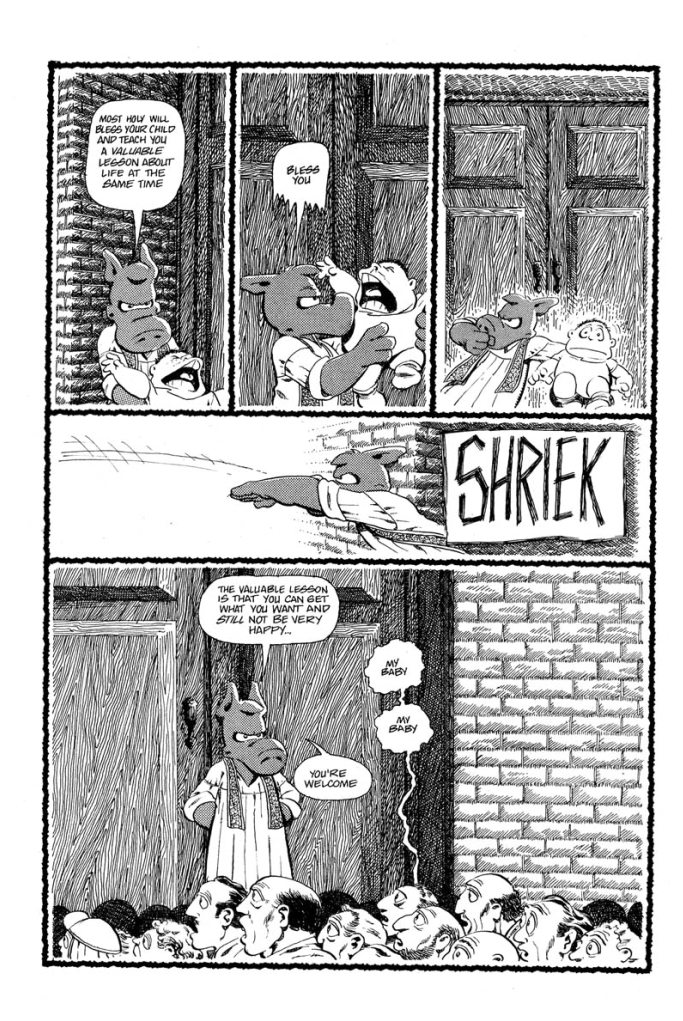
Pope Cerebus (Dave Sim)

11

“All utopias are depressing” (Georges Perec)

20130312-194740

“Thoughts on Various Subjects” — Jonathan Swift

“Thoughts on Various Subjects” by Jonathan Swift (From The Battle of the Books)

We have just enough religion to make us hate, but not enough to make us love one another.

Reflect on things past as wars, negotiations, factions, etc.  We enter so little into those interests, that we wonder how men could possibly be so busy and concerned for things so transitory; look on the present times, we find the same humour, yet wonder not at all.

A wise man endeavours, by considering all circumstances, to make conjectures and form conclusions; but the smallest accident intervening (and in the course of affairs it is impossible to foresee all) does often produce such turns and changes, that at last he is just as much in doubt of events as the most ignorant and inexperienced person.

Positiveness is a good quality for preachers and orators, because he that would obtrude his thoughts and reasons upon a multitude, will convince others the more, as he appears convinced himself.

How is it possible to expect that mankind will take advice, when they will not so much as take warning?

I forget whether Advice be among the lost things which Aristo says are to be found in the moon; that and Time ought to have been there.

No preacher is listened to but Time, which gives us the same train and turn of thought that older people have tried in vain to put into our heads before.

When we desire or solicit anything, our minds run wholly on the good side or circumstances of it; when it is obtained, our minds run wholly on the bad ones.

In a glass-house the workmen often fling in a small quantity of fresh coals, which seems to disturb the fire, but very much enlivens it.  This seems to allude to a gentle stirring of the passions, that the mind may not languish.

Religion seems to have grown an infant with age, and requires miracles to nurse it, as it had in its infancy.

All fits of pleasure are balanced by an equal degree of pain or languor; it is like spending this year part of the next year’s revenue.

The latter part of a wise man’s life is taken up in curing the follies, prejudices, and false opinions he had contracted in the former. Continue reading ““Thoughts on Various Subjects” — Jonathan Swift” →

“I like a look of agony” — Emily Dickinson

Capture

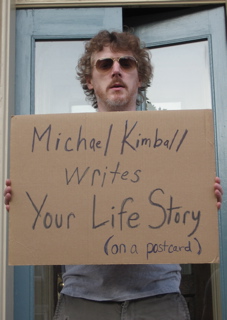
Michael Kimball Talks to Biblioklept About Writing Life Stories on Postcards

Michael Kimball’s latest book Michael Kimball Writes Your Life Story (On a Postcard) had its genesis in a performance piece at the Transmodern Performance Festival a few years back: Michael interviewed people for a few minutes and then crammed their biographies onto postcards. The project soon evolved into a blog, where Michael interviewed hundreds of people of all ages from around the world. The work is now collected in a book from Mud Luscious Press that features over fifty of the biographies, including the life stories of several contemporary writers, one dead U.S. President, a rooster, a T-shirt, a few cats, Edgar Allan Poe, and Michael himself.

In addition to Michael Kimball Writes Your Life Story (On a Postcard), Michael is the author of Big Ray, Us, Dear Everybody, and The Way the Family Got Away. He still holds the Meryl S. Colt Elementary School record for the 600-yard dash. Check out his website.

Michael was kind enough to talk to me about this latest book over a series of emails.
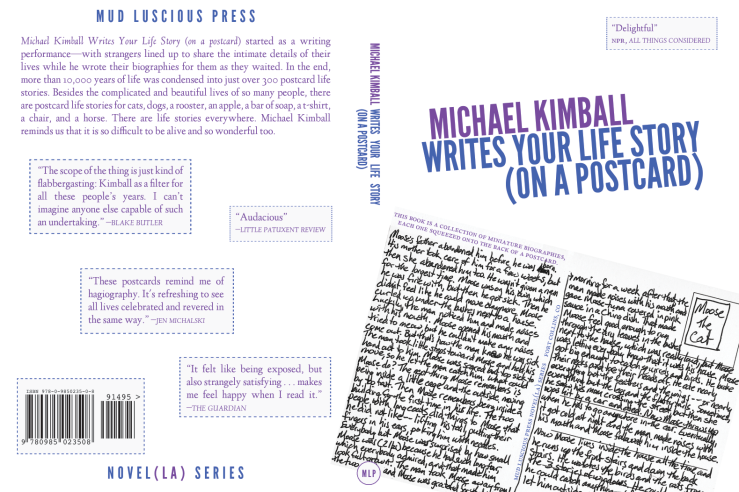
Kimball final cover copy

Biblioklept: What’s the hardest thing about writing someone’s life story on a postcard?

Michael Kimball: There are difficult things at different stages of the process. The first difficult thing is asking the right questions for the particular participant. The second difficult thing is being representative when condensing what I’ve been told. The third difficult thing is writing small enough to squeeze six hundred words or so onto a single postcard.

Biblioklept: When you started the project, it was a planned performance piece of sorts, but your description of it at the beginning of the book makes it seem rather off-the-cuff. Did you have a plan for the questions you would ask? How did the questions change as the project progressed?

MK: That first performance was definitely off-the-cuff. I had no idea what I was going to ask people and how I was going to write their life stories on a postcard. I mostly started with something pretty open-ended and then asked more specific questions about whatever I was told. As the project progressed, I developed a set of starter questions that elicited basic information and then asked more specific questions from there. Basically, I considered whatever I was being told to be important and then asked more questions about it.

Biblioklept: You interviewed people by email, in phone, in person — how did how you were doing the interview affect the process? Did you prefer one way over the other?

MK: I preferred the in-person interviews. There was a different kind of intimacy with those and there are a bunch of people I interviewed that way who are now friends. Of course, that wasn’t practical for lots of the interviews, since most people lived so far away from me. And the method did influence the process. With the phone interview and in-person interviews I was taking notes as fast as I could, but that was never fast enough. With the email interviews, it was easier for people to give me more detailed answers. Also, since I had the full text of their answers, I could use more of their language.
MKWYLS(oap)Biblioklept: Did you prefer to use as much of the subject’s language as possible? Maybe I’m getting into what you described as “the second difficult thing” — how much of yourself do you see in the pieces? I think there’s clearly a voice, a tone that unifies the pieces . . . I’m curious how much of the process was crafting or editing or revising or repurposing the subject’s original language…

MK: I tried to use the participant’s language wherever I thought it gave some sense of the person. At times, I thought of like using third-person close narration. Besides that, I was trying to be as objective as possible and I think that gave the life stories a certain consistency of tone. Clearly, I tend to write sentences a certain way, but beyond that I tried to keep myself out of it.

Biblioklept: What about pieces like “Chair” or “T-Shirt” — how did they come about?

MK: The first non-person one I wrote was Red Delicious Apple, which popped into my head almost fully formed, which happened because I used to almost always have apples on my desk, which just meant that I spent a lot of time with apples. But writing Red Delicious Apple opened up a lot of possibilities and so T-Shirt is written about my favorite t-shirt and Chair was written about a chair I once broke. And I have a great affection for animals, so I loved writing ones like Moose the Cat, Sammy the Dog, and Abby the Horse.

Biblioklept: You wrote over three hundred postcards. How did you choose which ones you would include in the book?

MK: The book would have been over seven hundred pages long if I had included all the postcard life stories, but it was difficult leaving any of them out. So, ultimately, it came down to trying to showing the range of the postcard life stories, which is why nearly every one I wrote about a non-human made it into the book.

Biblioklept: How did the Poe biography come about?

MK: That was for Gigantic’s Gigantic America issue. They asked me to write one of the great American bios that they printed on special card inserts and I suggested Poe, who had just had some anniversary of his life or his death.

Biblioklept: Several pieces in Life Story are about contemporary writers. Was writing about these writers different than writing about anyone else in the collection?

MK: Early on, it was other writers who seemed particularly keen on the project — Adam Robinson, Karen Lillis, Elizabeth Ellen, Elizabeth Crane, Blake Butler, etc. I approached every postcard life story the same way, but then let the participant tell me where they wanted to take it. I tried to ask questions that followed their answers.

Biblioklept: I imagine most people who asked to participate in the project were forthcoming with their answers. I’m curious though if you noticed any topics that people avoided or glossed over or maybe required additional prodding from you. Did you ever feel like your part of the interviewing process pushed your subject into uncomfortable territory?

MK: I didn’t realize it until later, but part of what made the project work was that people came to me wanting to tell their life story (rather than me asking them if they wanted it told). Still, there were a few times that people were reluctant to say things. There was one woman who was reluctant to talk about her husband and I couldn’t figure out why, but then they divorced not long after that. And there was one man who didn’t want to talk about his mother because she was really sick. But usually if there was reluctance, it was some kind of abuse or some other horrible thing that had happened to the person. In fact, I was reluctant to talk about the abuse I grew up with in my own postcard life story when it was initially written. In general, I tried to ask the difficult question, but then let the participant decide whether they wanted to answer and how much they wanted to tell me. And with particularly difficult life stories, I always showed the participant what I wrote and asked them if they were OK with it being public before I ever put their postcard life story out into the world.

Biblioklept: Talking about one’s own life clearly has some kind of therapeutic value. Do you think reading about one’s own life carries a similar value?

MK: Since starting the project, I’ve learned there are quite a few therapeutic techniques that involve narrative and telling (or retelling) one’s life story. Part of that process is hearing one’s life story told back or reading about one’s own life. There can be something useful in that perspective and there can be something reassuring about having a manageable version of one’s life story.

Biblioklept: What are you working on now?

MK: I’m very slowly working on two different novels and thinking about a third. I’m not sure if I’ll ever finish any of them.

Biblioklept: Have you ever stolen a book?

MK: I used to steal so many books, especially when I didn’t have the money to keep pace with my reading appetite and I couldn’t find the things I wanted to read in the library. I’ve tried to make up for that by giving away lots of books these days. I stole so many books that I’m not sure I can remember a specific instance. But it was always kind of thrilling and it seemed to make reading all the more exciting. Sometimes, if I didn’t like a book I would sneak it back into the bookstore.

George Saunders Riffs on Vonnegut, Teaching Writing, and How Capitalism Plunders the Sensuality of the Body

Is It About a Bicycle? (A Documentary About Flann O’Brien aka Brian O’Nolan aka Myles na gCopalee aka Brother Barnabas aka George Knowall)