“My Favorite Murder” — Ambrose Bierce

“My Favorite Murder” — Ambrose Bierce

Having murdered my mother under circumstances of singular atrocity, I was arrested and put upon my trial, which lasted seven years. In charging the jury, the judge of the Court of Acquittal remarked that it was one of the most ghastly crimes that he had ever been called upon to explain away.

At this, my attorney rose and said:

“May it please your Honor, crimes are ghastly or agreeable only by comparison. If you were familiar with the details of my client’s previous murder of his uncle you would discern in his later offense (if offense it may be called) something in the nature of tender forbearance and filial consideration for the feelings of the victim. The appalling ferocity of the former assassination was indeed inconsistent with any hypothesis but that of guilt; and had it not been for the fact that the honorable judge before whom he was tried was the president of a life insurance company that took risks on hanging, and in which my client held a policy, it is hard to see how he could decently have been acquitted. If your Honor would like to hear about it for instruction and guidance of your Honor’s mind, this unfortunate man, my client, will consent to give himself the pain of relating it under oath.”

The district attorney said: “Your Honor, I object. Such a statement would be in the nature of evidence, and the testimony in this case is closed. The prisoner’s statement should have been introduced three years ago, in the spring of 1881.”

“In a statutory sense,” said the judge, “you are right, and in the Court of Objections and Technicalities you would get a ruling in your favor. But not in a Court of Acquittal. The objection is overruled.”

“I except,” said the district attorney.

“You cannot do that,” the judge said. “I must remind you that in order to take an exception you must first get this case transferred for a time to the Court of Exceptions on a formal motion duly supported by affidavits. A motion to that effect by your predecessor in office was denied by me during the first year of this trial. Mr. Clerk, swear the prisoner.”

The customary oath having been administered, I made the following statement, which impressed the judge with so strong a sense of the comparative triviality of the offense for which I was on trial that he made no further search for mitigating circumstances, but simply instructed the jury to acquit, and I left the court, without a stain upon my reputation:

“I was born in 1856 in Kalamakee, Mich., of honest and reputable parents, one of whom Heaven has mercifully spared to comfort me in my later years. In 1867 the family came to California and settled near Nigger Head, where my father opened a road agency and prospered beyond the dreams of avarice. He was a reticent, saturnine man then, though his increasing years have now somewhat relaxed the austerity of his disposition, and I believe that nothing but his memory of the sad event for which I am now on trial prevents him from manifesting a genuine hilarity. Continue reading ““My Favorite Murder” — Ambrose Bierce”

D.T. Max and James Wood Talk About David Foster Wallace

“God keep me from ever completing anything” (Moby-Dick)

It was stated at the outset, that this system would not be here, and at once, perfected. You cannot but plainly see that I have kept my word. But I now leave my cetological System standing thus unfinished, even as the great Cathedral of Cologne was left, with the crane still standing upon the top of the uncompleted tower. For small erections may be finished by their first architects; grand ones, true ones, ever leave the copestone to posterity. God keep me from ever completing anything. This whole book is but a draught—nay, but the draught of a draught. Oh, Time, Strength, Cash, and Patience!

From Chapter 32 of Herman Melville’s Moby-Dick.


theNewerYork #2 Reviewed

20130106-104720.jpg

TheNewerYork is a new little magazine or journal or whatever you want to call it, featuring short fiction, poetry, art, lists, labels, fake reviews, and other stuff. Issue #2, clocking in at just over 80 pages fits neatly into a man’s jacket pocket and can be read in queues or at red lights or in between other readings or discreetly during end of semester faculty meetings. (I’m pretty sure you could read it in other occasions but I didn’t). You can see the front cover above; here’s the back cover, featuring this worrisome promise:

20130106-105947.jpg

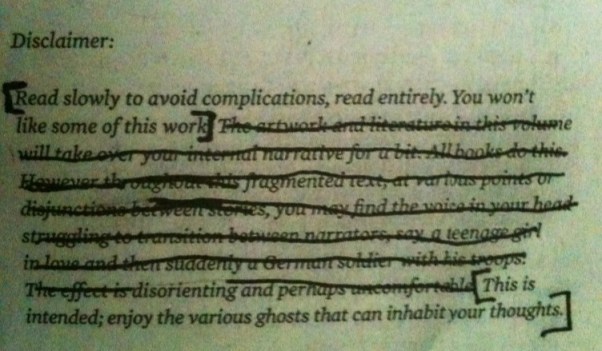
Maybe the best way to summarize (what I take to be) theNewerYork’s aesthetic/literary mission is to show off the issue’s disclaimer (which is preceded by a fancy Foucault quote):

20130106-105653.jpg

“You won’t like some of this work” seems like a fair warning, but theNewerYork is more hit than miss, starting with its excellent opener, ‘The Thank You War” by Elliot L. Ackerman, a four-paragraph flash that tackles how would-be patriotic citizens bungle human relationships with returning soldiers. Also very good is Jamie Grefe’s list “Over Thirteen,” which is a lovely little horror story that makes meaningful use of the reader’s imagination. Another list, Bruce Harris’s “Nearly A Dozen Things Sherlock Holmes Never Said” made me laugh (sample: “Watson, you’re right.”)

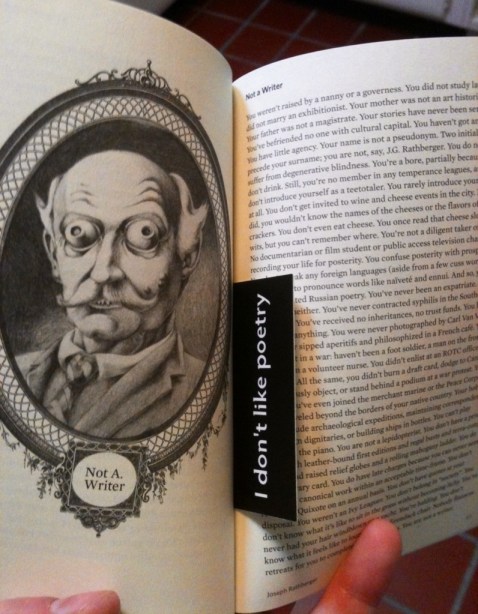
One of my favorite pieces in the volume is “Not a Writer” by Joseph Rathberger (indexed as “A Put Down”). You can see it below, filling up a page; you can also see the art that precedes it and the nifty bookmark that comes with the issue:

20130106-104746.jpg

Most of the art in the issue is black and white and all of it is varied (in style and in quality). Here is Food Poop by Shaina Yang:

20130106-104753.jpg

TheNewerYork’s willingness to showcase experimentation in what goes on paper for people to look at and read is both a strength and a weakness. Most of the pieces succeed, even when they shouldn’t (why is a Google translation from “Baby Got Back” from English to Latin and then back into English so funny?). The pieces in the issue that don’t succeed fail on their own terms: half-formed or poorly executed ideas, the occasionally gimmicky experiment, and, thankfully more rarely, pieces that feel too imitative. But like I said, most of the texts in theNewerYork’s second issue succeed, which is to say they entertain or amuse or baffle or occasionally move the reader. What I like most about theNewerYork is its spirit, which is daring and experimental without the heavy robes of irony that often cloak these sorts of operations. A promising beginning.

“Every lengthy, literary novel that has been published since Infinite Jest lives in its shadow” — Matt Bucher on David Foster Wallace

When Infinite Jest was published in 1996 and David Foster Wallace set the literary world on fire, he was the epitome of cool. He looked like Ethan Hawke and Kurt Cobain’s brother—and he was authentic, not just some poseur. And his talent could blow your mind; he was bona fide, high-brow literary, and important people called him a genius because they couldn’t think of a better word. Every lengthy, “literary” novel that has been published since Infinite Jest lives in its shadow. Is Adam Levin the next David Foster Wallace? Marisha Pessl? Zadie Smith? Eugenides? Is House of Leaves as good as Infinite Jest? How does Freedom or Witz compare? Safran Foer? Who is the female DFW? The thing is, at that moment, Wallace could have taken another direction. He could’ve gone on The Today Show or Good Morning America or been on a billboard in Times Square. He could’ve done some self-promotion and become the most famous young writer in America. But it’s not like he turned Pynchon and disappeared—he struggled with his gift and the image of himself. He winced on Charlie Rose and then went back to teaching in Illinois.

Do yourself a favor and read Matt Bucher’s essay “Consider the Year of David Foster Wallace.


“Sweeney Among the Nightingales” — T.S. Eliot

“Sweeney Among the Nightingales” by T.S. Eliot

Apeneck Sweeney spreads his knees
Letting his arms hang down to laugh,
The zebra stripes along his jaw
Swelling to maculate giraffe.

The circles of the stormy moon
Slide westward toward the River Plate,
Death and the Raven drift above
And Sweeney guards the hornèd gate.

Gloomy Orion and the Dog
Are veiled; and hushed the shrunken seas;
The person in the Spanish cape
Tries to sit on Sweeney’s knees

Slips and pulls the table cloth
Overturns a coffee-cup,
Reorganized upon the floor
She yawns and draws a stocking up;

The silent man in mocha brown
Sprawls at the window-sill and gapes;
The waiter brings in oranges
Bananas figs and hothouse grapes;

The silent vertebrate in brown
Contracts and concentrates, withdraws;
Rachel née Rabinovitch
Tears at the grapes with murderous paws;

She and the lady in the cape
Are suspect, thought to be in league;
Therefore the man with heavy eyes
Declines the gambit, shows fatigue,

Leaves the room and reappears
Outside the window, leaning in,
Branches of wisteria
Circumscribe a golden grin;

The host with someone indistinct
Converses at the door apart,
The nightingales are singing near
The Convent of the Sacred Heart,

And sang within the bloody wood
When Agamemnon cried aloud,
And let their liquid droppings fall
To stain the stiff dishonoured shroud.


A Lazy Riff on the First Three of Álvaro Mutis’s Maqroll Novellas

The Jungle by Wilfredo Lam

1. Last year on this blog, my friend Dave Cianci reviewed Álvaro Mutis’s collection of seven novellas, The Adventures and Misadventures of Maqroll. That review got me to eventually pick up the book and start reading. That review is better written and more accomplished than what I’ll likely end up doing here.

2. There are seven Maqroll novellas; I’ve read the first three. They are excellent.

3. Let me steal from Cianci’s review. He describes Maqroll the Gaviero as

a fleshed-out character, as well as the embodiment of an ideal: the knife fighters and Viking poets idolized by Borges, a mixture of Robinson Crusoe, Sam Spade, and Don Quixote. He indulges fantasy but prepares for disappointment. He lives between lawlessness and acceptability.

4. The Gaviero—the lookout—is a picaro, a roguish but poetical sailor. Mutis’s book is picaresque, carnivalesque, a river—or maybe a maze—of storytelling.

5. This is maybe what Maqroll is about: storytelling. Each Maqroll novella is framed as another’s story, or a found document—you know this trick, you’ve read Borges, right? 

6. The book is crammed with stories, stories that lead to other stories, that recall other stories, that tell their own stories—or cover over other stories.

7. A line that might instructively illustrate point 6: In Ilona Comes with the Rain, Mutis unpacks the life of a minor character, a sea captain named Wito. Consider his opening gambit:

His life deserves an entire book. It was so full of adventures, some of which he hurried over as if they were hot coals, that one became lost in their labyrinthine complexity.

The life described here could just as well be the Gaviero’s.

8. Well of course, that’s what Mutis is doing, channeling and conveying and expressing Maqroll’s life, a life of picaresque adventures (and titular misadventures), of loss and gain, of love and despair, drinking, sailing, scheming and plotting—a life full of allusions and hints and digressions. Mutis’s technique is marvelous (literally; he made this reader marvel): he gives us an aging (anti-)hero, a hero whose life is overstuffed with stories and mishaps and feats and enterprises and hazards; he gives us one strand of that life at a time in each novella—but then he points to the other adventures, the other serials of Maqroll that we would love to tune into if only we could.

9. To illustrate point 8: Consider Maqroll in Un Bel Morir, doing some time in prison: His consciousness floats to other prisons, other countries: Afghanistan, British Columbia: And then we get those stories, miniature epics—and nested within them, their own characters tell stories.

10. There’s a wonderful timelessness to Maqroll, a sense that the adventures exist somehow before the postmodern world, that they belong to the pulp fictions of jungle adventure…

11. (Indeed, re: point 10: In Ilona, we find one character who is unstuck in time, taking a Naopleonic lover during a transcontinental voyage…)

12. I’ve already noted the Borgesian quality of Mutis’s tales, brought up their picaresque scope (a la Cervantes), so let me lazily compare Mutis to others: let me note the sprawl of his storytelling, which recalls García Márquez—only more compact, more precise. Let me suggest that there’s something of Kafka in there too—indeed, the first novella, The Snows of the Admiral seems to me a reworking of “Before the Law.” (The tale is also conspicuously quixotic; tilting at windmills and all that). Conrad of course, but also something of Melville—the grand (Moby-Dick) and the sly (The Confidence Man). And hell, also something of Edgar Rice Burroughs’s high adventure, or even, dare I say it, the better parts of the Indiana Jones films.

13. Lazy as I am, I’ve failed to quote Mutis at any length—a shame, because it’s wonderful prose (translated by Edith Grossman, by the way). So here’s a little morsel—one that I think captures why we tell stories—from the appendix to Un Bel Morir, the last of the three novellas I read; before I offer it up I’ll conclude my riff by saying how happy I am that there are four more of these Maqroll novellas to read:

All the stories and lies about his past accumulating until they formed another being, always present and naturally more deeply loved than his own pale, useless existence composed of nausea and dreams.

“Hands” — Sherwood Anderson

“Hands” by Sherwood Anderson

Upon the half decayed veranda of a small frame house that stood near the edge of a ravine near the town of Winesburg, Ohio, a fat little old man walked nervously up and down. Across a long field that had been seeded for clover but that had produced only a dense crop of yellow mustard weeds, he could see the public highway along which went a wagon filled with berry pickers returning from the fields. The berry pickers, youths and maidens, laughed and shouted boisterously. A boy clad in a blue shirt leaped from the wagon and attempted to drag after him one of the maidens, who screamed and protested shrilly. The feet of the boy in the road kicked up a cloud of dust that floated across the face of the departing sun. Over the long field came a thin girlish voice. “Oh, you Wing Biddlebaum, comb your hair, it’s falling into your eyes,” commanded the voice to the man, who was bald and whose nervous little hands fiddled about the bare white forehead as though arranging a mass of tangled locks.

Wing Biddlebaum, forever frightened and beset by a ghostly band of doubts, did not think of himself as in any way a part of the life of the town where he had lived for twenty years. Among all the people of Winesburg but one had come close to him. With George Willard, son of Tom Willard, the proprietor of the New Willard House, he had formed something like a friendship. George Willard was the reporter on the Winesburg Eagle and sometimes in the evenings he walked out along the highway to Wing Biddlebaum’s house. Now as the old man walked up and down on the veranda, his hands moving nervously about, he was hoping that George Willard would come and spend the evening with him. After the wagon containing the berry pickers had passed, he went across the field through the tall mustard weeds and climbing a rail fence peered anxiously along the road to the town. For a moment he stood thus, rubbing his hands together and looking up and down the road, and then, fear overcoming him, ran back to walk again upon the porch on his own house. Continue reading ““Hands” — Sherwood Anderson”

“…over any ignominious blemish in him all his fellows should run to throw their costliest robes” (Moby-Dick)

Men may seem detestable as joint stock-companies and nations; knaves, fools, and murderers there may be; men may have mean and meagre faces; but man, in the ideal, is so noble and so sparkling, such a grand and glowing creature, that over any ignominious blemish in him all his fellows should run to throw their costliest robes. That immaculate manliness we feel within ourselves, so far within us, that it remains intact though all the outer character seem gone; bleeds with keenest anguish at the undraped spectacle of a valor-ruined man. Nor can piety itself, at such a shameful sight, completely stifle her upbraidings against the permitting stars. But this august dignity I treat of, is not the dignity of kings and robes, but that abounding dignity which has no robed investiture. Thou shalt see it shining in the arm that wields a pick or drives a spike; that democratic dignity which, on all hands, radiates without end from God; Himself! The great God absolute! The centre and circumference of all democracy! His omnipresence, our divine equality!

From Chapter 26 of Herman Melville’s Moby-Dick.


Everyday Reading: Poetry and Popular Culture in America (Book Acquired, Sometime in December of 2012)

20130105-110115.jpg

I got a little lax with these “books acquired” posts at the end of last year—chalk it up to end of semester deadlines and meetings, family-oriented holiday stuff, and an awful illness. Anyway–

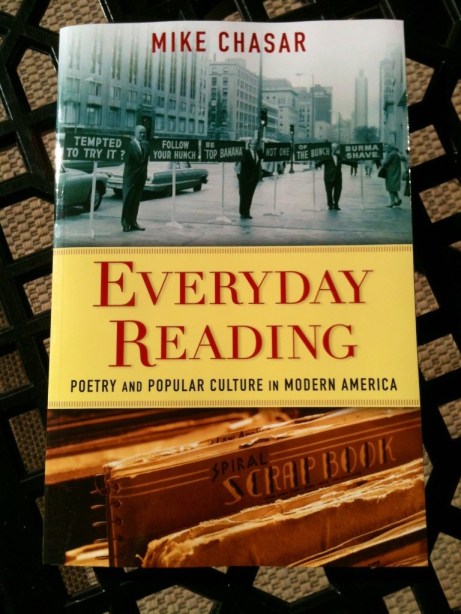
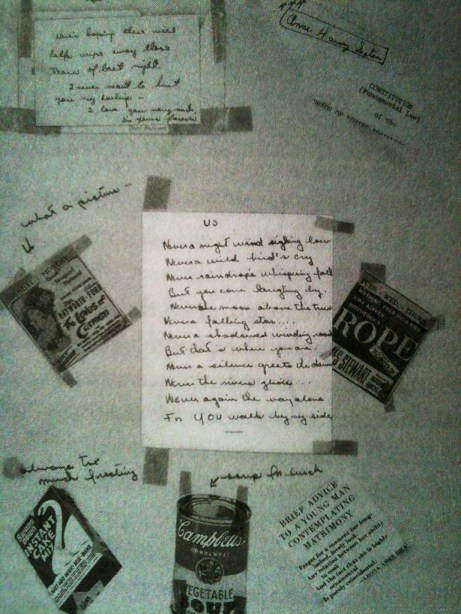
Mike Chasar’s Everyday Reading: Poetry and Popular Culture in Modern America, new from Columbia University Press is pretty cool: it’s kind of a dialogic study of how poetry evinces (or infiltrates or collides or emerges from or is bound by) a variety of popular media. Some of the most fascinating chapters dwell on scrapbooking. Here’s Columbia U of P’s blurb:

Exploring poetry scrapbooks, old-time radio show recordings, advertising verse, corporate archives, and Hallmark greeting cards, among other unconventional sources, Mike Chasar casts American poetry as an everyday phenomenon consumed and created by a vast range of readers. He shows how American poetry in the first half of the twentieth century and its reception helped set the stage for the dynamics of popular culture and mass media today.

Poetry was then part and parcel of American popular culture, spreading rapidly as the consumer economy expanded and companies exploited its profit-making potential. Poetry also offered ordinary Americans creative, emotional, political, and intellectual modes of expression, whether through scrapbooking, participation in radio programs, or poetry contests. Reenvisioning the uses of twentieth-century poetry, Chasar provides a richer understanding of the innovations of modernist and avant-garde poets and the American reading public’s sophisticated powers of feeling and perception.

A couple of snaps from the book—pics of pages from one of those scrapbooks—

20130105-110232.jpg

20130105-110245.jpg

And—

20130105-110159.jpg

“How the Whale Got His Throat” — Rudyard Kipling

“How the Whale Got His Throat” — Rudyard Kipling

IN the sea, once upon a time, O my Best Beloved, there was a Whale, and he ate fishes. He ate the starfish and the garfish, and the crab and the dab, and the plaice and the dace, and the skate and his mate, and the mackereel and the pickereel, and the really truly twirly-whirly eel. All the fishes he could find in all the sea he ate with his mouth—so! Till at last there was only one small fish left in all the sea, and he was a small ‘Stute Fish, and he swam a little behind the Whale’s right ear, so as to be out of harm’s way. Then the Whale stood up on his tail and said, ‘I’m hungry.’ And the small ‘Stute Fish said in a small ‘stute voice, ‘Noble and generous Cetacean, have you ever tasted Man?’

‘No,’ said the Whale. ‘What is it like?’

‘Nice,’ said the small ‘Stute Fish. ‘Nice but nubbly.’

‘Then fetch me some,’ said the Whale, and he made the sea froth up with his tail.

‘One at a time is enough,’ said the ‘Stute Fish. ‘If you swim to latitude Fifty North, longitude Forty West (that is magic), you will find, sitting on a raft, in the middle of the sea, with nothing on but a pair of blue canvas breeches, a pair of suspenders (you must not forget the suspenders, Best Beloved), and a jack-knife, one ship-wrecked Mariner, who, it is only fair to tell you, is a man of infinite-resource-and-sagacity.’

So the Whale swam and swam to latitude Fifty North, longitude Forty West, as fast as he could swim, and on a raft, in the middle of the sea, with nothing to wear except a pair of blue canvas breeches, a pair of suspenders (you must particularly remember the suspenders, Best Beloved), and a jack-knife, he found one single, solitary shipwrecked Mariner, trailing his toes in the water. (He had his mummy’s leave to paddle, or else he would never have done it, because he was a man of infinite-resource-and-sagacity.)

Then the Whale opened his mouth back and back and back till it nearly touched his tail, and he swallowed the shipwrecked Mariner, and the raft he was sitting on, and his blue canvas breeches, and the suspenders (which you must not forget), and the jack-knife—He swallowed them all down into his warm, dark, inside cup-boards, and then he smacked his lips—so, and turned round three times on his tail.

But as soon as the Mariner, who was a man of infinite-resource-and-sagacity, found himself truly inside the Whale’s warm, dark, inside cup-boards, he stumped and he jumped and he thumped and he bumped, and he pranced and he danced, and he banged and he clanged, and he hit and he bit, and he leaped and he creeped, and he prowled and he howled, and he hopped and he dropped, and he cried and he sighed, and he crawled and he bawled, and he stepped and he lepped, and he danced hornpipes where he shouldn’t, and the Whale felt most unhappy indeed. (Have you forgotten the suspenders?)

So he said to the ‘Stute Fish, ‘This man is very nubbly, and besides he is making me hiccough. What shall I do?’

‘Tell him to come out,’ said the ‘Stute Fish.

So the Whale called down his own throat to the shipwrecked Mariner, ‘Come out and behave yourself. I’ve got the hiccoughs.’

‘Nay, nay!’ said the Mariner. ‘Not so, but far otherwise. Take me to my natal-shore and the white-cliffs-of-Albion, and I’ll think about it.’ And he began to dance more than ever.

‘You had better take him home,’ said the ‘Stute Fish to the Whale.

‘I ought to have warned you that he is a man of infinite-resource-and-sagacity.’

So the Whale swam and swam and swam, with both flippers and his tail, as hard as he could for the hiccoughs; and at last he saw the Mariner’s natal-shore and the white-cliffs-of-Albion, and he rushed half-way up the beach, and opened his mouth wide and wide and wide, and said, ‘Change here for Winchester, Ashuelot, Nashua, Keene, and stations on the Fitchburg Road;’ and just as he said ‘Fitch’ the Mariner walked out of his mouth. But while the Whale had been swimming, the Mariner, who was indeed a person of infinite-resource-and-sagacity, had taken his jack-knife and cut up the raft into a little square grating all running criss-cross, and he had tied it firm with his suspenders (now, you know why you were not to forget the suspenders!), and he dragged that grating good and tight into the Whale’s throat, and there it stuck! Then he recited the following Sloka, which, as you have not heard it, I will now proceed to relate—

By means of a grating

I have stopped your ating.

For the Mariner he was also an Hi-ber-ni-an. And he stepped out on the shingle, and went home to his mother, who had given him leave to trail his toes in the water; and he married and lived happily ever afterward. So did the Whale. But from that day on, the grating in his throat, which he could neither cough up nor swallow down, prevented him eating anything except very, very small fish; and that is the reason why whales nowadays never eat men or boys or little girls.

The small ‘Stute Fish went and hid himself in the mud under the Door-sills of the Equator. He was afraid that the Whale might be angry with him.

The Sailor took the jack-knife home. He was wearing the blue canvas breeches when he walked out on the shingle. The suspenders were left behind, you see, to tie the grating with; and that is the end of that tale.

WHEN the cabin port-holes are dark and green

Because of the seas outside;

When the ship goes wop (with a wiggle between)

And the steward falls into the soup-tureen,

And the trunks begin to slide;

When Nursey lies on the floor in a heap,

And Mummy tells you to let her sleep,

And you aren’t waked or washed or dressed,

Why, then you will know (if you haven’t guessed)

You’re ‘Fifty North and Forty West!’


“Emily Dickinson” — Wendy Cope

“Emily Dickinson” by Wendy Cope:

Higgledy-piggledy
Emily Dickinson
Liked to use dashes
Instead of full stops.

Nowadays, faced with such
Idiosyncrasy,
Critics and editors
Send for the cops.

“Edgar Poe’s Significance” — Walt Whitman

“Edgar Poe’s Significance” by Walt Whitman. From Specimen Days.

Jan. 1, ’80.—In diagnosing this disease called humanity—to assume for the nonce what seems a chief mood of the personality and writings of my subject—I have thought that poets, somewhere or other on the list, present the most mark’d indications. Comprehending artists in a mass, musicians, painters, actors, and so on, and considering each and all of them as radiations or flanges of that furious whirling wheel, poetry, the centre and axis of the whole, where else indeed may we so well investigate the causes, growths, tally-marks of the time—the age’s matter and malady?

By common consent there is nothing better for man or woman than a perfect and noble life, morally without flaw, happily balanced in activity, physically sound and pure, giving its due proportion, and no more, to the sympathetic, the human emotional element—a life, in all these, unhasting, unresting, untiring to the end. And yet there is another shape of personality dearer far to the artist-sense, (which likes the play of strongest lights and shades,) where the perfect character, the good, the heroic, although never attain’d, is never lost sight of, but through failures, sorrows, temporary downfalls, is return’d to again and again, and while often violated, is passionately adhered to as long as mind, muscles, voice, obey the power we call volition. This sort of personality we see more or less in Burns, Byron, Schiller, and George Sand. But we do not see it in Edgar Poe. (All this is the result of reading at intervals the last three days a new volume of his poems—I took it on my rambles down by the pond, and by degrees read it all through there.) While to the character first outlined the service Poe renders is certainly that entire contrast and contradiction which is next best to fully exemplifying it.

Almost without the first sign of moral principle, or of the concrete or its heroisms, or the simpler affections of the heart, Poe’s verses illustrate an intense faculty for technical and abstract beauty, with the rhyming art to excess, an incorrigible propensity toward nocturnal themes, a demoniac undertone behind every page—and, by final judgment, probably belong among the electric lights of imaginative literature, brilliant and dazzling, but with no heat. There is an indescribable magnetism about the poet’s life and reminiscences, as well as the poems. To one who could work out their subtle retracing and retrospect, the latter would make a close tally no doubt between the author’s birth and antecedents, his childhood and youth, his physique, his so-call’d education, his studies and associates, the literary and social Baltimore, Richmond, Philadelphia and New York, of those times—not only the places and circumstances in themselves, but often, very often, in a strange spurning of, and reaction from them all.

The following from a report in the Washington “Star” of November 16, 1875, may afford those who care for it something further of my point of view toward this interesting figure and influence of our era. There occurr’d about that date in Baltimore a public reburial of Poe’s remains, and dedication of a monument over the grave:

“Being in Washington on a visit at the time, ‘the old gray’ went over to Baltimore, and though ill from paralysis, consented to hobble up and silently take a seat on the platform, but refused to make any speech, saying, ‘I have felt a strong impulse to come over and be here to-day myself in memory of Poe, which I have obey’d, but not the slightest impulse to make a speech, which, my dear friends, must also be obeyed.’ In an informal circle, however, in conversation after the ceremonies, Whitman said: ‘For a long while, and until lately, I had a distaste for Poe’s writings. I wanted, and still want for poetry, the clear sun shining, and fresh air blowing—the strength and power of health, not of delirium, even amid the stormiest passions—with always the background of the eternal moralities. Non-complying with these requirements, Poe’s genius has yet conquer’d a special recognition for itself, and I too have come to fully admit it, and appreciate it and him.

“‘In a dream I once had, I saw a vessel on the sea, at midnight, in a storm. It was no great full-rigg’d ship, nor majestic steamer, steering firmly through the gale, but seem’d one of those superb little schooner yachts I had often seen lying anchor’d, rocking so jauntily, in the waters around New York, or up Long Island sound—now flying uncontroll’d with torn sails and broken spars through the wild sleet and winds and waves of the night. On the deck was a slender, slight, beautiful figure, a dim man, apparently enjoying all the terror, the murk, and the dislocation of which he was the centre and the victim. That figure of my lurid dream might stand for Edgar Poe, his spirit, his fortunes, and his poems—themselves all lurid dreams.'”

Much more may be said, but I most desired to exploit the idea put at the beginning. By its popular poets the calibres of an age, the weak spots of its embankments, its sub-currents, (often more significant than the biggest surface ones,) are unerringly indicated. The lush and the weird that have taken such extraordinary possession of Nineteenth century verse-lovers—what mean they? The inevitable tendency of poetic culture to morbidity, abnormal beauty—the sickliness of all technical thought or refinement in itself—the abnegation of the perennial and democratic concretes at first hand, the body, the earth and sea, sex and the like—and the substitution of something for them at second or third hand—what bearings have they on current pathological study?

“The Four Fists” — F. Scott Fitzgerald

“The Four Fists” — F. Scott Fitzgerald

At the present time no one I know has the slightest desire to hit Samuel Meredith; possibly this is because a man over fifty is liable to be rather severely cracked at the impact of a hostile fist, but, for my part, I am inclined to think that all his hitable qualities have quite vanished. But it is certain that at various times in his life hitable qualities were in his face, as surely as kissable qualities have ever lurked in a girl’s lips.

I’m sure every one has met a man like that, been casually introduced, even made a friend of him, yet felt he was the sort who aroused passionate dislike—expressed by some in the involuntary clinching of fists, and in others by mutterings about “takin’ a poke” and “landin’ a swift smash in ee eye.” In the juxtaposition of Samuel Meredith’s features this quality was so strong that it influenced his entire life.

What was it? Not the shape, certainly, for he was a pleasant-looking man from earliest youth: broad-bowed with gray eyes that were frank and friendly. Yet I’ve heard him tell a room full of reporters angling for a “success” story that he’d be ashamed to tell them the truth that they wouldn’t believe it, that it wasn’t one story but four, that the public would not want to read about a man who had been walloped into prominence.

It all started at Phillips Andover Academy when he was fourteen. He had been brought up on a diet of caviar and bell-boys’ legs in half the capitals of Europe, and it was pure luck that his mother had nervous prostration and had to delegate his education to less tender, less biassed hands.

At Andover he was given a roommate named Gilly Hood. Gilly was thirteen, undersized, and rather the school pet. From the September day when Mr. Meredith’s valet stowed Samuel’s clothing in the best bureau and asked, on departing, “hif there was hanything helse, Master Samuel?” Gilly cried out that the faculty had played him false. He felt like an irate frog in whose bowl has been put goldfish. Continue reading ““The Four Fists” — F. Scott Fitzgerald”

“Nothing exists in itself” (Moby-Dick)

Yes, we became very wakeful; so much so that our recumbent position began to grow wearisome, and by little and little we found ourselves sitting up; the clothes well tucked around us, leaning against the head-board with our four knees drawn up close together, and our two noses bending over them, as if our kneepans were warming-pans. We felt very nice and snug, the more so since it was so chilly out of doors; indeed out of bed-clothes too, seeing that there was no fire in the room. The more so, I say, because truly to enjoy bodily warmth, some small part of you must be cold, for there is no quality in this world that is not what it is merely by contrast. Nothing exists in itself. If you flatter yourself that you are all over comfortable, and have been so a long time, then you cannot be said to be comfortable any more. But if, like Queequeg and me in the bed, the tip of your nose or the crown of your head be slightly chilled, why then, indeed, in the general consciousness you feel most delightfully and unmistakably warm. For this reason a sleeping apartment should never be furnished with a fire, which is one of the luxurious discomforts of the rich. For the height of this sort of deliciousness is to have nothing but the blanket between you and your snugness and the cold of the outer air. Then there you lie like the one warm spark in the heart of an arctic crystal.

From Chapter 11 of Herman Melville’s Moby-Dick.


J.R.R. Tolkien Links

Smaug Flies Round the Mountain — An Illustration by J.R.R. Tolkien

“I Have a Very Vivid Child’s View” — A 1967 Interview with J.R.R. Tolkien

J.R.R. Tolkien, In His Own Words (1968 BBC Documentary)

Tolkien Cover Gallery

“I Rarely Remember a Book About Which I Have Had Such Violent Arguments” — W.H. Auden Reviews J.R.R. Tolkien

The Hobbit Reconsidered as a Picaresque Novel

I Compare the First Three Books of George R. R. Martin’s A Song of Ice and Fire Series to Tolkien’s work


“The Californian’s Tale” — Mark Twain

“The Californian’s Tale” — Mark Twain

Thirty-five years ago I was out prospecting on the Stanislaus, tramping all day long with pick and pan and horn, and washing a hatful of dirt here and there, always expecting to make a rich strike, and never doing it. It was a lovely region, woodsy, balmy, delicious, and had once been populous, long years before, but now the people had vanished and the charming paradise was a solitude. They went away when the surface diggings gave out. In one place, where a busy little city with banks and newspapers and fire companies and a mayor and aldermen had been, was nothing but a wide expanse of emerald turf, with not even the faintest sign that human life had ever been present there. This was down toward Tuttletown. In the country neighborhood thereabouts, along the dusty roads, one found at intervals the prettiest little cottage homes, snug and cozy, and so cobwebbed with vines snowed thick with roses that the doors and windows were wholly hidden from sight—sign that these were deserted homes, forsaken years ago by defeated and disappointed families who could neither sell them nor give them away. Now and then, half an hour apart, one came across solitary log cabins of the earliest mining days, built by the first gold-miners, the predecessors of the cottage-builders. In some few cases these cabins were still occupied; and when this was so, you could depend upon it that the occupant was the very pioneer who had built the cabin; and you could depend on another thing, too—that he was there because he had once had his opportunity to go home to the States rich, and had not done it; had rather lost his wealth, and had then in his humiliation resolved to sever all communication with his home relatives and friends, and be to them thenceforth as one dead. Round about California in that day were scattered a host of these living dead men—pride-smitten poor fellows, grizzled and old at forty, whose secret thoughts were made all of regrets and longings—regrets for their wasted lives, and longings to be out of the struggle and done with it all. Continue reading ““The Californian’s Tale” — Mark Twain”