“Literary Indecencies” — H.L. Mencken

The low, graceless humor of names! On my shelf of poetry, arranged by the alphabet, Coleridge and J. Gordon Cooglar are next-door neighbors! Mrs. Hemans is beside Laurence Hope! Walt Whitman rubs elbows with Ella Wheeler Wilcox; Robert Browning with Richard Burton; Rossetti with Cale Young Rice; Shelly with Clinton Scollard; Wordsworth with George E. Woodberry; John Keats with Herbert Kaufman!

Ibsen, on the shelf of dramatists, is between Victor Hugo and Jerome K. Jerome. Sudermann follows Harriet Beecher Stowe. Maeterlinck shoulders Percy Mackaye. Shakespeare is between Sardou and Shaw. Euripides and Clyde Fitch! Upton Sinclair and Sophocles! Aeschylus and F. Anstey! D’Annunzio and Richard Harding Davis! Augustus Thomas and Tolstoi!

More alphabetical humor. Gerhart Hauptmann and Robert Hichens; Voltaire and Henry Van Dyke; Flaubert and John Fox, Jr.; Balzac and John Kendrick Bangs; Ostrovsky and E. Phillips Oppenheim; Elinor Glyn and Théophile Gautier; Joseph Conrad and Robert W. Chambers; Zola and Zangwill!…

Midway on my scant shelf of novels, between George Moore and Frank Norris, there is just room enough for the two volumes of “Derringforth,” by Frank A. Munsey.

“Literary Indecencies,” a chapter from H.L. Mencken’s collection Damn!


William S. Burroughs Shoots at William S. Burroughs T-Shirts

“Desiree’s Baby” — Kate Chopin

“Desiree’s Baby” by Kate Chopin

As the day was pleasant, Madame Valmonde drove over to L’Abri to see Desiree and the baby.

It made her laugh to think of Desiree with a baby. Why, it seemed but yesterday that Desiree was little more than a baby herself; when Monsieur in riding through the gateway of Valmonde had found her lying asleep in the shadow of the big stone pillar.

The little one awoke in his arms and began to cry for “Dada.” That was as much as she could do or say. Some people thought she might have strayed there of her own accord, for she was of the toddling age. The prevailing belief was that she had been purposely left by a party of Texans, whose canvas-covered wagon, late in the day, had crossed the ferry that Coton Mais kept, just below the plantation. In time Madame Valmonde abandoned every speculation but the one that Desiree had been sent to her by a beneficent Providence to be the child of her affection, seeing that she was without child of the flesh. For the girl grew to be beautiful and gentle, affectionate and sincere – the idol of Valmonde.

It was no wonder, when she stood one day against the stone pillar in whose shadow she had lain asleep, eighteen years before, that Armand Aubigny riding by and seeing her there, had fallen in love with her. That was the way all the Aubignys fell in love, as if struck by a pistol shot. The wonder was that he had not loved her before; for he had known her since his father brought him home from Paris, a boy of eight, after his mother died there. The passion that awoke in him that day, when he saw her at the gate, swept along like an avalanche, or like a prairie fire, or like anything that drives headlong over all obstacles.

Monsieur Valmonde grew practical and wanted things well considered: that is, the girl’s obscure origin. Armand looked into her eyes and did not care. He was reminded that she was nameless. What did it matter about a name when he could give her one of the oldest and proudest in Louisiana? He ordered the corbeille from Paris, and contained himself with what patience he could until it arrived; then they were married. Continue reading ““Desiree’s Baby” — Kate Chopin”

Krapp’s Last Tape — Samuel Beckett (Full Performance)

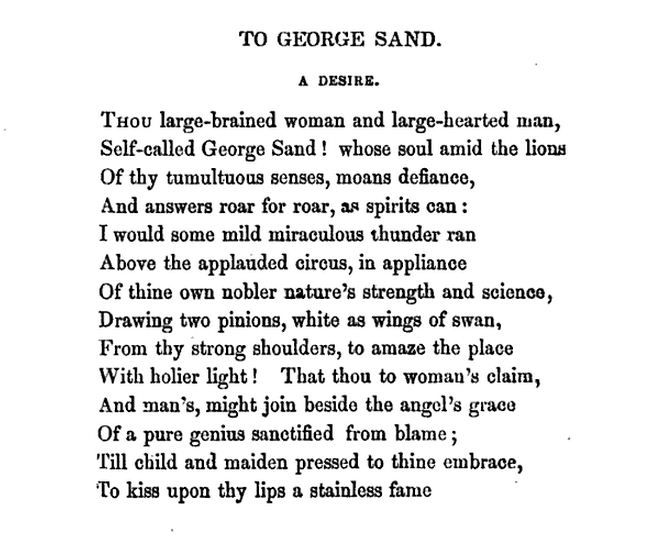
“To George Sand (A Desire)” — Elizabeth Barrett Browning

ebb

“The Model Millionaire” — Oscar Wilde

“The Model Millionaire” by Oscar Wilde

Unless one is wealthy there is no use in being a charming fellow. Romance is the privilege of the rich, not the profession of the unemployed. The poor should be practical and prosaic. It is better to have a permanent income than to be fascinating. These are the great truths of modern life which Hughie Erskine never realised. Poor Hughie! Intellectually, we must admit, he was not of much importance. He never said a brilliant or even an ill-natured thing in his life. But then he was wonderfully good-looking, with his crisp brown hair, his clear-cut profile, and his grey eyes. He was as popular with men as he was with women, and he had every accomplishment except that of making money. His father had bequeathed him his cavalry sword, and a History of the Peninsular War in fifteen volumes. Hughie hung the first over his looking-glass, put the second on a shelf between Ruff’s Guide and Bailey’sMagazine, and lived on two hundred a year that an old aunt allowed him. He had tried everything. He had gone on the Stock Exchange for six months; but what was a butterfly to do among bulls and bears? He had been a tea-merchant for a little longer, but had soon tired of pekoe and souchong. Then he had tried selling dry sherry. That did not answer; the sherry was a little too dry. Ultimately he became nothing, a delightful, ineffectual young man with a perfect profile and no profession. Continue reading ““The Model Millionaire” — Oscar Wilde”

“It was Christmas night and the proper things had been done” (The Once and Future King)

It was Christmas night and the proper things had been done. The whole village had come to dinner in hall. There had been boar’s head and venison and pork and beef and mutton and capons—but no turkey, because this bird had not yet been invented. There had been plum pudding and snap-dragon, with blue fire on the tips of one’s fingers, and as much mead as anybody could drink. Sir Ector’s health had been drunk with “Best respects, Measter,” or “Best compliments of the Season, my lords and ladies, and many of them.” There had been mummers to play an exciting dramatic presentation of a story in which St. George and a Saracen and a funny Doctor did surprising things, also carol-singers who rendered “Adeste Fideles” and “I Sing of a Maiden,” in high, clear, tenor voices. After that, those children who had not been sick from their dinner played Hoodman Blind and other appropriate games, while the young men and maidens danced morris dances in the middle, the tables having been cleared away. The old folks sat round the walls holding glasses of mead in their hands and feeling thankful that they were past such capers, hoppings and skippings, while those children who had not been sick sat with them, and soon went to sleep, the small heads leaning against their shoulders. At the high table Sir Ector sat with his knightly guests, who had come for the morrow’s hunting, smiling and nodding and drinking burgundy or sherries sack or malmsey wine.

After a bit, silence was prayed for Sir Grummore. He stood up and sang his old school song, amid great applause—but forgot most of it and had to make a humming noise in his moustache. Then King Pellinore was nudged to his feet and sang bashfully:

“Oh, I was born a Pellinore in famous Lincolnshire. Full well I chased the Questing Beast for more than seventeen year. Till I took up with Sir Grummore here In the season of the year. (Since when) ’tis my delight On a feather-bed night To sleep at home, my dear.

“You see,” explained King Pellinore blushing, as he sat down with everybody whacking him on the back, “old Grummore invited me home, what, after we had been having a pleasant joust together, and since then I’ve been letting my beastly Beast go and hang itself on the wall, what?”

“Well done,” they told him. “You live your own life while you’ve got it.”

William Twyti was called for, who had arrived on the previous evening, and the famous huntsman stood up with a perfectly straight face, and his crooked eye fixed upon Sir Ector, to sing:

“D’ye ken William Twyti

With his Jerkin so dagged? D’ye ken William Twyti

Who never yet lagged? Yes, I ken William Twyti,

And he ought to be gagged With his hounds and his horn in the morning.”

“Bravo!” cried Sir Ector. “Did you hear that, eh? Said he ought to be gagged, my dear feller. Blest if I didn’t think he was going to boast when he began. Splendid chaps, these huntsmen, eh? Pass Master Twyti the malmsey, with my compliments.”

The boys lay curled up under the benches near the fire, Wart with Cavall in his arms. Cavall did not like the heat and the shouting and the smell of mead, and wanted to go away, but Wart held him tightly because he needed something to hug, and Cavall had to stay with him perforce, panting over a long pink tongue.

“Now Ralph Passelewe.”

“Good wold Ralph.”

“Who killed the cow, Ralph?”

“Pray silence for Master Passelewe that couldn’t help it.”

At this the most lovely old man got up at the furthest and humblest end of the hail, as he had got up on all similar occasions for the past half-century. He was no less than eighty-five years of age, almost blind, almost deaf, but still able and willing and happy to quaver out the same song which he had sung for the pleasure of the Forest Sauvage since before Sir Ector was bound up in a kind of tight linen puttee in his cradle. They could not hear him at the high table—he was too far away in Time to be able to reach across the room—but everybody knew what the cracked voice was singing and everybody loved it. This is what he sang:

“Whe-an/Wold King-Cole/was a /wakkin doon-t’street, H-e /saw a-lovely laid-y a /steppin-in-a-puddle. / She-a /lifted hup-er-skeat/ For to / Hop acrorst ter middle, / An ee /saw her /an-kel. Wasn’t that a fuddle? / Ee could’ernt elp it, /ee Ad to.”

There were about twenty verses of this song, in which Wold King Cole helplessly saw more and more things that he ought not to have seen, and everybody cheered at the end of each verse until, at the conclusion, old Ralph was overwhelmed with congratulations and sat down smiling dimly to a replenished mug of mead.

It was now Sir Ector’s turn to wind up the proceedings. He stood up importantly and delivered the following speech:

“Friends, tenants and otherwise. Unaccustomed as I am to public speakin’—”

There was a faint cheer at this, for everybody recognized the speech which Sir Ector had made for the last twenty years, and welcomed it like a brother.

“Unaccustomed as I am to public speakin'” it is my pleasant duty—I might say my very pleasant duty—to welcome all and sundry to this our homely feast. It has been a good year, and I say it without fear of contradiction, in pasture and plow. We all know how Crumbocke of Forest Sauvage won the first prize at Cardoyle Cattle Show for the second time, and one more year will win the cup outright. More power to the Forest Sauvage. As we sit down tonight, I notice some faces now gone from among us and some which have added to the family circle. Such matters are in the hands of an almighty Providence, to which we all feel thankful. We ourselves have been first created and then spared to enjoy the rejoicin’s of this pleasant evening. I think we are all grateful for the blessin’s which have been showered upon us. Tonight we welcome in our midst the famous King Pellinore, whose labours in riddin’ our forest of the redoubtable Questin’ Beast are known to all. God bless King Pellinore. (Hear, hear!) Also Sir Grummore Grummursum, a sportsman, though I say it to his face, who will stick to his mount as long as his Quest will stand up in front of him. (Hooray!) Finally, last but not least, we are honoured by a visit from His Majesty’s most famous huntsman, Master William Twyti, who will, I feel sure, show us such sport tomorrow that we will rub our eyes and wish that a royal pack of hounds could always be huntin’ in the Forest which we all love so well. (Viewhalloo and several recheats blown in imitation.) Thank you, my dear friends, for your spontaneous welcome to these gentlemen. They will, I know, accept it in the true and warmhearted spirit in which it is offered. And now it is time that I should bring my brief remarks to a close. Another year has almost sped and it is time that we should be lookin’ forward to the challengin’ future. What about the Cattle Show next year? Friends, I can only wish you a very Merry Christmas, and, after Father Sidebottom has said our Grace for us, we shall conclude with a singin’ of the National Anthem.”

The cheers which broke out at the end of Sir Ector’s speech were only just prevented, by several hush-es, from drowning the last part of the vicar’s Grace in Latin, and then everybody stood up loyally in the firelight and sang:

“God save King Pendragon,

May his reign long drag on,

God save the King.

Send him most gorious,

Great and uproarious,

Horrible and Hoarious,

God save our King.”

The last notes died away, the hall emptied of its rejoicing humanity. Lanterns flickered outside, in the village street, as everybody went home in bands for fear of the moonlit wolves, and The Castle of the Forest Sauvage slept peacefully and lightless, in the strange silence of the holy snow.

—From T.H. White’s The Once and Future King.
 

“The Dead” — James Joyce

“The Dead” by James Joyce

Lily, the caretaker’s daughter, was literally run off her feet. Hardly had she brought one gentleman into the little pantry behind the office on the ground floor and helped him off with his overcoat than the wheezy hall-door bell clanged again and she had to scamper along the bare hallway to let in another guest. It was well for her she had not to attend to the ladies also. But Miss Kate and Miss Julia had thought of that and had converted the bathroom upstairs into a ladies’ dressing-room. Miss Kate and Miss Julia were there, gossiping and laughing and fussing, walking after each other to the head of the stairs, peering down over the banisters and calling down to Lily to ask her who had come.

It was always a great affair, the Misses Morkan’s annual dance. Everybody who knew them came to it, members of the family, old friends of the family, the members of Julia’s choir, any of Kate’s pupils that were grown up enough and even some of Mary Jane’s pupils too. Never once had it fallen flat. For years and years it had gone off in splendid style as long as anyone could remember; ever since Kate and Julia, after the death of their brother Pat, had left the house in Stoney Batter and taken Mary Jane, their only niece, to live with them in the dark gaunt house on Usher’s Island, the upper part of which they had rented from Mr Fulham, the corn- factor on the ground floor. That was a good thirty years ago if it was a day. Mary Jane, who was then a little girl in short clothes, was now the main prop of the household for she had the organ in Haddington Road. She had been through the Academy and gave a pupils’ concert every year in the upper room of the Antient Concert Rooms. Many of her pupils belonged to better-class families on the Kingstown and Dalkey line. Old as they were, her aunts also did their share. Julia, though she was quite grey, was still the leading soprano in Adam and Eve’s, and Kate, being too feeble to go about much, gave music lessons to beginners on the old square piano in the back room. Lily, the caretaker’s daughter, did housemaid’s work for them. Though their life was modest they believed in eating well; the best of everything: diamond-bone sirloins, three-shilling tea and the best bottled stout. But Lily seldom made a mistake in the orders so that she got on well with her three mistresses. They were fussy, that was all. But the only thing they would not stand was back answers.

Of course they had good reason to be fussy on such a night. And then it was long after ten o’clock and yet there was no sign of Gabriel and his wife. Besides they were dreadfully afraid that Freddy Malins might turn up screwed. They would not wish for worlds that any of Mary Jane’s pupils should see him under the influence; and when he was like that it was sometimes very hard to manage him. Freddy Malins always came late but they wondered what could be keeping Gabriel: and that was what brought them every two minutes to the banisters to ask Lily had Gabriel or Freddy come. Continue reading ““The Dead” — James Joyce”

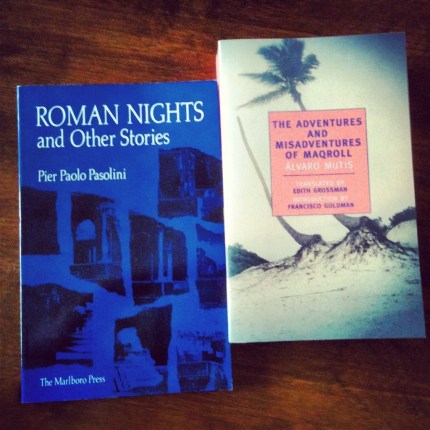
Pier Paolo Pasolini / Alvaro Mutis (Books Acquired, 12.21.20212)

20121223-132457.jpg

The edition I had of Mutis’s Maqroll only holds the first three novellas, so I ordered the NYRB seven-story volume. It’s like 700 pages and very attractive.

I also found this collection of Pier Paolo Pasolini short stories.

Read “The Honored Dead,” a Story by Breece D’J. Pancake

“The Honored Dead” by Breece D’J. Pancake

Watching little Lundy go back to sleep, I wish I hadn’t told her about the Mound Builders to stop her crying, but I didn’t know she would see their eyes watching her in the dark. She was crying about a cat run down by a car—her cat, run down a year ago, only today poor Lundy figured it out. Lundy is turned too much like her momma. Ellen never worries because it takes her too long to catch the point of a thing, and Ellen doesn’t have any problem sleeping. I think my folks were a little too keen, but Lundy is her momma’s girl, not jumpy like my folks.

My grandfather always laid keenness on his Shawnee blood, his half-breed mother, but then he was hep on blood. He even had an oath to stop bleeding, but I don’t remember the words. He was a fair to sharp woodsman, and we all tried to slip up on him at one time or another. It was Ray at the sugar mill finally caught him, but he was an old man by then, and his mind wasn’t exactly right. Ray just came creeping up behind and laid a hand on his shoulder, and the old bird didn’t even turn around; he just wagged his head and said, “That’s Ray’s hand. He’s the first fellow ever slipped on me.” Ray could’ve done without that because the old man never played with a full deck again, and we couldn’t keep clothes on him before he died.

I turn out the lamp, see no eyes in Lundy’s room, then it comes to me why she was so scared. Yesterday I told her patches of stories about scalpings and murders, mixed up the Mound Builders with the Shawnee raids, and Lundy chained that with the burial mound in the back pasture. Tomorrow I’ll set her straight. The only surefire thing I know about Mound Builders is they must have believed in a god and hereafter or they never would have made such big graves.

Continue reading “Read “The Honored Dead,” a Story by Breece D’J. Pancake”

An Animated Christmas Card from Maurice Sendak

Maurice Sendak’s animated intro for the 1977 film Simple Gifts was based on an earlier design for a Christmas card  by the artist:

(Image and info via the very cool Michael Sporn Animation blog, with a hat tip to Jescie for sending me the link).

Read “Farewell Tour,” New Short Fiction from Teju Cole

Here’s the first paragraph of Teju Cole’s new short story “Farewell Tour” —

Frank Low told me this one Friday night in Times Square. He said he’d been transfixed by “Lavoisier and His Wife” at the Metropolitan Museum that past Wednesday afternoon, and in telling me about it, he had the hesitant manner of someone trying to remember the precise wording of a poem. When his words came, they came complete. He had read the wall label next to the painting and noted that 222 years had passed since it was made. The text read: “Antoine-Laurent Lavoisier (1743-1794) and His Wife (Marie-Anne-Pierrette Paulze, 1758-1836)”. The picture was, historically speaking, an intake of breath, a preparation for what was to come. Within a year after David painted it the Bastille was stormed. When it came to revolutions Low himself would rather there were none. He preferred order, lived as he liked, in a world of well-kept invoices and precise appointments, a world in which he never spent beyond his means. The Jean-Georges dinner on Tuesday night had been an unusual extravagance that he hadn’t mentioned to his wife. She might have thought it odd, rightly so, given that he hadn’t worked in three months.

Read the rest of “Farewell Tour.”

Read our review of Cole’s brilliant novel Open City.

Book Shelves #52, 12.23.2012

Book shelves series #52, fifty-second Sunday of 2012: In which, in this penultimate chapter, we return to the site of entry #1.

The first entry in this project was my bedside nightstand. This is what it looked like back in January:

This is it this morning:

20121223-113957.jpg

This is the major difference:

20121223-114053.jpg

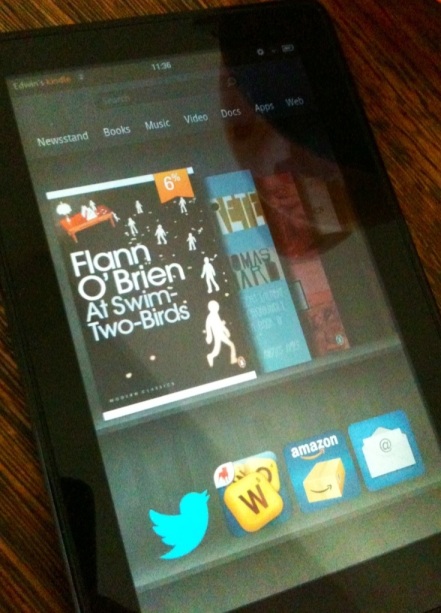
The Kindle Fire has changed my late night shuffling habits.

Here are the books that are in the nightstand:

20121223-114006.jpg

I read the Aira novel but completely forgot about it, which I’m sure says more about me than it.

Have no idea why this is in there:

20121223-114014.jpg

But it’s a fun book. With pictures! Sample:

20121223-114024.jpg

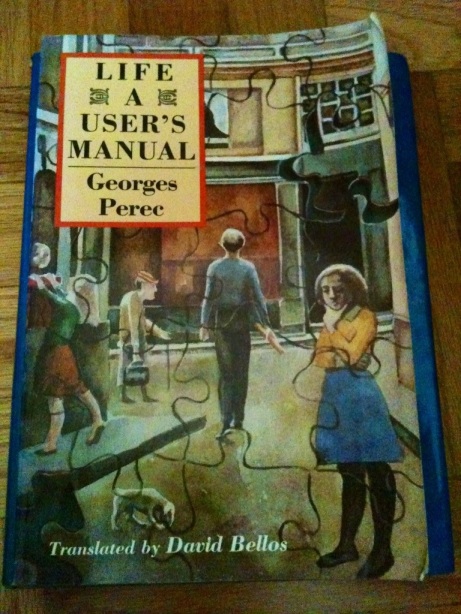
Finally, Perec’s Life A User’s Manual—this is one of my reading goals for 2013. It seems like a good way to close out this penultimate post, as one of Perec’s essays inspired this project

“Every library answers a twofold need, which is often also a twofold obsession: that of conserving certain objects (books) and that of organizing them in certain ways”

—Georges Perec, from ”Brief Notes on the Art and Manner of Arranging One’s Books” (1978)

20121223-114044.jpg

Read Nathaniel Hawthorne’s Short Story “The Christmas Banquet”

“The Christmas Banquet,” a tale from Nathaniel Hawthorne (from Mosses from an Old Manse):

“I HAVE HERE attempted,” said Roderick, unfolding a few sheets of manuscript, as he sat with Rosina and the sculptor in the summer-house–“I have attempted to seize hold of a personage who glides past me, occasionally, in my walk through life. My former sad experience, as you know, has gifted me with some degree of insight into the gloomy mysteries of the human heart, through which I have wandered like one astray in a dark cavern, with his torch fast flickering to extinction. But this man–this class of men–is a hopeless puzzle.”

“Well, but propound him,” said the sculptor. “Let us have an idea of him, to begin with.”

“Why, indeed,” replied Roderick, “he is such a being as I could conceive you to carve out of marble, and some yet unrealized perfection of human science to endow with an exquisite mockery of intellect; but still there lacks the last inestimable touch of a divine Creator. He looks like a man, and, perchance, like a better specimen of man than you ordinarily meet. You might esteem him wise–he is capable of cultivation and refinement, and has at least an external conscience–but the demands that spirit makes upon spirit, are precisely those to which he cannot respond. When, at last, you come close to him, you find him chill and unsubstantial–a mere vapor.”

Continue reading “Read Nathaniel Hawthorne’s Short Story “The Christmas Banquet””

Christmas in Shakespeare (From Thomas Firminger Thiselton-Dyer’s Folk-lore of Shakespeare)

From Thomas Firminger Thiselton-Dyer’s Folk-lore of Shakespeare:

Christmas. Among the observances associated with this season, to which Shakespeare alludes, we may mention the Christmas Carol, a reference to which is probably made in “A Midsummer-Night’s Dream” (ii. 1), by Titania: “No night is now with hymn or carol blest.”

Hamlet (ii. 2) quotes two lines from a popular ballad, entitled the “Song of Jephthah’s Daughter,” and adds: “The first row of the pious chanson will show you more.”

In days gone by, the custom of carol-singing was most popular, and Warton, in his “History of English Poetry,” notices a license granted in 1562 to John Tysdale for printing “Certayne goodly carowles to be songe to the glory of God;” and again “Crestenmas Carowles auctorisshed by my lord of London.”

In the “Taming of the Shrew” (Ind., sc. 2) Sly asks whether “a comonty is not a Christmas gambold.” Formerly the sports and merry-makings at this season were on a most extensive scale, being presided over by the Lord of Misrule. Again, in “Love’s Labour’s Lost” (v. 2), Biron speaks of “a Christmas comedy.”

As we have noticed, too, in our chapter on Plants, a gilt nutmeg was formerly a common gift at Christmas, and on other festive occasions, to which an allusion is probably made in the same scene. Formerly, at this season, the head of the house assembled his family around a bowl of spiced ale, from which he drank their healths, then passed it to the rest, that they might drink too. The word that passed among them was the ancient Saxon phrase wass hael , i. e., to your health. Hence this came to be recognized as the wassail or wassel bowl; and was the accompaniment to festivity of every kind throughout the year. Thus Hamlet (i. 4) says: “The king doth wake to-night, and takes his rouse, Keeps wassail.” And in “Love’s Labour’s Lost” (v. 2), Biron speaks of: “wakes and wassails, meetings, markets, fairs.” In “Macbeth” (i. 7), it is used by Lady Macbeth in the sense of intemperance, who, speaking of Duncan’s two chamberlains, says: “Will I with wine and wassail so convince, That memory, the warder of the brain, Shall be a fume, and the receipt of reason A limbeck only.” In “Antony and Cleopatra” (i. 4), Cæsar advises Antony to live more temperately, and to leave his “lascivious wassails.” In the same way, a “wassail candle” denoted a large candle lighted up at a festival, a reference to which occurs in “2 Henry IV.” (i. 2): “Chief-Justice. You are as a candle, the better part burnt out. Falstaff. A wassail candle, my lord; all tallow.”

A custom which formerly prevailed at Christmas, and has not yet died out, was for mummers to go from house to house, attired in grotesque attire, performing all kinds of odd antics. Their performances, however, were not confined to this season. Thus, in “Coriolanus” (ii. 1) Menenius speaks of making “faces like mummers.”


Tom McCarthy & D.T. Max Discuss David Foster Wallace

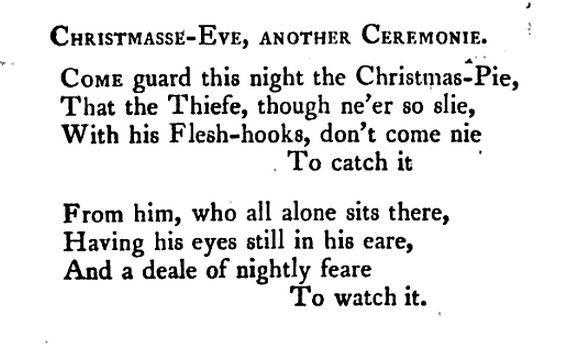
“Christmasse-Eve, Another Ceremonie” — Robert Herrick

herrick