Judge Holden holds forth on war (Blood Meridian)

From Chapter XVII of Cormac McCarthy’s novel Blood Meridian

They grew gaunted and lank under the white suns of those days and their hollow burnedout eyes were like those of noctambulants surprised by day. Crouched under their hats they seemed fugitives on some grander scale, like beings for whom the sun hungered. Even the judge grew silent and speculative. He’d spoke of purging oneself of those things that lay claim to a man but that body receiving his remarks counted themselves well done with any claims at all. They rode on and the wind drove the fine gray dust before them and they rode an army of gray-beards, gray men, gray horses. The mountains to the north lay sunwise in corrugated folds and the days were cool and the nights were cold and they sat about the fire each in his round of darkness in that round of dark while the idiot watched from his cage at the edge of the light. The judge cracked with the back of an axe the shinbone on an antelope and the hot marrow dripped smoking on the stones. They watched him. The subject was war.

The good book says that he that lives by the sword shall perish by the sword, said the black.

The judge smiled, his face shining with grease.

What right man would have it any other way? he said.

The good book does indeed count war an evil, said Irving. Yet there’s many a bloody tale of war inside it.

It makes no difference what men think of war, said the judge. War endures. As well ask men what they think of stone. War was always here. Before man was, war waited for him. The ultimate trade awaiting its ultimate practitioner. That is the way it was and will be. That way and not some other way.

He turned to Brown, from whom he’d heard some whispered slur or demurrer. Ah Davy, he said. It’s your own trade we honor here. Why not rather take a small bow. Let each acknowledge each.

My trade?

Certainly.

What is my trade?

War. War is your trade. Is it not?

And it aint yours?

Mine too. Very much so.

What about all them notebooks and bones and stuff?

All other trades are contained in that of war.

Is that why war endures?

No. It endures because young men love it and old men love it in them. Those that fought, those that did not.

That’s your notion.

The judge smiled. Men are born for games. Nothing else. Every child knows that play is nobler than work. He knows too that the worth or merit of a game is not inherent in the game itself but rather in the value of that which is put at hazard. Games of chance require a wager to have meaning at all. Games of sport involve the skill and strength of the opponents and the humiliation of defeat and the pride of victory are in themselves sufficient stake because they inhere in the worth of the principals and define them. But trial of chance or trial of worth all games aspire to the condition of war for here that which is wagered swallows up game, player, all.

Suppose two men at cards with nothing to wager save their lives. Who has not heard such a tale? A turn of the card. The whole universe for such a player has labored clanking to this moment which will tell if he is to die at that man’s hand or that man at his. What more certain validation of a man’s worth could there be? This enhancement of the game to its ultimate state admits no argument concerning the notion of fate. The selection of one man over another is a preference absolute and irrevocable and it is a dull man indeed who could reckon so profound a decision without agency or significance either one. In such games as have for their stake the annihilation of the defeated the decisions are quite clear. This man holding this particular arrangement of cards in his hand is thereby removed from existence. This is the nature of war, whose stake is at once the game and the authority and the justification. Seen so, war is the truest form of divination. It is the testing of one’s will and the will of another within that larger will which because it binds them is therefore forced to select. War is the ultimate game because war is at last a forcing of the unity of existence. War is god. Brown studied the judge.

You’re crazy Holden. Crazy at last.

The judge smiled.


The Mother Conspiracy (Gravity’s Rainbow)

Otto is earnestly explaining his views on the Mother Conspiracy. It’s not often a sympathetic girl will listen. The Mothers get together once a year, in secret, at these giant conventions, and exchange information. Recipes, games, key phrases to use on their children. “What did yours use to say when she wanted to make you feel guilty?”

“‘I’ve worked my fingers to the bone!’” sez the girl.

“Right! And she used to cook those horrible casseroles, w-with the potatoes, and onions—”

“And ham! Little pieces of ham—”

“You see, you see? That can’t be accidental! They have a contest, for Mother of the Year, breast-feeding, diaper-changing, they time them, casserole competitions, ja—then, toward the end, they actually begin to use the children. The State Prosecutor comes out on stage. ‘In a moment, Albrecht, we are going to bring your mother on. Here is a Luger, fully loaded. The State will guarantee you absolute immunity from prosecution. Do whatever you wish to do—anything at all. Good luck, my boy.’ The pistols are loaded with blanks, natürlich, but the unfortunate child does not know this. Only the mothers who get shot at qualify for the finals.

Here they bring in psychiatrists, and judges sit with stopwatches to see how quickly the children will crack. ‘Now then, Olga, wasn’t it nice of Mutti to break up your affair with that long-haired poet?’ ‘We understand your mother and you are, ah, quite close, Hermann. Remember the time she caught you masturbating into her glove? Eh?’ Hospital attendants stand by to drag the children off, drooling, screaming, having clonic convulsions. Finally there is only one Mother left on stage. They put the traditional flowered hat on her head, and hand her the orb and scepter, which in this case are a gilded pot roast and a whip, and the orchestra plays Tristan und Isolde.

From Thomas Pynchon’s novel Gravity’s Rainbow.

The true paranoid for whom all is organized in spheres joyful or threatening | A passage from Thomas Pynchon’s The Crying of Lot 49

“Please,” the sailor said. “Go on now. You don’t want to stay here.” She looked in her purse, found a ten and a single, gave him the ten. “I’ll spend it on booze,” he said.
“Remember your friends,” said the arthritic, watching the ten.
“Bitch,” said the sailor. “Why didn’t you wait till he was gone?”
Oedipa watched him make adjustments so he’d fit easier against the mattress. That stuffed memory. Register A . . .
“Give me a cigarette, Ramírez,” the sailor said. “I know you got one.”
Would it be today? “Ramírez,” she cried. The arthritic looked around on his rusty neck. “He’s going to die,” she said.
“Who isn’t?” said Ramírez.
She remembered John Nefastis, talking about his Machine, and massive destructions of information. So when this mattress flared up around the sailor, in his Viking’s funeral: the stored, coded years of uselessness, early death, self-harrowing, the sure decay of hope, the set of all men who had slept on it, whatever their lives had been, would truly cease to be, forever, when the mattress burned. She stared at it in wonder. It was as if she had just discovered the irreversible process. It astonished her to think that so much could be lost, even the quantity of hallucination belonging just to the sailor that the world would bear no further trace of. She knew, because she had held him, that he suffered DT’s. Behind the initials was a metaphor, a delirium tremens, a trembling unfurrowing of the mind’s plowshare. The saint whose water can light lamps, the clairvoyant whose lapse in recall is the breath of God, the true paranoid for whom all is organized in spheres joyful or threatening about the central pulse of himself, the dreamer whose puns probe ancient fetid shafts and tunnels of truth all act in the same special relevance to the word, or whatever it is the word is there, buffering, to protect us from. The act of metaphor then was a thrust at truth and a lie, depending where you were: inside, safe, or outside, lost. Oedipa did not know where she was. Trembling, unfurrowed, she slipped sidewise, screeching back across grooves of years, to hear again the earnest, high voice of her second or third collegiate love Ray Glozing bitching among “uhs” and the syncopated tonguing of a cavity, about his freshman calculus; “dt,” God help this old tattooed man, meant also a time differential, a vanishingly small instant in which change had to be confronted at last for what it was, where it could no longer disguise itself as something innocuous like an average rate; where velocity dwelled in the projectile though the projectile be frozen in midflight, where death dwelled in the cell though the cell be looked in on at its most quick. She knew that the sailor had seen worlds no other man had seen if only because there was that high magic to low puns, because DT’s must give access to dt’s of spectra beyond the known sun, music made purely of Antarctic loneliness and fright. But nothing she knew of would preserve them, or him.

From Thomas Pynchon’s novel The Crying of Lot 49.

Thomas Pynchon’s recipe for what is arguably the first British Pizza | A passage from Mason & Dixon

“Lud wishes to know,” Whike relays at last, “Mr. Emerson’s Cousin’s Views, upon the Structure of the World.”
“A Spheroid, the last I heard of it, Sir.”
“Ahr Ahr ahr, ’ahr ahhrr!”
“ ’And I say, ’tis Flat,’” the Jesuit smoothly translates. “Why of course, Sir, flat as you like, flat as a Funnel-Cake, flat as a Pizza, for all that,— ”
“Apologies, Sir,—” Whike all Unctuosity, “the foreign Word again, was . . . ?”
“The apology is mine,— Pizza being a Delicacy of Cheese, Bread, and Fish ubiquitous in the region ’round Mount Vesuvius. . . . In my Distraction, I have reach’d for the Word as the over-wrought Child for its Doll.”
“You are from Italy, then, sir?” inquires Ma.
“In my Youth I pass’d some profitable months there, Madam.”
“Do you recall by chance how it is they cook this ‘Pizza’? My Lads and Lasses grow weary of the same Daily Gruel and Haggis, so a Mother is ever upon the Lurk for any new Receipt.”
“Why, of course. If there be a risen Loaf about . . . ?”
Mrs. Brain reaches ’neath the Bar and comes up with a Brown Batch-Loaf, rising since Morning, which she presents to “Cousin Ambrose,” who begins to punch it out flat upon the Counter-Top. Lud, fascinated, offers to assault the Dough himself, quickly slapping it into a very thin Disk of remarkable Circularity.
“Excellent, Sir,” Maire beams, “I don’t suppose anyone has a Tomato?”
“A what?”
“Saw one at Darlington Fair, once,” nods Mr.”“Brain.
“No good, in that case,— eaten by now.”
“The one I saw, they might not have wanted to eat . . . ?”
Dixon, rummaging in his Surveyor’s Kit, has come up with the Bottle of Ketjap, that he now takes with him ev’rywhere. “This do?”
“That was a Torpedo, Husband.”
“That Elecktrickal Fish? Oh . . . then this thing he’s making isn’t elecktrical?”
“Tho’ there ought to be Fish, such as those styl’d by the Neopolitans, Cicinielli. . . .”
“Will Anchovy do?” Mrs. Brain indicates a Cask of West Channel ’Chovies from Devon, pickl’d in Brine.
“Capital. And Cheese?”
“That would be what’s left of the Stilton, from the Ploughman’s Lunch.”
“Very promising indeed,” Maire wringing his Hands to conceal their trembling. “Well then, let us just . . .”
By the Time what is arguably the first British Pizza is ready to come out of the Baking-Oven beside the Hearth, the Road outside has gone quiet and the Moorland dark, several Rounds have come and pass’d, and Lud is beginning to show signs of Apprehension. “At least ’tis cloudy tonight, no Moonlight’ll be getting thro’,” his Mother whispers to Mr. Emerson.”

From Thomas Pynchon’s novel Mason & Dixon.

The extinction of the dodo | A passage from Thomas Pynchon’s Gravity’s Rainbow

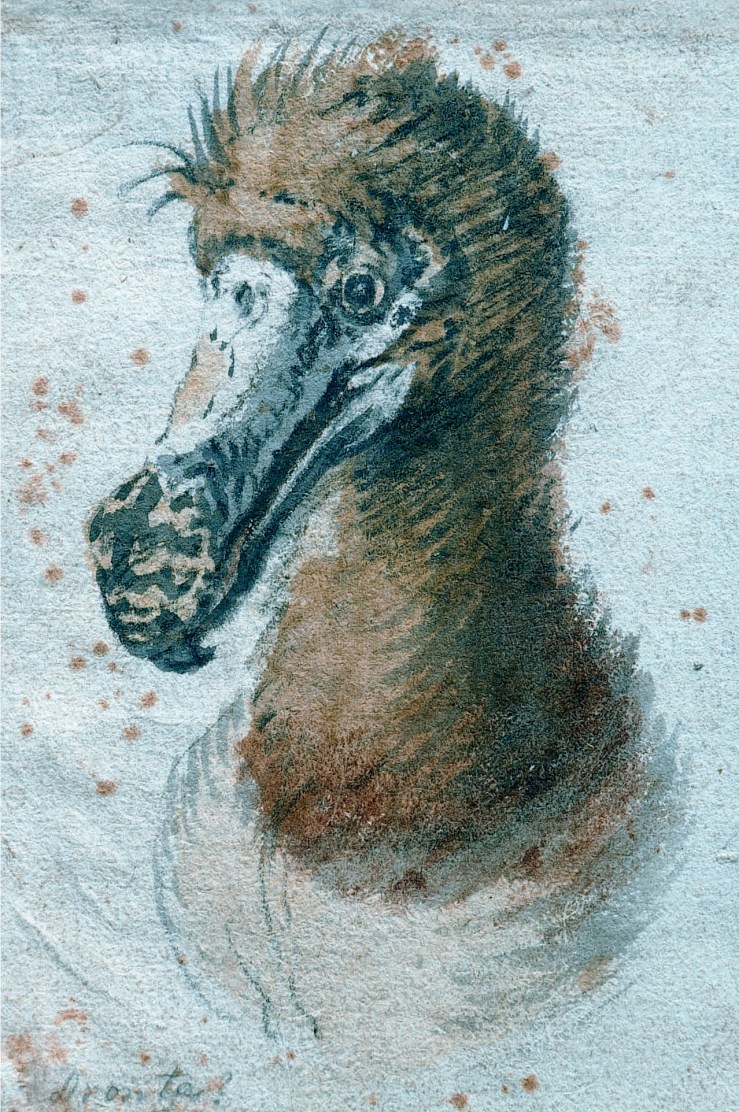
saftleven_dodo
Dodo, 1638 by Cornelis Saftleven (1607-1681)

He left the dodoes to rot, he couldn’t endure to eat their flesh. Usually, he hunted alone. But often, after months of it, the isolation would begin to change him, change his very perceptions—the jagged mountains in full daylight flaring as he watched into freak saffrons, streaming indigos, the sky his glass house, all the island his tulipomania. The voices—he insomniac, southern stars too thick for constellations teeming in faces and creatures of fable less likely than the dodo—spoke the words of sleepers, singly, coupled, in chorus. The rhythms and timbres were Dutch, but made no waking sense. Except that he thought they were warning him… scolding, angry that he couldn’t understand. Once he sat all day staring at a single white dodo’s egg in a grass hummock. The place was too remote for any foraging pig to’ve found. He waited for scratching, a first crack reaching to net the chalk surface: an emergence. Hemp gripped in the teeth of the steel snake, ready to be lit, ready to descend, sun to black-powder sea, and destroy the infant, egg of light into egg of darkness, within its first minute of amazed vision, of wet downstirred cool by these south-east trades… . Each hour he sighted down the barrel. It was then, if ever, he might have seen how the weapon made an axis potent as Earth’s own between himself and this victim, still one, inside the egg, with the ancestral chain, not to be broken out for more than its blink of world’s light. There they were, the silent egg and the crazy Dutchman, and the hookgun that linked them forever, framed, brilliantly motionless as any Vermeer. Only the sun moved: from zenith down at last behind the snaggleteeth of mountains to Indian ocean, to tarry night. The egg, without a quiver, still unhatched. He should have blasted it then where it lay: he understood that the bird would hatch before dawn. But a cycle was finished. He got to his feet, knee and hip joints in agony, head gonging with instructions from his sleeptalkers droning by, overlapping, urgent, and only limped away, piece at right shoulder arms.

Continue reading “The extinction of the dodo | A passage from Thomas Pynchon’s Gravity’s Rainbow”

Hooped pots, sneak-cup, and other drinking customs in Shakespeare’s plays

Drinking Customs.

Shakespeare has given several allusions to the old customs associated with drinking, which have always varied in different countries. At the present day many of the drinking customs still observed are very curious, especially those kept up at the universities and inns-of-court. Alms-drink was a phrase in use, says Warburton, among good fellows, to signify that liquor of another’s share which his companion drank to ease him. So, in “Antony and Cleopatra” (ii. 7) one of the servants says of Lepidus: “They have made him drink alms-drink.”

By-drinkings.This was a phrase for drinkings between meals, and is used by the Hostess in “1 Henry IV.” (iii. 3), who says to Falstaff: “You owe money here besides, Sir John, for your diet, and by-drinkings.”

Hooped Pots.In olden times drinking-pots were made with hoops, so that, when two or more drank from the same tankard, no one should drink more than his share. There were generally three hoops to the pots: hence, in “2 Henry VI.” (iv. 2), Cade says: “The three-hooped pot shall have ten hoops.” In Nash’s “Pierce Pennilesse” we read: “I believe hoopes on quart pots were invented that every man should take his hoope, and no more.” The phrases “to do a man right” and “to do him reason” were, in years gone by, the common expressions in pledging healths; he who drank a bumper expected that a bumper should be drunk to his toast. To this practice alludes the scrap of a song which Silence sings in “2 Henry IV.” (v. 3): “Do me right, And dub me knight: Samingo.” He who drank, too, a bumper on his knee to the health of his mistress was dubbed a knight for the evening. The word Samingo is either a corruption of, or an intended blunder for, San Domingo, but why this saint should be the patron of topers is uncertain.

Rouse.According to Gifford, [972] a rouse was a large glass in which a health was given, the drinking of which, by the rest of the company, formed a carouse. Hamlet (i. 4) says: “The king doth wake to-night, and takes his rouse.” The word occurs again in the following act (1), where Polonius uses the phrase “o’ertook in’s rouse;” and in the sense of a bumper, or glass of liquor, in “Othello” (ii. 3), “they have given me a rouse already.”

Sheer Ale. This term, which is used in the “Taming of the Shrew” (Induction, sc. 2), by Sly—“Ask Marian Hacket, the fat ale-wife of Wincot, if she know me not: if she say I am not fourteen pence on the score for sheer ale”—according to some expositors, means “ale alone, nothing but ale,” rather than “unmixed ale.”

Sneak-cup. This phrase, which is used by Falstaff in “1 Henry IV.” (iii. 3)—“the prince is a Jack, a sneak-cup”—was used to denote one who balked his glass.

From Thomas Firminger Thiselton-Dyer’s indispensable volume Folk-lore of Shakespeare.

What a great, broad-shouldered, elephantine personage I shall become by and by! | Nathaniel Hawthorne’s journal entry for April 22nd, 1841

April 22d.–. . . What an abominable hand do I scribble! but I have been chopping wood, and turning a grindstone all the forenoon; and such occupations are likely to disturb the equilibrium of the muscles and sinews. It is an endless surprise to me how much work there is to be done in the world; but, thank God, I am able to do my share of it,–and my ability increases daily. What a great, broad-shouldered, elephantine personage I shall become by and by!

Nathaniel Hawthorne’s journal entry for April 22nd, 1841. From Passages from the American Note-Books.

Hawthorne is hard at work on Brook Farm, a utopian project he eventually soured on. His time there informed his novel The Blithedale Romance.

Easter in Shakespeare

From Thomas Firminger Thiselton-Dyer’s indispensable volume Folk-lore in Shakespeare:

Easter. According to a popular superstition, it is considered unlucky to omit wearing new clothes on Easter Day, to which Shakespeare no doubt alludes in “Romeo and Juliet” (iii. 1), when he makes Mercutio ask Benvolio whether he did “not fall out with a tailor for wearing his new doublet before Easter.” In East Yorkshire, on Easter Eve, young folks go to the nearest market-town to buy some new article of dress or personal adornment to wear for the first time on Easter Day, as otherwise they believe that birds—notably rooks or “crakes”—will spoil their clothes. In “Poor Robin’s Almanac” we are told: “At Easter let your clothes be new, Or else be sure you will it rue.” Some think that the custom of “clacking” at Easter—which is not quite obsolete in some counties—is incidentally alluded to in “Measure for Measure” (iii. 2) by Lucio: “his use was, to put a ducat in her clack-dish.” [649] The clack or clap dish was a wooden dish with a movable cover, formerly carried by beggars, which they clacked and clattered to show that it was empty. In this they received the alms. Lepers and other paupers deemed infectious originally used it, that the sound might give warning not to approach too near, and alms be given without touching the person. A popular name for Easter Monday was Black Monday, so called, says Stow, because “in the 34th of Edward III. (1360), the 14th of April, and the morrow after Easter Day, King Edward, with his host, lay before the city of Paris; which day was full dark of mist and hail, and so bitter cold, that many men died on their horses’ backs with the cold. Wherefore unto this day it hath been call’d the Blacke Monday.” Thus, in the “Merchant of Venice” (ii. 5), Launcelot says, “it was not for nothing that my nose fell a-bleeding on Black Monday last at six o’clock i’ the morning.”

I have milked a cow!!! | Nathaniel Hawthorne’s journal entry for April 16th, 1841

April 16th.–. . . Since I last wrote, there has been an addition to our community of four gentlemen in sables, who promise to be among our most useful and respectable members. They arrived yesterday about noon. Mr. Ripley had proposed to them to join us, no longer ago than that very morning. I had some conversation with them in the afternoon, and was glad to hear them express much satisfaction with their new abode and all the arrangements. They do not appear to be very communicative, however,–or perhaps it may be merely an external reserve, like my own, to shield their delicacy. Several of theirprominent characteristics, as well as their black attire, lead me to believe that they are members of the clerical profession; but I have not yet ascertained from their own lips what has been the nature of their past lives. I trust to have much pleasure in their society, and, sooner or later, that we shall all of us derive great strength from our intercourse with them. I cannot too highly applaud the readiness with which these four gentlemen in black have thrown aside all the fopperies and flummeries which have their origin in a false state of society. When I last saw them, they looked as heroically regardless of the stains and soils incident to our profession as I did when I emerged from the gold-mine, . . .

I have milked a cow!!! . . . The herd has rebelled against the usurpation of Miss Fuller’s heifer; and, whenever they are turned out of the barn, she is compelled to take refuge under our protection. So much did she impede my labors by keeping close to me, that I found it necessary to give her two or three gentle pats with a shovel; but still she preferred to trust herself to my tender mercies, rather than venture among the horns of the herd. She is not an amiable cow; but she has a very intelligent face, and seems to be of a reflective cast of character. I doubt not that she will soon perceive the expediency of being on good terms with the rest of the sisterhood.

I have not yet been twenty yards from our house and barn; but I begin to perceive that this is a beautiful place. The scenery is of a mild and placid character, with nothing bold in its aspect; but I think its beauties will grow upon us, and make us love it the more, the longer we live here. There is a brook, so near the house that we shall be able to hear its ripplein the summer evenings, . . . but, for agricultural purposes, it has been made to flow in a straight and rectangular fashion, which does it infinite damage as a picturesque object. . . .

It was a moment or two before I could think whom you meant by Mr. Dismal View. Why, he is one of the best of the brotherhood, so far as cheerfulness goes; for if he do not laugh himself, he makes the rest of us laugh continually. He is the quaintest and queerest personage you ever saw,–full of dry jokes, the humor of which is so incorporated with the strange twistifications of his physiognomy, that his sayings ought to be written down, accompanied with illustrations by Cruikshank. Then he keeps quoting innumerable scraps of Latin, and makes classical allusions, while we are turning over the gold-mine; and the contrast between the nature of his employment and the character of his thoughts is irresistibly ludicrous.

I have written this epistle in the parlor, while Farmer Ripley, and Farmer Farley, and Farmer Dismal View were talking about their agricultural concerns. So you will not wonder if it is not a classical piece of composition, either in point of thought or expression.

Nathaniel Hawthorne’s journal entry for April 16th, 1841. From Passages from the American Note-Books.

I riffed a little last year on Hawthorne’s time at Brook Farm.


“A Worn Path” — Eudora Welty

“A Worn Path”

by

Eudora Welty


It was December—a bright frozen day in the early morning. Far out in the country there was an old Negro woman with her head tied red rag, coming along a path through the pinewoods. Her name was Phoenix Jackson. She was very old and small and she walked slowly in the dark pine shadows, moving a little from side to side in her steps, with the balanced heaviness and lightness of a pendulum in a grand-father clock. She carried a thin, small cane made from an umbrella, and with this she kept tapping the frozen earth in front of her. This made a grave and persistent noise in the still air, that seemed meditative like the chirping of a solitary little bird.

She wore a dark striped dress reaching down to her shoe tops, and an equally long apron of bleached sugar sacks, with a full pocket: all neat and tidy, but every time she took a step she might have fallen over her shoelaces, which dragged from her unlaced shoes. She looked straight ahead. Her eyes were blue with age. Her skin had a pattern all its own of numberless branching wrinkles and as though a whole little tree stood in the middle of her forehead, but a golden color ran underneath, and the two knobs of her cheeks were illumined by a yellow burning under the dark. Under the red rag her hair came down on her neck in the frailest of ringlets, still black, and with an odor like copper.

Now and then there was a quivering in the thicket. Old Phoenix said, “Out of my way, all you foxes, owls, beetles, jack rabbits, coons and wild animals!. . . Keep out from under these feet, little bob-whites…. Keep the big wild hogs out of my path. Don’t let none of those come running my direction. I got a long way.” Under her small black-freckled hand her cane, limber as a buggy whip, would switch at the brush as if to rouse up any hiding things.

On she went. The woods were deep and still. The sun made the pine needles almost too bright to look at, up where the wind rocked. The cones dropped as light as feathers. Down in the hollow was the mourning dove—it was not too late for him.

The path ran up a hill. “Seem like there is chains about my feet, time I get this far,” she said, in the voice of argument old people keep to use with themselves. “Something always take a hold of me on this hill— pleads I should stay.” Continue reading ““A Worn Path” — Eudora Welty”

Five from Félix Fénéon

ffff

Frogs have been melodious for a fortnight, and the birds sing pleasantly | Nathaniel Hawthorne’s journal entry for April 9th, 1851

April 9th.–There was a great rain yesterday,–wind from the southeast, and the last visible vestige of snow disappeared. It was a small patch near the summit of Bald Mountain, just on the upper verge of a grove of trees. I saw a slight remnant of it yesterday afternoon, but to-day it is quite gone. The grass comes up along the roadside and on favorable exposures, with a sort of green blush. Frogs have been melodious for a fortnight, and the birds sing pleasantly.

Nathaniel Hawthorne’s journal entry for April 9th, 1851. From Passages from the American Note-Books.

Selections from One-Star Amazon Reviews of Flannery O’Connor’s Short Story Collections and Novels

[Editorial note: The following citations come from one-star Amazon reviews of various Flannery O’Connor short story collections and novels. To be clear, I’m a big O’Connor fanI’ve preserved the reviewers’ own styles of punctuation and spelling. More one-star Amazon reviews.].

I wanted to burn it.

I like happy endings.

100 per cent not for me.

I did not finish the book.

This story was agonizing.

I do not like the words used.

To me it was very depressing.

I really, truly hated this book.

The plot was as much a mystery.

They barely even seemed human.

I would not recommend this to anyone.

I had to force myself to finish this book.

I didn’t understand the characters at all.

Not only that, but I really didn’t like them either.

I would never have guessed that the author was female.

I didn’t understand, and I’m fairly certain that I never will.

I think this is the only book I’ve ever felt that I really hated.

One finds it impossible to symapthize or identify with them.

O;Connor is a gifted writer. However this book is dark in tone.

This story just stopped, no solutions to the problems involved.

I think it was a failing of the author to make the character believable.

After reading this book I really need some sunshine and happy voices.

Perhaps most disurbing is the brutal portrayal of violence against children.

Flannery O’Connor is the most depressing writer I have ever had the misfortune to read.

I can’t understand an author who could treat her characters with such callous disregard!

There is little here that resonates with my life’s experiences or my understanding of them.

I would not read this book again without a gun to my head, and I regret ever having picked it up. Continue reading “Selections from One-Star Amazon Reviews of Flannery O’Connor’s Short Story Collections and Novels”

God’s spoilers (Gravity’s Rainbow)

What you felt stirring across the land… it was the equinox… green spring equal nights… canyons are opening up, at the bottoms are steaming fumaroles, steaming the tropical life there like greens in a pot, rank, dope-perfume, a hood of smell… human consciousness, that poor cripple, that deformed and doomed thing, is about to be born. This is the World just before men. Too violently pitched alive in constant flow ever to be seen by men directly. They are meant only to look at it dead, in still strata, transputrefied to oil or coal. Alive, it was a threat: it was Titans, was an overpeaking of life so clangorous and mad, such a green corona about Earth’s body that some spoiler had to be brought in before it blew the Creation apart. So we, the crippled keepers, were sent out to multiply, to have dominion. God’s spoilers. Us. Counterrevolutionaries. It is our mission to promote death. The way we kill, the way we die, being unique among the Creatures. It was something we had to work on, historically and personally. To build from scratch up to its present status as reaction, nearly as strong as life, holding down the green uprising. But only nearly as strong.

Only nearly, because of the defection rate. A few keep going over to the Titans every day, in their striving subcreation (how can flesh tumble and flow so, and never be any less beautiful?), into the rests of the folksong Death (empty stone rooms), out, and through, and down under the net, down down to the uprising.

In harsh-edged echo, Titans stir far below. They are all the presences we are not supposed to be seeing—wind gods, hilltop gods, sunset gods—that we train ourselves away from to keep from looking further even though enough of us do, leave Their electric voices behind in the twilight at the edge of the town and move into the constantly parted cloak of our nightwalk till

Suddenly, Pan—leaping—its face too beautiful to bear, beautiful Serpent, its coils in rainbow lashings in the sky—into the sure bones of fright—

Don’t walk home at night through the empty country. Don’t go into the forest when the light is too low, even too late. Don’t go into the forest when the light is too low, even too late in the afternoon—it will get you. Don’t sit by the tree like this, with your cheek against the bark.

From Thomas Pynchon’s Gravity’s Rainbow, pages 720-21.

“The Plot,” a very short story by Jorge Luis Borges

“The Plot”

by

Jorge Luis Borges

English translation by Andrew Hurley


To make his horror perfect, Caesar, hemmed about at the foot of a statue by his friends’ impatient knives, discovers among the faces and the blades the face of Marcus Junius Brutus, his ward, perhaps his very son—and so Caesar stops defending himself, and cries out Et tu, Brute? Shakespeare and Quevedo record that pathetic cry.

Fate is partial to repetitions, variations symmetries. Nineteen centuries later, in the southern part of the province of Buenos Aires, a  gaucho is set upon by other gauchos, and as he falls he recognizes a godson of his, and says to him in gentle remonstrance and slow surprise (these words must be heard, not read): Pero, ¡che! Heches, but he does not know that he has died so that a scene can be played out again.

Nathaniel Hawthorne’s journal entry for March 11th, 1851

March 11th.–After the ground had been completely freed of snow, there has been a snow-storm for the two days preceding yesterday, which made the earth all white again. This morning at sunrise, the thermometer stood at about 18 degrees above zero. Monument Mountain stands out in great prominence, with its dark forest-covered sides, and here and there a large, white patch, indicating tillage or pasture land; but making a generally dark contrast with the white expanse of the frozen and snow-covered lake at its base, and the more undulating white of the surrounding country. Yesterday, under the sunshine of mid-day, and with many voluminous clouds hanging overit, and a mist of wintry warmth in the air, it had a kind of visionary aspect, although still it was brought out in striking relief. But though one could see all its bulgings, round swells, and precipitous abruptnesses, it looked as much akin to the clouds as to solid earth and rock substance. In the early sunshine of the morning, the atmosphere being very clear, I saw the dome of Taconic with more distinctness than ever before, the snow-patches, and brown, uncovered soil on its round head, being fully visible. Generally it is but a dark blue unvaried mountain-top. All the ruggedness of the intervening hill-country was likewise effectively brought out. There seems to be a sort of illuminating quality in new snow, which it loses after being exposed for a day or two to the sun and atmosphere.

Nathaniel Hawthorne’s journal entry for March 11th, 1851. From Passages from the American Note-Books.

Read “Miss Furr and Miss Skeene,” a fiction by Gertrude Stein

“Miss Furr and Miss Skeene”

by

Gertrude Stein


Helen Furr had quite a pleasant home. Mrs. Furr was quite a pleasant woman. Mr. Furr was quite a pleasant man. Helen Furr had quite a pleasant voice a voice quite worth cultivating. She did not mind working. She worked to cultivate her voice. She did not find it gay living in the same place where she had always been living. She went to a place where some were cultivating something, voices and other things needing cultivating. She met Georgine Skeene there who was cultivating her voice which some thought was quite a pleasant one. Helen Furr and Georgine Skeene lived together then. Georgine Skeene liked travelling. Helen Furr did not care about travelling, she liked to stay in one place and be gay there. They were together then and travelled to another place and stayed there and were gay there.

They stayed there and were gay there, not very gay there, just gay there. They were both gay there, they were regularly working there both of them cultivating their voices there, they were both gay there. Georgine Skeene was gay there and she was regular, regular in being gay, regular in not being gay, regular in being a gay one who was one not being gay longer than was needed to be one being quite a gay one. They were both gay then there and both working there then.

They were in a way both gay there where there were many cultivating something. They were both regular in being gay there. Helen Furr was gay there, she was gayer and gayer there and really she was just gay there, she was gayer and gayer there, that is to say she found ways of being gay there that she was using in being gay there. She was gay there, not gayer and gayer, just gay there, that is to say she was not gayer by using the things she found there that were gay things, she was gay there, always she was gay there.

They were quite regularly gay there, Helen Furr and Georgine Skeene, they were regularly gay there where they were gay. They were very regularly gay.

To be regularly gay was to do every day the gay thing that they did every day. To be regularly gay was to end every day at the same time after they had been regularly gay. They were regularly gay. They were gay every day. They ended every day in the same way, at the same time, and they had been every day regularly gay.

The voice Helen Furr was cultivating was quite a pleasant one. The voice Georgine Skeene was cultivating was, some said, a better one. The voice Helen Furr was cultivating she cultivated and it was quite completely a pleasant enough one then, a cultivated enough one then. The voice Georgine Skeene was cultivating she did not cultivate too much. She cultivated it quite some. She cultivated and she would sometime go on cultivating it and it was not then an unpleasant one, it would not be then an unpleasant one, it would be a quite richly enough cultivated one, it would be quite richly enough to be a pleasant enough one.

They were gay where there were many cultivating something. The two were gay there, were regularly gay there. Georgine Skeene would have liked to do more travelling. They did some travelling, not very much travelling, Georgine Skeene would have liked to do more travelling, Helen Furr did not care about doing travelling, she liked to stay in a place and be gay there.

They stayed in a place and were gay there, both of them stayed there, they stayed together there, they were gay there, they were regularly gay there. Continue reading “Read “Miss Furr and Miss Skeene,” a fiction by Gertrude Stein”