Dennis Cooper on “Normal” Novels

The new issue of The Paris Review (198/Fall 2011) is outstanding, to say the least—Roberto Bolaño, a fantastic essay on translation by Lydia Davis, Geoff Dyer on Tarkovsky, an interview with Nicholson Baker—but one of the major highlights is the interview with Dennis Cooper. From the interview—

Interviewer: What are normal novels?

Cooper: Too much story, too much realism, too much overfamiliarity in general. They bought into the traditional, majority approach in opinion among American writers and arbiters of literature that life is most effectively depicted in fiction via one streamlined, time-proven method—the narrative arc, the sympathetic character, the snowballing plot, et cetera—and when I read a work like that, all I saw were the writers’ slight variations on a central formula that seemed reductive and arbitrary and bogus.

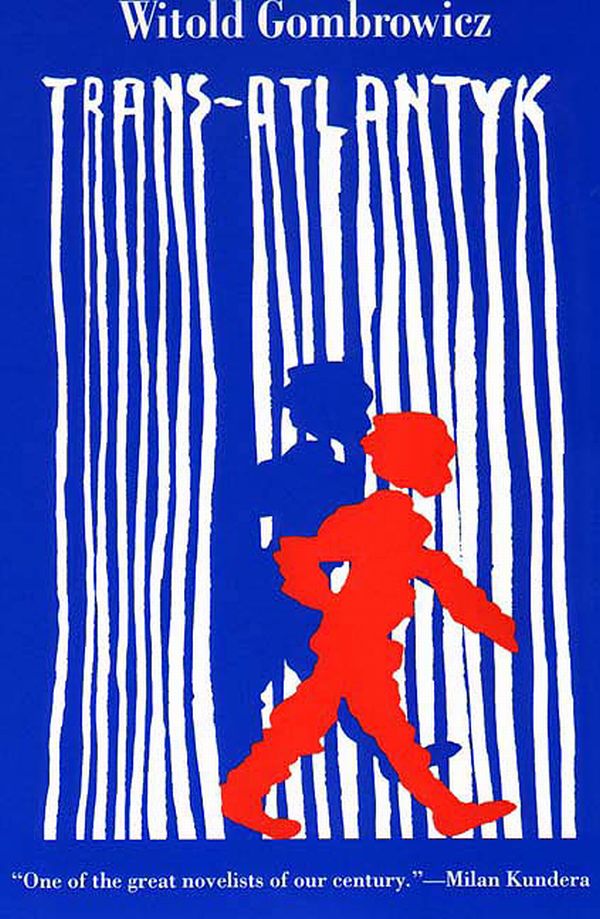
Trans-Atlantyk — Witold Gombrowicz

Witold Gombrowicz’s semi-autobiographical novel Trans-Atlantyk is a slim, bristling work that dances out over a mere 122 pages with a force that simultaneously exhausts and engages. Our hero is the eponymous Gombrowicz, a Polish intellectual who travels via pleasure cruise to visit Argentina. The ship arrives to the near-immediate news that the Nazis have occupied Poland. Most of the dutiful, patriotic Poles clamber back on the ship; Gombrowicz, doubling the real-life author, elects to stay in a self-imposed exile. None of the reasoning or rationale behind these decisions is made especially clear (indeed, I had to glean much of the reasoning for these events from the book’s introduction). Here is how the scene plays out in Gombrowicz’s strange syntax—

Then would I fain have fallen on my knees! Albeit I did not fall at all, just quietly began to Curse, Damn mightily but only to Myself: “Sail, sail, you Compatriots, to your People! Sail to that holy Nation of yours haply Cursed! Sail to that St. Monster Dark, dying for ages yet unable to die! Sail to your St. Freak, cursed by all Nature, ever being born and still Unborn! Sail, sail, so he will not suffer you to Live or Die but keep you for ever between Being and Non-being. Sail to your St. Slug that she may ever the more Enslime you.” The ship turned aslant now and was moving off so this I likewise say: “Sail to that Madman, to that St. Bedlamite of yours—oh, haply Cursed—so that he may Torment, Torture you by those leaps and frenzies of his, drown you in blood, howl at you and by his Howling howl you out, by Torturing torture you, Children of yours, wives, to Death, to Agony—in agony himself, in the agonies of Madness Madden you, O’ermadden you!” With this Curse, turning my back on the ship, I entered the Town.

The passage, which I encourage you, gentle reader, to read again (go ahead, I’ll wait), showcases much of Trans-Atlantyk’s strange power: the archaisms, the snaky syntax (Gombrowicz repeatedly delays his predicate verb or even his subject, burying them at the end of the sentence), the bizarre capitalization, the acid humor, the bloody pathos, the impossible tone. So many of the book’s conflicts are laid bare in this passage. We see the essential conflict of an individual vs. the culture and society that would claim him as its mouthpiece; we find Poland, “that St. Monster Dark,” that cursed “St. Slug” forever trailing behind the rest of Europe, playing out the fight between tradition and modernism; we find the conflict of the exile, projected through the distortion of a fun house mirror, smacking back on our narrator who himself is now cursed “for ever between Being and Non-being.”

Trans-Atlantyk was composed during and after WWII, and much of the madness inherent in its themes became normalized during this time. As if to call attention to these psychic disjunctions, Gombrowicz writes Trans-Atlantyk in the mode of the gawęda, an antiquated form of Polish folk narrative popular with the rural nobility. Gawęda, oral in scope and tradition, emphasizes inner-textual creation, randomness, digression, alliteration, and, above all, energetic narrative freeplay—features Trans-Atlantyk displays with remarkable force. Gombrowicz uses this idiom in a celebratory mode, showcasing the possibility and liveliness of language, but he also ironizes language itself: Trans-Atlantyk might be read as a sustained attack on Poland’s obsessions with archaic tradition, as well as an attack on patriotism and patriarchal authority in general. In the 1994 translation I read, Carolyn French and Nina Karsov render Gombrowicz’s pseudo-gawęda in a kind of 17th or 18th century English style—and they do so to grand effect. Their “Translator’s Note” is perhaps the most instructive piece of scholarship on how translation happens that I have ever read. It’s worth the price of admission alone. And while I do not possess the skills to read the book in its original Polish, I imagine that French and Karsov have accurately and faithfully telegraphed the spirit of Gombrowicz’s novel.

If we return briefly, kind reader, to the excerpt above, we find our hero penniless and cursed, heading into town. Here he finds an odd non-home among the Polish ex-pats, who humorously call the Argentinians “aliens.” (Gombrowicz repeatedly stages scenes that show the extreme disconnection between the Poles and their New World surroundings; it is as if these Europeans are unable to comprehend that they are in the midst of a culture other than their own). Unsure of what to do and fearing the stigma of being a traitor (and, honestly, broke), Gombrowicz heads to the Polish Legate, essentially to turn himself in, but also in the hopes of gaining some kind of employment. He meets with the Polish Minister in a scene that is hilarious but, in its historical irony, also shocking and sad. The Minister is something of a mouthpiece for the Polish attitude that Gombrowicz satirizes—

He drew a breath. Did flash his eye. Did say: “We will, by my troth. I say this to you, and I say this so you cannot say that I was saying that we would not Vanquish, since I say to you that we will Vanquish, will Win, for we will reduce to dust with our mighty, gracious hand—smash, crush to dust, powder, with Sabres, Lances, anatomize, annihilate, and under our Colours and in our Majesty, oh Jesus Maria, oh Jesus, oh Jesus . . . we will grind, Kill! Oh, we will kill, anatomize, demolish! And why are you staring so? I tell you indeed, we will annihilate! Indeed you can see, you can hear the Minister himself, the Gracious Envoy is telling you we will Annihilate; perchance you can see that the Envoy himself, the Minister, is pacing here before you, waving his hands and telling you that we will Annihilate! And don’t you dare bark thus: that I didn’t Pace before you, that I didn’t Say, as you see that I do Pace and Say!”

The minister’s phallic aggression, bound in two of the book’s motifs—walking and speaking—reveals the deep paranoia that seethes under the surface of the ex-pat community; indeed, it’s this very paranoia that drives Gombrowicz to the Legate in the first place. In any case, Gombrowicz soon finds a job as a bank clerk, although the specifics here are a bit murky. The real-life Gombrowicz worked as a bank clerk for years in Argentina, famously saying that the job gave him the freedom to write while his boss wasn’t looking. Thankfully, Trans-Atlantyk spends little time in its protagonist’s workplace, but I think it’s worth sharing one of the few passages about office life in the book. There’s a Kafkaesque scope to Gombrowicz’s observations about the modern office, an innate realization of the dehumanizing aspects inherent in bureaucracy, but also a strong vein of absurd humor—

Amidst these rustlings I slightly opened the door that led to the next Room. A big room, long and Darkish, and a row of tables at which clerks sit, over Promissory Notes, Ledgers, Folios studiously bent; and such a number of Papers, so lumped, Swamped that you can hardly move, for likewise on the floor there a multitude of papers and old scribblings; and Ledgers from a cupboard protrude and even to the ceiling heave, out onto the windowsills bulge and swamp the Office. So if any of the clerks moves, he rustles as a Mouse in these papers.

The description continues, Gombrowicz marking the ways  in which the clerks remain at their desks even to eat. As the passage reaches its conclusion, the scene described might take place in any contemporary office—

Whereupon Tea was brought in, viz. Mugs with coffee and buns on a tray, and then all the clerks, having paused in their work, set upon the food. And anon, as usual, discourse sounded. I was overcome by laughter at the sight of that Coffee Drinking of those clerklets! Since at first sight one could see that, for years, sitting together in this Office, every day the eternal Coffee drinking and the eternal Bun munching, with these same old jokes treating themselves, they at once all there was of theirs was comprehended.

So much of contemporary life is there: its mundane rituals, its mechanical repetitions, its pathetic consolations. If Gombrowicz feels contempt for the idea that an individual owes a duty to society, that contempt extends right into the workplace.

Yet I’m barely scratching the surface here. The real plot of Trans-Atlantyk—and bear in mind, kind reader, that this plot hurtles or waltzes or jerks through its motions, rarely employing conventional narrative sequencing signals; rather, we have here a picaresque of sorts, a constant deferral of clear meaning—the real plot of Trans-Atlantyk (if such a thing exists) careens around a good old-fashioned duel. Somehow our hero falls into this intrigue, which results when a senior Polish man finds his honor assaulted. What assaults his honor? The lascivious intentions of a notorious and wealthy homosexual Argentinian on said senior Pole’s son. It’s easy here to frame the conflict in any number of dualities: Euorpean vs. New World, patriarchal tradition vs. homosexual outsider, familial order vs. alien anarchy. But there’s more to the conflict than mere duality. The homosexual Gonzalo, with his predatory designs on the Pole’s teenage son, comes to embody himself that core conflict of “Being and Non-being,” a figure whose conceptual impossibility reflexively engenders new and untold possibilities. Here’s our narrator’s description—

Ergo methinks: And what is’t? Where am I? What do I do? And from him would I have fled long ago, yet sorrowful sore was I to desert my only companion. For a Companion he was. Yet, when by the Tree he so together with me, I feel somewhat discomfited as neither Fish nor Fowl. Viz. hairs black, manly he had on his hand, but this hand—Dimpled, White, dainty Hand . . . and likewise perchance foot . . . and although a Cheek dark with shaven hairs, this Cheek of his charms and coquettes as if ’twere not Dark but indeed white . . . and likewise Leg though Manly as if ‘twould be a Dainty leg and Charms in curious caprices . . . and though head of a man in his prime, bald at the brow, Wrinkled, this head as if slips off a head, seeking to be a dainty head . . . So he as if fain would not himself Transforms in the silence of the night, and now you wit not whether ’tis He or She . . . and perchance, being neither this nor that, he has the aspect of a Creature and not a human . . . He lurks, the rascal, stands, says naught, and only at his Boy silently gazes. So I think, what the Devil, Werewolf, and wherefore I here with him . . .”

Notice how this in-betweener, this “Werewolf” recapitulates the perception of his own indeterminacy back on our narrator, who feels “discomfited as neither Fish nor Fowl.” This radical ambiguity plays out through the remainder of the novel, which alternately writhes, skips, and dances in an exploration of a world without fixed meaning, or, perhaps more accurately, a world where all meaning must be questioned, weighed not just in words and books but also in blood. Trans-Atlantyk ends in an explosion of radically ambiguous laughter, a gesture of hilarity and violence, joy and ridicule—it is a laughter that might claim the reader as its object or, perhaps, invite the reader to laugh along.

Trans-Atlantyk is a marvelous dare to readers, a work of language invention on par with the best in late modernism. Like any work that creates and enacts its own idiom, Trans-Atlantyk poses a learning curve that will doubtless frustrate or intimidate many readers. But its rewards are plentiful for those willing to trek through its anarchy and slip unresisting into its chaos. Recommended.
Hunter S. Thompson Talks About Trying to Get The Rum Diary Published

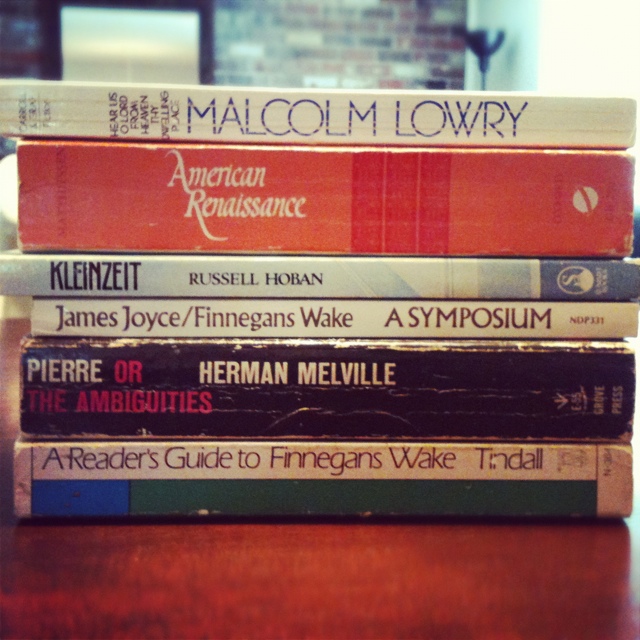
Books Removed from Stack, 10.07.2011

20111006-144432.jpg

Summer wanes into fall; time to clean out the stack of books in my nightstand. Most volumes were permitted to stay, but I’m going to go ahead and find shelf space for these fellows.

The Lowry book, Hear Us O Lord from Heaven Thy Dwelling Place collects short stories and other writings. It’s a muddled, unfinished affair, and I muddled through not very much of it, leaving it unfinished.

F.O. Matthiessen’s American Renaissance: Art and Expression in the Age of Emerson and Whitman is full of insight and keen writing, but its voluminous scope and long essays kept making me wonder why I wasn’t just reading Hawthorne and Melville themselves. No knock on lit crit, but it seems wiser to spend reading time on the originals.

Speaking of Melville—I gave his incest novel Pierre another (third?) serious shot this summer, influenced by the Matthiessen, I guess. No go. Got distracted. It’s long.

I did finish Kleinzeit by Russell Hoban, a baffling schizophrenic novel that has thwarted every attempt of mine to review it. Here’s a review: it’s a strange, funny novel, a cult novel without a big enough cult.

I read several of the essays in A Symposium (ones by Beckett and William Carlos Williams), as well as the letters it includes (attacking Finnegans Wake) and Sylvia Beach’s reluctant intro. An interesting book but sometimes dry. Its inclusion, along with Tindall’s A Reader’s Guide to Finnegans Wake remind me of the brave week I spent trying to get a handle on Joyce’s language vortex. For whatever reason, I left the Wake in the stack. A dare? A dare.

Swedish Poet Tomas Tranströmer Wins the Nobel Prize in Literature

From the Nobel committee–

The Nobel Prize in Literature for 2011 is awarded to the Swedish poet Tomas Tranströmer “because, through his condensed, translucent images, he gives us fresh access to reality”.

Here’s Tranströmer’s “After a Death,” translated by Robert Bly—

Once there was a shock
that left behind a long, shimmering comet tail.
It keeps us inside. It makes the TV pictures snowy.
It settles in cold drops on the telephone wires.

One can still go slowly on skis in the winter sun
through brush where a few leaves hang on.
They resemble pages torn from old telephone directories.
Names swallowed by the cold.

It is still beautiful to hear the heart beat
but often the shadow seems more real than the body.
The samurai looks insignificant
beside his armor of black dragon scales.

“Steinbeck Is Sincere” — William T. Vollmann on East of Eden

William Vollmann writes about John Steinbeck’s East of Eden (excerpted from Imperial via Expelled from Eden)—

The book of his which I admire the most is East of Eden. For a decade now the character of Kate, whom some critics find unconvincing has haunted my head; she’s horrific, she’s pathetic, she’s steady and successful and lonely; she is perfectly what she is. The retelling of the Cain and Abel story is brilliant, the landscape descriptions lovely and lush, the plotting as careful and convincing as the best of George Eliot. And of course there’s a message, a flaw, personified by a Chinese servant who tells us, sometimes at great length, what to think. But Lee has never annoyed me. He speechifies intelligently, at times wittily, and sometimes compassionately. Do I care that nobody I’ve ever met talks like that? He is sincere because Steinbeck is sincere. And this is what I love about Steinbeck most of all, his sincerity.

“The Best Reader Is One Who Is Most Open to Human Possibility” — Don DeLillo

From a 1982  NYT profile of Don DeLillo. DeLillo talks Pynchon, Gaddis, and reader responsibility.

THE writer to whom Mr. DeLillo has most often been likened and for whom he has great respect is Thomas Pynchon. ”Somebody quoted Norman Mailer as saying that he wasn’t a better writer because his contemporaries weren’t better,” he says. ”I don’t know whether he really said that or not, but the point I want to make is that no one in Pynchon’s generation can make that statement. If we’re not as good as we should be it’s not because there isn’t a standard. And I think Pynchon, more than any other writer, has set the standard. He’s raised the stakes.”

Mr. DeLillo also praises William Gaddis for extending the possibilities of the novel by taking huge risks and making great demands on his readers. Yet many readers complain about the abstruseness of much contemporary writing.

”A lot of characters,” Mr. DeLillo says, ”have become pure act. The whole point in certain kinds of modern writing is that characters simply do what they do. There isn’t a great deal of thought or sentiment or literary history tied up in the actions of characters. Randomness is always hard to absorb.”

Mr. DeLillo believes that it is vital that readers make the effort. ”The best reader,” he says, ”is one who is most open to human possibility, to understanding the great range of plausibility in human actions. It’s not true that modern life is too fantastic to be written about successfully. It’s that the most successful work is so demanding.” It is, he adds, as though our better writers ”feel that the novel’s vitality requires risks not only by them but by readers as well. Maybe it’s not writers alone who keep the novel alive but a more serious kind of reader.”

(A Very Beautiful) Book Acquired, 9.27.2011

20111004-142338.jpg

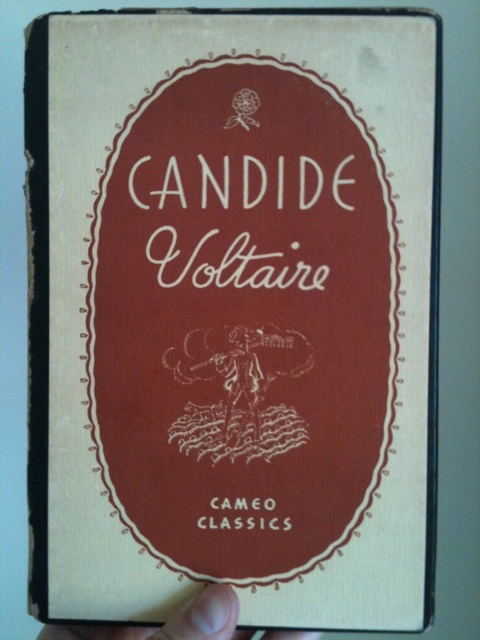
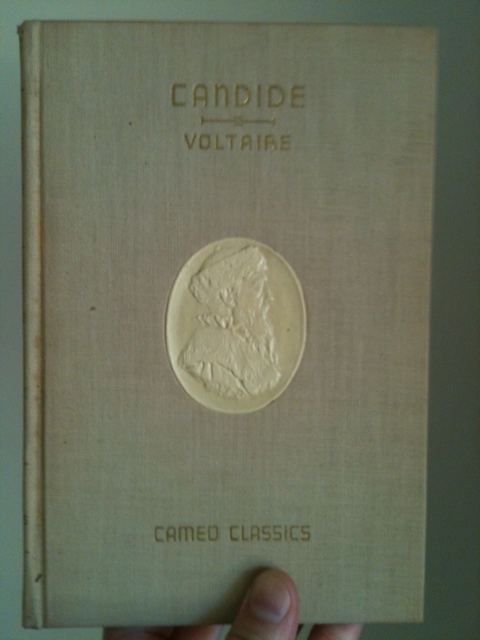
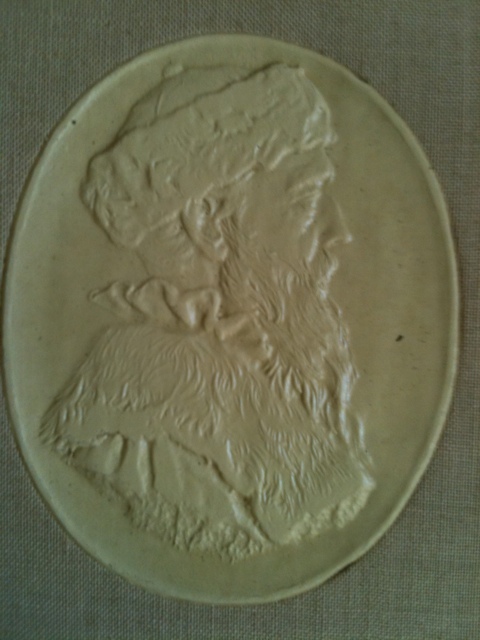
What a wonderful present: a 1930 Grosset & Dunlap edition Candide (read our review of Candide). Received it last week, but I’ve been to busy to photograph it. Has a nice slipcase (above), and the cover sports a tactile cameo of Gutenberg in profile—

20111004-142346.jpg

20111004-142354.jpg

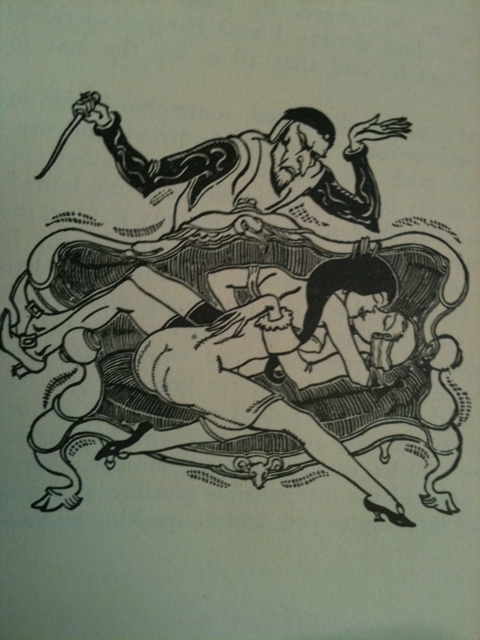
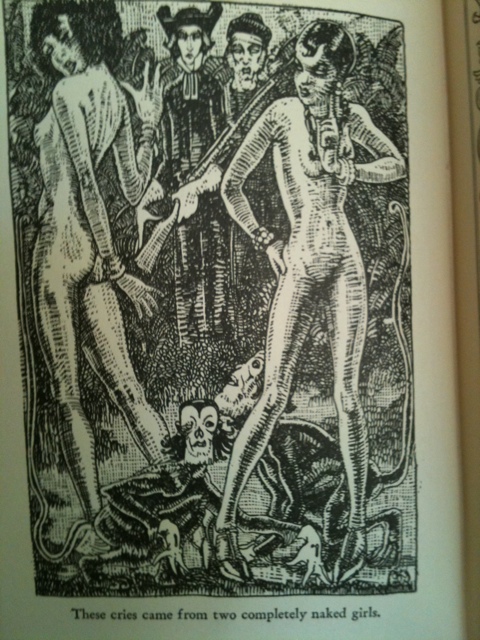
Illustrations are by Mahlon Blaine, and inevitably involve sex and/or violence—like this one below—

20111004-143419.jpg

There a number of handsome full page illustrations as well. Just lovely.

20111004-143428.jpg

Nobel Lit Odds, 10.04.2011

Via The New Yorker’s Book Bench blog, current odds (and yeah, we know, they change) from Ladbrokes for the 2011 Nobel Prize in Literature (the oddsmaker’s name is Magnus Puke, by the by).

Adonis (Syria): 4/1
Tomas Tranströmer (Sweden): 7/1
Haruki Murakami (Japan): 8/1
Bob Dylan (U.S.): 10/1
Assia Djebar (Algeria): 12/1
Peter Nadas (Hungary): 12/1
Ko Un (South Korea): 14/1
Les Murray (Australia): 16/1
Thomas Pynchon (U.S.): 20/1
Philip Roth (U.S.): 20/1
Nuruddin Farah (Somalia): 20/1

While it’s easy to dismiss literary competitions as trifling or even crass, they do much—particularly high profile ones like the Nobel or the Pulitzer—to augment the readership of these authors, cement the winner’s canonical place, and expose the winner to a larger audience. They also help writers get paid better, which is a good thing.

The odds don’t really mean that much of course—this time last year, Cormac McCarthy was the favorite with an 8:1 lead.

Sunday Reading, 10.02.2011

20111002-140847.jpg

Lydia Davis Reads Dream Stories

“I Write Stories About a Submerged Population” — Raymond Carver on Fiction, Class, and Political Writing

Raymond Carver talks about the political scope (or lack thereof) in his writing in a 1987 interview

A writer ought to speak about things that are important to him. As you know, I’ve taught in universities, in fact for some fifteen years. I had time there for other work, and I never wrote a single story about university life because it’s an experience that left no mark on my emotional life. I tend to go back to the time and the people I knew well when I was younger and who made a very strong impression on me . . . Some of my recent stories deal with executives. (For example, that one in The New Yorker, “Whoever Was Using This Bed,” where the people discuss things the characters in my earlier stories would never discuss). He’s a businessman, and so on. But most of the people in my stories are poor and bewildered, that’s true. The economy, that’s important . . . I don’t feel I’m a political writer and yet I’ve been attacked by right-wing critics in the U.S.A. who blame me for not painting a more smiling picture of America, for not being optimistic enough, for writing stories about the people who don’t succeed. But these lives are as valid as those of the go-getters. Yes, I take unemployment, money problems, and marital problems as givens in life. People worry about their rent, their children, their home life. That’s basic. That’s how 80-90 percent, or God knows how many people live. I write stories about a submerged population, people who don’t always have someone to speak for them. I’m sort of a witness, and, besides, that’s the life I myself lived for a long time. I don’t see myself as a spokesman but as a witness to these lives. I’m a writer.

Book Acquired, 9.30.2011

20110930-164525.jpg

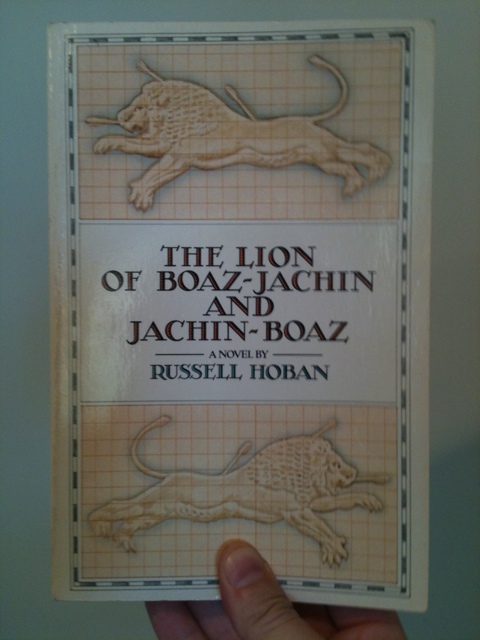
The Lion of Boaz-Jachin and Jachin-Boaz by Russell Hoban. It’s his first novel. Picked it up at the used bookshop today. Love the cover. I’m sure it’s as weird as the other stuff I’ve read by him (Riddley Walker, Pilgermann, Kleinzheit).

“Entering The Pale King Is Like Entering a Familiar Room, Now Stripped Bare”

At Seven Steps Back, there’s a marvelous series of posts—a long essay, really, broken down into digestible blog chunks—about David Foster Wallace’s The Pale King. The piece is easily one of the better analyses I’ve read about Wallace’s last book, well researched and well written through an intertextual lens. A taste, a riff on Wallace’s names—

Entering The Pale King is like entering a familiar room, now stripped bare, but with the footprints of its former occupant, your departed friend, still visible in the dust on the floor. For example, the good old names are back, strange and unharmonious, vaguely Germanic, Latinate, French, at root un-American; names like Lotwis and Glendenning and Bondurant and Henzke, not zany and humorous like Pynchon’s (it seems to me that the names and the scope of his books are the only reasons he has been called an epigone to Pynchon, nothing else), but rather like clothes one cannot find it in himself to feel at ease in, even though they aren’t tight or loose, but just right. They also seem like they were once normal, everyday names –names like George Smith and Janet Cooper– but at some point were taken apart and reconstructed by a neurotic tinkerer, in order to establish how long they can go on working before exploding.

“Fictional Map of L.A.” — Geoff McFetridge


Geoff McFetridge’s fictional map of L.A., from GOOD magazine.

Harold Bloom Talks About Blood Meridian (Video)

The Origin of “Moby Dick”

Where did Herman Melville get the strange, marvelous name of the leviathan at the center of his strange, marvelous novel Moby-Dick? The name of the great white whale derives from  an 1839 article by Jeremiah Reynolds, “Mocha Dick: or The White Whale of the Pacific” (originally published in Knickerbocker Magazine). As the editors of Melville.org point out though (and thanks be unto them for all their hard, excellent work), how “Mocha Dick” morphed into “Moby Dick” remains “some strange piece of hermetic Melvillean arcana.” From Reynolds’s article

But to return to Mocha Dick — which, it may be observed, few were solicitous to do, who had once escaped from him. This renowned monster, who had come off victorious in a hundred fights with his pursuers, was an old bull whale, of prodigious size and strength. From the effect of age, or more probably from a freak of nature, as exhibited in the case of the Ethiopian Albino, a singular consequence had resulted — he was white as wool! Instead of projecting his spout obliquely forward, and puffing with a short, convulsive effort, accompanied by a snorting noise, as usual with his species, he flung the water from his nose in a lofty, perpendicular, expanded volume, at regular and somewhat distant intervals; its expulsion producing a continuous roar, like that of vapor struggling from the safety-valve of a powerful steam engine. Viewed from a distance, the practised eye of the sailor only could decide, that the moving mass, which constituted this enormous animal, was not a white cloud sailing along the horizon. On the spermaceti whale, barnacles are rarely discovered; but upon the head of this lusus naturae, they had clustered, until it became absolutely rugged with the shells. In short, regard him as you would, he was a most extraordinary fish; or, in the vernacular of Nantucket, “a genuine old sog”, of the first water.