It was the Gramarye of the Middle Ages, which some people are accustomed to think of as the Dark Ages, and Arthur had made it what it was | From T.H. White’s The Candle in the Wind

It was the Gramarye of the Middle Ages, which some people are accustomed to think of as the Dark Ages, and Arthur had made it what it was. When the old King came to his throne it had been an England of armoured barons, and of famine, and of war. It had been the country of trial by ordeal with red-hot irons, of the Law of Englishry, and of the sad, wordless song of Morfa-Rhuddlan. Then, on the sea-coast, within a foreign vessel’s reach, not an animal, not a fruit tree, had been left. Then, in the fens and the vast forests, the last of the Saxons had defended themselves against the bitter rule of Uther the Conqueror; then the words “Norman” and “Baron” had been equivalent to the modern word of “Sahib”; then Llewellyn ap Griffith’s head, in its crown of ivy, had mouldered on the clustered spikes of the Tower; then you would have met the mendicants by the roadside, mutilated men who carried their right hands in their left, and the forest dogs would have trotted beside them, also mutilated by the removal of one toe—so that they could not hunt in the woodlands of the lord. When Arthur first came, the country people had been accustomed to bar themselves in their cottages every night as if for siege, and had prayed to God for peace during darkness, the goodman of the house repeating the prayers used at sea on the approach of storm and ending with the plea “the Lord bless us and help us,” to which all present had replied “Amen.” In the baron’s castle, in the early days, you would have found the poor men being disembowelled—and their living bowels burned before them—men being slit open to see if they had swallowed their gold, men gagged with notched iron bits, men hanging upside down with their heads in smoke, others in snake pits or with leather tourniquets round their heads, or crammed into stone-filled boxes which would break their bones. You have only to turn to the literature of the period, with its stories of the mythological families such as Plantagenets, Capets and so forth, to see how the land lay. Legendary kings like John had been accustomed to hang twenty-eight hostages before dinner; or, like Philip, had been defended by “sergeants-at-mace,” a kind of storm troopers who guarded their lord with maces; or, like Louis, had decapitated their enemies on scaffolds under the blood of which the children of the enemy had been forced to stand. This, at all events, is what Ingulf of Croyland used to tell us, until he was discovered to be a forgery. Then there had been Archbishops nicknamed “Skin-villain,” and churches used as forts—with trenches in the graveyards among the bones—and price-lists for fining murderers, and bodies of the excommunicated lying unburied, and famishing peasants eating grass or tree-bark or one another. (One of them ate forty-eight.) There had been roasting heretics on the one hand—forty-five Templars had been burned in one day—and the heads of captives being thrown into besieged castles from catapults on the other. Here a leader of the Jacquerie had been writhing in his chains, as he was crowned with a red-hot tripod. There a Pope had been complaining, as he was held to ransom, or another one had been wriggling as he was poisoned. Treasure had been cemented into castle walls, in the form of gold bars, and the builders had been executed afterwards. Children playing in the streets of Paris had frolicked with the dead body of a Constable, and others, with the women and old men, had starved outside the walls of beleaguered towns, yet inside the ring of the besiegers. Hus and Jerome, with the mitres of apostasy upon their heads, had flamed and fizzled at the stake. The hamstrung imbeciles of Jumièges had floated down the Seine. Giles de Retz had been found to have no less than a ton of children’s bones, calcined, in his castle, after having murdered them at the rate of twelve score a year for nine years. The Duke of Berry had lost a kingdom through the unpopularity which he earned by feeling sorry for eight hundred foot soldiers who had been killed in a battle. The youthful count of St. Pol had been taught the arts of war by being given twenty-four living prisoners to slaughter in various ways, for practice. Louis the Eleventh, another of the fictional kings, had kept obnoxious bishops in rather expensive cages. The Duke Robert had been surnamed “the Magnificent” by his nobles—but “the Devil” by his parishioners. And all the while, before Arthur came, the common people—of whom fourteen were eaten by wolves out of one town in a single week, of whom one third were to die in the Black Death, of whom the corpses had been packed in pits “like bacon,” for whom the refuges at evening had often been forests and marshes and caves, for whom, in seventy years, there had been known to be forty-eight of famine—these people had looked up at the feudal nobility who were termed the “lords of sky and earth,” and—themselves battered by bishops who, because they were not allowed to shed blood, went for them with iron clubs—had cried aloud that Christ and his saints were sleeping.

“Pourquoi,” the poor wretches had sung in their misery:

Pourquoi nous laisser faire dommage?
Nous sommes hommes comme ils sont.

From The Candle in the Wind by T.H. White.

HELP! A Stereophonic Narrative for Authorial Voice — John Barth


“HELP! A Stereophonic Narrative for Authorial Voice” by John Barth.

The World had been expected to end in the year one thousand | From T.H. White’s The Ill-Made Knight

The World had been expected to end in the year one thousand, and, in the reaction which followed its reprieve, there had been a burst of lawlessness and brutality which had sickened Europe for centuries. It had been responsible for the doctrine of Might which was the Table’s enemy. The fierce lords of the Strong Arm had hunted the wild woodlands—only, of course, there had always been exceptions like the good Sir Ector of Forest Sauvage—till John of Salisbury had been forced to advise his readers: “If one of these great and merciless hunters shall pass by your habitation, bring forth hastily all the refreshment you have in your house, or that you can readily buy, or borrow from your neighbour: that you may not be involved in ruin, or even accused of treason.” Children, Duruy tells us, had been seen hanging in trees, by the sinews of their thighs. It had been no uncommon sight to see a man-at-arms whistling like a lobster, and looking like porridge, because they had emptied a bucket of boiling bran over his armour during a siege. Other spectacles even more dramatic have been mentioned by Chaucer: the smyler with the knyf under the cloke, the careyne in the bush with throte y-corve, or the colde deeth with mouth gaping upright. Everywhere it had been blood on steel, and smoke on sky, and power unbridled—and, in the general confusion of the times, Gawaine had at last contrived to murder our dear old friend King Pellinore, in revenge for the death of his own father, King Lot.

Such had been the England which Arthur had inherited, such the birthpangs of the civilization which he had sought to invent. Now, after twenty-one years of patient success, the land presented a different picture.

Where the black knights had hoved, all brim and furious by some ford, to take toll of anybody rash enough to pass that way, now any virgin could circumambulate the whole country, even with gold and ornaments upon her person, without the least fear of harm. Where once the horrible lepers—they called them Measles—had been accustomed to ramble through the woods in white cowls, ringing their doleful clappers if they wanted to give warning, or just pouncing on you without ringing them if they did not, now there were proper hospitals, governed by religious orders of knighthood, to look after those who had come back sick with leprosy from the Crusades. All the tyrannous giants were dead, all the dangerous dragons—some of which used to come down with a burrr like the peregrine’s stoop—had been put out of action. Where the raiding parties had once streamed along the highways with fluttering pennoncels, now there were merry bands of pilgrims telling each other dirty stories on the way to Canterbury. Demure clerics, taking a day’s outing to Our Lady of Walsingham, were singing Alleluia Dulce Carmen, while the less demure ones were warbling the great medieval drinking-song of their own composition: Meum est propositum in taberna mori. There were urbane abbots, titupping along on ambling palfreys, in furred hoods which were against the rules of their orders, and yeomen in smart tackle with hawks on their fists, and sturdy peasants quarrelling with their wives about new cloaks, and jolly parties going out to hunt without armour of any sort. Some were riding to fairs as great as that of Troyes, others to universities which rivalled Paris, where there were twenty thousand scholars whose ranks eventually provided seven popes. In the abbeys all the monks were illuminating the initial letters of their manuscripts with such a riot of invention that it was impossible to read the first page at all. Those who were not doing the chi-ro page were carefully copying out the Historia Francorum of Gregory of Tours, or the Legenda Aurea, or the Jeu d’Echecs Moralisé, or a Treatise of Hawkynge—that is, if they were not engaged upon the Ars Magna of the magician Lully, or the Speculum Majus by the greatest of all magicians. In the kitchens the famous cooks were preparing menus which included, for one course alone: ballock broth, caudle ferry, lampreys en galentine, oysters in civey, eels in sorré, baked trout, brawn in mustard, numbles of a hart, pigs farsed, cockintryce, goose in hoggepotte, venison in frumenty, hens in brewet, roast squirrels, haggis, capon-neck pudding, garbage, tripe, blaundesorye, caboges, buttered worts, apple mousse, gingerbread, fruit tart, blancmange, quinces in comfit, stilton cheese, and causs boby. In the dining halls the older gentlemen, who had spoiled their palates with drinking, were relishing those strange delicacies of the Middle Ages—the strong flavours of whale and porpoise. Their dainty ladies were putting roses and violets in their dishes—baked marigolds still make an excellent flavouring for bread-and-butter puddings—while the squires were showing their weakness for sheep’s-milk cheese. In the nurseries all the little boys were moving heaven and earth to persuade their mothers to have hard pears for dinner, which were stewed in honey-syrup and vinegar, and eaten with whipped cream. The manners of the table, too, had reached a pitch of civilization far beyond our own. Now, instead of the plates made of bread, there were covered dishes, scented finger bowls, sumptuous table cloths, a plethora of napkins. The diners themselves were wearing chaplets of flowers and graceful draperies. The pages were serving the food with the formal movements of a ballet. Wine bottles were being placed on the tables, but ale, being less respectable, was being put beneath. The musicians, with strange orchestras of bells, large horns, harps, viols, zithers and organs, were playing as the people ate. Where once, before King Arthur had made his chivalry, the Knight of the Tower Landry had been compelled to warn his daughter against entering her own dining hall in the evening unaccompanied—for fear of what might happen in the dark corners—now there was music and light. In the smoky vaults, where once the grubby barons had gnawed their bones with bloody fingers, now there were people eating with clean fingers, which they had washed with herb-scented toilet soap out of wooden bowls. In the cellars of the monasteries the butlers were tapping new and old ale, mead, port, claree, dry sherry, hock, beer, metheglyn, perry, hippocras, and the best white whisky. In the law courts the judges were dispensing the King’s new law, instead of the fierce law of Fort Mayne. In the cottages the good wives were making hot griddle bread enough to make your mouth water, and putting fine turf on their fires regardless of expense, and herding fat geese on the commons enough to support twenty families for twenty years. The Saxons and Normans of Arthur’s accession had begun to think of themselves as Englishmen.

From The Ill-Made Knight by T.H. White.

Steven Moore on William Gaddis and Russian Literature

Photograph of William Gaddis by William H. Gass

The good folks at indie publisher Sublunary have shared on their site the text of Gaddis scholar Steven Moore’s essay “William Gaddis and Russian Literature.” The essay serves as the preface for a forthcoming Russian translation of Moore’s Gaddis study, William Gaddis: Expanded Edition.

From the essay:

By the age of twenty Gaddis had already read Dostoevsky’s Crime and Punishment—he later called it “the first ‘great’ novel I experienced”—and over the next decade he devoured much more Russian literature, as is evident from the letters he wrote while writing his first novel, The Recognitions. He tells his mother about reading Chekhov’s plays and Dostoevsky’s House of the Dead, praises Crime and Punishment and The Idiot to short-story writer Katherine Anne Porter, and informs an ex-girlfriend that he is re-reading Goncharov’s Oblomov, which he continued to praise all his life. When his first novel was published in 1955, many critics mistakenly assumed that it was influenced by James Joyce’s Ulysses; but an informed reader would have noticed the numerous references to books by Dostoevsky (Brothers Karamazov, Crime and Punishment, Demons, The Idiot) and Tolstoy (Kingdom of God, Power of Darkness, Redemption), and would have correctly concluded that Gaddis had adapted the 19th-century Russian novel for 20th-century Americans, one closer to The Idiot than to Ulysses.

Read the essay at Sublunary.

“Slow Grounder,” a short story by Hob Broun

“Slow Grounder”

by

Hob Broun

from

Cardinal Numbers

img_9613


Up or down, in motion or asleep and half asleep, Speed has the same musical questions that slosh in his head. How could you play twelve years in the majors and end up like this? Did you go stupid on purpose? Where is the curly wife birdfeeding you popcorn tinged with lipstick? And the little girls begging to stand on your big feet to be danced in circles? The Barca-lounger? The riding mower? The tropical aquarium? Going, going, all long gone.

So now Speed has transistor radios in his place, on sills and ledges, hanging by wrist straps from bedpost and cabinet knob, on top of the fridge and the toilet tank. They have silver aerials that always point up. They have leather casings that snap over the top like overalls; or go naked in turquoise Jap plastic. Below, their countable speaker dots and on top a grid of numbers make super dominoes. Very advanced. Dominoes from Outer Space.

But even playing all together so Lurtsema downstairs spears his ceiling with a mop handle, they can’t drown out Speed’s musical questions. What happened to the four-bedroom house with skylight and sundeck? To the Chrysler New Yorker with gray velour upholstery Kimmie called mouseskin, chanting it at her sister and bouncing?

Back in Dakota, when he was still Russell and a boy, there’d been Gramp in his chair. Gramp clicking his plates on the stem of a cold pipe. Gramp in full expectation, bird gun across his knees, and sooner or later the door would suck open on a winter-crazed redskin come to take, and let him reach for one potato or lump of coal, Gramp would blast him back across the frozen porch.

You were supposed to be on guard, block the plate. But Speed had his chest protector on backwards, or something. Now he’s getting the razz. The hotfoot and the horselaugh. “This bum,” and he can see his picture coming down in delis and barbershops. Bumhood like something he could pass over wire so the guys duck out when he calls. “Going south for the tarpon, Speed. Keep in touch.” Even his roomie four years with the Sox saying, “I’m kind of extended now, Speed. Maybe you could put it in a letter,” then hanging up before he can get the address. And what had him extended was a thing called Bob’s Bag-O-Salad, three of them opened around Philadelphia there, the shaved lettuce and carrots, so on, in a special plastic bag you could eat out of, then throw away, and the dressing faucets, your choice of ten. People were flocking to the greens, trying to ward off cancer.

Back in Dakota one year when he was visiting for Christmas, the wind had come down off the Canadian plains to swirl snow and dirt into what they called a “snirt” storm. It clattered against the house. Mom said, “Hardly recognize you in those clothes.” Pop said, warily lifting his present, “Is it something to eat?” Pop had been three years at the Colorado School of Mines. As a cook. It was still snirting the next day and the day after that. “That dog can’t but hardly see,” Pop said. Perry Como sang about mistletoe and Mom sniffled. Speed went to the cellar. He put his hands in the bin of seed potatoes. Things can live in the dark, he thought, and didn’t feel any better.

Speed gets out his fourteen gum cards, still shiny. Twelve full seasons, plus the one in front when they sent him down to Asheville for seasoning, and the one in back when they said you’re not in our plans for this year. But we could let you be a batting coach in the Bean Dip League. He remembers the Fargo girl who sent pictures of herself on a horse, or in her band uniform. “Carry me up there and hit the big one.” And the one night he puts her in his pocket Fuentes throws a no-hitter. Sandi, with a heart over the i. He thinks about pictures as a residue of time. “Adams led the club last year in RBIs.”

Back in tenth grade in Dakota, geometry had calmed him down. Nothing he knew was so pure as those angles and arcs. Not even the hiss of a fastball inside the four points of a diamond. He made figures with compass and ruler and colored them in. Numbers might be a trick, but he could understand the laws of shape.

It’s almost dark outside, so Speed turns some radios on. The sound is tight, a pressure leak, but Speed hears his questions the same. And what they want is the clacking logic of one domino tipping the next one as it falls and the next and the next and the next. But all he can remember is what the things were, not why or where they went. From the couch to the John to the bed is the only geometry left. The lines don’t really meet, okay.

Noticing the buzzer, he can tell its been going some time behind his radios. Getting up, he feels light, light as paper, when the door sucks open on a man with silver eyes, skin with a rubbery shine, and where the ears ought to be, holes in a circle like the mouthpart of a telephone.

He says, “Bless my stars.”

Speed says come on in, but the shape of the doorframe seems to make him nervous. He tries to smile and it’s like something he had to learn in a hurry.

Nodding to the radios: “You’re a listener.”

Speed shrugs a little. Those eyes are really terrible.

“So you’re ready to go, then?”

Speed doesn’t say, “I don’t care if I never come back.” He sings it.

“Really very nice there.” The man gestures vaguely, impatiently. “All the lines meet. It’s very forgiving.”

Speed really wants him to come in now, but the man says he needs to run a couple or errands first.

“My vehicle’s parked on the roof. Wait here.”

Okay. In the kitchen Speed empties a can of Hormel chili into a pan. Hearing the traffic report is nice. He breaks two eggs into the pot, stirs. It doesn’t require a look to know there are bits of shell in there. But so why take them out?

“Space” — Mark Strand

“Space”

by

Mark Strand


A beautiful woman stood at the roof-edge of one of New York’s tall midtown apartment houses. She was on the verge of jumping when a man, coming out on the roof to sunbathe, saw her. Surprised, the woman stepped back from the ledge. The man was about thirty or thirty-five and blond. He was lean, with a long upper body and short, thin legs. His black bathing suit shone like satin in the sun. He was no more than ten steps from the woman. She stared at him. The wind blew strands of her long dark hair across her face. She pulled them back and held them in place with one hand. Her white blouse and pale blue skirt kept billowing, but she paid no attention. He saw that she was barefoot and that two high-heeled shoes were placed side by side on the gravel near where she stood. She had turned away from him. The wind flattened her skirt against the front of her long thighs. He wished he could reach out and pull her toward him. The air shifted and drew her skirt tightly across her small, round buttocks; the lines of her bikini underpants showed. “I’ll take you to dinner,” he yelled. The woman turned to look at him again. Her gaze was point-blank. Her teeth were clenched. The man looked at her hands which were now crossed in front of her, holding her skirt in place. She wore no wedding band. “Let’s go someplace and talk,” he said. She took a deep breath and turned away. She lifted her arms as if she were preparing to dive. “Look,” he said, “if it’s me you’re worried about, you have nothing to fear.” He took the towel he was carrying over his shoulders and made it into a sarong. “I know it’s depressing,” he said. He was not sure what he had meant. He wondered if the woman felt anything. He liked the way her back curved into her buttocks. It struck him as simple and expressive; it suggested an appetite or potential for sex. He wished he could touch her. As if to give him some hope, the woman lowered her arms to her sides and shifted her weight. “I’ll tell you what,” the man said, “I’ll marry you.” The wind once again pulled the woman’s skirt tightly across her buttocks. “We’ll do it immediately,” he said, “and then go to Italy. We’ll go to Bologna, we’ll eat great food. We’ll walk around all day and drink grappa at night. We’ll observe the world and we’ll read the books we never had time for.” The woman had not turned around or backed off from the ledge. Beyond her lay the industrial buildings of Long Island City, the endless row houses of Queens. A few clouds moved in the distance. The man shut his eyes and tried to think of how else to change her mind. When he opened them, he saw that between her feet and the ledge was a space, a space that would always exist now between herself and the world. In the long moment when she existed before him for the last time, he thought, How lovely. Then she was gone.

Kafka diary entry, 19 July 1910

Sunday, 19 July, slept, awoke, slept, awoke, miserable life.

From Diaries, Franz Kafka; trans. by Joseph Kresh.

“Chairs” — Stanley Elkin

Compared to many forms that lend themselves to art or craft—drama, the novel, painting, the composition of music, even the interpretation of music, like, oh, say, singing the national anthem before the game, infinite other forms that seem to thrive, almost to wallow, in permutation, assuming new content, a mother lode of fresh ideas and differentiated styles as they’re taken up by one artist after another—it’s extraordinary how furniture is like most other furniture, as if furniture, alone among crafts, not only lived along the perimeters of some platonic ideal but had somehow actually managed to colonize it: an imperialism of the conventional. Except for a detail here, a detail there, inlay, marquetry, the pile-on of money, of pharaohs’ or aristocracy’s royal dispensations, a couch is a couch, an escritoire an escritoire. Beds resemble beds, tables and chairs are like tables and chairs. In domestic arrangements, form, bound to the custom cloth of human shape, really does follow function. The height of a table has to do with average lap tolerances. Chairs and beds are the hard aura of a strictly skeletal repose. Even so, something’s busted, I think, in the imagination of the furniture designers—I except the art directors of certain major motion pictures set in Manhattan apartments; talkin’ environment, the ecology of “life-style,” of plot and character, what the principals look like against the bookcase, propped among the furnishings; one must learn the script of one’s life and be able to afford it; because only in movies does furniture play well—all lamps and appointments, all cunning, edge-of-the-field doodad and inspired house-dower; one has at least the illusion one could live with this stuff, that it won’t vanish in a season like a Nehru shirt—something stuck in the vision, some sorcerer’s-apprentice effect, which permits to keep on coming and keep on coming with minimal variation, if any, what has come before. It isn’t anything elegant as highest math happening here, just lump-sum arrangement, ball-park figure, bottom line. It’s the fallacy of the assembly line, the notion that only costs get cut in such a wide sweep of swath. No, but really. Isn’t it astonishing that personality, surely as real as the width of one’s shoulders or the breadth of one’s beam, should be so infinite but attention to body so meager and hand-to-mouth that—chairs, say chairs, I know about chairs—there’s been less progress in the design of chairs than in the design of luggage. (I speak as a cripple full-fledged—chairs are a hangup with me—but set that aside.) It’s as if clothing came in a single size, pants like tube socks, every dress like a muumuu. And a rule of the chair seems to be that if it’s beautiful it’s rarely comfortable, if comfortable it rarely makes the cut to beauty.

Indeed, there are so few contemporary “museum-quality” chairs one can almost list them—Marcel Breuer’s side chairs, his “Wassily” chair like a leather-and-steel cat’s cradle; Jacobsen’s “Egg” chair; Thonet’s bentwood rockers; Mies Van Der Rohe’s “Barcelona”; Saarinen’s molded plastic chairs on their round bases and tapered stems like cross sections of parfaits; all Eames’s ubiquitous plastic like stackable poker chips or the pounded, hollowed-out centers of catchers’ mitts, and as locked into a vision of the fifties as pole lamps, his famous lounge chair and ottoman that, like the Nehru shirt, have become a cliché. A spectrum of vernacular chairs—soda-fountain chairs, directors’ chairs, black canvas camp chairs, those crushed—almost imploded—white or charcoal leather pillow chairs like soft fortresses or marshmallow thrones; some of the new ergonomic chairs that sit on you as much as you ever manage to sit on them.

So I know about chairs and still have my eye out, never mind I’m sixty if I’m a day, for that evasive, lost-chord masterpiece of the genre, which, like love, I’ll know when I see like a sort of fate.

Though maybe not. Not because I haven’t the imagination to cut my losses, or even the courage to finesse my life and choose to sit out the close of my days in desuetudinous splendor, but because it may not exist. The chair, my gorgeous prosthetic of choice, may not have been fashioned yet. Because oddly, strangely, ultimately, chairs are all attitude, molds of the supine or up on pointe, aggressive or submissive as sexual position. Occupied or unoccupied either, they are shadows, ghosts, signs of the been-and-gone, some pipe-and-slippers choreography of spiritual disposition, how one chooses to acquit oneself, highly personalized as an arrangement of flowers, and oh, oh, if one but had the body for it one would live out one’s days in Van Gogh’s room at Arles, eating up comfort and beauty and having it, too, there in one last fell binge of boyhood in the cane and wood along those powder-blue walls of the utile, of basin and pitcher, of military brush and drinking glass, of apothecary bottles clear as gin on a crowded corner of the nightstand, to be there on the feather bed, on the oilcloth-looking floor amid one’s things. All, as I say, you have to know is the script of your life.

From Stanley Elkin’s 1991 essay “Some Overrated Masterpieces.” Collected in Pieces of Soap.

“It was a lone tree burning on the desert” | Blood Meridian’s Moral Core

Cormac McCarthy’s Blood Meridian begins as a strange, violent picaresque bildungsroman, detailing the adventures of a teenage runaway known only as “the kid.” When the Kid falls in with John Glanton’s marauders, the narrative lens expands and pulls back; Glanton’s gang essentially envelopes the Kid’s personality. The pronoun “they” dominates the Kid’s own agency, for the most part, and the massive figure of Judge Holden usurps the narrative’s voice. The effect is that the Glanton gang’s killing, raping, and scalping spree becomes essentially de-personalized, and, to a certain extent, amoralized.

The Kid, and perhaps the ex-priest Tobin and the Kid’s erstwhile partner Toadvine, are the only major characters who bear any semblance of conventional morality in the narrative. The Kid exhibits a willingness to help others early on when he agrees to stitch one of Tobin’s wounds; later, he removes an arrowhead from a wounded man when no other member of the company will (Tobin chides him for caring, declaring that the wounded man would have killed the Kid had the Kid’s efforts been unsuccessful). For most of the central narrative though, the Kid’s individual actions are consumed into the gang’s “they.” However, at the beginning of chapter 15 the narrative focuses again on the Kid, who is charged with killing a wounded man named Shelby to “spare” him from the approaching Mexican army (this is a bizarre version of mercy in Blood Meridian). Shelby pleads to live and the Kid allows it, even giving the man some water from his own canteen. After he leaves he catches up with a man named Tate whose horse is wounded. Tate remarks on the boy’s foolishness for helping him, but the Kid does so nonetheless, sharing Tate’s burden as they try to make their way back to the rest of their party. Tate is soon killed by Mexican scouts. In both cases, the outcome of the Kid’s moral actions–the will to help, to save, to preserve life–are negated by the book’s narrative outcomes, but I would argue that his intentions in the face of violence somehow secure his humanity.

His journey alone to rejoin the Glanton gang is figured as a kind of vision quest, a strange echo of Christ in the desert, perhaps. At its core–and perhaps the moral core of the book–is the following strange passage–

It was a lone tree burning on the desert. A herladic tree that the passing storm had left afire. The solitary pilgrim drawn up before it had traveled far to be here and he knelt in the hot sand and held his numbed hands out while all about in that circle attended companies of lesser auxiliaries routed forth into the inordinate day, small owls that crouched silently and stood from foot to foot and tarantulas and solpugas and vinegarroons and the vicious mygale spiders and beaded lizards with mouths black as a chowdog’s, deadly to man, and the little desert basilisks that jet blood from their eyes and the small sandvipers like seemly gods, silent and the same, in Jedda, in Babylon. A constellation of ignited eyes that edged the ring of light all bound in a precarious truce before the torch whose brightness had set back the stars in their sockets.

The burning tree alludes to YHWH’s appearance to Moses as a burning bush, and also the tree of smoke that led the Israelites through the desert. Significantly, all the strange, terrible creatures of the desert come to meet around it in a “precarious truce.” The burning tree inverts the natural, inescapable violence that dominates the novel and turns it into a solitary, singular moment of peace. When the Kid awakes–alone–the tree is merely a “smoldering skeleton of a blackened scrog.” God is not in the permanence of the object but rather in the witnessing of the event–Blood Meridian locates (a version of a) god in the natural violence of burning and consumption. There is a strong contrast here, I believe, with the book’s other version of god, the Judge’s proclamation that “War is god.” The Judge, a cunning, devilish trickster, wants to reduce (or enlarge) war to all contest of wills, to pure violence–to divorce it from any ideological structure. Yet the burning tree episode reveals natural violence divorced from ideology. The animals (and the man, the Kid) suspend their Darwinian animosities in order to witness the sublime. The episode is silent, outside of language, order, ideology. This silence is echoed in the novel’s final confrontation between the Judge and the Kid, who retorts simply “You ain’t nothin'” to the Judge’s barrage of grandiose language. While the rejoinder may not save the Kid, its rejection perhaps saves his soul (if such a thing exists in the novel, which I believe it does). So, while larger-than-life Judge Holden may dominate the novel, Cormac McCarthy has nonetheless given us another moral road to follow, should we choose.

[Ed. note—Biblioklept first published a version of this post in October, 2010.]

“Books are made out of books” | Blood Meridian and Samuel Chamberlain

In his 1992 interview with The New York Times, Cormac McCarthy said, “The ugly fact is books are made out of books. The novel depends for its life on the novels that have been written.” McCarthy’s masterpiece Blood Meridian, as many critics have noted, is made of some of the finest literature out there–the King James Bible, Moby-Dick, Dante’s Inferno, Paradise Lost, Faulkner, and Shakespeare. While Blood Meridian echoes and alludes to these authors and books thematically, structurally, and linguistically, it also owes much of its materiality to Samuel Chamberlain’s My Confession: The Recollections of a Rogue.

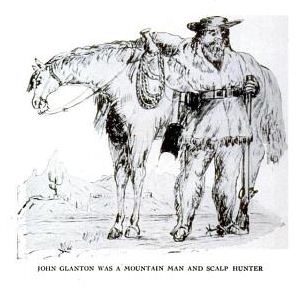
Chamberlain, much like the Kid, Blood Meridian’s erstwhile protagonist, ran away from home as a teenager. He joined the Illinois Second Volunteer Regiment and later fought in the Mexican-American War. Confession details Chamberlain’s involvement with John Glanton’s gang of scalp-hunters. The following summary comes from the University of Virginia’s American Studies webpage

According to Chamberlain, John Glanton was born in South Carolina and migrated to Stephen Austin’s settlement in Texas. There he fell in love with an orphan girl and was prepared to marry her. One day while he was gone, Lipan warriors raided the area scalping the elderly and the children and kidnapping the women- including Glanton’s fiancee. Glanton and the other settlers pursued and slaughtered the natives, but during the battle the women were tomahawked and scalped. Legend has it, Glanton began a series of retaliatory raids which always yielded “fresh scalps.” When Texas fought for its independence from Mexico, Glanton fought with Col. Fannin, and was one of the few to escape the slaughter of that regiment at the hands of the Mexican Gen. Urrea- the man who would eventually employ Glanton as a scalp hunter. During the Range Wars, Glanton took no side but simply assassinated individuals who had crossed him. He was banished, to no avail, by Gen. Sam Houston and fought as a “free Ranger” in the war against Mexico. Following the war he took up the Urrea’s offer of $50 per Apache scalp (with a bonus of $1000 for the scalp of the Chief Santana). Local rumor had it that Glanton always “raised the hair” of the Indians he killed and that he had a “mule load of these barbarous trophies, smoke-dried” in his hut even before he turned professional.

Chamberlain’s Confession also describes a  figure named Judge Holden. Again, from U of V’s summary–

Glanton’s gang consisted of “Sonorans, Cherokee and Delaware Indians, French Canadians, Texans, Irishmen, a Negro and a full-blooded Comanche,” and when Chamberlain joined them they had gathered thirty-seven scalps and considerable losses from two recent raids (Chamberlain implies that they had just begun their careers as scalp hunters but other sources suggest that they had been engaged in the trade for sometime- regardless there is little specific documentation of their prior activities). Second in command to Glanton was a Texan- Judge Holden. In describing him, Chamberlain claimed, “a cooler blooded villain never went unhung;” Holden was well over six feet, “had a fleshy frame, [and] a dull tallow colored face destitute of hair and all expression” and was well educated in geology and mineralogy, fluent in native dialects, a good musician, and “plum centre” with a firearm. Chamberlain saw him also as a coward who would avoid equal combat if possible but would not hesitate to kill Indians or Mexicans if he had the advantage. Rumors also abounded about atrocities committed in Texas and the Cherokee nation by him under a different name. Before the gang left Frontreras, Chamberlain claims that a ten year old girl was found “foully violated and murdered” with “the mark of a large hand on her throat,” but no one ever directly accused Holden.

It’s fascinating to note how much of the Judge is already there–the pedophilia, the marksmanship, the scholarship, and, most interesting of all, the lack of hair. Confession goes on to detail the killing, scalping, raping, and raiding spree that comprises the center of Blood Meridian. Chamberlain even describes the final battle with the Yumas, an event that signals the dissolution of the Glanton gang in McCarthy’s novel.

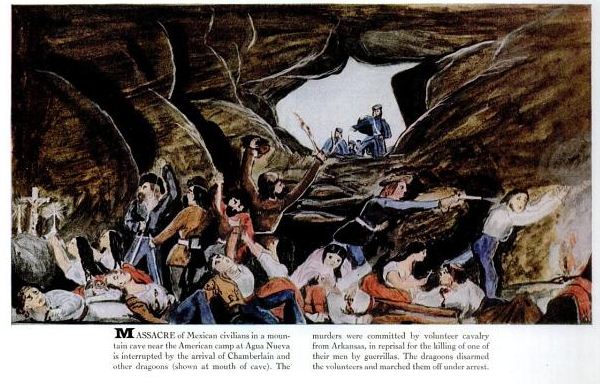
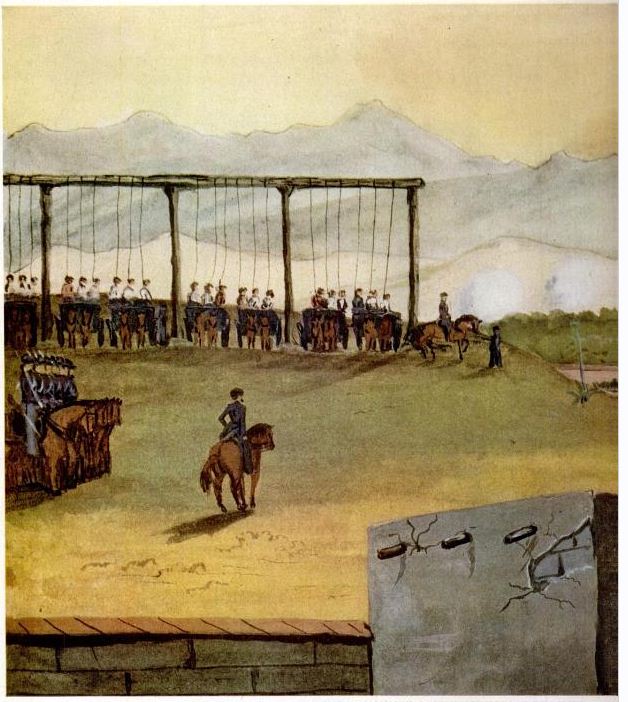
Content aside, Chamberlain’s prose also seems to presage McCarthy’s prose. In his book Different Travelers, Different Eyes, James H. Maguire notes that, “Both venereal and martial, the gore of [Chamberlain’s] prose evokes Gothic revulsion, while his unschooled art, with its stark architectural angles and leaden, keen-edged shadows, can chill with the surreal horrors of the later Greco-Italian painter Giorgio de Chirico.” Yes, Chamberlain was an amateur painter (find his paintings throughout this post), and undoubtedly some of this imagery crept into Blood Meridian.

You can view many of Chamberlain’s paintings and read an edit of his Confession in three editions of Life magazine from 1956, digitally preserved thanks to Google Books–here’s Part I, Part II, and Part III. Many critics have pointed out that Chamberlain’s narrative, beyond its casual racism and sexism, is rife with factual and historical errors. He also apparently indulges in the habit of describing battles and other events in vivid detail, even when there was no way he could have been there. No matter. The ugly fact is that books are made out of books, after all, and if Chamberlain’s Confession traffics in re-appropriating the adventure stories of the day, at least we have Blood Meridian to show for his efforts.

[Ed. note–Biblioklept first ran this post in September of 2010.]

Suttree, Cormac McCarthy’s Grand Synthesis of American Literature

In his 1992 interview with The New York Times, Cormac McCarthy said, “The ugly fact is books are made out of books. The novel depends for its life on the novels that have been written.” McCarthy’s fourth novel, 1979’s Suttree is such a book, a masterful synthesis of the great literature — particularly American literature — that came before it. And like any masterful synthesis, Suttree points to something new, even as it borrows, lifts, and outright steals from the past. But before we plumb its allusions and tropes and patterns, perhaps we should overview the plot, no?

The novel rambles over several years in the life of Cornelius Suttree. It is the early 1950s in Knoxville, Tennessee, and Suttree ekes out a mean existence on the Tennessee River as a fisherman, living in a ramshackle houseboat on the edge of a shantytown. This indigent life is in fact a choice: Suttree is the college-educated son of an established, wealthy family. His choice is a choice for freedom and self-reliance, those virtues we like to think of, in our prejudicial manner, as wholly and intrinsically American. Suttree then is both Emersonian and Huck Finnian, a reflective and insightful man who finds his soul via a claim to agency over his own individuality, an individuality poised in quiet, defiant rebellion against the conforming forces of civilization. These forces manifest most pointedly in the Knoxville police, a brutal, racist organization, but we also see social constraint in the form of familial duty. One thinks of the final lines of Huckleberry Finn: “I reckon I got to light out for the Territory ahead of the rest, because Aunt Sally she’s going to adopt me and sivilize me and I can’t stand it. I been there before.”

Like Huck, Suttree aims to resist all forces that would “sivilize” him. His time on the river and in the low haunts of Tennessee (particularly the vice-ridden borough of McAnally) brings him into close contact with plenty of other outcasts, but also his conscience, which routinely mulls over its place in the world. Suttree is punctuated by–perhaps even organized by–several scenes of hallucination. Some of these psychotrips result from drunkeness, one comes from accidentally ingesting the wrong kind of mushrooms (or, the right kind, if that’s your thing), and the final one, late in the novel, sets in as Suttree suffers from a terrible illness. In his fever dream, a small nun–surely a manifestation of the guilt that would civilize us–accuses him–

Mr. Suttree it is our understanding that at curfew rightly decreed by law in that hour wherein night draws to its proper close and the new day commences and contrary to conduct befitting a person of your station you betook yourself to various low places within the shire of McAnally and there did squander several ensuing years in the company of thieves, derelicts, miscreants, pariahs, poltroons, spalpeens, curmudgeons, clotpolls, murderers, gamblers, bawds, whores, trulls, brigands, topers, tosspots, sots and archsots, lobcocks, smellsmocks, runagates, rakes, and other assorted and felonious debauchees.

The passage is a marvelous example of McCarthy’s stream-of-consciousness technique in Suttree, moving through the various voices that would ventriloquize Suttree, into the edges of madness, strangeness, and the sublimity of language. The tone moves from somber and portentous into bizarre imagery that blends humor and pathos. This is the tone of Suttree, a language that gives voice to transients and miscreants, affirming the dignity of their humanity even as it details the squalor of their circumstance.

It is among these criminals and whores, transvestites and gamblers that Suttree affirms his own freedom and humanity, a process aided by his comic foil, Gene Harrogate. Suttree meets Harrogate on a work farm; the young hillbilly is sent there for screwing watermelons. After his release, Harrogate moves to a shantytown in Knoxville. He’s the country mouse determined to become the city rat, the would-be Tom Sawyer to Suttree’s older and wiser Huck Finn. Through Harrogate’s endless get-rich-quick schemes, McCarthy parodies that most-American of tales, the Horatio Alger story. Simply put, the boy is doomed, on his  “way up to the penitentiary” as Suttree constantly admonishes. In one episode, Harrogate tries to buy arsenic from “a grayhaired and avuncular apothecary” to poison bats he hopes to sell to a hospital (don’t ask)–

May I help you? said the scientist, his hands holding each other.

I need me some strychnine, said Harrogate.

You need some what?

Strychnine. You know what it is dont ye?

Yes, said the chemist.

I need me about a good cupful I reckon.

Are you going to drink it here or take it with you?

Shit fire I aint goin to drink it. It’s poisoner’n hell.

It’s for your grandmother.

No, said Harrogate, craning his neck suspectly. She’s done dead

Suttree, unwilling father-figure, eventually buys the arsenic for the boy against his better judgment. The scene plays out as a wonderful comic inversion of William Faulkner’s “A Rose for Emily,” from which it is so transparently lifted. McCarthy borrows liberally from Faulkner here, of course, most notably in the language and style of the novel, but also in scenes like this one, or a later episode that plays off Faulkner’s comic-romantic story of a man and a woman navigating the aftermath of a flood, “Old Man.” Unpacking the allusions in Suttree surpasses my literary knowledge or skill, but McCarthy is generous, if oblique, with his breadcrumb trail. Take, for example, the following sentence: “Suttree with his miles to go kept his eyes to the ground, maudlin and muttersome in the bitter chill, under the lonely lamplight.” The forced phrase “miles to go” does not immediately present itself as a reference to Robert Frost’s famous poem, yet the direction of the sentence retreats into the history of American poetry; with its dense alliteration and haunted vowels, it leads us into Edgar Allan Poe territory. Only a few dozen pages later, McCarthy boldly begins a chapter with theft: “In just spring the goatman came over the bridge . . .” The reference to e.e. cummings explicitly signifies McCarthy’s intentions to play with literature. Later in the book, while tripping on mushrooms in the mountains, Suttree is haunted by “elves,” the would-be culprits in Frost’s poem “Mending Wall.” The callback is purposeful, but tellingly, McCarthy’s allusions are not nearly as fanciful as their surface rhetoric might suggest: the goatman does not belong in Knoxville–he’s an archaic relic, forced out of town by the police; the elves are not playful spirits but dark manifestations of a tortured psyche.

Once one spots the line-lifting in Suttree it’s hard to not see it. What’s marvelous is McCarthy’s power to convert these lines, these riffs, these stories, into his own tragicomic beast. An early brawl at a roadhouse recalls the “Golden Day” episode of Ralph Ellison’s Invisible Man; a rape victim’s plight echoes Hubert Selby’s “Tralala”; we find the comic hobos of John Steinbeck’s Cannery Row–we even get the road-crossing turtle from The Grapes of Wrath. A later roadhouse chapter replays the “Circe/Nighttown” nightmare in James Joyce’s Ulysses. Ulysses is an easy point of comparison for Suttree, which does for Knoxville what Joyce did for Dublin. Suttree echoes Ulysses’s language, both in its musicality and appropriation of varied voices, as well as its ambulatory structure, its stream-of-consciousness technique, its rude earthiness, and its size (nearly 600 pages). But, as I argued earlier, there’s something uniquely American about Suttree, and its literary appropriations tend to reflect that. Hence, we find Mark Twain, Herman Melville, Ernest Hemingway, Walt Whitman, Emerson and Thoreau, Emily Dickinson, and William Carlos Williams, to name just a few writers whose blood courses through this novel (even elegant F. Scott Fitzgerald is here, in an unexpected Gatsbyish episode late in the novel).

Making a laundry list of writers is weak criticism though, and these sources–all guilty of their own proud plagiarisms–are mentioned only as a means to an end, to an argument that what McCarthy does in Suttree is to synthesize the American literary tradition with grace and humor, while never glossing over its inherent dangers and violence. So, while it appropriates and plays with the tropes of the past, Suttree is still pure McCarthy. Consider the following passage, which arrives at the end of a drunken, awful spree, Suttree locked up for the night–

He closed his eyes. The gray water that dripped from him was rank with caustic. By the side of a dark dream road he’d seen a hawk nailed to a barn door. But what loomed was a flayed man with his brisket tacked open like a cooling beef and his skull peeled, blue and bulbous and palely luminescent, black grots his eyeholes and bloody mouth gaped tonguless. The traveler had seized his fingers in his jaws, but it was not alone this horror that he cried. Beyond the flayed man dimly adumbrate another figure paled, for his surgeons move about the world even as you and I.

Suttree’s dark vision points directly toward the language of McCarthy’s next novel, 1985’s Blood Meridian, roundly considered his masterpiece. Critics who disagree tend to point to Suttree as the pinnacle of McCarthy’s writing. I have no interest at this time in weighing the books against each other, nor do I think that doing so would be especially enlightening. For all of their sameness, they are very different animals: Suttree provides us intense access to its hero’s consciousness, where Blood Meridian always keeps the reader on the outside of its principals’ souls (if those grotesques could be said to have souls). And while Blood Meridian does display some humor, it is the blackest and driest humor I’ve ever read. Suttree is broader and more compassionate; it even has a fart joke. Blood Meridian, at least in my estimation (and many critics will contend this notion) has no flawed episodes; much of this results from the book’s own internal program–it resists love, compassion, and even human dignity. In contrast, Suttree is punctuated by two deaths the audience is meant to read as tragic, yet I found it impossible to do so. The first is the death of Suttree’s child, whom he has abandoned, along with its mother. As such, he is not permitted to take part in the funeral, observing the process rather from its edges. The second tragedy is the death of Suttree’s young lover in a landslide. The book begs us to empathize with Suttree, just as he often empathizes with the marginal figures in the novel, but ultimately these tragedies are a failed ploy. They underwrite a sublime encounter with death for Suttree, an encounter that deepens and enriches his character while paradoxically freeing him from the burdens of social duty and familial order. McCarthy is hardly alone in such a move; indeed, it seems like the signature trope of American masculine literature to me. It’s the move that Huck Finn wishes to make when he promises to light out for the Territory to escape the civilizing body of Aunt Sally; it’s the ending that Hemingway was compelled to give to Frederic Henry at the end of A Farewell to Arms; it’s all of Faulkner, with his mortification of fatherhood and the dramatic responsibility fatherhood entails. It is a cost analysis that neglects any potential benefits.

But these are small criticisms of a large, beautiful, benevolent novel, a book that begs to be reread, a rambling picaresque of comic and tragic proportions. “I learned that there is one Suttree and one Suttree only,” our hero realizes, but this epiphany is set against a larger claim. Near the end of the novel, Suttree goes to check on an old ragman who he keeps a watchful eye on. He finds the man dead, his shack robbed, his body looted. Despairing over the spectacle’s abject lack of humanity, Suttree cries, “You have no right to represent people this way,” for “A man is all men. You have no right to your wretchedness.” Here, Suttree’s painful epiphany is real and true, an Emersonian insight coded in the darkest of Whitman’s language. If there is one Suttree and one Suttree only, he is still beholden to all men; to be anti-social or an outcast is not to be anti-human. Self-hood is ultimately conditional on others and otherness. To experience the other’s wretchedness is harrowing; to understand the other’s wretchedness and thus convert it to dignity is life-affirming and glorious. Suttree is a brilliant, bold, marvelous book. Very highly recommended.

[Ed. note—Biblioklept originally published a version of this review on November 27, 2010].


Letter to Oppenheimer | William Gaddis

New York City
4 January 1955
Dear Doctor Oppenheimer.

I have already taken a greater liberty than this, asking your attention to my letter, in having called Harcourt, Brace & Co., who are publishing a long novel I have written, to ask that they send you a copy. You must receive mail of all sorts, crank notes and fan letters of every description, but few I should think of half a million words. And since I can also well imagine that you seldom if ever read novels, if only for not having the time, it is an added imposition to have sent you such a bulky one.

But for having read your recent address at Columbia’s anniversary, I should never have presumed to do so. But I was so stricken by the succinctness, and the use of the language, with which you stated the problems which it has taken me seven years to assemble and almost a thousand pages to present, that my first thought was to send you a copy. And I do submit this book to you with deepest respect. Because I believe that The Recognitions was written about “the massive character of the dissolution and corruption of authority, in belief, in ritual and in temporal order, . . .” about our histories and traditions as “both bonds and barriers among us,” and our art which “brings us together and sets us apart.” And if I may go on presuming to use your words, it is a novel in which I tried my prolonged best to show “the integrity of the intimate, the detailed, the true art, the integrity of craftsmanship and preservation of the familiar, of the humorous and the beautiful” standing in “massive contrast to the vastness of life, the greatness of the globe, the otherness of people, the otherness of ways, and the all-encompassing dark.”

The book is a novel about forgery. I know that if you do get into it, you will find boring passages, offensive incidents, and some pretty painful sophomorics, all these in my attempts to present “the evils of superficiality and the terrors of fatigue” as I have seen them: I tried to present the shadowy struggle of a man surrounded by those who have “dissolved in a universal confusion,” those who “know nothing and love nothing.”

However you feel about the book, please allow my most humble congratulations on your address which provoked my taking the liberty of sending it to you, and in expression of my deepest admiration for men like yourself in the world you described.

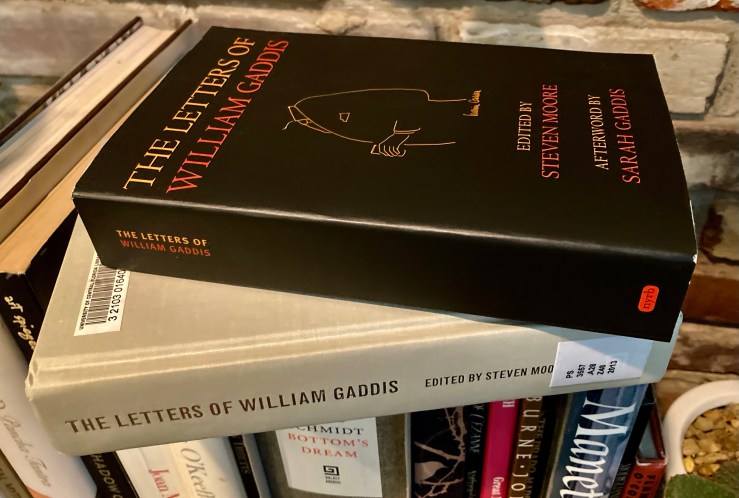
From The Letters of William Gaddis; ed. Steve Moore. Moore adds the following note: [American physicist (1904–67), known for his work on the atomic bomb. On 26 December 1954 he gave a lecture entitled “Prospects in the Arts and Sciences” at Columbia University’s bicentennial anniversary celebration, reprinted in his book The Open Mind (1955). The following letter is a corrected draft.]

You can read a version of “Prospects in the Arts and Sciences” here.

“A Way You’ll Never Be” — Ernest Hemingway

“A Way You’ll Never Be”

by

Ernest Hemingway


The attack had gone across the field, been held up by machine-gun fire from the sunken road and from the group of farm houses, encountered no resistance in the town, and reached the bank of the river. Coming along the road on a bicycle, getting off to push the machine when the surface of the road became too broken, Nicholas Adams saw what had happened by the position of the dead.

They lay alone or in clumps in the high grass of the field and along the road, their pockets out, and over them were flies and around each body or group of bodies were the scattered papers. Continue reading ““A Way You’ll Never Be” — Ernest Hemingway”

You know, I’ve never been entirely clear what “postmodern” means | Steve Erickson

Q. It’s interesting that you say your new book is surreal but not magical realism. You’ve said that you don’t consider your earlier books to be surrealistic. Why not?

A. Surrealism was born out of a preoccupation with the irrationality and illogic of the subconscious, and a view that human relationships are fundamentally absurd. Whatever else my books may be about, they don’t express an absurd view of existence. The form of the books, and the strange juxtapositions of their narratives, may strike people as surreal, but the central concerns that drive the stories are traditional ones. I don’t think any true surrealist would consider me a surrealist, in the same way no hard-core science-fiction fan would consider me a science-fiction writer, since the basic concern of most classic science fiction is the relationship between man and technology. Philip K. Dick and Theodore Sturgeon and a few others are exceptions. Technology is a completely valid and important topic to write about, but it just doesn’t happen to interest me. And my books aren’t “experimental” because my priorities don’t involve reinventing literary forms, and they’re not fantastic because they’re not characterized by the sense of wonder that fantasy evokes. I think it’s been hard for my novels to find a niche.

Q. Do you see your books as being postmodern?

A. You know, I’ve never been entirely clear what “postmodern” means. But to at least some extent postmodernism seems to involve a cultural or aesthetic self-awareness, and an insistence on art recognizing and tweaking its own artifice. My aim isn’t to call attention to the artifice of my books but to make readers forget the artifice, to persuade them to exchange their reality for the one I’ve created. I’m aware that trying to get readers to give themselves over to another reality is always doomed to failure. On the other hand, that’s the job of the novelist, to fail and fail again. The great hope isn’t to succeed-I’m not sure what success would really mean-but to risk everything, and perhaps to fail by narrower  margins, until there’s nothing left to fail with.

From a 1997 interview with novelist Steve Erickson. Larry McCaffery and Takayuki Tatsumi conducted the interview, which published in Contemporary Literature, Autumn, 1997, Vol. 38, No. 3.

“Wet” — Joy Williams

“Wet”

by

Joy Williams

from 99 Stories of God


The Lord was drinking some water out of a glass. There was nothing wrong with the glass, but the water tasted terrible.

This was in a white building on a vast wasteland. The engineers within wore white uniforms and booties on their shoes and gloves on their hands. The water had traveled many hundreds of miles through wide pipes to be here.

What have you done to my water? the Lord asked. My living water…

Oh, they said, we thought that was just a metaphor.

WET

“Mothers” — William Gaddis

“Mothers”

by

William Gaddis

When Ralph Waldo Emerson informed—or rather, perhaps, warned us—that we are what our mothers made us, we might dismiss it as received opinion and let it go at that, like the broken clock which is right twice a day, like the self-evident answer contained in Freud’s oft-quoted query “What do women want?” when, as nature’s handmaid, she must want what nature wants which is, quite simply, More. But which woman? Whose mother, Emerson’s? A woman so in thrall to religion that we confront another dead end; or Freud’s? or even one’s own, even mine, offering an opportune bit of wisdom to those of us engaged in the creative arts, where paranoia is almost an occupational hazard: “Bill, just try to remember,” she said, “there is much more stupidity than there is malice in the world,” an observation lavish with possibilities recalling Anatole France finding the fool more dangerous than the rogue because “the rogue does at least take a rest sometimes, the fool never.”

This is hardly to see stupidity and malice as mutually exclusive: look at your morning paper, where their combined forces explode exponentially (women and children first) from Bosnia to Belfast, unlike the international “intelligence community” so self-contained in its malice-free exercises that it generally ensnares only its own dubious cast of players. Of further importance is the distinction between stupidity and ignorance, since ignorance is educable, while stupidity’s self-serving mission is the cultivation and exploitation of ignorance, as politicians are keenly aware.

How, then, might Emerson’s mother have seen herself stumbling upon Thomas Carlyle’s vision of her son as a “hoary-headed and toothless baboon”? Or Freud’s, in the gross unlikelihood of her reading the Catholic World’s review of her son’s book Moses and Monotheism as “poorly written, full of repetitions . . . and spoiled by the author’s atheistic bias and his flimsy psychoanalytic fancies”? Goethe’s Wilhelm Meister dismissed as “sheer nonsense” by the Edinburgh Review and, a good century later, the hero of Saul Bellow’s Dangling Man ridiculed as a “pharisaical stinker” in Time magazine, John Barth’s The End of the Road recommended by Kirkus Reviews “for those schooled in the waste matter of the body and the mind,” and William Faulkner’s Absalom, Absalom! shrugged off as the “final blowup of what was once a remarkable, if minor, talent” by The New Yorker magazine where, just forty years later, “a group of avant-garde critics has put forward the idea that books should be made unreadable. This movement has manifest advantages. Being unreadable, the text repels reviewers, critics, anthologists, academic literati, and other parasitical forms of life,” indicting the author of the novel J R wherein “to produce an unreadable text, to sustain this foxy purpose over 726 pages, demands rare powers. Mr. Gaddis has them.” “You’re a fool, a fool!” the distraught mother of Dostoevski’s ill-fated hero Nikolay Stavrogin cries out at the “parasitical forms of life” surrounding her. “You’re all ungrateful fools. Give me my umbrella!”

(“Mothers” is collected in The Rush to Second Place).

I am on kind of a Borges kick (Thomas Pynchon)

sq69phy

g7cznmh

More Thomas Pynchon letters here. Via Reddit user Forest Limit.