A first riff on rereading Gravity’s Rainbow (and some thoughts on Weisenburger’s Companion)

I enjoy rereading more than reading. Returning to Moby-Dick2666, Ulysses, or Blood Meridian reveals so much more: More depth, more art, more structure, more precision, more humor, more pain, more more.

Thomas Pynchon’s novel Gravity’s Rainbow is all more. Rereading Gravity’s Rainbow is like reading it for the first time, or, rather, more precisely, that is how I am experiencing it now—with clarity—compelled as I was to immediately circle back through its loop again.

Gravity’s Rainbow’s cohesion hides (hides is not the right verb) under detritus, in the flux of objects and concepts that tangle and unravel throughout the text. Indeed, the novel’s themes seem to repeat (with difference, with opposition) in the lists and rants that lard it.

A simple, early example comes on page 18, where Teddy Bloat turns spying eyes over our hero Tyrone Slothrop’s desk, where “Things have fallen roughly into layers, over a base of bureaucratic smegma that sifts steadily to the bottom…” In A Gravity’s Rainbow Companion: Sources and Contexts for Pynchon’s Novel, Steven Weisenburger points out that “Among the list of objects on Slothrop’s desk are items, allusions, and brand names left in his wake throughout the novel.” Weisenburger proceeds to sift through these layers, pointing out connections, and offering (as always) helpful page numbers which attest how damn precise Pynchon’s novel is.

I picked up Weisenburger’s Companion on solicited recommendations from Twitter folk and readers of this blog, and I’ve found it unobtrusive and helpful so far. Weisenburger’s introductory essay is especially good, and foregrounds his intertextual approach to his Companion (he all but namechecks Mikhail Bakhtin: “Gravity’s Rainbow sets in motion ‘the Night’s Mad Carnvival’ (V133.38) of intertextual entertainments”; a few lines later, he describes the novel as a work of “encyclopedic heteroglossia”). Weisenburger also quickly helped to (re)confirm my sense that GR loops back into itself, its end cycling back to its beginning: “Gravity’s Rainbow is ‘heterocyclic’ (V249.26): rings are looped together in still larger, polymerized rings, looped together in the still larger cycling of its four parts.”

I’m about halfway through the second of those four parts, “Un Perm’ au Casino Hermann Goering,” but still playing catch-up with the Weisenburger. I sometimes skim—sometimes with undue pride (Hey I got that reference on my own, thanks anyway Dr. W), and sometimes, admittedly with a vague but cheerful boredom (Weisenburger has an occasional tendency to lay out Pynchon’s source texts in detailed detail).

The Companion is at its finest, in my estimation, when Weisenburger extrapolates from his sources and contexts into GR’s deepest themes, like here, where our introduction to Gottfried (a seemingly minor character) branches into etymology, mythology, and comparative religion:

image

(My favorite moment here is probably where Dr. W poses that question about Pynchon knowing Branston and Grimm, and then immediately answers it (in what I like to pretend is Robert Evans’s voice)).

While Weisenburger’s Companion often enlightens and clarifies, so does simply (or not so simply) rereading Gravity’s Rainbow enlighten and clarify the first reading. I’m thankful that I didn’t use Weisenburger’s book on my first full trip though GR. Sure, Companion hazards a number of plot spoilers, which I imagine would annoy many readers. But more significant to me is that using Weisenburger’s annotations as a first-timer’s guide through Pynchon’s detritus would have likely spoiled the aesthetic effect of that detritus. It would likely have spoiled some of the richness in the rereading that I’m enjoying so very much now.

Read Kurt Vonnegut’s early story “2 B R 0 2 B”


“2 B R 0 2 B”

by

Kurt Vonnegut

Everything was perfectly swell.

There were no prisons, no slums, no insane asylums, no cripples, no poverty, no wars.

All diseases were conquered. So was old age.

Death, barring accidents, was an adventure for volunteers.

The population of the United States was stabilized at forty-million souls.

One bright morning in the Chicago Lying-in Hospital, a man named Edward K. Wehling, Jr., waited for his wife to give birth. He was the only man waiting. Not many people were born a day any more.

Wehling was fifty-six, a mere stripling in a population whose average age was one hundred and twenty-nine.

X-rays had revealed that his wife was going to have triplets. The children would be his first.

Young Wehling was hunched in his chair, his head in his hand. He was so rumpled, so still and colorless as to be virtually invisible. His camouflage was perfect, since the waiting room had a disorderly and demoralized air, too. Chairs and ashtrays had been moved away from the walls. The floor was paved with spattered dropcloths.

The room was being redecorated. It was being redecorated as a memorial to a man who had volunteered to die.

A sardonic old man, about two hundred years old, sat on a stepladder, painting a mural he did not like. Back in the days when people aged visibly, his age would have been guessed at thirty-five or so. Aging had touched him that much before the cure for aging was found.

The mural he was working on depicted a very neat garden. Men and women in white, doctors and nurses, turned the soil, planted seedlings, sprayed bugs, spread fertilizer.

Men and women in purple uniforms pulled up weeds, cut down plants that were old and sickly, raked leaves, carried refuse to trash-burners.

Never, never, never—not even in medieval Holland nor old Japan—had a garden been more formal, been better tended. Every plant had all the loam, light, water, air and nourishment it could use.

A hospital orderly came down the corridor, singing under his breath a popular song:

If you don’t like my kisses, honey,
Here’s what I will do:
I’ll go see a girl in purple,
Kiss this sad world toodle-oo.
If you don’t want my lovin’,
Why should I take up all this space?
I’ll get off this old planet,
Let some sweet baby have my place.

The orderly looked in at the mural and the muralist. “Looks so real,” he said, “I can practically imagine I’m standing in the middle of it.”

“What makes you think you’re not in it?” said the painter. He gave a satiric smile. “It’s called ‘The Happy Garden of Life,’ you know.”

“That’s good of Dr. Hitz,” said the orderly. Continue reading “Read Kurt Vonnegut’s early story “2 B R 0 2 B””

“You, Hart Crane” — Charles Olson

Screenshot 2015-04-20 at 8.30.25 PM

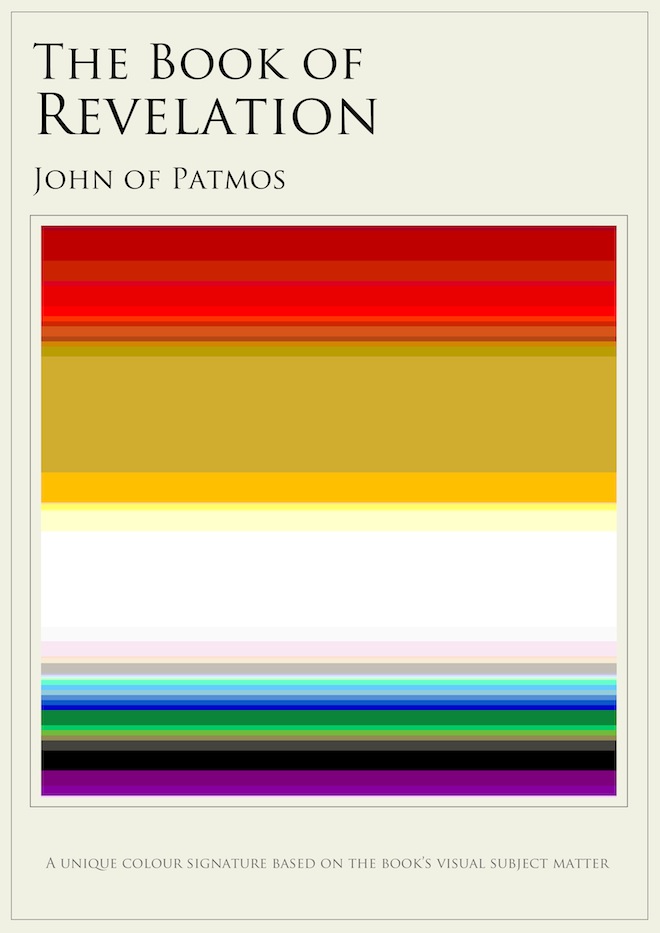
Cool color signature covers

book-The-Road

Cool article from Wired (yeah it’s a few years old now but hey) about artist Jaz Parkinson, who indexed the references to colors in various novels and created visual signatures of them. From the article

 Jaz Parkinson, an art student from England, was curious about how the written imagery in the work would translate into color, so she decided to chart the color signatures of some of her favorite books.

Using the color-related data pulled from novels, Parkinson visualized how famous books would look if you could only read them through a visual signature. “I think the charts are beautiful and informative, which is a very special mix of the subjective and the objective,” she says. “They reveal a new dataset which hasn’t been associated with the book before.”
book-The-Little-Prince book-Revelation

Subtraction from reality

At The Reading Experience, Daniel Green reviews David Winters’s Infinite Fictions. From the review:

Reckoning with literary qualities is something Winters does exceptionally well. Most of the books discussed in the first section of Infinite Fictions (“On Literature”) are complex, unconventional works of fiction, and Winters is painstaking in attempting to describe the strategies the author at hand seems to be using, to account for the effect of reading the work as registered in Winters’s own experience of it. As he says in the introduction to the book, “As a reviewer, all I can do is try to stay true to the texture of that experience. . . Strange as it sounds, each of these books briefly allowed me to subtract myself from reality. In this respect, when writing reviews, I’m less intent on making prescriptions than on exploring the space left by my subtraction.” Thus Winters attends to the specificity of the reading experience itself, something academic criticism generally abjures, while also avoiding the superficial approach of the most “trivial” kind of book reviews, the kind that aim merely to “make prescriptions.”

“Subtraction” from reality perhaps seems like a version of being “immersed” in a book, but I would presume Winters means something closer to what John Dewey called “pure experience,” which Dewey believed becomes most accessible to us as aesthetic experience.  According to Dewey, aesthetic experience is “experience freed from the forces that impede and confuse its development as experience; freed, that is, from factors that subordinate an experience as it is directly had to something beyond itself.” The reader truly receptive to the kind of experience art, in this case literary art, makes available is not in some kind of mystical trance but is fully engaged in an act of what Dewey calls “recreation,” perceiving the writer’s conceptual and expressive moves thoroughly enough that the reader in effect replays those moves. Literary criticism then becomes in part the attempt to communicate the tenor of this reading experience through the most felicitous description and analytical insight the critic can muster.

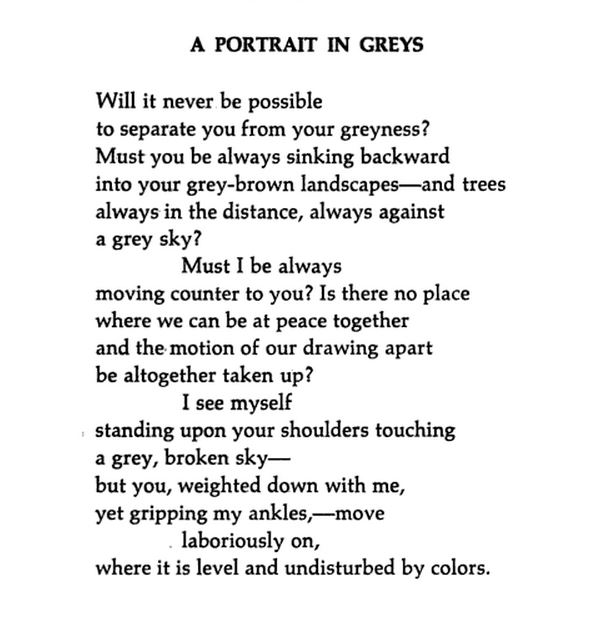
“A Portrait in Greys” — William Carlos Williams

Capture

Leonora Carrington in the LRB

 spaw01_3708_04

The Temptation of St. Antony, Leonora Carrington

Nice piece by Alice Sprawls on Leonora Carrington (whose work is now on display in the Tate) in The London Review of Books today. Excerpt:

Domesticity in Carrington’s paintings and stories is the scene of Ovidian and spiritual transformations; cooking was a sort of alchemy, like painting, and she began increasingly to use egg tempera – influenced by paintings she had seen in Siena but also by its almost culinary processes (separating the egg yolk, adding wine or vinegar then water and pigment). She refused to explain her personal symbolism, but called reading The White Goddess ‘the greatest revelation of my life’. The figure of the muse, Robert Graves’s ‘Mother of all Living, the ancient power of fright and lust’, became less burdensome as manifested in The Giantess (c.1950), whose colossal central figure towers over the scene like a Madonna della Misericordia. She cradles an egg; geese fly out from beneath her pallium; her golden hair is a field of wheat. Around her feet a hunt is taking place – Uccello’s Hunt in the Forest but with a sylph instead of a stag – while the sea behind is teeming with boats, whales, crabs and bizarre creatures like monsters on a medieval map.

From 1950 the paintings become even more fantastical. Many are dominated by bald, spectral white figures: the Sidhe of Irish legends her grandmother told her. In Darvault(1950), Carrington’s two sons by Weisz, Pablo and Gabriel, stand in a de Chirico-esque courtyard, pale and cloaked with small plants growing from their heads. Is Carrington the feline figure in the apron with the elaborate white headdress and whiskers? InDown Below Carrington had described the worldview of her madness – ‘the father was the planet Cosmos, represented by the planet Saturn: the son was the Sun and I the Moon, an essential element of the Trinity, with a microscopic knowledge of the earth’ – and in Mexico she incorporated more and more elements of myth and occultism into her works; not just the Catholicism and Celtic stories of her childhood but astrological and Egyptian imagery, cabbala, Tibetan Buddhism, tarot.

I write only for myself (Dostoevsky)

Every man has reminiscences which he would not tell to every one, but only to his friends. He has other matters in his mind which he would not reveal even to his friends, but only to himself, and that in secret. But there are other things which a man is afraid to tell even to himself, and every decent man has a number of such things stored away in his mind. The more decent he is, the greater the number of such things in his mind. Anyway, I have only lately determined to remember some of my early adventures. Till now I have always avoided them, even with a certain uneasiness. Now, when I am not only recalling them, but have actually decided to write an account of them, I want to try the experiment whether one can, even with oneself, be perfectly open and not take fright at the whole truth. I will observe, in parenthesis, that Heine says that a true autobiography is almost an impossibility, and that man is bound to lie about himself. He considers that Rousseau certainly told lies about himself in his confessions, and even intentionally lied, out of vanity. I am convinced that Heine is right; I quite understand how sometimes one may, out of sheer vanity, attribute regular crimes to oneself, and indeed I can very well conceive that kind of vanity. But Heine judged of people who made their confessions to the public. I write only for myself, and I wish to declare once and for all that if I write as though I were addressing readers, that is simply because it is easier for me to write in that form. It is a form, an empty form—I shall never have readers. I have made this plain already….

From Fyodor Dostoevsky’s novel Notes from Underground. English translation by Constance Garnett.

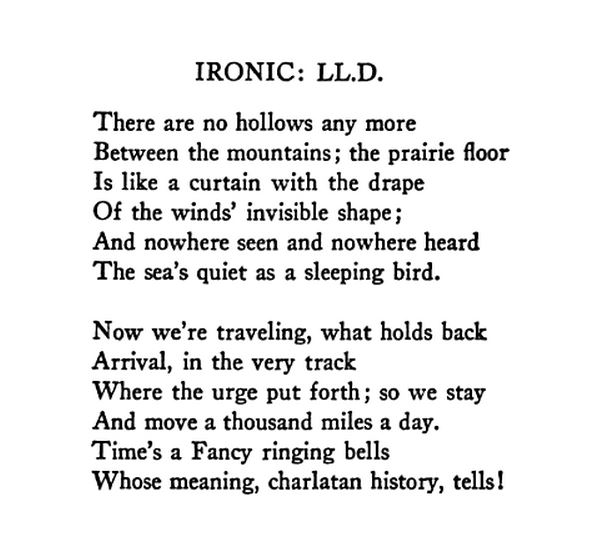
“Ironic: LL.D” — William Stanley Braithwaite

Capture

“How Nuth Would Have Practised His Art upon the Gnoles” — Lord Dunsany

“How Nuth Would Have Practised His Art upon the Gnoles”

by

Lord Dunsany

Despite the advertisements of rival firms, it is probable that every tradesman knows that nobody in business at the present time has a position equal to that of Mr. Nuth. To those outside the magic circle of business, his name is scarcely known; he does not need to advertise, he is consummate. He is superior even to modern competition, and, whatever claims they boast, his rivals know it. His terms are moderate, so much cash down when the goods are delivered, so much in blackmail afterwards. He consults your convenience. His skill may be counted upon; I have seen a shadow on a windy night move more noisily than Nuth, for Nuth is a burglar by trade. Men have been known to stay in country houses and to send a dealer afterwards to bargain for a piece of tapestry that they saw there—some article of furniture, some picture. This is bad taste: but those whose culture is more elegant invariably send Nuth a night or two after their visit. He has a way with tapestry; you would scarcely notice that the edges had been cut. And often when I see some huge, new house full of old furniture and portraits from other ages, I say to myself, “These mouldering chairs, these full-length ancestors and carved mahogany are the produce of the incomparable Nuth.”

It may be urged against my use of the word incomparable that in the burglary business the name of Slith stands paramount and alone; and of this I am not ignorant; but Slith is a classic, and lived long ago, and knew nothing at all of modern competition; besides which the surprising nature of his doom has possibly cast a glamour upon Slith that exaggerates in our eyes his undoubted merits. Continue reading ““How Nuth Would Have Practised His Art upon the Gnoles” — Lord Dunsany”

Hemingway died one day and Pynchon was born the next (DeLillo on Pynchon)

It was as though, in some odd quantum stroke, Hemingway died one day and Pynchon was born the next. One literature bends into another. Pynchon has made American writing a broader and stronger force. He found whispers and apparitions at the edge of modern awareness but did not lessen our sense of the physicality of American prose, the shotgun vigor, the street humor, the body fluids, the put-on.

I was writing ads for Sears truck tires when a friend gave me a copy of V. in paperback. I read it and thought, Where did this come from?

The scale of his work, large in geography and unafraid of major subjects, helped us locate our fiction not only in small anonymous corners, human and ever-essential, but out there as well, in the sprawl of high imagination and collective dreams.

Don DeLillo on Thomas Pynchon. From the Summer 2005 issue of Bookforum.

“Greville Fane” — Henry James


“Greville Fane”

by

Henry James

Coming in to dress for dinner, I found a telegram: “Mrs. Stormer dying; can you give us half a column for to-morrow evening?  Let her off easy, but not too easy.”  I was late; I was in a hurry; I had very little time to think, but at a venture I dispatched a reply: “Will do what I can.”  It was not till I had dressed and was rolling away to dinner that, in the hansom, I bethought myself of the difficulty of the condition attached.  The difficulty was not of course in letting her off easy but in qualifying that indulgence.  “I simply won’t qualify it,” I said to myself.  I didn’t admire her, but I liked her, and I had known her so long that I almost felt heartless in sitting down at such an hour to a feast of indifference.  I must have seemed abstracted, for the early years of my acquaintance with her came back to me.  I spoke of her to the lady I had taken down, but the lady I had taken down had never heard of Greville Fane.  I tried my other neighbour, who pronounced her books “too vile.”  I had never thought them very good, but I should let her off easier than that.

I came away early, for the express purpose of driving to ask about her.  The journey took time, for she lived in the north-west district, in the neighbourhood of Primrose Hill.  My apprehension that I should be too late was justified in a fuller sense than I had attached to it—I had only feared that the house would be shut up.  There were lights in the windows, and the temperate tinkle of my bell brought a servant immediately to the door, but poor Mrs. Stormer had passed into a state in which the resonance of no earthly knocker was to be feared.  A lady, in the hall, hovering behind the servant, came forward when she heard my voice.  I recognised Lady Luard, but she had mistaken me for the doctor.

“Excuse my appearing at such an hour,” I said; “it was the first possible moment after I heard.”

“It’s all over,” Lady Luard replied.  “Dearest mamma!”

She stood there under the lamp with her eyes on me; she was very tall, very stiff, very cold, and always looked as if these things, and some others beside, in her dress, her manner and even her name, were an implication that she was very admirable.  I had never been able to follow the argument, but that is a detail.  I expressed briefly and frankly what I felt, while the little mottled maidservant flattened herself against the wall of the narrow passage and tried to look detached without looking indifferent.  It was not a moment to make a visit, and I was on the point of retreating when Lady Luard arrested me with a queer, casual, drawling “Would you—a—would you, perhaps, be writing something?”  I felt for the instant like an interviewer, which I was not.  But I pleaded guilty to this intention, on which she rejoined: “I’m so very glad—but I think my brother would like to see you.”  I detested her brother, but it wasn’t an occasion to act this out; so I suffered myself to be inducted, to my surprise, into a small back room which I immediately recognised as the scene, during the later years, of Mrs. Stormer’s imperturbable industry.  Her table was there, the battered and blotted accessory to innumerable literary lapses, with its contracted space for the arms (she wrote only from the elbow down) and the confusion of scrappy, scribbled sheets which had already become literary remains.  Leolin was also there, smoking a cigarette before the fire and looking impudent even in his grief, sincere as it well might have been. Continue reading ““Greville Fane” — Henry James”

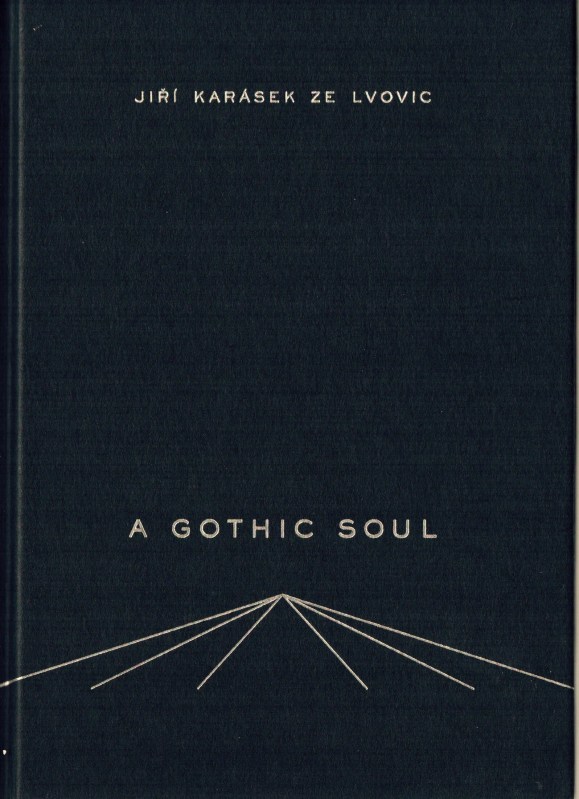
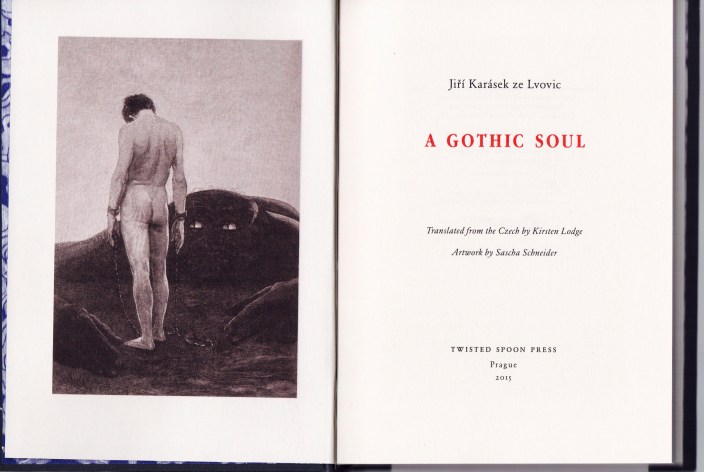
Jiří Karásek ze Lvovic’s A Gothic Soul (Book acquired, 3.30.2015)

image

Another beautiful volume from Twisted SpoonA Gothic Soul by Jiří Karásek ze Lvovic, translated from the Czech by Kirsten Lodge, featuring prints by Sascha Schneider.

I dipped my toe in this weekend—strange, brooding stuff. More to come.

image

Twisted Spoon’s blurb:

A Gothic Soul is the most acclaimed work of Czech Decadent prose. Expressing concerns that are unique to the Czech movement while alluding creatively and ironically to Joris-Karl Huysman’s Against Nature, the novella is set in Prague, which is portrayed as a dead city, a city peopled by shades, who, like the protagonist — a nihilist and the “last scion of a noble line” — are only a dim reflection of the city’s medieval splendor. The man lives in a dreamworld, the labyrinth of his soul giving rise to visions. In his quest for meaning, he walks the city, often hallucinating, while pondering questions of religious fervor and loss of faith, the vanity of life, his own sense of social alienation, human identity and its relationship to a “nation,” the miserable situation of the Czechs under Habsburg rule, and Prague’s loss of its soul on the cusp of modernity as old sections, such as much of the squalid Jewish Quarter, are demolished to make way for gaudy new buildings and streets. With a history of madness running in the family and afraid the same fate awaits him, he ultimately retreats into seclusion, preferring the monastic way of life as the epitome of unity and wholeness and a tonic to present-day fragmentation. Yet Karásek eschews the mawkish, opting instead for darker tones that play with the tropes and motifs of Decadence while conflating the same-sex desires of his protagonist, the fatalism and futility of such an existence within the social construct of the day, with concerns for the dual fates of his nation and city.

Given his importance for Czech literature and for European Decadence, very little of Karásek’s work has been translated into English. Kirsten Lodge included translations of his poetry in Solitude, Vanity, Night: An Anthology of Czech Decadent Poetry, and we have made available her translations of some of his shorter prose here and here. This is the first time A Gothic Soul, or any full-length work of Karásek’s prose, has been translated into English.

As birds as well as words (Gertrude Stein on the way Chaucer sounds)

You do remember Chaucer, even if you have not read him you do remember not how it looks but how it sounds, how simply it sounds as it sounds. That is as I say because the words were there. They had not yet to be chosen, they had only has yet to be there just there.

That makes a sound that gently sings that gently sounds but sounds as sounds. It sounds as sounds of course as words but it sounds as sounds. It sounds as sounds that is to say as birds as well as words. And that is because the words are there, they are not chosen as words, they are already there. That is the way Chaucer sounds.

From Gertrude Stein’s lecture “What Is English Literature” (no question mark); collected in Look at Me Now and Here I Am.

“Someone who has 500 friends, has no friends” — Günter Grass on Facebook

“A Worn Path” — Eudora Welty

“A Worn Path”

by

Eudora Welty

It was December—a bright frozen day in the early morning. Far out in the country there was an old Negro woman with her head tied red rag, coming along a path through the pinewoods. Her name was Phoenix Jackson. She was very old and small and she walked slowly in the dark pine shadows, moving a little from side to side in her steps, with the balanced heaviness and lightness of a pendulum in a grand-father clock. She carried a thin, small cane made from an umbrella, and with this she kept tapping the frozen earth in front of her. This made a grave and persistent noise in the still air, that seemed meditative like the chirping of a solitary little bird.

She wore a dark striped dress reaching down to her shoe tops, and an equally long apron of bleached sugar sacks, with a full pocket: all neat and tidy, but every time she took a step she might have fallen over her shoelaces, which dragged from her unlaced shoes. She looked straight ahead. Her eyes were blue with age. Her skin had a pattern all its own of numberless branching wrinkles and as though a whole little tree stood in the middle of her forehead, but a golden color ran underneath, and the two knobs of her cheeks were illumined by a yellow burning under the dark. Under the red rag her hair came down on her neck in the frailest of ringlets, still black, and with an odor like copper.

Now and then there was a quivering in the thicket. Old Phoenix said, “Out of my way, all you foxes, owls, beetles, jack rabbits, coons and wild animals!. . . Keep out from under these feet, little bob-whites…. Keep the big wild hogs out of my path. Don’t let none of those come running my direction. I got a long way.” Under her small black-freckled hand her cane, limber as a buggy whip, would switch at the brush as if to rouse up any hiding things.

On she went. The woods were deep and still. The sun made the pine needles almost too bright to look at, up where the wind rocked. The cones dropped as light as feathers. Down in the hollow was the mourning dove—it was not too late for him.

The path ran up a hill. “Seem like there is chains about my feet, time I get this far,” she said, in the voice of argument old people keep to use with themselves. “Something always take a hold of me on this hill— pleads I should stay.” Continue reading ““A Worn Path” — Eudora Welty”

Riff on the end/beginning of Gravity’s Rainbow

Well: “A screaming comes across the sky. It has happened before [—]”

□ □ □ □ □ □ □

So. Okay. So I finished Gravity’s Rainbow on Friday night, and reread the opening section (and more than the opening section) on Saturday morning, resisting a compulsion to immediately return to the beginning.

□ □ □ □ □ □ □

So: Okay: Right?

The ending of Gravity’s Rainbow cycles back to the beginning (like Finnegans Wake): Blicero’s rocket, screaming across the sky—yes? no?—to invade the dreams (?) of psychic Pirate Prentice? The book: a loop, a Möbius strip, a film, its reels discombobulated, jostled, scattered

□ □ □ □ □ □ □

“…it’s all theatre,” we learn on the book’s first page (page 3); the book ends in a theater—the Orpheus Theater!—where maybe scattered Slothrop is the leading man, scattered, we find ourselves in him, parts of him—where the audience demands, on the book’s last page: “Start-the-show!”

□ □ □ □ □ □ □

“You’re putting response before stimulus,” Spectro shakes his head at Pointsman, early in “Beyond the Zero,” the first section of Gravity’s Rainbow—does this describe the beginning/end of the novel? (“It has happened before”).

□ □ □ □ □ □ □

Or, a bit earlier even, at the seance, (page 32), Gloaming describes one kind of plot: “…we should get something like a straight line” — but then gives us another kind of plot — “…however we’ve data that suggest the curves for certain —conditions, well they’re actually quite different—schizophrenics for example tend to run a bit flatter in the upper part then progressively steeper—a sort of bow shape … classical paranoiac—” Is this the shape of Gravity’s Rainbow?

□ □ □ □ □ □ □

—but right this moment it’s that final dash that intrigues me—this in a novel full of dashes, this in a novel that name-checks Emily Dickinson, Eternal Empress of Dashes—the fragmented conclusion is full of dashes, lines obliterated by more perfect, straight lines, simultaneously connecting and disconnecting—like the novel’s final line:

“Now everybody—“

□ □ □ □ □ □ □ Continue reading “Riff on the end/beginning of Gravity’s Rainbow”