Read “Tony and the Beetles,” an early short story by Philip K. Dick

illus

“Tony and the Beetles”

by

Philip K. Dick

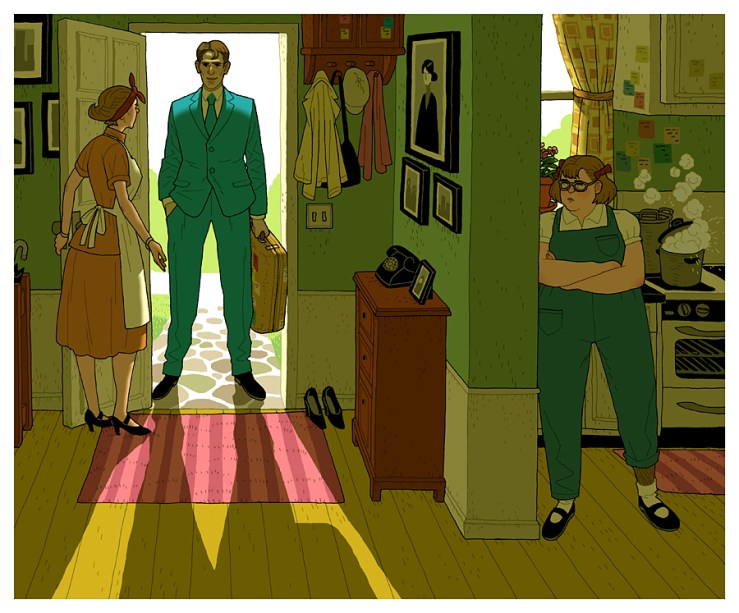
Reddish-yellow sunlight filtered through the thick quartz windows into the sleep-compartment. Tony Rossi yawned, stirred a little, then opened his black eyes and sat up quickly. With one motion he tossed the covers back and slid to the warm metal floor. He clicked off his alarm clock and hurried to the closet.

It looked like a nice day. The landscape outside was motionless, undisturbed by winds or dust-shift. The boy’s heart pounded excitedly. He pulled his trousers on, zipped up the reinforced mesh, struggled into his heavy canvas shirt, and then sat down on the edge of the cot to tug on his boots. He closed the seams around their tops and then did the same with his gloves. Next he adjusted the pressure on his pump unit and strapped it between his shoulder blades. He grabbed his helmet from the dresser, and he was ready for the day.

In the dining-compartment his mother and father had finished breakfast. Their voices drifted to him as he clattered down the ramp. A disturbed murmur; he paused to listen. What were they talking about? Had he done something wrong, again?

And then he caught it. Behind their voices was another voice. Static and crackling pops. The all-system audio signal from Rigel IV. They had it turned up full blast; the dull thunder of the monitor’s voice boomed loudly. The war. Always the war. He sighed, and stepped out into the dining-compartment.

“Morning,” his father muttered.

“Good morning, dear,” his mother said absently. She sat with her head turned to one side, wrinkles of concentration webbing her forehead. Her thin lips were drawn together in a tight line of concern. His father had pushed his dirty dishes back and was smoking, elbows on the table, dark hairy arms bare and muscular. He was scowling, intent on the jumbled roar from the speaker above the sink.

“How’s it going?” Tony asked. He slid into his chair and reached automatically for the ersatz grapefruit. “Any news from Orion?”

Neither of them answered. They didn’t hear him. He began to eat his grapefruit. Outside, beyond the little metal and plastic housing unit, sounds of activity grew. Shouts and muffled crashes, as rural merchants and their trucks rumbled along the highway toward Karnet. The reddish daylight swelled; Betelgeuse was rising quietly and majestically. Continue reading “Read “Tony and the Beetles,” an early short story by Philip K. Dick”

“Valley Candle” — Wallace Stevens

Screenshot 2015-04-11 at 4.08.02 PM

Just when I was on the point of choking with a huge German word (Nathaniel Hawthorne’s journal entry, 11 April 1843)

April 11th.–I meditated accordingly, but without any very wonderful result. Then at eight o’clock bothered myself till after nine with this eternal tale of Tieck. The forenoon was spent in scribbling; but at eleven o’clock my thoughts ceased to flow,–indeed, their current has been wofully interrupted all along,–so I threw down my pen, and set out on the daily journey to the village. Horrible walking! I wasted the customary hour at the Athenæum, and returned home, if home it may now be called. Till dinner-time I labored on Tieck’s tale, and resumed that agreeable employment after the banquet.

Just when I was on the point of choking with a huge German word, Molly announced Mr. Thoreau. He wished to take a row in the boat, for the last time, perhaps, before he leaves Concord. So we emptied the water out of her, and set forth on our voyage. She leaks, but not more than she did in the autumn. We rowed to the foot of the hill which borders the North Branch, and there landed, and climbed the moist and snowy hill-side for the sake of the prospect. Looking down the river, it might well have been mistaken for an arm of the sea, so broad is now its swollen tide; and I could have fancied that, beyond one other headland, the mighty ocean would outspread itself before the eye. On our return we boarded a large cake of ice, which was floating down the river, and were borne by it directly to our own landing-place, with the boat towing behind.

Parting with Mr. Thoreau, I spent half an hour in chopping wood, when Molly informed me that Mr. Emerson wished to see me. He had brought a letter of Ellery Channing, written in a style of very pleasant humor. This being read and discussed, togetherwith a few other matters, he took his leave, since which I have been attending to my journalizing duty; and thus this record is brought down to the present moment.

From Nathaniel Hawthorne’s American Note-Books.

Lydia Davis on Thomas Pynchon

A rather appealing specimen of early Pynchon is the last story in his collection Slow Learner. The story, “The Secret Integration”—first published in the Saturday Evening Post more than forty years ago (three years after V. appeared)—involves a gang of young practical jokers and a rich childhood setting of an old town with a new development, a sprawling estate with a derelict mansion, and a downtown, complete with seedy hotel. In one deftly described scene, the boys coast on their bikes down a long hill in the early evening toward the hotel, “leaving behind two pages of arithmetic homework and a chapter of science” and, on the TV, “a lousy movie, some romantic comedy.” Because all the televisions in town receive only one channel, the boys, as they fly by, are able to follow the movie’s progress from house to house, through doors and windows “still open for the dark’s first coolness.”

In his introduction to Slow Learner, Pynchon, who somewhat preempts our reactions to the story, remarks that he likes it more than he dislikes it. In fact it is so likable that one envies the boys their comfortable society and the fields, streams, and town of their games. Their collaboration and apportioning of assignments is charming (to develop an arsenal for sabotaging the railroad; to enlist malcontent first-graders to destroy the boys’ latrine; to infiltrate PTA meetings); the elaborateness of their schemes, and the number that succeed, is impressive; and the animation of the central character, Grover the boy genius—with his enormous vocabulary, fund of information, and flights of hilarity—is particularly savory. The pranks the boys plan are potentially devastating to the community, yet, as Pynchon says in a lovely bit of writing, the boys would never actually take “any clear or irreversible step,” because “everybody on the school board, and the railroad, and the PTA and paper mill had to be somebody’s mother or father, whether really or as a member of a category; and there was a point at which the reflex to their covering warmth, protection, effectiveness against bad dreams, bruised heads and simple loneliness took over and made worthwhile anger with them impossible.”

There is a lyrical humanity in this story, an almost unapologetic gentleness, inviting and inclusive, that contrasts with the weightier, complex pessimism and bravura of Pynchon’s later works, in which perhaps it is more difficult for the characters to go home and be comforted at the end of the day.

From the Summer 2005 issue of Bookforum.

“The She-Owl” — Robert Walser

“The She-Owl”

by

Robert Walser

A she-owl in a ruined wall said to herself: What a horrifying existence. Anyone else would be dismayed, but me, I am patient. I lower my eyes, huddle. Everything in me and on me hangs down like gray veils, but above me, too, the stars glitter; this knowledge fortifies me. Bushy plumage covers me: by day I sleep, at night I’m awake. I need no mirror to discover how I look: feeling tells me. I can easily think of my peculiar face.

People say I’m ugly. If they only knew what smiles I feel in my soul, they’d not run from me in fright anymore. Yet they don’t see into the interior, they stop at the body, the clothes. Once I was young and pretty, I might say, but that makes it sound as if I pine for the past, and that is not my way. The she-owl, who once practiced growing big, endures the course and change of time tranquilly, she finds herself and every present moment.

They say to me: “Philosophy.” Yet the death that comes beforetimes cancels the later one. Death is nothing new to this she-owl, she knows it already. It looks as if I’m a lady of learning, wear glasses, and somebody is so interested in me that he pays me a visit now and then. He finds me Harmonious. He tells me I’m somebody who doesn’t disappoint him. Of course, I have never bewitched him either. He studies me profoundly, strokes my wings, brings me candy sometimes, with which to delight, so he believes, the most serious of females, and he’s making no mistake. I am reading a poet whose finesse makes him fit to be digested by owls. There’s something sweet in his ways, something veiled, undefinable, which is to say, he suits me well. Once I was charming, I laughed and twittered jokes into the blue of the day, I turned many young men’s heads. Now things look different, the shoes I wear have holes in them, I’m old, I sit and say nothing.

Translated by Christopher Middleton.

A scattered riff on Thomas Pynchon’s novel Gravity’s Rainbow

I’m safe here at my office, away from Thomas Pynchon’s Gravity’s Rainbow. I almost certainly would not dare to write about it were it proximal. If the book were here with me, its text would infect me, and I’d replicate it in chunks here for you, dear reader, to sort out (or not sort out) as you wish (or do not wish).

□ □ □ □ □ □ □

I’m almost finished with Gravity’s Rainbow, which is how I know that I’m not finished with Gravity’s Rainbow. I’m going to have to read it again. (I want to read it again).

□ □ □ □ □ □ □

I’m about fifty pages from the last page—just got through/endured/delighted in/icked and acked at the Gross Suckling Conference, or, as I like to think of it, the alliterative abject dinner party.

□ □ □ □ □ □ □

Gravity’s Rainbow is filled with more abject imagery than any novel I’ve ever read.

□ □ □ □ □ □ □

I mean abjection here in the general sense of degradation, etc., but also in the specific sense that Julia Kristeva uses in Powers of Horror:

The corpse (or cadaver: cadere, to fall), that which has irremediably come a cropper, is cesspool, and death; it upsets even more violently the one who confronts it as fragile and fallacious chance. A wound with blood and pus, or the sickly, acrid smell of sweat, of decay, does not signify death. In the presence of signified death—a flat encephalograph, for instance—I would understand, react, or accept. No, as in true theater, without makeup or masks, refuse and corpses show me what I permanently thrust aside in order to live. These body fluids, this defilement, this shit are what life withstands, hardly and with difficulty, on the part of death. There, I am at the border of my condition as a living being. My body extricates itself, as being alive, from that border. Such wastes drop so that I might live, until, from loss to loss, nothing remains in me and my entire body falls beyond the limit—cadere, cadaver. If dung signifies the other side of the border, the place where I am not and which permits me to be, the corpse, the most sickening of wastes, is a border that has encroached upon everything. It is no longer I who expel, “I” is expelled. The border has become an object. How can I be without border? That elsewhere that I imagine beyond the present, or that I hallucinate so that I might, in a present time, speak to you, conceive of you—it is now here, jetted, abjected, into “my” world. Deprived of world, therefore, I fall in a faint. In that compelling, raw, insolent thing in the morgue’s full sunlight, in that thing that no longer matches and therefore no longer signifies anything, I behold the breaking down of a world that has erased its borders: fainting away. The corpse, seen without God and outside of science, is the utmost of abjection. It is death infecting life. Abject. It is something rejected from which one does not part, from which one does not protect oneself as from an object. Imaginary uncanniness and real threat, it beckons to us and ends up engulfing us.

□ □ □ □ □ □ □

Forgive me for citing at such length, but perhaps Kristeva summarizes some aspect of Gravity’s Rainbow that deeply interests me: The core of the novel (the core that Pynchon atomizes, decentralizes, scatters like his main man Tyrone Slothrop)—the core of the novel rests on love and death, me and not-me: “How can I be without border?” The war and its corpses and rockets and dissolutions. Continue reading “A scattered riff on Thomas Pynchon’s novel Gravity’s Rainbow”

Incapable of writing even one word (Kafka diary entry, 8 April 1914)

8 April. Yesterday incapable of writing even one word. Today no better. Who will save me? And the turmoil in me, deep down, scarcely visible; I am like a living lattice-work, a lattice that is solidly planted and would like to tumble down.

Today in the coffee-house with Werfel. How he looked from the distance, seated at the coffee-house table. Stooped, half reclining even in the wooden chair, the beautiful profile of his face pressed against his chest, his face almost wheezing in its fullness (not really fat); entirely indifferent to the surroundings, impudent, and without flaw. His dangling glasses by contrast make it easier to trace the delicate outlines of his face.


From the diaries of Franz Kafka. The entry is from 8 April 1914. English translation by Martin Greenberg.

Reading backwards (Oscar Wilde)

There is a great deal to be said in favour of reading a novel backwards.  The last page is, as a rule, the most interesting, and when one begins with the catastrophe or the dénoûment one feels on pleasant terms of equality with the author.  It is like going behind the scenes of a theatre.  One is no longer taken in, and the hairbreadth escapes of the hero and the wild agonies of the heroine leave one absolutely unmoved.

From the “Sententiae” section of A Critic in Pall Mall.

Good Country People (Illustration of the Flannery O’Connor Story) — Afu Chan

good_country_people_by_aznmextofu-d59t5jl

More of Afu Chan’s work.

Read the Flannery O’Connor story “Good Country People.”

Yuri Herrera’s Signs Preceding the End of the World is sharp subterranean fiction

IMG_5790

Yuri Herrera’s sharp, thrilling novella Signs Preceding the End of the World opens with calamity. A sinkhole — “the earth’s insanity” — nearly swallows our hero before we can properly meet her:

I’m dead, Makina said to herself when everything lurched: a man with a cane was crossing the street, a dull groan suddenly surged through the asphalt, the man stood still as if waiting for someone to repeat the question and then the earth opened up beneath his feet: it swallowed the man, and with him a car and a dog, all the oxygen around and even the screams of passers-by. I’m dead, Makina said to herself, and hardly had she said it than her whole body began to contest that verdict and she flailed her feet frantically backward, each step mere inches from the sinkhole, until the precipice settled into a perfect circle and Makina was saved.

This opening passage sets the tone of Signs Preceding the End of the World. Makina will repeatedly plunge into and out of danger as she treks from her village in borderland Mexico into the weird world of the Big Chilango–the United States.

Makina crosses the border to find her estranged brother, who left the village years ago with the dubious plan of claiming some land (supposedly) owned by his family. (Reader, mark the symbolism there). Makina’s mother prompts her journey, but she’s also aided by a trio of adversarial gangsters—Mr. Double-U, Mr. Aitch, and Mr. Q. At the end of the first chapter of Signs, Mr. Q summarizes Makina’s impending quest (and the novella itself) in terse but eloquent language:

You’re going to cross and you’re going to get your feet wet and you’re going to be up against real roughnecks; you’ll get desperate, of course, but you’ll see wonders and in the end you’ll find your brother, and even if you’re sad, you’ll wind up where you need to be.

Mr. Q plays seer in his short monologue, just one example of the novella’s mythic overtones. Or maybe the word I want is undertones: Signs Preceding the End of the World opens with the earth swallowing victims; underworld mobsters send a hero on a night-quest over rough waters and alien terrain; aided by an underground network, Makina must traverse labyrinths and mazes and dark spaces; and, yes, the book ends underground. This is subterranean fiction. Continue reading “Yuri Herrera’s Signs Preceding the End of the World is sharp subterranean fiction”

“The Tomb of Pan” — Lord Dunsany

“The Tomb of Pan”

by

Lord Dunsany

“Seeing,” they said, “that old-time Pan is dead, let us now make a tomb for him and a monument, that the dreadful worship of long ago may be remembered and avoided by all.”

So said the people of the enlightened lands. And they built a white and mighty tomb of marble. Slowly it rose under the hands of the builders and longer every evening after sunset it gleamed with rays of the departed sun.

And many mourned for Pan while the builders built; many reviled him. Some called the builders to cease and to weep for Pan and others called them to leave no memorial at all of so infamous a god. But the builders built on steadily.

And one day all was finished, and the tomb stood there like a steep sea-cliff. And Pan was carved thereon with humbled head and the feet of angels pressed upon his neck. And when the tomb was finished the sun had already set, but the afterglow was rosy on the huge bulk of Pan.

And presently all the enlightened people came, and saw the tomb and remembered Pan who was dead, and all deplored him and his wicked age. But a few wept apart because of the death of Pan.

But at evening as he stole out of the forest, and slipped like a shadow softly along the hills, Pan saw the tomb and laughed.

Mandrake parable (Gravity’s Rainbow)

The sand-colored churchtops rear up on Slothrop’s horizons, apses out to four sides like rocket fins guiding the streamlined spires… chiseled in the sandstone he finds waiting the mark of consecration, a cross in a circle. At last, lying one afternoon spread-eagled at his ease in the sun, at the edge of one of the ancient Plague towns he becomes a cross himself, a crossroads, a living intersection where the judges have come to set up a gibbet for a common criminal who is to be hanged at noon. Black hounds and fanged little hunters slick as weasels, dogs whose breeds have been lost for 700 years, chase a female in heat as the spectators gather, it’s the fourth hanging this spring and not much spectacle here except that this one, dreaming at the last instant of who can say what lifted smock, what fat-haunched gnädige Frau Death may have come sashaying in as, gets an erection, a tremendous darkpurple swelling, and just as his neck breaks, he actually comes in his ragged loin-wrapping creamy as the skin of a saint under the purple cloak of Lent, and one drop of sperm succeeds in rolling dripping hair to hair down the dead leg, all the way down, off the edge of the crusted bare foot, drips to earth at the exact center of the crossroad where, in the workings of the night, it changes into a mandrake root. Next Friday, at dawn, the Magician, his own moving Heiligenschein rippling infrared to ultraviolet in spectral rings around his shadow over the dewy grass, comes with his dog, a coal-black dog who hasn’t been fed for a few days. The Magician digs carefully all around the precious root till it’s held only by the finest root-hairs—ties it to the tail of his black dog, stops his own ears with wax then comes out with a piece of bread to lure the unfed dog rrrowf! dog lunges for bread, root is torn up and lets loose its piercing and fatal scream. The dog drops dead before he’s halfway to breakfast, his holy-light freezes and fades in the million dewdrops. Magician takes the root tenderly home, dresses it in a little white outfit and leaves money with it overnight: in the morning the cash has multiplied tenfold. A delegate from the Committee on Idiopathic Archetypes comes to visit. “Inflation?” the Magician tries to cover up with some flowing hand-moves.” ‘Capital?” “Never heard of that.” “No, no,” replies the visitor, “not at the moment. We’re trying to think ahead. We’d like very much to hear about the basic structure of this. How bad was the scream, for instance?” “Had m’ears plugged up, couldn’t hear it.” The delegate flashes a fraternal business smile. “Can’t say as I blame you… .”

From Thomas Pynchon’s novel Gravity’s Rainbow.

“There Sat Down, Once, a Thing on Henry’s Heart” — John Berryman

“Easter Eve” — Anton Chekhov

“Easter Eve”

by

Anton Chekhov

I was standing on the bank of the River Goltva, waiting for the ferry-boat from the other side. At ordinary times the Goltva is a humble stream of moderate size, silent and pensive, gently glimmering from behind thick reeds; but now a regular lake lay stretched out before me. The waters of spring, running riot, had overflowed both banks and flooded both sides of the river for a long distance, submerging vegetable gardens, hayfields and marshes, so that it was no unusual thing to meet poplars and bushes sticking out above the surface of the water and looking in the darkness like grim solitary crags.

The weather seemed to me magnificent. It was dark, yet I could see the trees, the water and the people. . . . The world was lighted by the stars, which were scattered thickly all over the sky. I don’t remember ever seeing so many stars. Literally one could not have put a finger in between them. There were some as big as a goose’s egg, others tiny as hempseed. . . . They had come out for the festival procession, every one of them, little and big, washed, renewed and joyful, and everyone of them was softly twinkling its beams. The sky was reflected in the water; the stars were bathing in its dark depths and trembling with the quivering eddies. The air was warm and still. . . . Here and there, far away on the further bank in the impenetrable darkness, several bright red lights were gleaming. . . .

A couple of paces from me I saw the dark silhouette of a peasant in a high hat, with a thick knotted stick in his hand.

“How long the ferry-boat is in coming!” I said.

“It is time it was here,” the silhouette answered.

“You are waiting for the ferry-boat, too?”

“No I am not,” yawned the peasant—”I am waiting for the illumination. I should have gone, but to tell you the truth, I haven’t the five kopecks for the ferry.”

“I’ll give you the five kopecks.”

“No; I humbly thank you. . . . With that five kopecks put up a candle for me over there in the monastery. . . . That will be more interesting, and I will stand here. What can it mean, no ferry-boat, as though it had sunk in the water!”

The peasant went up to the water’s edge, took the rope in his hands, and shouted; “Ieronim! Ieron—im!” Continue reading ““Easter Eve” — Anton Chekhov”

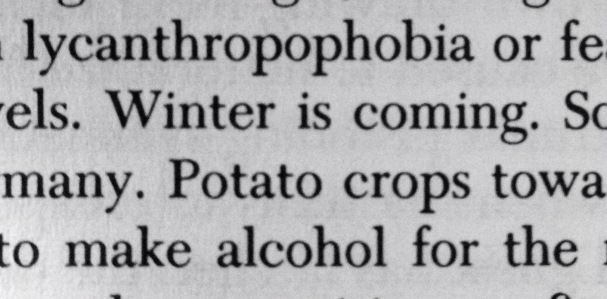
Winter is coming (Thomas Pynchon)

IMG_5728

Sorry sorry sorry couldn’t help myself. From page 640 of Thomas Pynchon’s Gravity’s Rainbow.

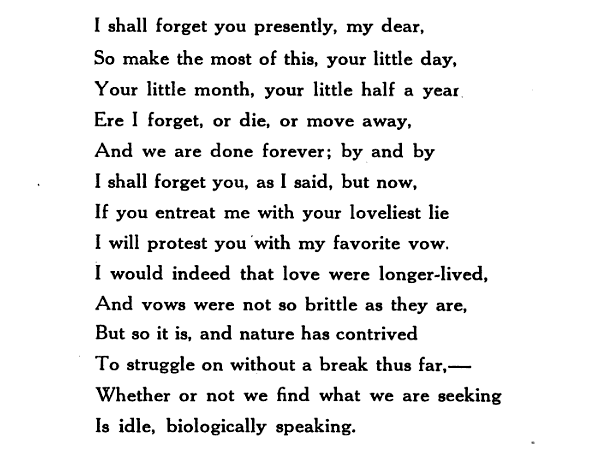
“[I shall forget you presently, my dear]” — Edna St. Vincent Millay

Screenshot 2015-04-03 at 1.46.38 PM

“Thus do authors beget authors” — Washington Irving on Plagiarism and Creation

0126m

Now and then one of these personages would write something on a small slip of paper, and ring a bell, whereupon a familiar would appear, take the paper in profound silence, glide out of the room, and return shortly loaded with ponderous tomes, upon which the other would fall, tooth and nail, with famished voracity. I had no longer a doubt that I had happened upon a body of magi, deeply engaged in the study of occult sciences. The scene reminded me of an old Arabian tale, of a philosopher shut up in an enchanted library, in the bosom of a mountain, which opened only once a year; where he made the spirits of the place bring him books of all kinds of dark knowledge, so that at the end of the year, when the magic portal once more swung open on its hinges, he issued forth so versed in forbidden lore, as to be able to soar above the heads of the multitude, and to control the powers of Nature.

My curiosity being now fully aroused, I whispered to one of the familiars, as he was about to leave the room, and begged an interpretation of the strange scene before me. A few words were sufficient for the purpose. I found that these mysterious personages, whom I had mistaken for magi, were principally authors, and were in the very act of manufacturing books. I was, in fact, in the reading-room of the great British Library, an immense collection of volumes of all ages and languages, many of which are now forgotten, and most of which are seldom read: one of these sequestered pools of obsolete literature to which modern authors repair, and draw buckets full of classic lore, or “pure English, undefiled,” wherewith to swell their own scanty rills of thought.

Being now in possession of the secret, I sat down in a corner, and watched the process of this book manufactory. I noticed one lean, bilious-looking wight, who sought none but the most worm-eaten volumes, printed in black letter. He was evidently constructing some work of profound erudition, that would be purchased by every man who wished to be thought learned, placed upon a conspicuous shelf of his library, or laid open upon his table—but never read. I observed him, now and then, draw a large fragment of biscuit out of his pocket, and gnaw; whether it was his dinner, or whether he was endeavoring to keep off that exhaustion of the stomach, produced by much pondering over dry works, I leave to harder students than myself to determine.

There was one dapper little gentleman in bright-colored clothes, with a chirping gossiping expression of countenance, who had all the appearance of an author on good terms with his bookseller. After considering him attentively, I recognized in him a diligent getter-up of miscellaneous works, which bustled off well with the trade. I was curious to see how he manufactured his wares. He made more stir and show of business than any of the others; dipping into various books, fluttering over the leaves of manuscripts, taking a morsel out of one, a morsel out of another, “line upon line, precept upon precept, here a little and there a little.” The contents of his book seemed to be as heterogeneous as those of the witches’ cauldron in Macbeth. It was here a finger and there a thumb, toe of frog and blind worm’s sting, with his own gossip poured in like “baboon’s blood,” to make the medley “slab and good.”

After all, thought I, may not this pilfering disposition be implanted in authors for wise purposes? may it not be the way in which Providence has taken care that the seeds of knowledge and wisdom shall be preserved from age to age, in spite of the inevitable decay of the works in which they were first produced? We see that Nature has wisely, though whimsically provided for the conveyance of seeds from clime to clime, in the maws of certain birds; so that animals, which, in themselves, are little better than carrion, and apparently the lawless plunderers of the orchard and the corn-field, are, in fact, Nature’s carriers to disperse and perpetuate her blessings. In like manner, the beauties and fine thoughts of ancient and obsolete authors are caught up by these flights of predatory writers, and cast forth, again to flourish and bear fruit in a remote and distant tract of time. Many of their works, also, undergo a kind of metempsychosis, and spring up under new forms. What was formerly a ponderous history, revives in the shape of a romance—an old legend changes into a modern play—and a sober philosophical treatise furnishes the body for a whole series of bouncing and sparkling essays. Thus it is in the clearing of our American woodlands; where we burn down a forest of stately pines, a progeny of dwarf oaks start up in their place; and we never see the prostrate trunk of a tree mouldering into soil, but it gives birth to a whole tribe of fungi.

Let us not then, lament over the decay and oblivion into which ancient writers descend; they do but submit to the great law of Nature, which declares that all sublunary shapes of matter shall be limited in their duration, but which decrees, also, that their element shall never perish. Generation after generation, both in animal and vegetable life, passes away, but the vital principle is transmitted to posterity, and the species continue to flourish. Thus, also, do authors beget authors, and having produced a numerous progeny, in a good old age they sleep with their fathers, that is to say, with the authors who preceded them—and from whom they had stolen.


From Washington Irving’s story-essay “The Art of Book-Making.”