There is a theory going around that the U.S.A. was and still is a gigantic Masonic plot under the ultimate control of the group known as the Illuminati (Gravity’s Rainbow)

There is a theory going around that the U.S.A. was and still is a gigantic Masonic plot under the ultimate control of the group known as the Illuminati. It is difficult to look for long at the strange single eye crowning the pyramid which is found on every dollar bill and not begin to believe the story, a little. Too many anarchists in 19th-century Europe—Bakunin, Proudhon, Salverio Friscia—were Masons for it to be pure chance. Lovers of global conspiracy, not all of them Catholic, can count on the Masons for a few good shivers and voids when all else fails. One of the best of the classic Weird Mason Stories has Doctor Livingstone (living stone? oh, yes) come wandering into a native village in, not even the heart, but the subconscious of Darkest Africa, a place, a tribe he’s never seen before: fires in the silence, unfathomable stares, Livingstone ambles up to the village chief and flashes him a Masonic high sign—the chief recognizes it, returns it, all smiles, and orders every fraternal hospitality laid on for the white stranger. But recall that Dr. Livingstone, like Wernher von Braun, was born close to the Spring Equinox, and so had to confront the world from that most singular of the Zodiac’s singular points… . Well, and keep in mind where those Masonic Mysteries came from in the first place. (Check out Ishmael Reed. He knows more about it than you’ll ever find here.)

We must also never forget famous Missouri Mason Harry Truman: sitting by virtue of death in office, this very August 1945, with his control-finger poised right on Miss Enola Gay’s atomic clit, making ready to tickle 100,000 little yellow folks into what will come down as a fine vapor-deposit of fat-cracklings wrinkled into the fused rubble of their city on the Inland Sea… .


From Thomas Pynchon’s Gravity’s Rainbow.

Categories are bad news (Barry Hannah)

 WT: Do you read magazines?

BH: If someone would rave about a story in the New Yorker, I’ll read it. But you get a lot of that Woody Allen–New Yorker–Hamptons fiction. My [students] have to send off to the little magazines. I get the sense that only grad students read those.

WT: Writer’s writers?

BH: I don’t like that term, because I wouldn’t buy somebody’s album on a dare if they called him a musician’s musician. I don’t write to be a writer’s writer. I don’t want to be like the little-magazine writer. I don’t want to be that.

Categories are bad news. Being Southern will just kill you sometimes. It’s not always a graceful adjective. Sometimes it means, don’t bother because it’s gonna be [sings a lick from dueling banjos]. It’s gonna be: porch, banjo, Negroes. There’s a canned dream of the South that a lot of people get into, and I’ve resisted that stuff my entire so-called career. Ready-made Southernism just disgusts me, just makes me nauseated. I mean, you can’t see a movie without hearing that goddamned slide guitar. Shit, I’m just so tired of it.


From Barry Hannah’s interview with Wells Tower in The Believer.

“Holy Thursday” (Experience) — William Blake

“Holy Thursday” (Innocence) — William Blake

One Possible Sequence for Reading Thomas Pynchon’s Novels, Presented Without Remarks

Mason & Dixon

Against the Day

Gravity’s Rainbow

V.

The Crying of Lot 49

Inherent Vice

Vineland

Bleeding Edge

Watch The Lives of Brian, A Documentary About Flann O’Brien

“Our April Letter” — F. Scott Fitzgerald

This is April again. Roller skates rain slowly down the street
Your voice far away on the phone
Once I would have jumped like a clown through a hoop—
but
“Then the area of infection has increased? …oh …What can I expect after all—I’ve had worse shocks.
Anyhow, I know and that’s something.” (Like hell it is, but it’s what you say to an X-ray doctor.)
Then the past whispering faint now on another phone:
“Is there any change?”
“Little or no change”
“I see”
The roller skates rain down the streets,
The black cars shine between the leaves,
Your voice far away:
“I am going with my daughter to the country. My husband left today. . . No he knows nothing.”
“Good”.
I have asked a lot of my emotions—one hundred and twenty stories, The price was high, right up with Kipling, because there was one little drop of something not blood, not a tear, not my seed, but me more intimately than these, in every story, it was the extra I had. Now it has gone and I am just like you now.
Once the phial was full—here is the bottle it came in.
Hold on there’s a drop left there. . . No, it was just the way the light fell
But your voice on the telephone. If I hadn’t abused words so what you said might have meant something.
But one hundred and twenty stories
April evening spreads over everything, the purple blur left by a child who has used the whole paint-box.

“Our April Letter” is from F. Scott Fitzgerald’s Notebooks.


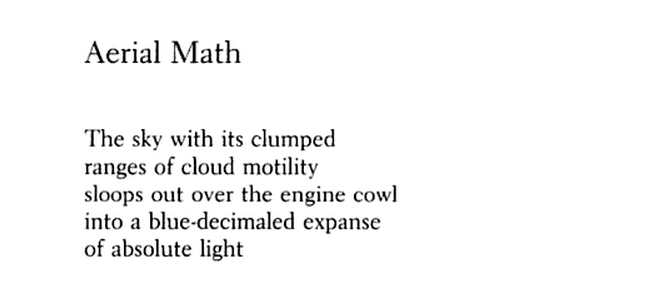
“Aerial Math” — Tom Clark

Screenshot 2015-03-31 at 4.03.24 PM

A universal sense of guilt or an attitude of universal accusation (Italo Calvino)

…if it is impossible today for anyone to feel innocent, if in whatever we do or say we can discover a hidden motive – that of a white man,or a male, or the possessor of a certain income, or a member of a given economic system, or a suffer from a certain neurosis – this should not induce in us either a universal sense of guilt or an attitude of universal accusation.

When we become aware of our disease or of our hidden motives, we have already begun to get the better of them. What matters is the way in which we accept our motives and live through the ensuing crisis. This is the only chance we have of becoming different from the way we are – that is, the only way of starting to invent a new way of being.

From Italo Calvino’s essay “Right and Wrong Uses of Political Uses of Literature.” The essay was delivered as a lecture–in English–in 1976. (Translation credit for the volume the essay is collected in, The Uses of Literature, goes to Patrick Creagh).

Always eat grapes downwards (Samuel Butler)

Always eat grapes downwards—that is, always eat the best grape first; in this way there will be none better left on the bunch, and each grape will seem good down to the last.  If you eat the other way, you will not have a good grape in the lot.  Besides, you will be tempting Providence to kill you before you come to the best.  This is why autumn seems better than spring: in the autumn we are eating our days downwards, in the spring each day still seems “Very bad.”  People should live on this principle more than they do, but they do live on it a good deal; from the age of, say, fifty we eat our days downwards.

In New Zealand for a long time I had to do the washing-up after each meal.  I used to do the knives first, for it might please God to take me before I came to the forks, and then what a sell it would have been to have done the forks rather than the knives!

From Samuel Butler’s Note-Books

Brief internal feminist critique (perhaps) of Gravity’s Rainbow

tnagr

From page 507 of Thomas Pynchon’s novel Gravity’s Rainbow.

The Mother Conspiracy (Gravity’s Rainbow)

Otto is earnestly explaining his views on the Mother Conspiracy. It’s not often a sympathetic girl will listen. The Mothers get together once a year, in secret, at these giant conventions, and exchange information. Recipes, games, key phrases to use on their children. “What did yours use to say when she wanted to make you feel guilty?”

“‘I’ve worked my fingers to the bone!’” sez the girl.

“Right! And she used to cook those horrible casseroles, w-with the potatoes, and onions—”

“And ham! Little pieces of ham—”

“You see, you see? That can’t be accidental! They have a contest, for Mother of the Year, breast-feeding, diaper-changing, they time them, casserole competitions, ja—then, toward the end, they actually begin to use the children. The State Prosecutor comes out on stage. ‘In a moment, Albrecht, we are going to bring your mother on. Here is a Luger, fully loaded. The State will guarantee you absolute immunity from prosecution. Do whatever you wish to do—anything at all. Good luck, my boy.’ The pistols are loaded with blanks, natürlich, but the unfortunate child does not know this. Only the mothers who get shot at qualify for the finals.

Here they bring in psychiatrists, and judges sit with stopwatches to see how quickly the children will crack. ‘Now then, Olga, wasn’t it nice of Mutti to break up your affair with that long-haired poet?’ ‘We understand your mother and you are, ah, quite close, Hermann. Remember the time she caught you masturbating into her glove? Eh?’ Hospital attendants stand by to drag the children off, drooling, screaming, having clonic convulsions. Finally there is only one Mother left on stage. They put the traditional flowered hat on her head, and hand her the orb and scepter, which in this case are a gilded pot roast and a whip, and the orchestra plays Tristan und Isolde.

From Thomas Pynchon’s novel Gravity’s Rainbow.

A Conversation about Evan Dara’s Novel Flee (Part 2)

IMG_5657

[Context/editorial note: I’d been meaning to read Evan Dara’s latest novel Flee for a while, and when Biblioklept contributor Ryan Chang told me he’d be reading it as part of a contemporary literature class I decided to join him. This is the second part of a two-part discussion which took place over a few weeks of emails. We discuss the book’s conclusion, including what some people might think of as “spoilers.”

Read part one of our discussion of  Flee.

The tl;dr version of all of this: Both Ryan and I loved Flee, a 2013 novel about the citizens of a New England town who, uh, flee, for reasons never made entirely clear I claim that “Flee is maybe the best novel (so far, anyway) to aesthetically and philosophically address the economic collapse of ’08.” Ryan called it a book “for people who like books to fuck with them and then be their friend.” And I agree with him. — ET]

Ryan Chang: Right–Flee doesn’t prescribe a future, or at least an alternative future. “841” testifies to this. The A-burgian upstakers are no different from the new settlers, rejoicing in the bargains to be had in the town. Carol and Marcus quietly disappear (Spoiler alert). Flee is overall hesitant to prescribe, I think. In my previous e-mail, I was thinking out loud a bit, trying to see if something in the book was pointing to these spaces of the “nonidentical” as Adorno calls it; that Flee as an aesthetic object figures, in exactly what isn’t said, the suffocating presence that squeezes the life out of A-burg, could figure a moment of possibility in absence. Some kind of fracture that, even if it is a failure (as A-burg is, I think), is a temporary moment of reprieve from the administered life.

I’m not sure what the forms of Kimball’s “radical forgiveness” and “hospitality” would be, if he points to them — especially of the former. And is it only that the literary artists get to have all the fun of democracy? Exactly where does democratic critique happen off the page? I’m wondering because it seems that the form of popular critique — save from public protest and other distortions of space — are infected with exploitative capital, with ideology, unwittingly going along with the system that saves the banks before humanity. Additionally: to whom–or what–is forgiveness granted? Hospitality seems more tangible to me, but the phrases Yes? Who’s There? imply exclusion rather than inclusion to me. As if at the door of democracy, the speaker hesitates. Should not a radical affirmation continually say yes rather than no at the door? The questioning yes is skeptical. I wonder if a self-consciousness and -becoming out of administration is required. The molectular make-up of the present absence that suffocates A-Burg and, implicitly, whatever other small town, would have to be transposed, if you like, into another key. To mention Lerner again (briefly) — do you remember that scene in the book, with the first hurricane, the (eventually fictional) threat of Irene destroying the infrastructure as a moment when disparate communities — who would otherwise keep to themselves, much like the voices in Flee — begin convening? That was just a way of getting to the epigraph of the book: “Everything will be as it is now, just a little different.” Continue reading “A Conversation about Evan Dara’s Novel Flee (Part 2)”

Read “The Dreadful Mucamas” by Lydia Davis

“The Dreadful Mucamas”

by

Lydia Davis

They are very rigid, stubborn women from Bolivia. They resist and sabotage whenever possible.

They came with the apartment. They were bargains because of Adela’s low IQ. She is a scatterbrain.

In the beginning, I said to them: I’m very happy that you can stay, and I am sure that we will get along very well.

This is an example of the problems we are having. It is a typical incident that has just taken place. I needed to cut a piece of thread and could not find my six-inch scissors. I accosted Adela and told her I could not find my scissors. She protested that she had not seen them. I went with her to the kitchen and asked Luisa if she would cut my thread. She asked me why I did not simply bite it off. I said I could not thread my needle if I bit it off. I asked her please to get some scissors and cut it off – now. She told Adela to look for the scissors of la Señora Brodie, and I followed her to the study to see where they were kept. She removed them from a box. At the same time I saw a long, untidy piece of twine attached to the box and asked her why she did not trim off the frayed end while she had the scissors. She shouted that it was impossible. The twine might be needed to tie up the box some time. I admit that I laughed. Then I took the scissors from her and cut it off myself. Adela shrieked. Her mother appeared behind her. I laughed again and now they both shrieked. Then they were quiet. Continue reading “Read “The Dreadful Mucamas” by Lydia Davis”

Anti-paranoia (Gravity’s Rainbow)

Rain drips, soaking into the floor, and Slothrop perceives that he is losing his mind. If there is something comforting—religious, if you want—about paranoia, there is still also anti-paranoia, where nothing is connected to anything, a condition not many of us can bear for long. Well right now Slothrop feels himself sliding onto the anti-paranoid part of his cycle, feels the whole city around him going back roofless, vulnerable, uncentered as he is, and only pasteboard images now of the Listening Enemy left between him and the wet sky.

Either They have put him here for a reason, or he’s just here. He isn’t sure that he wouldn’t, actually, rather have that reason…

From Thomas Pynchon’s novel Gravity’s Rainbow. The “pasteboard images” line recalls a favorite passage of Moby-Dick.

Even more beautiful emotions (Kafka’s diary entry, 27 March 1912)

27. March. Monday, on the street. The boy who with several others, threw a large ball at a servant girl walking defencelessly in front of them; just as the ball was flying at the girls’ behind I grabbed him by the throat, choked him in a fury, thrust him aside, and swore. Then walked on and didn’t even look at the girl. One quite forgets one’s earthly existence because one is so entirely full of fury is permitted to believe that, given the opportunity, one would in the same way fill oneself with even more beautiful emotions.

Franz Kafka’s diary entry, 27 March 1912. Translation by Joseph Kresh.

“Rain” — Roberto Bolaño