A dedicated storyteller, though – a true lie-minded man – will serve his history best, and guarantee its popularity, not by imitating nature, since nature’s no source of verisimilitude, but by following as closely as he can our simplest, most direct and unaffected forms of daily talk, for we report real things, things which intrigue and worry us, and such resembling gossip in a book allows us to believe in figures and events we cannot see, shall never touch, with an assurance of safety which sets our passions free. He will avoid recording consciousness since consciousness is private – we do not normally “take it down” – and because no one really believes in any other feelings than his own. However, the moment our writer concentrates on sound, the moment he formalizes his sentences, the moment he puts in a figure of speech or turns a phrase, shifts a tense or alters tone, the moment he carries description, or any account, beyond need, he begins to turn his reader’s interest away from the world which lies among his words like a beautiful woman among her slaves, and directs him toward the slaves themselves. This illustrates a basic principle: if I describe my peach too perfectly, it’s the poem which will make my mouth water…while the real peach spoils.
Category: Literature
“When I Have Fears That I May Cease to Be” — John Keats

Read “Small Fry,” a very short story by Anton Chekhov
“Small Fry”
by
Anton Chekhov
“HONORED Sir, Father and Benefactor!” a petty clerk called Nevyrazimov was writing a rough copy of an Easter congratulatory letter. “I trust that you may spend this Holy Day even as many more to come, in good health and prosperity. And to your family also I…”
The lamp, in which the kerosene was getting low, was smoking and smelling. A stray cockroach was running about the table in alarm near Nevyrazimov’s writing hand. Two rooms away from the office Paramon the porter was for the third time cleaning his best boots, and with such energy that the sound of the blacking-brush and of his expectorations was audible in all the rooms.
“What else can I write to him, the rascal?” Nevyrazimov wondered, raising his eyes to the smutty ceiling.
On the ceiling he saw a dark circle—the shadow of the lamp-shade. Below it was the dusty cornice, and lower still the wall, which had once been painted a bluish muddy color. And the office seemed to him such a place of desolation that he felt sorry, not only for himself, but even for the cockroach.
“When I am off duty I shall go away, but he’ll be on duty here all his cockroach-life,” he thought, stretching. “I am bored! Shall I clean my boots?”
And stretching once more, Nevyrazimov slouched lazily to the porter’s room. Paramon had finished cleaning his boots. Crossing himself with one hand and holding the brush in the other, he was standing at the open window-pane, listening.
“They’re ringing,” he whispered to Nevyrazimov, looking at him with eyes intent and wide open. “Already!”
Nevyrazimov put his ear to the open pane and listened. The Easter chimes floated into the room with a whiff of fresh spring air. The booming of the bells mingled with the rumble of carriages, and above the chaos of sounds rose the brisk tenor tones of the nearest church and a loud shrill laugh.
“What a lot of people!” sighed Nevyrazimov, looking down into the street, where shadows of men flitted one after another by the illumination lamps. “They’re all hurrying to the midnight service…. Our fellows have had a drink by now, you may be sure, and are strolling about the town. What a lot of laughter, what a lot of talk! I’m the only unlucky one, to have to sit here on such a day: And I have to do it every year!”
“Well, nobody forces you to take the job. It’s not your turn to be on duty today, but Zastupov hired you to take his place. When other folks are enjoying themselves you hire yourself out. It’s greediness!”
“Devil a bit of it! Not much to be greedy over—two roubles is all he gives me; a necktie as an extra…. It’s poverty, not greediness. And it would be jolly, now, you know, to be going with a party to the service, and then to break the fast…. To drink and to have a bit of supper and tumble off to sleep…. One sits down to the table, there’s an Easter cake and the samovar hissing, and some charming little thing beside you…. You drink a glass and chuck her under the chin, and it’s first-rate…. You feel you’re somebody…. Ech h-h!… I’ve made a mess of things! Look at that hussy driving by in her carriage, while I have to sit here and brood.”
“We each have our lot in life, Ivan Danilitch. Please God, you’ll be promoted and drive about in your carriage one day.”
“I? No, brother, not likely. I shan’t get beyond a ‘titular,’ not if I try till I burst. I’m not an educated man.”
“Our General has no education either, but…”
“Well, but the General stole a hundred thousand before he got his position. And he’s got very different manners and deportment from me, brother. With my manners and deportment one can’t get far! And such a scoundrelly surname, Nevyrazimov! It’s a hopeless position, in fact. One may go on as one is, or one may hang oneself…”
He moved away from the window and walked wearily about the rooms. The din of the bells grew louder and louder…. There was no need to stand by the window to hear it. And the better he could hear the bells and the louder the roar of the carriages, the darker seemed the muddy walls and the smutty cornice and the more the lamp smoked.
“Shall I hook it and leave the office?” thought Nevyrazimov.
But such a flight promised nothing worth having…. After coming out of the office and wandering about the town, Nevyrazimov would have gone home to his lodging, and in his lodging it was even grayer and more depressing than in the office…. Even supposing he were to spend that day pleasantly and with comfort, what had he beyond? Nothing but the same gray walls, the same stop-gap duty and complimentary letters….
Nevyrazimov stood still in the middle of the office and sank into thought. The yearning for a new, better life gnawed at his heart with an intolerable ache. He had a passionate longing to find himself suddenly in the street, to mingle with the living crowd, to take part in the solemn festivity for the sake of which all those bells were clashing and those carriages were rumbling. He longed for what he had known in childhood—the family circle, the festive faces of his own people, the white cloth, light, warmth…! He thought of the carriage in which the lady had just driven by, the overcoat in which the head clerk was so smart, the gold chain that adorned the secretary’s chest…. He thought of a warm bed, of the Stanislav order, of new boots, of a uniform without holes in the elbows…. He thought of all those things because he had none of them.
“Shall I steal?” he thought. “Even if stealing is an easy matter, hiding is what’s difficult. Men run away to America, they say, with what they’ve stolen, but the devil knows where that blessed America is. One must have education even to steal, it seems.”
The bells died down. He heard only a distant noise of carriages and Paramon’s cough, while his depression and anger grew more and more intense and unbearable. The clock in the office struck half-past twelve.
“Shall I write a secret report? Proshkin did, and he rose rapidly.”
Nevyrazimov sat down at his table and pondered. The lamp in which the kerosene had quite run dry was smoking violently and threatening to go out. The stray cockroach was still running about the table and had found no resting-place.
“One can always send in a secret report, but how is one to make it up? I should want to make all sorts of innuendoes and insinuations, like Proshkin, and I can’t do it. If I made up anything I should be the first to get into trouble for it. I’m an ass, damn my soul!”
And Nevyrazimov, racking his brain for a means of escape from his hopeless position, stared at the rough copy he had written. The letter was written to a man whom he feared and hated with his whole soul, and from whom he had for the last ten years been trying to wring a post worth eighteen roubles a month, instead of the one he had at sixteen roubles.
“Ah, I’ll teach you to run here, you devil!” He viciously slapped the palm of his hand on the cockroach, who had the misfortune to catch his eye. “Nasty thing!”
The cockroach fell on its back and wriggled its legs in despair. Nevyrazimov took it by one leg and threw it into the lamp. The lamp flared up and spluttered.
And Nevyrazimov felt better.
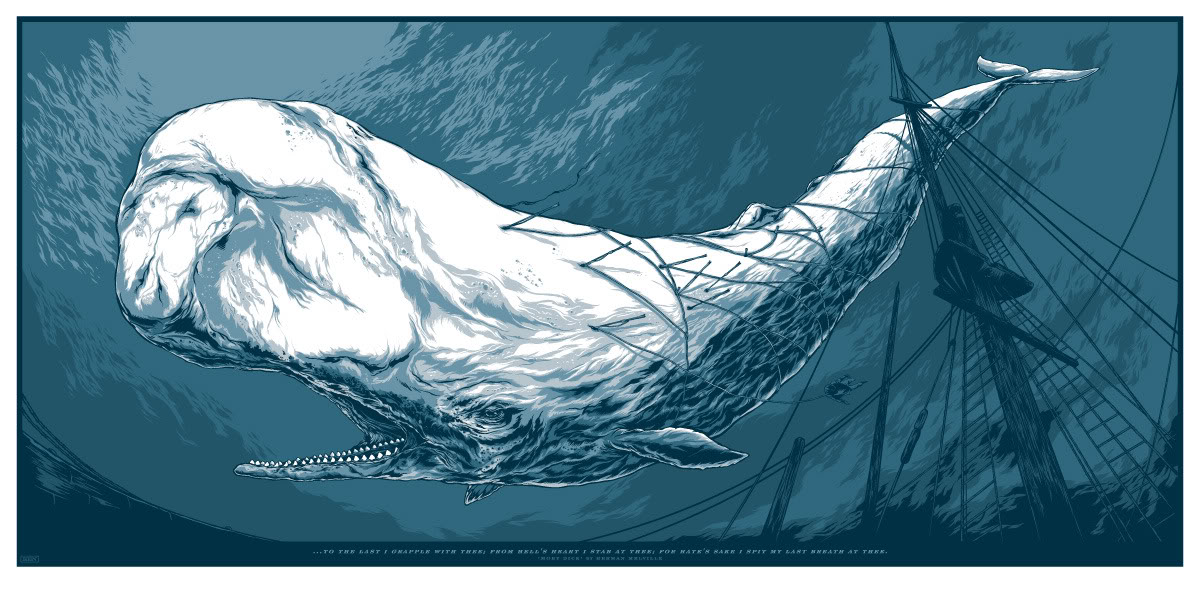
Moby-Dick — Ken Taylor
Reading the very best writers is not going to make us better citizens (Harold Bloom)
Reviewing bad books, W. H. Auden once remarked, is bad for the character. Like all gifted moralists, Auden idealized despite himself, and he should have survived into the present age, wherein the new commissars tell us that reading good books is bad for the character, which I think is probably true. Reading the very best writers-let us say Homer, Dante, Shakespeare, Tolstoy-is not going to make us better citizens. Art is perfectly useless, according to the sublime Oscar Wilde, who was right about everything. He also told us that all bad poetry is sincere. Had I the power to do so, I would command that these words be engraved above every gate at every university, so that each student might ponder the splendor of the insight.
From Harold Bloom’s The Western Canon.
Mr. Icky, a one-act play by F. Scott Fitzgerald
Mr. Icky
The Quintessence of Quaintness in One Act
by F.Scott Fitzgerald
The Scene is the Exterior of a Cottage in West Issacshire on a desperately Arcadian afternoon in August. MR. ICKY, quaintly dressed in the costume of an Elizabethan peasant, is pottering and doddering among the pots and dods. He is an old man, well past the prime of life, no longer young, From the fact that there is a burr in his speech and that he has absent-mindedly put on his coat wrongside out, we surmise that he is either above or below the ordinary superficialities of life.
_Near him on the grass lies PETER, a little boy. PETER, of course, has his chin on his palm like the pictures of the young Sir Walter Raleigh. He has a complete set of features, including serious, sombre, even funereal, gray eyes—and radiates that alluring air of never having eaten food. This air can best be radiated during the afterglow of a beef dinner. Be is looking at MR. ICKY, fascinated._
Silence. . . . The song of birds.
PETER: Often at night I sit at my window and regard the stars. Sometimes I think they’re my stars…. (Gravely) I think I shall be a star some day….
ME. ICKY: (Whimsically) Yes, yes … yes….
PETER: I know them all: Venus, Mars, Neptune, Gloria Swanson.
MR. ICKY: I don’t take no stock in astronomy…. I’ve been thinking o’ Lunnon, laddie. And calling to mind my daughter, who has gone for to be a typewriter…. (He sighs.)
PETER: I liked Ulsa, Mr. Icky; she was so plump, so round, so buxom. Continue reading “Mr. Icky, a one-act play by F. Scott Fitzgerald”
When you are dead you will lie forever unremembered and no one will miss you (Sappho)

Five Ideas from Nathaniel Hawthorne’s Note-Books
- For the virtuoso’s collection,–the pen with which Faust signed away his salvation, with a drop of blood dried in it.
- An article on newspaper advertisements,–a country newspaper, methinks, rather than a city one.
- An eating-house, where all the dishes served out, even to the bread and salt, shall be poisoned with the adulterations that are said to be practised. Perhaps Death himself might be the cook.
- Personify the century,–talk of its present middle age, of its youth, and its adventures and prospects.
- An uneducated countryman, supposing he had a live frog in his stomach, applied himself to the study of medicine in order to find a cure for this disease; and he became a profound physician. Thus misfortune, physical or moral, may be the means of educating and elevating us.
A Scapegoat for Promiscuous Drunks, Friendly Calls, and Humbug Resolutions

From Mark Twain’s January 1st, 1863 column in the Territorial Enterprise:
Now is the accepted time to make your regular annual good resolutions. Next week you can begin paving hell with them as usual. Yesterday, everybody smoked his last cigar, took his last drink, and swore his last oath. To-day, we are a pious and exemplary community. Thirty days from now, we shall have cast our reformation to the winds and gone to cutting our ancient short comings considerably shorter than ever. We shall also reflect pleasantly upon how we did the same old thing last year about this time. However, go in, community. New Year’s is a harmless annual institution, of no particular use to anybody save as a scapegoat for promiscuous drunks, and friendly calls, and humbug resolutions, and we wish you to enjoy it with a looseness suited to the greatness of the occasion.
“How the First Letter Was Written” — Rudyard Kipling
ONCE upon a most early time was a Neolithic man. He was not a Jute or an Angle, or even a Dravidian, which he might well have been, Best Beloved, but never mind why. He was a Primitive, and he lived cavily in a Cave, and he wore very few clothes, and he couldn’t read and he couldn’t write and he didn’t want to, and except when he was hungry he was quite happy. His name was Tegumai Bopsulai, and that means, ‘Man-who-does-not-put-his-foot-forward-in-a-hurry’; but we, O Best Beloved, will call him Tegumai, for short. And his wife’s name was Teshumai Tewindrow, and that means, ‘Lady-who-asks-a-very-many-questions’; but we, O Best Beloved, will call her Teshumai, for short. And his little girl-daughter’s name was Taffimai Metallumai, and that means, ‘Small-person-without-any-manners-who-ought-to-be-spanked’; but I’m going to call her Taffy. And she was Tegumai Bopsulai’s Best Beloved and her own Mummy’s Best Beloved, and she was not spanked half as much as was good for her; and they were all three very happy. As soon as Taffy could run about she went everywhere with her Daddy Tegumai, and sometimes they would not come home to the Cave till they were hungry, and then Teshumai Tewindrow would say, ‘Where in the world have you two been to, to get so shocking dirty? Really, my Tegumai, you’re no better than my Taffy.’
Now attend and listen! Continue reading ““How the First Letter Was Written” — Rudyard Kipling”
“The Man and the Snake” — Ambrose Bierce
“The Man and the Snake”
by
Ambrose Bierce
I
It is of veritabyll report, and attested of so many that there be nowe of wyse and learned none to gaynsaye it, that ye serpente hys eye hath a magnetick propertie that whosoe falleth into its svasion is drawn forwards in despyte of his wille, and perisheth miserabyll by ye creature hys byte.
Stretched at ease upon a sofa, in gown and slippers, Harker Brayton smiled as he read the foregoing sentence in old Morryster’s “Marvells of Science.” “The only marvel in the matter,” he said to himself, “is that the wise and learned in Morryster’s day should have believed such nonsense as is rejected by most of even the ignorant in ours.”
A train of reflections followed—for Brayton was a man of thought— and he unconsciously lowered his book without altering the direction of his eyes. As soon as the volume had gone below the line of sight, something in an obscure corner of the room recalled his attention to his surroundings. What he saw, in the shadow under his bed, were two small points of light, apparently about an inch apart. They might have been reflections of the gas jet above him, in metal nail heads; he gave them but little thought and resumed his reading. A moment later something—some impulse which it did not occur to him to analyze—impelled him to lower the book again and seek for what he saw before. The points of light were still there. They seemed to have become brighter than before, shining with a greenish luster which he had not at first observed. He thought, too, that they might have moved a trifle—were somewhat nearer. They were still too much in the shadow, however, to reveal their nature and origin to an indolent attention, and he resumed his reading. Suddenly something in the text suggested a thought which made him start and drop the book for the third time to the side of the sofa, whence, escaping from his hand, it fell sprawling to the floor, back upward. Brayton, half-risen, was staring intently into the obscurity beneath the bed, where the points of light shone with, it seemed to him, an added fire. His attention was now fully aroused, his gaze eager and imperative. It disclosed, almost directly beneath the foot rail of the bed, the coils of a large serpent—the points of light were its eyes! Its horrible head, thrust flatly forth from the innermost coil and resting upon the outermost, was directed straight toward him, the definition of the wide, brutal jaw and the idiotlike forehead serving to show the direction of its malevolent gaze. The eyes were no longer merely luminous points; they looked into his own with a meaning, a malign significance. Continue reading ““The Man and the Snake” — Ambrose Bierce”
Musical Duet Summary of Pynchon’s Mason & Dixon in Two Stanzas

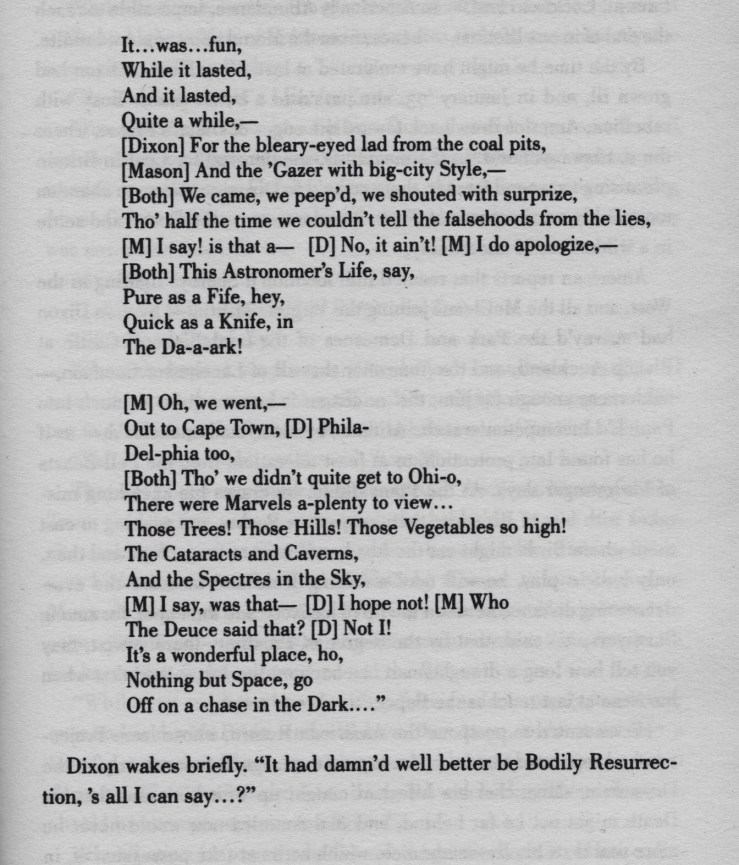
From Ch. 77 of Thomas Pynchon’s Mason & Dixon. I love the elision expressed in those dashes — “I say, was that–” — I say, was that a talking dog? I say, was that were-beaver? I say, was that a giant cannabis plant? I say, was that a Sino-Jesuit cabal? I say, was that the Lost Tribe of Israel? I say, was that the missing 11 days, and the Asiatick Pygmies who inhabit them? I say, was that a mechanical duck, looking for love? I say, was that an electric eel? I say, was that a recipe for catsup? I say, was that the first English pizza? I say, was that The Black Dog? I say, was that an iron bathtub? I say, was that a ridotto of inflamed debauchery? I say, was that a Masonic conspiracy? I say, was that the metaphysical wind? I say, was that a dead wife’s ghost? I say, was that a friendship? I say!
Thomas Pynchon’s Mason & Dixon (Third Riff: The Rabbi of Prague)
A. I’m a few chapters–three, precisely—from finishing Mason & Dixon. “Finishing” is not the right verb here, though—Pynchon’s novel is so rich, funny, strange, and energetic that I want to return to it immediately.
B. But I need to backtrack a bit, riff on one of my favorite episodes—Chapter 50.
C. (First riff and second riff for those inclined).
D. In Chapter 50,
’tis Dixon’s luck to discover The Rabbi of Prague, headquarters of a Kabbalistick Faith, in Correspondence with the Elect Cohens of Paris, whose private Salute they now greet Dixon with, the Fingers spread two and two, and the Thumb held away from them likewise, said to represent the Hebrew letter Shin and to signify, “Live long and prosper.”
Pynchon plays here on the reader’s initial understanding of the signal and phrase as a pop culture reference—
—but the goof isn’t merely postmodernist shtick—Pynchon is pointing to how the invisible manifests itself in signs and wonders, covert, cryptic, but perhaps—perhaps—decipherable.

E. (Maybe this needs clarification: The Rabbi of Prague is a tavern. I lost track of how many bars taverns pubs inns alehouses coffeehouses etc. show up in M&D). Continue reading “Thomas Pynchon’s Mason & Dixon (Third Riff: The Rabbi of Prague)”
Balestrini/Pasolini (Books acquired, 12.27.2014)

So I picked up two ebooks from Verso today for less than a pint of beer. Ridiculous! The Unseen by Nanni Balestrini, and Pasolini’s unproduced screenplay St. Paul. All kinds of great stuff. I think my favorite thing about Verso’s ebooks is how straightforward they are to access—no weird third-party app or DRM issues.
“Fancy’s Show-Box” — Nathaniel Hawthorne
“Fancy’s Show-Box”
by
Nathaniel Hawthorne
What is guilt? A stain upon the soul. And it is a point of vast interest whether the soul may contract such stains in all their depth and flagrancy from deeds which may have been plotted and resolved upon, but which physically have never had existence. Must the fleshly hand and visible frame of man set its seal to the evil designs of the soul, in order to give them their entire validity against the sinner? Or, while none but crimes perpetrated are cognizable before an earthly tribunal, will guilty thoughts—of which guilty deeds are no more than shadows,—will these draw down the full weight of a condemning sentence in the supreme court of eternity? In the solitude of a midnight chamber or in a desert afar from men or in a church while the body is kneeling the soul may pollute itself even with those crimes which we are accustomed to deem altogether carnal. If this be true, it is a fearful truth.
Let us illustrate the subject by an imaginary example. A venerable gentleman—one Mr. Smith—who had long been regarded as a pattern of moral excellence was warming his aged blood with a glass or two of generous wine. His children being gone forth about their worldly business and his grandchildren at school, he sat alone in a deep luxurious arm-chair with his feet beneath a richly-carved mahogany table. Some old people have a dread of solitude, and when better company may not be had rejoice even to hear the quiet breathing of a babe asleep upon the carpet. But Mr. Smith, whose silver hair was the bright symbol of a life unstained except by such spots as are inseparable from human nature—he had no need of a babe to protect him by its purity, nor of a grown person to stand between him and his own soul. Nevertheless, either manhood must converse with age, or womanhood must soothe him with gentle cares, or infancy must sport around his chair, or his thoughts will stray into the misty region of the past and the old man be chill and sad. Wine will not always cheer him. Continue reading ““Fancy’s Show-Box” — Nathaniel Hawthorne”
“Merry Christmas” (Moby-Dick)
“Merry Christmas”
from Herman Melville’s Moby-Dick
At length, towards noon, upon the final dismissal of the ship’s riggers, and after the Pequod had been hauled out from the wharf, and after the ever-thoughtful Charity had come off in a whale-boat, with her last gift- a nightcap for Stubb, the second mate, her brother-in-law, and a spare Bible for the steward- after all this, the two Captains, Peleg and Bildad, issued from the cabin, and turning to the chief mate, Peleg said:
“Now, Mr. Starbuck, are you sure everything is right? Captain Ahab is all ready- just spoke to him- nothing more to be got from shore, eh? Well, call all hands, then. Muster ‘em aft here- blast ‘em!”
“No need of profane words, however great the hurry, Peleg,” said Bildad, “but away with thee, friend Starbuck, and do our bidding.”
How now! Here upon the very point of starting for the voyage, Captain Peleg and Captain Bildad were going it with a high hand on the quarter-deck, just as if they were to be joint-commanders at sea, as well as to all appearances in port. And, as for Captain Ahab, no sign of him was yet to be seen; only, they said he was in the cabin. But then, the idea was, that his presence was by no means necessary in getting the ship under weigh, and steering her well out to sea. Indeed, as that was not at all his proper business, but the pilot’s; and as he was not yet completely recovered- so they said- therefore, Captain Ahab stayed below. And all this seemed natural enough; especially as in the merchant service many captains never show themselves on deck for a considerable time after heaving up the anchor, but remain over the cabin table, having a farewell merry-making with their shore friends, before they quit the ship for good with the pilot.
But there was not much chance to think over the matter, for Captain Peleg was now all alive. He seemed to do most of the talking and commanding, and not Bildad.
“Aft here, ye sons of bachelors,” he cried, as the sailors lingered at the main-mast. “Mr. Starbuck, drive aft.”
“Strike the tent there!”- was the next order. As I hinted before, this whalebone marquee was never pitched except in port; and on board the Pequod, for thirty years, the order to strike the tent was well known to be the next thing to heaving up the anchor.
“Man the capstan! Blood and thunder!- jump!”- was the next command, and the crew sprang for the handspikes.
Now in getting under weigh, the station generally occupied by the pilot is the forward part of the ship. And here Bildad, who, with Peleg, be it known, in addition to his other officers, was one of the licensed pilots of the port- he being suspected to have got himself made a pilot in order to save the Nantucket pilot-fee to all the ships he was concerned in, for he never piloted any other craft- Bildad, I say, might now be seen actively engaged in looking over the bows for the approaching anchor, and at intervals singing what seemed a dismal stave of psalmody, to cheer the hands at the windlass, who roared forth some sort of chorus about the girls in Booble Alley, with hearty good will. Nevertheless, not three days previous, Bildad had told them that no profane songs would be allowed on board the Pequod, particularly in getting under weigh; and Charity, his sister, had placed a small choice copy of Watts in each seaman’s berth. Continue reading ““Merry Christmas” (Moby-Dick)”
Illustration to Milton’s On the Morning of Christ’s Nativity — William Blake