“A Relation of the Apparition of Mrs. Veal” — Daniel Defoe

“A Relation of the Apparition of Mrs. Veal”

by

Daniel Defoe

The Preface

This relation is matter of fact, and attended with such circumstances, as may induce any reasonable man to believe it. It was sent by a gentleman, a justice of peace, at Maidstone, in Kent, and a very intelligent person, to his friend in London, as it is here worded; which discourse is attested by a very sober and understanding gentlewoman, a kinswoman of the said gentleman’s, who lives in Canterbury, within a few doors of the house in which the within-named Mrs. Bargrave lives; who believes his kinswoman to be of so discerning a spirit, as not to be put upon by any fallacy; and who positively assured him that the whole matter, as it is related and laid down, is really true; and what she herself had in the same words, as near as may be, from Mrs. Bargrave’s own mouth, who, she knows, had no reason to invent and publish such a story, or any design to forge and tell a lie, being a woman of much honesty and virtue, and her whole life a course, as it were, of piety. The use which we ought to make of it, is to consider, that there is a life to come after this, and a just God, who will retribute to every one according to the deeds done in the body; and therefore to reflect upon our past course of life we have led in the world; that our time is short and uncertain; and that if we would escape the punishment of the ungodly, and receive the reward of the righteous, which is the laying hold of eternal life, we ought, for the time to come, to return to God by a speedy repentance, ceasing to do evil, and learning to do well: to seek after God early, if happily he may be found of us, and lead such lives for the future, as may be well pleasing in his sight.


A Relation of the Apparition of Mrs. Veal

This thing is so rare in all its circumstances, and on so good authority, that my reading and conversation has not given me anything like it: it is fit to gratify the most ingenious and serious inquirer. Mrs. Bargrave is the person to whom Mrs. Veal appeared after her death; she is my intimate friend, and I can avouch for her reputation, for these last fifteen or sixteen years, on my own knowledge; and I can confirm the good character she had from her youth, to the time of my acquaintance. Though, since this relation, she is calumniated by some people, that are friends to the brother of this Mrs. Veal, who appeared; who think the relation of this appearance to be a reflection, and endeavour what they can to blast Mrs. Bargrave’s reputation, and to laugh the story out of countenance. But by the circumstances thereof, and the cheerful disposition of Mrs. Bargrave, notwithstanding the ill-usage of a very wicked husband, there is not yet the least sign of dejection in her face; nor did I ever hear her let fall a desponding or murmuring expression; nay, not when actually under her husband’s barbarity; which I have been witness to, and several other persons of undoubted reputation.

Now you must know, Mrs. Veal was a maiden gentlewoman of about thirty years of age, and for some years last past had been troubled with fits; which were perceived coming on her, by her going off from her discourse very abruptly to some impertinence. She was maintained by an only brother, and kept his house in Dover. She was a very pious woman, and her brother a very sober man to all appearance; but now he does all he can to null or quash the story. Mrs. Veal was intimately acquainted with Mrs. Bargrave from her childhood. Mrs. Veal’s circumstances were then mean; her father did not take care of his children as he ought, so that they were exposed to hardships; and Mrs. Bargrave, in those days, had as unkind a father, though she wanted neither for food nor clothing, whilst Mrs. Veal wanted for both; insomuch that she would often say, Mrs. Bargrave, you are not only the best, but the only friend I have in the world, and no circumstance of life shall ever dissolve my friendship. They would often condole each other’s adverse fortunes, and read together Drelincourt upon Death, and other good books; and so, like two Christian friends, they comforted each other under their sorrow. Continue reading ““A Relation of the Apparition of Mrs. Veal” — Daniel Defoe”

Two ghosts (David Foster Wallace)

The truth is that there are two actual, non-hallucinatory ghosts haunting Post 047’s wiggle room. No one knows whether there are any in the Immersive Pods; those Pods are worlds unto themselves.
 
The ghosts’ names are Garrity and Blumquist. Much of the following info comes after the fact from Claude Sylvanshine. Blumquist is a very bland, dull, efficient rote examiner who died at his desk unnoticed in 1980. Some of the older examiners actually worked with him in rotes in the 1970s. The other ghost is older. Meaning dating from an earlier historical period. Garrity had evidently been a line inspector for Mid West Mirror Works in the mid-twentieth century. His job was to examine each one of a certain model of decorative mirror that came off the final production line, for flaws. A flaw was usually a bubble or unevenness in the mirror’s aluminum backing that caused the reflected image to distend or distort in some way. Garrity had twenty seconds to check each mirror. Industrial psychology was a primitive discipline then, and there was little understanding of non-physical types of stress. In essence, Garrity sat on a stool next to a slow-moving belt and moved his upper body in a complex system of squares and butterfly shapes, examining his face’s reflection at very close range. He did this three times a minute, 1,440 times per day, 356 days a year, for eighteen years. Toward the end he evidently moved his body in the complex inspectorial system of squares and butterfly shapes even when he was off-duty and there were no mirrors around. In 1964 or 1965 he had apparently hanged himself from a steam pipe in what is now the north hallway off the REC Annex’s wiggle room. Among the staff at 047, only Claude Sylvanshine knows anything detailed about Garrity, whom he’s never actually seen—and then most of what Sylvanshine gets is repetitive data on Garrity’s weight, belt size, the topology of optical flaws, and the number of strokes it takes to shave with your eyes closed. Garrity is the easier of the wiggle room’s two ghosts to mistake for a phantom because he’s extremely chatty and distracting and thus is often taken by wigglers straining to maintain concentration as the yammering mind-monkey of their own personality’s dark, self-destructive side.
 
Blumquist is different. When Blumquist manifests in the air near an examiner, he just basically sits with you. Silently, without moving. Only a slight translucence about Blumquist and his chair betrays anything untoward. He’s no bother. It’s not like he stares at you in an uncomfortable way. You get the sense that he just likes to be there. The sense is ever so slightly sad. He has a high forehead and mild eyes made large by his glasses. Sometimes he’s hatted; sometimes he holds the hat by the brim as he sits. Except for those examiners who spasm out at any sort of visitation—and these are the rigid, fragile ones who are ripe for phantom-visits anyhow, so it’s something of a vicious circle—except for these, most examiners accept or even like a visit from Blumquist. He has a few he seems to favor, but he is quite democratic. The wigglers find him companionable. But no one ever speaks of him.

From David Foster Wallace’s novel The Pale King.

Lispector/Jobim

ct

Clarice Lispector interviewed Antônio Carlos Jobim in 1968. Lovely, even through the strange wonderful estranging filter of Google translate.

Doré’s Ghost of Banquo (Ghost Riff 1)

It’s the disconcerting incompleteness of Gustave Doré’s The Spectrum Appearance of Banquo at Macbeth’s Feast that, paradoxically, creates the full, troubling effect of the picture.

“Enter Ghost of Banquo, and sits in Macbeth’s place” (Act 3, Sc. 4)—thus the stage directions from Shakespeare (or the actors who wrote down his words from memory)—and thus Banquo, draped, robed, sullen, taciturn, a marble effigy—but no, lifelike—no?

The Macbeths, shocked—Doré stages Lady M as a shadowy echo/support for Lord M—teeter aslant, Lord M’s left hand braced on the chairback that divides the painting—their faces, the Macbeths’ faces, wholly enshadowed (not wholly; Lady M’s nose peeks out in white silhouette); Lord M’s whole head a gravid mass of dark crowned with an incomplete crown, a broken circle.

Banquo’s eyes: Chilly, stern, accusatory, sad. And over them, thy gory locks. Do they shake at Lord Macbeth?

In The Life and Reminiscences of Gustave Doré, Blanche Roosevelt claims to have “seen no less than six sketches of Macbeth at the banquet, when confronted by Banquo’s ghost.” The biographer continues: “Doré was so original that it was almost impossible for him to repeat himself, even designedly.”

There seems here a condensation of repetitions. Doré’s control is to let loose control: Banquo’s robes are mummy wrappings unraveling: unraveling Lord Macbeth’s consciousness, even, I suppose. Squiggles, pulses, suggesting phantom movement, energy without depth. They unwind from his firm, marble visage—the look, the gory locks that shake, the chin that nods.

Cousin Ross has called out Banquo for his absence, which “lays blame upon his promise,” and of course this is Shakespeare’s big trick, the trick that Doré captures so well here—that Banquo is the most startlingly present absence, the most impossible absence, the absence that proves the radical uncertainty of presence, the present absence that haunts Macbeth, that silently affirms future ghostliness, attesting mutely that “charnel-houses and our graves must send Those that we bury back,” that “our monuments Shall be the maws of kites.”

“A Ghost” — Guy de Maupassant

“A Ghost”

by Guy de Maupassant

Trans. by M. Charles Sommer.

We were speaking of sequestration, alluding to a recent lawsuit. It was at the close of a friendly evening in a very old mansion in the Rue de Grenelle, and each of the guests had a story to tell, which he assured us was true.

Then the old Marquis de la Tour-Samuel, eighty-two years of age, rose and came forward to lean on the mantelpiece. He told the following story in his slightly quavering voice.

“I, also, have witnessed a strange thing—so strange that it has been the nightmare of my life. It happened fifty-six years ago, and yet there is not a month when I do not see it again in my dreams. From that day I have borne a mark, a stamp of fear,—do you understand?

“Yes, for ten minutes I was a prey to terror, in such a way that ever since a constant dread has remained in my soul. Unexpected sounds chill me to the heart; objects which I can ill distinguish in the evening shadows make me long to flee. I am afraid at night.

“No! I would not have owned such a thing before reaching my present age. But now I may tell everything. One may fear imaginary dangers at eighty-two years old. But before actual danger I have never turned back, mesdames.

“That affair so upset my mind, filled me with such a deep, mysterious unrest that I never could tell it. I kept it in that inmost part, that corner where we conceal our sad, our shameful secrets, all the weaknesses of our life which cannot be confessed.

Continue reading ““A Ghost” — Guy de Maupassant”

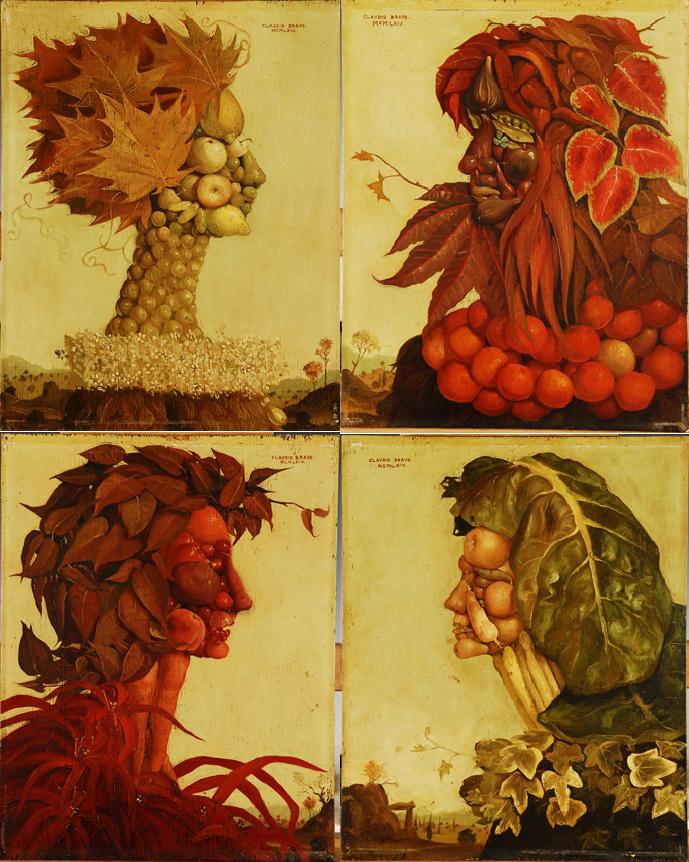
The Four Seasons — Claudio Bravo

claudio-bravo

“Two celebrated ghosts existed, once on a time, in the wilds of Craig-Aulnaic, a romantic place in the district of Strathdown, Banffshire.”

“The Ghosts of Craig-Aulnaic”

from Folk-Lore and Legends of Scotland by W.W. Gibbings

Two celebrated ghosts existed, once on a time, in the wilds of Craig-Aulnaic, a romantic place in the district of Strathdown, Banffshire.  The one was a male and the other a female.  The male was called Fhuna Mhoir Ben Baynac, after one of the mountains of Glenavon, where at one time he resided; and the female was called Clashnichd Aulnaic, from her having had her abode in Craig-Aulnaic.  But although the great ghost of Ben Baynac was bound by the common ties of nature and of honour to protect and cherish his weaker companion, Clashnichd Aulnaic, yet he often treated her in the most cruel and unfeeling manner.  In the dead of night, when the surrounding hamlets were buried in deep repose, and when nothing else disturbed the solemn stillness of the midnight scene, oft would the shrill shrieks of poor Clashnichd burst upon the slumberer’s ears, and awake him to anything but pleasant reflections.

But of all those who were incommoded by the noisy and unseemly quarrels of these two ghosts, James Owre or Gray, the tenant of the farm of Balbig of Delnabo, was the greatest sufferer.  From the proximity of his abode to their haunts, it was the misfortune of himself and family to be the nightly audience of Clashnichd’s cries and lamentations, which they considered anything but agreeable entertainment. Continue reading ““Two celebrated ghosts existed, once on a time, in the wilds of Craig-Aulnaic, a romantic place in the district of Strathdown, Banffshire.””

“The Facts in the Case of M. Valdemar” — Edgar Allan Poe

“The Facts in the Case of M. Valdemar”

by

Edgar Allan Poe

Harry-Clarke--Poe--Tales-of-Mystery-and-Imagination--22_900

Illustration by Harry Clarke

Of course I shall not pretend to consider it any matter for wonder, that the extraordinary case of M. Valdemar has excited discussion. It would have been a miracle had it not-especially under the circumstances. Through the desire of all parties concerned, to keep the affair from the public, at least for the present, or until we had farther opportunities for investigation—through our endeavors to effect this—a garbled or exaggerated account made its way into society, and became the source of many unpleasant misrepresentations, and, very naturally, of a great deal of disbelief.

It is now rendered necessary that I give the facts—as far as I comprehend them myself. They are, succinctly, these:

My attention, for the last three years, had been repeatedly drawn to the subject of Mesmerism; and, about nine months ago it occurred to me, quite suddenly, that in the series of experiments made hitherto, there had been a very remarkable and most unaccountable omission:—no person had as yet been mesmerized in articulo mortis. It remained to be seen, first, whether, in such condition, there existed in the patient any susceptibility to the magnetic influence; secondly, whether, if any existed, it was impaired or increased by the condition; thirdly, to what extent, or for how long a period, the encroachments of Death might be arrested by the process. There were other points to be ascertained, but these most excited my curiosity—the last in especial, from the immensely important character of its consequences. Continue reading ““The Facts in the Case of M. Valdemar” — Edgar Allan Poe”

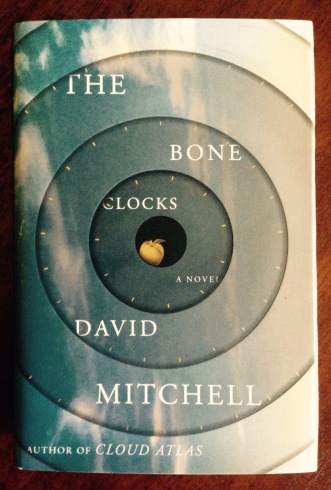
David Mitchell’s New Novel The Bone Clocks Falls Far Short of His Best Work

IMG_3700

David Mitchell’s latest novel The Bone Clocks is 624 pages in hardback, its sprawling metaphysical plot jammed into six overlapping sections that move through six decades and several genres. Any number of critical placeholders might be applied here: Sweepingambitious, genre-skeweringkaleidoscopic (I stole that last one from the book jacket). Or, perhaps we prefer our descriptors more academic? Okay: Postmodernmetatextualmetacritical, polyglossic. With The Bone Clocks, Mitchell has used these functional, formal postmodernist techniques to string together a few good novellas with some not-so-good novellas into a novel that’s not bad—but also not particularly good.The Bone Clocks is just okay. It fills space, it fills time. But unlike Mitchell’s previous stronger novels—Black Swan Green and Cloud Atlas in particular—The Bone Clocks fills without nourishing.

The Bone Clocks opens in 1984 with “A Hot Spell,” introducing us to the novel’s ostensible subject, Holly Sykes, a fifteen year-old who runs away from home. This section also introduces us to Mitchell’s consistent idiom here, a first-person present tense narration that forces the plot forward like an engine. When Mitchell needs to deliver any background information, the narrator simply trots out old memories, or a character politely shows up to dump exposition. The exposition-dumping is particularly egregious in the novel’s final sections.

Our heroine Holly Sykes helps out with some of that exposition early on, filling in some of the contours we’ll need to understand if we want to suss out the Big Metaphysical Plot of The Bone Clocks: There are “the radio people,” voices that contact Holly, um, telepathically; there are the strange figures of Marinus and Constantin; there is the drama of Holly’s deep-souled, old-souled little brother Jacko, who ominously makes her memorize a labyrinthine map in the book’s early pages (foreshadowing!):

The one Jacko’s drawn’s actually dead simple by his standards, made of eight or nine circles inside each other.

“Take it,” he tells me. “It’s diabolical.”

“It doesn’t look all that bad to me.”

“ ‘Diabolical’ means ‘satanic,’ sis.”

“Why’s your maze so satanic, then?”

“The Dusk follows you as you go through it. If it touches you, you cease to exist, so one wrong turn down a dead end, that’s the end of you. That’s why you have to learn the labyrinth by heart.”

Christ, I don’t half have a freaky little brother.

“Right. Well, thanks, Jacko. Look, I’ve got a few things to—” Jacko holds my wrist. “Learn this labyrinth, Holly. Indulge your freaky little brother. Please.” That jolts me a bit.

See how young Holly doesn’t quite cotton that Jacko has, like, responded to her by using the same phrase she thought but didn’t say aloud? Mitchell has a talent for crafting characters like this—characters who can’t see their own blind spots, characters utterly naïve to how we see them. Mitchell excelled at this technique in Black Swan Green, whose narrator Jason Taylor describes for us what he cannot name or fully understand. Holly’s 1984 narrative often feels like a rewrite of Black Swan Green. Jason actually shows up—sort of—in The Bone Clocks; his cousin Hugo Lamb, a minor character in Black Swan Green, narrates the section after young Holly’s story.

Hugo Lamb’s “Myrrh Is Mine, Its Bitter Perfume” propels us to 1991. Lamb is a charming, conniving con man. If young Holly echoes Adam Ewing of Mitchell’s superior novel Cloud Atlas in her naïve innocence (she does), then Hugo Lamb echoes Cloud Atlas’s genius con man, Robert Frobisher. Indeed, most of the central narrators in The Bone Clocks read like familiar repetitions of characters from Cloud Atlas. I enjoyed Frobisher’s plotting and scheming, and I enjoyed it again in Lamb, a sympathetic rake. I was digging The Bone Clocks all through his section, despite feeling vaguely worried that Mitchell was not exactly doing much to flesh out The Big Metaphysical Plot that would have to hold this thing together.

Continue reading “David Mitchell’s New Novel The Bone Clocks Falls Far Short of His Best Work”

“Authenticity’s Wiped Out” — A Passage from William Gaddis’s Last Novel, Agapē Agape

William Gaddis’s last novel Agapē Agape is a bitter, funny rant, a monologic stream-of-consciousness that, through its extreme powers of synthesis, spills over into heteroglossic eruptions, a carnival of erudite voices. Driven by terrible physical pain, hints of madness, and, most of all, the need to “explain all this” before he dies, the voice of the novel (surely Gaddis himself) channels cultural historian Johan Huizinga and philosopher Walter Benjamin into a conversation about the conflict of art and commerce set against the backdrop of the rise of mass culture:

. . . falls right into line doesn’t it, collapse of authenticity collapse of religion collapse of values what Huizinga called one of the most important phases in the history of civilization, and Walter Benjamin picks it up in his Art in the Age of Mechanical Reproduction in this heap somewhere, the authentic work of art is based in ritual he says, and wait Mr. Benjamin, got to get in there the romantic mid-eighteenth century aesthetic pleasure in the worship of art was the privilege of the few. I was saying, Mr. Huizinga, that the authentic work of art had its base in ritual, and mass reproduction freed it from this parasitical dependence. Ah, quite so Mr. Benjamin quite so, turn of the century religion was losing its steam and art came in as its substitute would you say? Absolutely Mr. Huizinga, and I’d add that this massive technical reproduction of works of art could be manipulated, changed the way the masses looked at art and manipulated them. Inadvertently Mr. Benjamin you might say that art now became public property, for the simply educated Mona Lisa and the Last Supper became calendar art to hang over the kitchen sink. Absolutely Mr. Huizinga, Paul Valery saw it coming, visual and auditory images brought into homes from far away like water gas and electricity and finally, God help us all, the television. Positively Mr. Benjamin, with mechanization, advertising artworks made directly for a market what America’s all about. Always has been, Mr. Huizinga. Always has been, Mr. Benjamin. Everything becomes an item of commerce and the market names the price. And the price becomes the criterion for everything. Absolutely Mr. Huizinga! Authenticity’s wiped out when the uniqueness of every reality is overcome by the acceptance of its reproduction, so art is designed for its reproducibility. Give them the choice, Mr. Benjamin, and the mass will always choose the fake. Choose the fake, Mr. Huizinga! Authenticity’s wiped out, it’s wiped out Mr. Benjamin. Wiped out, Mr. Huizinga. Choose the fake, Mr. Benjamin. Absolutely, Mr. Huizinga! Positively Mr. Benjamowww! Good God! a way to find a sharp pencil just sit still avoid stress stop singing what, anybody heard me they’d think I was losing my, that I’d lost it yes maybe I have . . .

“Tragic Hunt” — Michelangelo Antonioni

IMG_3611

“She Unnames Them” — Ursula K. Le Guin

“She Unnames Them”

by

Ursula K. Le Guin

MOST of them accepted namelessness with the perfect indifference with which they had so long accepted and ignored their names. Whales and dolphins, seals and sea otters consented with particular alacrity, sliding into anonymity as into their element. A faction of yaks, however, protested. They said that “yak” sounded right, and that almost everyone who knew they existed called them that. Unlike the ubiquitous creatures such as rats and fleas, who had been called by hundreds or thousands of different names since Babel, the yaks could truly say, they said, that they had a name. They discussed the matter all summer. The councils of elderly females finally agreed that though the name might be useful to others it was so redundant from the yak point of view that they never spoke it themselves and hence might as well dispense with it. After they presented the argument in this light to their bulls, a full consensus was delayed only by the onset of severe early blizzards. Soon after the beginning of the thaw, their agreement was reached and the designation “yak” was returned to the donor.

Among the domestic animals, few horses had cared what anybody called them since the failure of Dean Swift’s attempt to name them from their own vocabulary. Cattle, sheep, swine, asses, mules, and goats, along with chickens, geese, and turkeys, all agreed enthusiastically to give their names back to the people to whom—as they put it—they belonged.

A couple of problems did come up with pets. The cats, of course, steadfastly denied ever having had any name other than those self-given, unspoken, ineffably personal names which, as the poet named Eliot said, they spend long hours daily contemplating though none of the contemplators has ever admitted that what they contemplate is their names and some onlookers have wondered if the object of that meditative gaze might not in fact be the Perfect, or Platonic, Mouse. In any case, it is a moot point now. It was with the dogs, and with some parrots, lovebirds, ravens, and mynahs, that the trouble arose. These verbally talented individuals insisted that their names were important to them, and flatly refused to part with them. But as soon as they understood that the issue was precisely one of individual choice, and that anybody who wanted to be called Rover, or Froufrou, or Polly, or even Birdie in the personal sense, was perfectly free to do so, not one of them had the least objection to parting with the lowercase (or, as regards German creatures, uppercase) generic appellations “poodle,” “parrot,” “dog,” or “bird,” and all the Linnaean qualifiers that had trailed along behind them for two hundred years like tin cans tied to a tail. Continue reading ““She Unnames Them” — Ursula K. Le Guin”

I hate nature, because it is killing me (Thomas Bernhard)

I do not care for walks either, and have been a reluctant walker all my life. I have always disliked walking, but I am prepared to go for walks with friends, and this makes them think I am a keen walker, for there is an amazing theatricality about the way I walk. I am certainly not a keen walker, nor am I a nature lover or a nature expert. But when I am with friends I walk in such a way as to convince them I am a keen walker, a nature lover, and a nature expert. I know nothing about nature. I hate nature, because it is killing me. I live in the country only because the doctors have told me that I must live in the country if I want to survive—for no other reason. In fact I love everything except nature, which I find sinister; I have become familiar with the malignity and implacability of nature through the way it has dealt with my own body and soul, and being unable to contemplate the beauties of nature without at the same time contemplating its malignity and implacability, I fear it and avoid it whenever I can. The truth is that I am a city dweller who can at best tolerate nature. It is only with reluctance that I live in the country, which on the whole I find hostile.

From Thomas Bernhard’s novel Wittgenstein’s Nephew.

“Pickman’s Model” — H.P. Lovecraft

“Pickman’s Model”

by

H. P. Lovecraft

You needn’t think I’m crazy, Eliot—plenty of others have queerer prejudices than this. Why don’t you laugh at Oliver’s grandfather, who won’t ride in a motor? If I don’t like that damned subway, it’s my own business; and we got here more quickly anyhow in the taxi. We’d have had to walk up the hill from Park Street if we’d taken the car.
     I know I’m more nervous than I was when you saw me last year, but you don’t need to hold a clinic over it. There’s plenty of reason, God knows, and I fancy I’m lucky to be sane at all. Why the third degree? You didn’t use to be so inquisitive.
     Well, if you must hear it, I don’t know why you shouldn’t. Maybe you ought to, anyhow, for you kept writing me like a grieved parent when you heard I’d begun to cut the Art Club and keep away from Pickman. Now that he’s disappeared I go around to the club once in a while, but my nerves aren’t what they were.
     No, I don’t know what’s become of Pickman, and I don’t like to guess. You might have surmised I had some inside information when I dropped him—and that’s why I don’t want to think where he’s gone. Let the police find what they can—it won’t be much, judging from the fact that they don’t know yet of the old North End place he hired under the name of Peters. I’m not sure that I could find it again myself—not that I’d ever try, even in broad daylight! Yes, I do know, or am afraid I know, why he maintained it. I’m coming to that. And I think you’ll understand before I’m through why I don’t tell the police. They would ask me to guide them, but I couldn’t go back there even if I knew the way. There was something there—and now I can’t use the subway or (and you may as well have your laugh at this, too) go down into cellars any more.
     I should think you’d have known I didn’t drop Pickman for the same silly reasons that fussy old women like Dr. Reid or Joe Minot or Bosworth did. Morbid art doesn’t shock me, and when a man has the genius Pickman had I feel it an honour to know him, no matter what direction his work takes. Boston never had a greater painter than Richard Upton Pickman. I said it at first and I say it still, and I never swerved an inch, either, when he shewed that “Ghoul Feeding”. That, you remember, was when Minot cut him.
     You know, it takes profound art and profound insight into Nature to turn out stuff like Pickman’s. Any magazine-cover hack can splash paint around wildly and call it a nightmare or a Witches’ Sabbath or a portrait of the devil, but only a great painter can make such a thing really scare or ring true. That’s because only a real artist knows the actual anatomy of the terrible or the physiology of fear—the exact sort of lines and proportions that connect up with latent instincts or hereditary memories of fright, and the proper colour contrasts and lighting effects to stir the dormant sense of strangeness. I don’t have to tell you why a Fuseli really brings a shiver while a cheap ghost-story frontispiece merely makes us laugh. There’s something those fellows catch—beyond life—that they’re able to make us catch for a second. Doré had it. Sime has it. Angarola of Chicago has it. And Pickman had it as no man ever had it before or—I hope to heaven—ever will again.
     Don’t ask me what it is they see. You know, in ordinary art, there’s all the difference in the world between the vital, breathing things drawn from Nature or models and the artificial truck that commercial small fry reel off in a bare studio by rule. Well, I should say that the really weird artist has a kind of vision which makes models, or summons up what amounts to actual scenes from the spectral world he lives in. Anyhow, he manages to turn out results that differ from the pretender’s mince-pie dreams in just about the same way that the life painter’s results differ from the concoctions of a correspondence-school cartoonist. If I had ever seen what Pickman saw—but no! Here, let’s have a drink before we get any deeper. Gad, I wouldn’t be alive if I’d ever seen what that man—if he was a man—saw!
     You recall that Pickman’s forte was faces. I don’t believe anybody since Goya could put so much of sheer hell into a set of features or a twist of expression. And before Goya you have to go back to the mediaeval chaps who did the gargoyles and chimaeras on Notre Dame and Mont Saint-Michel. They believed all sorts of things—and maybe they saw all sorts of things, too, for the Middle Ages had some curious phases. I remember your asking Pickman yourself once, the year before you went away, wherever in thunder he got such ideas and visions. Wasn’t that a nasty laugh he gave you? It was partly because of that laugh that Reid dropped him. Reid, you know, had just taken up comparative pathology, and was full of pompous “inside stuff” about the biological or evolutionary significance of this or that mental or physical symptom. He said Pickman repelled him more and more every day, and almost frightened him toward the last—that the fellow’s features and expression were slowly developing in a way he didn’t like; in a way that wasn’t human. He had a lot of talk about diet, and said Pickman must be abnormal and eccentric to the last degree. I suppose you told Reid, if you and he had any correspondence over it, that he’d let Pickman’s paintings get on his nerves or harrow up his imagination. I know I told him that myself—then. Continue reading ““Pickman’s Model” — H.P. Lovecraft”

Edgar Poe, Charles Baudelaire, an Orangutan and the Raven — Julio Pomar

Flannery O’Connor’s Kiss of Death

During these travels, I met a professor at the University of Georgia. She suggested that I pay a visit to a local woman who had had her first book published by Harcourt, Brace & Company, where I was now a sales agent in the education branch. The professor believed that this author would enjoy meeting me because of her affiliation with the publishing firm. Weakened as she was by her disease, lupus, she wasn’t in contact with many people, so it would be nice to receive a visit from outside. A few years back, her father had died from the same disease, but the doctors had told her not to worry.
 
I was driven to her home outside the town of Milledgeville, Georgia. The farm was situated in the middle of a pretty deserted landscape consisting of a few villages, fields, and some woods. When I arrived, I saw a two-story farmhouse, which turned out to be from the middle of the 1800s.
 
Then Flannery’s mother, Regina, appeared in the doorway. Flannery herself couldn’t make it to the entrance because of her crutches. The mother was happy to receive a visitor for her daughter, since they lived in quite a lonesome place, but she made it clear that I shouldn’t expect to stay the night. Once I started visiting Flannery regularly, I could tell that Regina didn’t like my visits, even though she was quite polite. She perceived me as a threat, afraid that Flannery might settle down with me in Denmark.

In the new issue of AsymptoteKlaus Rothstein offers Erik Langkjær’s fascinating account of meeting—and kissing!—Flannery O’Connor. (Langkjær is the narrator of the section). Continue reading at Asymptote to get to the kissing.

Watch Toby Dammit, Federico Fellini’s Short Film Loosely Based on Stories by Edgar Allan Poe