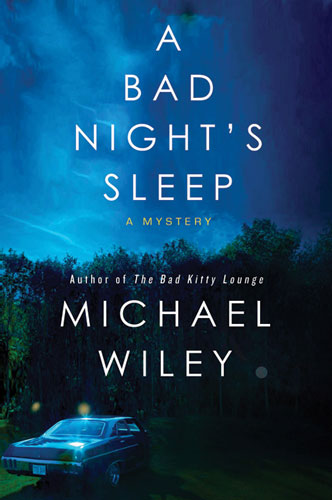
A Bad Night’s Sleep — Michael Wiley

A Bad Night’s SleepMichael Wiley’s third detective novel, opens with protagonist PI Joe Kozmarski working what appears to be a boring job. He’s hired to investigate the repeated robberies of a Chicago construction site. Sure, it’s a glorified nightwatchman gig, but this job might get him closer to retiring in a certain north Florida fishing town he dreams about. The job gets too interesting too quickly, however, when the burglars arrive and begin stealing equipment and material. Then the police show up—and help rob the site. Kozmarski calls 911, more police arrive, and, in the firefight that ensues he shoots—and kills—one of the robber cops.

While waiting in jail to be charged—an event that never quite comes to light—Kozmarski reflects—

Every time I’d seen someone die I’d felt the world go a little quieter like I’d lost part of my hearing, and sooner or later the singing, laughing, and screaming would fade into a hushing wind of white noise. That had happened when my dad died. It had happened when Kevin, a boy I was supposed to be protecting, ended up twisted and broken on his mother’s kitchen floor. It happened. Shooting the cop felt worse. I’d ripped a little hole in the universe and I wondered what sound would fly through it.

Kozmarski’s little hole lets in more than strange sounds. The cop-shooting imperils his PI license, damages his (not exactly heretofore spotless) reputation, and leads undercover cops to threaten him (to the point of firing shots) as he leaves jail. The stress doesn’t exactly help protect his tenuous sobriety either, and Kozmarski’s soon on the sauce again (let’s not even mention that little bag of coke his “friend” sends him to help through these troubled times). Luckily (although that’s hardly an appropriate adverb here), Kozmarski’s friend on the force sets up another job for our distressed hero, one that could clear his name and clean out some of the dirty cops of the Chicago PD. Kozmarski infiltrates the corrupt gang of crooked cops, but as he plumbs deeper into the mystery, the line between good guys and bad guys becomes increasingly nebulous.

A Bad Night’s Sleep is a page turner telegraphed in terse, tense, vivid prose. Wiley’s plot and dialogue alike are hardboiled in the noir tradition of Hammett or Chandler, and his characters and pacing bristle with the gritty immediacy one might find in George V. Higgins. There’s a smart brush of black humor to A Bad Night’s Sleep that comes from Wiley’s characterization and his protagonist’s wry observations. And for all of his hard edges, we find in Kozmarski an engaged protagonist, a man of genuine pathos. Wiley delivers what readers want from an intelligent mystery—keen, suspenseful plotting, sharp action sequences, and a hero we can care about.

A Bad Night’s Sleep is available now in hardback from St. Martin’s Minotaur imprint. Read our interview with Michael Wiley.

I Review Attack the Block, A Charming, Confused Film About Teens Fighting Aliens

Attack the Block is a strange, charming little film that imagines what would happen if aliens attacked a council estate in inner-city London on Guy Fawkes Night. (In Americanese, a council estate is a project, an urban ghetto marked by violent crime, disenfranchisement, and low opportunity). The teenage heroes of Attack the Block are slang- (and sword and bat) wielding youths right on the precipitous edge of adulthood; Attack the Block narrativizes the strange intersection of children’s games with the kind of real-world concrete violence that entails lifelong consequence. Moses, the gang’s perceptive and courageous leader, already has one foot strongly planted in the adult criminal world. The alien invasion—an attack on the block, which is to say the entire known world for these kids—affords Moses a real chance to rise to the talent—and violence—writhing inertly within him.

We first meet Moses and his gang of charming ruffians in the middle of a mugging. They rob poor Sam, a female nurse whom they don’t recognize as actually living in the same building as them, but a meteor crashes into a nearby car, interrupting the robbery. A bizarre ape-featured creatures erupts from the explosion; Sam takes the opportunity to run away and Moses and his gang follow the alien. In a tense scene that establishes Moses’ badassery (and thoughtless recklessness), they kill the thing. After scaring a few of the estate girls, Moses takes the creature’s corpse to the “weed room,” the most secure spot on the block. The weed room is owned and operated by Hi-Hatz, a ruthless drug dealer/would-be rap artist who is equal parts menacing and comical (Nick Frost plays his front room dealer). However, the alien corpse only serves to attract much larger, gorilla-sized aliens who, um, attack the block in manic droves. The kids’ response: go grab their store of weapons (bats, novelty swords, fireworks, and chains), jump on their bikes, and set  out to kill the suckers. In the process, they’re reunited with their victim Sam, a conflict that underlines the core message of the movie, which concerns understanding our neighbors (so that we can, like, kill outside invading forces). The film is in a sense about the misplaced “othering” that functions in ideology, an “othering” that prescribes social and economic roles and prevents empathy or progress.

Attack the Block, a British production, was directed and written by Joe Cornish, whose sense of exactly what the film should be doing is muddy to say the least. Tonally, Attack the Block is all over the place: it’s not sure if it wants to be a hard-edged horror film, a “kids-take-the-night” adventure film with ironic edges and a fun-loving spirit, or a study in contemporary British views on race and class with preachy undertones. Is the movie ultimately dark or sweet, message-driven or an exposition of economic disenfranchisement and nihilism? It’s never quite clear. This messiness is awfully charming though, just like the creature effects which are, uh, very BBC. Attack the Block is at its best when it smashes its ironic self-awareness of the hoary tropes its trotting out (from War of the Worlds to The Goonies) up against an earnest, heart-felt spirit, a spirit that perfectly matches the enthusiasm of a bunch of repressed and forgotten young males actually getting to go prove themselves by doing awesome shit. Cornish’s best scenes restage the classical conventions of British romantic adventures, right down to a new-fashioned joust scene that’s both rousing and comical.

American viewers may feel we hold a monopoly on films about youth in the projects trying to survive (a survival which Attack the Block obviously literalizes through the magnifying lens of a sci-fi horror invasion); this sense of cultural entitlement can lead to strange moments of cross-cultural cognitive dissonance that won’t be unfamiliar to anyone who’s felt the minor alterity of watching a British synthesis of Hollywood tropes (Guy Ritchie’s films come immediately to mind). There’s also the issue of dialogue and slang; perhaps Cornish used LPs from Dizzee Rascal and The Streets to flesh out his lexicon (or maybe Cornish is just that “down,” but one senses affectation either way)—in any case, I was never quite sure if a British audience would find the youths’ speech legitimate, but I did very much enjoy it. It only compounded my sense that Attack the Block is sort of like a crueler E.T. scripted by Russell Hoban. There’s a lovely streak of Riddley Walker in Attack the Block.

Attack the Block, despite—or perhaps because of its flaws—is a charming, spirited film with a strong protagonist in Moses. It’s one of the few films I’ve seen that actually gains something (some ineffable quality I don’t know how to name) in trying to appeal to fans of different genres and backgrounds, and if it made me cringe at times with its clumsy tonal shifts, it also thrilled and moved me in turn. Recommended.

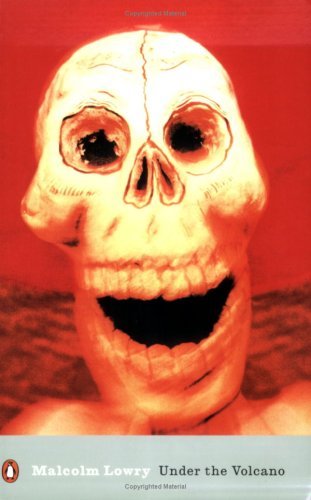
Under the Volcano — Malcolm Lowry

Most of Malcolm Lowry’s dense, depressing novel Under the Volcano takes place over the course of November 2nd, 1938, the Mexican Day of the Dead. Like a reticent, dour Virgil, Lowry guides the reader through the day’s tragic arc, floating between the minds of his novel’s three protagonists: Geoffrey Firmin, his half-brother Hugh, and Geoffrey’s estranged wife Yvonne. Geoffrey is British Consul to Mexico — ex-Consul, really, as British-Mexican relations sour against the backdrop of Spanish fascism and the rise of nationalism in Mexico — but he is almost always referred to as “the Consul,” a blackly ironic title. See, the Consul bears little authority aside from an extreme expertise on how to stay drunk (or “drunkly sober un-drunk”) 24/7. He’s ambassador to bar stools, a manager of mescal and little else (certainly not his own life; certainly not diplomatic affairs). The Consul is a wreck, an alcoholic to put Hemingway and Fitzgerald’s (and even Bukowski’s) alter-egos to shame.

After a first chapter that seems to derail all but the most patient readers, the narrative conflict arrives when Yvonne returns to Quauhnahuac, Mexico, a year after leaving (and divorcing) the Consul. She arrives to find the Consul (“Geoffrey,” as he’s called when the free indirect style inhabits her mind) drinking whiskey in a hotel bar in order to sober up (yep). It’s not immediately clear why Yvonne has returned to the Consul, but it seems that she hopes to save him from drowning in a drunken downward spiral. As the pair walks to the Consul’s house, they pass numerous advertisements for a boxing match; a child’s funeral proceeds down the avenue. These motifs of fighting, death, and futility permeate the novel.

During the walk we learn that Yvonne is not the only one concerned about the Consul’s health; his (much) younger brother Hugh has come to stay with him in the hopes of sobering him up. (Hugh employs a revolting and unsuccessful “strychnine cure”). That Hugh has also returned doubly complicates the plot. Much of Under the Volcano remains implicit, unnamed, hinted at, and this seems especially true of the implication that Yvonne cheated on the Consul with Hugh in the recent past (this implication may have been stated conclusively at some point in the novel, but I’ve only read the book once, which is perhaps like not having read it at all). What’s certainly clear is that Yvonne cheated on the Consul with a French filmmaker, Jacques Laruelle, a man whom the Consul, through sheer bizarre coincidence (but of course it isn’t sheer bizarre coincidence), spent a childhood summer with, an experience which bonded them as brothers in an Edenic holiday that eventually (inevitably) soured.

Despite her infidelities, Yvonne is generally present (I choose the verb “present” over “presented as” to highlight Lowry’s impeccable Modernist style) as a sympathetic character. Still, it is hard not to identify with the Consul (with “Geoffrey,” I suppose, if we are going to be familiar), the dark soul of this novel, and his complicated, painful feelings for Yvonne form the core of Volcano’s tragedy. He longs for her, pines for a complete life with her, yet resents her, cannot forgive her, hates her. For what? For leaving him. For betraying him. But perhaps foremost, he despises her inability to understand his alcoholism (he is particularly upset when she refuses to share a morning libation with him when they meet for the first time in a year). I’ll quote a passage at length now, one that showcases Lowry’s free indirect style, and one that reveals the strange indignities of the Consul’s sense of his own alcoholism. For context, dear reader, you must only know that Yvonne has suggested that she and the Consul might make long-term plans when he is sober “in a day or two”—

The Consul sat perfectly still staring at the floor while the enormity of the insult passed into his soul. As if, as if, he were not sober now! Yet there was some elusive subtlety in the impeachment that still escaped him. For he was not sober. No, he was not, not at this very moment he wasn’t! But what had that to do with a minute before, or half an hour ago? And what right had Yvonne to assume it, assume either that he was not sober now, or that, far worse, in a day or two he would be sober? And even if he were not sober now, by what fabulous stages, comparable indeed only to the paths and spheres of the Holy Cabbala itself, had he reached this stage again, touched briefly once before this morning, this stage at which alone he could, as she put it, “cope,” this precarious precious stage, so arduous to maintain, of being drunk in which alone he was sober! What right had she, when he had sat suffering the tortures of the damned and the madhouse on her behalf for fully twenty-five minutes on end without having a decent drink, even to hint that he was anything but, to her eyes, sober? Ah, a woman could not know the perils, the complications, yes, the importance of a drunkard’s life! From what conceivable standpoint of rectitude did she imagine she could judge what was anterior to her arrival? And she knew nothing whatever of what all too recently he had gone through, his fall in the Calle Nicaragua, his aplomb, coolness, even bravery there—the Burke’s Irish whiskey! What a world! And the trouble was she had now spoiled the moment.

The “fall in the Calle Nicaragua” the Consul references is quite literally a drunkard’s blackout (followed by the aforementioned fortifying whiskey, courtesy of a tourist), but it — falling — is perhaps the dominant motif in a novel crammed with motifs. In allegorical terms, if we want to ruin a good book (I don’t recommend this, of course), Volcano is pure Faust-stuff: end of innocence, fall of man, intractability of the human condition, ethical peril, moral inertia. While the Consul’s fall dominates the novel, Lowry brings this decline into dramatic relief in a late, climactic episode when his (anti-)heroic trio encounter a dying (dead?) man on the side of the road. Hugh tries to help, but the Darwinian venality of Mexican commonplace law makes his attempt impotent. Yvonne and the Consul are basically paralyzed.

Hugh’s attempt to save the man is a desperate call to action, an endeavor to perform some good in a world dominated by war and fascism. Hugh’s character fascinates. We learn of his past in one of the novel’s most intriguing episodes, a mini-bildungsroman that finds young Hugh working in the merchant marine as a calculated ploy to lend romance to his persona — he longs to prevail as a songwriter. He returns to find that no one cares about — has even heard — his guitar compositions; his publicity stunt fails. Although Hugh is only twenty-nine, he already seems himself as a failure, a fallen hero; he obsesses over the Battle of Ebro, daydreaming of helming a ship laden with hidden arms that he will deliver to the Loyalists who oppose the Fascists. Hugh’s greatest pain — and perhaps (only perhaps) Lowry’s greatest cruelty — is the awareness that the idealism of romantic heroism is intrinsically bound to a kind of selfish egoism. Hugh, perhaps with the visceral signal of his half-brother as a kind of radical prescience, can already see his own fall; his parts in Volcano are in a sense a constant meditation on falling. Hugh tries to save the dying man on the road, the cold double of his brother, whom he also tries to save — and yet it is all to little avail.

In Lowry’s world, in the volcano-world, there is only expulsion from the Eden. Lowry spells out this theme near the middle of his novel in a strange episode. The Consul wanders into his neighbor’s garden and reads a sign —

¿LE GUSTA ESTE JARDÍN?
¿QUE ES SUYO?
¡EVITE QUE SUS HIJOS LO DESTRUYAN!

The Consul stared back at the black words on the sign without moving. You like this garden? Why is it yours? We evict those who destroy! Simple words, simple and terrible words, words which one took to the very bottom of one’s being, words which, perhaps a final judgement on one, were nevertheless unproductive of any emotion whatsoever, unless a kind of colourless cold, a white agony, an agony chill as that iced mescal drunk in the Hotel Canada on the morning of Yvonne’s departure.

Significantly, either the sign is posted with improper punctuation, or (and?) the Consul’s translation is wrong — in either case a meaningful misreading occurs. We later receive the “proper” version of the sign: “¿Le gusta este jardín, que es suyo? ¡Evite que sus hijos lo destruyan! – “Do you like this garden that is yours? See to it that your children do not destroy it!”  The Consul’s first reading is a corruption, a cruel misreading that questions humanity’s right to happiness, and, tellingly, he connects the sign to the end of his relationship with Yvonne. The second version of the sign, while still foreboding, perhaps signals a kernel of hope in Lowry’s bleak work — the idea that a garden might be preserved, might be tended to; that children might be raised who do not kill, cheat, steal, rape, enslave, or otherwise prey on each other. Still, Lowry refuses to imagine what such a world might look like for us. Did I mention that Volcano is really, really sad?

For all its bleak, bitter bile, Volcano contains moments of sheer, raw beauty, especially in its metaphysical evocations of nature, which always twist back to Lowry’s great themes of Eden, expulsion, and death. Lowry seems to pit human consciousness against the naked power of the natural world; it is no wonder then, against such a grand, stochastic backdrop, that his gardeners should fall. The narrative teems with symbolic animals — horses and dogs and snakes and eagles — yet Lowry always keeps in play the sense that his characters bring these symbolic identifications with them. The world is just the world until people walk in it, think in it, make other meanings for it.

In many ways, Under the Volcano is an antipodal response to Joyce’s Ulysses. Both novels stream through a number of consciousnesses over the course of one day; both novels invert and subvert mythical frameworks against diurnal concerns; both novels point to the ways that the smallest meannesses — and kindnesses — can color and affect our lives. And while there are many divergences (chiefest, I believe, the spirit of redemption in Ulysses that seems entirely absent from Volcano), the greatest similarity may be their difficulty. Simply put, Lowry, like Joyce, throws his readers into the deep end. The first chapter of the novel inhabits the mind of Jacques Laruelle and takes place exactly one year after the events of the rest of the novel. It is both overture and context for all that follows, and yet it is radically alienating; indeed, it only fully makes sense after one finishes the novel and goes back and reads it again, realizing it is the rightful coda, the sad epilogue of a sad story. Lowry leads with his conclusion, show us the fall-out up front, the splinters and shards of the narrative to come. Picking up these pieces is hardly easy and never joyful, but it is a rewarding experience. Very highly recommended.

[Editorial note: Biblioklept ran this review in March of 2011; we run it again in honor of The Day of the Dead]


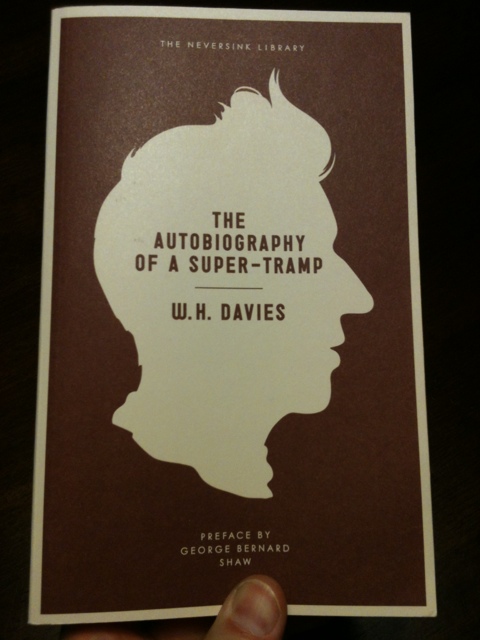
The Autobiography of a Super-Tramp — W.H. Davies

The Autobiography of a Super-Tramp documents W.H. Davies’s picaresque adventures in America in the last decade of the nineteenth century. In bildungsroman mode, Davies begins by relating the story of his childhood in Wales, where he was raised by his grandparents after his father died and his mother essentially abandoned her children. Despite his grandparents’ care, Davies soon turns to petty crime, shoplifting for sport (as well as to provide trifles for his girlfriend). He’s caught, tried,  and beaten, an early run-in that would set a template for future dealings with authority figures. A restless spirit with a hankering for adventure, Davies has trouble attaining steady work; he’s a bit of a romantic, always stuck in a book. He elects to set off for America. In one of the funnier moments in the book, Davies describes writing a letter comparing America to England. Davies mails the missive home—only he’s still in Liverpool and has yet to see the New World, let alone the open sea. Of course, after years trekking across the US, Davies got to know much of the national characteristic; here he is reflecting—

My impression of Americans from the beginning is of the best, and I have never since had cause to alter my mind. They are a kind, sympathetic race of people and naturally proud of their country. The Irish-American is inclined to be the most bitter, remembering from his youth the complaints of his parents, who were driven through unjust laws from their own beloved land; and such a man is not to be idly aggravated, for life is a serious subject to him. This man is not to be aggravated, especially under the consideration that our conscience is not too clean in this respect, and that we are apt to be very slow in making that open confession which is good for the soul. The most pleasing trait in Americans, which cannot for long escape us, is their respect for women and the way in which the latter do deserve it.

In a strange moment that’s never quite fully explained (there are lots of these in Super-Tramp), upon arrival in America, our hero elects to take up with a vagabond named Brum, who teaches the would-be tramp the ins-and-outs of jumping rail, beating trail, and begging from town to town. In one inspired episode, Brum takes our hero to Michigan, where vagabonds could wait out the winter in warm jails with plenty of food (and tobacco). Here, the tramps could barter their own sentences with the complicity of the judge and jailers, who were basically working a scam on the taxpayers. (Luckily, no one makes undue profits by overcrowding prisons in America today. Right? Right?) Brum is one of the first players in a large cast of indigents and outsiders, men of dubious honesty and strange talents whose common thread is that they are all aliens to mainstream society. These are self-exiles whose only telos is movement itself.

These themes of travel and outsider status link Davies’s narratives strongly to those two Jacks of all trades, London and Kerouac, although the clean, spare style of Super-Tramp shares more blood with London’s reportorial rhythms than Kerouac’s unbound typing. It’s also hard to read Super-Tramp without recalling Steinbeck’s bindlestiffs, and just as in Steinbeck’s finest works, there’s depth, humility, and pathos in Davies’s writing, whether he’s describing picking berries, sharing a drink with the fellows, or moving cattle across the Atlantic.

And if Davies demonstrates empathy for his fellow man, that empathy extends to his keen descriptions of nature and animals; his tender descriptions of the poor cattle he helps transport to England are especially moving. Here, Davies shows the reader his naturalist sympathies—

I like to see to a good scientific bout by men who know the use of their hands, but would rather walk twenty miles than see animals in strife. Although of a quiet disposition, my fondness for animals is likely at any time to lead me into danger. After reading cases of vivisection I have often had dreams of boldly entering such places, routing the doctors with an iron bar, cutting the cords and freeing the animals, despite of any hurt I might receive from bites and scratches. Perhaps I should cut a ridiculous figure, walking the crowded streets with a poor meek creature under each arm, but that would not bother me in the performance of a humane action.

These dual drives—empathy and outrage against injustice—guide Super-Tramp, set against an abiding spirit of freedom and nature. As the narrative progresses, Davies repeatedly foregrounds the Darwinian peril the emerging capitalist industrial culture places on ordinary people. His note on vivisection above becomes tragically ironic late in the book when a terrible accident on the rails claims one of his feet.

Despite his hard (if self-elected) life, Davies would later become more comfortable as one of the most famous poets of his age in England, lauded for his plain, naturalist style, and championed by George Bernard Shaw (who wrote the preface to Super-Tramp and helped get the book published). The Autobiography of a Super-Tramp is an engaging page-turner that will likely appeal to fans of Jack London and John Steinbeck or anyone fascinated by the grime and romance of a hobo jungle. With its emphasis on the human face of those who refuse to play into the capitalist system, the book is as timely as it ever was.

And yes, the band got their name from the book.

The Autobiography of a Super-Tramp is part of Melville House’s new Neversink line.

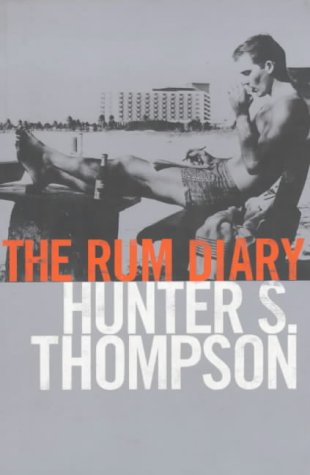
Hey, We Reviewed That Book The Rum Diary by Hunter S. Thompson, the One That Hollywood Turned into a Johnny Depp Movie

Set in the 1950s, Hunter S. Thompson’s second novel The Rum Diary chronicles the drunken misadventures of Paul Kemp, a journalist who moves from New York City to Puerto Rico to write for a small newspaper. While there, Kemp gets involved with a crazy couple who fight all the time (he develops a serious crush on the girl), attends a rum festival, and winds up in jail. Along the way there’s enough drinking to put Hemingway’s characters to shame, and plenty of nude swimming to boot.

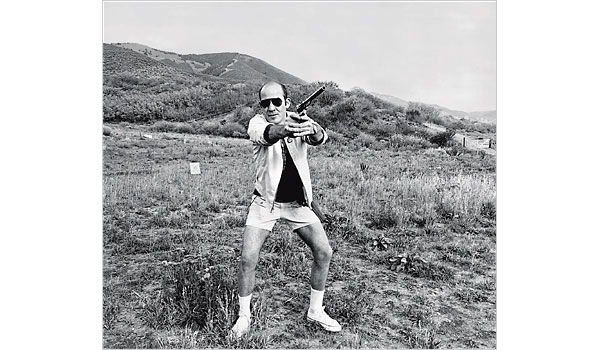
Although The Rum Diary was written in the early sixties, it wasn’t published until 1998, long after the infamous gonzo godfather had made his indelible mark on the American literary consciousness. Thompson was 22 when he wrote The Rum Diary, a significant eight years younger than his stand-in in the novel, jaded journalist Paul Kemp. And while it’s easy to imagine that HST was born a cranky old man, at times Kemp’s world-weariness reads more like an affected pose rather than an earned cynicism.

The novel works best when HST focuses on denigrating the cretins, phonies, perverts, and degenerates that are never in short supply in his sick universe. Where the average travel writer might see a joyous festival throbbing with life and humanity, HST finds dread and disgust, fear and loathing. His frenzied yet steady prose moves quickly, adding to the general manic tone of the novel, and, despite its 200+ pages, The Rum Diary is an easy weekend read. Additionally, HST’s reflections on American imperialism and tourism in general remain relevant and fresh over forty years later.

The Rum Diary is hardly the HST starting place, but this is quite obvious (if, dear reader, this is not obvious to you, get thee to a bookstore posthaste and obtain Fear and Loathing in Las Vegas). However, for casual fans The Rum Diary will make an interesting beach read. Apparently a movie featuring HST friend-alum Johnny Depp (as Paul Kemp) is slated to come out next year, so stay one step ahead of Hollywood by reading this now. Recommended. [Editorial note: Yes, this review is a few years old. There’s a movie now, clearly].

From Hell — Alan Moore & Eddie Campbell

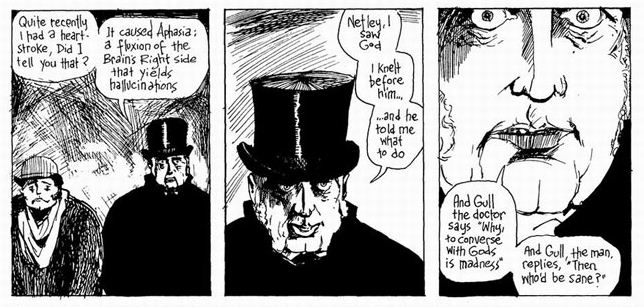
From HellAlan Moore and Eddie Campbell’s epic revision of the Jack the Ripper murders, posits Sir William Gull, a physician to Queen Victoria, as the orchestrator of the Jack the Ripper murders that terrified Londoners at the end of the 19th century. The murders initially arise out of the need to cover up the knowledge of the existence of an illegitimate son begat by foolish Prince Albert, Victoria’s grandson. However, for Gull the murders represent much more–they are part of the continued forces of “masculine rationality” that will constrain “lunar female power.” Gull is a high-level Mason; during a stroke, he experiences a vision of the Masonic god Jahbulon, one which prompts him to his “great work”–namely, the murders that will reify masculine dominance.

One of the standout chapters in the book is Gull’s tour of London, with his hapless (and witless) sidekick Netley. In a trip that weds geography, religion, politics, and mythology, Gull riffs on a barbaric, hermetic history of London, revealing the gritty city as an ongoing site of conflict between paganism and orthodoxy, artistic lunacy and scientific rationality, female and male, left brain and right brain. The tour ends with a plan to commit the first murder. From there, the book picks up the story of Frederick Abberline, the Scotland Yard inspector charged with solving the murders. Of course, the murders are unsolvable, as the hierarchy of London–from the Queen down to the head of police–are well aware of who the (government-commissioned) murderer is. The police procedural aspects of the plot are fascinating and offer a balanced contrast with Gull’s mystical visions–visions that culminate in a climax of a sort of time-travel, in which Gull not only sees London at the end of the twentieth century, but also receives a guarantee that his murder plot has had its intended effect. From Hell takes many of its cues from the idea that history is shaped not by random events, but rather by tragic conspiracies that force people to willingly give up freedom to a “rational” authority. The book points repeatedly to the 1811 Ratcliffe Highway murders, which led directly to the world’s first modern police force. In our own time, if we’re open to conspiracy theories, we might find the same pattern in the 21st century responses to terrorism (Patriot Act, anyone?).

Although From Hell features moments of supernatural horror in Gull’s mysticism, it is the book’s grimy realism that is far more terrifying. London in the late 1880s is no place you want to be, especially if you are poor, especially if you are a woman. The city is its own character, a labyrinth larded with ancient secrets the inhabitants of which cannot hope to plumb. Despite the nineteenth century’s claims for enlightenment and rationality, this London is bizarrely cruel and deeply unfair. Campbell’s style evokes this London and its denizens with a surreal brilliance; his dark inks are by turns exacting and then erratic, concentrated and purposeful and then wild and severe. The art is somehow both rich and stark, like the coal-begrimed London it replicates. Although Moore has much to say, he allows Campbell’s art to forward the plot whenever possible. Moore is erudite and fascinating; even when one of his characters is lecturing us, it’s a lecture we want to hear. His ear for dialog and tone lends great sympathy to each of the characters, especially the unfortunate women who must turn to prostitution to earn their “doss” money. And while Abberline’s frustrations at having to solve a crime that no higher-ups want solve make him the hero of this story, Gull’s mystic madness makes him the narrative’s dominant figure. Rereading this time, I realized there is no character he reminds me of as much as Judge Holden from Cormac McCarthy’s Blood Meridian. I’m also reading Joseph Conrad’s The Secret Agent now, a book that dovetails neatly with From Hell, both in its time and setting, but also in its exploration of social unrest and duplicitous authority. Both novels feature detectives fighting a complacent system, and both novels feature a working class that threatens to erupt in socialist or anarchist rebellion.

From Hell is a fantastic starting place for anyone interested in Moore’s work, more self-contained than his comics that reimagine superhero myths, like Watchmen or Swamp Thing, and more satisfying and fully achieved than Promethea or V Is for Vendetta. Be forewarned that it is a graphic graphic novel, although I do not believe its violence is gratuitous or purposeless. Indeed, From Hell aspires to remark upon the futility and ugliness of cyclical violence, and it does so with wisdom and verve. Highly recommended.

[Ed. note: We ran a version of this review last year; we run it again in celebration of Halloween].

Ray — Barry Hannah

ray

Barry Hannah’s slim 1980 novel Ray is a strange wonder, a poem rocket assured to offend any unsuspecting customer who wanders in unaware. I use the term “offend” here loosely: some may be offended by Hannah’s subject matter (booze, drugs, sex, violence), others may be offended by his refusal to submit to any of the conventions we expect from a “novel.” Sure, there are defined characters, conflicts, hints of a plot even, but don’t expect arc, easily recognizable growth, or even linearity. Hannah breaks almost every convention, right down to a first-person narration that shifts occasionally into a kind of second-person meditation and then into a faux-objective third-person voice and then into the third-person free indirect style that marks modernism. The subject Ray careens not just through perspectives but also through time. Here he is in Chapter V (this is the chapter in its entirety)—

I live in so many centuries. Everybody is still alive.

And if Ray is busy stumbling through his own psychic quagmire, shooting down planes in ‘Nam or killing Yankees under Jeb Stuart’s command, he’s also a very real, concrete personality, a doctor, a family man, an alcoholic, a suffering soul trying to navigate children and lovers and patients and neighbors in the swelter of Tuscaloosa, Alabama at the end of Carter’s presidency.

None of this should work, of course, but Hannah’s writing assimilates the reader, inculcates the reader, infects the reader. Ray is a dramatically unstable figure of the old school—misogynist, casually racist, the kind of doctor who finds himself “drinking five bottles of wine a day just to stay cool” — but Hannah’s syntactic powers (which he awards to his narrator Ray) become the core of a novel that by rights should run off the tracks, what with its sharp velocity and manic force and hairpin turns. But Ray doesn’t run off the tracks; it explodes them.

It’s hard to summarize the plot of this fragmentary novel, but I’ll give it a try (and at least share some of Hannah’s remarkable prose). Ray is a country doctor of some note and education, a former pilot who fought and killed in Vietnam, a man with literary ambitions who tries his hand at poetry and occasionally lectures at the local college. Here’s a taste of one of those lectures, showcasing Hannah’s wit, the radically ambivalent place of history in his work, and the core paradoxes of his lead character—

So now, class, I say:

“Americans have never been consistent. They represent gentleness and rage together. Franklin was the inventor of the stove, bifocals, and so on. Yet he abused his neglected family. Jefferson, with his great theories, could not actually release the slaves even though he regularly fornicated with one of them. One lesson we as Americans must learn is to get used to the conrarieties in our hearts and live with them.” Etc.

Lazy Blakean. In addition to his history lectures, Ray has even written a number of papers with unlikely titles about women and depressives and medicine; it is wholly ironic that Ray should lay claims to understanding women and depressed people, let alone understanding how to treat them. During the course of the novel he marries again, to a woman named Westy, and they combine their children into a post-nuclear family that recalls The Brady Bunch on Dexedrine and bourbon and weed (that description sounds far more negative than I intend; I’m trying to telegraph the spirit or tone of the novel, which is difficult, impossible). Ray’s lusty marriage to Westy doesn’t prevent his shambolic philandering. Not all of Ray’s infidelities are born of human weakness though. His love for a young woman named Sister from a white trash family called the Hooches deeply informs the novel; it also allows me another chance to quote from the novel—

Sister is always in love with somebody, sometimes me. There is a capricious wisdom she has about attaching herself to anybody for very long, although her loyalties are fast. She plays the guitar well and has a nice voice that she keeps to herself. Life has been such for her that she has no attitude at all. She expects no sympathy. Two of her teenage lovers died in an accident at the railroad tracks. That’s when I met Sister. I rode down to the tracks, and she was standing there in a long sleeping gown, two weeks after the accident.

“What’s wrong, girl?”

“I growed up.”

Along with Sister, a man named Charlie DeSoto plays a large role in Ray; indeed, at times the novel comes to inhabit his consciousness, as if he was some alter-ego of Ray. That consciousness also becomes unstuck in time. In a passage that recalls (and predates) Blood Meridian, DeSoto (via Ray?) migrates back to the mid 1500s, into the mind of one of Hernando DeSoto’s companions in arms. In a bizarre first-person sequence, this ancient Christian describes slaughtering 4,000 Indians under the command of the war chief Tuscaloosa. History is a nightmare that Ray cannot wake up from.

Ray is a strange fever dream, buzzing with tumult, beauty, filth, and ugly vitality. Our clumsy (anti?)hero cannot seem to reconcile his violent past (both as a fighter pilot in Vietnam and as an American with “contrarieties” in his heart) with his duty as a healer, a doctor. He tells us—

I am infected with every disease I ever tried to cure. I am a vicious nightmare of illnesses. God cured me with a memory that holds everything in my brain. There is no forgetting with me. Every name, every foot, every disease, every piece of jewelry hanging from an ear. Nothing is hazy.

If “Nothing is hazy” then everything is brought into vibrant foreground, all details afforded a prominent place, none pushed to a defining background. If “Nothing is hazy” then everything is hazy; contrariety rules.

Perhaps Ray might be summed up by one of its chapters, LII (again, in its entirety)—

To live and delight in healing, flying, fucking. Here are the men and women.

Hannah might have been heir to Faulkner, with his grotesque characters and bizarre syntax and challenging tropes (not to mention the sweaty ickiness of both writers’ prose). Ray also hearkens back to Henry Miller’s rants, although I’d suggest a larger, or at least more loving spirit in Hannah. There are even tinges of Bukoswki here. Ray also recalls Renata Adler’s strange novel Speedboat, another discursive, vaulting piece from the late ’70s. But comparing Ray to other works risks belying its radical originality, which is surely one of its great pleasures. Ray is not a novel for everyone, and those interested in Hannah might do better to begin with his equally strange compilation Airships, but those seeking a challenging, funny novel will appreciate Ray, a novel that explodes literary convention even as it reaffirms the affective power of literature. Highly recommended.


Why I Abandoned Chad Harbach’s Over-Hyped Novel The Art of Fielding After Only 100 Pages

Genre fiction gets a bad rap from some readers and critics because it often rigidly follows a set of formal conventions, from plot to character to prose, to satisfy reader expectations. One mark of literary fiction, in opposition to genre fiction, might be that the literary work disrupts or destabilizes these conventions (works that get called experimental tend to explode these conventions or radically recombine them). Harold Bloom, in The Western Canon (and elsewhere), argues that it is the strangeness and originality of a work that confers its literary power; in some cases, he argues, this strangeness assimilates us (the readers, the culture) to the point that we can no longer recognize its strangeness. While Bloom may be a pompous windbag (and really, what literary critic worth his salt isn’t?), and I don’t always agree with him (especially in his unrelenting agon with “The School of Resentment”), I think he’s given us a good rubric by which to measure or understand what sets great literature apart from the ordinary, the conventional, the ephemeral.

I bring all of this up because it seems to me that literary fiction is its own genre, one with its own conventions, tropes, and formulations. The genre of literary fiction is as much a marketing tool, of course, as it is a set of conventions, and publishers release these books because the author’s Great Ambition and Sterling Prose and Big Ideas (in theory) cast esteem back on the publisher. And while there are plenty of great books with major houses behind them, many books claiming to be “literary fiction” are simply conventional retreads of an antiquated formula, outfitted in the grand themes of the day (these days, that tends to “identity”). These books offer no strangeness, make no attempt to open the realm of literary possibility. They are intellectual comfort food. And there’s nothing wrong with that, just as there’s nothing wrong with a good mystery novel. But I think we lie to ourselves when we overinflate the powers of our “literary” novelists. I enjoyed Jeffrey Eugenides’s middlebrow Middlesex as much as the next lad, for example, but still find it wildly overrated. Another example: Michael Chabon is not my cup of tea, but I wouldn’t argue against his talent. Still, even when he attempts the strange (The Yiddish Policemen’s Union, for example), he’s blandly trying territory already colonized by others. Give me Philip K. Dick or George V. Higgins any day.

My favorite novels tend toward strangeness; they upset or confound or baffle me. I love it when I have no idea what the novelist is doing. And while reckless innovation or experimentation for its own sake can sometimes fall flat (or fall apart), an interesting failure is better than another complacent, forgettable entry in the non-canon of contemporary “literary fiction.”

Which brings me to Chad Harbach’s wildly over-hyped novel The Art of Fielding.

Let me be up front: Yes, this is backlash. The acclaim directed at this novel deserves backlash—although I’d like to be clear up front that I’m not trying to attack the novel itself; that would be like attacking a run-of-the-mill sci-fi novel for indulging in run-of-the-mill sci-fi tropes. My aim is simply to point out that Harbach’s book is no great feat of literature, no work of astounding genius—it’s just run-of-the-mill literary fiction. And yes, I didn’t read past page 100, which conveniently is the last page of chapter 11. Why would I slog it out through 400 more pages when there are so many great books in the world that I haven’t read and precious little time in which to read them? And that’s the point of the rant that follows.

The book is not entirely terrible. It just isn’t very good, certainly not good enough to warrant the excessive praise that’s been heaped upon it. Cardboard characters, cliché after cliché (plot, character, prose), and plenty of bad writing. The dialogue is particularly heinous; I’m fine with unrealistic speech, but Harbach lacks subtlety or style. In fact, the book lost me on page 18, when the character Owen Dunne introduces himself to the protagonist Henry Skrimshander with this groan-inducing nugget: “My name’s Owen Dunne. I’ll be your gay mulatto roommate.” I suppose that the line is meant to be heard in a perhaps ironically self-reflexive sense—a metafictive gesture that extends from Dunne to the audience, like a knowing wink (and bypassing poor boring Henry), but it strikes me instead as utterly tone-deaf, showing us nothing about Dunne and his (supposed hip) cleverness and everything about Harbach’s inability to create concrete, real characters.

Dunne is a particularly grating character in a novel full of grating characters. The worst aspect of this character is that he is presented as an intellectual, but Harbach fails to harness his intellect in the text. We are told the names of some of the authors in his library; we hear some of his pretentious speech; he tells us how smart he is, and one senses that Harbach would have us believe him—only at no point in the first 100 pages are we treated to any real aspect of his intelligence. Critics, or people who write about books, have bent over backwards to call Fielding a smart book, to liken it to Jonathan Franzen or David Foster Wallace or, Jesus Christ, even Herman Melville. But Dunne is the simplest illustration that Harbach’s bench isn’t very deep; there is nothing here to approximate the mind of Hal Incandenza or the heart of Don Gately; there’s certainly no one here on par with Ishmael. But this is hardly Harbach’s fault, of course. Who can make an Ishmael?

If I appear to be attacking Harbach, please let me clarify: I think that he’s written a passable novel in the genre of “literary fiction” (which I contrast here now, for the sake of clarity, with strong literature or even canonical literature, if you like). But this book isn’t another Infinite Jest or Moby-Dick (as if one could even speak of “another” Moby-Dick); it isn’t even in the same league, and its champions do it no favors in overpraising it.

Let’s take a peek at some of that purple praise:

Here’s Michiko Kakutani in The New York Times, who, granted, manages to be wrong about almost everything all the time, but her gushing here is especially egregious—

Chad Harbach’s book “The Art of Fielding” is not only a wonderful baseball novel — it zooms immediately into the pantheon of classics, alongside “The Natural” by Bernard Malamud and “The Southpaw” by Mark Harris — but it’s also a magical, melancholy story about friendship and coming of age that marks the debut of an immensely talented writer.

Mr. Harbach, a co-founder and co-editor of the literary journal n + 1, has the rare abilities to write with earnest, deeply felt emotion without ever veering into sentimentality, and to create quirky, vulnerable and fully imagined characters who instantly take up residence in our own hearts and minds. He also manages to rework the well-worn, much-allegorized subject of baseball and make us see it afresh, taking tired tropes about the game (as a metaphor for life’s dreams, disappointments and hopes of redemption) and injecting them with new energy. In doing so he has written a novel that is every bit as entertaining as it is affecting.

She gets a few things right: Harbach’s characters are “quirky,” in the completely-unrealistic-and-totally-annoying sense; also, yes, the book is full of “tired tropes.” But the rest? I metaphorically throw up in my brain when I read her claim that these “vulnerable and fully imagined characters . . .  instantly take up residence in our own hearts and minds.” Get me the fuck out of your pronouns, Kakutani. Because Kakutani’s honeyed spewing was not enough, for some reason, the Times ran another glowing review just a few days later, where Gregory Clowes suggests—

Measured against other big, ambitious debuts by striving young writers (Harbach is a founder and editor of the literary magazine n+1), “The Art of Fielding” is surprisingly old-fashioned and almost freakishly well behaved. There’s some strained humor in the early going, when Harbach seems unsure of his register, but once he settles into a mildly satiric mode of psychological realism — the mode of latter-day Jonathan Franzen, rather than the high turbulence of David Foster Wallace — the book assumes an attractive, and fitting, 19th-century stateliness.

Franzen, whose blurb blazons Fielding’s cover, is an apt comparison (over-hyped, turgid, boring, middle class, middlebrow). And even though Wallace’s The Pale King was over-hyped in the wake of his suicide, I think the Franzen/Wallace disjunction is informative here: Wallace’s work is challenging, disruptive, strange.

When Clowes points out how “old-fashioned and almost freakishly well behaved” Fielding is, he signals the same sense of comfort that Kakutani finds in the work: Like most middling works of the “literary fiction” genre, Fielding provides its audience a sense of comfort, a confirmation that the literary constructions (and worldviews) of yore still exist.

Clowes then brings up the Herman Melville references in Fielding, which aren’t so much allusions as they are lazy infodumps about more interesting books. At least Clowes has the good sense not to find parallels between Melville’s grand, strange writing and Harbach’s bland business, unlike Ellen Wernecke at The AV Club, who wrote—

Harbach takes plenty of cues from other great baseball novels, like Bernard Malamud’s The Natural and Philip Roth’s The Great American Novel, but more so from Melville, in a display of cleverness that wraps around Westish life.

Harbach’s “display of cleverness” is absolutely the problem. Who wants a display of cleverness? To me, the first fifth of Fielding reads like a self-congratulatory wankfest of cleverness, where the audience is invited to alternately smirk or nod sagely (blankly), with protagonist Henry playing the small town rube (butt of the joke) and the fish out of water (audience surrogate in what is supposed to be the fascinating world of Westish, a stand-in for Harvard in the Midwest, which, let me just stop to say, is one of the more unconvincing settings I’ve ever read). There is no challenge to the reader; even worse, Harbach seems to rely on some sense of fellow-feeling or shared common ground from his readers to land his points. Home games are always easier. The reward Harbach offers seems to be a simple reconfirmation of the forms and tropes and tired language of the “literary fiction” genre.

I detest negative book reviews as much as I hate overpraise, so let me conclude by offering a short list of relatively contemporary books (past thirty or fifty years) that I think will challenge readers who want more from their novels than a retread of the old-fashioned and well behaved: Roberto Bolaño’s 2666, Renata Adler’s Speedboat, David Foster Wallace’s novels and short stories, Cormac McCarthy’s novels (especially Blood Meridian and Suttree), Russell Hoban’s Riddley Walker or Kleinzheit, Barry Hannah’s Airships and Ray, anything by W.G. Sebald, William T. Vollmann’s The Rifles or Butterfly Stories, Sam Lipsyte’s The Ask,  Lars Iyer’s Spurious, PK Dick’s The Man in the High Castle, Gordon Lish’s short stories, Denis Johnson’s Angels, Thomas Pynchon’s V, Don DeLillo’s Underworld or White Noise . . . but now I am riffing wankerishly—never my intent here. Just didn’t want to end on a negative note. I’d love to hear what I missed on this list.
Trans-Atlantyk — Witold Gombrowicz

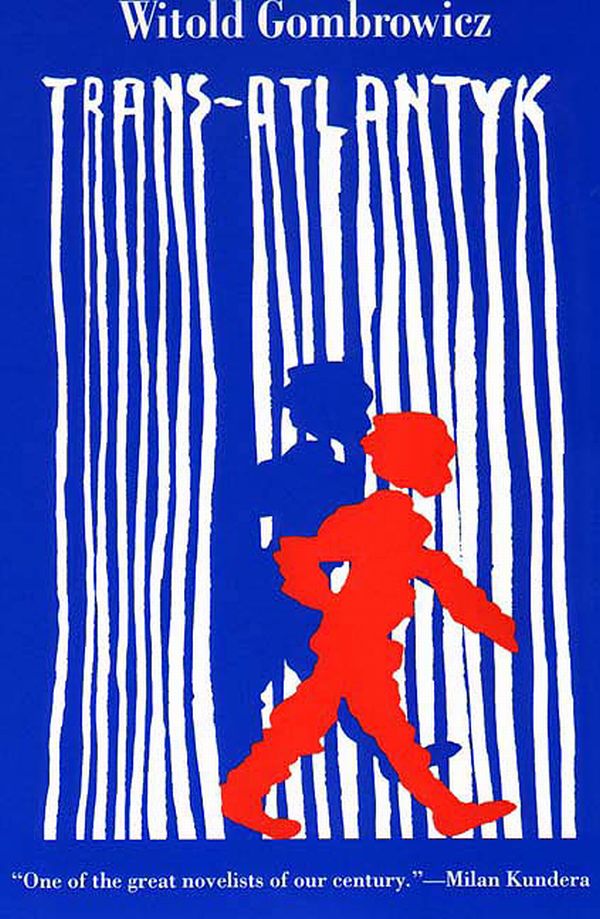
Witold Gombrowicz’s semi-autobiographical novel Trans-Atlantyk is a slim, bristling work that dances out over a mere 122 pages with a force that simultaneously exhausts and engages. Our hero is the eponymous Gombrowicz, a Polish intellectual who travels via pleasure cruise to visit Argentina. The ship arrives to the near-immediate news that the Nazis have occupied Poland. Most of the dutiful, patriotic Poles clamber back on the ship; Gombrowicz, doubling the real-life author, elects to stay in a self-imposed exile. None of the reasoning or rationale behind these decisions is made especially clear (indeed, I had to glean much of the reasoning for these events from the book’s introduction). Here is how the scene plays out in Gombrowicz’s strange syntax—

Then would I fain have fallen on my knees! Albeit I did not fall at all, just quietly began to Curse, Damn mightily but only to Myself: “Sail, sail, you Compatriots, to your People! Sail to that holy Nation of yours haply Cursed! Sail to that St. Monster Dark, dying for ages yet unable to die! Sail to your St. Freak, cursed by all Nature, ever being born and still Unborn! Sail, sail, so he will not suffer you to Live or Die but keep you for ever between Being and Non-being. Sail to your St. Slug that she may ever the more Enslime you.” The ship turned aslant now and was moving off so this I likewise say: “Sail to that Madman, to that St. Bedlamite of yours—oh, haply Cursed—so that he may Torment, Torture you by those leaps and frenzies of his, drown you in blood, howl at you and by his Howling howl you out, by Torturing torture you, Children of yours, wives, to Death, to Agony—in agony himself, in the agonies of Madness Madden you, O’ermadden you!” With this Curse, turning my back on the ship, I entered the Town.

The passage, which I encourage you, gentle reader, to read again (go ahead, I’ll wait), showcases much of Trans-Atlantyk’s strange power: the archaisms, the snaky syntax (Gombrowicz repeatedly delays his predicate verb or even his subject, burying them at the end of the sentence), the bizarre capitalization, the acid humor, the bloody pathos, the impossible tone. So many of the book’s conflicts are laid bare in this passage. We see the essential conflict of an individual vs. the culture and society that would claim him as its mouthpiece; we find Poland, “that St. Monster Dark,” that cursed “St. Slug” forever trailing behind the rest of Europe, playing out the fight between tradition and modernism; we find the conflict of the exile, projected through the distortion of a fun house mirror, smacking back on our narrator who himself is now cursed “for ever between Being and Non-being.”

Trans-Atlantyk was composed during and after WWII, and much of the madness inherent in its themes became normalized during this time. As if to call attention to these psychic disjunctions, Gombrowicz writes Trans-Atlantyk in the mode of the gawęda, an antiquated form of Polish folk narrative popular with the rural nobility. Gawęda, oral in scope and tradition, emphasizes inner-textual creation, randomness, digression, alliteration, and, above all, energetic narrative freeplay—features Trans-Atlantyk displays with remarkable force. Gombrowicz uses this idiom in a celebratory mode, showcasing the possibility and liveliness of language, but he also ironizes language itself: Trans-Atlantyk might be read as a sustained attack on Poland’s obsessions with archaic tradition, as well as an attack on patriotism and patriarchal authority in general. In the 1994 translation I read, Carolyn French and Nina Karsov render Gombrowicz’s pseudo-gawęda in a kind of 17th or 18th century English style—and they do so to grand effect. Their “Translator’s Note” is perhaps the most instructive piece of scholarship on how translation happens that I have ever read. It’s worth the price of admission alone. And while I do not possess the skills to read the book in its original Polish, I imagine that French and Karsov have accurately and faithfully telegraphed the spirit of Gombrowicz’s novel.

If we return briefly, kind reader, to the excerpt above, we find our hero penniless and cursed, heading into town. Here he finds an odd non-home among the Polish ex-pats, who humorously call the Argentinians “aliens.” (Gombrowicz repeatedly stages scenes that show the extreme disconnection between the Poles and their New World surroundings; it is as if these Europeans are unable to comprehend that they are in the midst of a culture other than their own). Unsure of what to do and fearing the stigma of being a traitor (and, honestly, broke), Gombrowicz heads to the Polish Legate, essentially to turn himself in, but also in the hopes of gaining some kind of employment. He meets with the Polish Minister in a scene that is hilarious but, in its historical irony, also shocking and sad. The Minister is something of a mouthpiece for the Polish attitude that Gombrowicz satirizes—

He drew a breath. Did flash his eye. Did say: “We will, by my troth. I say this to you, and I say this so you cannot say that I was saying that we would not Vanquish, since I say to you that we will Vanquish, will Win, for we will reduce to dust with our mighty, gracious hand—smash, crush to dust, powder, with Sabres, Lances, anatomize, annihilate, and under our Colours and in our Majesty, oh Jesus Maria, oh Jesus, oh Jesus . . . we will grind, Kill! Oh, we will kill, anatomize, demolish! And why are you staring so? I tell you indeed, we will annihilate! Indeed you can see, you can hear the Minister himself, the Gracious Envoy is telling you we will Annihilate; perchance you can see that the Envoy himself, the Minister, is pacing here before you, waving his hands and telling you that we will Annihilate! And don’t you dare bark thus: that I didn’t Pace before you, that I didn’t Say, as you see that I do Pace and Say!”

The minister’s phallic aggression, bound in two of the book’s motifs—walking and speaking—reveals the deep paranoia that seethes under the surface of the ex-pat community; indeed, it’s this very paranoia that drives Gombrowicz to the Legate in the first place. In any case, Gombrowicz soon finds a job as a bank clerk, although the specifics here are a bit murky. The real-life Gombrowicz worked as a bank clerk for years in Argentina, famously saying that the job gave him the freedom to write while his boss wasn’t looking. Thankfully, Trans-Atlantyk spends little time in its protagonist’s workplace, but I think it’s worth sharing one of the few passages about office life in the book. There’s a Kafkaesque scope to Gombrowicz’s observations about the modern office, an innate realization of the dehumanizing aspects inherent in bureaucracy, but also a strong vein of absurd humor—

Amidst these rustlings I slightly opened the door that led to the next Room. A big room, long and Darkish, and a row of tables at which clerks sit, over Promissory Notes, Ledgers, Folios studiously bent; and such a number of Papers, so lumped, Swamped that you can hardly move, for likewise on the floor there a multitude of papers and old scribblings; and Ledgers from a cupboard protrude and even to the ceiling heave, out onto the windowsills bulge and swamp the Office. So if any of the clerks moves, he rustles as a Mouse in these papers.

The description continues, Gombrowicz marking the ways  in which the clerks remain at their desks even to eat. As the passage reaches its conclusion, the scene described might take place in any contemporary office—

Whereupon Tea was brought in, viz. Mugs with coffee and buns on a tray, and then all the clerks, having paused in their work, set upon the food. And anon, as usual, discourse sounded. I was overcome by laughter at the sight of that Coffee Drinking of those clerklets! Since at first sight one could see that, for years, sitting together in this Office, every day the eternal Coffee drinking and the eternal Bun munching, with these same old jokes treating themselves, they at once all there was of theirs was comprehended.

So much of contemporary life is there: its mundane rituals, its mechanical repetitions, its pathetic consolations. If Gombrowicz feels contempt for the idea that an individual owes a duty to society, that contempt extends right into the workplace.

Yet I’m barely scratching the surface here. The real plot of Trans-Atlantyk—and bear in mind, kind reader, that this plot hurtles or waltzes or jerks through its motions, rarely employing conventional narrative sequencing signals; rather, we have here a picaresque of sorts, a constant deferral of clear meaning—the real plot of Trans-Atlantyk (if such a thing exists) careens around a good old-fashioned duel. Somehow our hero falls into this intrigue, which results when a senior Polish man finds his honor assaulted. What assaults his honor? The lascivious intentions of a notorious and wealthy homosexual Argentinian on said senior Pole’s son. It’s easy here to frame the conflict in any number of dualities: Euorpean vs. New World, patriarchal tradition vs. homosexual outsider, familial order vs. alien anarchy. But there’s more to the conflict than mere duality. The homosexual Gonzalo, with his predatory designs on the Pole’s teenage son, comes to embody himself that core conflict of “Being and Non-being,” a figure whose conceptual impossibility reflexively engenders new and untold possibilities. Here’s our narrator’s description—

Ergo methinks: And what is’t? Where am I? What do I do? And from him would I have fled long ago, yet sorrowful sore was I to desert my only companion. For a Companion he was. Yet, when by the Tree he so together with me, I feel somewhat discomfited as neither Fish nor Fowl. Viz. hairs black, manly he had on his hand, but this hand—Dimpled, White, dainty Hand . . . and likewise perchance foot . . . and although a Cheek dark with shaven hairs, this Cheek of his charms and coquettes as if ’twere not Dark but indeed white . . . and likewise Leg though Manly as if ‘twould be a Dainty leg and Charms in curious caprices . . . and though head of a man in his prime, bald at the brow, Wrinkled, this head as if slips off a head, seeking to be a dainty head . . . So he as if fain would not himself Transforms in the silence of the night, and now you wit not whether ’tis He or She . . . and perchance, being neither this nor that, he has the aspect of a Creature and not a human . . . He lurks, the rascal, stands, says naught, and only at his Boy silently gazes. So I think, what the Devil, Werewolf, and wherefore I here with him . . .”

Notice how this in-betweener, this “Werewolf” recapitulates the perception of his own indeterminacy back on our narrator, who feels “discomfited as neither Fish nor Fowl.” This radical ambiguity plays out through the remainder of the novel, which alternately writhes, skips, and dances in an exploration of a world without fixed meaning, or, perhaps more accurately, a world where all meaning must be questioned, weighed not just in words and books but also in blood. Trans-Atlantyk ends in an explosion of radically ambiguous laughter, a gesture of hilarity and violence, joy and ridicule—it is a laughter that might claim the reader as its object or, perhaps, invite the reader to laugh along.

Trans-Atlantyk is a marvelous dare to readers, a work of language invention on par with the best in late modernism. Like any work that creates and enacts its own idiom, Trans-Atlantyk poses a learning curve that will doubtless frustrate or intimidate many readers. But its rewards are plentiful for those willing to trek through its anarchy and slip unresisting into its chaos. Recommended.

Amexica — Ed Vulliamy’s Violent Chronicle of the Border Wars

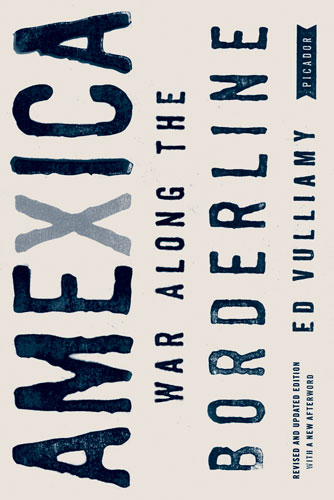
Like Cormac McCarthy’s Blood Meridian or Roberto Bolaño’s  2666, Ed Vulliamy’s Amexica explores violence and bloodshed along the porous border between Mexico and America. Unlike those blistering novels, Amexica belongs in the nonfiction section: it’s a sustained work of investigative journalism, part travelogue, part horror story, and all-too real. Blood Meridian and 2666 both have clear roots in the violent history of the borderland, but the membrane of literary fiction serves as a kind of psychological protection for the reader, an affective out, perhaps — “It’s just a book,” we might tell ourselves. Amexica, on the other hand, is unrelentingly true, real, and inescapably ugly. I have a predilection, I almost hate to admit, for literary violence, for bloody books—Blood Meridian and 2666 are two of my favorite books—although bloodshed is not the only reason I read. The violence in Amexica though can be stomach turning at times. Here’s a litmus test—the book’s first paragraph—

As dawn breaks over the vast desert, the body is hanging from a concrete overpass known as the Bridge of Dreams. It has been there for two hours—decapitated and dangling by a rope tied around the armpits. The sun begins to throw its rays across the busy intersection with its rush-hour traffic and former American school buses carrying workers to sweatshops. And it is still there an hour later, this grotesque, headless thing—swaying, hands cuffed behind its back—in the cold early morning wind that kicks up dust and cuts through the Mexican border town of Ciudad Juárez, the most dangerous city in the world.

From the outset, Vulliamy is unflinching in his portrayal of the borderland, the strange, amorphous world he calls “Amexica,” a place riddled with ambiguity, paradox, and uncertainty; indeed the only thing certain in Amexica is violence.

Vulliamy’s book is a west-to-east travelogue of Amexica, from the Pacific Coast (where he takes part in a surreal picnic on the beach where relatives pass food through a wire fence) to the Gulf Coast of Texas. What unites each stop along Vulliamy’s way is the relentless war between rivaling drug cartels and the federal, state, and local police. To clarify that last sentence, let me point out that the drug wars on the border are bellum omnium contra omnes, war of all against all—the drug cartels are at war with each other, but law enforcement are at war against each other as well, the various police forces backing various drug cartels.

Vulliamy’s difficult job is to suss out the whys and the hows of the drug war, but it’s an almost impossibly huge task. He tells us—

This book is not so much about a war as it is a view of a singular place in time of war. It is about the ways war impacts Amexica, but it is also about how the war is a consequence of other—mainly economic—degradations and exploitations, quite apart from drugs, from which the border’s people suffer. A suffering due not least to the fact that narco cartels are corporations like any other, applying the commercial logic and following the same globalized “business models” as the multiplicity of legal enterprises that have wreaked havoc along the borderline. Indeed, the drug violence is in many ways a direct result of this depredation caused by the legal globalized economy. The cartels are not pastiches of multinational capital—they are pioneers of it, integral to it, and apply its rules and logic (or, rather, lack of rules and logic) to their marketplace just as does any other commercial enterprise.

Vulliamy’s indictment of global capitalism as the root of the narco wars is plain—as is his righteous anger—but Amexica works better when it focuses on character and detail than when Vulliamy tries for targets that are simply too unwieldy. Amexica is at its best when Vulliamy plays tour guide, showing us the people of the border first hand, like the coroner in Tijuana who deciphers bodily mutilations as an Egyptologist might study hieroglyphs, or the bereaved mother of two notorious gangsters, or Julian Cardona, whose photographs of Juárez are charged with pathos, loss, and the traces of violence that plague that center of anarchy.

Indeed, Juárez is the grand, ugly center of both Vulliamy’s journey as well as his book; those who thrilled and suffered in Bolaño’s thinly-fictionalized version in 2666, “Santa Theresa,” will find a similar and equally disturbing beast. Anyone still searching for “the real killers” from Bolaño’s murder mystery are encouraged to read Vulliamy’s chapter on Juárez (short answer: we all did it).

Vulliamy’s journalism has a strong literary vein running through it, and like William T. Vollmann (who also chronicled a slice of the border in Imperial), he makes no pretense toward objectivity or neutrality. While Vulliamy puts his subjects and interviewees front and center, he never tries to hide or obscure his own involvement in the process; nor does he aggrandize his role, which surely must have been tempting given the extreme dangers of his project. And if at times his anger or indignation tips into furious verbosity (he could stand to slice a dependent clause or two), he’s surely earned it.

Amexica should be on the radar and reading list of anyone interested in the narco wars, or anyone who wants to learn more of the “real” story behind the murders explored in 2666. For all Amexica’s violence, there’s also dry, ironic humor, and a bristling current of justice, even optimism, at times. Amexica is not for everyone, to be sure, but those who wish to learn more about this massive war (which gets little or no coverage from major media outlets) will not be disappointed. Recommended.

Amexica is available now in an updated trade paperback edition from Picador.

In the Company of Strangers — We Review Barry McCrea’s New Book About Queer Family Ties in Dickens, Joyce, and Proust

Barry McCrea’s In the Company of Strangers: Family and Narrative in Dickens, Conan Doyle, Joyce, and Proust is one of the more engaging works of literary criticism I’ve seen in some time. And while I’m interested in McCrea’s subjects (the weird lines between the Victorian era and modernism, family and marriage plots, Dickens and Joyce, etc.), it’s the clarity of his writing that I find most impressive. Clear, frank writing is too rare in current literary criticism. Here’s McCrea describing his project—
This book argues that the formal innovations of the high-modernist novel are inseparable from a fundamental rethinking of how family ties are formed and sustained. Genealogy was thematically and structurally central to the English nineteenth-century novel. In the Company of  Strangers shows how the formal strategies employed by Joyce and Proust grow out of an attempt to build a fully coherent narrative system that is not rooted in the genealogical family. Modernism’s rejection of the familiar and cultivation of the strange, in other words, are inseparable from its abandonment of the family and embrace of the bond with the stranger as an alternative to it.

[In the Company of Strangers] offers a reassessment of the relationship between the modernists and their Victorian predecessors, suggesting that the key precursor to this queer model of narrative can be located, paradoxically, in the genealogical obsession of the English nineteenth-century novel. Far from representing a clean break with the Victorian family novel, the radical narrative formalism of high modernism exploits the potential of an alternative queer plot that was already present as a formal building block in the nineteenth-century novel.

McCrea’s queer theory lens is keenly attuned to the homoerotic content present in the novels he examines, but his critical gaze is ultimately more interested in how “queer time” functions as an organizing principle throughout the structure of these narratives. McCrea argues that this queer model of time is a central and defining characteristic of literary modernism. The agent (or one agent) of queer time is “the stranger,” the character who figuratively threatens (and paradoxically defines) the family. McCrea points out that the typical Victorian marriage plot resolves the problem of the stranger by incorporating him or her into the family as a point of narrative resolution. In contrast, in “the queer modernist narrative strategies of Ulysses and the Recherche, the stranger rivals and ultimately usurps the family plot.”

McCrea sifts through family plots (and the strangers who would challenge or queer them) in Dickens (Oliver Twist, Bleak House, Great Expectations), Arthur Conan Doyle’s Sherlock Holmes stories, Ulysses (“a queer family epic”), and Proust’s big book. In the Company of Strangers constantly scrutinizes the ways that family organizes narrative (and narrative organizes family). The book also analyzes what “urban literature” might mean, examining what it means to live in proximity to one’s fellows, and the ways in which urban living necessitate ad hoc families.

In the Company of Strangers does a lovely job of tracing the strange currents that run from Victorian lit to modernism and beyond—currents that extend from our conceptions of family itself, and indeed, our conceptions of life and an end to life. McCrea’s writing is precise, supported by a close textual readings, and if I didn’t always agree with his conclusions, he achieved what every critic ought to aim for: he made me want to read the books he was writing about again.

In the Company of Strangers is new from Columbia University Press.

Good Offices — Evelio Rosero

In Poetics, that ancient didact Aristotle informs us that admirable drama adheres to unities of action, place, and time. There must be no extraneous subplots, just one central action confined to a specific and defined place and time—no more than 24 hours, in fact.

I was reminded of these (oft-broken) rules when reading Evelio Rosero’s Good Offices, a sharp, gleaming novel that illustrates just how effective these classical unities might be in the hands of a gifted author. Rosero’s tale snakes out over the course of only a few hours and takes place entirely in a Catholic church in Bogotá, Colombia. The action—more on that in a moment—is indivisible from the time and place.

Good Offices centers on Tancredo, a hunchback afflicted with “a terrible fear of being an animal.” Tancredo is basically an indentured servant of the church, strung along by Father Almida’s promises of a college education that never seems to surface. His great “cross to bear” is the program of Community Meals that Father Almida mandates (yet never helps execute) each night—charity meals for children, old people, blind people, whores, and families (all segregated by day of the week, naturally). In particular, Tancredo hates the nights for the old people, indigents who complain about the free food and then pretend to be dead so they don’t have to go back to the dark streets of Bogotá. Sometimes they do die though, and it’s Tancredo who must discover their abject corpses.

Aiding Tancredo in the family meal labor are Sabina Cruz, and the Lilias, three ancient widows of the same name who bear more than a passing resemblance to the Moirae. It is the Lilia’s lot to cook these massive meals, making something from nothing, essentially, a job made all the harder by their arthritic joints. They pester Tancredo mercilessly. Sabina doesn’t so much pester Tancredo as haunt him, imploring repeatedly that they run away together. She’s the sexton’s god-daughter, and like Tancredo she is more or less church property. What our cast shares in common is a suppressed humanity, that vital spark now ground down to a dim nub.

This feeling of endless, indefinite weariness hangs over our heroes at the beginning of the novel, as we see here, when the sexton and priest begin an interrogation of sorts of Tancredo—

. . . he felt worn out, exhausted: after the old people crawling around the hall, over and under the table, bathed in soup, stepped in filth and saliva, like a Roman orgy or a witches’s Sabbath, to have a to face the sacristan’s inquisition infuriated him. Once again he experienced the dreadful fear of becoming an animal, or the desire to be one, which was worse. He imagined himself dashing that table against the ceiling; kicking over the chairs of the Church’s two representatives; tipping out their occupants, pissing on their sacred heads; pursuing Sabina, pulling up her heavy lay sister’s skirt, ripping into the apparent innocence of her blouse, buttoned up to the neck, pawing her breasts, pinching her belly button, her thighs, her backside. Truly, he thought, aghast, he needed to confess to the Father about his dreadful fear of being an animal, and the sooner the better.

Rosero’s remarkable prose here twists through the writhing subsurface urges the Catholic Church has worked for hundreds of years to suppress. The writing is violent, funny, sexy, and passionate, culminating in a devastating punchline. The passage is indicative of the book’s strange blending of tones, a sardonic but also sensual crash course in the seven sins.

Almida is too busy to take the time to fully listen to Tancredo’s confession though—he and the sexton must rush to meet a rich benefactor (a gangster, of course). For the first time ever, Almida will miss the mass, necessitating a substitute: Father Matamoros.

To Tancredo’s horror, part of Matamoros’ preparation involves getting drunk; however, he sings the mass in a beautiful voice that entrances the congregants—including Tancredo and the Lilias, who are so enthralled they set to work preparing a feast. Matamoros insists they drink with him, and in time, our principals are all quite drunk, not just on the fine wine that Almida and the sexton secret away for themselves, but also on the Lilia’s rich feast and Matamoros’ splendid singing. These visceral pleasures inject a humanity (and real purpose for living) that has been missing in the church for far too long, and as the night creeps into the morning, the rapture caused by the stranger’s presence overwhelms our cast.

Having lost faith in Almida (and perhaps Catholicism and even God), Tancredo confesses to Matomoros. Before I offer another passage of Rosero’s sensual, intense writing, let me commend the work of translators Anne McLean and Anna Milsom. From Tancredo’s second confession—

Without knowing how, Tancredo resumed the conversation, as if he really had been holding that non-existent conversation with the Father, or did it exist?  Whatever the case, he said, or kept on saying, as if it were the most natural thing in the world, that he had dreamt, Father, that he had an Indian slave-girl, tied up in with a chain like an animal, and that he took her for a walk through a sunlit meadow, the sun, the smell of the sunshine, “everything full of the most terrible lustfulness, Father, hanging over our heads, it was impossible not to take her in my arms, the soft moss offered itself, the leafy oak gave its shade, she stretched out wearily on the grass, it wrapped itself around her like a sheet, offering her rest, and, with the same chain I used for leading her about, she drew me toward her, as if I were an animal and not her, and she spread her legs and all her Hell burned me, Father.”

Matamoros offers Tancredo comfort, if not wisdom, but in treating the young man like a human and not an animal in bondage, he underscores the simple but strong theme of the book.

I won’t spoil more of Good Offices, which I think you should read. It’s a compact, vigorous treat, often blue, sharp as a scimitar, and saturated in suspense. Like any good Aristotelian drama, Rosero’s novel offers catharsis for its audience, but its greater impact comes from what it withholds, from what is left implicit, lingering under the details that ball together toward an end that is funny, horrific, and quite moving. Highly recommended.

Good Offices is new from New Directions this month.

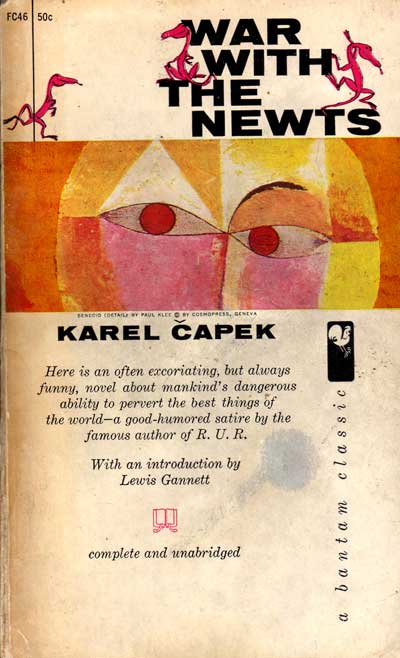
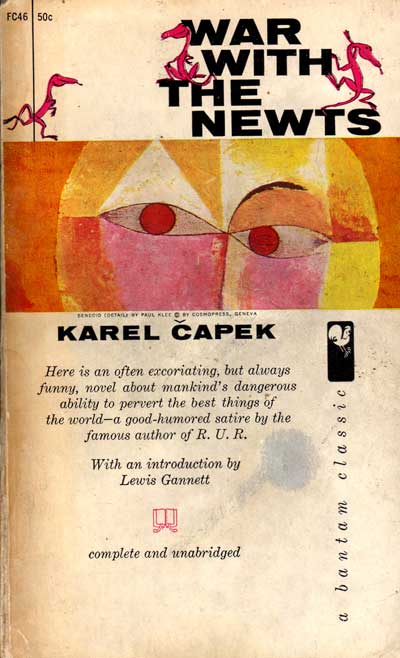
War With the Newts — Karel Capek


Even though the plot of War with the Newts may not shock audiences accustomed to its “human-invention-intended-for- good-becomes-in-the-end-not-so-good” story, readers shouldn’t neglect this often-overlooked science-fiction classic from 1937 by notable Czech writer and satirist Karel Capek.  Humans, motivated by a range of impulses: greed, curiosity, and sometimes even the best of intentions, have created an uncontrollable menace and brought about the end to their dominion over the planet.  Computers, robots, even monkeys have spelled doom for mankind, but Capek warned, in this short and sparkling book, that while masses of intelligent amphibians must be dealt with cautiously, true danger arises from our manipulation of the natural world, the unceasing capitalist drive to increase production by exploiting the weakest, and our inability to foresee the consequences of our actions.

The action begins when a drunk but benevolent sea captain discovers a new species of amphibians inhabiting the waters near an isolated island in the Pacific Ocean.  These docile creatures are able to breathe on land, walk on their hind legs, and communicate using rudimentary sounds and gestures.  The captain trains them to speak a pidgin English and dive for pearls before arming them so that they might fend off the sharks that prey on their young.  Once he receives generous financial backing from a Dutch conglomerate, he ships them to similar islands where pearl harvests have been been impossible or unproductive.  Eventually big business determines that the tireless and fecund newts are valuable for the expansion and development of economic activities near the coasts and under the seas and develop a global marketplace for trade in their labor and bodies.  Educated, well-equipped, and trained to use with the most advanced technologies, the newts produce the greatest expansion of wealth in the history of the world before taking it all for themselves, returning the continents to the bottom of the ocean while requiring a small cadre of humans, relocated to the mountains, to produce the steel and weapons required to support their new Atlantis.

Written as a history book, Capek brilliantly footnotes his narrative with carefully crafted primary sources: newspaper reports, academic studies, religious tracts, political manifestos and corporate minutes in order to illustrate human reaction to new, unsettling circumstance.  A nimble author blessed with the knowledge and skill to write comfortably about a wide variety of subjects, Capek captures both the progressive and cautious voices that shape human reaction to the slow advancement of a new and underestimated intelligence.  He shows that agreement against economic interest is impossible;  labor, for instance, bemoans loss of work to newt hordes while agriculture comes to rely on the millions of new mouths that have to be fed.  Scholars measure, analyze, and categorize; anonymous tract-writers urge an uneasy populace to take up arms against sea-dwelling usurpers while the young and fashionable flock to newt cults, giving themselves up to sexual licentiousness they relish the mysterious and taboo.

But though Capek capably documents trivialities, most of his accounts reflect the time in which he lived and wrote, between the two great European wars, situated between Stalin’s Russia and Hitler’s new Germany, at the height of colonial exploitation, not yet separated by a century from the horrors of the trans-Atlantic slave trade and the American Civil War.  In a report written by the “Salamander Syndicate,” the organization responsible for the organization and dissemination of the world trade in newts justifies the “humane” husbandry, categorization, and sale of newts according to their physical attributes.  Exemplary newts are invited to join committees and expound on their visions for a future shared with humans.  Echoes of American abolitionist thought appear in the debates waged in the media regarding the existence of newt art and culture, their assumed “soullessness,” and the minimal levels of education required for their lives as workers.

The newts, masters of human technology, eventually take over.  Humans, fleeing to higher ground,  are incapable of bringing the fight to the seas.   War with the Newts is an indictment not only of our ability to take without question unearned economic value, but also of our inability to halt the mechanisms by which we accrue those benefits once it becomes evident that the process of enrichment, by itself, is detrimental to the common good.  This is a very good book, a satire of the institutions that will fail when we need them the most, created by a writer whose demonstrated virtuosity deserves more attention.

“The Stench of Corpses” — William Vollmann Reviews William Vollmann

“The Stench of Corpses” is a self-review by William T. Vollmann of the poorly-received and rarely read book Argall, one of his “Seven Dreams” series (still incomplete). The piece originally ran in the October 7, 2001 edition of The Los Angeles Times, but I read it in Expelled from Eden, a Vollmann reader that I am very much enjoying.  There’s an immediate post-9/11 vibe running through Vollmann’s scathing review of Vollmann, culminating in his declaration that Argall is “positively un-American.”

“The Stench of Corpses”

A hundred years after William T. Vollmann was killed in a gun cleaning accident, I, William the Blind, received a commission to review the long novel “Argall,” which marks the midpoint of his uncompleted “Seven Dreams” series. According to Dombey’s “Easily Digested Biographies of Minor Authors,” which I just happen to have right here inside my reading pod, it was always Vollmann’s hope that the “Seven Dreams,” which were second in ambition only to his still-unpublished essay on violence, “Rising Up and Rising Down,” would “somehow, uh, mean something to people a hundred years from now.”

This desire is best understood as a form of wish compensation. Vollmann lived what can only be called a pathetic life. Isolated within and stubbornly estranged from millennial American society, he consoled himself with a sophomorically romantic belief that art, if protected in time capsules, can outlast Dark Ages. Let’s temporarily ignore the fact that Vollmann’s so-called art was never worth preserving, being infested by individualism, moral relativism and sexual depravity. More to the point, since stars, elephants and gods suffer death, how could even the greatest art be “immortal”? As we all know, the Liu-Mallinger Act of 2027, which made cranial stimulation devices compulsory for all inhabitants of the Global Trans-Industrial Zone, reduced the printed word to irrelevancy at last. Continue reading ““The Stench of Corpses” — William Vollmann Reviews William Vollmann”

Candide — Voltaire

I liked pretty much all of the assigned reading in high school (okay, I hated every page of Tess of the D’Ubervilles). Some of the books I left behind, metaphorically at least (Lord of the Flies, The Catcher in the Rye), and some books bewildered me, but I returned to them later, perhaps better equipped (Billy Budd; Leaves of Grass). No book stuck with me quite as much as Candide, Voltaire’s scathing satire of the Enlightenment.

20110911-025457.jpg

I remember being unenthusiastic when my 10th grade English teacher assigned the book—it was the cover, I suppose (I stole the book and still have it), but the novel quickly absorbed all of my attention. I devoured it. It was (is) surreal and harsh and violent and funny, a prolonged attack on all of the bullshit that my 15 year old self seemed to perceive everywhere: baseless optimism, can-do spirit, and the guiding thesis that “all is for the best.” The novel gelled immediately with the Kurt Vonnegut books I was gobbling up, seemed to antecede the Beat lit I was flirting with. And while the tone of the book certainly held my attention, its structure, pacing, and plot enthralled me. I’d never read a book so willing to kill off major characters (repeatedly), to upset and displace its characters, to shift their fortunes so erratically and drastically. Not only did Voltaire repeatedly shake up the fortunes of Candide and his not-so-merry band—Pangloss, the ignorant philosopher; Cunegonde, Candide’s love interest and raison d’etre and her maid the Old Woman; Candide’s valet Cacambo; Martin, his cynical adviser—but the author seemed to play by Marvel Comics rules, bringing dead characters back to life willy nilly. While most of the novels I had been reading (both on my own and those assigned) relied on plot arcs, grand themes, and character development, Candide was (is) a bizarre series of one-damn-thing-happening-after-another. Each chapter was its own little saga, an adventure writ in miniature, with attendant rises and falls. I loved it.

I reread Candide this weekend for no real reason in particular. I’ve read it a few times since high school, but it was never assigned again—not in college, not in grad school—which may or may not be a shame. I don’t know. In any case, the book still rings my bell; indeed, for me it’s the gold standard of picaresque novels, a genre I’ve come to dearly love. Perhaps I reread it with the bad taste of John Barth’s The Sot-Weed Factor still in my mouth. As I worked my way through that bloated mess, I just kept thinking, “Okay, Voltaire did it 200 years earlier, much better and much shorter.”

Revisiting Candide for the first time in years, I find that the book is richer, meaner, and far more violent than I’d realized. Even as a callow youth, I couldn’t miss Voltaire’s attack on the Age of Reason, sustained over a slim 120 pages or so. Through the lens of more experience (both life and reading), I see that Voltaire’s project in Candide is not just to satirize the Enlightenment’s ideals of rationality and the promise of progress, but also to actively destabilize those ideals through the structure of the narrative itself. Voltaire offers us a genuine adventure narrative and punctures it repeatedly, allowing only the barest slivers of heroism—and those only come from his innocent (i.e. ignorant) title character. Candide is topsy-turvy, steeped in both irony and violence.

As a youth, the more surreal aspects of the violence appealed to me. (An auto-da-fé! Man on monkey murder! Earthquakes! Piracy! Cannibalizing buttocks!). The sexy illustrations in the edition I stole from my school helped intrigue me as well—

20110911-025719.jpg

The self who read the book this weekend still loves a narrative steeped in violence—I can’t help it—Blood Meridian, 2666, the Marquis de Sade, Denis Johnson, etc.—but I realize now that, despite its occasional cartoonish distortions, Candide is achingly aware of the wars of Europe and the genocide underway in the New World. Voltaire by turns attacks rape and slavery, serfdom and warfare, always with a curdling contempt for the powers that be.

But perhaps I’ve gone too long though without quoting from this marvelous book, so here’s a passage from the last chapter that perhaps gives summary to Candide and his troupe’s rambling adventures: by way of context (and, honestly spoiling nothing), Candide and his friends find themselves eking out a living in boredom (although not despair) and finding war still raging around them (no shortage of heads on spikes); Candide’s Cunegonde is no longer fair but “growing uglier everyday” (and shrewish to boot!), Pangloss no longer believes that “it is the best of all worlds” they live in, yet he still preaches this philosophy, Martin finds little solace in the confirmation of his cynicism and misanthropy, and the Old Woman is withering away to death. The group finds their only entertainment comes from disputing abstract questions—

But when they were not arguing, their boredom became so oppressive that one day the old woman was driven to say, “I’d like to know which is worse: to be raped a hundred times by Negro pirates, to have one buttock cut off, to run the guantlet in the Bulgar army, to be whipped and hanged in an auto-da-fé, to be dissected, to be a galley slave—in short, to suffer all the miseries we’ve all gone through—or stay here and do nothing.

“That’s a hard question,” said Candide.

It’s amazing that over 200 years ago Voltaire posits boredom as an existential dilemma equal to violence; indeed, as its opposite. (I should stop and give credit here to Lowell Blair’s marvelous translation, which sheds much of the finicky verbiage you might find in other editions in favor of a dry, snappy deadpan, characterized in Candide’s rejoinder above). The book’s longevity might easily be attributed to its prescience, for Voltaire’s uncanny ability to swiftly and expertly assassinate all the rhetorical and philosophical veils by which civilization hides its inclinations to predation and straight up evil. But it’s more than that. Pointing out that humanity is ugly and nasty and hypocritical is perhaps easy enough, but few writers can do this in a way that is as entertaining as what we find in Candide. Beyond that entertainment factor, Candide earns its famous conclusion: “We must cultivate our garden,” young (or not so young now) Candide avers, a simple, declarative statement, one that points to the book’s grand thesis: we must work to overcome poverty, ignorance, and, yes, boredom. I’m sure, gentle, well-read reader, that you’ve read Candide before, but I’d humbly suggest to read it again.

Time, Space, Distortion: Falling Toward a 9/11 Literature

The_Falling_Man

In his essay In the Ruins of the Future,” published in December of 2001, Don DeLillo wrote this about the 9/11 attacks: “The writer wants to understand what this day has done to us. Is it too soon?” His question was both profound and at the same time utterly banal—of course it was too soon to measure the effects of the 9/11 attacks. But could time’s distance somehow sharpen or enrich perspective? DeLillo continues: “We seem pressed for time, all of us. Time is scarcer now. There is a sense of compression, plans made hurriedly, time forced and distorted.”

In retrospect—what with the Bush administration’s ludicrous invasion of Iraq and the power-grab of the Patriot Act—DeLillo’s notation of “plans made hurriedly” seems downright scary. Still, I remember that immediate, overwhelming shock, that paralyzing inertia that had to be overcome. DeLillo wanted—needed—to grapple with this spectacular destruction immediately. David Foster Wallace responded with similar immediacy; the caveat that prefaces his moving essay The View from Mrs. Thompson’s states that the piece was “Written very fast and in what probably qualifies as shock.” The same caveat would also apply neatly to Art Spiegelman’s big, brilliant, messy attempt at cataloging his impressions immediately post-9/11, In the Shadow of No Towers.

In contrast, the trio of 9/11 stories at the heart of Chris Adrian’s short story collection, A Better Angel, all employ distance and distortion—both temporal and spatial—as a means to address the disaster (or inability to address the disaster) of the attacks on the World Trade Center. Adrian’s 9/11 tales (and his works in general, really), ask how one can grieve or attest to death on such a massive, spectacular scale. The victims of the 9/11 attacks forever haunt his protagonists, literally possessing them, demons that can’t let go, forcing the living to wallow in grief. In “The Changeling,” for example, the grief of the attacks is literally measured in blood, as a father repeatedly maims himself as the only means to assuage the terror and confusion of his possessed son. Adrian sets one of the collection’s most intriguing tales, “The Vision of Peter Damien,” in nineteenth-century rural Ohio. This temporal distortion veers into metaphysical territory as the titular Damien, along with other children in his village, become sick, haunted by the victims of 9/11. Adrian’s displaced milieu creates a bizarre cognitive dissonance for his readers, a response that DeLillo also articulated in his 2007 novel Falling Man.

DeLillo initiates the novel as a sort of creation story: “It was not a street anymore but a world, a time and space of falling ash and near night.” The demarcation of this new world recapitulates DeLillo’s initial concern with time and space, but his novel seems ultimately to suggest an inertia, a meaninglessness, or at least the hollow ambiguity of any artistic response. This stands, of course, in sharp contrast to his sense of urgency in his earlier essay. Like the performance artist in the novel who is repeatedly sighted hanging suspended from a harness, there’s a sad anonymity in the background of Falling Man: the artist hangs as static witness to disaster, but looking for comfort, or even perhaps meaning, in the gesture is impossible.

David Foster Wallace’s short story “The Suffering Channel,” (from his 2004 collection Oblivion) is in many ways a far more satisfying take on 9/11, although to be fair, the majority of the story’s events take place in July of 2001. The story (or novella, really; it’s 90 pages) centers around a magazine headquartered in the World Trade Center that plans to run an article—on September 10th, 2001—about a man who literally shits out pieces of art. Wallace’s critique of American culture (shit as art, commerce as style, advertising as language) is devastating against the context of the looming disaster to which his characters are so oblivious. As the novella reaches its close (culminating in the shit artist producing an original work for a live audience), we learn more about “The Suffering Channel,” a cable channel devoted to broadcasting only images of human beings suffering intense and horrible pain. Wallace seems to suggest that The Suffering Channel’s audience watches out of Schadenfreude or morbid fascination, that modern American culture so disconnects people that genuine suffering cannot be witnessed with empathy, but only as a form of spectacular, disengaged entertainment. And yet even as Wallace critiques American culture, the specter of the 9/11 attacks ironically inform his story. With our awful knowledge of what will happen the day after the shit artist article is published, we are able to see the ridiculous and ephemeral nature of the characters’ various concerns. At the same time, Wallace’s tale reveals that empathy for suffering is possible, but also that it comes at a tremendous price.

To contrast the journalistic immediacy of pieces like “In the Ruins of the Future” and “The View from Mrs. Thompson’s” with their respective writers attempts to measure 9/11 in literary fiction is perhaps a bit unfair. Still, Wallace’s and DeLillo’s essays transmit something of the ineffable, visceral quality of that terrible day, as well as the strange ways we sought comfort through human connection. In contrast, the distance and distortion of their literary efforts lose something. I apologize—I don’t have a word for this “something” that the essays have that the novel and novella lack (perhaps the absence is purposeful; perhaps not). It’s not clarity, but perhaps it’s a clarity of distortion that the essays convey, the duress, or to return to Wallace’s own notation, the pieces were “Written very fast and in what probably qualifies as shock.” It’s that shock, I suppose, that I’m trying to name, to say that it’s still there, accessible in those early responses (I realize now I’ve unfairly neglected Spiegelman’s book, which is a great example of immediacy). And to relive that shock is important, because, as Wallace reveals in both of his pieces, the cathartic power of shared tragedy makes us human, allows us to really live, and to be thankful that we do live.

Looking over this piece, I realize that it’s overly long and really says nothing, or at least nothing much about 9/11, or literature, or whatever. But I don’t want to be negative. I highly encourage you to read (or re-read) The View from Mrs. Thompson’s” and In the Ruins of the Future.” And I’ll leave it at that.

[Editorial note: We ran a (somewhat sloppier) version of this essay on 9.11.2009]

Biblioklept’s Favorite Books of the Summer

With Memorial Day ’11 just a memory and Labor Day warning off the wearing of white, I revisit some of the best books I read this summer:

Although I posted a review of Roberto Bolaño’s collection Between Parentheses two weeks before Memorial Day, I continued to read and reread the book over the entire summer. It was the gift that kept giving, a kind of blurry filter for the summer heat, a rambling literary dictionary for book thieves. For example, when I started Witold Gombrowicz’s Trans-Atlantyk a week or two ago, I spent a beer-soaked midnight tracing through Bolaño’s many notations on the Polish self-exile.

Trans-Atlantyk also goes on this list, or a sub-list of this list: great books that I’ve read, been reading (or in some cases, listened to/am listening to) but have not yet reviewed. I finished Trans-Atlantyk at two AM Sunday morning (surely the intellectual antidote to having watched twelve hours of college football that day) and it’s one of the strangest, most perplexing books I’ve ever read—and that’s saying something. Full review when I can process the book (or at least process the idea of processing the book).

I also read and absolutely loved Russell Hoban’s Kleinzeit, which is almost as bizarre as Trans-Atlantyk; like that novel (and Hoban’s cult classic Riddley Walker), Kleinzeit  is written in its own idiom, an animist world where concepts like Death and Action and Hospital and even God become concrete characters. It’s funny and sad. Also funny and sad: Christopher Boucher’s How to Keep Your Volkswagen Alive (new from Melville House). Like Trans-Atlantyk and Kleinzheit, Volkswagen is composed in its own language, a concrete surrealism full of mismatched metaphorical displacements. It’s a rare bird, an experimental novel with a great big heart. Full reviews forthcoming.

I’ll be running a review of Evelio Rosero’s new novel Good Offices this week, but I read it two sittings at the beginning of August and it certainly belongs on this list. It’s a compact and spirited satire of corruption in a Catholic church in Bogotá, unwinding almost like a stage play over the course of a few hours in one life-changing evening for a hunchback and his friends. Good stuff.

On the audiobook front, I’ve been working my way through George R. R. Martin’s A Song of Ice and Fire series; I finished the first audiobook, A Game of Thrones, after enjoying the HBO series, and then moved into the second book, A Clash of Kings, which I’m only a few hours from completing. I think that the HBO series, which follows the first book fairly faithfully, is much closer to The Wire or Deadwood than it is to Peter Jackson’s Tolkien films—the story is less about fantasy and magic than it is about political intrigue during an ongoing civil war. This is a world where honor and chivalry, not to mention magic and dragons, have disappeared, replaced by Machiavellian cunning and schemers of every stripe. Martin slowly releases fantastic elements into this largely desacralized world, contesting his characters’ notions of order and meaning. There are also beheadings. Lots and lots of beheadings. The books are a contemporary English department’s wet dream, by the by. Martin’s epic concerns decentered authority; it critiques power as a constantly shifting set of differential relations lacking a magical centering force. He also tells his story through multiple viewpoints, eschewing the glowing third person omniscient lens that usually focuses on grand heroes in fantasy, and concentrates instead, via a sharp free indirect style, on protagonists who have been relegated to the margins of heroism: a dwarf, a cripple, a bastard, a mother trying to hold her family together, a teenage exile . . . good stuff.

Leo Tolstoy’s final work Hadji Murad also depicts a world of shifting power, civil war, unstable alliances, and beheadings (although not as many as in Martin’s books). Hadji Murad tells the story of the real-life Caucasian Avar general Hadji Murad who fought under Imam Shamil, the leader of the Muslim tribes of the Northern Caucuses; Shamil was Russia’s greatest foe. This novel concerns Murad’s attempt to defect to the Russians and save his family, which Shamil has captured. The book is a richly detailed and surprisingly funny critique of power and violence.

William Faulkner’s Light in August might be the best book I read this summer; it’s certainly the sweatiest, headiest, and grossest, filled with all sorts of vile abjection and hatred. Faulkner’s writing is thick, archaeological even, plowing through layers of Southern sediment to dig up and reanimate old corpses. The book is somehow both nauseating and vital. Not a pleasant read, to be honest, but one that sticks with you—sticks in you even—long after the last page.

Although David Foster Wallace’s posthumous novel The Pale King was released in the spring, I didn’t start reading it until June; too much buzz in my ears. If you’ve avoided reading it so far because of the hype, fair enough—but don’t neglect it completely. It’s a beautiful, frustrating, and extremely rewarding read.

Speaking of fragments from dead writers: part two of Roberto Bolaño’s The Third Reich, published in the summer issue of The Paris Review, was a perfect treat over the July 4th weekend. I’m enjoying the suspense of a serialized novel far more than I would have imagined.

Wayne Koestenbaum’s Humiliation is probably the funniest, wisest, and most moving work of cultural studies I’ve ever read.  Unlike many of the tomes that clutter academia, Humiliation is accessible, humorous, and loving, a work of philosophical inquiry that also functions as cultural memoir. Despite its subject of pain and abjection, it repeatedly offers solutions when it can, and consolation and sympathy when it cannot.

So the second posthumously published, unfinished novel from a suicide I read this summer was Ernest Hemingway’s The Garden of Eden, the sultry strange tale of a doomed ménage à trois. (I’m as humiliated by that last phrase as you might be, dear reader. Sorry). Hemingway’s story of young beautiful newlyweds drinking and screwing and eating their way across the French Riviera is probably the weirdest thing he ever wrote. It’s a story of gender reversals, the problems of a three-way marriage, elephant hunting, bizarre haircuts, and heavy, heavy drinking. The Garden of Eden is perhaps Hemingway at his most self-critical; it’s a study in how Hemingway writes (his protagonist and stand-in is a rising author) that also actively critiques his shortcomings (as both author and human). The Garden of Eden should not be overlooked when working through Hemingway’s oeuvre. I’d love to see a critical edition with the full text someday (the novel that Scribner published pared down Hemingway’s unfinished manuscript to about a third of its size).

Also fragmentary fun: F. Scott Fitzgerald’s Notebooks. Like Twitter before Twitter, sort of.

These weren’t the only books I read this summer but they were the best.