“A country, a people…Those are strange and very difficult ideas.”
— Four Ways to Forgivenss, Ursula K. Le Guin (1995)
—Each of the novels in Ursula K. Le Guin’s so-called Hainish cycle obliquely addresses Wells’s question by tackling those strange and very difficult ideas of “a country, a people.” The best of these Hainish books do so in a manner that synthesizes high-adventure sci-fi fantasy with dialectical philosophy.
—What am I calling here “the best”? Well—
The Left Hand of Darkness
Planet of Exile/City of Illusions (treat as one novel in two discursive parts)
The Dispossessed
—(How oh how oh how dare I rank The Dispossessed—clearly a masterpiece, nay?—so low on that little list? It’s too dialectical, maybe? Too light on the, uh, high adventure stuff, on the fantasy and romance and sci-fi. Its ideas are too finely wrought, well thought out, expertly cooked (in contrast to the wonderful rawness of Rocannon’s World, for example). None of this is to dis The Dispossessed—it’s probably the best of the Hainish books, and the first one casual readers should attend to. (It was also the first one I read way back when in high school)).
—The novels in Le Guin’s so-called Hainish cycle are
Rocannon’s World (1966)
Planet of Exile (1966)
City of Illusions (1967)
The Left Hand of Darkness (1969)
The Dispossessed (1974)
The Word for World is Forest (1976)
Four Ways to Forgiveness (1995)
The Telling (2000)
—Okay, so I decided to include For Ways to Forgiveness in the above list even though most people wouldn’t call it a “novel” — but its four stories (novellas, really) are interconnected and tell a discrete story of two interconnected planets that are part of the Hainish world. And I pulled a quote from it above. So.
—(I keep modifying “Hainish cycle” with “so-called” because the books aren’t really a cycle. Le Guin’s world-building isn’t analogous to Tolkien’s Middle Earth or Faulkner’s Yoknapatawpha County. (Except when her world-building is analogous). But let us return to order).
People write me nice letters asking what order they ought to read my science fiction books in — the ones that are called the Hainish or Ekumen cycle or saga or something. The thing is, they aren’t a cycle or a saga. They do not form a coherent history. There are some clear connections among them, yes, but also some extremely murky ones. And some great discontinuities (like, what happened to “mindspeech” after Left Hand of Darkness? Who knows? Ask God, and she may tell you she didn’t believe in it any more.)
OK, so, very roughly, then:
Rocannon’s World, Planet of Exile, City of Illusions: where they fit in the “Hainish cycle” is anybody’s guess, but I’d read them first because they were written first. In them there is a “League of Worlds,” but the Ekumen does not yet exist.
—I agree with the author. Read this trilogy first. Read it as one strange book.
—(Or—again—pressed for time and wanting only the essential, read The Dispossessed and The Left Hand of Darkness—but you already knew that, no?).
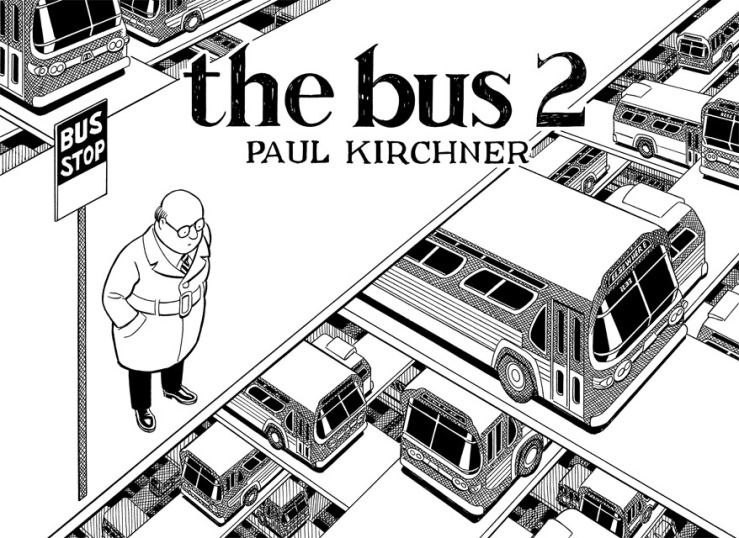
Paul Kirchner’s cult classic comic strip The Bus originally ran in Heavy Metal from 1979-1985. The (anti-)story of “a hapless commuter and a demonic bus” (as Kichner put it himself in a recent memoir at The Boston Globe), The Bus, at its finest moments, transcends our expectations for what a comic strip can and should do. Sure, Kirchner delivers the set-ups, gags, japes, and jests we expect from a cartoon—but more often than not The Bus surpasses the confines of its form and medium. Its protagonist The Commuter is an allegorical everyman, a passenger tripping through an absurd world. Kirchner’s strip often shows us ways to see that absurd world—which is of course our own absurd world—with fresh eyes.
Thanks in part to the internet (and, in particular, an album of scans posted at Imgur), Kirchner’s comic has found a new audience. Over the past few years, Kirchner’s produced more than 40 new strips, which are now collected in one handsome volume as The Bus 2 (or the bus 2 if you like) from French publisher Tanibis Editions. Tanibis also has collected the original run of The Busin an edition that’s more complete (and polished) than the Imgur album. These books are fantastic stuff.
The Bus 2 picks up in full satirical mode with an intro that informs us that “the studio that produced ‘The Bus’ was forced to shut down” in 1985; “Its closing left over 70 talented employees jobless.” The intro unwinds over a few pages—we’re told the bus itself and the “commuter’s iconic overcoat” are now in museums, and that the role of the commuter in this sequel will be played by the son of the actor who played the original commuter. From the outset, Kirchner uses irony to draw our attention to the artificiality of his strip, highlighting The Bus as a performance, an entertainment focused on the utterly mundane topic of a daily commute. And even though the intro unfolds over four pages, Kirchner keeps it true to form—literally: Six equal black and white panels.
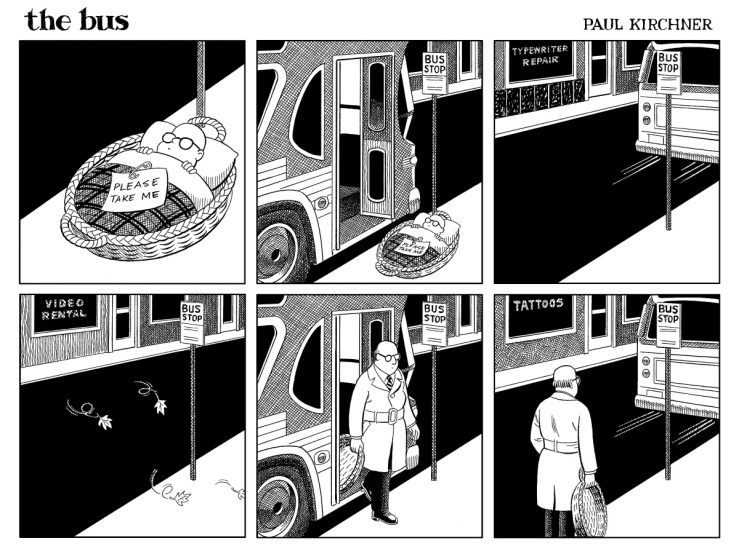
The first strip in the new collection positions The Commuter as an ironic hero, a foundling in a basket like Moses or Superman (note the signs that Kirchner employs to show the passage of time):
In Kazuo Ishiguro’s 2015 novel The Buried Giant, a metaphysical mist engulfs sixth-century Britain, clouding the memories of all who inhabit the land. Saxons and Britons alike cannot recall their bellicose past. Against this mist, elderly Britons Axl and Beatrice seek their long-lost son. They meet a Saxon warrior who hunts an ancient she-dragon he’s vowed to slay. He’s aided by a youth, Edwin, who’s been exiled from his village after being bitten by a mythic creature. King Arthur’s aged nephew Sir Gawain lingers as a courtly protector, a figure from an already-bygone era; the mist seems to slowly rot his brain and his conscience, pushing him into paranoia and madness. There are Charonic ferrymen and awful ogres; there are mad monks and terrible pixies. A hellhound, a dragon, a poisoned goat. Rivers and mountains and crypts and villages. But most of all that mist.
Charon, Joachim Patinir
Ishiguro makes the reader experience that mist. He obscures. The action that occurs—and yes, there’s action here, measured action (often measured in a literal sense)—the action that occurs in The Buried Giant is almost always oblique, shadowed, indistinct, but also very mechanical. The memory-mist renders the world treacherous, immediate, a dark, vague place that offers its travelers no purchase of reference. Deceptive.
Forgive me for quoting at such length, but I think a longish passage here shows how and what Ishiguro is doing. Almost all of our principals are here, underground—note their procession, their movement—a constant motif in the novel, movement, single file or side by side—and the presence of a light, illumination—also a motif. Note the variety of interpretations of not knowing, not seeing, note the simple horror:
They went on into the tunnel, Sir Gawain leading, Axl following with the flame, Beatrice holding his arm from behind, and Edwin now at the rear. There was no option but to go in single file, the passage remaining narrow, and the ceiling of dangling moss and sinewy roots grew lower and lower until even Beatrice had to stoop. Axl did his best to hold the candle high, but the breeze in the tunnel was now stronger, and he was often obliged to lower it and cover the flame with his other hand. Sir Gawain though never complained, and his shape going before them, sword raised over his shoulder, seemed never to vary. Then Beatrice let out an exclamation and tugged Axl’s arm.
“What is it, princess?”
“Oh, Axl, stop! My foot touched something then, but your candle moved too quickly.”
“What of it, princess? We have to move on.”
“Axl, I thought it a child! My foot touched it and I saw it before your light passed. Oh, I believe it’s a small child long dead!”
“There, princess, don’t distress yourself. Where was it you saw it?”
“Come, come, friends,” Sir Gawain said from the dark. “Many things in this place are best left unseen.”
Beatrice seemed not to hear the knight. “It was over here, Axl. Bring the flame this way. Down there, Axl, shine it down there, though I dread to see its poor face again!”
Despite his counsel, Sir Gawain had doubled back, and Edwin too was now at Beatrice’s side. Axl crouched forward and moved the candle here and there, revealing damp earth, tree roots and stones. Then the flame illuminated a large bat lying on its back as though peacefully asleep, wings stretched right out. Its fur looked wet and sticky. The pig-like face was hairless, and little puddles had formed in the cavities of the outspread wings. The creature might indeed have been sleeping but for what was on the front of its torso. As Axl brought the flame even closer, they all stared at the circular hole extending from just below the bat’s breast down to its belly, taking in parts of the ribcage to either side. The wound was peculiarly clean, as though someone had taken a bite from a crisp apple.
“What could have done work like this?” Axl asked.
He must have moved the candle too swiftly, for at that moment the flame guttered and went out.
Ishiguro gives us mystery, interpretation, and then an incomplete, ambiguous revelation. (This is the basic structure of the novel). Beatrice never relents in her belief that she’s stumbled over a dead child. Brimming with lost children and lost parents and orphans, The Buried Giant is a novel of erasures. But an erasure leaves a trace, a violent, visceral marking into the page’s blankness. Revelation through absence.
We would have no plot, not really, without some overcoming of blankness, and Axl in particular overcomes the mist in his quest. A backstory fleshes out, in watery strokes albeit. The Buried Giant, as far as fantasy epics go, is awfully indistinct. Or rather, Ishiguro offers only mechanical and immediate glimpses into this world, a Britain on the cusp of the Middle Ages. Through Axl’s consciousness (and conscience), we see the vital precision in hand-to-hand combat, for example. Its patience, its slowness, its dependence on muscle memory. Or perhaps (dare I say) more boringly, we feel the very real peril involved in walking in the wild dark as an elderly person. The thrills in The Buried Giant come not from its sword and sorcery costumes, but from its Kafkaesque edges and gaps. This is a novel about not knowing.
And it’s here that The Buried Giant is most successful—as an evocation of not knowing. Axl and Beatrice’s quest unfolds as a series of choices and consequences severed, for the most part, from the anchor of memory. There’s an episodic vibe to the novel, a sense that it’s making itself up as it goes along. (It’s not). The novel strongly reminded me of some of the old RPGs I’d play on a Commodore 64 as a kid. The graphics weren’t great and I had to use my imagination a lot. The games were sometimes frustrating and slow. But perhaps you want a more, uh, literary comparison? Something more recent too? The Buried Giant recalls Ishiguro’s short story “A Village after Dark” a lot more than, say, A Game of Thrones or The Lord of the Rings.It’s a fantasy novel, but one that feels etiolated, its vivid colors drained. More Gustave Doré than Gustave Moreau.
While a precise indistinctness (forgive the oxymoron) is part of The Buried Giant’s program, there’s nothing indistinct about its heroes’ love for each other. Axl and Beatrice, A & B—can I say I came to love them? Or if I didn’t quite love them, I was rooting for them, say? Rooting for their survival, but specifically their survival as a they, a shared survival. Ishiguro successfully communicates their intimacy, their romance, their love, a love threatened by both the natural world and the supernatural return of lost memory. Their relationship is the heart of the novel upon which Ishiguro fixes his themes of memory, justice, vengeance, and love. Ishiguro’s commentary on those themes ultimately may feel pessimistic to many readers, particularly in the novel’s conclusion.
Excepting the ones that we love and return to and obsess over, we retain little of the novels that we read. What memories remain are kernels—the outline of a plot, a strange lingering phrase or detail, a bright or bold character, a theme, an idea, an image. It’s the love between Axl and Beatrice that I’ll likely recall most strongly from the shadows of The Buried Giant. If we can’t remember, we can at least experience.
With the bad taste of a recentish YAish post-apocalyptish novel in my brain, I riffled through some old sci-fi titles, hoping to find something to hit “reset.” J.G. Ballard’s 1975 novel High-Rise—which I hadn’t read since I was a teenager—wrapped me up immediately with its opening sentence:
Later, as he sat on his balcony eating the dog, Dr Robert Laing reflected on the unusual events that had taken place within this huge apartment building during the previous three months.
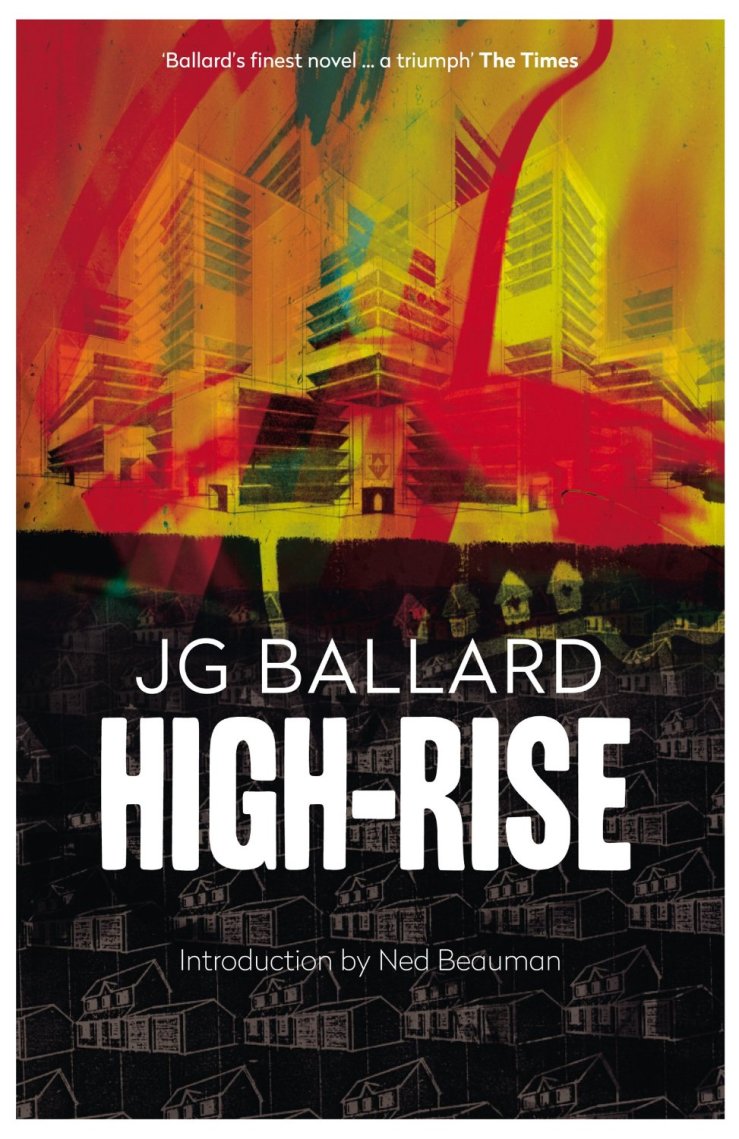
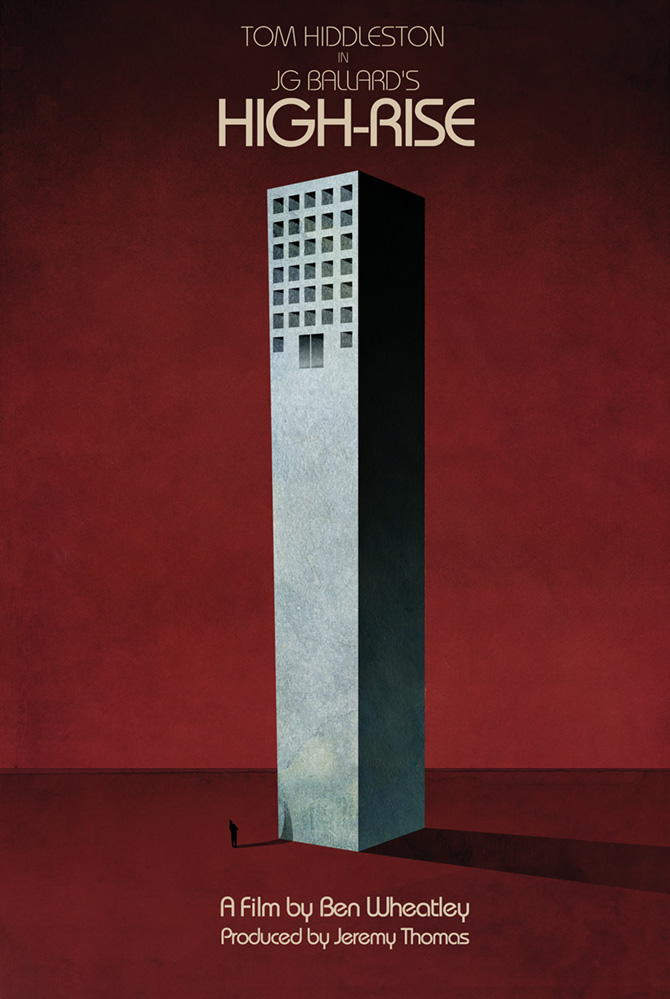
(If the promise of that first line doesn’t intrigue you, High-Rise isn’t for you. Maybe you’ll enjoy all the old High-Rise covers I couldn’t help but to scatter through this riff).
The first chapter of High-Rise is aptly titled “Critical Mass.” This is a book where things, uh, escalate quickly, if you’ll forgive my indulging in the parlance of our times. Ballard dispenses with any simmering in his tale of depraved debauchery (or is that debauched depravity?). He gets that pot boilin’.
Depravity. Debauchery. Degeneration. The boiling pot of late-20th century consciousness.
So, what is High-Rise about? Like, the plot, man? Class-war in a high-rise condo: A self-contained society that fails, its id overspilling into sex and violence: The veneer dissolved in piss and spite. And the best part? Ballard dispenses with any sort of explanation whatsoever. We begin at critical mass. He counted on his late-20th-century reader to intuit the whole damn deal (or throw down the book in defensive disgust).
Ballard structures the book around three anti-heroes, who represent, probably, id, ego, and superego—or rather, what I mean to say is ironic send-ups of id, ego, and superego—with the high-rise itself a kind of consciousness in crisis.
From the middle-class (and perhaps ego)—the 25th floor—there’s Dr. Robert Laing—not really a practicing doctor, no, but he works at a teaching hospital. Ballard tricks us into thinking he’s the protagonist—which I guess he is!—by which I mean audience surrogate, and also typical Ballardian hero (divorced; mama issues; a drinker). His name may recall to you the (anti-)psychiatrist R.D. Laing (as well as, perhaps, Language).
We might find a tidy—as in sanitary–summary of High-Rise in this brief excerpt, where our ego hero Laing packs away his tools and totems of the old world in anticipation of the new one to come:
In this suitcase-sized cavity he hid away his cheque book and insurance policies, tax returns and share certificates. Lastly, he forced in his medical case with vials of morphine, antibiotics and cardiac stimulants. When he nailed the floorboards back into place he felt that he was sealing away for ever the last residues of his previous life, and preparing himself without reservation for the new one to come.
The phrase “to come” — as in a future to come — repeats throughout High-Rise—a kind of irony, ultimately, that I shouldn’t step all over here. I’ll get back to that momentarily, but—
Ballard soon trips us up by shifting his free-indirect style from Laing to Richard Wilder of the 2nd floor. A bestial brawny brawly dude (and the only father in this trio of anti-heroes) Wilder (c’mon with that name man!) is id id id all the way down (up). Wilder’s also a filmmaker, a camera in his hand, a sensing thing all the way down (up). He causes some problems.
(The idea that a middle-class man like Wilder might represent the proletariat here is addressed in more (although oblique) depth in Ballard’s 2003 novel Millennium People).
And then the super-ego/upper crust: Anthony Royal (O!c’mon with that name dammit!) of the penthouse. He’s the literal architect of the high-rise, which makes him possibly maybe probably responsible for its many, many design flaws, which boil down to intake, outtake, and power, but look like parking, garbage, and electricity.
And so Ballard shuttles us between these three consciousnesses, like the elevators that symbolically anchor this novel. (Anchor is a terrible verb for these mobile metaphors. Or maybe it’s the precise verb).
Like I said in point 5, Ballard doesn’t really bother to foreground the causes for the high-rises’s society’s degenerate descent (ascent?)—instead, he offers concrete contours and psychological descriptions. Like this one, when a psychiatrist (yep) offers this analysis to Laing (and the reader, of course):
I had a bucket of urine thrown over me this afternoon. Much more of that and I may take up a cudgel myself. It’s a mistake to imagine that we’re all moving towards a state of happy primitivism. The model here seems to be less the noble savage than our un-innocent post-Freudian selves, outraged by all that over-indulgent toilet-training, dedicated breast-feeding and parental affection — obviously a more dangerous mix than anything our Victorian forebears had to cope with. Our neighbours had happy childhoods to a man and still feel angry. Perhaps they resent never having had a chance to become perverse . . .
(“Perverse” is a term that repeats throughout High-Rise, and I had to leave in those bucket of urine and cudgel details).
The concrete contours, the description, the late-20th century analysis—that’s the reason to boil along with High-Rise. The book is fucking fun in its thrilling awful decadence—it’s Lord of the Flies for adults, with the spiritual mumbo-jumbo replaced with psychiatric mumbo-jumbo. Or Salò.
Back to that future to come thing, here’s another citation, at some length (enjoy those concrete contours), but with my emphasis in boldface if you’re in some big fucking hurry:
Still uncertain how long he had been awake, or what he had been doing half an hour earlier, Laing sat down among the empty bottles and refuse on the kitchen floor. He gazed up at the derelict washing-machine and refrigerator, now only used as garbage-bins. He found it hard to remember what their original function had been. To some extent they had taken on a new significance, a role that he had yet to understand. Even the run-down nature of the high-rise was a model of the world into which the future was carrying them, a landscape beyond technology where everything was either derelict or, more ambiguously, recombined in unexpected but more meaningful ways. Laing pondered this — sometimes he found it difficult not to believe that they were living in a future that had already taken place, and was now exhausted.
Ballard’s describing the late 20th century there, but perhaps he intuits the beginning of the 21st as well.
—Or maybe those are the same thing, I suppose—I mean, High-Rise was published in 1975, four decades ago, but doesn’t feel that old. For some perspective, Karel Capek’s War with the Newts was published in 1936, almost forty years before High-Rise, and that novel doesn’t feel horribly dated either, a tribute to its sharp satire.
—Which is my way of transitioning to the probably completely non-controversial idea that High-Rise is wonderful dark satire. Ballard ushers our consciousness to the high-rise’s summit through surrogate Laing, the limited concrete prose focused on the failed doctor’s misperception of transcendence. Laing perceives himself as the conquering brute, alpha male par excellence, inheritor not only of the falling high-rise, but also its female cohort, his harem in a future to come, his genealogical generativity restored. Laing can’t see that he’s been x’ed out of this equation, the failed phallic figure jutting impotently into mother sky.
So you know that High-Rise is going to be a movie? A Major Motion Picture? Starring Tom Hiddleston? As cynical as I am, I think the book should make a fine film—it’s adaptable, yes. It could even be a great video game. A video game where you eat a dog. A video game where you think you win, but you don’t.
‘I miss TV,’ Orin said, looking back down. He no longer smiled coolly.
‘The former television of commercial broadcast.’
‘I do.’
‘Reason in several words or less, please, for the box after REASON,’ displaying the board.
‘Oh, man.’ Orin looked back up and away at what seemed to be nothing, feeling at his jaw around the retromandibular’s much tinier and more vulnerable throb. ‘Some of this may sound stupid. I miss commercials that were louder than the programs. I miss the phrases “Order before midnight tonight” and “Save up to fifty percent and more.” I miss being told things were filmed before a live studio audience. I miss late-night anthems and shots of flags and fighter jets and leathery-faced Indian chiefs crying at litter. I miss “Sermonette” and “Evensong” and test patterns and being told how many megahertz something’s transmitter was broadcasting at.’ He felt his face. ‘I miss sneering at something I love. How we used to love to gather in the checker-tiled kitchen in front of the old boxy cathode-ray Sony whose reception was sensitive to airplanes and sneer at the commercial vapidity of broadcast stuff.’
‘Vapid ditty,’ pretending to notate.
‘I miss stuff so low-denominator I could watch and know in advance what people were going to say.’
‘Emotions of mastery and control and superiority. And pleasure.’
‘You can say that again, boy. I miss summer reruns. I miss reruns hastily inserted to fill the intervals of writers’ strikes, Actors’ Guild strikes. I miss Jeannie, Samantha, Sam and Diane, Gilligan, Hawkeye, Hazel, Jed, all the syndicated airwave-haunters. You know? I miss seeing the same things over and over again.’ …
The man tended to look up at him like people with legs look up at buildings and planes. ‘You can of course view entertainments again and again without surcease on TelEntertainment disks of storage and retrieval.’
Orin’s way of looking up as he remembered was nothing like the seated guy’s way of looking up. ‘But not the same. The choice, see. It ruins it somehow. With television you were subjected to repetition. The familiarity was inflicted. Different now.’
‘Inflicted.’
‘I don’t think I exactly know,’ Orin said, suddenly dimly stunned and sad inside. The terrible sense as in dreams of something vital you’ve forgotten to do. The inclined head’s bald spot was freckled and tan. ‘Is there a next item?’
—From David Foster Wallace’s novel Infinite Jest (1996).
Perception, Plato said, is a form of pain.
The working consciousness, for instance, is narrow, shuttered by utility, its transitions eased by habit past reflection like a thief. Impulses from without or from within must use some strength to reach us, we do not go out to them. Machines are made this way. Alert as lights and aimed like guns, they only see the circle of their barrels. How round the world is; how like a well arranged. Thus when desire is at an ebb and will is weak, we trail the entertainer like a child his mother, restless, bored and whining: what can I do? what will amuse me? how shall I live? Then
L’ennui, fruit de la morne incuriosite,
Prend les proportions de l’immortalite.
The enjoyment of sensation as sensation, a fully free awareness, is very rare. We keep our noses down like dogs to sniff our signs. Experience must mean. The content of an aimless consciousness is weak and colorless; we may be filled up by ourselves instead—even flooded basements, some days, leak the other way—and then it’s dread we feel, anxiety.
To tie experience to a task, to seek significance in everything, to take and never to receive, to keep, like the lighter boxer, moving, bob and weave, to fear the appearance of the self and every inwardness: these are such universal characteristics of the average consciousness that I think we can assume that popular culture functions fundamentally with regard to them.
—From William H. Gass’s essay “Even if, by All the Oxen in the World.” (1968). Collected in Fiction and the Figures of Life. The lines of verse are from Baudelaire, which I suppose is a third citation, no?
A note on the context of the first reading, subsequent ventures, and this rereading
I bought David Foster Wallace’s novel Infinite Jest in 1997 when I was a freshman in college, as required by law. I attempted reading it a few times without really getting to page 100. (I did read and reread the short stories and the essays and Wallace’s first novel in that time though. None were assigned readings. The DFW Academic Industry was not a Thing yet).
The first time I read the book the whole way through was in the weird fall of 2001, the first fall I hadn’t returned to school because I had graduated from school, the fall of 9/11, the fall I moved to Tokyo the week after 9/11, packing the book in a smallish suitcase that the airport security guy had to take everything out of with his latex-gloved hands, removing every item, all the clothes and books, because I was traveling on a one-way ticket to a foreign land. It was in that weird fall that I finally read the book, reading mostly in the very very early a.m., sometimes reading for hours, reading too late, becoming addicted.
In years since, I’ve poked at rereadings, often looking for very specific passages/sections, and always meaning to do a full reread, but there are all those other big books that need to get read (and then reread).
Well so and anyway: This reread has been prompted by back-to-back readings of Gravity’s Rainbow, which I take to be the most obvious precursor text for Infinite Jest (and likely the greatest source of Wallace’s Oedipal anxiety if we want to get all Bloomian). I thought about Infinite Jest a lot while reading GR.
So far, like any rereading of a big encyclopedic novel, Infinite Jest seems much, much easier than my initial go through (although coming off GR almost anything would probably seem much, much easier). With the contours of the “big plot” in place (and the rhetorical dazzle of some of Wallace’s embedded-essays not as blinding as before), focusing on details, patterns, and motifs becomes simply more possible. (I don’t think I connected Hal’s clipping his toenails in Ch. 18 to the toenails Gately finds in Ennet House in Ch. 19 before, f’r’instance). (There are no actual chapter numbers in IJ, although there are circles separating chapters which can be counted).
A note to readers new to Infinite Jest
Infinite Jest is very long but it’s not nearly as difficult as its reputation suggests. There is a compelling plot behind the erudite essaying and sesquipedalian vocabulary. That plot develops around three major strands which the reader must tie together, with both the aid of—and the challenge of—the novel’s discursive style. Those three major plot strands are the tragic saga of the Incandenzas (familial); the redemptive narrative of Ennet House Drug and Alcohol Recovery House, with Don Gately as the primary hero (socicultural); and the the schemes of the Québécois separatists (national/international/political). An addictive and thus deadly film called Infinite Jest links these three plots (through discursive and byzantine subplots).
Wallace often obscures the links between these plot strands, and many of the major plot connections have to be intuited or outright guessed. Furthermore, while there are clear, explicit connections between the plot strands made for the reader, Wallace seems to withhold explicating these connections until after the 200-page mark. Arguably, the real contours of the Big Plot come into (incomplete) focus in a discussion between Hal Incandenza and his brother Orin in pages 242-58. While that scene by no means telegraphs what happens in IJ, it nonetheless offers some promise that the set pieces, riffs, scenes, lists, and vignettes shall add up to Something Bigger. Continue reading “Some notes from 299 pages into a rereading of Infinite Jest”→
A. Okay. So I finished the first section of Mason & Dixon a few days ago. I’m now at the part where our titular heroes are smoking weed and eating snacks with George Washington. I can’t possibly handle all the material I’ve read so far—even in a riff (here’s the first riff for anyone inclined)—so instead I’ll annotate a few passages from Ch. 19, one of my favorite episodes so far.
One (satirical) source for this controversy comes from William Hogarth’s 1755 painting An Election Entertainment; in the detail below, you can read (barely) the slogan “Give us our Eleven Days” on the black banner under the man’s foot.
In 1750 England and her empire, including the American colonies, still adhered to the old Julian calendar, which was now eleven days ahead of the Gregorian calendar, introduced in 1582 by Pope Gregory XIII and in use in most of Europe.
Attempts in the sixteenth and seventeenth centuries to adopt the new calendar had broken on the rock of the Church of England, which denounced it as popish. The prime mover in changing the situation was George Parker, second Earl of Macclesfield, a keen astronomer and a Fellow of the Royal Society. He was assisted in his calculations by his friend James Bradley…
I emphasized Bradley—Mason’s mentor—and Macclesfield as they are minor characters in this episode.
Basically, the pub patrons demand that Mason explain what happened to the missing eleven days.
1. “News from the Sun” (1981) / “Myths of the Near Future” (1982) / “Memories of the Space Age” (1982)
Let me first confess how happy I am to be finished with this enormously enormous book (okay, not physically enormous on my Kindle, but still…). Let me also confess to dread at having to finish out these riffs (no, no one is forcing me, but still…). At this point, I feel like I could write my own Ballard story—a crazed astronaut here, a drained swimming pool there, a femme fatale, some psychotropic drugs, armchair psychology, a swamp, some birds (perhaps), a plane or two, time obsession, sex obsession, space obsession. Obsession obsession Anyway. Ballard arguably peaks in the early 1980s; everything after reads like a day-glow Keith Haringesque pop-approximation of his grittier seventies stuff—or (worse) scolding wrapped up in little morality plays.
But, like I said (wrote), Ballard is in his prime in the early 1980s, and “News,” “Myths,” and “Memories” are some of his finest stories (file these triplets in my quasi-fictional-but-c’mon-we-can-make-this-happen collection The Essential Short Stories of J.G. Ballard)—they are also some of his most Ballardian, riffing on space-travel-as-cosmic-taboo, paranoid parables obsessed with time. A particularly Ballardian paragraph (from “Memories”):
He had almost ceased to breathe. Here, at the centre of the space grounds, he could feel time rapidly engorging itself. The infinite pasts and future of the forest had fused together. A long–tailed parakeet paused among the branches over his head, an electric emblem of itself more magnificent than a peacock. A jewelled snake hung from a bough, gathering to it all the embroidered skins it had once shed.
(Parenthetical aside: “Myths” and “Memories” are both set in Florida. Ballard’s depiction of Florida feels thoroughly inauthentic (I’m Floridian), but that inauthenticity also feels thoroughly appropriate).
2. “A Host of Furious Fancies” (1980)
Ballard constructs this little tale around a psychoanalytic reading of Cinderella:
The entire fairy tale of Cinderella was being enacted, perhaps unconsciously, by this deranged heiress. If she herself was Cinderella, Dr Valentina Gabor was the fairy godmother, and her magic wand the hypodermic syringe she waved about so spectacularly. The role of the pumpkin was played by the ‘sacred mushroom’, the hallucinogenic fungus from which psilocybin was extracted. Under its influence even an ancient laundry van would seem like a golden coach. And as for the ‘ball’, this of course was the whole psychedelic trip.
But who then was Prince Charming? As I arrived at the great mansion at the end of its drive it occurred to me that I might be unwittingly casting myself in the role, fulfilling a fantasy demanded by this unhappy girl. . . .
For all my resistance to that pseudo–science, it occurred to me that once again a psychoanalytic explanation made complete sense of these bizarre events and the fable of Cinderella that underpinned them. I walked up the staircase past the dismembered clock. Despite the fear–crazed assault on them, the erect hands still stood upright on the midnight hour – that time when the ball ended, when the courtships and frivolities of the party were over and the serious business of a real sexual relationship began. Fearful of that male erection, Cinderella always fled at midnight.
Etc.
Ballard’s Freudian riff would be more interesting as an essay.
(The story also showcases some of his typical chauvinism: The psychiatrist is described as the “woman psychiatrist” — just as earlier a dentist is referred to as a “lady dentist,” etc. Straight through to the end of the collection. In the 1990s).
3. “Report on an Unidentified Space Station” (1982) / “The Enormous Space” (1989)
“Report” and “Space” both read like takes on Sigizmund Krzhizhanovsky’s Soviet-era short story “Quadraturin” — both concern space, that corollary to time, and, just as Ballard repeatedly posits time as a matter of perspective, he treats space—area—the same way here. “Report” is a bit more satisfying than “Space,” which feels like a retread of so many of Ballard’s revenge stories—only with, uh, some comical cannibalism.
4. “The Object of the Attack” (1984) / “Answers to a Questionnaire” (1985)
“Attack” and “Questionnaire” are maybe the same story—only “Questionnaire” is essentially perfect, whereas “Attack” feels like a clumsy, heavy first draft (but only because “Questionnaire” exists—do you see what I mean by this?)
Both stories showcase Ballard’s syntheses of religion (messianic; apocalyptic) and assassination (political; media-saturated). While “Attack” employs a discursive-but-still-linear approach to the theme, “Answers to a Questionnaire” gives us a discontinuous but more engaging riff in the form of (uh) exactly what its title promises. First fifth:
1) Yes.
2) Male (?)
3) do Terminal 3, London Airport, Heathrow.
4) Twenty–seven.
5) Unknown.
6) Dr Barnardo’s Primary, Kingston–upon–Thames; HM Borstal, Send, Surrey; Brunel University Computer Sciences Department.
19) My greatest ambition is to turn into a TV programme.
20) I first saw the deceased on 17 February 1986, in the chapel at London Airport. He was praying in the front pew.
Essential, natch.
5. “The Man Who Walked on the Moon” (1985)
I should’ve wedged this passable but ultimately forgettable little tale in elsewhere. J.G. Ballard’s faux memoir of a faux astronaut. Pass.
6. “The Secret History of World War 3” (1988)
“The Secret History of World War 3” is Ballard’s “I told you so” sequel to one of his best stories (frankly a much better story), 1968’s “Why I Want to Fuck Ronald Reagan.” In his unofficial sequel, Ballard imagines (the horror!) of a third Reagan term (post-Bush 1), in which the country is obsessed with the President’s (lack of) health:
…the nation’s TV screens became a scoreboard registering every detail of the President’s physical and mental functions. His brave, if tremulous, heartbeat drew its trace along the lower edge of the screen, while above it newscasters expanded on his daily physical routines, on the twenty–eight feet he had walked in the rose garden, the calorie count of his modest lunches, the results of his latest brain–scan, read–outs of his kidney, liver and lung function. In addition, there was a daunting sequence of personality and IQ tests, all designed to reassure the American public that the man at the helm of the free world was more than equal to the daunting tasks that faced him across the Oval Office desk.
The story concerns a man who—alone, always alone, despite his wife, I mean this is Ballard here, hero’s alone (and right, justified) in his paraonoia—a man who is the only person to remember the brief outbreak of WW3, wedged, as it is, among updates of Ronnie and Nancy’s bowel movements. The story is farcical but juvenile, and if it seems surprisingly sophomoric, it’s worth noting that “TSHofWW3” echoes not just “Fuck Ronald Reagan,” but also one of Ballard’s earliest efforts, “Escapement” (1956), where a man sits on his couch in disbelief as his wife (stand-in for the whole world) fails to perceive what he perceives.
7. “Love in a Colder Climate” (1989) / “The Largest Theme Park in the World” (1989) /“War Fever” (1989)
A trio of late period lectures blazoned in the day glow approximations that anyone who live in the late eighties will not-so-fondly recall. Ballard evokes the neon apocalyptic impulses of the day, reworking his familiar themes—reproduction, civilization, war (etc.). Our baroque surrealist’s strokes are broader, not as sharp, more magnified—more Haring than Delvaux. Michel Houellebecq will pick up JGB’s torch here (with arguably better results) a decade and a half later.
8. On the horizon:
A handful of stories of the nineties: Or: Ballard returns to the same well with diminishing returns.
1. I’ve watched each of the first four episodes of the first season of True Detective at least twice now—compelled to do so, staying up later than I should have to do so.
2. Everything that follows is full of spoilers, although I won’t be discussing the plot heavily. Fair warning, okay? Also: The video clips in this riff are NSFW.
4. “The Long Bright Dark” is one of the best first episodes of a TV show I’ve ever seen, its slow burn pointing toward a payoff that the fourth and most recent episode has already delivered (the climax of that episode (the so fucking-climactic climax), midway through the season, must surely be balanced (imbalanced) with some other, different climax in the season’s second half). I’ll admit though to a slight—very slight—disappointment in the second episode, “Seeing Things,” which feels at times overstuffed, as the showmakers compress so many of the plot points and back story that will propel the rest of the narrative.
5. “Seeing Things,” as its title implies, examines the ways that perspective (and blindness) inform our sense of identity. After four years as an undercover narco, Cohle experiences hallucinations—but he’s keenly aware of his hallucinations—he sees that what he sees is an illusion, but he also sees that what he sees is no less real, in a sense, for all its unreality. Cohle contrasts strongly here with Hart, who sees himself as a family man, a patriarch, a good guy—but he’s a philanderer and a bully. Even when confronted with his young daughter’s interest in aberrant sexual scenarios, his impulse is to look away. Hart’s paternalistic horror at finding an underage girl working in a sylvan brothel is contrary to Cohle’s intuition that the girl’s circumstances might be improved under the care of the madame. For Cohle, identity is always destabilized, an hallucination.
6. In one of the scenes set in 2012—the interrogation scenes–
–(Have I failed to discuss this structure? I have failed. I am sorry. Look, clearly the two detectives—one a rookie, green, callow, both black—clearly this pair, an othered version of Rust and Hart, seem intent to jam Cohle up, pin the 2012 murder on him. But Cohle knows that, knew it before he walked into the room. When he cuts the top off of his empty Lone Star tallboy and uses it as an ad hoc urinal, how else am I to read this, gentle reader, other than a territorial pissing?—he knows this terrain. He marks it—both with his piss (abject essence) and the weird little totem he sculpts from the aluminum scrap. Where was I? Oh).–
7. In one of the scenes set in 2012, Cohle, asked why he wanted to move from narcotics to homicide, paraphrases 1 Corinthians 12:12 “For as the body is one, and hath many members, and all the members of that one body, being many, are one body: so also is Christ.” (Significantly, Cohle suspends the ultimate referent of that body, Christ). Asked what the verse might mean, Cohle says, “I was just trying to stay part of the body.” The body here—any body, all bodies (as the verse promises)—is an abject body, figured in the body of the victim that initiates the series, which thematically doubles the body of Cohle’s dead daughter. The verse promises that an individual can, via his or her (abject) body, find an identity.
8. But staying part of the body is hard, especially when the body is so goddamn stupid. The opening scenes of episode three, “The Locked Room,” seem to respond directly to Cohle’s biblical citation:
9. The phrase “our mutual illusions” comes in the final climactic monologue of “The Locked Room,” where Cohle, in prose that could have come straight from Cormac McCarthy’s typewriter, posits human existence as wholly abject, “a jury rig of presumption and dumb will . . . it was all . . . a dream you had inside a locked room. A dream about being a person”:
10. (As I wedged a Cormac McCarthy reference into point 9, I may as well wedge another one in here: The second episode of True Detective pretty much wholesale lifts the scene in No Country where Sheriff Ed Tom and his sheriff friend lament that folks don’t say “Yes sir” and “No ma’am” anymore).
11. If “The Locked Room” slowed the pace of True Detective, returned some of the moodiness and philosophy to this police procedural, then episode four, “Who Goes There,” synthesizes everything that’s come before it into a throttling, thrilling climax.
We see Hart fall low, fall apart; for the first time, he has to recognize what he has been hitherto unwilling to recognize—namely, his own blindness, his own pride. His entire identity has been wrapped up in the idea that he is a father and a law man, but his approach to both of these roles has been dishonest—he’s a cheater, an absent father, and a bully. But flashing his badge doesn’t get him that far in “Who Goes There.”
For Cohle, identity is fluid, discontinuous, and unstable. When he goes “undercover” as “Crash,” connecting back with a motorcycle gang in the hopes of finding the suspect in the murder case, he doesn’t put on a mask so much as he simply becomes a different version of himself (which is the same version).
The end of the episode plunges into a nightworld operating on Lynchian logic; to call it dark would be an understatement, and Hart, despite all his macho posturing, is unsteady here, stumbling even. Perhaps for the first time in a long time, Hart sees that he cannot see.
12. The final moments of “Who Goes There” coalesce in a strange costume drama (Cohle as Crash in biker garb; the biker gang leering and lurid in cop blues). We’ve moved from the swampy, indeterminate bayou into the concrete box of the projects. No easy exit, but the terrain is somehow just as malleable for Agent Crash Cohle, who doesn’t so much command the screen as navigate it. The last shot of the episode is an uninterrupted slow burn that boils over, seers with a volitional energy that I haven’t seen on film since Children of Men. The scene reaches its end, the partners make their getaway from the scene of the crime, and the camera—via a helicopter shot—rises above the fray, its eye the eye of god, an impossible, inhuman perspective that surveys the whole indiscriminate mess: Seeing:
HBO debuted the first episode of True Detective this weekend. The series will be an anthology, with its first eight-episode season exploring a ritualistic murder in the backwoods of Louisiana. Written by series creator Nic Pizzolatto and directed by Cary Fukunaga (who filmed a moody 2011 adaptation of Jane Eyre), True Detective stars Woody Harrelson and Matthew McConaughey as State murder police trying to solve the crime.
I loved the opening episode, “The Long Bright Dark.” There’s a heavy streak of Cormac McCarthy and James Ellroy here, not to mention a dose of The Wire, Michael Mann (and a pinch of David Lynch). Detractors of the show will likely single out its ponderous and cerebral dialogue, or maybe point out that, yeah, we’ve seen this story before. Such criticisms would be (will be) intertwined; those who want a murder mystery delivered with a nice neat bow on it are almost surely going to be disappointed—and most likely, will fault the show’s philosophical tone.
It’s easy—comforting, maybe—to ignore that philosophical tone, most of it delivered by McConaughey’s Rust Cohle. There’s even something of an audience surrogate in Cohle’s partner Marty Hart (Harrelson), who bristles uncomfortably at Cohle’s near-nihilism. I found this particular scene electrifying (uh, language NSFW):
The lines that stand out in particular come at about the 2 minute mark. Cohle:
I think human consciousness is a tragic misstep in evolution. We became too self aware. Nature created an aspect of nature separate from itself—we are creatures that should not exist by natural law . . . We are things that labor under the illusion of having a self, a secretion of sensory, experience, and feeling—programmed with total assurance that we are each somebody, when in fact everybody is nobody.
It’s easy to dismiss these lines, as Hart would like to—to not listen, to fail to attend to the meaning there—to pin Cohle’s outlook down as meaningless, dark gobbledygook—because the lines essentially attack “the illusion of having a self,” an illusion we all hold dear, an illusion that protects us. Cohle here echoes what Jacques Derrida called “auto-affection”—the I that thinks/feels itself into being. This auto-affection stabilizes us, tells us our certitude is, y’know, certain. It authorizes us.
I’ve seen only the first episode, but my guess is that the murder that the series would seem to foreground is really its backdrop. Murder—figured here in the gruesome, abject corpse that we (to use Cohle’s term) “bear witness” to in the show’s opening moments—destabilizes the illusion of having a self. It tears down the borders between the illusion and the real.
The murder is not to be solved/resolved then. The murder instead functions to call attention to the problem that Cohle posits in the middle of this first episode: The illusion of having a self.
1. Margaret Atwood’s latest novel, MaddAddam concludes the trilogy she began with Oryx and Crake (2003) and The Year of the Flood (2009).
2. Both of those novels are superior to MaddAddam (Oryx and Crake is the strongest, in my estimation, although I read it almost a decade ago).
3. I audited the audiobook of MaddAddam, read by Bernadette Dunne, Bob Walter and Robbie Daymond. The actors do a fine job and the production is swell.
4. I am now going to rip off elements of my own 2010 review for The Year of the Flood.
5. In that review I wrote:
Apocalypse lit isn’t so much predictive as it is descriptive of the contemporary world, and Atwood’s dystopian vision is no exception.
I still more or less agree with that sentence, and MaddAddam is, like the two books preceding it, a satire of sorts on modern life.
6. And–
Viscerally prescient, Flood paints our own society in bold, vibrant colors, magnifying the strange relationships with nature, religion, and our fellow humans that modernity prescribes.
I don’t know if it’s me or the book or just the fact that so much of what Atwood conjures in her trilogy seems more real than it was just a decade ago—but MaddAddam didn’t read quite so bold or vibrant as the first two books.
7. I also wrote:
Atwood ends her book in media res, with Toby and a handful of other characters somehow still alive, ready, perhaps, to become stewards of a new world. Flood concludes tense and, in a sense, unresolved, but Atwood implies hope: Toby will lead her small group to cultivate a new Eden. Despite all the ugliness and cruelty and devastation, people can be redeemed.
MaddAddam picks up right where Flood and O&C end (those novels essentially converge). In some ways—often very obvious, sometimes boring ways—MaddAddam provides a sense of resolution for the trilogy’s many threads.
8. What is the book about?
I will lazily slap in publisher Random House’s blurb here, interspersed with my riffage :
Months after the Waterless Flood pandemic has wiped out most of humanity, Toby and Ren have rescued their friend Amanda from the vicious Painballers.
The opening of MaddAddam was a bit too in media res for me: I think the beginning of the book will probably read much smoother if the reader has immediately read the first two books. I had to go reread a summary of the first two books (thanks Wikipedia!) to refresh my old brain.
They [Toby/Ren/Amanda] return to the MaddAddamite cob house, newly fortified against man and giant pigoon alike. Accompanying them are the Crakers, the gentle, quasi-human species engineered by the brilliant but deceased Crake.
The Crakers are potentially the most interesting aspect of MaddAddam, but Atwood keeps them on the margins; in the book’s most disappointing moments they’re behavior is basically relegated to punchlines. (Maybe I wanted the book to be an entirely different book—never a fair position for a reviewer to take, but hell, I’ll just say it here in the protection of parentheses—I wanted the book to be about the Crakers in the new world).
Their [the Crakers’] reluctant prophet, Snowman-the-Jimmy, is recovering from a debilitating fever, so it’s left to Toby to preach the Craker theology, with Crake as Creator. She must also deal with cultural misunderstandings, terrible coffee, and her jealousy over her lover, Zeb.
MaddAddam kinda sorta takes the form of an oral history (the novel is polyglossic, fragmented, decentered, blah blah blah). Toby, taking over Jimmy’s storytelling role with the Crakers, essentially invents a mythology. These are some of the best moments of the novel—little riffs on storytelling and memory and legend and myth and history and language and how meaning is made and preserved and transmitted. By the end of the novel, Toby has taught a Craker child—Blackbeard—to read and write. He becomes a translator between the MaddAddamites and the pigoons, but he also takes on the role of storyteller and scribe. He becomes Blackboard, Blackbard.
Zeb has been searching for Adam One, founder of the God’s Gardeners, the pacifist green religion from which Zeb broke years ago to lead the MaddAddamites in active resistance against the destructive CorpSeCorps. But now, under threat of a Painballer attack, the MaddAddamites must fight back with the aid of their newfound allies, some of whom have four trotters. At the center of MaddAddam is the story of Zeb’s dark and twisted past, which contains a lost brother, a hidden murder, a bear, and a bizarre act of revenge.
Atwood devotes most of the novel to Zeb’s backstory, which is mildly entertaining but oh lord! exposition exposition exposition. Even when Zeb’s backstory is conveyed with action and energy, there’s often this constant state of clarification/reminder/callback going on, where the narrative voice has to remind the reader for some reason how the particular event being narrated squares against events in the previous two books.
9. In my review for YotF I wrote
Atwood’s prose sometimes relies on placeholders and stock expressions common to sci-fi and YA fiction, and her complex plot (disappointingly) devolves to a simple adventure story in the end, but her ideas and insights into what our society might look like in a few decades are compelling reading (or, uh, listening in this case).
Okay, so ditto most of that for MaddAddam, only perhaps less compelling. There’s nothing wrong with the simple adventure story that Atwood uses to move her ideas along on here, but there’s also nothing especially engaging either.
10. MaddAddam features an overlong dénouement, culminating in several deaths and births. Even though the ending seems stretched (and often predictable), it nevertheless offers the most cohesive vision in the novel: A future of hybridization and radical diversity that is still beholden to the Darwinian economy of the natural world.
11. The novel resolves by clearing out all of its major characters (sorry if this is a spoiler, but it really isn’t), freeing the imaginative space that Atwood has created—and to be clear, that’s a rich, fertile space—for new adventures, new ways of living, new creatures. I suppose I wanted more What now? explored than the novel had to offer—more exploration of what the genetically-hybridized world might look like with humans no longer the dominant species.
12. But a review (or even a lazy riff) shouldn’t fault a novel for what it doesn’t set out to do. Perhaps leaving the post-flood world barely explored is Atwood’s parting gift to the trilogy’s readers: She offers us a chance to imagine more.
Zadie Smith’s essay, “Man vs. Corpse,” in the New York Review of Books asks us to
Imagine being a corpse. Not the experience of being a corpse—clearly being a corpse is the end of all experience. I mean: imagine this drawing represents an absolute certainty about you, namely, that you will one day be a corpse. Perhaps this is very easy. You are a brutal rationalist, harboring no illusions about the nature of existence. I am, a friend once explained, a “sentimental humanist.” Not only does my imagination quail at the prospect of imagining myself a corpse, even my eyes cannot be faithful to the corpse for long, drawn back instead to the monumental vigor.
“Corpsed” letters may be characterized by a certain kind of desperation that contradicts itself in the act of speech (or writing); by writing, narrators acknowledge the necessity of communication and the inscrutable feeling that s/he has failed in that act of communication. That failure signals the desperation, and so on. How to figure/perform a “corpsed” perspective, outside of reality? Gerald Murnane’s Inland makes a kind of utopia out of death, but not a death as the absence of life. Death as the space wherein all people are irrevocably connected. Death and loss as, perhaps, the only thing that can be shared between us without the mediation of language, with fiction paradoxically as the sole vehicle.
. . . In fact, this happens often—when I feel as if words, others’ words, have crowded mine out, and have left me no place; I do not know why, through what mechanism, this occurs, but when it does, and it is often, I find that I developed a need, an earnest yearning, for words that have not become sour and strange—that is, for words that are my own, words that are uniquely mine amid this foreign wash; and yet I find, when I look for such words—my words—none seem to be there: all of my words, upon the slightest inspection, seem so foreign to me, so much the work of others; and so I wonder how I can claim that anything that occurs in my consciousness is mine, and not the product of some othernesses; often I feel that I am not thinking so much as eavesdropping on my own thoughts, listening in on the narrative being told between othernesses—that it is the otherness thinking me; because none of it, in truth, seems to issue from me; even my unplanned cries, my most heartfelt exclamations, have been determined by others: I have noticed that it is precisely at times of highest emotion—when I am going to the deepest regions of my responses, to the deepest particularity of me—that my words, which would then seem to be at their most personal and spontaneous, are in fact at their most derivative, just pure banal cliché: oh my God!, Will you look at that!, I don’t believe it!; but where are my words, I wonder, my own thoughts?; it seems, sometimes, that I am a conduit and not a content—a transfer point, a capacitor, a pattern in waves; or, at most, I am a bricklayer, combining chunks of accepted solidity to wall out fresh perception; is this adolescent thinking?—
From Evan Dara’s novel The Lost Scrapbook.
I am really loving this book so far, this novel that moves through consciousnesses in a (yes, I’ll use that cliché that book reviewers so often grab for) dazzling performance, shifting through minds, monologues, dialogues, always a few steps (or more) ahead of its reader, beckoning though, inviting, calling its reader to participate in discussions (or performances) of art, science, politics, psychology, education, loneliness, ecology, family, fireflies, radio plays, alienation, voting trends, Chomskyian linguistics, Eisensteinian montage, theft, Walkman Personal Stereos, semiotics, one-man shows, drum sets, being ventriloquized—a novel that takes ventriloquism as not just a theme (as we can see in the citation above) but also as a rhetorical device, a novel that ventriloquizes its reader, throws its reader into a metaphorical deep end and then dramatically shifts the currents as soon as the reader has learned to swim, a novel of othernesses, a novel that offers content through conduits, patterns that coalesce through waves, a novel composed in transfer points, each transfer point announcing the limitations of first-person perspective, the perspective that the reader is logically and spiritually and psychologically beholden to—and then, perhaps, transcending (or at least producing the affective illusion of transcendence of) first-person perspective, and this (illusion of) transcendence, oh my, what a gift, what a gift . . .
1. So in the final pages of Against the Day, Thomas Pynchon takes us back to those heroes of the ether who initiated the book, the Chums of Chance. They’ve been absent for a long stretch, with only the occasional mention here or there to assure us that yes, they are still in the narrative, but under its surface, or, rather—invisible (this, in a novel full of invisibility).
2. Example: in a maddening moment, we learn that, via Pugnax’s girlfriend, a dog named Ksenija, “the Chums of Chance had been invisibly but attentively keeping an eye on the progress of Reef’s family exfiltration from the Balkan Peninsula.”
3. Several chapters later, Pynchon makes our sky-heroes visible again; they’ve dramatically expanded the size of their ship Inconvenience and have essentially declared independence from Chums headquarters.
They learn of a strange “updraft” over the Sahara desert that spells new adventure—
Tonight’s meeting was about whether or not to take the Inconvenience into the great updraft over the Sahara without somebody paying for it in advance. Miles called the session to order by bashing upon a Chinese gong acquired years before from an assassination cult active in that country, during the boys’ unheralded but decisive activities in the Boxer Rebellion (see The Chums of Chance and the Wrath of the Yellow Fang), and wheeled around a refrigerated Champagne cart, refilling everyone’s glass from a Balthazar of ’03 Verzenay.
4. And so of course they go, and we get this remarkable passage:
And as they entered and were taken, Chick Counterfly thought back to his first days aboard the Inconvenience, and Randolph’s dark admonition that going up would be like going north, and his own surmise that one could climb high enough to descend to the surface of another planet. Or, as the commander had put it then, “Another ‘surface,’ but an earthly one . . . all too earthly.”
—and jeez I hate to break in, but I just have to point out that Pynchon is citing himself here, that the lines that Chick Counterfly recollects go all the way back to page nine, to the first chapter of the book.
5. Continuing:
The corollary, Chick had worked out long ago, being that each star and planet we can see in the Sky is but the reflection of our single Earth along a different Minkowskian spacetime track. Travel to other worlds is therefore travel to alternate versions of the same Earth. And if going up is like going north, with the common variable being cold, the analogous direction in Time, by the Second Law of Thermodynamics, ought to be from past to future, in the direction of increasing entropy.
So the great grand theme of bilocation gets tied in here to the novel’s hard sci-fi tropes, all pointing to “increasing entropy.” There are other Chums on other Earths, bilocating into other systems that are breaking “in the direction of increasing entropy.”
6. Which is a fairly accurate description of both the plot and the structure of Against the Day. The novel is shaggy and seemingly fails to cohere because it is a stylistic approximation of entropy.
7. And a few paragraphs later, we get a demonstration of this program. Miles Blundell, the most mystical and reflective Chum, is able to perceive the violence and terror of The Great War that rages below the Chums—who, bilocated, displaced cannot see it—it’s invisible.
Blundell:
“Those poor innocents,” he exclaimed in a stricken whisper, as if some blindness had abruptly healed itself, allowing him at last to see the horror transpiring on the ground. “Back at the beginning of this . . . they must have been boys, so much like us. . . . They knew they were standing before a great chasm none could see to the bottom of. But they launched themselves into it anyway. Cheering and laughing. It was their own grand ‘Adventure.’ They were juvenile heroes of a World-Narrative—unreflective and free, they went on hurling themselves into those depths by tens of thousands until one day they awoke, those who were still alive, and instead of finding themselves posed nobly against some dramatic moral geography, they were down cringing in a mud trench swarming with rats and smelling of shit and death.”
“Miles,” said Randolph in some concern. “What is it? What do you see down there?”
Miles points out that the “boys” fighting in the war are “so much like” the Chums — “juvenile heroes of a World-Narrative” on their “own grand ‘Adventure'” and then punctures the high heroic rhetoric that marked the Chums episode up until this point, his analysis culminating in the abject image of “a mud trench swarming with rats and smelling of shit and death.” The language and sentiment of the Chums is bilocated, unraveling in the direction of increasing entropy.
3. Because that’s what Borges does: He situates, analyzes, condenses, clarifies, expands, complicates, archives, curates, cultivates, teaches, improves literature.
4. And he does it in a way that makes following him with my own mealy mottled words seem superfluous (or maybe futile is the word I want—although I think Borges is unrelentingly positive and futile is such an ugly word).
5. I read a book of Borges’ essays this summer, a collection entitled Other Inquisitions. I read most of it in the Great Smoky Mountains, where the crisp morning air was perfect for Borges. Or for me to read Borges. It was lovely.
6. I wanted to write about Borges’ book—or, rather, and more exactly, I wanted to have written Borges’ book.
7. In one essay—I’ve put the book aside for now and can’t recall exactly which essay (maybe on FitzGerald and Omar Khayyam?); nor will I go look; if I had it out I’d only cite it, recycle it here; the book would kill this riff immediately, put a stake through its heart—Borges suggests that “A great writer creates his precursors.” — This, years, decades before Harold Bloom makes a career out of the same notion.
8. And Borges’ essays are a canon-making: His own canon–the formation and creation of his own precursors: Whitman, Kafka, DeQuincey, Carlyle, Becher, Valery, Wilde, Poe, Hawthorne…
9. The shock I experienced reading Borges’ essay on Nathaniel Hawthorne. That Borges had set about to riff on Hawthorne’s Note-Books, the same note-books I’d been reading since the early spring, the same note-books that seemed and still seem so generative to me, so full of entire worlds, so rich, so much fuller and richer than Hawthorne’s novels or his stories, so full in their singularity and off-focus, these notes, these Borgesian notes. Oh and that Borges had written the essay that I wished I could write!
10. Borges, who never wrote a novel, whose entire work might be some kind of postmodern novel.
11. Borges, whose short stories often seem like pretexts to an essay he’d like to write—and here pretext is not the right word, again—-so maybe the short stories, so many of them so brilliant, act as some kind of surface text that illuminates and yet simultaneously hides an essay underneath.
12. The great joy of reading Borges: We read through Borges: Borges the librarian grants us access to so many minds. We get to share his perceptions, read over his shoulder, or maybe through his glasses—we get to glance over his annotations, his notes. But that’s not accurate—he’s so much more lucid than that scatter-shot image suggests, even when he’s at his most Borgesian, which is to say his most labyrinthine, mirrored, winding, forking, decentering and recentering, deferring, echoing, prefiguring…
13. I’ve written more than I intended to and have yet barely edged into all the thicket of anxieties that guard Borges’ oeuvre from poseurs like myself. It’s enough to know that his works exist, will exist.
Did I read it before? In high school? Not in college, not in grad school, I’m certain of that.
That I could have read Notes from Undergroundin full three times, but not Crime and Punishment—how?
I vaguely recall wandering into Crime and Punishment as a young man. All those Russian names though. My attention was on other matters.
And so reading Crime and Punishment this month I repeatedly felt a strange anger or shame at all my younger selves for lacking the attention or the will or the discipline to stick it out . . . and these words, attention, discipline, will, they don’t seem like the right words, because the book compels, commands,rewards . . .
2. You are familiar with the plot of course:
Our hero, our anti-hero, young Raskolnikov murders a pawnbroker, an old woman; in the rush of the crime, he fails to close the door, and the pawnbroker’s innocent sister sees him. So he murders her too. The rest of the novel deals with the psychological fall out of this crime. Sure, there’s a sister and a mother, a failed marriage plot, a detective, a friend, and a love interest, a prototypical hooker with a heart of gold, etc.—but that’s it. That’s the plot.
3. What impels Raskolnikov to murder the pawnbroker?
Perhaps I shouldn’t answer here. Perhaps it’s better to suggest you just read the book if you haven’t yet—because is not this the driving question?
(Oh you’ve read the book? I’ll continue then).
4. Raskolnikov murders the pawnbroker not because he is an indigent student in need of funds. He murders her to test his theory—or rather, he murders her to test his place within the scheme of his theory.
The Murderer, Edvard Munch
5. Raksolnikov’s idea:
I maintain that all great men or even men a little out of the common, that is to say capable of giving some new word, must from their very nature be criminals—more or less, of course. Otherwise it’s hard for them to get out of the common rut; and to remain in the common rut is what they can’t submit to, from their very nature again, and to my mind they ought not, indeed, to submit to it. . . . I only believe in my leading idea that men are in general divided by a law of nature into two categories, inferior (ordinary), that is, so to say, material that serves only to reproduce its kind, and men who have the gift or the talent to utter a new word. . . . The first category, generally speaking, are men conservative in temperament and law-abiding; they live under control and love to be controlled. To my thinking it is their duty to be controlled, because that’s their vocation, and there is nothing humiliating in it for them. The second category all transgress the law; they are destroyers or disposed to destruction according to their capacities. The crimes of these men are of course relative and varied; for the most part they seek in very varied ways the destruction of the present for the sake of the better. But if such a one is forced for the sake of his idea to step over a corpse or wade through blood, he can, I maintain, find within himself, in his conscience, a sanction for wading through blood . . .
Raskolnikov believes that “extraordinary men” have the right, the duty, even, to transgress law—even to the extremes of murder (even mass murder) in order to bring about a new word, a new idiom, a new philosophy, a new paradigm, a new zeitgeist, even a New Jerusalem.
Raskolnikov wants to know if he is one of these “extraordinary men.”
6. But Raskolnikov, like Macbeth or a figure out of Poe, is plagued by doubt, misgiving—and more than a touch of insanity and egomania.
His instability and his psychological and moral dilemma is summed up neatly in only the second chapter of the book:
“And what if I am wrong,” he cried suddenly after a moment’s thought. “What if man is not really a scoundrel, man in general, I mean, the whole race of mankind—then all the rest is prejudice, simply artificial terrors and there are no barriers and it’s all as it should be.”
7. The word or an iteration of the word psychology appears 25 times in the Constance Garnett translation I read.
Crime and Punishment was published in 1866, when Sigmund Freud was ten years old.
(I am not naively/stupidly suggesting that Freud invented psychology, by the way. I’m just riffing).
8. What Crime and Punishment does so well:
Harnesses the intellect of its protagonist Raskolnikov, shows us his fevered mind in revolution, shifts us through his moods and dilemmas and despairs and strange joys.
9. And it’s not just the interior of Rakolnikov’s skull we get such access to—Dostoevsky gives our lead a marvelous, taunting foil in the detective Porfiry, a loyal and empathetic counterpoint in friend Razumikhin, a despicable enemy in the poseur Luzhin, and a dark-future forecast in Svidrigaïlov.
Each of these characters represent viewpoints and attitudes about psychology and morality without ever falling into being mere allegorical sketches or mouthpieces for Dostoevsky’s ideas.
10. Dostoevsky—unlike certain contemporary novelists I’ll neglect to name—doesn’t tell us that his character is brilliant (or troubled, or confounded, or fucked up). And he goes beyond showing us—he actually lets us experience the character’s psychology.
11. A marvelous, frightening episode that illustrates point 10:
12. This isn’t to say that Dostoevsky’s handling of characterization is flawless.
His women appear less fully-realized than his men, as if he perhaps cannot inhabit their minds so fully or exercise their brains, their souls, their voices.
Raskolnikov’s sister Dunya, for example, is a bold, more perfect, more more moral, more stable version of her brother, a woman who seems able to withstand conflict, disappointment, and misfortune with ease—too much ease. Raskolnikov’s mother, in contrast, is something of an idealized blank—not just a mother, but the mother figure: nonjudgmental, loving—her character summed up in her hugging her son and forgiving him for what she cannot forgive.
It’s the depiction of Raskolnikov’s love interest Sonia that I find most troubling though. Dostoevsky renders her an unsubtle merging of the Virgin Mary with Mary Magdalene. Her alcoholic father forces her into prostitution to save the family, but she never appears bitter or angry or even upset. Dostoevsky rarely affords her a speaking role, and in her biggest scene she reads the entire parable of Lazarus. Sure, she makes the words her own, but she’s being ventriloquized. The strings show. She’s pure symbolism, really, and stands in stark contrast to the dark, flawed humanity of Raskolnikov.
13. Re: Point 12 above: If Dostoevsky shows a certain weakness in his depiction of women, he perhaps compensates in other areas. For example, Luzhin’s roomate Andrey Semyonovitch, a utopian socialist, serves as a mouthpiece for emerging feminist ideas. And if Dostoevsky mocks would-be reformers in his novel, it’s not always with vitriol, but sometimes with understanding, and even perhaps love. After all, this is Raskolnikov’s pretension—to be a reformer of others, to step over the line of law, to be a great man.
14. But Raskolnikov is a failed reformer, or at least is unable to live with his trespass, his sin. Crime and Punishment’s epilogue emphasizes the Jesusian theme of the possibility of resurrection, even as it subdues or complicates that possibility.
We get the final image of Raskolnikov “mechanically” taking up Sonia’s copy of the New Testament; he doesn’t open it to read, but instead reflects on the possibility of a new life with Sonia, a life that “would cost him great striving, great suffering.” Dostoevsky does not let his protagonist off the hook, even as he offers the reader a final comforting vision of “the gradual renewal of a man, the story of his gradual regeneration, of his passing from one world into another, of his initiation into a new unknown life.”
15. There’s a strong temptation to see the epilogue as tacked on, as a sentimental gesture to the reader’s sense of stable morality, as a bit of window dressing that covers the ugliness of the narrative.
And perhaps this is true.
I’d argue though that Dostoevsky gives us a cold, ugly ending in the figure of Svidrigaïlov, who more or less commands the final moments of the narrative, moments that lead inexorably to his suicide—the self-erasing gesture that Raskolnikov cannot commit to. I think that Svidrigaïlov’s suicide might stand as a placeholder for Raskolnikov’s—an exchange of sorts.
And Svidrigaïlov’s death is not without a small measure of redemption—the redemption of other-directedness, of giving, of selflessness. It is far more complicated and troubling than the Jesusian resurrection that Dostoevsky implies as a possibility for Raskolnikov, but it also strikes me as far more real.








 Biblioklept