“Letter of Advice and Apology to a Young Burglar” — Hilaire Belloc

“Letter of Advice and Apology to a Young Burglar” — Hilaire Belloc


My dear Ormond,

Nothing was further from my thoughts. I had imagined you knew me well enough—and, for the matter of that, all your mother’s family—to judge me better. Believe me, no conception of blaming your profession entered my mind for a moment. Whether there be such a thing as “property” in the abstract I should leave it to metaphysicians to decide: in practical affairs everything must be judged in its own surroundings.

It was not upon any musty theological whimsy that I wrote; the definition of stealing or “theft”—I care not by what name you call it—is not for practical men to discuss. Nor was I concerned with the ethical discussion of burglary (to give the matter its old legal and technical title); it was lack of judgment, sudden actions due to nothing but impulse, and what I think I may call “the speculative side” of a burglar’s life.

You have not, as yet, any great responsibilities. No one is dependent upon you—you have but yourself to provide for; but you must remember that such responsibilities will arrive in their natural course, and that if you form habits of rashness or obstinacy now they will cling to you through life. We are all looking forward to a certain event when Anne is free again; in plain English, my boy, we know your loyal heart, and we shall bless the union; but I should feel easier in my mind if I saw you settled into one definite branch of the profession before you undertook the nurture of a family.

Adventure tempts you because you are brave, and something of a poet in you leads you to unusual scenes of action. Well, Youth has a right to its dreams, but beware of letting a dangerous Quixotism spoil your splendid chances.

Take, for example, your breaking into Mr. Cowl’s house. You may say Mr. Cowl was not a journalist, but only a reviewer; the distinction is very thin, but let it pass. You know and I know that the houses of none in any way connected with the daily Press should ever be approached. It is plain common sense. The journalist comes home at all hours of the night. His servant (if he keeps one) is often up before he is abed. Do you think to enter such houses unobserved? Continue reading ““Letter of Advice and Apology to a Young Burglar” — Hilaire Belloc”

Summary of Bloom’s Day in Ulysses — Evan Lavender-Smith (From Old Notebooks)

Makes breakfast for his wife. Goes to the butcher. Goes to the post office. Goes to church. Goes to a chemist. Goes to a public bath. Goes to a funeral. Goes to a newspaper press. Goes to a locksmith to canvass an ad. Feeds some seagulls. Goes to a bar. Helps a blind man cross the street. Goes to the museum. Goes to to the library. Visits a bookseller. Window-shops. Goes to a restaurant. Listens to some live music. Writes a love letter. Goes to another bar. Nearly gets in a fight. Masturbates to a beautiful eighteen-year-old exhibitionist giving him a private show. Takes an alfresco nap. Takes up a collection for a widow. Goes to a hospital to visit a pregnant woman. Flits with a nurse. Feeds a stray dog. Goes to a whorehouse. Helps avert a row with the police. Goes to a cabman’s shelter and listens to a sailor tell stories. Breaks into his own house. Urinates under the stars with another man. Watches the sunrise. Kisses his wife on her arse.

It would have been the single busiest, most adventurous day of my life.

From Evan Lavender-Smith’s From Old Notebooks.


“…by its indefiniteness it shadows forth the heartless voids and immensities of the universe…” (Moby-Dick)

But not yet have we solved the incantation of this whiteness, and learned why it appeals with such power to the soul; and more strange and far more portentous—why, as we have seen, it is at once the most meaning symbol of spiritual things, nay, the very veil of the Christian’s Deity; and yet should be as it is, the intensifying agent in things the most appalling to mankind.

Is it that by its indefiniteness it shadows forth the heartless voids and immensities of the universe, and thus stabs us from behind with the thought of annihilation, when beholding the white depths of the milky way? Or is it, that as in essence whiteness is not so much a colour as the visible absence of colour; and at the same time the concrete of all colours; is it for these reasons that there is such a dumb blankness, full of meaning, in a wide landscape of snows—a colourless, all-colour of atheism from which we shrink? And when we consider that other theory of the natural philosophers, that all other earthly hues—every stately or lovely emblazoning—the sweet tinges of sunset skies and woods; yea, and the gilded velvets of butterflies, and the butterfly cheeks of young girls; all these are but subtile deceits, not actually inherent in substances, but only laid on from without; so that all deified Nature absolutely paints like the harlot, whose allurements cover nothing but the charnel-house within; and when we proceed further, and consider that the mystical cosmetic which produces every one of her hues, the great principle of light, for ever remains white or colourless in itself, and if operating without medium upon matter, would touch all objects, even tulips and roses, with its own blank tinge—pondering all this, the palsied universe lies before us a leper; and like wilful travellers in Lapland, who refuse to wear coloured and colouring glasses upon their eyes, so the wretched infidel gazes himself blind at the monumental white shroud that wraps all the prospect around him. And of all these things the Albino whale was the symbol. Wonder ye then at the fiery hunt?

From “The Whiteness of the Whale,” Chapter 42 of Moby-Dick by Herman Melville.


Nelson Algren’s Mugshot

(More/about).

“A Dry Spell” — Einar Hjörleifsson Kvaran

“A Dry Spell” by Einar Hjörleifsson Kvaran

It had rained for a fortnight—not all the time heavily, but a fog had sullenly hung about the mountain tops, clinging to the atmosphere and rendering the whole of existence a dull gray colour. Every little while it would discharge a fine drizzle of rain or a heavy shower down upon the hay and everything else on earth, so that only the stones would occasionally be dry—but the grass never.

We were tired of the store—indeed, I should like to know who would have enjoyed it. It dated back to the beginning of the last century, a tarred, coal-black, ramshackle hut. The windows were low and small, the windowpanes diminutive. The ceiling was low. Everything was arranged in such a way as to exclude the possibility of lofty flights of thought or vision.

Just now, not a living soul looked in—not even those thriftless fellows who lived by chance jobs in the village and met in daily conclave at the store. We had often cursed their lengthy visits, but now that they had hired themselves out during the haymaking, we suddenly realized that they had often been entertaining. They had made many amusing remarks and brought us news of the neighbourhood. And now we cursed them for their absence.

We sat there and smoked, staring vacantly at the half-empty shelves, and all but shivering in the damp room. There was no heater in the store at any season, and the one in the office, if used, emitted spurts of smoke through every aperture except the chimney. It had not been cleaned since sometime during winter, and we were not ambitious enough for such an undertaking in the middle of the summer.

We tried to transfer our thoughts from the store to the world outside. We made clever comments to the effect that the farmers were now getting plenty of moisture for the hay-fields, and that it would be a pity if rain should set in now, right at the beginning of the haying season. We had nothing further to say on the subject, but this we repeated from day to day. In short, we were depressed and at odds with things in general. Until the dry spell.

One morning, about nine o’clock, the bank of fog began to move. First, there appeared an opening about the size of your hand, and through it the eastern sky showed a bright blue. Then another opening, and through it shone the sun. Continue reading ““A Dry Spell” — Einar Hjörleifsson Kvaran”

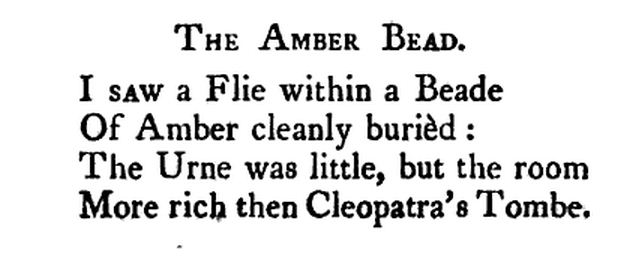
“The Amber Bead” — Robert Herrick

herrick

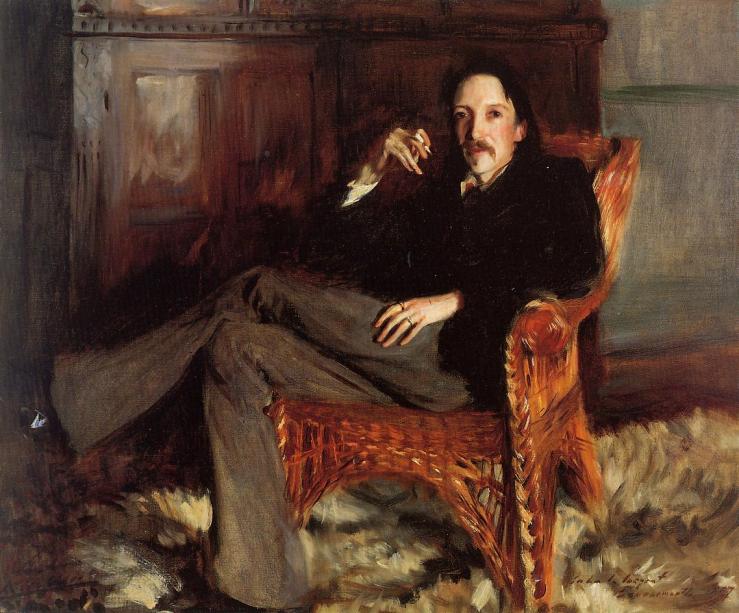
Robert Louis Stevenson — John Singer Sargent

robert-louis-stevenson-1887-jss

“The Hollow of the Three Hills” — Nathaniel Hawthorne

“The Hollow of the Three Hills” by Nathaniel Hawthorne

In those strange old times when fantastic dreams and madmen’s reveries were realized among the actual circumstances of life, two persons met together at an appointed hour and place. One was a lady graceful in form and fair of feature, though pale and troubled and smitten with an untimely blight in what should have been the fullest bloom of her years; the other was an ancient and meanly-dressed woman of ill-favored aspect, and so withered, shrunken and decrepit that even the space since she began to decay must have exceeded the ordinary term of human existence. In the spot where they encountered no mortal could observe them. Three little hills stood near each other, and down in the midst of them sunk a hollow basin almost mathematically circular, two or three hundred feet in breadth and of such depth that a stately cedar might but just be visible above the sides. Dwarf pines were numerous upon the hills and partly fringed the outer verge of the intermediate hollow, within which there was nothing but the brown grass of October and here and there a tree-trunk that had fallen long ago and lay mouldering with no green successor from its roots. One of these masses of decaying wood, formerly a majestic oak, rested close beside a pool of green and sluggish water at the bottom of the basin. Such scenes as this (so gray tradition tells) were once the resort of a power of evil and his plighted subjects, and here at midnight or on the dim verge of evening they were said to stand round the mantling pool disturbing its putrid waters in the performance of an impious baptismal rite. The chill beauty of an autumnal sunset was now gilding the three hill-tops, whence a paler tint stole down their sides into the hollow. Continue reading ““The Hollow of the Three Hills” — Nathaniel Hawthorne”

“Suicide and wife arrive in Cuba” and Other Wise Cracks from F. Scott Fitzgerald

From the “Epigrams, Wise Cracks and Jokes” section ofd  F. Scott Fitzgerald’s Noteboooks:

Suicide and wife arrive in Cuba.

Let’s all live together.

Debut—the first time a young girl is seen drunk in public.

He repeated to himself an old French proverb he had made up that morning.

A sleeping porch is a back room with no pictures on the walls. It should contain at least one window.

Kill the scrub sire is our slogan.

Why can’t you be square? Well, when I was young I used to play with old automobile tires.

Forgotten is forgiven.

If all your clothes are worn to the same state it means you go out too much.

American actresses now use European convents as a sort of female Muldoon’s.

You must stoop a little in order to jump.

For a car—Excuse my lust.

Andre Gide lifted himself by his own jockstrap so to speak—and one would like to see him hoisted on his own pedarasty.

Creditors’ jokes


“Extracts From Adam’s Diary” — Mark Twain

MONDAY — This new creature with the long hair is a good deal in the way. It is always hanging around and following me about. I don’t like this; I am not used to company. I wish it would stay with the other animals. . . . Cloudy today, wind in the east; think we shall have rain. . . . WE? Where did I get that word-the new creature uses it.

TUESDAY — Been examining the great waterfall. It is the finest thing on the estate, I think. The new creature calls it Niagara Falls-why, I am sure I do not know. Says it LOOKS like Niagara Falls. That is not a reason, it is mere waywardness and imbecility. I get no chance to name anything myself. The new creature names everything that comes along, before I can get in a protest. And always that same pretext is offered — it LOOKS like the thing. There is a dodo, for instance. Says the moment one looks at it one sees at a glance that it “looks like a dodo.” It will have to keep that name, no doubt. It wearies me to fret about it, and it does no good, anyway. Dodo! It looks no more like a dodo than I do.

WEDNESDAY — Built me a shelter against the rain, but could not have it to myself in peace. The new creature intruded. When I tried to put it out it shed water out of the holes it looks with, and wiped it away with the back of its paws, and made a noise such as some of the other animals make when they are in distress. I wish it would not talk; it is always talking. That sounds like a cheap fling at the poor creature, a slur; but I do not mean it so. I have never heard the human voice before, and any new and strange sound intruding itself here upon the solemn hush of these dreaming solitudes offends my ear and seems a false note. And this new sound is so close to me; it is right at my shoulder, right at my ear, first on one side and then on the other, and I am used only to sounds that are more or less distant from me.

FRIDAY — The naming goes recklessly on, in spite of anything I can do. I had a very good name for the estate, and it was musical and pretty — GARDEN OF EDEN. Privately, I continue to call it that, but not any longer publicly. The new creature says it is all woods and rocks and scenery, and therefore has no resemblance to a garden. Says it LOOKS like a park, and does not look like anything BUT a park. Consequently, without consulting me, it has been new-named NIAGARA FALLS PARK. This is sufficiently high-handed, it seems to me. And already there is a sign up:

KEEP OFF THE GRASS

My life is not as happy as it was. Continue reading ““Extracts From Adam’s Diary” — Mark Twain”

Tarzan (Via William Burroughs)

tarzan

“Tarzan Based on the works of Burroughs”— Comic by Kelly Shane & Woody Compton, part of their Is This Tomorrow? series.

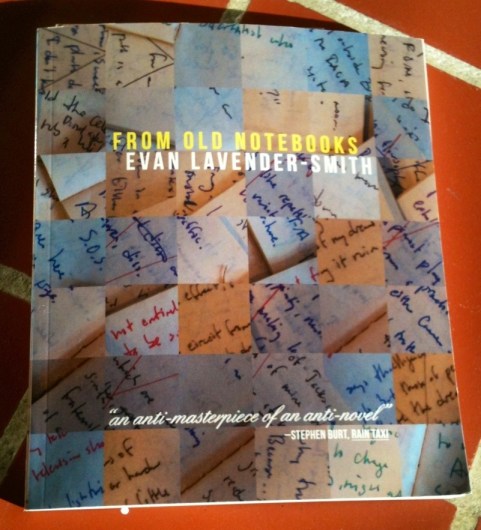
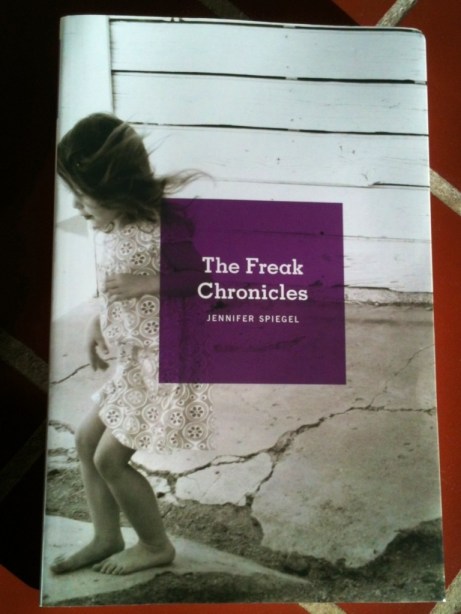
From Old Notebooks/The Freak Chronicles (Books Acquired, 1.04.2013)

20130107-202041.jpg

A few weeks back, Matt Bucher (via Twitter) suggested that because I enjoyed David Markson’s “notecard” novels so much, I should get a hold of Evan Lavender-Smith’s anti-novel From Old Notebooks. I went to order it from my bookstore, promptly found out it was out of print, and was bummed. And then like maybe a week after this, Matt let me know that the book was back in print from the good people at Dzanc. Anyway, it’s good stuff, and I’ll have a full write-up later this month.

Because of a postage screw-up, my original order was lost. When I let Dzanc know my book hadn’t arrived yet, they promptly sent another copy of the book, along with Jennifer Spiegel’s story collection The Freak Chronicles:

20130107-202048.jpg

Dzanc’s blurb:

An American missionary sleeps on the dung floor in a witch doctor’s hut in South Africa. Two women contemplate “poverty porn” while trying to start a nonprofit in China. An heiress locks eyes with a whore on the streets of Cape Town. A college girl stalks Mickey Rourke. A professor from New Jersey gets scammed in Old Havana before Castro’s demise. A mom obsesses about the fate of Sesame Street characters. A study abroad student goes home with a Russian street artist. Backpackers question their global idealism. Terrain, both ordinary and extraordinary, work on the imaginations and perceptions of people on the run, freaks in the making, eccentrics by choice.

The short stories in this collection explore, both implicitly and explicitly, the notion of freakiness. They worry over eccentricity, alienation, normalcy, and intimacy. What is it that makes one a freak, makes one want to embrace quirkiness, have the fortitude to cultivate oddity? Is there a fine line between abnormality and the extraordinary? Jennifer Spiegel’s stories delve into these questions and others.

“The Story of Gulnare of the Sea” (Arabian Nights)

“The Story of Gulnare of the Sea”

from The Arabian Nights: Their Best Known Tales (1909)

There was, in olden time, and in an ancient age and period, in the land of the Persians, a king named Shahzeman, and the place of his residence was Khorassan. He had not been blest, during his whole life, with a male child nor a female; and he reflected upon this, one day, and lamented that the greater portion of his life had passed, and he had no heir to take the kingdom after him as he had inherited it from his fathers and forefathers. So the utmost grief befell him on this account.

Now while he was sitting one day, one of his mamelukes came in to him, and said to him: “O my lord, at the door is a slave-girl with a merchant: none more beautiful than she hath been seen.” And he replied: “Bring to me the merchant and the slave-girl.” The merchant and the slave-girl therefore came to him; and when he saw her, he found her to resemble the lance in straightness and slenderness. She was wrapped in a garment of silk embroidered with gold, and the merchant uncovered her face, whereupon the place was illuminated by her beauty, and there hung down from her forehead seven locks of hair reaching to her anklets. The King, therefore, wondered at the sight of her, and at her beauty, and her stature and justness of form; and he said to the merchant: “O sheikh, for how much is this damsel to be sold?” The merchant answered: “O my lord, I purchased her for two thousand pieces of gold of the merchant who owned her before me, and I have been for three years travelling with her, and she hath cost, to the period of her arrival at this place, three thousand pieces of gold; and she is a present from me unto thee.” Upon this, the king conferred upon him a magnificent robe of honour, and gave orders to present him with ten thousand pieces of gold. So he took them, and kissed the hands of the king, thanking him for his beneficence, and departed. Then the king committed the damsel to the tirewomen, saying to them: “Amend the state of this damsel, and deck her, and furnish for her a private chamber, and take her into it.” He also gave orders to his chamberlains that everything which she required should be conveyed to her. The seat of government where he resided was on the shore of the sea, and his city was called the White City. And they conducted the damsel into a private chamber, which chamber had windows overlooking the sea; and the king commanded his chamberlains to close all the doors upon her after taking to her all that she required. Continue reading ““The Story of Gulnare of the Sea” (Arabian Nights)”

In Cold Blood (Full Film)

“All visible objects, man, are but as pasteboard masks” (Moby-Dick)

Hark ye yet again—the little lower layer. All visible objects, man, are but as pasteboard masks. But in each event—in the living act, the undoubted deed—there, some unknown but still reasoning thing puts forth the mouldings of its features from behind the unreasoning mask. If man will strike, strike through the mask! How can the prisoner reach outside except by thrusting through the wall? To me, the white whale is that wall, shoved near to me. Sometimes I think there’s naught beyond. But ’tis enough. He tasks me; he heaps me; I see in him outrageous strength, with an inscrutable malice sinewing it. That inscrutable thing is chiefly what I hate; and be the white whale agent, or be the white whale principal, I will wreak that hate upon him. Talk not to me of blasphemy, man; I’d strike the sun if it insulted me. For could the sun do that, then could I do the other; since there is ever a sort of fair play herein, jealousy presiding over all creations. But not my master, man, is even that fair play. Who’s over me? Truth hath no confines.

From Chapter 36 of Herman Melville’s Moby-Dick. The speaker, of course, is Ahab.


Andrei Tarkovsky: The Collector of Dreams (Book Acquired, 12.29.2012)

20130107-202014.jpg

Layla Alexander-Garrett’s memoir Andrei Tarkovsky: The Collector of Dreams is new from Glagoslav. Their blurb:

The Sacrifice is Andrei Tarkovsky’s final masterpiece. The film was shot in Sweden, during the summer of 1985, while Tarkovsky was in exile; it turned out to be his final testament. Day after day, while the film was being made, Layla Alexander-Garrett – Tarkovsky’s on-site interpreter – kept a diary which forms the basis of her award-winning book Andrei Tarkovsky: The Collector Of Dreams. In this book the great director is portrayed as a real, living person: tormented, happy, inexhaustibly kind but at times harsh, unrelenting, conscience-stricken and artistically unfulfilled.

I’ve been riffling through it over the past few days. Alexander-Garrett describes her time with Tarkovsky in vivid detail—there’s a concrete richness to the book, and the author doesn’t try to psychoanalyze or interpret or otherwise interpose herself between the reader and the subject. More to come.

“A Reflection” — Kate Chopin

“A Reflection” by Kate Chopin—

Some people are born with a vital and responsive energy. It not only enables them to keep abreast of the times; it qualifies them to furnish in their own personality a good bit of the motive power to the mad pace. They are fortunate beings. They do not need to apprehend the significance of things. They do not grow weary nor miss step, nor do they fall out of rank and sink by the wayside to be left contemplating the moving procession.

Ah! that moving procession that has left me by the road-side! Its fantastic colors are more brilliant and beautiful than the sun on the undulating waters. What matter if souls and bodies are failing beneath the feet of the ever-pressing multitude! It moves with the majestic rhythm of the spheres. Its discordant clashes sweep upward in one harmonious tone that blends with the music of other worlds—to complete God’s orchestra.

It is greater than the stars—that moving procession of human energy; greater than the palpitating earth and the things growing thereon. Oh! I could weep at being left by the wayside; left with the grass and the clouds and a few dumb animals. True, I feel at home in the society of these symbols of life’s immutability. In the procession I should feel the crushing feet, the clashing discords, the ruthless hands and stifling breath. I could not hear the rhythm of the march.

Salve! ye dumb hearts. Let us be still and wait by the roadside.