Gustave Dore’s marvelous illustration’s for Edgar Allan Poe’s poem “The Raven”

(From “A Chapter of Suggestions”).
“55 Miles to the Gas Pump” is a very short story by Annie Proulx.
Rancher Croom in handmade boots and filthy hat, that walleyed cattleman, stray hairs like the curling fiddle string ends, that warm-handed, quick-foot dancer on splintery boards or down the cellar stairs to a rack of bottles of his own strange beer, yeasty, cloudy, bursting out in garlands of foam, Rancher Croom at night galloping drunk over the dark plain, turning off at a place he knows to arrive at a canyon brink where he dismounts and looks down on tumbled rock, waits, then steps out, parting the air with his last roar, sleeves surging up, windmill arms, jeans riding over boot tops, but before he hits he rises again to the top of the cliff like a cork in a bucket of milk.
Mrs. Croom on the roof with a saw cutting a hole into the attic where she has not been for twelve years thanks to old Croom’s padlocks and warnings, whets to her desire, and the sweat flies as she exchanges the saw for a chisel and hammer until a ragged slab peak is free and she can see inside: just as she thought: the corpses of Mr. Croom’s paramours – she recognizes them from their photographs in the paper: MISSING WOMAN – some desiccated as jerky and much the same color, some moldy from lying beneath roof leaks, and, all of them used hard, covered with tarry handprints, the marks of boot heels, some bright blue with remnants of paint used on the shutters years ago, one wrapped in newspaper nipple to knee.
When you live a long way out you make your own fun.

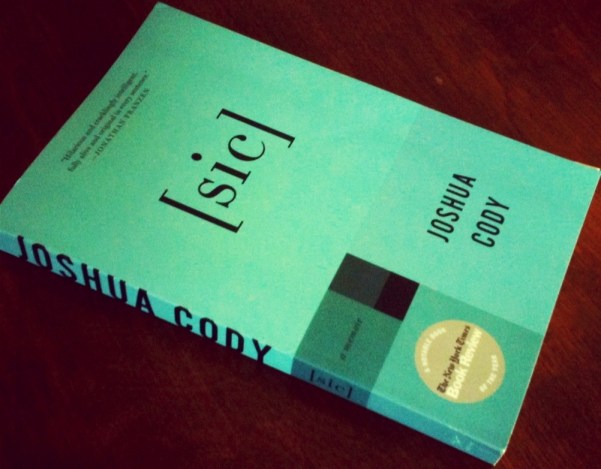
Joshua Cody’s memoir [sic] showed up at Biblioklept World Headquarters a few weeks ago and despite my prejudices, I coasted through it over a few afternoons.
Those prejudices:
1) It’s a memoir.
2) There’s a Jonathan Franzen blurb on the cover.
3) The title [sic] is an unbearably too-clever pun (and this from a guy who loves puns).
The first thing I noticed about [sic] were the pictures : paintings, maps, charts, sketches, lists, collages, other texts, and so on interspersed throughout the text. I like pictures in books.
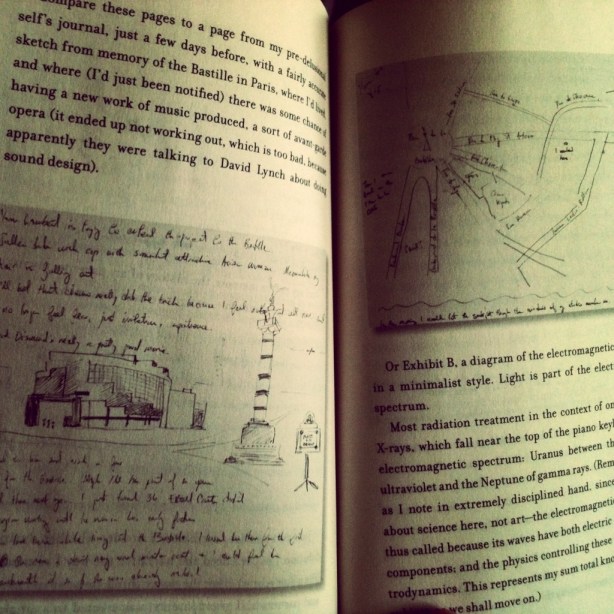
The way that Cody uses these illustrations at first reminded me of W.G. Sebald, who employed pictures in novels like Austerlitz and The Rings of Saturn in an oblique, documentary approach.
Cody is less oblique than Sebald, and perhaps flippant too. He doesn’t namecheck Sebald, at any rate, unlike David Byrne, who openly admitted to following Sebald’s path in his 2008 memoir Bicycle Diaries. (Cody does namecheck David Byrne though).
Then I edged my way into the plot, such as it is. I’ll lazily let publisher W.W. Norton summarize:
Joshua Cody, a brilliant young composer, was about to receive his PhD when he was diagnosed with an aggressive form of cancer. Facing a bone marrow transplant and full radiation, he charts his struggle: the fury, the tendency to self-destruction, and the ruthless grasping for life and sensation; the encounter with beautiful Ariel, who gives him cocaine and a blow job in a Manhattan restaurant following his first treatment; the detailed morphine fantasy complete with a bride called Valentina while, in reality, hospital staff are pinning him to his bed.
Moving effortlessly between references to Don Giovanni and the Rolling Stones, Ezra Pound and Buffalo Bill, and studded with pages from his own diaries and hospital notebooks, [sic] is a mesmerizing, hallucinatory glimpse into a young man’s battle against disease and a celebration of art, language, music, and life.
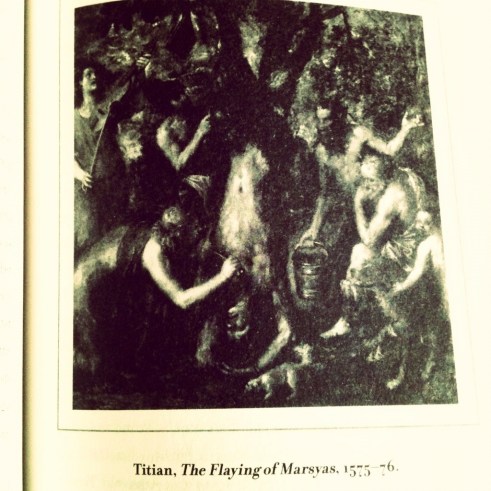
As Norton’s summary suggests, Cody’s memoir is highly discursive and playful, loaded with references to art, music, and literature. Digressions on figures like David Foster Wallace, Orson Welles, or Alexander Theroux lard the book—indeed, they often seem to edge out the story Cody intends to tell, his cancer memoir. He seems reticent to fully engage his own feelings, instead layering reference upon reference. These references become insufferable at times—are we supposed to care that Cody met David Lynch and would like to be his friend, or that Cody briefly studied ancient Greek? Cody is so busy trying to impress the reader that he forgets to express meaning.
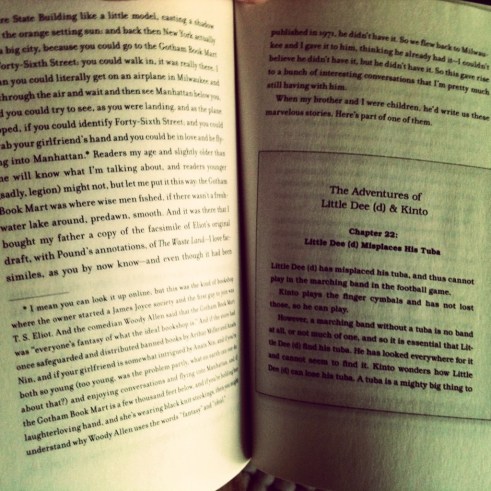
We see this reticence, this turning away from, here over two pages: Cody moves from a story about buying a facsimile copy of Pound’s notes on the original draft of The Wasteland to a lengthy footnote that manages to name drop James Joyce, T.S. Eliot, Woody Allen, Anaïs Nin, and Henry Miller (in just two sentences!) and then into a facsimile reproduction of one of the stories his brother would write for him as a child:
The big problem with Cody’s memoir is that it never feels particularly real. I enjoy discursive referential postmodernism as much as the next fella, but [sic] often fails to cohere around a central idea, let alone an emotion. When Cody describes dating a stripper/dominatrix, it feels like a party trick, an inflated anecdote—there’s no emotional core, no contemplative connection to his illness. Other sexual episodes read like a parody of Henry Miller.
As its title suggests, [sic] is a dodge, a bait-and-switch, an evasion. Cody is clearly very clever—but a dazzling display of cleverness can’t sustain a narrative.
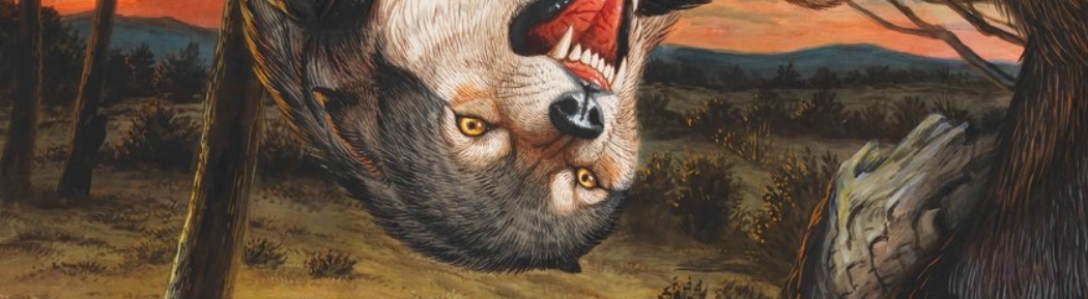
(From “A Chapter of Suggestions”).

In a disguised way, Goya in the Caprichos drew a parallel between witchcraft and the activities of the clergy. He stressed the resemblance between witches and friars in their obedience to the hierarchy of their calling, the younger deferring to the older. In plate 47, Obsequio al maestro (“Homage to the master”), an apparently senior witch looks down with stony disdain at another, who ois offering her (or him) the gift of a dead baby; the supplicant’s gesture reminds one of a groveling postulant kissing the cardinal’s ring. “Es muy justo,” runs the Prado text: “This is quite fair, they would be ungrateful disciples who failed to visit their professor, to whom they owe everything they know about their diabolical faculties.”
Plate 46, Correccion (“Correction”), shows a group of brujos, male witches, as seminarians, consulting “the great witch who runs the Barahona seminary” — whatever that institution may have been. Of course, Goya could not be too explicit about this: on the other side of any public criticism of clerical practices lay the ever-watchful eye of the Inquisition, which Goya had to be at pains to avoid.
—From Robert Hughes’s biography Goya.
Continuing kinda sorta where we left off—
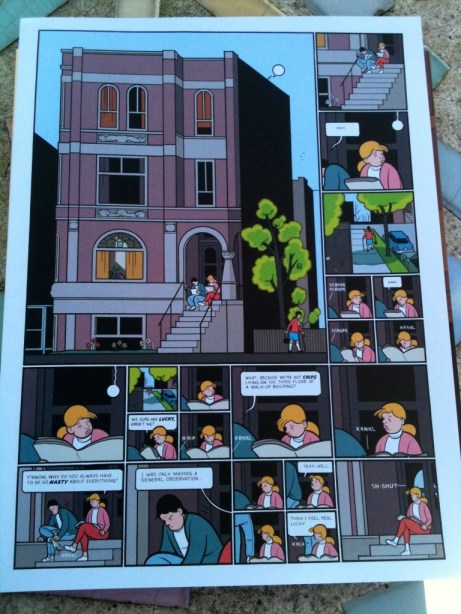
Not sure of the name of this episode, but I’ll refer to it as I just met, a phrase that repeats twice in a huge headlinish font that seems to suggest, y’know, title:

I just met uses a few pages to tell the story of a deteriorating relationship—what happens when two twenty-somethings turn into two mid-to-late-thirtysomethings?
The comic opens with an establishing shot of what I take to be the building in Building Stories; we also get a glimpse of what I assume will be another character, the beehive, and a few other details that surely will attach themselves to these panels in future readings. We also get the general bitter tone of the couple’s relationship:

He was one of those dudes who was once in a band; she was one of those chicks who thought guys in bands were cool.
The romance of their initial hookup is summed up neatly in the pic below; knowing Ware’s spare, precise style, the trash on the floor seems to scream symbolic detail!

The hurt and disappointment in I just met unfolds over just a few painful pages—painful mostly in their concrete reality.
We know who these people are, even if we’re lucky enough not to be them.
Just as in Branford, the Best Bee in the World , which I read earlier (although, to be clear again, there are no reading directions or prescriptions for Building Stories), there’s a theme of eternal recurrence, of mistakes playing out again and again in a painful, recursive loop.
Just when Ware threatens to overstate the mundane repetitions his principals suffer, he pulls off a daring and effective move, transposing his characters into the psychic collective memory of a future that’s in many ways already familiar. The effect is simultaneously jarring and oddly reassuring—the promise that our capacity for human connection and deep empathy will never buckle under the threat of drastic technological change, but also suggesting that the cost of maintaining this emotional constant is deep, ugly pain.


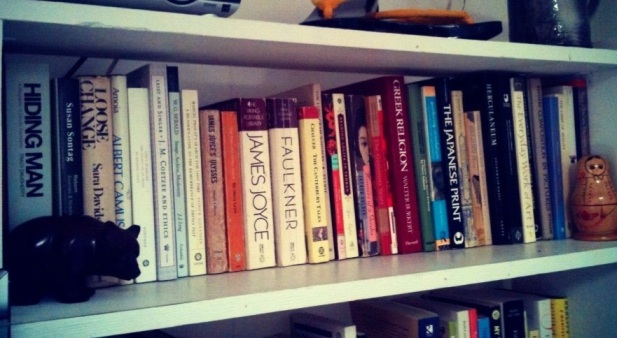
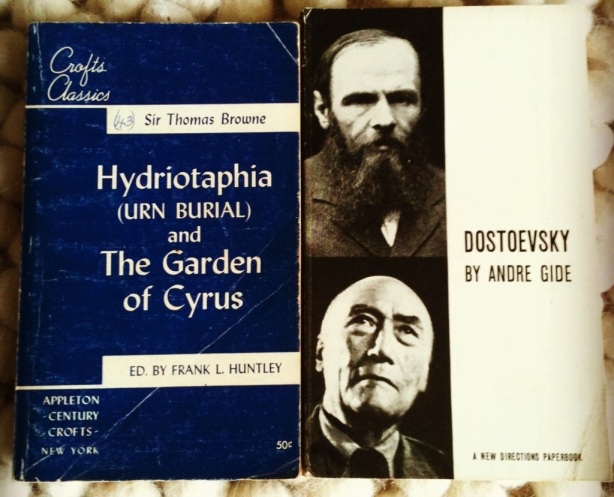
Book shelves series #43, forty-third Sunday of 2012
Kind of a hodgepodge shelf—some literary biography, a few now-redundant collections, some literary criticism, art books, etc.
Tracy Daugherty’s Donald Barthelme biography Hiding Man is on the far left; I reviewed it a few years ago, taking note of my favorite part, the so-called postmodernists’ dinner.
Next to it is Susan Sontag’s Reborn, a collection of early journals that I also reviewed.
Next to these two is Sara Davidson’s Loose Change. My aunt gave me a box of books years ago (lots of Asimov and Octavia Butler) and this was in here.
I knew about it because of a long essay in a 2007 issue of The Believer.

I picked up Penguin’s The Essential James Joyce in Jimbocho, an area in Tokyo known for used bookstores.
I recall paying maybe ¥100 for it. It comprises a few selections from Ulysses and Finnegans Wake, some of Joyce’s (totally unessential) poetry, and the entirety of Dubliners, Exiles, and Portrait. I’ve kept it because of sentiment (and I like the cover).

“Robinson Crusoe” by Franz Kafka:
Had Robinson Crusoe never left the highest, or more correctly the most visible point of his island, from desire for comfort, or timidity, or fear, or ignorance, or longing, he would soon have perished; but since without paying any attention to passing ships and their feeble telescopes he started to explore the whole island and take pleasure in it, he managed to keep himself alive and finally was found after all, by a chain of causality that was, of course, logically inevitable.
We couldn’t endure a life in nature, necessarily always a free nature, without respite, so we always step outside nature, for no reason but survival, and take refuge in our reading, and live for a long time in our books, a more undisturbed life. I’ve lived half my life not in nature but in my books as a nature-substitute, and the one half was made possible only by the other half. Or else we exist in both simultaneously, in nature and in reading-as-nature, in this extreme nervous tension which as a form of consciousness is endurable only for the shortest possible time span. The question can’t be whether I live in nature as nature, or in reading-as-nature, or in nature-as-reading, in the nature of nature-as-reading andsoforth, so Roithamer. To everything that we think and fill our own life and that we hear and see, perceive, we always have to add: the truth, however, is … as a result, uncertainty has become a chronic condition with us. Those abrupt transitions from one nature into the other, from one form of awareness into the other, so Roithamer. When we think, we know nothing, everything is open, nothing, so Roithamer.
From Thomas Bernhard’s novel Correction.
“One need not be a Chamber — to be Haunted –” by Emily Dickinson:
One need not be a Chamber — to be Haunted —
One need not be a House —
The Brain has Corridors — surpassing
Material Place —Far safer, of a Midnight Meeting
External Ghost
Than its interior Confronting —
That Cooler Host.Far safer, through an Abbey gallop,
The Stones a’chase —
Than Unarmed, one’s a’self encounter —
In lonesome Place —Ourself behind ourself, concealed —
Should startle most —
Assassin hid in our Apartment
Be Horror’s least.The Body — borrows a Revolver —
He bolts the Door —
O’erlooking a superior spectre —
Or More —
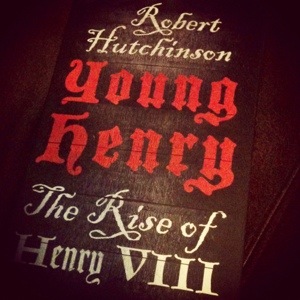
Robert Hutchinson’s Young Henry: The Rise of Henry VIII is new in hardback from Thomas Dunne/Macmillan. Their blurb:
Immortalized as a domineering king, notorious philanderer, and the unlikely benefactor of a new church, Henry VIII became a legend during his own reign. Who, though, was the young royal who would grow up to become England’s most infamous ruler? Robert Hutchinson’s Young Henry examines Henry Tudor’s childhood beginnings and subsequent rise to power in the most intimate retelling of his early life to date.


While Henry’s elder brother Arthur was scrupulously groomed for the crown by their autocratic father, the ten-year-old “spare heir” enjoyed a more carefree childhood, given prestige and power without the looming pressures of the throne. Everything changed for the young prince, though, when his brother died. Henry was nine weeks shy of his eighteenth birthday when he inherited both his brother’s widow and the crown.
As King, Henry preferred magnificence and merriment to his royal responsibilities, sweeping away the musty cobwebs of his father’s court with feasting, dancing, and sport. Frustrated, too, by the seeming inability of his wife, Katherine of Aragon, to produce an heir, Henry turned his attention to a prospective second queen whose name would endure as long as his: Anne Boleyn. With the king still lacking a successor by the age of 35, however, the time for youthful frolic had come to an end.
Divorcing his wife and the Catholic Church, executing his lover and his violent will, Henry charged forward on a scandalous path of terrifying self-indulgence from which there was no turning back. Young Henry is an illuminating portrait of this tyrannical yet groundbreaking king—before he transformed his country, and the face of the monarchy, irrevocably.
Chris Ware’s latest collection Building Stories comprises fourteen comics of different shapes, sizes, and formats. I wrote about opening the box a few days ago, and I’ll (try to) write about reading each of the pieces.
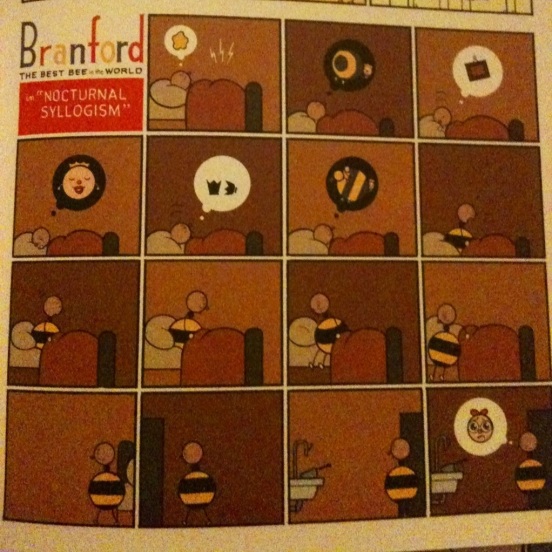
I started with Brandford, the Best Bee in the World, the tragicomic existential dilemma of a bee:

In an opening segment freighted with peril, our hero Branford finds himself “trapped in a box of hard air,” in a predicament that makes “the water run fast out of the holes in the front of his face.” When he does find a way out, he takes at as a sign of redemption from the Almighty:

Branford, now free to return home to his wife and family, promises God to quit lusting after the queen bee.
Easier said than done—even if his erotic dreams are interrupted with the domestic problems of crooked picture frames, broken vases, and burnt dinners:

Branford solves his domestic trouble by going out into the world to provide pollen for his family, even if it means suffering an existential breakdown of identity, one that causes him to flashback to his beeblooded past.
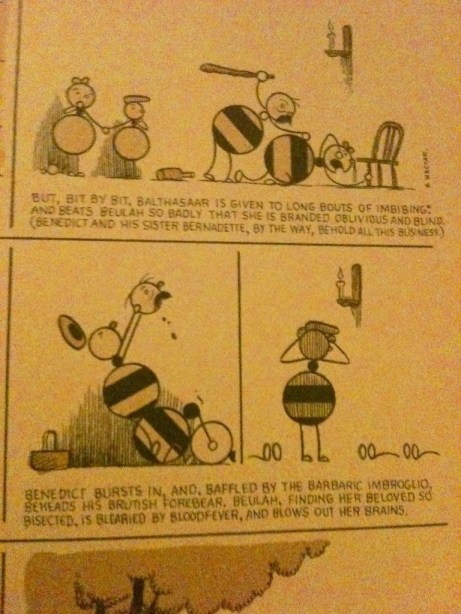
The flashback episode introduces heavy alliteration that continues throughout the rest of the narrative. Framed as a 19th century comic strip, it combines zany humor with horrific familial violence and suicidal despair, an unnerving, bizarre combination that carries over throughout the comic:

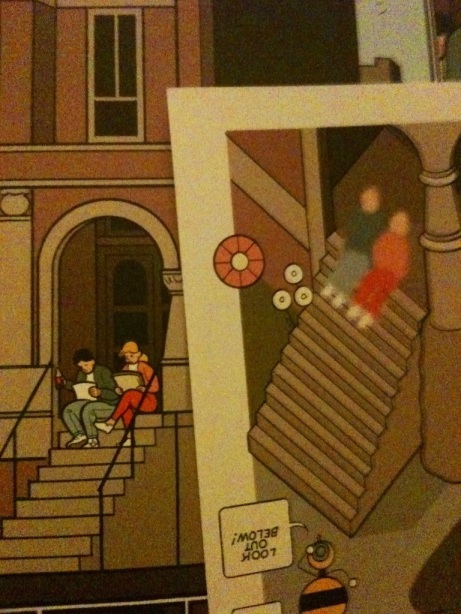
I won’t spoil anymore of Branford, other than pointing out that its narrative arcs in a strange loop. And even as its narrative doubles back into itself, it also points out, metatextually calling to another volume of Building Stories: here, see Branford to the right (and upside down) to a larger comic with no name.

I took the visual overlap as a prompt to read the comic on the left next. How did I start with Branford and not one of the other comics? It was on top.
“An Uncomfortable Bed” by Guy de Maupassant:
One autumn I went to stay for the hunting season with some friends in a chateau in Picardy.
My friends were fond of practical joking, as all my friends are. I do not care to know any other sort of people.
When I arrived, they gave me a princely reception, which at once aroused distrust in my breast. We had some capital shooting. They embraced me, they cajoled me, as if they expected to have great fun at my expense.
I said to myself:
“Look out, old ferret! They have something in preparation for you.”
During the dinner, the mirth was excessive, far too great, in fact. I thought: “Here are people who take a double share of amusement, and apparently without reason. They must be looking out in their own minds for some good bit of fun. Assuredly I am to be the victim of the joke. Attention!”
During the entire evening, everyone laughed in an exaggerated fashion. I smelled a practical joke in the air, as a dog smells game. But what was it? I was watchful, restless. I did not let a word or a meaning or a gesture escape me. Everyone seemed to me an object of suspicion, and I even looked distrustfully at the faces of the servants.
The hour rang for going to bed, and the whole household came to escort me to my room. Why? They called to me: “Good night.” I entered the apartment, shut the door, and remained standing, without moving a single step, holding the wax candle in my hand.
I heard laughter and whispering in the corridor. Without doubt they were spying on me. I cast a glance around the walls, the furniture, the ceiling, the hangings, the floor. I saw nothing to justify suspicion. I heard persons moving about outside my door. I had no doubt they were looking through the keyhole.
An idea came into my head: “My candle may suddenly go out, and leave me in darkness.”
Then I went across to the mantelpiece, and lighted all the wax candles that were on it. After that, I cast another glance around me without discovering anything. I advanced with short steps, carefully examining the apartment. Nothing. I inspected every article one after the other. Still nothing. I went over to the window. The shutters, large wooden shutters, were open. I shut them with great care, and then drew the curtains, enormous velvet curtains, and I placed a chair in front of them, so as to have nothing to fear from without.
Then I cautiously sat down. The armchair was solid. I did not venture to get into the bed. However, time was flying; and I ended by coming to the conclusion that I was ridiculous. If they were spying on me, as I supposed, they must, while waiting for the success of the joke they had been preparing for me, have been laughing enormously at my terror. So I made up my mind to go to bed. But the bed was particularly suspicious-looking. I pulled at the curtains. They seemed to be secure. All the same, there was danger. I was going perhaps to receive a cold shower-bath from overhead, or perhaps, the moment I stretched myself out, to find myself sinking under the floor with my mattress. I searched in my memory for all the practical jokes of which I ever had experience. And I did not want to be caught. Ah! certainly not! certainly not! Then I suddenly bethought myself of a precaution which I consider one of extreme efficacy: I caught hold of the side of the mattress gingerly, and very slowly drew it toward me. It came away, followed by the sheet and the rest of the bedclothes. I dragged all these objects into the very middle of the room, facing the entrance door. I made my bed over again as best I could at some distance from the suspected bedstead and the corner which had filled me with such anxiety. Then, I extinguished all the candles, and, groping my way, I slipped under the bedclothes.
For at least another hour, I remained awake, starting at the slightest sound. Everything seemed quiet in the chateau. I fell asleep.
I must have been in a deep sleep for a long time, but all of a sudden, I was awakened with a start by the fall of a heavy body tumbling right on top of my own body, and, at the same time, I received on my face, on my neck, and on my chest a burning liquid which made me utter a howl of pain. And a dreadful noise, as if a sideboard laden with plates and dishes had fallen down, penetrated my ears.
I felt myself suffocating under the weight that was crushing me and preventing me from moving. I stretched out my hand to find out what was the nature of this object. I felt a face, a nose, and whiskers. Then with all my strength I launched out a blow over this face. But I immediately received a hail of cuffings which made me jump straight out of the soaked sheets, and rush in my nightshirt into the corridor, the door of which I found open.
O stupor! it was broad daylight. The noise brought my friends hurrying into the apartment, and we found, sprawling over my improvised bed, the dismayed valet, who, while bringing me my morning cup of tea, had tripped over this obstacle in the middle of the floor, and fallen on his stomach, spilling, in spite of himself, my breakfast over my face.
The precautions I had taken in closing the shutters and going to sleep in the middle of the room had only brought about the interlude I had been striving to avoid.
Ah! how they all laughed that day!