Did I read it before? In high school? Not in college, not in grad school, I’m certain of that.
That I could have read Notes from Undergroundin full three times, but not Crime and Punishment—how?
I vaguely recall wandering into Crime and Punishment as a young man. All those Russian names though. My attention was on other matters.
And so reading Crime and Punishment this month I repeatedly felt a strange anger or shame at all my younger selves for lacking the attention or the will or the discipline to stick it out . . . and these words, attention, discipline, will, they don’t seem like the right words, because the book compels, commands,rewards . . .
2. You are familiar with the plot of course:
Our hero, our anti-hero, young Raskolnikov murders a pawnbroker, an old woman; in the rush of the crime, he fails to close the door, and the pawnbroker’s innocent sister sees him. So he murders her too. The rest of the novel deals with the psychological fall out of this crime. Sure, there’s a sister and a mother, a failed marriage plot, a detective, a friend, and a love interest, a prototypical hooker with a heart of gold, etc.—but that’s it. That’s the plot.
3. What impels Raskolnikov to murder the pawnbroker?
Perhaps I shouldn’t answer here. Perhaps it’s better to suggest you just read the book if you haven’t yet—because is not this the driving question?
(Oh you’ve read the book? I’ll continue then).
4. Raskolnikov murders the pawnbroker not because he is an indigent student in need of funds. He murders her to test his theory—or rather, he murders her to test his place within the scheme of his theory.
The Murderer, Edvard Munch
5. Raksolnikov’s idea:
I maintain that all great men or even men a little out of the common, that is to say capable of giving some new word, must from their very nature be criminals—more or less, of course. Otherwise it’s hard for them to get out of the common rut; and to remain in the common rut is what they can’t submit to, from their very nature again, and to my mind they ought not, indeed, to submit to it. . . . I only believe in my leading idea that men are in general divided by a law of nature into two categories, inferior (ordinary), that is, so to say, material that serves only to reproduce its kind, and men who have the gift or the talent to utter a new word. . . . The first category, generally speaking, are men conservative in temperament and law-abiding; they live under control and love to be controlled. To my thinking it is their duty to be controlled, because that’s their vocation, and there is nothing humiliating in it for them. The second category all transgress the law; they are destroyers or disposed to destruction according to their capacities. The crimes of these men are of course relative and varied; for the most part they seek in very varied ways the destruction of the present for the sake of the better. But if such a one is forced for the sake of his idea to step over a corpse or wade through blood, he can, I maintain, find within himself, in his conscience, a sanction for wading through blood . . .
Raskolnikov believes that “extraordinary men” have the right, the duty, even, to transgress law—even to the extremes of murder (even mass murder) in order to bring about a new word, a new idiom, a new philosophy, a new paradigm, a new zeitgeist, even a New Jerusalem.
Raskolnikov wants to know if he is one of these “extraordinary men.”
6. But Raskolnikov, like Macbeth or a figure out of Poe, is plagued by doubt, misgiving—and more than a touch of insanity and egomania.
His instability and his psychological and moral dilemma is summed up neatly in only the second chapter of the book:
“And what if I am wrong,” he cried suddenly after a moment’s thought. “What if man is not really a scoundrel, man in general, I mean, the whole race of mankind—then all the rest is prejudice, simply artificial terrors and there are no barriers and it’s all as it should be.”
7. The word or an iteration of the word psychology appears 25 times in the Constance Garnett translation I read.
Crime and Punishment was published in 1866, when Sigmund Freud was ten years old.
(I am not naively/stupidly suggesting that Freud invented psychology, by the way. I’m just riffing).
8. What Crime and Punishment does so well:
Harnesses the intellect of its protagonist Raskolnikov, shows us his fevered mind in revolution, shifts us through his moods and dilemmas and despairs and strange joys.
9. And it’s not just the interior of Rakolnikov’s skull we get such access to—Dostoevsky gives our lead a marvelous, taunting foil in the detective Porfiry, a loyal and empathetic counterpoint in friend Razumikhin, a despicable enemy in the poseur Luzhin, and a dark-future forecast in Svidrigaïlov.
Each of these characters represent viewpoints and attitudes about psychology and morality without ever falling into being mere allegorical sketches or mouthpieces for Dostoevsky’s ideas.
10. Dostoevsky—unlike certain contemporary novelists I’ll neglect to name—doesn’t tell us that his character is brilliant (or troubled, or confounded, or fucked up). And he goes beyond showing us—he actually lets us experience the character’s psychology.
11. A marvelous, frightening episode that illustrates point 10:
12. This isn’t to say that Dostoevsky’s handling of characterization is flawless.
His women appear less fully-realized than his men, as if he perhaps cannot inhabit their minds so fully or exercise their brains, their souls, their voices.
Raskolnikov’s sister Dunya, for example, is a bold, more perfect, more more moral, more stable version of her brother, a woman who seems able to withstand conflict, disappointment, and misfortune with ease—too much ease. Raskolnikov’s mother, in contrast, is something of an idealized blank—not just a mother, but the mother figure: nonjudgmental, loving—her character summed up in her hugging her son and forgiving him for what she cannot forgive.
It’s the depiction of Raskolnikov’s love interest Sonia that I find most troubling though. Dostoevsky renders her an unsubtle merging of the Virgin Mary with Mary Magdalene. Her alcoholic father forces her into prostitution to save the family, but she never appears bitter or angry or even upset. Dostoevsky rarely affords her a speaking role, and in her biggest scene she reads the entire parable of Lazarus. Sure, she makes the words her own, but she’s being ventriloquized. The strings show. She’s pure symbolism, really, and stands in stark contrast to the dark, flawed humanity of Raskolnikov.
13. Re: Point 12 above: If Dostoevsky shows a certain weakness in his depiction of women, he perhaps compensates in other areas. For example, Luzhin’s roomate Andrey Semyonovitch, a utopian socialist, serves as a mouthpiece for emerging feminist ideas. And if Dostoevsky mocks would-be reformers in his novel, it’s not always with vitriol, but sometimes with understanding, and even perhaps love. After all, this is Raskolnikov’s pretension—to be a reformer of others, to step over the line of law, to be a great man.
14. But Raskolnikov is a failed reformer, or at least is unable to live with his trespass, his sin. Crime and Punishment’s epilogue emphasizes the Jesusian theme of the possibility of resurrection, even as it subdues or complicates that possibility.
We get the final image of Raskolnikov “mechanically” taking up Sonia’s copy of the New Testament; he doesn’t open it to read, but instead reflects on the possibility of a new life with Sonia, a life that “would cost him great striving, great suffering.” Dostoevsky does not let his protagonist off the hook, even as he offers the reader a final comforting vision of “the gradual renewal of a man, the story of his gradual regeneration, of his passing from one world into another, of his initiation into a new unknown life.”
15. There’s a strong temptation to see the epilogue as tacked on, as a sentimental gesture to the reader’s sense of stable morality, as a bit of window dressing that covers the ugliness of the narrative.
And perhaps this is true.
I’d argue though that Dostoevsky gives us a cold, ugly ending in the figure of Svidrigaïlov, who more or less commands the final moments of the narrative, moments that lead inexorably to his suicide—the self-erasing gesture that Raskolnikov cannot commit to. I think that Svidrigaïlov’s suicide might stand as a placeholder for Raskolnikov’s—an exchange of sorts.
And Svidrigaïlov’s death is not without a small measure of redemption—the redemption of other-directedness, of giving, of selflessness. It is far more complicated and troubling than the Jesusian resurrection that Dostoevsky implies as a possibility for Raskolnikov, but it also strikes me as far more real.
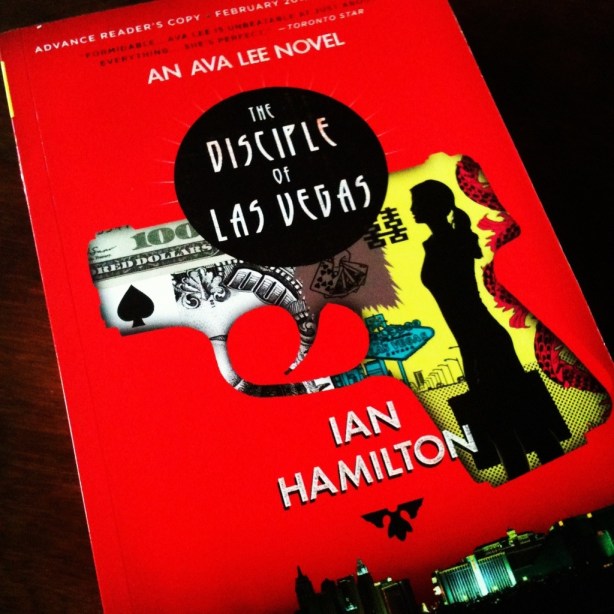
I guess these books are already big in the UK, or maybe they will be big, or something. This one’s an ARC and it doesn’t come out until early next year. Here’s the UK pub copy:
Hired by Tommy Ordonez, the richest man in the Philippines, to recover $50 million in a land swindle, Ava has her work cut out. Tommy’s brother has messed up and the Filipino billionaire’s reputation is on the line.
Tracking the money, Ava uncovers an illegal online gambling ring, and follows the trail to Las Vegas. Once there, she turns her gaze to David Douglas, one of the greatest poker players in the world – and someone who knows more about the missing money than he’s letting on.
Meanwhile, Jackie Leung, an old target of Ava’s, has made it rich. He wants revenge, and he’s going after Ava.
Bring Up the Bodies continues Mantel’s reappraisal of the Tudor saga through the eyes of Thomas Cromwell, a story she began in Wolf Hall, which won the Booker Prize in 2009.
Hers is a story unique in Man Booker history. She becomes only the third author, after Peter Carey and J.M. Coetzee, to win the prize twice, which puts her in the empyrean. But she is also the first to win with a sequel (Wolf Hall won in 2009) and the first to win with such a brief interlude between books. Her resuscitation of Thomas Crowell – and with him the historical novel – is one of the great achievements of modern literature. There is the last volume of her trilogy still to come so her Man Booker tale may yet have a further chapter.
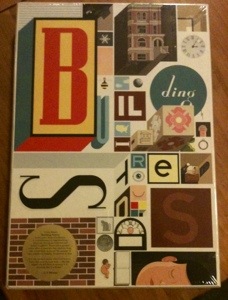
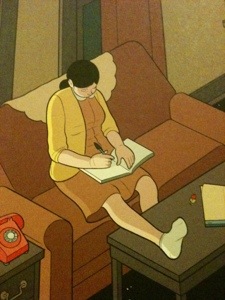
Thrilled today to get Building Stories, Chris Ware’s latest.
Thrilled here is no hyperbole—I can’t remember being so excited to open a book in quite some time.
But Building Stories isn’t really a book.
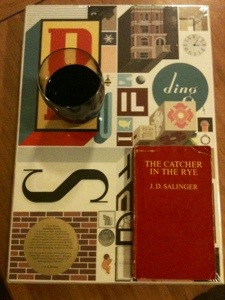
First, it comes in this big box—like a board game.
Here:
I show it set against The Catcher in the Rye in mass market paperback and a glass of red.
(The Catcher in the Rye + glass of red is the international standard for items used to show relative dimensions of size).
(Also, don’t worry about the wine ring—still shrinkwrapped at this point).
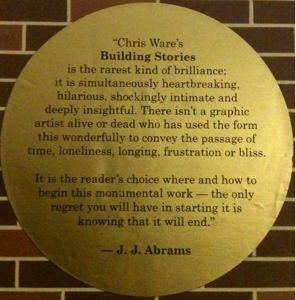
And on that shrinkwrap blazons a blurb by some guy named J.J. Abrams:
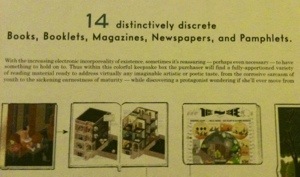
A description of the formal elements of Building Stories from the back of the box:
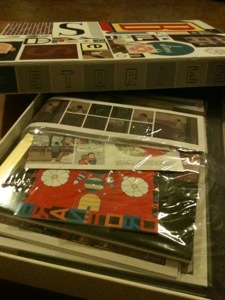
I open the box:
From the inside of the top of the box:
Not sure if that second quote shows here, but:
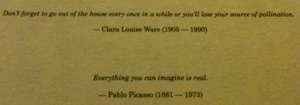
Pablo Picasso suggests that, Everything you can imagine is real.
The package:
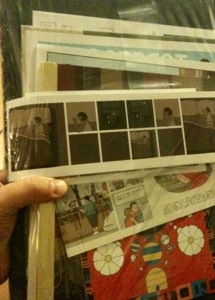
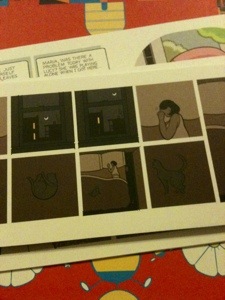
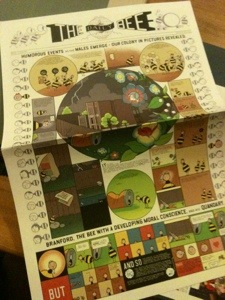
Strips and papers and books.
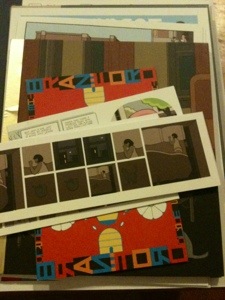
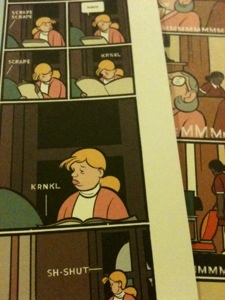
Shots as I go through it:
Stack: The shorter/smaller stuff is on top—a suggestion to read it first? / Probably not.
Probably more a packing issue.
I remember a professor in grad school musing about where a book begins.
The title page?
The cover?
How and where does a book begin?
Chris Ware’s Building Stories: a kind of Möbius strip,
crammed with ideas,
illustrations,
writing,
stories . . .
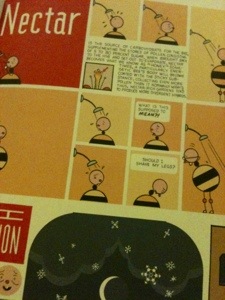
Little golden book
. . . and broadside.
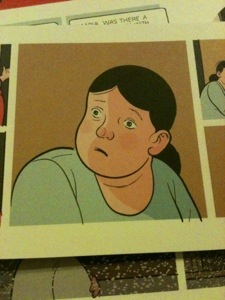
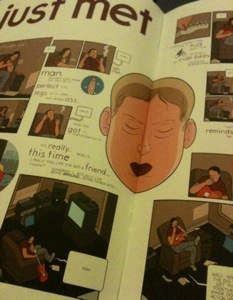
. . . so many faces . . .
. . . layers . . .
. . . and layers . . .
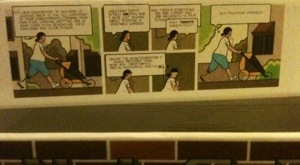
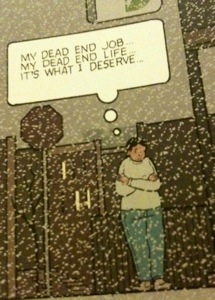
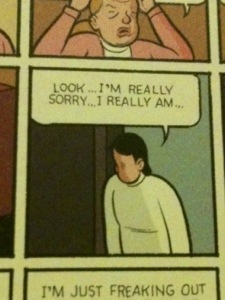
Ware’s transitions:
(They always remind me of David Foster Wallace, who I know Ware read).
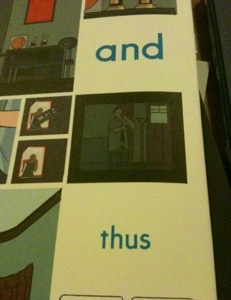
And thus so well . . .
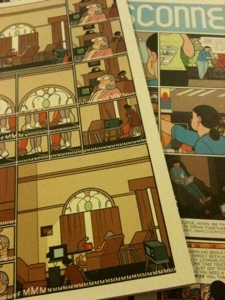
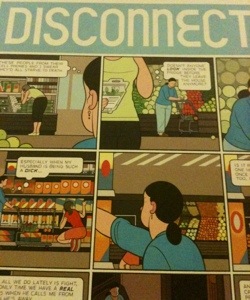
Disconnect?
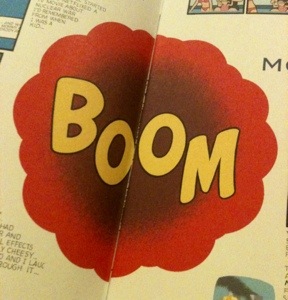
Boom!
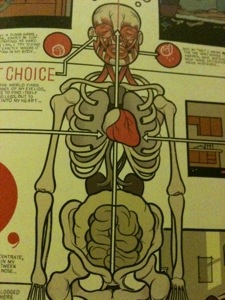
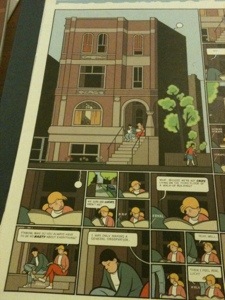
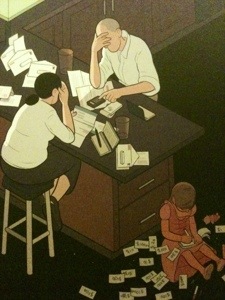
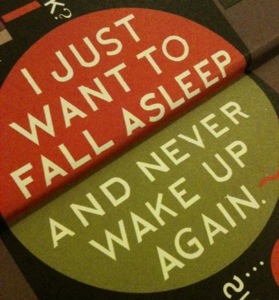
I should’ve busted out the wine glass or the Salinger here to show the scale of this marvelous painting, better than anything I’ve seen in contemporary art in ages. It tells all the story. (Wait, you (maybe) say, have you actually read the story yet?)
No.
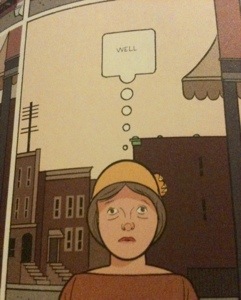
But who hasn’t felt:
And
Thus
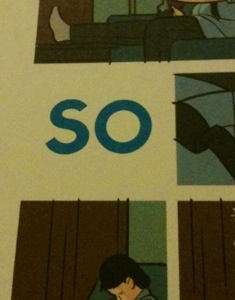
So
Well . . .
[Insert ideas about malleability of form, sequence, narrative, idea—riff on discursive-novel-as-future-novel, etc.]
Late in life the emperor Charlemagne fell in love with a German girl. The barons at his court were extremely worried when they saw that the sovereign, wholly taken up with his amorous passion and unmindful of his regal dignity, was neglecting the affairs of state. When the girl suddenly died, the courtiers were greatly relieved—but not for long, because Charlemagne’s love did not die with her. The emperor had the embalmed body carried to his bedchamber, where he refused to be parted from it. The Archbishop Turpin, alarmed by this macabre passion, suspected an enchantment and insisted on examining the corpse. Hidden under the girl’s dead tongue he found a ring with a precious stone set in it. As soon as the ring was in Turpin’s hands, Charlemagne fell passionately in love with the archbishop and hurriedly had the girl buried. In order to escape the embarrassing situation, Turpin flung the ring into Lake Constance. Charlemagne thereupon fell in love with the lake and would not leave its shores.
From Italo Calvino’s Six Memos for the Next Millennium.
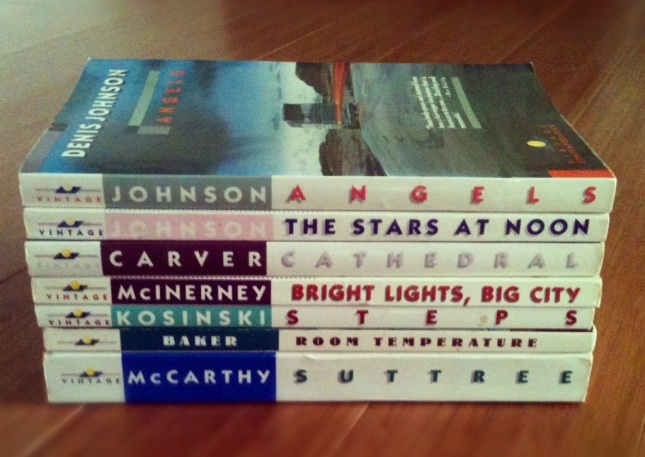
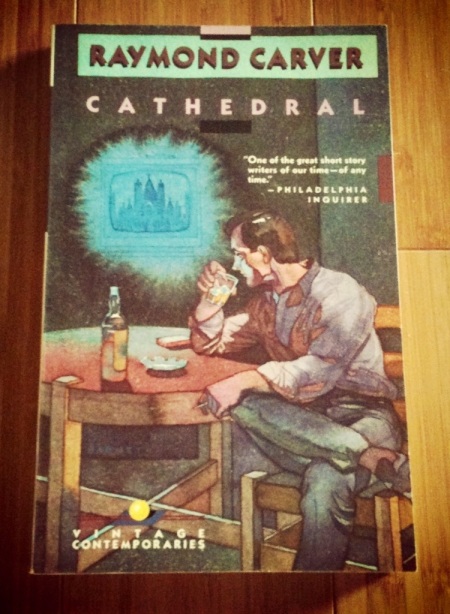
I’ve been a fan of Vintage Contemporaries for years. I’m pretty sure the first one I ever picked up was Raymond Carver’s Cathedral. I recall being vaguely dismayed about the cover and trying to find another used edition, but thrift won out. This was in the early or mid nineties, and book design was trending toward a more minimal, conceptual style.
In contrast to a tasteful, minimalist cover, the Vintage Contemporaries edition of Cathedral is garishly literal. Ditto the cover for Denis Johnson’s Angels: sure, there’s a symbolic touch in those storm clouds, and a surreal tweak in the laser lights, but there’s something ghastly about the whole design.
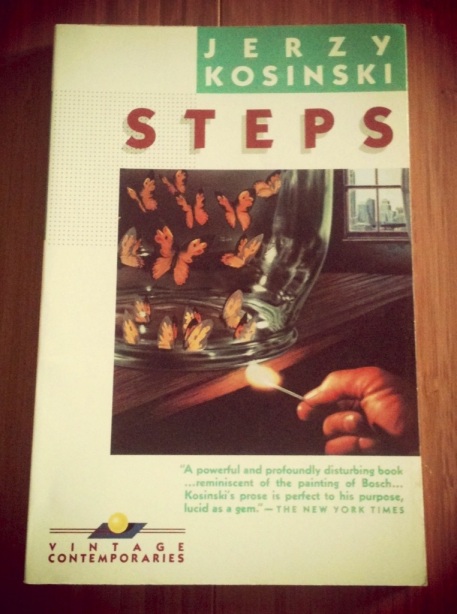
Even the cover for Jerzy Kosinski’s twisted horrorshow-in-vignettes Steps is remarkably literal—sure, the image seems surreal, but it’s straight out of Kosinski’s text. (It’s also one of my favorite covers in the line).
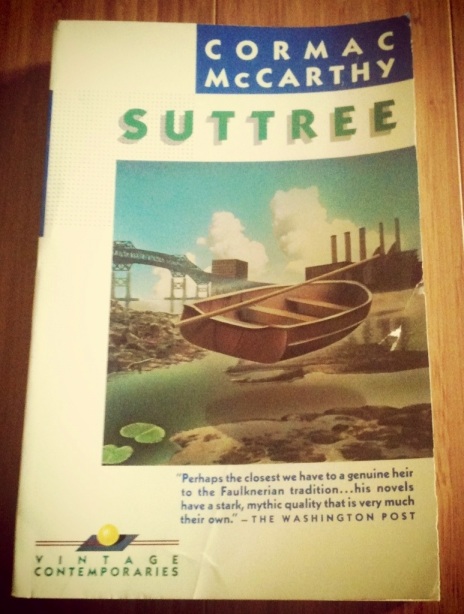
Anyway, in the past few years I’ve kept an eye out for certain titles from the Vintage Contemporaries line, even if I already own the book in another edition—DeLillo, for instance, or Cormac McCarthy. I was thrilled to find this edition of Suttree earlier this year. (And I’d love to get another copy of Harold Brodkey’s First Love and Other Sorrows; I gave mine away to a friend).
I’d been wanting to write about the Vintage Contemporaries series for a while now, and had even gone so far as to write to a few artists and designers I know to see if they could put me in touch with a source of info. A few weeks ago, Mahendra Singh was kind enough to point out a thorough, in-depth essay on Vintage Contemporaries over at Talking Covers. Plenty of history, photos, and even interviews. It’s the mother-lode, the post I wished I could’ve mustered. (And if I seem a bit jealous, I can console myself in the knowledge that they used my first pic of Suttree. So there’s that). I encourage you to check it out.
Book shelves series #42, forty-second Sunday of 2012
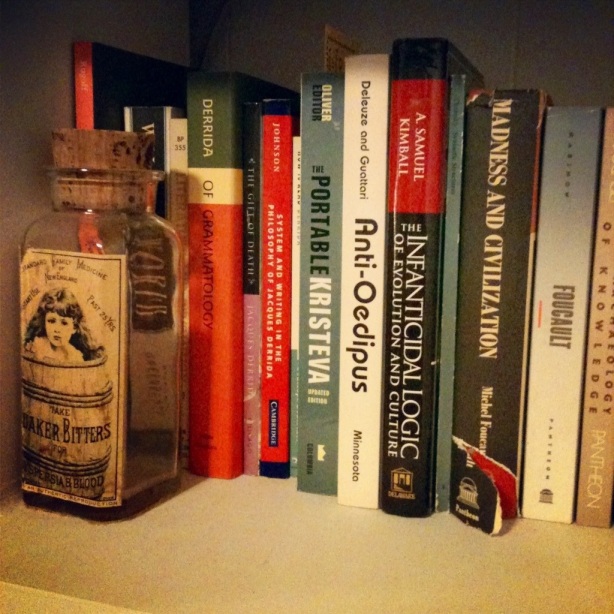
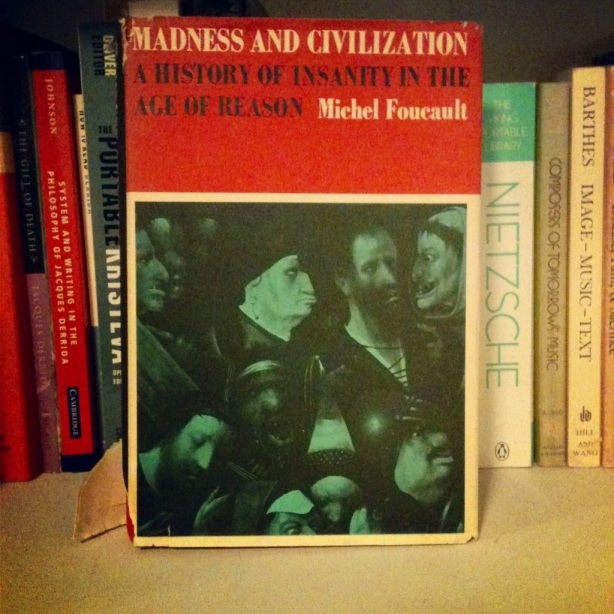
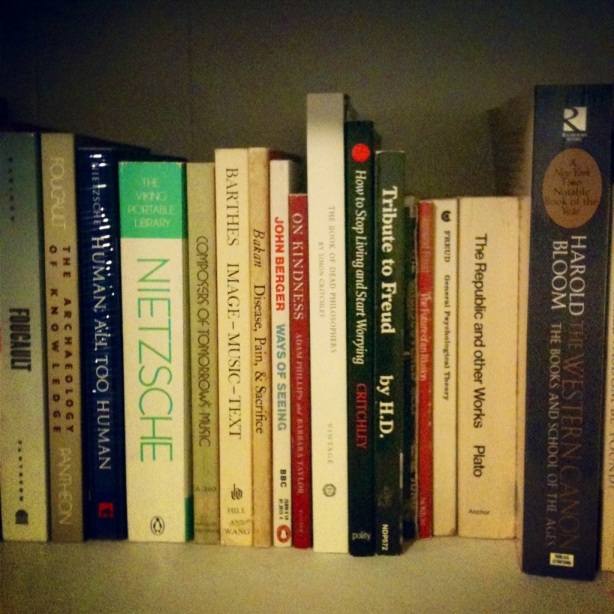
Couldn’t really get a good pic of the whole shelf, so in portions, starting with a spread of postmodernist favorites from years past. Julia Kristeva was a particular favorite of mine in grad school, but her Portable stands up well outside of, jeez, I dunno, theory and deconstruction and all that jazz; there are plenty of memoirish essays, including a wonderful piece on Paris ’68 and Tel Quel &c. Sam Kimball‘s book The Infanticidal Logic of Evolution and Culture still maintains an important place in the way I approach analyzing any kind of storytelling. Love the cover of this first American edition of Foucault’s Madness and Civilization, which I bought for a dollar years ago at a Friends of the Library sale:
I may or may not have obtained the The Viking Portable Nietzsche through nefarious means in my sixteenth year. In any case, it’s not really the best intro (I’m partial to The Gay Science), but it’s not bad. The Plato I’ve had forever. I never finishedBloom’s The Western Canon, although I’ve returned to it many times in the past five or six years, as I’ve opened up more to his ideas. I wrote about many of the books on this shelf, including a few by Simon Critchley.
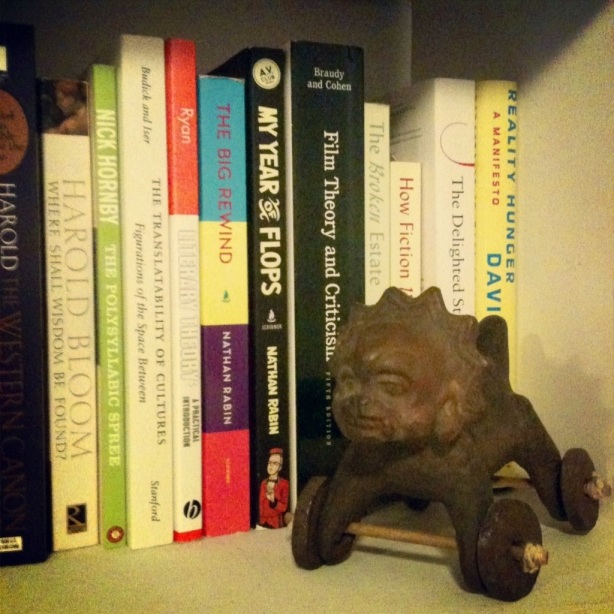
The end of the shelf moves into more pop territory, including two good ones by AV Club head writer Nathan Rabin. You might also note Reality Hunger, a book that I am increasingly afraid to go back to, fearing that I probably agree more with Shields’s thesis, even if I didn’t particularly like his synthesis.
Like most people who love to read, both academically and for pleasure, I like a good argument, and Wood’s aesthetic criticism is a marvelous platform for my ire, especially in a world that increasingly seems to not care about reading fiction. Wood is a gifted writer, even if his masterful skill at sublimating his personal opinion into a front of absolute authority is maddening. There’s actually probably more in his book that I agree with than not, but it’s those major sticking points on literary approaches that stick in my craw. It’s also those major sticking points that make the book an interesting read. I’d like to think that I’m not interested in merely having my opinions re-confirmed.