“Now I Was a Great Squid God” — A Weird Passage from Jonathan Littell’s Weird Novel, The Kindly Ones

I’ve been listening to  an audiobook of Jonathan Littell’s strange novel about an SS officer, The Kindly Ones, and this passage made me dig out my paperback copy in order to share the weirdness—

Finally I dozed off and had a strange, striking dream. Now I was a great Squid God, and I was ruling over a beautiful walled city of water and white stone. The center, especially, was all water, and tall buildings rose up all around. My city was peopled with humans who worshipped me. I had delegated part of my power and authority to one of them, my Servant. But one day I decided I wanted all these humans out of my city, at least for a while. The order went out, propagated by my Servant, and immediately droves of humans started fleeing out the gates of the city, to wait in hovels and shantytowns out in the desert beyond the walls. But they didn’t leave fast enough to my liking, and I began to thrash violently, churning back up the water of the center with my tentacles, then coiling them back and bearing down on swarms of terrible humans, lashing out and roaring with my terrible voice: Out! Out! Out!” My Servant ran frantically about, commanded, guided, prompted the sluggish, and in this way the city emptied out. But in the buildings closest to the walls and farthest from the water where I was giving vent to my divine rage, some groups of humans were not heeding my commands. These were foreigners, not really aware of my existence, of my power over this city. They had heard the evacuation orders, but thought them ridiculous and were ignoring them. My Servant had gone to see these groups one after another, to convince them diplomatically to leave: such as this conference of Finnish officers, who protested that they had rented teh hotel and conference room and paid in advance, and wouldn’t leave just like that. With them, my Servant had to lie skillfully, explaining for instance that there was an alert, a grave security problem, and that they had to evacuate for their own safety. I found this deeply humiliating, since the real reason was my Will; they were supposed to leave just because I wanted it, not because they were coaxed. My rage increased. I thrashed about and roared more violently than ever, sending great waves crashing through the city.

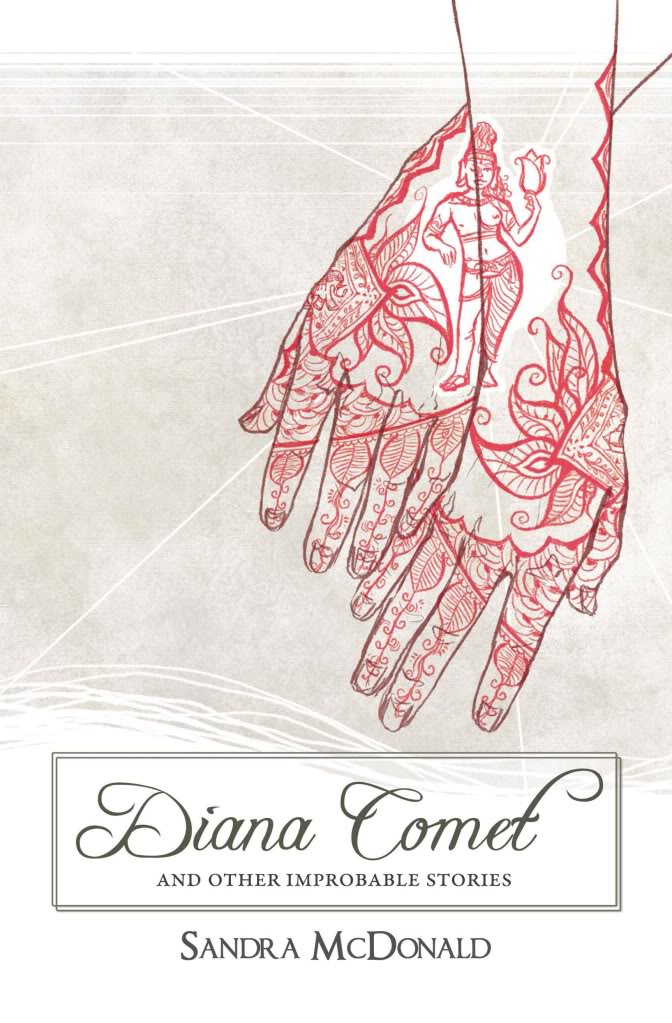
Diana Comet and Other Improbable Stories — Sandra McDonald

Fantasy gets a bad rap. While science-fiction has enjoyed something of a restoration of sanctified hipness in recent years, thanks in part to the genre-bending efforts of authors like David Foster Wallace and Jonathan Lethem, as well as a reappraisal of the works of authors like Philip K. Dick and Margaret Atwood, novels that find themselves classified in the fantasy genre can often be outright dismissed as having no artistic or literary merit. Amazingly, even the work of king daddy J.R.R. Tolkien still finds itself in need of critical defense from time to time. And while fantasy certainly has more than its fair share of rote genre exercises, including countless copycat cash-ins, it’s also an imaginative space buzzing with invention and the capacity for social commentary. Sandra McDonald’s Diana Comet and Other Improbable Stories exemplifies the best kind of invention and social commentary that we might expect from post-modern fantasy.

Diana Comet collects fifteen stories connected via shared motifs, characters, and settings. McDonald crafts a world that inverts or displaces our own. This world, with its lands like New Dalli and Massasoit, is slightly decentered from our own: we find familiar iterations of our history here—there’s war and imperialism, colonialism and poverty, homophobia and racism—but the idioms are all slightly off, displaced enough be paradoxically familiar and alienating at the same time. “Diana Comet and the Lovesick Cowboy,” for instance, seems set in a 19th-century American milieu amidst a civil war (there’s even a poet named Whit Waltman), yet the transposition, articulate as it is, is also nebulous, disturbing even. McDonald’s spare distortion forces the reader to reconsider his own notions of cultural history, and she does this to great effect, whether taking on gender ideologies (“Diana Comet and the Disappearing Lover”), homophobia (“The Fireman’s Fairy”), or racism (“Fay and the Goddesses”). None of these issues are presented glibly, didactically, or clumsily; indeed, it’s through the slightest distortions of fantastic imagination that the reader must re-examine his own society through McDonald’s reflective lens. Most of the stories end with enumerated discussion questions, often silly or whimsical, that serve to puncture the seriousness of the tales; they sometimes force details from our “real” world into the texts of Diana Comet in a way that’s doubly disconcerting. It’s a meta-textual gambit that pays off, however, both in belying any self-seriousness to the narrative proper as well as establishing a thin membrane between fantasy and reality—a membrane of questions that allows the reader to “play,” to disrupt that boundary through his or her own imagination.

McDonald’s world-building in Diana Comet never comes at the expense of good storytelling. With a few exceptions, most of the stories here piece together the frame of a world, leaving the reader’s imagination to fill in most of the gaps. Most of the stories seem to take place in an iteration of the nineteenth century, but some to be set earlier, later, and even in a displaced future, like “Kingdom Coming,” a playful apocalypse tale. McDonald’s expositive restraint does wonders; too many writers of inventive fiction feel the need to tell the reader every single detail and nuance of their worlds. I think here of Ursula K. LeGuin’s marvelous novel The Left Hand of Darkness, a book toward which I believe Diana Comet bears considerable comparison, particularly with respect to the exploration of how gender and sexuality functions in a society. While LeGuin’s book is terrific and fully-realized, she spends a bit too much narrative energy transmitting every detail of that realization to her audience. Diana Comet is rewarding in its gaps and mysteries, as well as its ability to evoke a sense of the uncanny in its reader. Oh, I should probably add that McDonald can write; her prose is elegant, lively, wry, and spare.

Diana Comet is a smart, thoughtful post-modern fantasy that may appeal to the kids out there who have outgrown the narrative simplicity of Harry Potter and are looking for a challenge; it will undoubtedly appeal to fans of writers like LeGuin and Atwood, writers who know how to channel narrative traditional tropes of imaginative fiction through distortion and ambiguity and force their readers to think, even as they entertain. Recommended.

“After Reading a Child’s Guide to Modern Physics” — W.H. Auden

“After Reading a Child’s Guide to Modern Physics” by W. H. Auden—

If all a top physicist knows
About the Truth be true,
Then, for all the so-and-so’s,
Futility and grime,
Our common world contains,
We have a better time
Than the Greater Nebulae do,
Or the atoms in our brains.

Marriage is rarely bliss
But, surely it would be worse
As particles to pelt
At thousands of miles per sec
About a universe
Wherein a lover’s kiss
Would either not be felt
Or break the loved one’s neck.

Though the face at which I stare
While shaving it be cruel
For, year after year, it repels
An ageing suitor, it has,
Thank God, sufficient mass
To be altogether there,
Not an indeterminate gruel
Which is partly somewhere else.

Our eyes prefer to suppose
That a habitable place
Has a geocentric view,
That architects enclose
A quiet Euclidian space:
Exploded myths – but who
Could feel at home astraddle
An ever expanding saddle?

This passion of our kind
For the process of finding out
Is a fact one can hardly doubt,
But I would rejoice in it more
If I knew more clearly what
We wanted the knowledge for,
Felt certain still that the mind
Is free to know or not.

It has chosen once, it seems,
And whether our concern
For magnitude’s extremes
Really become a creature
Who comes in a median size,
Or politicizing Nature
Be altogether wise,
Is something we shall learn.

J.R.R. Tolkien, In His Own Words (1968 BBC Documentary)

From the BBC series In Their Own Words: British Authors. Fantastic 1968 documentary: Tolkien walks about Oxford, shares insights on his work, looks at trees, and contemplates his love of beer. Great stuff.

“Toolin’ Around” — Barry Hannah’s Tuscaloosa

Barry Hannah takes John Oliver Hodges on a tour of Tuscaloosa and shows him the shack where he wrote Ray; he also shares some wild stories from his alcoholic past. Read more at the Oxford American.

We Peruse the Latest Issue of Oxford American: Barry Hannah, Eudora Welty, Black Republicans, and Fried Green Tomatoes

The spring issue of Oxford American is out now, sporting a Barry Hannah cover. In addition to a review of Hannah’s Long, Last, Happy: New and Collected  Stories, the issue features eight pages of remembrances by Hannah’s students, fans, and friends (along with pictures, of course). In fact, John Oliver Hodges’s review of Long, Last, Happy is really a memoir itself. Here’s an anecdote he shares—

Barry called me his amanuensis, and as such I heard him talk a bit about his feelings on fathers and sons and beautiful women, heartache, football, stool softener, and Krystal hamburgers. On the day that Ole Miss beat Gainesville, 31-30, it happened that we were in Tuscaloosa. To celebrate the win, we drove around the town in his silver Chrysler, his pistol in its holster under the seat. He gave me the grand tour, and as I drove, I videotaped him talking beside me, drinking a Budweiser tallboy (a rare treat to lessen the abiding pain), and smoking a USA, his brand. As we approached the green shack by the tracks where he wrote Ray, he said, “It was probably the saddest time in my life.”

(Quick editorial note: I’m glad that Hannah and Hodges could celebrate Ole Miss’s narrow victory, but Tebow and the Gators did go on to win every other game of the season, including the SEC Championship and the BCS title bowl. So there).

In addition to the Hannah stuff, there’s a great essay on fried green tomatoes, a look at what it means to be a black Republican, an appreciation of Southern hip-hop, stories and poems, and a series of letters by Eudora Welty, including her hilarious application to The New Yorker. Good stuff.

While I’m shilling for Oxford American, I might as well point out that they’re hosting a Summit for Ambitious Writers this June. It’s on top of a freaking mountain! Biblioklept fave Wells Tower will be there. Sounds cool.

“The Ego Is the Enemy of Imagination” — David Milch on Writing

Melville House Publishes Imre Kertész’s “Missing” Novel, Fiasco

Melville House has just published Imre Kertész’s Fiasco, available for the first time in English translation (Tim Wilkinson). Fiasco is the final part of a trilogy, along with Fatelessness and Kaddish for an Unborn Child, that tells the story of the author’s time in the Auschwitz and Bunchenwald concentration camps, and his eventual return to an alien home. When I interviewed Melville House publisher Dennis Loy Johnson last year, he was enthusiastic about the book—

We’re doing another one with Kertész next year, which is a big novel called Fiasco. He wrote a trilogy years ago about his experience in the camps. What was he, fifteen or something, when he was sent to Auschwitz-Birkenau, working in a Nazi factory trying to turn coal into gasoline? And he wrote a novel called Fatelessness about that and another one called Kaddish for an Unborn Child. And Knopf published Kaddish and Fatelessness but they never published Fiasco. So we’re really excited about that.

I haven’t read Fatelessness or Kaddish, but I very much enjoyed Kertész’s novella The Union Jack, and I’ve been enjoying Fiasco as well so far. It’s a strange novel, beginning with a 100 page prologue of sorts detailing “the old boy” (surely Kertész) riffling through a cabinet full of old sketches, half-formed ideas, and old papers in the hopes of generating a new novel, a novel that will save his name from sinking into oblivion—a fate he wishes to avoid for (apparently) purely monetary reasons. This prologue is recursive, full of parenthetical asides, diversions, and a general Kafkaesque anxiety about the narrative proper, the Auschwitz story, I suppose, that I guess will begin with chapter one (on page 119!). Anyway, more to come.

“I Rarely Remember a Book About Which I Have Had Such Violent Arguments” — W.H. Auden Reviews J.R.R. Tolkien

From the Oh, This Exists? Department — W.H. Auden’s 1956 New York Times review of J.R.R. Tolkien’s The Return of the King. It’s a fantastic review that defends Tolkien’s literary authenticity against his many haters, using Erich Auerbach’s groundbreaking work Mimesis as a central arguing point. Here’s Auden’s intro, but again, I recommend reading the whole review—

In “The Return of the King,” Frodo Baggins fulfills his Quest, the realm of Sauron is ended forever, the Third Age is over and J. R. R. Tolkien’s trilogy “The Lord of the Rings” complete. I rarely remember a book about which I have had such violent arguments. Nobody seems to have a moderate opinion: either, like myself, people find it a masterpiece of its genre or they cannot abide it, and among the hostile there are some, I must confess, for whose literary judgment I have great respect. A few of these may have been put off by the first forty pages of the first chapter of the first volume in which the daily life of the hobbits is described; this is light comedy and light comedy is not Mr. Tolkien’s forte. In most cases, however, the objection must go far deeper. I can only suppose that some people object to Heroic Quests and Imaginary Worlds on principle; such, they feel, cannot be anything but light “escapist” reading. That a man like Mr. Tolkien, the English philologist who teaches at Oxford, should lavish such incredible pains upon a genre which is, for them, trifling by definition, is, therefore, very shocking.

“Good Luck Editing This” — Outtakes from David Foster Wallace’s ZDF Interview

Cormac McCarthy and Werner Herzog on Science Friday (In Case You Missed It (Like We Did))

Cormac McCarthy and Werner Herzog, along with physicist Lawrence Krauss on NPR’s Science Friday with Ira Flatow, in case you missed it. Which I did.

David Foster Wallace, Slavoj Žižek, and Scatological Ideology

I came across this clip of Slavoj Žižek discussing the different types of toilets that one finds across Europe the other day, and his riff immediately reminded me of David Foster Wallace’s novella The Suffering Channel (or “The Suffering Channel,” if you prefer to think of it as a long short story). Here’s a version of the riff in English, which seems to approach a stand-up comedy routine at times—

“You go to the toilet and you sit on ideology,” says Žižek, arguing that “Disgust . . . is not necessarily, immediately characterized by its object” — disgust is when you confront something from your inside on your outside (Žižek is likely working in part from Julia Kristeva’s theory of the abject here). His inventory and analysis of the differences between French, English, and German toilets immediately recalled this passage from The Suffering Channel

She had also at some point spent a trimester at Cambridge, and still spoke with a slight British accent, and asked generally now whether anyone else who traveled abroad much had noticed that in German toilets  the hole into which the poop is supposed to disappear when you flush is positioned way in front, so that the poop just sort of lies there in full view and there’s almost no way you can avoid looking at it when you get up and turn around to flush. Which she observed was so almost stereotypically German, almost as if you were supposed to study and analyze your poop and make sure it passed muster before you flushed it down

Of course, pretty much every page of The Suffering Channel concerns the scatological: it is literally about a man who shits out art. Wallace seems to be exploring the ways in which we are unable to reconcile what is inside us — that is, what makes us us — with its final form. For Kristeva, the ultimate abject is the corpse. Žižek, less mordant perhaps, seems to be signalling (in the short clip anyway) the relatively straightforward idea that ideology is always operating, always a force conditioning our identity.

Near the end of the clip (around 5:25 or so), Žižek brings up the example of saliva, pointing out that we are constantly swallowing it, producing it and absorbing it back into ourselves, yet to fill a glass with it and then try to drink it would be revolting, horrific. Compare this with another passage from The Suffering Channel

‘Your own saliva,’ said Laurel Manderley. ‘You’re swallowing it all the time. Is it disgusting to you? No. But now imagine gradually filling up a juice glass or something with your own saliva, and then drinking it all down.’

‘That really is disgusting,’ the editorial intern admitted.

‘But why? When it’s in your mouth it’s not gross, but the minute it’s outside of your mouth and you consider putting it back in, it becomes gross.’

‘Are you suggesting it’s somehow the same thing with poo?’

‘I don’t know. I don’t think so. I think with poo, it’s more like as long as it’s inside us we don’t think about it. In a way, poo only becomes poo when it’s excreted. Until then, it’s more like a part of you, like your inner organs.’

‘It’s maybe the same way we don’t think about our organs, our livers and intestines. They’re inside all of us —‘

‘They are us. Who can live without intestines?’

‘But we still don’t want to see them. If we see them, they’re automatically disgusting.’

Wallce lards his novella with example after example of this kind, of the ways in which abject encounters with the borders of self — shit, saliva, menstrual blood, farts — confer identity through a kind of ritual shame. I doubt that Wallace is following, overtly anyway, any post-Lacanian figures in The Suffering Channel, and the concordance of examples used by Wallace and Žižek is probably ultimately not that remarkable. What I do find worth remarking upon, I suppose, are the ways in which Wallace and Žižek were/are so adept at discussing those areas of humanity we’re often happy to overlook.

“A Kind of Kafka Steeped in LSD and Rage” — Roberto Bolaño on Philip K. Dick

Here’s Roberto Bolaño on Philip K. Dick (from New Directions’ forthcoming collection of Bolaño’s newspaper columns, forewords, and other ephemera Between Parentheses)—

Dick was a schizophrenic. Dick was a paranoiac. Dick is one of the ten best American writers of the 20th century, which is saying a lot. Dick was a kind of Kafka steeped in LSD and rage. Dick talks to us, in The Man in the High Castle, in what would become his trademark way, about how mutable reality can be and therefore how mutable history can be. Dick is Thoreau plus the death of the American dream. Dick writes, at times, like a prisoner, because ethically and aesthetically he really is a prisoner. Dick is the one who, in Ubik, comes closest to capturing the human consciousness or fragments of consciousness in the context of their setting; the correspondence between what he tells and the structure of what’s told is more brilliant than similar experiments conducted by Pynchon or DeLillo.

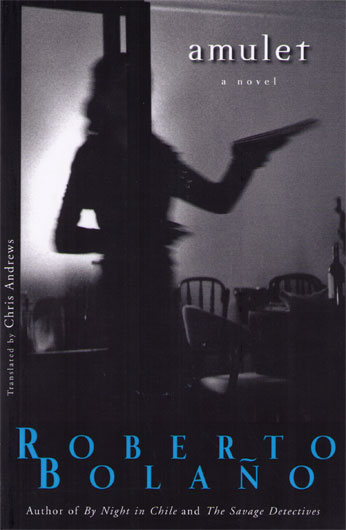
Amulet — Roberto Bolaño

When one takes on the project of reading the novels of Roberto Bolaño — and 2666 is the sort of beast that is likely to hook a reader into such an endeavor — it becomes increasingly impossible to separate and compartmentalize his fictions. Instead, the reader becomes ever more entangled in a labyrinthine Bolañoverse, a chilling, dreadful mirror-maze world that discharges its echoes across continents and epochs. In a fascinating essay at The Quarterly Conversation, Javier Moreno attempts to map out this world. I’d read the essay (and commented on it) a few years ago, but I revisited it after finishing Amulet, mostly because I was pretty sure Moreno had already succinctly stated a key idea that I wanted to bring up in my review. He writes—

Amuleto, which tells the story of an Uruguayan poet that claims herself to be the mother of all Mexican writers, may be seen both as an extra chapter to Los Detectives or as a short introduction to 2666—or both at the same time.

Readers of 2666 and The Savage Detectives will find in Amulet a channel between Bolaño’s “big books,” just as Nazi Literature in the Americas serves as a strange, ironic connective tissue for the violence and chaos of the rest of Bolañoverse. Amulet is narrated by Auxilio Lacouture, and her story appears in a much shorter form in The Savage Detectives. I’ll let her summarize Amulet’s plot (such that it is)—

I am the mother of Mexico’s poets. I am the only one who held out in the university in 1968, when the riot police and the army came in. I stayed there on my own in the Faculty, shut up in the a bathroom, with no food, for more than ten days, for more than fifteen days, from the eighteenth to the thirtieth of September, I think, I’m not sure anymore.

I stayed there with a book by Pedro Garfias and my satchel, wearing a little white blouse and a pleated sky-blue skirt, and I had more than enough times to think things over. But couldn’t think about Arturo Belano , because I hadn’t met him yet.

In these two short paragraphs, late in the book, we get so many of the motifs that populate Bolaño’s world: the self-naming poet, the influence of violence in Latin America, the horrors inherent in resisting this violence, exile, hints of madness. We even get Bolaño’s elusive alter-ego, Arturo Belano, who floats through Amulet and the rest of the Bolañoverse like an unknowable specter.

The fact that Auxilio couldn’t think about Belano when she was stuck in the bathroom in 1968 does not actually stop her from doing so. She is, to borrow a phrase from Vonnegut, a woman unstuck in time. It is as if the entire novel, that is to say her narrative, her telling of her story, is tenuously anchored in the those traumatic days of September, 1968. She tells us, echoing Stephen Dedalus perhaps, that “History is a horror story”; unlike Dedalus, she can’t awake from the nightmare. Here’s a relatively early passage that describes what Auxilio can never really explain—

I don’t know why I remember that afternoon. That afternoon of 1971 or 1972. And the strangest thing is that I remember it prospectively, from 1968. From my watchtower, my bloody subway carriage, from my gigantic rainy day. From the women’s bathroom on the fourth floor of the Faculty of Philosophy and Literature, the timeship from which I can observe the entire life and times of Auxilio Lacouture, such as they are.

The life and times of Auxilio Lacouture, such as they are, will be somewhat familiar to anyone who’s read some of Bolaño’s other novels: plenty of dread, lots of sinister shadows, and many, many drunk poets. The anecdotes and small set pieces that fill Amulet seem culled from Bolaño’s own life (real or imagined), and can be alternately thrilling, dull, or even maddening. For my taste, the novel works itself into its finest moments when Auxilio’s grip on reality — both temporal and spacial — is at its weakest. At one point she tells us—

I don’t know if I’m in 1968 or 1974 or 1980, gliding, finally, like the shadow of a sunken ship, toward the blessed year 2000, which I shall not live to see.

Auxilio’s sanity both unravels and compresses, and Bolaño codes these movements in images of descent and ascension. Auxilio moves through fever dreams and nightmares, memories and prognostications, alternate realities and astral projections. Near the end of the novel, still in the bathroom, starving, probably in shock, she experiences her ordeal as a difficult climb up a frozen mountain. Along the way, she begins casting bizarre literary prophecies. A quick taste—

Virginia Woolf shall be reincarnated as an Argentinian fiction writer in the year 2076. Louis-Ferdinand Celine shall enter Purgatory in the year 2094. Paul Eluard shall appeal to the masses in the year 2101.

These pronouncements continue for a few pages. Underneath the madness, one can sense Bolaño’s goofy joy, but there’s more here than just list-making: Auxilio is pointing toward metempsychosis, suggesting her own soul’s migration, perhaps—here we find a way in which literature might transcend the violence and horror of history. And yet there’s also a sense of doom, of repeated violence and exile. Late in the novel Auxilio finds herself cast in the role of Erigone, daughter Aegisthus and Clytemnestra, forced from home by her half-brother, Orestes. There’s a sense that tragedy capitulates throughout time; that even if Auxilio can survive the army’s occupation, it will nevertheless scar her forever. Cycles of violence are bound to recur indefinitely.

This recurrence evinces in what might be the book’s most famous passage. Auxilio is walking home with some friends—

Then we walked down the Avenida Guerrero; they weren’t stepping so lightly any more, and I wasn’t feeling too enthusiastic either. Guerrero, at that time of night, is more like a cemetery than an avenue, not a cemetery in 1974 or in 1968, or 1975, but a cemetery in the year 2666, a forgotten cemetery under the eyelid of a corpse or an unborn child, bathed in the dispassionate fluids of an eye that tried so hard to forget one particular thing that it ended up forgetting everything else.

The passage names Bolaño’s opus: there is no mention of “2666” in 2666. The reference rests outside the book; or, perhaps Bolaño demands that we read his books intertextually. In any case, 2666 has its graveyards and its corpses, its own demanding geometry of memory. One gets the sense that this oblique reference to “2666” is really part of Bolaño crafting his own canon, an internal canon of the Bolañoverse, almost as if he were J.R.R. Tolkien or even Philip K. Dick. I think again of Auxilio’s prophecies, of her list of writers who will be reborn or forgotten, where we find Bolaño securing a historical place for the writers he loves and values.

Looking over this review, I realize that it might not be helpful for readers new to Bolaño: mea culpa. Amulet is a very fine novel, but not the right starting point. That would be 2666 or, if that prospect is too daunting, Last Evenings on Earth. To me, Amulet reads like the “Mexico” chapter in a trilogy about violence and exile in Latin America; the other two parts would be Distant Star (which I enjoyed more) and By Night in Chile. But perhaps I’m simply reaching for evidence to support this idea that Bolaño’s books are best read together. I’m sure that one can enjoy them on their own—only, at this point, I’m not sure how to do that.

Amulet, translated by Chris Andrews, is available now from New Directions.

On the Feeling of Being In-between Books

Like most bibliophiles, I have a big ole stack of books — multiple stacks, really — lying around the house; that is, I have unshelved books in little intermediary piles that I am either always reading or planning to read “next,” which is to say, sometime in the near future. I’ve written before about books I’m always reading (and re-reading), so I’ll set that aside for the moment; also, there are those books of a somewhat fragmentary nature that I like to read slowly (fodder for a future post, perhaps) — but let’s set those aside as well, because they are not what I’m speaking of here.

I found a few years ago that the best way to finish a book, especially a challenging book, but really any novel worth reading, is to simply give it as much undivided attention as you can — to do your best to not let all those other books jump the queue. And for the most part, I’m pretty good at doing this.

So well anyway.

I finished Roberto Bolaño’s Amulet the night before last. I’ve had the book for a while, and though I had desired to read it, I hadn’t had the feeling of wanting to commit to this particular book; so, what I’m doing now, gentle reader, is distinguishing between these two things. We, that is bibliophiles, we all desire to read certain books (lots of certain books, no doubt), but that’s not the same as the feeling of wanting to commit to the particular book. Because generally a bibliophile knows that a great book, or at least a book worth reading, requires a certain level of commitment.

I picked Amulet out of the stack after reading Malcolm Lowry’s Under the Volcano. I don’t know why. There was no intellectual impulse in the choice, although a connection might easily be made between the two novels, both set in Mexico; indeed, Bolaño opens The Savage Detectives with a quote from Under the Volcano, and the heroine of Amulet shows up in The Savage Detectives — so there is some connection. But again, the decision to read Amulet next, instead of, say, Giuseppe Tomasi di Lampedusa’s The Leopard or Heinrich Böll’s The Train Was on Time or any of the other dozens of books cluttering up Biblioklept International Headquarters, was, or at least I believe was, more a matter of intuition and feeling than intellect.

So, as I mentioned, I finished Amulet the other night, and, during the course of reading that novel, another dead literary darling’s novel came out, David Foster Wallace’s The Pale King. Which I’ve been greatly anticipating. Which I’ve been very much desiring to read. Which I have absolutely no desire to commit to reading now, which is to say in that moment between books. Which is strange, I suppose, but perhaps easy to account for on several fronts. First, every day seems to bring some new, fully realized review of The Pale King to the internet, or some piece about Wallace’s “legacy” and The Pale King, or, even worse, some coverage about coverage of The Pale King (which, yes, I realize this post is now threatening to become). Another reason that might account for the fact that I have no feeling to commit to reading The Pale King now may be that it is Wallace’s last novel; maybe I want to wait a bit, give myself a bit of distance from the internet buzz, let anticipation build again. Divorce myself from the idea of having to read the book — especially in the context of Biblioklept, a maybe-literary blog.

To go back to my earlier point, the point of all of this (if this rambling can be said to have a point) is that I realize that I rarely choose to read the “next” book in an intellectual way — that is, the choice is almost always intuitive, born from some feeling that I don’t know how to name, except to say that it’s the feeling that I have when I’m in-between books. It’s a wonderful feeling, exhilarating and freeing and full of possibility, as corny as that sounds, but also a kind of anxiety, a feeling paradoxically tempered by the temporal messiness of being a reader, which is to say being a human, as if the limited time we have to read dampens — and thus defines — the edges of this particular exhilaration. I love the feeling because it opens a seemingly illimitable range of possibilities — the possibilities of new books, new narratives — even as the choice forecloses the possibility of another choice. Etymologically, the word “decide” means “to cut off.” But enough dithering. Time to riffle through the stack.

In Brief — New Books from Gabrielle Hamilton, Meg Howrey, and Frances Stonor Saunders

The memoir-in-food is something of a cliché at this point, but Gabrielle Hamilton’s new book Blood, Bones & Butter came with enough accolades (including a glowing blurb from Anthony Bourdain) and positive early reviews (like Kakutani’s at The NYT) for me to spend a few hours thumbing through it. Much has been made of Hamilton’s writing bona fides (an MFA in fiction writing from University of Michigan), and while she can put a sentence together without relying on the stock phrases and tropes that lard most memoirs these days, that skill wouldn’t really matter if she didn’t have a tale to tell. Blood, Bones & Butter follows a strange culinary career (it’s subtitled The Inadvertent Education of a Reluctant Chef), complete with drug abuse, theft, and, of course cooking. Only I wish there was more cooking, more time in the kitchen, the butcher’s, the market. Instead, Hamilton seems to channel her (often mean-spirited) energy on her family; her parents’ divorce hangs over the narrative like a Greek tragedy, and her own attitude toward her husband is bizarre, to say the least. The results are mixed, but fans of food-writing à la Bourdain’s Kitchen Confidential will likely enjoy Blood, Bones & Butter. New in hardback from Random House.
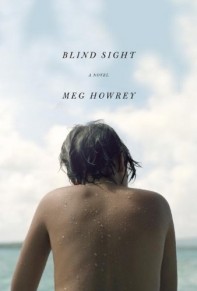
Meg Howrey’s new novel Blind Sight tells the story of Luke Prescott, a bright, introspective seventeen year old obsessed with brain biology. Raised by a hippie mother and two half-sisters, Luke gets the opportunity to the summer before college with his estranged father, a famous television star. In Los Angeles, Luke gets to know his father better, sorting out the difference between public persona and private truth; this process in turn leads Luke to re-evaluate his own sense of identity. There’s also some pot-smoking and sex. Howrey moves the narrative between Luke’s first-person voice (in the past tense) to a third person present tense narrator. At times this disjunction seems like a lazy shorthand to allow the reader to see something Luke can’t see (or doesn’t want the reader to see), but it works nicely on the whole, underlining the gaps between truth and belief that the novel seeks to explore. Blind Sight is new in hardback from Pantheon.

In The Woman Who Shot Mussolini, Frances Stonor Saunders plays historical detective, reconstructing the story of Violet Gibson, who fired on Mussolini in April of 1926 (she grazed his nose). Gibson, the daughter of the Lord Chancellor of Ireland, was 50 when she shot Mussolini, and perhaps more than a little crazy. She was almost lynched after shooting Il Duce, but the not-so-benevolent dictator pardoned her, and she was quickly returned to England, where she spent the rest of her life in an insane asylum. Saunders’s book explores whether Gibson’s attack was the motivation of an insane woman or part of a bigger conspiracy theory, illustrating her mystery with poignant black and white photos. And although Saunders focuses on the little-known Gibson, she works to draw parallels between the would-be assassin and Mussolini. Saunders’s exploration of an otherwise unremarked upon episode balances historical scholarship with the pacing and rhythm of an historical thriller. New in trade paperback edition from Picador.

Roberto Bolaño on William Burroughs

Here’s Roberto Bolaño on William Burroughs (from New Directions’ forthcoming collection of Bolaño’s essays, newspaper columns, and other ephemera Between Parentheses)—

For some of those of my generation, William Burroughs was the affectless man, the shard of ice that never melted, the eye that never closed. They say he possessed every vice there was, but I think he was a saint who attracted all the sinners in the world because he was gracious and unwise enough never to shut his door. Literature, his livelihood for the last thirty years, interested him, but not too much, and in that regard he was like other classic American figures who focused their efforts on observing life or on experience. When he talked about what he read one got the impression that he was remembering vague stretches of time in prison.