“I Learn as Much from Painters About How to Write as from Writers” — Hemingway on His Literary Forebears

Ernest Hemingway describes his influences in his 1958 interview with George Plimpton at The Paris Review

INTERVIEWER

Who would you say are your literary forebears—those you have learned the most from?

HEMINGWAY

Mark Twain, Flaubert, Stendhal, Bach, Turgenev, Tolstoy, Dostoyevsky, Chekhov, Andrew Marvell, John Donne, Maupassant, the good Kipling, Thoreau, Captain Marryat, Shakespeare, Mozart, Quevedo, Dante, Virgil, Tintoretto, Hieronymus Bosch, Brueghel, Patinir, Goya, Giotto, Cézanne, Van Gogh, Gauguin, San Juan de la Cruz, Góngora—it would take a day to remember everyone. Then it would sound as though I were claiming an erudition I did not possess instead of trying to remember all the people who have been an influence on my life and work. This isn’t an old dull question. It is a very good but a solemn question and requires an examination of conscience. I put in painters, or started to, because I learn as much from painters about how to write as from writers. You ask how this is done? It would take another day of explaining. I should think what one learns from composers and from the study of harmony and counterpoint would be obvious.


“He Is a Gloriously Life-affirming Good Man” — Orson Welles on Falstaff

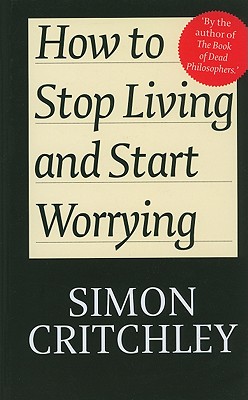
How to Stop Living and Start Worrying — Simon Critchley

Simon Critchley’s latest book How to Stop Living and Start Worrying picks up where his last work, The Book of Dead Philosophers, left off. Both works explore what Critchley contends to be the signal problem of all philosophy; namely, how one might live a meaningful life against the backdrop of inevitable death. In Dead Philosophers, Critchley plumbed this question by surveying the deaths of dozens of famous philosophers, ultimately affirming a positive reality in death (both our own deaths and the deaths of others), and arguing that philosophies (and religions) that advocate the idea of a spiritual afterlife ultimately negatively disrupt human existence and lead to inauthentic lives. How to Stop Living reiterates these themes in a new form, essentially arguing that in asking “how to live,” we must also ask “how to die” — and also how to love and how to laugh. How to Stop Living takes form as a series of conversations between Critchley and Carl Cederström, an Associate Professor at the Institute of Economic Research at Lund University in Sweden. There’s a warm rapport between the pair, and although Critchley does most of the talking, there’s a genuine dialog in play, not merely a flat interview. The book unfolds over six chapters. The first, “Life,” is a discussion of, well, Critchley’s life, both personal and academic. I originally thought I’d be doing a lot of skimming here, but it’s actually kind of fascinating; more importantly, though, it establishes Critchley’s contention that a philosopher’s work cannot be divorced from his biography. To philosophize is to live. This idea is reiterated succinctly at the beginning of the second chapter, “Philosophy,” when Critchley states—

The first thing to say is that philosophy is not a solely professional or academic activity for me. Philosophy is not a thing, it’s not an entity; it’s an activity. To put it tautologically: philosophy is the activity of philosophizing, an activity which is conducted by finite, thinking creatures like us. Now, my general view of philosophy is that this activity must for part of the life of a culture. Philosophy is the living activity of critical reflection in a specific context; it always has a radically local character.

What follows in “Philosophy” is a somewhat discursive overview of the philosophers who will pop up again and again in the book: Heidegger, Husserl, Kant, Nietzsche, and, of course, Derrida. While I’m laundry listing, I might as well add Freud, Lacan, Beckett, and Hegel as key figures in How to Stop Living. In the third chapter, “Death,” Critchley discusses how many of these philosophers frame a subject’s individual relationship to his or her personal death. In a particularly enlightening passage, Critchley explains Heidegger’s “possibility of impossibility,” the idea that to be authentic, to lead an authentic life, one must internalize and master the finitude of a personal death. The chapter continues, working through other conceptions of death, including those of Freud, Beckett, and Derrida. Perhaps because of its dialogic structure, How to Stop Living often feels like a rap session, a big brainstorm, a work in process, and nowhere is this more evident in a chapter called “Love,” where Critchley moves from Hannah Arendt to The Song of Solomon to Lacan and Freud to a story about his marriage proposal. It’s all a bit messy, a bit watery, a bit undefined, and therefore difficult to summarize, so I’ll let Critchley dish on love in his own words—

Love is the attempt to break the logic of masochism that defines the subject, and to behave in a different way. That’s something that has to be wound up everyday . . . and it’s something with no end; and it requires a constant experience of faith. That’s the only sense I can make of love.

The next section, “Humour,” is better defined—and one of the highlights of the book. Critchley discusses jokes against a backdrop of psychoanalysis and anthropology, ultimately arguing that humor has the power to disrupt an individual’s relation to time or place, and thus reconstitute that relation in some meaningful way. Critchley’s book itself is indeed a meta-joke, a play against the sophistry of New Age self-help books. Indeed, the very name of the book is an inversion of Dale Carnegie’s 1948 “classic” of the genre, How to Stop Worrying and Start Living. If you find the cover of Critchley’s book as off-putting and cheesy as I do, just remind yourself that it’s a parody of Carnegie’s cover. And yet Critchley’s sense of humor is not ultimately black irony, but rather a humor of affirmation of — and confrontation of — the absurdity of contemporary life. It’s not irony but authenticity he wants. “Authenticity” is thus the final chapter of this relatively short book, and here Critchley invites his friend (and partner in the International Necronautical Society) novelist Tom McCarthy to participate in the conversation. The chapter is lively, almost frenetic, and frankly all over the place, as Critchley and McCarthy rocket from subject to subject — Finnegans Wake, the Challenger explosion, Terrence Malick, J.G. Ballard, Levinas, A Midsummer Night’s Dream, McCarthy’s first novel Remainder — each reference seems to slip into the next, reined in occasionally by Cederström, who steers the conversation back to its center (leave it to deconstructionists to get off center). Good stuff.

How to Stop Living and Start Worrying, despite its tongue in cheek title and cover, and its discursive flow, is serious (if playful) about philosophy. Those interested in the thinkers and topics I’ve mentioned in this review may be interested, but it’s not necessary for one to have a working knowledge of Continental philosophy to enjoy Critchley’s latest. Recommended.

How to Stop Living and Start Worrying is available now from Polity Books.

Simon Critchley on Terrence Malick’s The Thin Red Line

In his new book, How to Stop Living and Start Worrying, Simon Critchley talks about death in Terrence Malick’s film The Thin Red Line (you can read Critchley’s earlier essay “Calm — On Terrence Malick’s The Thin Red Line” here)—

So, the hero of The Thin Red Line is this character Witt. And we meet him for the first time on the beach meditating about his mother’s death, imagining that he could meet death with the same calm that his mother seemed to meet it. We then get this romantic flashback: it’s somewhere in the Midwest; he’s touching his mother’s hand; then the hand is pulled away and she’s gone. That’s the fantasy of the authentic death. And Witt, according to Malick, fulfills the fantasy: approaching death with calm — this is Epicurus, Lucretius, Spinoza. Interestingly, when I was looking at the sources — he’s very faithful to Jim Jones’s novel The Thin Red Line — he inserts the word ‘calm’ into the passage, it’ s not there in the novel. It might or might not be an allusion to Heidegger, where Heidegger, where Heidegger talks about anxiety as an anxiety towards death as an experience of calm, or peace: the German is Ruhe. This is a Romantic ideas of death. For Heidegger, if human beings are authentic they’re heading towards death; if they’re inauthentic they experience demise, which means that we just pass out of existence. But only animals and plants perish, and that just seems to be ridiculous. Human beings perish all the time, can perish, and there are examples like in Kafka’s Trial where one dies like a dog. Human beings die in all sorts of ways, in a permanent vegetative state or whatever.

April Fools: Seven Literary Hoaxes

J.T. LeRoyJames FreyHerman Rosenblat, Margaret Seltzer . . . recent years have seen an explosion of memoirists lying, faking, or otherwise hoaxing the public–but this is hardly anything new. In honor of April Fool’s Day we present seven April Fools.

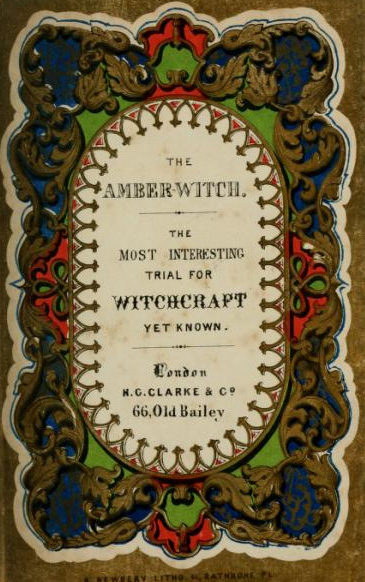
The Amber Witch — Johannes Wilhelm Meinhold (1844)

Meinhold pretended that The Amber Witch was the true story of a seventeenth-century minister’s daughter falsely accused of witchcraft. Meinhold claimed he found the minister’s manuscript in the refuse of an old church. When the book received critical attention, Meinhold admitted to the hoax, but audiences didn’t believe him at first.

“Geraint the Blue Bard” aka Iolo Morganwg aka Edward Williams (1747-1826)

Welshman Edward Williams was widely considered a leading antiquarian and expert on the antiquities of the British Isles. After his death, however, many of his manuscripts were revealed to have been forgeries, including those produced by “Geraint the Blue Bard,” supposedly a ninth-century composer. Oh well.

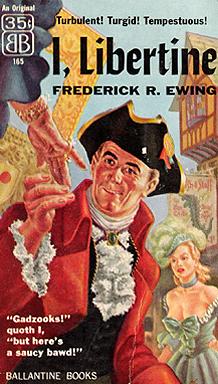
I, Libertine — Frederick R. Ewing  (1956)

Proto-shock jock Jean “Shep” Shepherd perpetrated I, Libertine as a purposeful hoax. He told his radio audience to demand the (non-existent) book by the (non-existent) author “Frederick R. Ewing” from their local booksellers, and even fabricated a basic plot for listeners to in turn relate (he even included the salacious detail that the book had been banned in Boston). Publisher Ballantine hired sci-fi scribe Theodore Sturgeon to write the book from Shepherd’s outline, and the book was published very soon after. All proceeds went to charity.

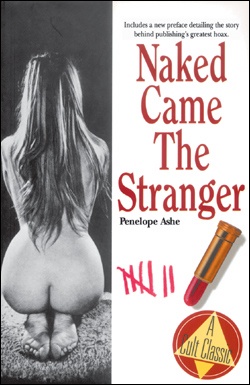
Naked Came the Stranger — Penelope Ashe (1969)

To prove that American culture was smutty and degraded, Newsday columnist Mike McGrady enlisted 24 of his fellow writers to write a smutty and degraded novel that they believed would top the bestseller list in spite of its lack of literary value. By the time “Penelope Ashe” had put out Naked Came the Stranger, the hoax had leaked, and it was unclear if this is what led to the book actually topping the New York Times bestseller list (for one slim week). The book later became the basis of a porno film.

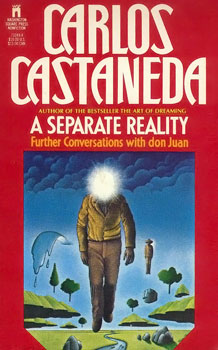
A Separate Reality — Carlos Castaneda (1971)

The debate around Castaneda’s series of “memoirs” in some ways gets to the heart of the problems of truth and invention, facts and authenticity, experience and memory. Castaneda claimed that he trained under Don Juan Matus, a Yaqui Indian sorcerer. Part of that training included taking massive amounts of psychotropic drugs like peyote as a means to “see” the energy of the universe. Don Juan Matus’s actual existence is questionable at best, but hey, when you’re doing large quantities of peyote, who knows what, like, truth is, man.

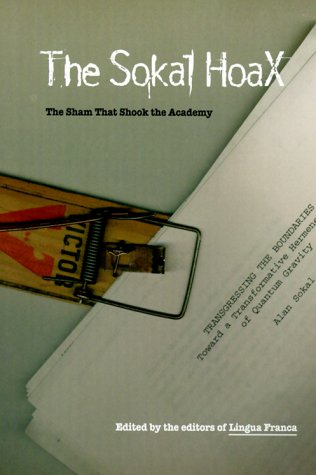
“Transgressing the Boundaries: Towards a Transformative Hermeneutics of Quantum Gravity”– Alan Sokal (1996)

Disgusted with a perceived slackness and ineptitude in modern academia, Dr. Alan Sokal published a paper full of nonsensical gibberish in Duke University’s cultural studies journal Social Text. The same day the essay was published, he announced the hoax in the journal Lingua Franca. Ouch. Biblioklept wrote a post about the incident a few years ago, if you’re interested.

The Songs of Bilitis — Pierre Louÿs (1894)

Louÿs claimed that the erotic poems he fabricated were the work of “Bilitis,” one of Sappho’s lovers; he even invented a biography of the woman, citing a fictional archaeologist named Herr G. Heim with discovering her tomb. (“Herr G. Heim” translates roughly to “Lord S. Ecret”). Despite the hoax, many critics consider it a work of literary merit, and it’s become something of a cult book among queer theory enthusiasts.

[Biblioklept originally published this post in 2010].

“Stupid” — Raymond Carver

“Stupid,” a poem by Raymond Carver—

It’s what the kids nowadays call weed. And it drifts
like clouds from his lips. He hopes no one
comes along tonight, or calls to ask for help.
Help is what he’s most short on tonight.
A storm thrashes outside. Heavy seas
with gale winds from the west. The table he sits at
is, say, two cubits long and one wide.
The darkness in the room teems with insight.
Could be he’ll write an adventure novel. Or else
a children’s story. A play for two female characters,
one of whom is blind. Cutthroat should be coming
into the river. One thing he’ll do is learn
to tie his own flies. Maybe he should give
more money to each of his surviving
family members. The ones who already expect a little
something in the mail first of each month.
Every time they write they tell him
they’re coming up short. He counts heads on his fingers
and finds they’re all survivng. So what
if he’d rather be remembered in the dreams of strangers?
He raises his eyes to the skylights where rain
hammers on. After a while —
who knows how long? — his eyes ask
that they be closed. And he closes them.
But the rain keeps hammering. Is this a cloudburst?
Should he do something? Secure the house
in some way? Uncle Bo stayed married to Aunt Ruby for 47 years. Then hanged himself.
He opens his eyes again. Nothing adds up.
It all adds up. How long will this storm go on?

“Joyce Maims Words” — William Carlos Williams on James Joyce

William Carlos Williams on James Joyce (from Our Exagmination Round His Factification for Incamination of Work in Progress, a symposium on Finnegans Wake)—

Joyce maims words. Why? Because meanings have been dulled, then lost, then perverted by their connotations (which have grown over them) until their effect on teh mind is no longer what it was when they were fresh, but grows rotten as poi — though we may get to like poi.

Meanings are perverted by time and chance — but kept perverted by academic observance and intention. At worst they are inactive and get only the static value of anything, which retains its shape but is dead. All words, all sense of being is gone out of them. Or trained into them by the drill of the deadly minded. Joyce is restoring them.

Biblioklept Interviews Camelia Elias, Editor-in-Chief of EyeCorner Press

Camelia Elias is the founder and editor-in-chief of EyeCorner Press, an independent publisher devoted to printing a host of difficult-to-classify writings, including creative academic writing, and poetic fragments and aphorisms. EyeCorner publishes works in English, Danish, and Romanian, as well as bilingual editions. This multilingual approach gels with the publishing house’s fragmentary philosophy, as well as its origins as a collaborative venture between universities in three nations. In addition to her editorial duties, Elias is also one of EyeCorner’s authors; her latest work Pulverizing Portraits is a monograph on the poetry of Lynn Emanuel. Elias is Associate Professor of American Studies at Roskilde University in Denmark and she blogs at FRAG/MENTS. Elias was kind enough to talk with me over a series of emails; in our discussion she defines creative criticism, discusses the value in being open to error, accounts for hostility against deconstruction and post-structuralism in academia, and explains why it doesn’t hurt to throw the word “fuck” into a textbook now and then.

Camelia Elias

Biblioklept: EyeCorner Press is somewhat unusual, even for an indie publisher — a joint venture between universities in Denmark, Finland, and the US that focuses on creative criticism. How did the press come into being?

Camelia Elias: The press came into being as an act of anarchism, if you like, a form of resistance against the idea that academic work must be measured not only against its own standard, but also against the standard that idiotic governments sets for measuring, and hence controlling, intelligence, creativity, and freedom. In 2007 I was editing new research papers written by colleagues and associates of the Institute of Language and Culture at Aalborg University with view to publication by the Faculty of Humanities at AU. A new change in leadership also brought about a new set of ideas. These were rigidly formulated along the newly established injunction passed down by the Danish government, which dictated that all Danish academics must now prioritize publishing with Oxford and Harvard. Without getting into the silly and imbecilic arguments produced for the sustainability of such a demand in reality, the fact remains that many heads of department throughout our Danish universities tried to implement the new regulations literally. The good publishing folks at Aalborg were told that Research News (the publishing venue) was going to close, and no, as the justification for it ran, this was not because the papers were not good enough, but 1) because publishing new research under the aegis of the department was likely to have the undesirable effect of preventing the researchers from expanding their range of publishing possibilities – and hence not consider Oxford and Harvard – and 2) there will be no money for it anymore. Few of us tried to make obvious the stupidity pertaining to the first argument – bad idea, as bosses generally don’t want to be told that they have limited visions – and as to the second argument, pertaining to the precarious, or rather by then non-existent financial support, a few of us also tried to suggest that we could go ‘on demand’ and even work ‘con amore’ for it, which would involve no expenses. The answer was still no. So, there we were, with a few manuscripts in the pipeline and no possibility of getting them out. As the editor of these papers, I felt a responsibility not only towards the writers but also towards the readers who had bothered to peer-review the works. I decided to start EyeCorner Press in my own name, but retain the ties we had in terms of publishing jointly with a few other partner universities. With Brenau University in Gainesville, Georgia, we had just finalized a volume on transatlantic relations (aesthetics and politics) within Cultural Text Studies Series published by Aalborg University Press. We are happy to call them our close allies. University of Georgia, Gwinnett, and Oulu University in Finland followed suit and so did Roskilde University, which became my new working place not long after the Aalborg ‘situation’.

Continue reading “Biblioklept Interviews Camelia Elias, Editor-in-Chief of EyeCorner Press”

Barry Hannah on Cormac McCarthy

From The Paris Review’s interview with Barry Hannah

INTERVIEWER

Some writers turn away completely from their origins, though. Like Cormac McCarthy.

HANNAH

Right, he turned western when he went out to El Paso. He’s one of my favorites. He invests a region. Learns it so thoroughly it’s as if God visited that place and made no mistakes about the botany, flora, fauna. He has about three thousand books, I hear. He had so many books on this upper story of this little concrete house he has, the floor was about to cave in. So the man reads everything there is about the place and you can tell that. Nobody else like him.


“Check This Out!” — Robert Crumb

Frank O’Hara Reads “Fantasy”

Barry Hannah Addresses the Whole “Pointing a Gun at a Student” Rumor

From The Paris Review’s interview with Barry Hannah

INTERVIEWER

But about the guns. When you left Alabama, there was an incident . . .

HANNAH

Yes, I was a tenured professor there, and I was fired. I had just been voted in, but I was too heavily into drinking. I was holding class at home or in my studio and they said, Don’t hold any more classes in your studio. And I said, Well, I will. I brought in an empty pistol once and, as I recall, twirled the chambers to explain six movements in a short story. And that is where the gun—pointing a gun at a student—rumor started, but I never pointed a loaded gun at anybody in my life. Even dead drunk. Never, never. I really don’t like that rumor now because of the school shootings. The world has changed so much. I still love my old .22’s from my youth, for shooting beer cans and rats in the city dump. I love the instrument. It’s just a beautiful, clean instrument—and the history —but I have never had any interest in pointing a gun at a person.

INTERVIEWER

Do you remember what the six movements were?

HANNAH

No. I could make up something, but it would be untrue. There’s just three, anyway: beginning, middle, and end. I was com-plicating something that didn’t need to be any more complicated. At one time I’m sure I had six points in my head and they may have been decent, but I refuse to remember them because they’re not necessary now.

INTERVIEWER

The rumor about pointing the gun was that you were playing your trumpet, trying to get their attention. When that didn’t work, you brought out the gun.

HANNAH

I did play my trumpet in class at Alabama. And at the University of Chicago. Blues solo. Ta da na tee. And I was pretty good sober but real loud and inappropriate in a small chamber. The people at Chicago enjoyed it, but a student complained at Alabama. Still, the trumpet’s a much better idea than bringing a pistol. It’s all alcoholism.


RIP Diana Wynne Jones

According to a number of sources, including Neil Gaiman and the fan-operated site she approved of, author Diana Wynne Jones has passed away after fighting cancer. Jones wrote dozens of novels, mostly in the fantasy genre, for adults and children alike, although she is perhaps most known for Howl’s Moving Castle, which Hayao Miyazaki adapted into an excellent film in 2004. Jones’s work bears comparison to the Harry Potter series, and recent reissues of her novels insure that a younger generation will have access to her work.

Amy Hempel on Gordon Lish and Steve Martin

Amy Hempel talks about studying under Gordon Lish (and how Steve Martin influenced her) in her 2003 interview with The Paris Review

INTERVIEWER

Why Lish?

HEMPEL

At Esquire in the seventies and, later, at Knopf, he was publishing the voices that interested me most. I felt allied with his choices, so he was the one I wanted to work with. Writers like Raymond Carver, Barry Hannah, Mary Robison. These were the three who had the most effect on me when I started.

INTERVIEWER

What about their work interested you?

HEMPEL

They didn’t sound like anyone else I had read. For me, they redefined what a story could be—the thing happening off to the side of the story other writers were telling; they would start where someone else would leave off, or stop where someone else would start. As Hannah said later in Boomerang, a lot of people have their overview, whereas he has his “underview,” scouting “under the bleachers, for what life has dropped.”

INTERVIEWER

Do you remember the first class?

HEMPEL

Vividly. The assignment was to write our worst secret, the thing we would never live down, the thing that, as Gordon put it, “dismantles your own sense of yourself.” And everybody knew instantly what that thing, for them, was. We found out immediately that the stakes were very high, that we were expected to say something no one else had said, and to divulge much harder truths than we had ever told or ever thought to tell. No half-measures. He thought any of us could do it if we wanted it badly enough. And that, when I was starting out, was a great thing to hear from someone who would know.

INTERVIEWER

What was, if you can say, your “worst secret”?

HEMPEL

I failed my best friend when she was dying. It became the subject of the first story I wrote, “In the Cemetery Where Al Jolson Is Buried.”

INTERVIEWER

You stayed on in his workshop as a student for years. You must have been repeatedly humbled.

HEMPEL

I felt humbled by realizing how hard the job was. How hard it is to write a moving, worthwhile, memorable story. But more often I was inspired. It turned out that one of the most helpful things I did without knowing it would be helpful later was hang out with stand-up comics in San Francisco. I went to their shows night after night after night. I watched them performing, working through the same material. I saw some nights it killed and other nights it bombed. All that time I was observing nuance, inflection, timing, how the slightest difference mattered. How the littlest leaning on a word—or leaning away from it—would get the laugh, and this lesson was so valuable. And the improv work—they called it “being human on purpose,” this falling back on the language in your mouth—was hugely important. Just listening to what you’re saying. I learned this when my late friend Morgan Upton, an actor and member of the Committee, took me to a Steve Martin show at the Boarding House in San Francisco. Back in the green room, Steve Martin was sick, but preparing to do his show anyway. I told him I admired that, I said I couldn’t go out there and make people laugh if I were sick. And he said, Don’t be silly—you couldn’t do it if you were well. A brilliant reply on any number of levels. I based an early story, “Three Popes Walk into a Bar,” on that night. Then I ran into him about twenty years later and reminded him of our exchange. He laughed and said, “It sounds mean!” But I thought it was great.


The Subject Steve — Sam Lipsyte

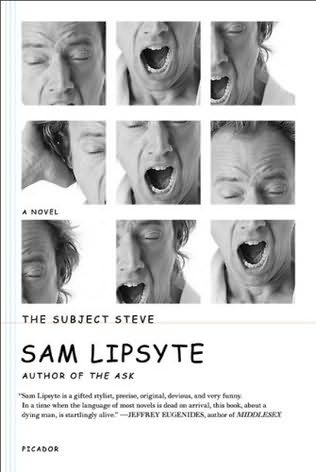
A few years ago, I wrote about cult novels, and, in trying to define them, I suggested that “a cult book is not (necessarily) a book about cults.”  Sam Lipsyte’s first novel The Subject Steve is a cult novel about a cult, or at least heavily features a cult. Like many cult novels, there’s an apocalyptic scope to Steve, one in this particular case (or subject, if you will), that extends from the personal to the universal.

I’ll let Lipsyte’s compressed acerbic prose spell out the book’s central conflict—

The bad news was bad. I was dying of something nobody had ever died of before. I was dying of something nobody had ever died of before. I was dying of something absolutely, fantastically new. Strangely enough, I was in fine fettle. My heart was strong and my lungs were clean. My vitals were vital. Nothing was enveloping me or eating away at me or brandishing itself towards some violence in my brain. There weren’t any blocks or clots or seeps or leaks. My levels were good. My counts were good. All my numbers said my number wasn’t up.

The problem of death, or the problem of how to live a meaningful life against the specter of death, is of course an ancient conceit, and Lipsyte makes it the core of his book, upon which he hangs an often shaggy picaresque plot. The Subject Steve is post-modernist caustic satire in the good old vein of Candide; put another way, it’s just one damn thing happening after the next.

So, what are some of those things that happen? Steve (not his real name) is condemned to die of a disease with no name; he tries to make contact with his estranged wife and not-quite-a-genius daughter; he blows his life savings on hookers and blow; he heads upstate to a cult’s compound in the hopes of finding a cure to his unnamed (unnameable) disease; he suffers the cult’s sadistic practices; he escapes the cult’s sadistic practices; he reunites with his wife and daughter; he abandons his wife and daughter; he reunites with a new version of the cult somewhere in the Nevada desert; he becomes enslaved by the cult in the Nevada desert; he escapes the cult; &c. And he reflects on his life (and his death) repeatedly. I’ll let Steve reflect on his life at length, if for no other reason than to share more of Lipsyte’s marvelous prose—

And I was still dying, wasn’t I? Who would note? What had I ever noted? I’d taken my pleasures, of course, I’d eaten the foods of the world, drunk my wine, put this or that forbidden particulate in my nose until the room lit up like a festival town and all my friends, but just my friends, were seers. I’d seen the great cities, the great lakes, the oceans and the so-called seas, slept in soft beds and awakened to fresh juice and fluffy towels and terrific water pressure. I’d fucked in moonlight, sped through desolate interstate kingdoms of high broken beauty, met wise men, wise women, even a wise movie star. I’d lain on lawns that, cut, bore the scent of rare spice. I’d ridden dune buggies, foreign rails. I’d tasted forty-five kinds of coffee, not counting decaf.

I love this passage. In almost any other book I can think of, the final detail about coffee would puncture the passage’s inflation, serve as a comic anti-climax. In Lipsyte’s phrasing it’s both tragic and triumphant.

I don’t mean to gloss over the plot of The Subject Steve, but the book’s narrative, its sense of time, is so radically compressed (again, I think of the compression of Candide) that reading it is more like experiencing a rapid series of scenarios. I’m particularly fond of books like this, that seem to ramble and erupt in strange and unexpected moments. I think of Ellison’s Invisible Man or Woolf’s Orlando, but there’s also something of Aldous Huxley in Steve, that apocalyptic-comic axis, the satire of despair. The book is one of those pre-9/11 novels (forgive the phrase) that seems utterly prescient. Take the following observation for example—

Someday sectors of this city would make the most astonishing ruins. No pyramid or sacrificial ziggurat would compare to these insurance towers, convention domes. Unnerved, of course, or stoned enough, you always could see it, tomorrow’s ruins today, carcasses of steel teetered in a halt of death, half globes of granite buried like worlds under shards of street. Sometimes I pictured myself a futuristic sifter, some odd being bred for sexlessness, helmed in pulsing Lucite, stooping to examine an elevator panel, a perfectly preserved boutonniere.

The language here anticipates the Dead America that Lipsyte explores in his latest novel, The Ask, and reinforces a general argument I’d like to make, which is that Lipsyte is at heart a writer of dystopian fictions, fictions so contemporary that their dystopian nature becomes effaced.

These dystopian tropes coalesce in the frantic, hyperbolic ending of Steve, where our subject becomes the object of a bizarre cult’s ritual sadistic practices, all available via the panopticon of the internet. Lipsyte’s vision is of a post-human existence, a radical otherness of degradation through technological alienation. At this late moment in the book, the satire is so black that even Lipsyte’s tightest, pithiest sentences fail to elicit a laugh or a smile — indeed, I am almost certain that they are not intended to do so. Instead we are immersed in the apocalyptic horror of dehumanization (the book here reminded me of Hunter S. Thompson’s Fear and Loathing, of all things, both in its desert location and in its gradual movement from sardonic humor to vivid terror).

Like any cult novel, or destined cult novel, The Subject Steve is Not For Everyone. Those looking for plot development and tidy endings will not find them here, and, if the tone of this review has not already made it clear, the book is extremely dark. But it’s also very, very funny, and there are few stylists working today who can match Lipsyte’s mastery of the sentence. Highly recommended.

The Subject Steve is now available in trade paperback from Picador.
“I Don’t Know If You’d Call It Stealing” — Sam Lipsyte, Book Thief

Sam Lipsyte read live from his novel The Ask last year on HTML GIANT’s Ustream channel. The reading was cool but the best part was the q&a session afterward. We asked Lipsyte the one question all true biblioklepts are dying to know (and the one question we ask every person we interview): “Have you ever stolen a book?”

Vodpod videos no longer available.

Here’s Lipsyte’s response, which you can hear/see at 31:25 in the video:

‘Have you ever stolen a book?’ There was one time when I stole a few books when I worked in a library; it was a university library and my job was to stick the metal strips into the spines of the books that would set off the alarm. And so if a particularly good book came through (and this only happened three or four times) I just wouldn’t–I don’t know if I’d call it stealing–but I wouldn’t put the strip in. And then once it was shelved I would take it.

That’s a pretty sophisticated operation. Kudos to Lipsyte for his candor.


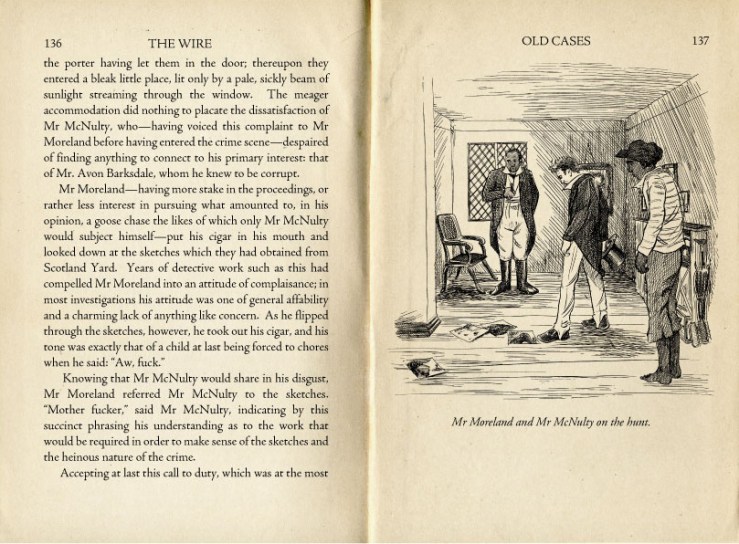
What If The Wire Was a Victorian Novel?

Do yourself a favor and read Joy Delyria and Sean Michael Robinson’s send up of lit crit “‘When It’s Not Your Turn’: The Quintessentially Victorian Vision of Odgen’s ‘The Wire.'” Their essay is a reappraisal of The Wire that imagines David Simon’s Baltimore saga as a serialized Victorian novel contemporary with Dickens.