To reflect that each one who enters imagines himself to be the first to enter whereas he is always the last term of a preceding series even if the first term of a succeeding one, each imagining himself to be first, last, only and alone whereas he is neither first nor last nor only nor alone in a series originating in and repeated to infinity.
What preceding series?
Assuming Mulvey to be the first term of his series, Penrose, Bartell d’Arcy, professor Goodwin, Julius Mastiansky, John Henry Menton, Father Bernard Corrigan, a farmer at the Royal Dublin Society’s Horse Show, Maggot O’Reilly, Matthew Dillon, Valentine Blake Dillon (Lord Mayor of Dublin), Christopher Callinan, Lenehan, an Italian organgrinder, an unknown gentleman in the Gaiety Theatre, Benjamin Dollard, Simon Dedalus, Andrew (Pisser) Burke, Joseph Cuffe, Wisdom Hely, Alderman John Hooper, Dr Francis Brady, Father Sebastian of Mount Argus, a bootblack at the General Post Office, Hugh E. (Blazes) Boylan and so each and so on to no last term.
A passage from the penultimate episode of James Joyce’s Ulysses.
What a tremendous affair it was, the world of Homer, with its indeterminate boundaries, vast regions, and immeasurable distances. The Mediterranean and the Euxine were illimitable stretches of ocean waste over which years could be spent in endless wandering. On their mysterious shores were the improbable homes of impossible peoples. The Great Sea, the Broad Sea, the Boundless Sea; the Ethiopians, “dwelling far away, the most distant of men,” and the Cimmerians, “covered with darkness and cloud,” where “baleful night is spread over timid mortals.” Phœnicia was a sore journey, Egypt simply unattainable, while the Pillars of Hercules marked the extreme edge of the universe. Ulysses was nine days in sailing from Ismarus the city of the Ciconians, to the country of the Lotus-eaters—a period of time which to-day would breed anxiety in the hearts of the underwriters should it be occupied by the slowest tramp steamer in traversing the Mediterranean and Black Seas from Gibraltar to Sebastopol.
Homer’s world, restricted to less than a drummer’s circuit, was nevertheless immense, surrounded by a thin veneer of universe—the Stream of Ocean. But how it has shrunk! To-day, precisely charted, weighed, and measured, a thousand times larger than the world of Homer, it is become a tiny speck, gyrating to immutable law through a universe the bounds of which have been pushed incalculably back. The light of Algol shines upon it—a light which travels at one hundred and ninety thousand miles per second, yet requires forty-seven years to reach its destination. And the denizens of this puny ball have come to know that Algol possesses an invisible companion, three and a quarter millions of miles away, and that the twain move in their respective orbits at rates of fifty-five and twenty-six miles per second. They also know that beyond it are great chasms of space, innumerable worlds, and vast star systems.
While much of the shrinkage to which the planet has been subjected is due to the increased knowledge of mathematics and physics, an equal, if not greater, portion may be ascribed to the perfection of the means of locomotion and communication. The enlargement of stellar space, demonstrating with stunning force the insignificance of the earth, has been negative in its effect; but the quickening of travel and intercourse, by making the earth’s parts accessible and knitting them together, has been positive.
The advantage of the animal over the vegetable kingdom is obvious. The cabbage, should its environment tend to become worse, must live it out, or die; the rabbit may move on in quest of a better. But, after all, the swift-footed creatures are circumscribed in their wanderings. The first large river almost inevitably bars their way, and certainly the first salt sea becomes an impassable obstacle. Better locomotion may be classed as one of the prime aims of the old natural selection; for in that primordial day the race was to the swift as surely as the battle to the strong. But man, already pre-eminent in the common domain because of other faculties, was not content with the one form of locomotion afforded by his lower limbs. He swam in the sea, and, still better, becoming aware of the buoyant virtues of wood, learned to navigate its surface. Likewise, from among the land animals he chose the more likely to bear him and his burdens. The next step was the domestication of these useful aids. Here, in its organic significance, natural selection ceased to concern itself with locomotion. Man had displayed his impatience at her tedious methods and his own superiority in the hastening of affairs. Thenceforth he must depend upon himself, and faster-swimming or faster-running men ceased to be bred. The one, half-amphibian, breasting the water with muscular arms, could not hope to overtake or escape an enemy who propelled a fire-hollowed tree trunk by means of a wooden paddle; nor could the other, trusting to his own nimbleness, compete with a foe who careered wildly across the plain on the back of a half-broken stallion. Continue reading ““The Shrinkage of the Planet” — Jack London”→
Here’s Davis’s short story “Money” from Samuel Johnson Is Indignant (and also in The Collected Stories of Lydia Davis)
I don’t want any more gifts, cards, phone calls, prizes, clothes, friends, letters, books, souvenirs, pets, magazines, land, machines, houses, entertainments, honors, good news, dinners, jewels, vacations, flowers, or telegrams. I just want money.
According to the Man Booker press release,
Sir Christopher Ricks, chairman of the judges, said her “writings fling their lithe arms wide to embrace many a kind. Just how to categorise them? They have been called stories but could equally be miniatures, anecdotes, essays, jokes, parables, fables, texts, aphorisms or even apophthegms, prayers or simply observations.” Davis then is not like any other writer and she follows, and contrasts with, the previous winners of the prize -Ismail Kadaré, Chinua Achebe, Alice Munro and Philip Roth.
I love love love Davis’s work, including her essays, and am glad to see her win the money and the award. Maybe it speaks to a shift in what people are willing to accept as fiction. Or maybe not.
If you’re at all interested in Davis’s work, I highly recommend The Collected Stories, which collects her first four volumes (read my review if you need more persuasion).
“On the Knocking at the Gate, in Macbeth” by Thomas De Quincey
From my boyish days I had always felt a great perplexity on one point in Macbeth. It was this: the knocking at the gate, which succeeds to the murder of Duncan, produced to my feelings an effect for which I never could account. The effect was, that it reflected back upon the murder a peculiar awfulness and a depth of solemnity; yet, however obstinately I endeavored with my understanding to comprehend this, for many years I never could see why it should produce such an effect.
Here I pause for one moment, to exhort the reader never to pay any attention to his understanding when it stands in opposition to any other faculty of his mind. The mere understanding, however useful and indispensable, is the meanest faculty in the human mind, and the most to be distrusted; and yet the great majority of people trust to nothing else; which may do for ordinary life, but not for philosophical purposes. Of this out of ten thousand instances that I might produce, I will cite one. Ask of any person whatsoever, who is not previously prepared for the demand by a knowledge of perspective, to draw in the rudest way the commonest appearance which depends upon the laws of that science; as for instance, to represent the effect of two walls standing at right angles to each other, or the appearance of the houses on each side of a street, as seen by a person looking down the street from one extremity. Now in all cases, unless the person has happened to observe in pictures how it is that artists produce these effects, he will be utterly unable to make the smallest approximation to it. Yet why? For he has actually seen the effect every day of his life. The reason is—that he allows his understanding to overrule his eyes. His understanding, which includes no intuitive knowledge of the laws of vision, can furnish him with no reason why a line which is known and can be proved to be a horizontal line, should not appear a horizontal line; a line that made any angle with the perpendicular less than a right angle, would seem to him to indicate that his houses were all tumbling down together. Accordingly he makes the line of his houses a horizontal line, and fails of course to produce the effect demanded. Here then is one instance out of many, in which not only the understanding is allowed to overrule the eyes, but where the understanding is positively allowed to obliterate the eyes as it were, for not only does the man believe the evidence of his understanding in opposition to that of his eyes, but, (what is monstrous!) the idiot is not aware that his eyes ever gave such evidence. He does not know that he has seen (and therefore quoad his consciousness has not seen) that which he has seen every day of his life. But to return from this digression, my understanding could furnish no reason why the knocking at the gate in Macbeth should produce any effect, direct or reflected. In fact, my understanding said positively that it could not produce any effect. But I knew better; I felt that it did; and I waited and clung to the problem until further knowledge should enable me to solve it. At length, in 1812, Mr. Williams made his début on the stage of Ratcliffe Highway, and executed those unparalleled murders which have procured for him such a brilliant and undying reputation. On which murders, by the way, I must observe, that in one respect they have had an ill effect, by making the connoisseur in murder very fastidious in his taste, and dissatisfied by anything that has been since done in that line. All other murders look pale by the deep crimson of his; and, as an amateur once said to me in a querulous tone, “There has been absolutely nothing doing since his time, or nothing that’s worth speaking of.” But this is wrong; for it is unreasonable to expect all men to be great artists, and born with the genius of Mr. Williams. Now it will be remembered that in the first of these murders, (that of the Marrs,) the same incident (of a knocking at the door soon after the work of extermination was complete) did actually occur, which the genius of Shakspeare has invented; and all good judges, and the most eminent dilettanti, acknowledged the felicity of Shakspeare’s suggestion as soon as it was actually realized. Here, then, was a fresh proof that I was right in relying on my own feeling in opposition to my understanding; and I again set myself to study the problem; at length I solved it to my own satisfaction; and my solution is this. Murder in ordinary cases, where the sympathy is wholly directed to the case of the murdered person, is an incident of coarse and vulgar horror; and for this reason, that it flings the interest exclusively upon the natural but ignoble instinct by which we cleave to life; an instinct, which, as being indispensable to the primal law of self-preservation, is the same in kind, (though different in degree,) amongst all living creatures; this instinct therefore, because it annihilates all distinctions, and degrades the greatest of men to the level of “the poor beetle that we tread on,” exhibits human nature in its most abject and humiliating attitude. Such an attitude would little suit the purposes of the poet. What then must he do? He must throw the interest on the murderer. Our sympathy must be with him; (of course I mean a sympathy of comprehension, a sympathy by which we enter into his feelings, and are made to understand them,—not a sympathy of pity or approbation.) In the murdered person all strife of thought, all flux and reflux of passion and of purpose, are crushed by one overwhelming panic; the fear of instant death smites him “with its petrific mace.” But in the murderer, such a murderer as a poet will condescend to, there must be raging some great storm of passion,—jealousy, ambition, vengeance, hatred,—which will create a hell within him; and into this hell we are to look. Continue reading ““On the Knocking at the Gate, in Macbeth” — Thomas De Quincey”→
The following morning he came down, he very calmly told Oberlin how his mother had appeared to him in the night; she had emerged from the dark churchyard wall in a white dress and had a white and a red rose pinned to her chest; she had then sunk into a corner and the roses had slowly grown over her, she had no doubt died; he had felt quite calm about this. Oberlin then remarked that when his father died he was alone in the fields and then heard a voice so that he knew his father was dead when he came back home this was indeed so. This led them further, Oberlin spoke of the mountain people, of girls who could detect water and metal under the ground, of men who had been possessed on certain peaks and wrestled with spirits; he also told of how he had once been transported into a state of somnambulism upon looking into the empty depths of a mountain pool. Lenz told him that the spirit of water had come over him, that he had then experienced something of its special essence. He continued on: the simplest, purest creatures were closest to elemental nature, the more refined a man’s mental life and feelings, the more blunted this elemental sense became; he did not consider it to be a higher plane, it lacked the requisite self-sufficiency, but he believed it must be an endless delight to feel moved by the unique life of each and every form; to have a soul for stones, metals, water and plants; to take in every being in nature into oneself as in a dream, as flowers do with air at every waxing of the moon.
From Georg Büchner’s Lenz, in translation by Richard Sieburth. Lenz (1836) is a novella or story or fragment based on the diary of J.F. Oberlin, who briefly took care of Jakob Lenz, a playwright suffering from schizophrenia.
There were two white men in charge of the trading station. Kayerts, the chief, was short and fat; Carlier, the assistant, was tall, with a large head and a very broad trunk perched upon a long pair of thin legs. The third man on the staff was a Sierra Leone nigger, who maintained that his name was Henry Price. However, for some reason or other, the natives down the river had given him the name of Makola, and it stuck to him through all his wanderings about the country. He spoke English and French with a warbling accent, wrote a beautiful hand, understood bookkeeping, and cherished in his innermost heart the worship of evil spirits. His wife was a negress from Loanda, very large and very noisy. Three children rolled about in sunshine before the door of his low, shed-like dwelling. Makola, taciturn and impenetrable, despised the two white men. He had charge of a small clay storehouse with a dried-grass roof, and pretended to keep a correct account of beads, cotton cloth, red kerchiefs, brass wire, and other trade goods it contained. Besides the storehouse and Makola’s hut, there was only one large building in the cleared ground of the station. It was built neatly of reeds, with a verandah on all the four sides. There were three rooms in it. The one in the middle was the living-room, and had two rough tables and a few stools in it. The other two were the bedrooms for the white men. Each had a bedstead and a mosquito net for all furniture. The plank floor was littered with the belongings of the white men; open half-empty boxes, torn wearing apparel, old boots; all the things dirty, and all the things broken, that accumulate mysteriously round untidy men. There was also another dwelling-place some distance away from the buildings. In it, under a tall cross much out of the perpendicular, slept the man who had seen the beginning of all this; who had planned and had watched the construction of this outpost of progress. He had been, at home, an unsuccessful painter who, weary of pursuing fame on an empty stomach, had gone out there through high protections. He had been the first chief of that station. Makola had watched the energetic artist die of fever in the just finished house with his usual kind of “I told you so” indifference. Then, for a time, he dwelt alone with his family, his account books, and the Evil Spirit that rules the lands under the equator. He got on very well with his god. Perhaps he had propitiated him by a promise of more white men to play with, by and by. At any rate the director of the Great Trading Company, coming up in a steamer that resembled an enormous sardine box with a flat-roofed shed erected on it, found the station in good order, and Makola as usual quietly diligent. The director had the cross put up over the first agent’s grave, and appointed Kayerts to the post. Carlier was told off as second in charge. The director was a man ruthless and efficient, who at times, but very imperceptibly, indulged in grim humour. He made a speech to Kayerts and Carlier, pointing out to them the promising aspect of their station. The nearest trading-post was about three hundred miles away. It was an exceptional opportunity for them to distinguish themselves and to earn percentages on the trade. This appointment was a favour done to beginners. Kayerts was moved almost to tears by his director’s kindness. He would, he said, by doing his best, try to justify the flattering confidence, &c., &c. Kayerts had been in the Administration of the Telegraphs, and knew how to express himself correctly. Carlier, an ex-non-commissioned officer of cavalry in an army guaranteed from harm by several European Powers, was less impressed. If there were commissions to get, so much the better; and, trailing a sulky glance over the river, the forests, the impenetrable bush that seemed to cut off the station from the rest of the world, he muttered between his teeth, “We shall see, very soon.”
Next day, some bales of cotton goods and a few cases of provisions having been thrown on shore, the sardine-box steamer went off, not to return for another six months. On the deck the director touched his cap to the two agents, who stood on the bank waving their hats, and turning to an old servant of the Company on his passage to headquarters, said, “Look at those two imbeciles. They must be mad at home to send me such specimens. I told those fellows to plant a vegetable garden, build new storehouses and fences, and construct a landing-stage. I bet nothing will be done! They won’t know how to begin. I always thought the station on this river useless, and they just fit the station!”
“They will form themselves there,” said the old stager with a quiet smile.
The fact that Henry Armstrong was buried did not seem to him to prove that he was dead: he had always been a hard man to convince. That he really was buried, the testimony of his senses compelled him to admit. His posture – flat upon his back, with his hands crossed upon his stomach and tied with something that he easily broke without profitably altering the situation – the strict confinement of his entire person, the black darkness and profound silence, made a body of evidence impossible to controvert and he accepted it without cavil.
But dead – no; he was only very, very ill. He had, withal, the invalid’s apathy and did not greatly concern himself about the uncommon fate that had been allotted to him. No philosopher was he – just a plain, commonplace person gifted, for the time being, with a pathological indifference: the organ that he feared consequences with was torpid. So, with no particular apprehension for his immediate future, he fell asleep and all was peace with Henry Armstrong.
But something was going on overhead. It was a dark summer night, shot through with infrequent shimmers of lightning silently firing a cloud lying low in the west and portending a storm. These brief, stammering illuminations brought out with ghastly distinctness the monuments and headstones of the cemetery and seemed to set them dancing. It was not a night in which any credible witness was likely to be straying about a cemetery, so the three men who were there, digging into the grave of Henry Armstrong, felt reasonably secure.
Two of them were young students from a medical college a few miles away; the third was a gigantic negro known as Jess. For many years Jess had been employed about the cemetery as a man-of-all-work and it was his favorite pleasantry that he knew “every soul in the place.” From the nature of what he was now doing it was inferable that the place was not so populous as its register may have shown it to be.
Outside the wall, at the part of the grounds farthest from the public road, were a horse and a light wagon, waiting.
The work of excavation was not difficult: the earth with which the grave had been loosely filled a few hours before offered little resistance and was soon thrown out. Removal of the casket from its box was less easy, but it was taken out, for it was a perquisite of Jess, who carefully unscrewed the cover and laid it aside, exposing the body in black trousers and white shirt. At that instant the air sprang to flame, a cracking shock of thunder shook the stunned world and Henry Armstrong tranquilly sat up. With inarticulate cries the men fled in terror, each in a different direction. For nothing on earth could two of them have been persuaded to return. But Jess was of another breed.
In the gray of the morning the two students, pallid and haggard from anxiety and with the terror of their adventure still beating tumultuously in their blood, met at the medical college.
“You saw it?” cried one.
“God! yes – what are we to do?”
They went around to the rear of the building, where they saw a horse, attached to a light wagon, hitched to a gatepost near the door of the dissecting-room. Mechanically they entered the room. On a bench in the obscurity sat the negro Jess. He rose, grinning, all eyes and teeth.
“I’m waiting for my pay,” he said.
Stretched naked on a long table lay the body of Henry Armstrong, the head defiled with blood and clay from a blow with a spade.
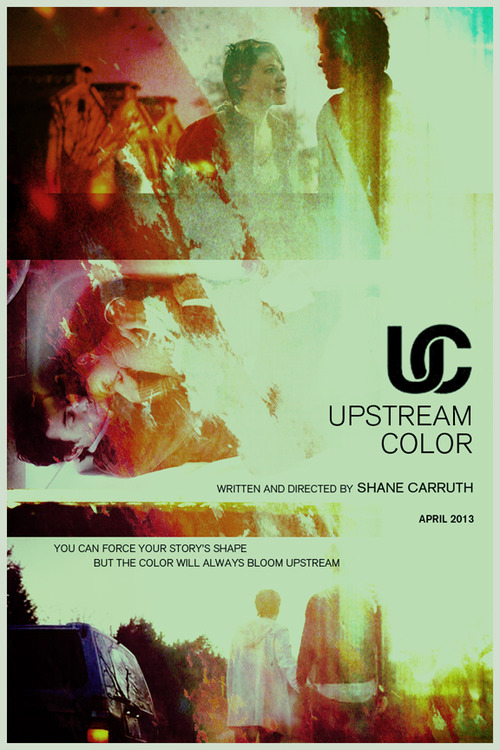
1. I managed to avoid reading anything about Shane Carruth’s new film Upstream Color before I saw it.
I just knew that this was the guy who did Primer, this was his new film, and I wanted to see it because Primer was so strange and engaging.
2. Two immediate responses after viewing Upstream Color:
i). The desire to see Upstream Color again and
ii). The desire to read what other people thought about Upstream Color.
3. (My wife and I, reading the credits, pausing the credits, reassessing the film against the backdrop of the credits, arguing about the film, discussing the film, etc.).
4. I think it’s better that if you have any interest at all in Upstream Color that you just see it cold [update/warning: the comments section of this post is full of spoilers]. But I know that 100 minutes is an investment of time, so maybe you’d like some kind of précis or at least description. So, a loose attempt, which surely will devolve into fragments and references:
Upstream Color is a sci-film, sort of.
Or maybe its a mystery film about ethics and biology.
Maybe a nature film, sort of.
Henry David Thoreau’s Walden.
Worms—parasites.
Theft.
Pigs.
Shades of Philip K. Dick, David Cronenberg, Terence Malick, but also something utterly original.
Mind control.
Trauma.
Ambient music.
Orchids.
Sampling nature.
Memory.
Swimming.
Drowning.
Creation: knitting, paper chains, music, seeds, life, children, etc.
A film that can and should be described as poetic.
It’s a love story, too.
5. It occurs to me that there’s a trailer for the film. I haven’t seen it yet. Should we watch it?
6. Does that do it for you? I don’t know how to do this anymore. Recommend things. I don’t know, the trailer makes the film perhaps look more pretentious than it is. It isn’t pretentious. It isn’t even confusing—just perplexing, haunting, troubling.
7. (Wanted: Quinoa Valley Record Co., complete discography).
8. My take on Upstream Color, spoiler-free, supporting-detail-free:
The film is about agency, about drive, about how the characters (and, implicitly, us, we, the audience, who identify with the characters on the screen) may be driven by something beyond us, something controlling us like a parasite (internal) or from afar like a ventriloquist (external). That even when we do assert agency the effect, the fallout, the shape lays beyond us, upstream.
9. (This morning, my wife telling me about her dream, a nightmare that our young daughter had ingested hallucinogenic mushrooms, clearly a response to the film).
10. I haven’t done a good job of really saying anything about the film. So, lazily:
I think Caleb Crain provides a perceptive and persuasive reading of the film in his essay “The Thoreau Poison.” He reads the film through the American transcendentalists, particularly Thoreau, of course, but also Emerson and Hawthorne.
There’s also a piece at Slate by Forrest Wickman that perhaps over-explicates but nonetheless offers perspective, including elements of Carruth’s own take.
11. (I will avoid Carruth’s explanation of the film until I’ve seen it a second time. Maybe I’ll avoid his explanation forever).
12. A take on Upstream Color that I don’t quite buy into (the take is my own): The film perhaps invites us to find metaphysical entities in two of its secondary characters, both of whom exert influence (creative and destructive) over the primary characters. Something something godlike, something something devillike.
I like that the film offers this simple duality and then crushes it, shows something far more complicated, suggests a cycle far more strange.
13. (White orchid. Blue orchid. Yellow orchid).
14. Upstream Color features minimal dialogue and nothing approaching traditional exposition, but we still learn about its characters, come to feel for them, feel their desires and traumas. The film is cerebral and philosophical, but it’s also emotional, offering an aesthetic that sublimely overwhelms the viewer.
15. Carruth wrote, produced, directed, scored, photographed, cast and starred in Upstream Color. (I’m sure he did a lot of other stuff too). He also distributed the film himself. The entire filmmaking process was untouched by the Hollywood system. There’s so much hope for film as an art form in this knowledge.
16. Parting thoughts: See Upstream Color. Resist imposing whatever film grammar you usually bring with you to the movies. Resist the temptation to see the film as a puzzle to figure out. See Upstream Color.
What are fairy stories for? Freud gave an answer – they were related to daydreams and wish-fulfilment fantasies, in which the questing self meets helpers and enemies, and in which the ending is always happy. He wondered if myths were the “secular dreams of youthful humanity” but distinguished myths from fairy tales by claiming that myth is “related to disaster”. It can also be argued that myth is related to the human need to know what was before, and what will be after the individual life, the living society. Myths are concerned with origins, the fear of death, and the hope for the overcoming of death in another world. The universe of Asgard and Valhalla, of Olympus and Hades, is not the fairy-tale unreal world with its visiting suns and moons, castles and undifferentiated forests. We don’t put it together in our imaginations in the same way. There is neither explanation nor teaching in the true wonder tale.
Other things which are not essentially part of true fairy tales are character, psychological causation, and real morality. Princesses are virtually interchangeable – they are either kind and modest and housewifely, or vain and stupid and inconsiderate. They are called “princesses” but peasants and merchants’ daughters have the same limited and recognisable natures. Simpletons and gallant princes have the same chance of solving riddles, obtaining magic feathers, or keys, the same insect or fishy helpers. Lazy girls are caught out by boasts that they can spin flax into gold, and are helped by strange brownies, or dwarves, or other creatures. The best single description I know of the world of the fairy tale is that of Max Lüthi who describes it as an abstract world, full of discrete, interchangeable people, objects and incidents, all of which are isolated and are nevertheless interconnected, in a kind of web or network of two-dimensional meaning. Everything in the tales appears to happen entirely by chance – and this has the strange effect of making it appear that nothing happens by chance, that everything is fated.


 Biblioklept