
Skjaldbreiður (from Grafninguur), 1962 by Johannes Sveinsson Kjarval (1885 –1972)

Skjaldbreiður (from Grafninguur), 1962 by Johannes Sveinsson Kjarval (1885 –1972)
“A Guide to Virtual Death”
by
J.G. Ballard
For reasons amply documented elsewhere, intelligent life on earth became extinct in the closing hours of the 20th Century. Among the clues left to us, the following schedule of a day’s television programmes transmitted to an unnamed city in the northern hemisphere on December 23, 1999, offers its own intriguing insight into the origins of the disaster.
6.00 am Porno–Disco. Wake yourself up with his–and–her hard–core sex images played to a disco beat.
7.00 Weather Report. Today’s expected micro–climates in the city’s hotel atriums, shopping malls and office complexes. Hilton International promises an afternoon snow–shower as a Christmas appetiser.
7.15 News Round–up. What our news–makers have planned for you. Maybe a small war, a synthetic earthquake or a famine–zone! charity tie–in.
7.45 Breakfast Time. Gourmet meals to watch as you eat your diet cellulose.
8.30 Commuter Special. The rush–hour game–show. How many bottoms can you pinch, how many faces can you slap?
9.30 The Travel Show. Visit the world’s greatest airports and under ground car parks.
10.30 Home–makers of Yesterday. Nostalgic scenes of old–fashioned housework. No.7 – The Vacuum Cleaner.
11.00 Office War. Long–running serial of office gang–wars.
12.00 Newsflash. The networks promise either a new serial killer or a deadly food toxin.
1.00 pm Live from Parliament. No .12 – The Alcoholic MP.
1.30 The Nose–Pickers. Hygiene programme for the kiddies.
2.00 Caress Me. Soft–porn for the siesta hour.
2.30 Your Favourite Commericials. Popular demand re–runs of golden oldie TV ads.
3.00 Housewives’ Choice. Rape, and how to psychologically prepare yourself.
4.00 Count–down. Game show in which contestants count backwards from one million.
5.00 Newsflash. Either an airliner crash or a bank collapse. Viewers express preference.
6.00 Today’s Special. Virtual Reality TV presents ‘The Kennedy Assassination.’ The Virtual Reality head–set takes you to Dallas, Texas, on November 22, 1963. First you fire the assassin’s rifle from the Book Depository window, and then you sit between Jackie and JFK in the Presidential limo as the bullet strikes. For premium subscribers only – feel the Presidential brain tissue spatter your face OR wipe Jackie’s tears onto your handkerchief.
8.00 Dinner Time. More gourmet dishes to view with your evening diet–cellulose.
9.00 Science Now. Is there life after death? Micro–electrodes pick up ultra–faint impulses from long–dead brains. Relatives question the departed.
10.00 Crime–Watch. Will it be your home that is broken into tonight by the TV Crime Gang?
11.00 Today’s Special. Tele–Orgasm. Virtual Reality TV takes you to an orgy. Have sex with the world’s greatest movie–stars. Tonight: Marilyn Monroe and Madonna OR Warren Beatty and Tom Cruise. For premium subscribers only – experience transexualism, paedophiia, terminal syphilis, gang–rape, and bestiality (choice: German Shepherd or Golden Retriever).
1.00 am Newsflash. Tonight’s surprise air–crash.
2.00 The Religious Hour. Imagine being dead. Priests and neuroscientists construct a life–like mock–up of your death.
3.00 Night–Hunter. Will the TV Rapist come through your bedroom window?
4.15 Sex for Insomniacs. Soft porn to rock you to sleep.
5.00 The Charity Hour. Game show in which Third–World contestants beg for money.
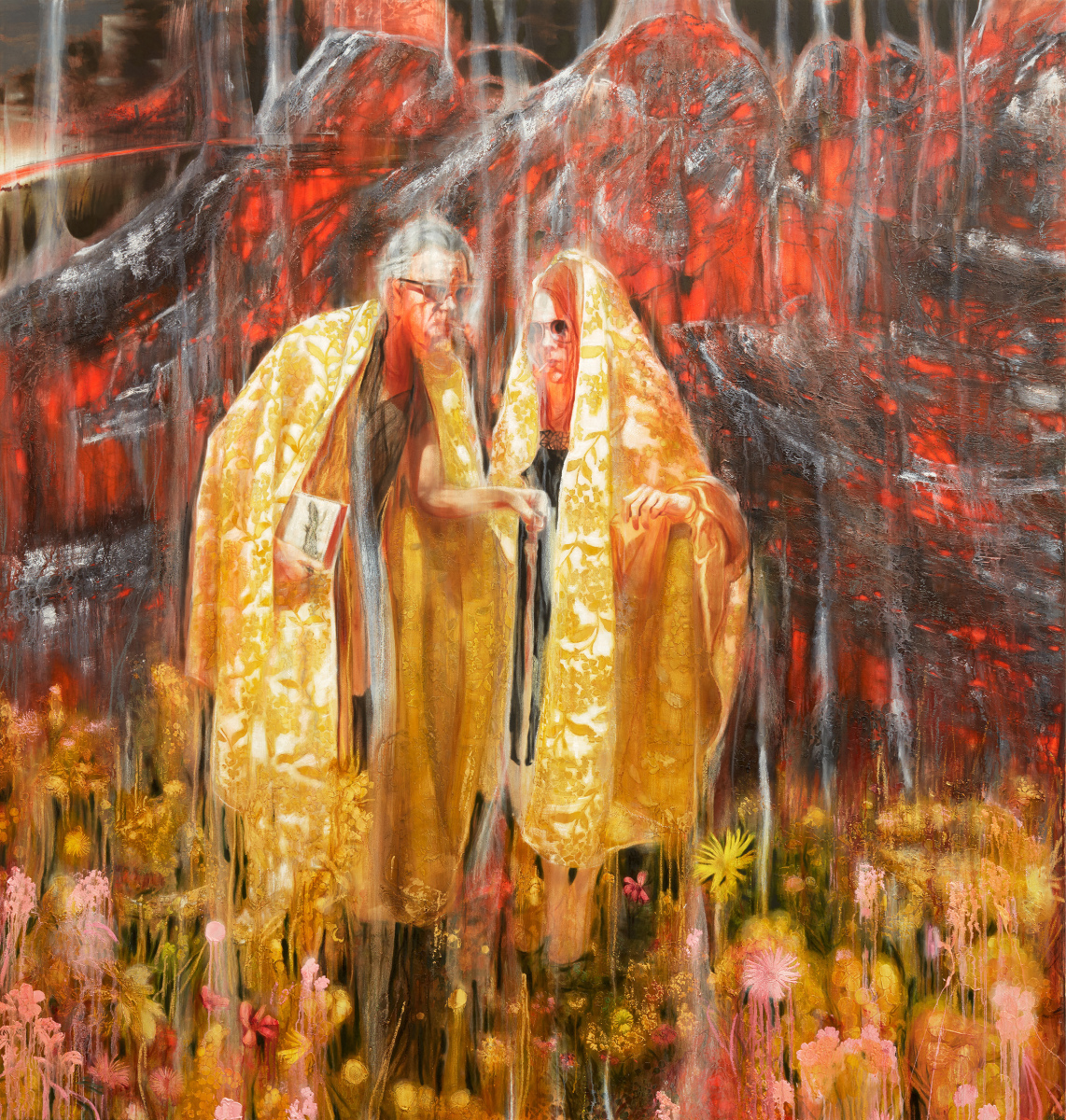
Smoking Lovers, 2016 by Nigel Cooke (b. 1973)

The Mycologist, 2016 by Paulina Olowska (b. 1976)
IN THIS RIFF:
Introductions
Stories published between 1956 and 1959:
“Prima Belladonna”
“Escapement”
“The Concentration City”
“Venus Smiles”
“Manhole 69”
“Track 12”
“The Waiting Grounds”
“Now: Zero”
Introduction
I first read J.G. Ballard in high school. I found his work, somehow, after reading Burgess, Burroughs, and Vonnegut. I devoured many of his novels over the next few years, as well as several short story collections. One of these, The Best Short Stories of J.G. Ballard was particularly important to me. That collection—which I loaned to a friend who thought enough of it to never give it back—offers a concise overview of Ballard’s development as a writer, from the pulp sci-fi of his earliest days (“Chronopolis”) to his later evocations of ecological disaster and dystopia (“Billenium,” “The Terminal Beach”) to his more experimental work from The Atrocity Exhibition, stories that pointed toward one of his most famous books, Crash.
I hadn’t returned to Ballard since reading Super-Cannes when it came out a decade ago; at the time I recall being disappointed in the novel and filing it away with William Gibson’s recent efforts, which I found dull.
I’d been reading Donald Barthelme’s wonderful and strange short stories, and, rereading “Glass Mountain,” a story composed in a list, I remembered Ballard’s brilliant story “Answers to a Questionnaire” (from 1990’s War Fever). I tracked the story down in The Complete Short Stories of J.G. Ballard, read it, read a few more at random, and then decided to start at the beginning.
I’ll be reading and riffing on all 98 stories in the collection over the next few months—giving myself breaks for other stuff, of course (although Ballard’s stuff, especially the early stuff is really easy to read).
Another introduction
Martin Amis writes the introduction to the 2009 edition and of course manages to bring up his father Kingsley almost immediately. He talks about the times he (Martin) got to spend with Ballard. He points out that Ballard possessed “a revealingly weak ear for dialogue.” He suggests that Ballard could have been the love child of Saki and Jorge Luis Borges. He describes Ballard as “somehow uniquely unique.” He reminds me of why I usually skip introductions.
And Ballard’s introduction, from the 2001 first edition of the book
He situates his hero, his contemporary, and his forbear in the first paragraph:
Short stories are the loose change in the treasury of fiction, easily ignored beside the wealth of novels available, an over-valued currency that often turns out to be counterfeit. At its best, in Borges, Ray Bradbury and Edgar Allan Poe, the short story is coined from precious metal, a glint of gold that will glow for ever in the deep purse of your imagination.
He also tells us,
Curiously, there are many perfect short stories, but no perfect novels.
I agree, except for the adverb there.
Did Ballard’s sensibilities gel with the sci-fi fans who read the pulp mags his early stories were published in?
I was interested in the real future that I could see approaching, and less in the invented future that science fiction preferred.
In the final lines of his introduction he describes his oeuvre and addresses criticisms that there’s so much damn analog tech in his stuff:
Vermilion Sands isn’t set in the future at all, but in a kind of visionary present – a description that fits the stories in this book and almost everything else I have written. But oh for a steam-powered computer and a wind-driven television set. Now, there’s an idea for a short story.
Vermilion Sands, the strange resort town where Ballard set over a half-dozen of his tales, is the setting of the first and fourth tales in the collection.
“Prima Belladonna” (1956) / “Venus Smiles” (1957)
Ballard already had a distinct setting in mind to play out his future-nowisms. That early stories “Prima Belladonna” and “Venus Smiles” are both in set in Vermilion Sands is maybe the most interesting thing about them. “Prima Belladonna” is never better than its first line:
I first met Jane Ciracylides during the Recess, that world slump of boredom, lethargy and high summer which carried us all so blissfully through ten unforgettable years, and I suppose that may have had a lot to do with what went on between us.
Ballard has the good sense to leave that cryptic reference to “the Recess” unexplained, or at least underexplained throughout the story—exposition is usually the worst aspect of pulp sci-fi. Still, the story is hardly one of his best. I’m guessing Roger Corman must have read it though, as his film Little Shop of Horrors (1960) seems to owe it a certain debt.

“Venus Smiles” is also set in Vermilion Sands, and it also takes music—sound—as its major motif (several of Ballard’s early stories do). Ballard strives to do too much in the story—he wants to criticize public attitudes about art, sculpture, music, etc., and also name drop John Cage to bolster his avant garde bona fides. Both stories drag, weighed down by Ballard’s clunky similes and bad dialogue (dear lord I’m agreeing with Amis here!). What’s most frustrating is knowing that Ballard is just a decade away from finding a rhetorical style to match the content of his ideas.
“Escapement” (1956)
The story of a man who realizes he is stuck in a time loop, repeating the same actions, “Escapement” is particularly frustrating. The stakes are incredibly low—the domestic scene of a married couple watching TV on a couch begs for darker treatment—and the reader figures out what’s going on way before the narrator. Time is clearly a major motif for Ballard, but his earliest published treatment of it is not especially inspiring. (I realize writing this what an ass I sound like: look, I know this is early work, pulp fiction—my frustration is that I want it to be better—or at least more abbreviated.
“The Concentration City” (1957)
“The Concentration City” finally sees Ballard in stronger territory, here exploring one of his favorite dystopic tropes—overpopulation—via one of his favorite conceits—the intrepid and intellectually curious young man. “The Concentration City” also showcases some early experimental touches in its opening paragraphs:
Noon talk on Millionth Street:
‘Sorry, these are the West Millions. You want 9775335th East.’
‘Dollar five a cubic foot? Sell!’
‘Take a westbound express to 495th Avenue, cross over to a Redline elevator and go up a thousand levels to Plaza Terminal. Carry on south from there and you’ll find it between 568th Avenue and 422nd Street.’
‘There’s a cave–in down at KEN County! Fifty blocks by twenty by thirty levels.’
‘Listen to this – “PYROMANIACS STAGE MASS BREAKOUT! FIRE POLICE CORDON BAY COUNTY!”
‘It’s a beautiful counter. Detects up to .005 per cent monoxide. Cost me three hundred dollars.’
‘Have you seen those new intercity sleepers? They take only ten minutes to go up 3,000 levels!’
‘Ninety cents a foot? Buy!’
The story follows up on these early notes, using the initially-estranging material to tell the story of a seemingly-infinite city; our young hero of course wants to bust out. Ballard also gives us an early prototype of what will be one of his major conventions: the green-zone/danger-zone split:
‘City Authority are starting to seal it off,’ the man told him. ‘Huge blocks. It’s the only thing they can do. What happens to the people inside I hate to think.’ He chewed on a sandwich. ‘Strange, but there are a lot of these black areas. You don’t hear about them, but they’re growing. Starts in a back street in some ordinary dollar neighbourhood; a bottleneck in the sewage disposal system, not enough ash cans, and before you know it a million cubic miles have gone back to jungle. They try a relief scheme, pump in a little cyanide, and then – brick it up. Once they do that they’re closed for good.’
No exit!
“Manhole 69” (1957)
Despite its unfortunate name, “Manhole 69” is perfect early Ballard. The story follows three men in an experimental group who have undergone a surgery that eliminates their ability to sleep. The story is precise and concise; Ballard seems comfortable here (“comfortable” is not a very Ballardian word, but hey…)—he sets up his experiment and then lets his principals carry it out. The story’s heavy Jungian vibe resurfaces a few years later in Ballard’s early novel The Drowned World.
“Manhole 69” is the first of the 98 stories here I’d put in a collection I’ll tentatively call The Essential Short Stories of J.G. Ballard.
“Track 12” (1958)
While “Track 12” is hardly perfect, its concision and focus do it many favors. Again, we find Ballard playing with sound—particularly something called “microsonics”:
Amplified 100,000 times animal cell division sounds like a lot of girders and steel sheets being ripped apart – how did you put it? – a car smash in slow motion. On the other hand, plant cell division is an electronic poem, all soft chords and bubbling tones. Now there you have a perfect illustration of how microsonics can reveal the distinction between the animal and plant kingdoms.
As is often the case, Ballard has an idea that fascinates him (“microsonics,” here) and simply constructs a story to deliver that idea. Or, rather, rips off a story—and Ballard has the good sense to steal from the best. “Track 12” is a fairly straightforward Edgar Allan Poe ripoff, a revenge tale recalling “The Cask of Amontillado,” and if the reader seems to guess where everything is going before the victim, well, it works here.
“The Waiting Grounds” (1959)
Ballard is better at inner space than outer space. “The Waiting Grounds” seems like a bait and switch, or at least I imagine many meat and potatoes SF fans might have felt that way. Ballard has his hero head to some distant planet, only to spend most of that trip in his own mind. And oh what a trip! The story’s central set piece anticipates the final scenes of Kubrick’s 2001: A Space Odyssey as Ballard sends his hero through “deep time”:
Deep Time: 10,000,000,000 mega–years. The ideation–field has now swallowed the cosmos, substituted its own dynamic, its own spatial and temporal dimensions. All primary time and energy fields have been engulfed. Seeking the final extension of itself within its own bounds the mantle has reduced its time period to an almost infinitesimal 0.00000000… n of its previous interval. Time has virtually ceased to exist, the ideation–field is nearly stationary, infinitely slow eddies of sentience undulating outward across its mantles.
The frame Ballard builds to deliver his idea is clunky, but I suppose in those days one could make a sort of living writing stories for magazines, and maybe more words meant more moolah. Again, this story points to the Jungian themes that Ballard would explore in greater depth in The Drowned World.
“Now: Zero” (1959)
Here is the first paragraph of “Now: Zero,” the last story of Ballard’s to be published in the 1950s:
You ask: how did I discover this insane and fantastic power? Like Dr Faust, was it bestowed upon me by the Devil himself, in exchange for the deed to my soul? Did I, perhaps, acquire it with some strange talismanic object – idol’s eyepiece or monkey’s paw – unearthed in an ancient chest or bequeathed by a dying mariner? Or, again, did I stumble upon it myself while researching into the obscenities of the Eleusinian Mysteries and the Black Mass, suddenly perceiving its full horror and magnitude through clouds of sulphurous smoke and incense?
No doubt, dear reader, you immediately detect Edgar Allan Poe all over this piece, and you’re not wrong. The story is mostly interesting as a style exercise—namely, Ballard doing Poe—but its cheesiness and predictability drowns out any humor. But again, these are the complete short stories—not just the perfect exercises.
On the horizon:
The early 1960s! “Chronopolis”! “The Overloaded Man”! “Billenium”! You are encouraged to play along.
[Ed. note: Biblioklept originally ran a series of posts on The Complete Short Stories of J.G. Ballard between October 2013 and March 2014.]

Ali, 1974 by Lucian Freud (1922-2011)
“Sather Tower Mystery”
by
Ishmael Reed
Seems there was this Professor
a member of what should be called
The Good German Department
Must have signed his name to
5,000 petitions in front of
the Co-Op on Cedar
and bought two tons of benefit
cookies
Blames Texas for the sorry
state of the oceans
Rode a Greyhound bus “Civil
Rights,” Alabama, 1960
Found the long yellow war
“deplorable”
Believes John “Duke” Wayne’s
values to be inferior to his
He said, “Ishmael, I’d
love to do the right thing
for as you know I’m all for
the right thing and against
the wrong thing, but
these plaster of paris busts
of deceased Europeans
Our secret ways
Our sacred fears
“These books, leather-bound ‘copyright 1789’
All of these things, precious
to me, gleaming like the
stainless steel coffee urn in
the faculty club, an original
Maybeck, 1902
“I’d stand up for Camelot
by golly, even if it meant
shooting all the infidels in
the world,” he said
reaching into his desk drawer
“Why, I might even have to
shoot you, Ishmael”
Staring down the cold
tunnel of a hard .38
I thought
Most people are to the right
when it comes to where they must
eat and lay their heads!

Woman in Blue Combing Her Hair, 1920 by Goyo Hashiguchi (1880–1921)

My beloved bookstore reopened this Monday. This past Wednesday, I donned my finest mask, got into the car for the first time in a while, and drove the 1.1 miles to my beloved bookstore, which reopened this Monday. I had done curbside pickup on a few books for my kids sometime early in April, but I hadn’t been into a bookstore since the middle of March.
The staff were all wearing masks, as were the few customers in the store (with the exception of two elderly patrons). The store is a sprawling maze of stacks covering close to 25,000 (very irregular, bendy, weird) square feet (it’s not a small space), and the stacks were marked for distancing.
I managed to find all the books on my list—two dystopian teen novels for my not-quite-yet-teen daughter, novels by Roald Dahl and Neil Gaiman for the boy (who’s already finished both), a copy of My Brilliant Friend for my wife, who loved the filmic teevee adaptation (I gave my copy to my department head years ago, thinking she’d love it, but she never mentioned anything about it to me, and I don’t press), and two books for me: Kazuo Ishiguro’s 1995 novel The Unconsoled, which I’ve been meaning to read for ages, and Herman Melville’s fourth novel Redburn (which I’ve been meaning to read for awhile after reading Elizabeth Hardwick’s literary biography of Melville a few weeks ago). Edward Gorey did the Redburn cover, by the way.
Despite already being into four other novels, I started in on The Unconsoled. The novel reads like a hallucinatory series of side quests in the strangest first-person video game ever made–a novel of absurdity and art and time and memory, wherein the first-person narrator Ryder, on a mission he can never quite name or even possibly remember, constructs and deconstructs his (always-deferred) present “reality” on a moment-to-moment basis. The book is weird in the best way—it reminds me a lot of Alasdair Gray’s Lanark, Anna Kavan’s Ice, João Gilberto Noll’s Quiet Creature on the Corner, and pretty much everything by Kafka. I imagine it will frustrate many readers with its refusal to cohere or to settle on a plot, but I’m digging it big time.

Street Circus, 2010 by Xiao Guo Hui (b. 1969)
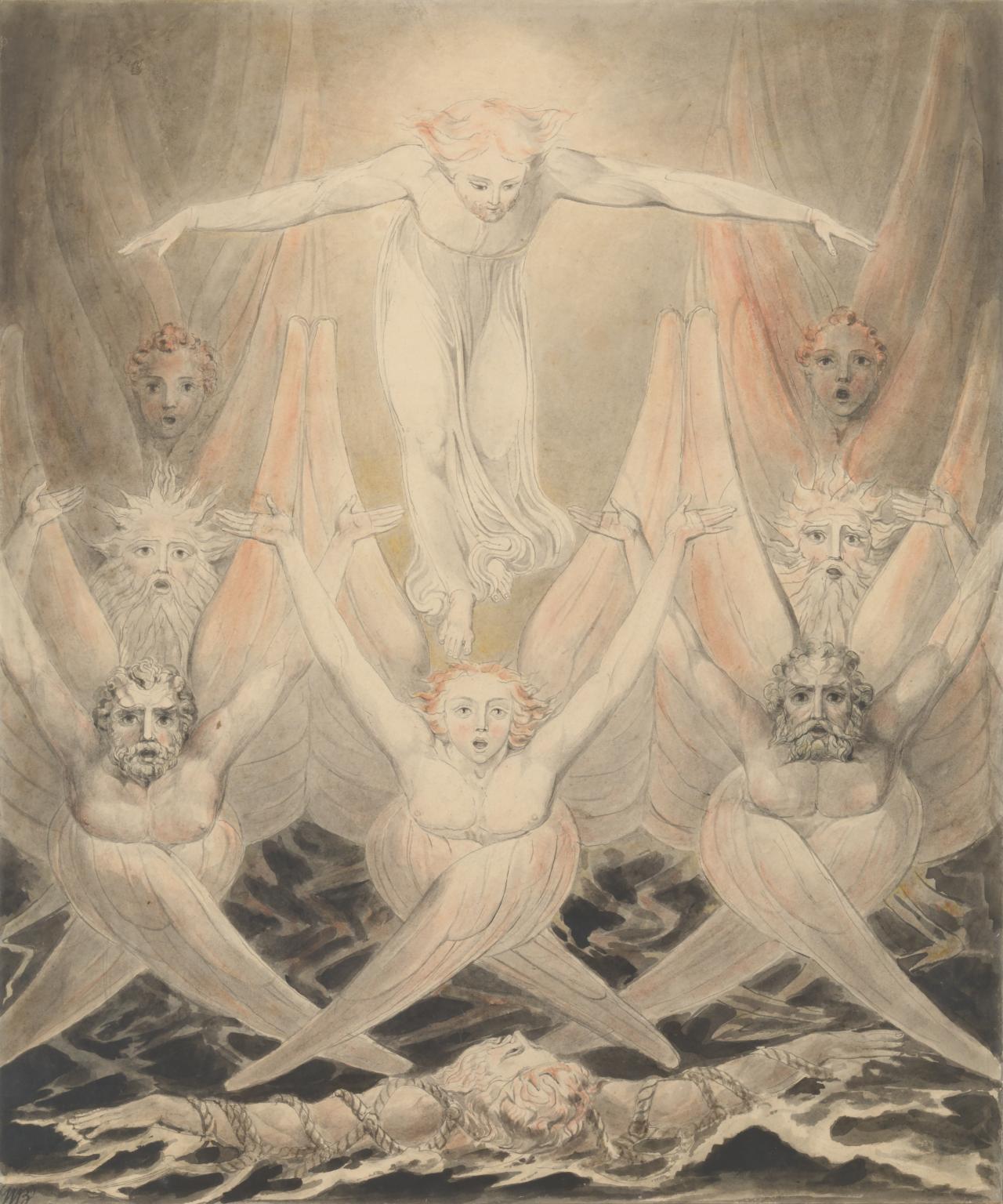
David Delivered out of Many Waters, c. 1805 by William Blake (1757–1827)
May 16th.–It has been an easterly rain yesterday and to-day, with occasional lightings up, and then a heavy downfall of the gloom again.
Scenes out of the rear windows,–the glistening roof of the opposite houses; the chimneys, now and then choked with their own smoke, which a blast drives down their throats. The church-spire has a mist about it. Once this morning a solitary dove came and alighted on the peak of an attic window, and looked down into the areas, remaining in this position a considerable time. Now it has taken a flight, and alighted on the roof of this house, directly over the window at which I sit, so that I can look up and see its head and beak, and the tips of its claws. The roofs of the low out-houses are black with moisture; the gutters are full of water, and there is a little puddle where there is a place for it in the hollow of a board. On the grass-plot are strewn the fallen blossoms of the cherry-tree, and over the scene broods a parallelogram of sombre sky. Thus it will be all day as it was yesterday; and, in the evening, one window after another will be lighted up in the drawing-rooms. Through the white curtains may be seen the gleam of an astral-lamp, like a fixed star. In the basement rooms, the work of the kitchen going forward; in the upper chambers, here and there a light.
In a bar-room, a large, oval basin let into the counter, with a brass tube rising from the centre, out of which gushes continually a miniature fountain, and descends in a soft, gentle, never-ceasing rain into the basin, where swim a company of gold-fishes. Some of them gleam brightly in their golden armor; others have a dull white aspect, going through some process of transformation. One would think that the atmosphere, continually filled with tobacco-smoke, might impregnate the water unpleasantly for the scaly people; but then it is continually flowing away and being renewed. And what if some toper should be seized with the freak of emptying his glass of gin or brandy into the basin,–would the fishes die or merely get jolly?
I saw, for a wonder, a man pretty drunk at Parker’s the other evening,–a well-dressed man, of not ungentlemanly aspect. He talked loudly and foolishly, but in good phrases, with a great flow of language, and he was no otherwise impertinent than in addressing his talk to strangers. Finally, after sitting a long time staring steadfastly across the room in silence, he arose, and staggered away as best he might, only showing his very drunken state when he attempted to walk.
Old acquaintances,–a gentleman whom I knew ten years ago, brisk, active, vigorous, with a kind of fire of physical well-being and cheerful spirits glowing through him. Now, after a course, I presume, of rather free living, pale, thin, oldish, with a grave and care or pain worn brow,–yet still lively and cheerful in his accost, though with something invincibly saddened in his tones. Another, formerly commander of a revenue vessel,–a man of splendid epaulets and very aristocratic equipment and demeanor; now out of service and without position, and changed into a brandy-burnt and rowdyish sort of personage. He seemed as if he might still be a gentleman if he would; but his manners show a desperate state of mind by their familiarity, recklessness, the lack of any hedge of reserve about himself, while still he is evidently a man of the world, accustomed to good society. He has latterly, I think, been in the Russian service, and would very probably turn pirate on fair occasion.
Nathaniel Hawthorne’s journal entry, 16 May 1850. From American Note-Books.
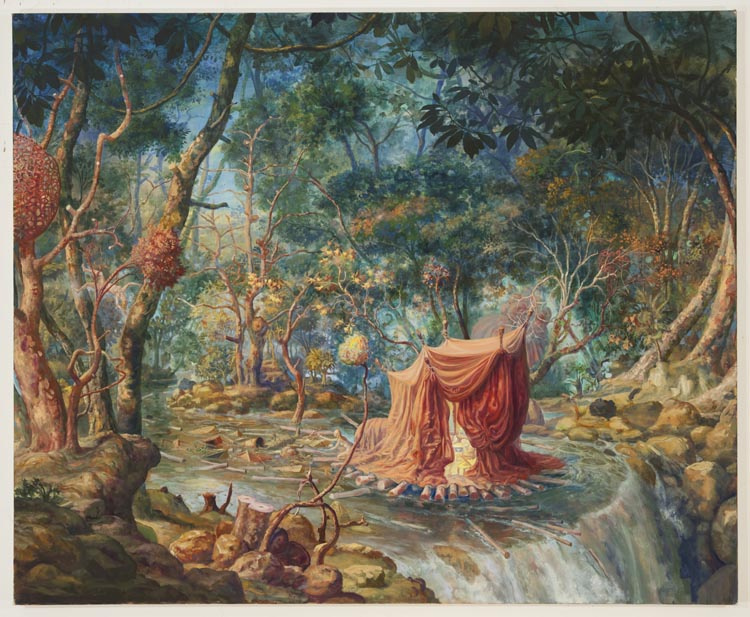
Self Portrait on the Brink, 2013 by Julie Heffernan (b. 1956)
Tutte, 2009 by Jen Mazza (b. 1972)

Edith Sitwell, 1923–35 by Wyndham Lewis (1882–1957)
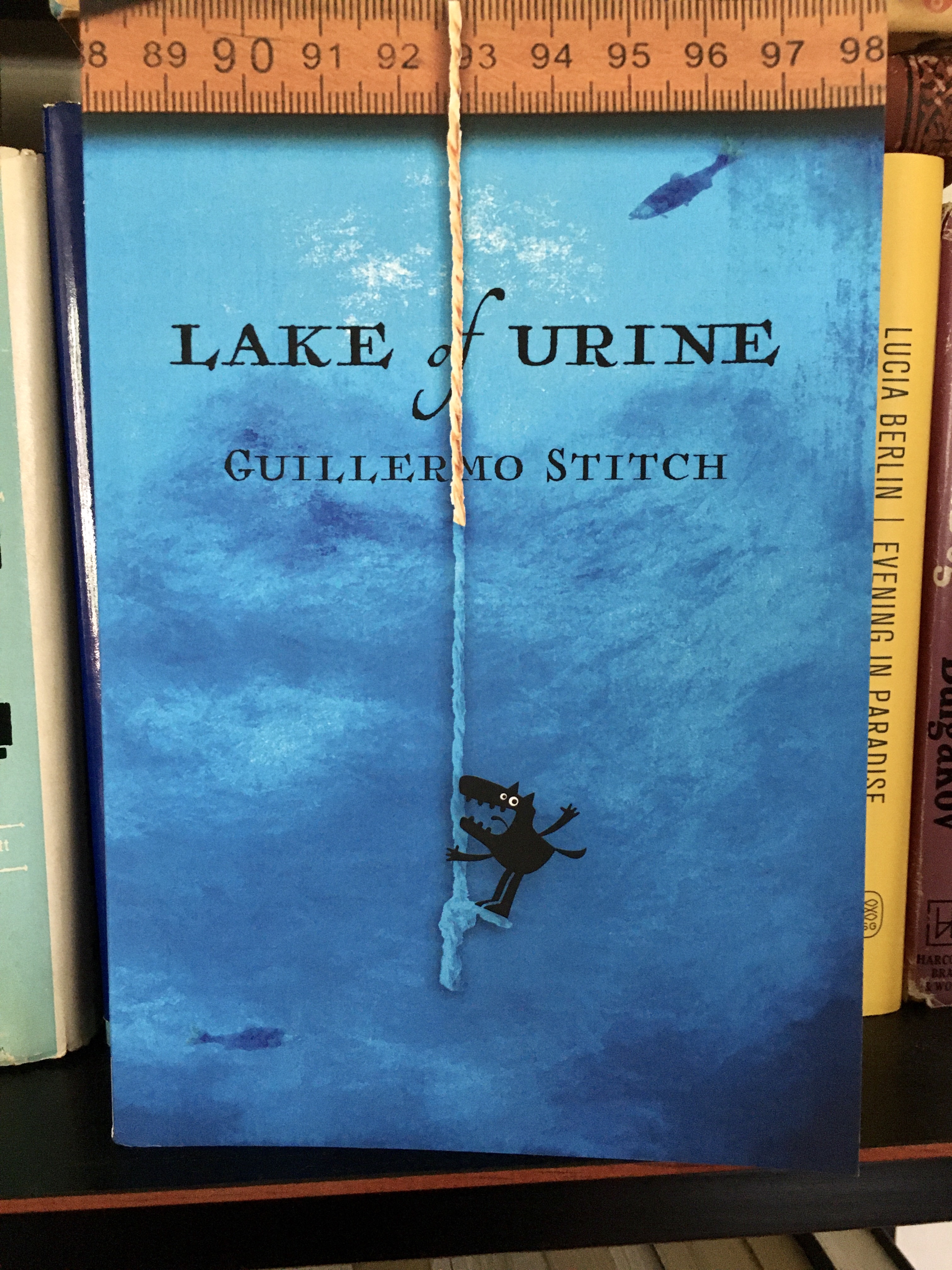
I just finished the first section of Guillermo Stitch’s new novel Lake of Urine (from indie Sagging Meniscus). The beginning of the novel has made me want to read the rest of the novel. It is weird, man, which I guess you’d expect from a novel titled Lake of Urine. So far, the book seems to run on its own comic-logic, a verbal slapstick routine that shifts in voice and tone from paragraph to paragraph. The sentences are fantastic; Stitch’s prose so far reminds me of Barry Hannah and Donald Barthelme, but also definitely its own thing. Here’s a blurb, via the author’s site:
Once upon a time that doesn’t make a blind bit of sense, in a place that seems awfully familiar but definitely doesn’t exist, Willem Seiler’s obsession with measuring his world—with wrapping it up in his beloved string to keep the madness out—wreaks havoc on the Wakeling family.
Noranbole Wakeling lives in the scrub and toil of the pantry, in the ashes of the cold hearth…which, come to think of it, also sounds pretty familiar…She lives, too, in the shadow of her much wooed and cosseted sister, worshipped by the madman Seiler but overlooked by everyone else.
And that, it turns out, is a good thing.
As lives are lost to Seiler’s vanity, the inattention spares her. She spots her chance to break free of the fetters that tie her to Tiny Village—and bolts.
But some cords are never really cut. In her absence, the unravelling of the world she has escaped is complete. Another madness—her mother’s—reaches out to entangle her newfound Big City freedom. The unpicked quilt-work of a life in ruins threatens to ruin her own. It will be up to Noranbole to stitch it all together, into something she can call true.
The blurb doesn’t really capture the energy and humor in Lake of Urine though (let alone its utter weirdness. Here’s an excerpt; the conversation is between Emma Wakeling (mother of Urine and Noranbole) and her tenant, William Seiler:
The melts are not long off.
. . .
Yes?
Yes.
The days grow lengthier and more detailed.
I’m not, eh . . .
You have been here for nine weeks.
Yes.
You may recall the conversation we had in November, Mr Seiler, which resulted in your entering my employ.
A bit formal.
Just answer.
I do remember, yes.
Your brief which I outlined at the time was to be of assistance to me during the winter in the monitoring of my two girls, both of whom were of marriageable age and one of whom was attractive—a siren to the lads of the county.
Yes.
I haven’t asked much else of you.
No.
Apart from the sharpening of some tools. Indeed your . . . remunerations have exceeded what we originally agreed in both nature and degree. Despite your squirreling yourself away in that shed, increasingly. I am only trying to help, you know.
Yes.
A man’s fluids require frequent liberation or they will stew.
Some of the tools are really very blunt.
I have asked for this little chat Mr Seiler because I wish to express my disappointment.
Oh?
Oh? I surprise you? Really? You are surprised? For reals? You didn’t anticipate disappointment here, today?
Well . . .
You need reminding perhaps of yesterday’s unfortunate events? The toesnappingly cold trek through wolf-infested forest? The yelling and the wailing? The gnashing? The wet clouds of breath in the grief-stricken air, the frozen-teared faces of the bereaved? A quick recap?
No, I do remember.
Excellent. You would acknowledge then that as we approach the end of your tenure here one of my girls appears to be—and I recognize that there is some evidential uncertainty here—dead?
That would appear to be the case, yes, notwithstanding the as you say murky specifics.
I am to be grateful I suppose, to be appreciative of the fact that at least it isn’t my Urine who has been lost.
Eh . . .
You give no indication, Mr Seiler, that you recognize the seriousness of the . . . the precariousness of your . . . hm?
Oh, no . . . no, no I can . . . what?
Be under no illusions, Seiler. One more dead daughter and you’re fired.
That does seem fair.
Now lie still. Stop squirming!
Reification #66, 2020 by Dario Maglionico (b. 1986)
 Biblioklept