
Mercury Sent to Admonish Aeneas, by Joseph Mallord William Turner (1775–1851)

Mercury Sent to Admonish Aeneas, by Joseph Mallord William Turner (1775–1851)

PREVIOUSLY:
Introductions + stories 1956-1959
“The Subliminal Man,” Black Friday, and Consumerism
IN THIS RIFF:
“The Reptile Enclosure” (1963)
“A Question of Re-Entry” (1963)
“The Time Tombs” (1963)
“Now Wakes the Sea” (1963)
“The Venus Hunters” (1963)
“End-Game” (1963)
“Minus One” (1963)
“The Sudden Afternoon” (1963)
“The Screen Game” (1963)
“Time of Passage” (1964)
“Prisoner of the Coral Deep” (1964)
“The Lost Leonardo” (1964)
“The Terminal Beach” (1964)
“The Illuminated Man” (1964)
“The Delta at Sunset” (1964)
“The Drowned Giant” (1964)
“The Gioconda of the Twilight Noon” (1964)
“The Volcano Dances” (1964)
“The Reptile Enclosure” (1963) / “A Question of Re-Entry” (1963) / “The Time Tombs” (1963) / “Now Wakes the Sea” (1963) / “The Venus Hunters” (1963) / “Minus One” (1963) / “Prisoner of the Coral Deep” (1964) / “The Illuminated Man” (1964) / “The Delta at Sunset” (1964) / “The Gioconda of the Twilight Noon” /”The Volcano Dances” (1964)
There are 98 stories in The Complete Short Stories of J.G. Ballard. That’s a lot of stories. Maybe too many. Too many for me to write about in full, anyway. I’ve lumped these stories together because they are somewhat unremarkable: Ballard does his Ballardian thing way better elsewhere. Several of these stories feel like sketches (or leftovers) from Ballard’s early novels like The Drowned World, The Burning World, and The Crystal World. Themes of time, memory, art, and nature abound here, usually glommed on to simple adventure narratives or sci-fi pulp treadthroughs. Jungles, watches, crystals, structures, beaches. Misanthropy, paranoia, nagging wives, misunderstood heroes. Man apart from nature, but beholden to nature. Etc. The worst moments of these stories—and we can find these moments all through early Ballard, to be fair—suffer from a bad case of White Man’s Burden doubled up with a shot of misogyny. I’ve written it before in these posts, but the most disappointing aspect of early Ballard is our would-be futurist’s inability to transcend the patriarchal ideology of the post-war era. So now let’s move to the good stuff.
“End-Game” (1963)
I first read “End-Game” when I was sixteen or seventeen, and it’s always stuck with me. It’s the story of a former “party member” who’s been imprisoned under nebulous circumstances—only his prison isn’t that bad—a nice little villa, comfortable, with books and a chess set. He even has a housekeeper. Unfortunately, the housekeeper is also his executioner, and the date and method of the execution is forever withheld from him:
This ironic inversion of the classical Kafkaesque situation, by which, instead of admitting his guilt to a non–existent crime, he was forced to connive in a farce maintaining his innocence of offences he knew full well he had committed, was preserved in his present situation at the execution villa.
The psychological basis was more obscure but in some way far more threatening, the executioner beckoning his victim towards him with a beguiling smile, reassuring him that all was forgiven. Here he played upon, not those unconscious feelings of anxiety and guilt, but that innate conviction of individual survival, that obsessive preoccupation with personal immortality which is merely a disguised form of the universal fear of the image of one’s own death. It was this assurance that all was well, and the absence of any charges of guilt or responsibility, which had made so orderly the queues into the gas chambers.
Ballard directly invokes Kafka, whose tale “Before the Law” comes to mind here (not to mention The Trial and The Castle); “End-Game” also feels like Ballard’s take on 1984. It’s a great little tale, and I think it helps to prove that Ballard is at his best when he sticks to a confined, limited cast and setting. Much of the force of “End-Game” comes from Ballard pitting his prisoner/protagonist against the protagonist’s mental conception of his guard/executioner. Part of my ideal collection, The Essential Short Stories of J.G. Ballard.
“The Sudden Afternoon” (1963) / “Time of Passage” (1964)
In “The Sudden Afternoon” and “Time of Passage,” Ballard explores how time and place—context, I suppose—constitute identity. The former story is a tale of metempsychosis with a troubling take on Indian spirituality, wherein a doctor—an Indian, of course—transplants his psyche and his wife’s psyche into the bodies of another couple (his wife is dying of a terminal disease). Ballard’s own wife died a year after the story was first published (I’m reminded of Poe here, whose wife Virginia died after the publication of “The Raven”). “The Sudden Afternoon” isn’t very good, but structurally we see Ballard beginning to employ something approaching the cut-ups/fragments he’ll move to in the next decade.
“Time of Passage” is essentially a rewrite of F. Scott Fitzgerald’s “The Curious Case of Benjamin Button.” It’s also basically a rewrite of Ballard’s own 1961 tale “Mr. F Is Mr. F” — only this time, Ballard dispenses with abject-horror-for-maternal-body in lieu of a fable-like exploration of what a life in reverse might actually look like. A lovely story. Stick it in The Essentials.
“The Screen Game” (1963)
Another Vermilion Sands story. More insanity. Another femme fatale. An attempt at the story of Orpheus, perhaps. I would have lumped it in with the stories in point 1, but I wanted to clarify: The Vermilion Sands stories are the worst.
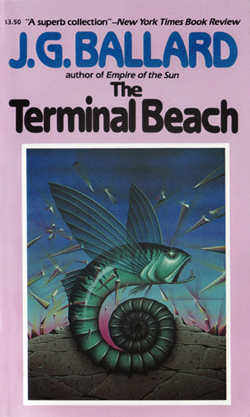
“The Lost Leonardo” (1964)
This is an excellent little detective tale with mystical-magic undertones. I’m a sucker for any story of art theft, too. We all know Dan Brown ripped off Umberto Eco, but maybe Eco ripped off Ballard? Who cares. Lovely stuff. Ballard is excellent at the detective story; Poe is one of his clearest predecessors, but like Poe, he’s more famous for other stuff. Too bad. Let’s call it Essential.
“The Terminal Beach” (1964)
1964’s “The Terminal Beach” is such a big break through for Ballard in terms of formal elements and structuring that it probably deserves its own post, but I’ll jab at it here anyway. Up until now, Ballard’s stories have been notable almost entirely for their ideas—his prose has improved some, but ultimately, the pulp fiction he’s writing for magazine publication constrains him to a pedestrian rhetoric that simply can’t match how far out his concepts are. With “The Terminal Beach,” Ballard finally approaches a narrative structure—fractured, polyglossic, shifting through interiors to exteriors, breaking through different forms—that can match the themes of his tale. The story–clearly an Essential—points to the finest of Ballard’s future work. You can read it here in two parts, but here’s a taste that I think stands alone as a microfiction:
The Fly
(A small fly, which Traven presumes has followed him into the fissure, now buzzes about the corpse’s face. Guiltily, Traven leans forward to kill it, then reflects that perhaps this minuscule sentry has been the corpse’s faithful companion, in return fed on the rich liqueurs and distillations of its pores. Carefully, to avoid injuring the fly, he encourages it to alight on his wrist.)
DR YASUDA: Thank you, Traven. In my position, you understand
TRAVEN: Of course, Doctor. I’m sorry I tried to kill it – these ingrained habits, you know, they’re not easy to shrug off. Your sister’s children in Osaka in ’44, the exigencies of war, I hate to plead them. Most known motives are so despicable, one searches the unknown in the hope that YASUDA: Please, Traven, do not be embarrassed. The fly is lucky to retain its identity for so long. ‘That son you mourn, not to mention my own two nieces and nephew, did they not die each day? Every parent in the world grieves for the lost sons and daughters of their earlier childhoods.
TRAVEN: You’re very tolerant, Doctor. I wouldn’t dare – YASUDA: Not at all, Traven. I make no apologies for you. Each of us is little more than the meagre residue of the infinite unrealized possibilities of our lives. But your son, and my nephew, are fixed in our minds forever, their identities as certain as the stars.
TRAVEN: (not entirely convinced) That may be so, Doctor, but it leads to a dangerous conclusion in the case of this island. For instance, the blocks – YASUDA: They are precisely what I refer to, Traven. Here among the blocks you at last find an image of yourself free of the hazards of time and space. This islandis an ontological Garden of Eden, why seek to expel yourself into a world of quantal flux?
TRAVEN: Excuse me (The fly has flown back to the corpse’s face and sits in one of the dried-up orbits, giving the good doctor an expression of quizzical beadiness. Reaching forward, Traven entices it on to his palm. He examines it carefully) Well, yes, these bunkers may be ontological objects, but whether this is the ontological fly is doubtful. It’s true that on this island it’s the only fly, which is the next best thing
YASUDA: You can’t accept the plurality of the universe – ask yourself why, Traven. Why should this obsess you? It seems to me that you are hunting for the white leviathan, zero. The beach is a dangerous zone. Avoid it. Have a proper humility, pursue a philosophy of acceptance.
TRAVEN: Then may I ask why you came here, Doctor?
YASUDA: To feed this fly. ‘What greater love – ?’
TRAVEN: (Still puzzling) It doesn’t really solve my problem. The blocks, you see
YASUDA: Very well, if you must have it that way
TRAVEN: But, Doctor
YASUDA: (Peremptorily) Kill that fly!
TRAVEN: That’s not an end, or a beginning.
(Hopelessly, he kills the fly. Exhausted, he falls asleep beside the corpse.)
“The Drowned Giant” (1964)
Another Essential, this puzzling fable readily recalls Gabriel García Márquez’s story “A Very Old Man with Enormous Wings.” Ballard rarely handles archetypes so directly as he does here. Even if the story’s theme seems almost too-plain—we lose the miracle, we cast down the old gods, we deny the sublime, etc.—its construction and telling are wonderfully achieved.
The lower jaw, typically, found its way to the museum of natural history. The remainder of the skull has disappeared, but is probably still lurking in the waste grounds or private gardens of the city – quite recently, while sailing down the river, I noticed two ribs of the giant forming a decorative arch in a waterside garden, possibly confused with the jaw–bones of a whale. A large square of tanned and tattooed skin, the size of an indian blanket, forms a backcloth to the dolls and masks in a novelty shop near the amusement park, and I have no doubt that elsewhere in the city, in the hotels or golf clubs, the mummified nose or ears of the giant hang from the wall above a fireplace. As for the immense pizzle, this ends its days in the freak museum of a circus which travels up and down the north–west. This monumental apparatus, stunning in its proportions and sometime potency, occupies a complete booth to itself. The irony is that it is wrongly identified as that of a whale, and indeed most people, even those who first saw him cast up on the shore after the storm, now remember the giant, if at all, as a large sea beast.
On the horizon:
Ballard plays with fragmentation again in “The Beach Murders” and “The Assassination of John Fitzgerald Kennedy Considered as a Downhill Motor Race” — and we finally get to his stories of the late sixties.
[Ed. note: Biblioklept originally ran a series of posts on The Complete Short Stories of J.G. Ballard between October 2013 and March 2014.]

Venus and Adonis, 1981 by Stephen McKenna (1939–2017)

A Boy Reading, c. 1795 by Ramsay Richard Reinagle (1775–1862)
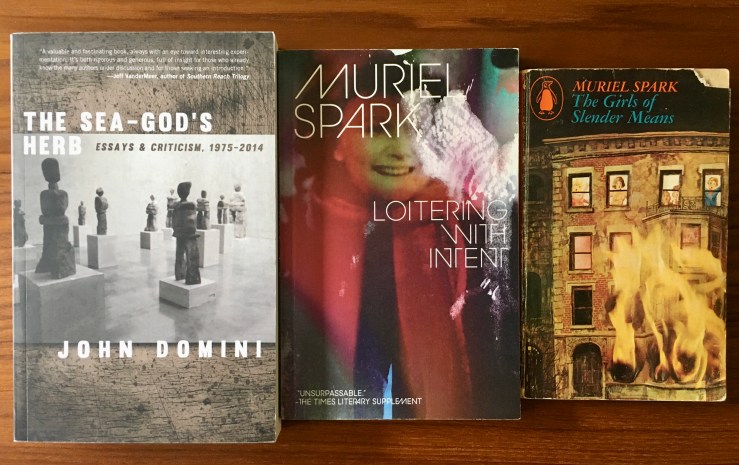
I dropped by the bookstore yesterday to pick up some more books by Muriel Spark. I finished her novel The Prime of Miss Jean Brodie over the Memorial Day weekend and was hungry for more. I picked out Loitering with Intent and The Girls of Slender Means, mostly because of the covers and titles.
I read about half of The Girls of Slender Means yesterday and this morning, and it’s really good. Set primarily “Long ago in 1945,” Girls focuses on a few months in the lives of some of the titular inhabitants of the “May of Teck Club.” The narrator dips between the consciousness of a few of these “girls of good family but slender means,” but focuses primarily on Jane Wright, a would-be member of the “world of books” whose 1963 phone calls to some of the other “girls” frames the narrative proper. It’s witty stuff, occasionally vicious, and even includes some literary hoaxing! I’ll probably finish it tonight.
I also picked up John Domini’s collection of literary criticism, The Sea-God’s Herb, which I’ve been wanting to pick through for ages now. When I spied the unbroken spine, I assumed it was new, but no–just unread. I opened it up to find the price and saw that not only was the book used (half cover price), it was signed by the author. On top of that, this copy was inscribed to another author, a somewhat-famous sci-fi writer (you might have seen a recent film adaptation of one of his novels). Anyway, it was a strange find.
[Ed. note: Biblioklept originally ran a series of posts on The Complete Short Stories of J.G. Ballard between October 2013 and March 2014.]
Today is Black Friday in America. I don’t think it’s necessary to remark at length on the bizarre disjunction between this exercise in consumerism-as-culture and the intended spirit of the Thanksgiving holiday that precedes it. Indeed, I think that the cognitive dissonance that underwrites Black Friday—the compulsion to suffer (and cause suffering), both physically and mentally, to “save” money on “consumer goods” (sorry for all the scare quotes, but these terms are euphemisms and must be placed under suspicion)—I think that this cognitive dissonance is nakedly apparent to all who choose to (or are forced to) actively engage in Black Friday. The name itself is dark, ominous, wonderfully satanic.
Rereading “The Subliminal Man,” I was struck by how presciently J.G. Ballard anticipated not only the contours of consumerist culture—urban sprawl, a debt-based economy, the mechanization of leisure, the illusion of freedom of choice—but also how closely he intuited the human, psychological responses to the consumerist society he saw on the horizon. Half a century after its publication, “The Subliminal Man” seems more relevant than ever.
The premise of the tale is fairly straightforward and fits neatly with the schema of many other early Ballard stories: Franklin, an overworked doctor, is approached by Hathaway, a “crazy beatnik,” who refuses to take part in the non-stop consumerism of contemporary society. Hathaway can “see” the subliminal messages sent through advertising. He asks for Franklin’s help in stopping the spread of these messages. Hathaway reasons that the messages are intended to enforce consumerist society:
Ultimately we’ll all be working and spending twenty–four hours a day, seven days a week. No one will dare refuse. Think what a slump would mean – millions of lay–offs, people with time on their hands and nothing to spend it on. Real leisure, not just time spent buying things . . .
The fear of a slump. You know the new economic dogmas. Unless output rises by a steady inflationary five per cent the economy is stagnating. Ten years ago increased efficiency alone would raise output, but the advantages there are minimal now and only one thing is left. More work. Subliminal advertising will provide the spur.
Franklin is unconvinced, even though he is already working Saturdays and Sunday mornings to payoff TVs, radios, and other electronic goods that he and his wife replace every few months. Soon, however, he realizes that something is wrong:
He began his inventory after hearing the newscast, and discovered that in the previous fortnight he and Judith had traded in their Car (previous model 2 months old) 2 TV sets (4 months) Power mower (7 months) Electric cooker (5 months) Hair dryer (4 months) Refrigerator (3 months) 2 radios (7 months) Record player (5 months) Cocktail bar (8 months)
Franklin finally sees the truth, but only after Hathaway takes to blowing up signs’ switch boxes (the word “terrorism” is of course not used in the text, although it surely would be today):
Then the flicker of lights cleared and steadied, blazing out continuously, and together the crowd looked up at the decks of brilliant letters. The phrases, and every combination of them possible, were entirely familiar, and Franklin knew that he had been reading them for weeks as he passed up and down the expressway.
BUY NOW BUY NOW BUY NOW BUY NOW BUY NEW CAR NOW NEW CAR NOW NEW CAR NOW
YES YES YES YES YES YES YES YES YES YES
Like many Ballard stories, “The Subliminal Man” ends on a pessimistic note, with Franklin choosing to ignore his brief enlightenment and give in. Ballard drives his criticism home in the final image of the story, with Franklin and his wife heading out to shop:
They walked out into the trim drive, the shadows of the signs swinging across the quiet neighbourhood as the day progressed, sweeping over the heads of the people on their way to the supermarket like the blades of enormous scythes.
“The Subliminal Man” offers a critique of consumerism that John Carpenter would make with more humor, violence, and force in his 1988 film They Live. In Carpenter’s film, the hero John Nada (played by Roddy Piper) finds a pair of sunglasses that allow him to see through the ads, billboards, and other commercials he’s exposed. What’s underneath? Naked consumerism:
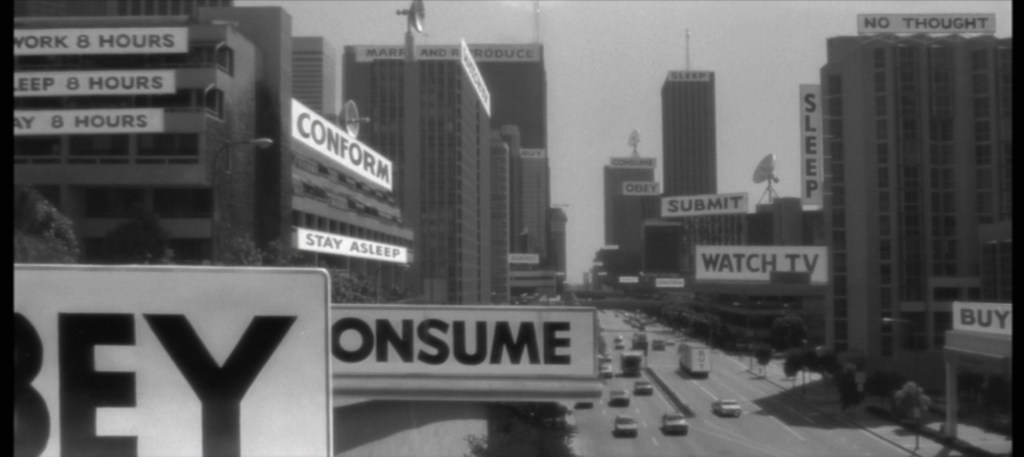
The images here recall the opening lines of “The Subliminal Man”: ‘The signs, Doctor! Have you seen the signs?’ Like Ballard’s story, Carpenter’s film is about waking up, to seeing the controlling messages under the surface.
In his film The Pervert’s Guide to Ideology, Slavoj Žižek offers a compelling critique of just how painful it is to wake up to these messages:
It’s worth pointing out that Carpenter offers a far more optimistic vision than Ballard. Ballard’s hero gives in—goes back to sleep, shuts his eyes. Carpenter’s hero Nada resists the subliminal messages—he actually takes up arms against them. This active resistance is possible because Carpenter allows his narrative an existential escape hatch: In They Live, there are real, genuine bad guys, body-snatching ugly-assed aliens—others that have imposed consumerism on humanity to enslave them. That’s the big trick to They Live: It’s not us, it’s them.
Ballard understands that there is no them; indeed, even as the story skirts around the idea of a conspiracy to dupe consumers into cycles of nonstop buying, working, and disposing, it never pins that conspiracy on any individual or group. There’s no attack on corporations or government—there’s not even a nebulous “them” or “they” that appears to have controlling agency in “The Subliminal Man.” Rather, Ballard’s story posits ideology as the controlling force, with the only escape a kind of forced suicide.
I don’t think that those who engage in consumerism-as-sport, in shopping-as-a-feeling are as blind as Ballard or Carpenter represent. I think they are aware. Hell, they enjoy it. What I think Ballard and Carpenter (and others, of course) really point to is the deep dissatisfaction that many of us feel with this dominant mode of life. For Ballard, we have resistance in the form of the beatnik Hathaway, an artist, a creator, a person who can perceive what real leisure would mean. For Carpenter, Nada is the resister—an outsider, a loner, a weirdo too. It’s somehow far more satisfying to believe that those who engage in spectacle consumerism are brainwashed by aliens than it is to have to come to terms with the notion that these people are acting through their own agency, of their own will and volition. Happy shopping everyone!

Entrapped Otter, c. 1830 by John James Audubon (1785–1851).
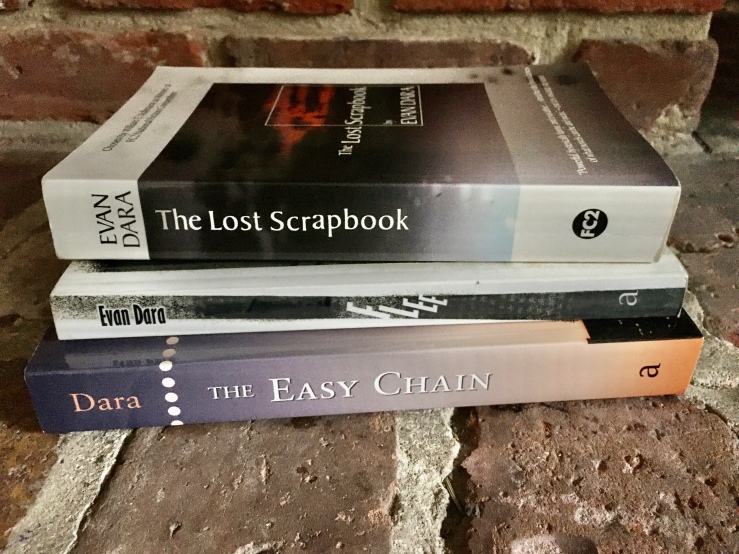
Literary critic Daniel Green has written a longish essay on the writings of Evan Dara. Titled, “Giving Voice: On the Work of Evan Dara,” the essay situates Dara’s work within the context of its postmodern forebears and so-called “experimental” literature in general. Green contends that,
…it is obvious once one begins reading these novels that the author wants to subvert any presumptions we might have that the novel we are reading will bear enough family resemblance to those we have read before that it will be explicable according to the “rules” we believe we have learned about how novels should proceed. Clearly it intends to replace those rules with others applicable only to this work (although any one of Dara’s novels certainly does then provide direction in reading the others), rules that we will have to learn as we read. In this way, Dara’s novels work like all of their predecessors in the lineage of “experimental” fiction, presenting the reader with a heterodox formal arrangement the reader must learn to assimilate by attending closely to the new patterns the work establishes as alternatives to those patterns more conventional fiction has predisposed us to expect. Indeed, in the challenge they pose to the assumption that the conventional patterns define the novel as a form, Dara’s novels are arguably the most radically disruptive books in American fiction since, say, Gilbert Sorrentino in a work like Mulligan Stew (1979)
Much of Green’s essay is devoted to Dara’s 1995 debut, The Lost Scrapbook, which is a great starting point for anyone interested in Dara. Green describes The Lost Scrapbook as a work that
seems to consist of a series of disconnected episodes (some longer than others) leaning heavily on interior monologue and introducing “characters” whose relationships to each other are not immediately apparent. Moreover, these self-standing scenes don’t merely succeed each other but at times appear to merge, one dissolving into the other, as if the novel’s discourse represents a radio set whose dial is being tuned, bringing in one station before moving on to another.
Green also discusses Dara’s follow-ups to The Lost Scrapbook, 2007’s The Easy Chain and 2013’s Flee, as well as Dara’s most recent work, a 2018 play titled Provisional Biography of Mose Eakins. Green’s reading of the latter seems to inform his conclusion that Dara is ultimately “a moralist, not an aesthete,” a claim that I’m not quite sure I fully agree with (maybe he’s both?)—but I haven’t reread the works (although reading Green’s essay makes me want to). Green’s essay is, to my knowledge the only lengthy measure of Dara’s career to date, although I’m sure it won’t be the last of this under-read and important contemporary writer.
Read “Giving Voice: On the Work of Evan Dara” by Daniel Green.
Read my 2016 interview with Daniel Green.
Read my review of Evan Dara’s play Provisional Biography of Mose Eakins.

[Ed. note: Biblioklept originally ran this review in January, 2020 and is posting it again today as Uncut Gems is now streaming in the U.S. on Netflix.]
Frenetic, chaotic, and unceasingly energetic, the Safdie brothers’ 2019 film Uncut Gems plays out like a two-hour panic attack. Uncut Gems opens in the turbulent aftermath of a mining accident. An Ethiopian mine worker is borne up by his frenzied fellows, his leg a raw mangled bloody mess. The Ethiopian workers’ voices mix into the Chinese mine operators’ attempts to calm the situation. This initial cacophony signals the babble and buzz that will continue through the rest of the film, and the camera’s lingering on the destroyed leg signals the violent cost that underwrites the material splendor at the heart of Uncut Gems.
Two Ethiopian miners take a gamble and use the chaos as an opportunity to sneak away, back into the mine to make off with a rare black opal, the titular uncut gem. One of the miners peers into the gem, and the camera follows his gaze. We are taken into a kaleidoscope of shifting colors as Daniel Lopatin’s beautiful synth score kicks in. The camera swirls through the gem and, in an opening sequence that rivals Gaspar Noé’s Enter the Void, eventually enters the colon of our hero, Howard Ratner.
A title card informs us it is two years later. It is 2012 in New York City and Howard Ratner is getting a colonoscopy. There is probably some metaphor here—the aesthetic journey from the gem’s dazzle of color to the interior glistening-chewing-gum-pink flesh of Howard’s colon—but I’ll avoid remarking further upon it.
Here is the film’s premise: Howard owns and runs a jewelry store in the Diamond District. His associate Demany brings rappers and athletes to him to buy unique, high-end pieces. He is flush with cash all the time, but is also severely indebted to a loan shark named Arno (among other folks). However, his debts don’t stop him from continuing to place bets. He is also in the middle of an affair with one of his employees, Julia, whom he keeps in his Manhattan apartment, barely-concealed from his wife and children in Long Island.
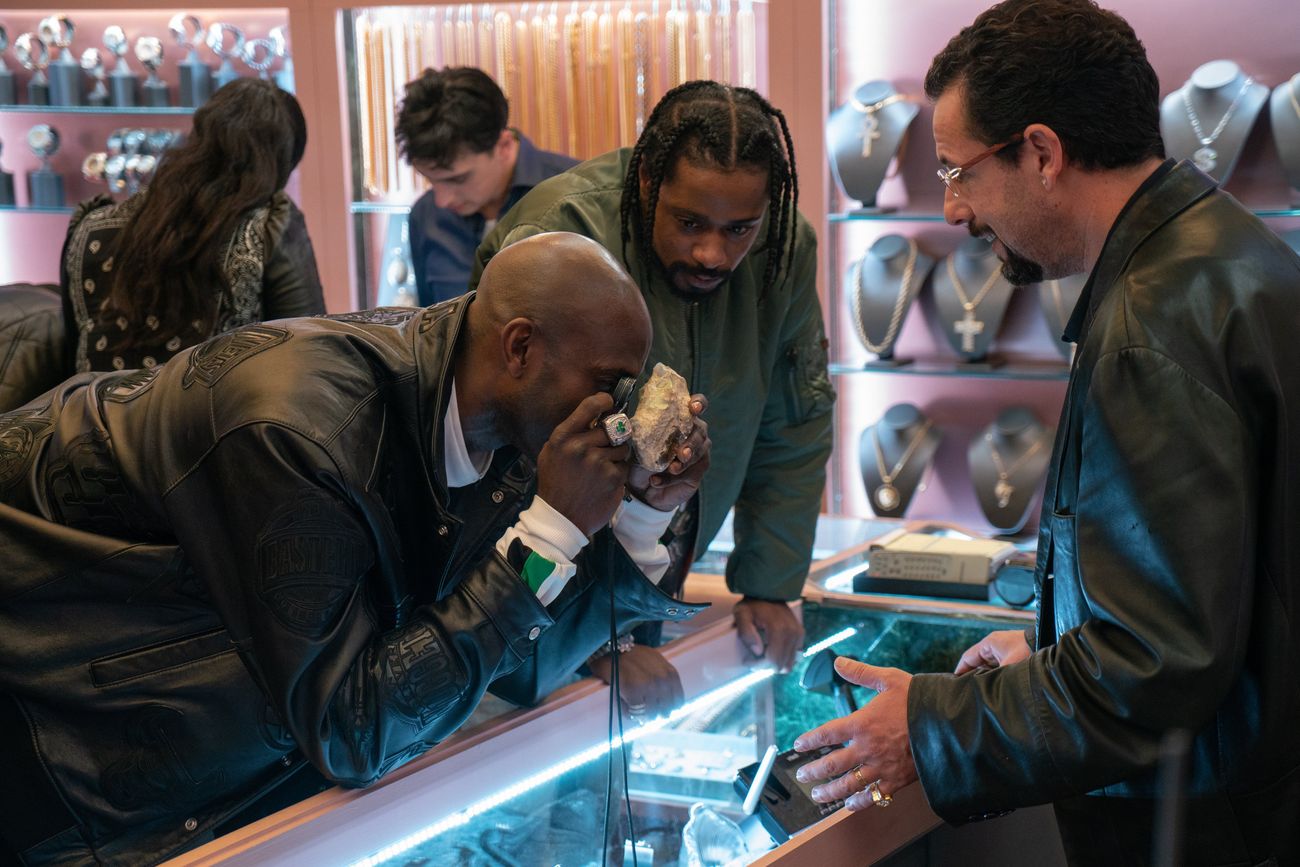
Three things happen on the day we meet Howard: Arno’s henchmen come to prove good on their threats of violence towards him if he does not pay back his loans; Demany brings Boston Celtics power forward Kevin Garnett to Howard’s shop; and Howard receives the titular uncut black opal, which he plans to sell at auction for at least a million dollars. Seeking to impress Kevin Garnett (“KG!”), the jeweler shows off his opal, Ratner’s star. In one of the film’s most extraordinary visual sequences, KG gazes into the opal and undergoes a seismic epiphany. He demands to buy the gem, but Howard refuses—he needs the money from the auction to get clean of debt. However, Howard allows KG to borrow the gem for the night, taking Garnett’s 2008 NBA Championship ring as collateral for its return. KG is convinced that the gem will lead to his success in that night’s Eastern Conference Semifinals game against the Philadelphia ’76ers (it does).
From this early point in the film Howard goes on to make a series of increasingly-nerve-wracking decisions against the backdrop of his loan shark’s enforcers’ increasingly-violent promises of retribution. I will not spoil any more of the plot—my “premise” paragraph seems too long as it is—I’ll simply say that there were moments that I (and other audience members) audibly gasped (in shock, in exasperation, in frustrated disbelief) at Howard’s choices.
Uncut Gems never really lets up. There are a few moments of respite as well as moments of comedy, but they mostly serve to suspend the anxiety the film creates, not release it. Uncut Gems is a horror film posing as a crime thriller, an anxiety film equal to Aronofsky’s mother! or Polanski’s Repulsion. The Safdies conjure a hectic, bustling world in Uncut Gems, a world of babble and noise and beauty and ugliness. Characters crowd the frames, their voices colliding in a way reminiscent of the films of Altman, Cassavetes, or early Scorsese.
Under and through the noise of voices in Uncut Gems floats Daniel Lopatin’s wonderful score. Waves of synths swing between between evocations of romance and horror; menacing swells and whimsical melodies, simultaneously busy and calming, cascade over the film. Lopatin, better known as the electronic artist Oneohtrix Point Never, is a highlight of this film.
Another highlight of Uncut Gems is Darius Khondji’s cinematography. The saturated shots are reminiscent of his work on Wong Kar-Wai’s under-rated 2007 film My Blueberry Nights (as well as his work the same year on Haneke’s equally-anxiety-producing black comedy/horror Funny Games). Khondji conjures a candy-colored Manhattan, lush and opulent. The painterly frames are seductive but also dangerous, recalling the neon-noir of films by Gaspar Noé and Nicolas Winding Refn.
And of course the acting. I have spent close to 800 words not pointing out that this is an Adam Sandler film. Sandler inhabits his role as Howard Ratner with a vibrating energy that is hard to capture in words. It’s hard to imagine any one else playing the part. Sandler’s Howard is a degenerate gambler, addicted to the thrills of his own confidence games, a trickster blowing up his life in real time. He’s in love with his own chaos, and it’s hard not to root for him, even as he destroys everything around him.
Kevin Garnett is fantastic as himself. His eyes are especially expressive, and his screen presence is utterly natural. His final scene with Sandler’s Howard is a highlight of the film, as he seems to deliver any sane person’s remarks to the gambling addict. Lakieth Stanfield is also excellent in the film as Demany, Howard’s procurer. He both balances and matches Howard’s energetic chaos, even if he can’t ground his erstwhile partner. Eric Bogosian brings ballast to the role of Arno, Howard’s loan shark, as does Judd Hirsch, playing his father-in-law. Idina Menzel plays Howard’s (soon-to-be-ex-) wife with an unflinching meanness that the character deserves. Newcomer Julia Fox is a standout as Julia, Howard’s mistress. She enables Howard, but in some ways she’s also the hero of the film.
Uncut Gems is a very good film and I was very relieved when it was over. The Safdie brothers have created something that sustains a feeling that many of us take SSRIs to avoid. “Wow, I really hated that,” the young woman next to me remarked to her date as the closing credits began. I can understand that reaction. Uncut Gems will not be entertaining for most folks, but I thought it was great. Its initial evocations of worldly violence as the cost of worldly pleasures are answered in its final moments. Catch it in the theater if you can.
PREVIOUSLY:
Introductions + stories 1956-1959
IN THIS RIFF:
Nine stories published in 1962:
“The Insane Ones”
“The Garden of Time”
“The Thousand Dreams of Stellavista”
“Thirteen to Centaurus”
“Passport to Eternity”
“The Cage of Sand”
“The Watch Towers”
“The Singing Statues”
“Man on the 99th Floor”
“The Insane Ones” (1962)
Psychology, and particularly subliminal psychology, remained a major theme throughout Ballard’s writing career. “The Insane Ones” is a thought-experiment that examines what might happen if libertarianism were taken to its most extreme:
The Mental Freedom legislation enacted ten years earlier by the ultraconservative UW government had banned the profession outright and enshrined the individual’s freedom to be insane if he wanted to, provided he paid the full civil consequences for any infringements of the law. That was the catch, the hidden object of the MF laws. What had begun as a popular reaction against ‘subliminal living’ and the uncontrolled extension of techniques of mass manipulation for political and economic ends had quickly developed into a systematic attack on the psychological sciences. Overpermissive courts of law with their condoning of delinquency, pseudo–enlightened penal reformers, ‘Victims of society’, the psychologist and his patient all came under fierce attack. Discharging their self–hate and anxiety onto a convenient scapegoat, the new rulers, and the great majority electing them, outlawed all forms of psychic control, from the innocent market survey to lobotomy. The mentally ill were on their own, spared pity and consideration, made to pay to the hilt for their failings. The sacred cow of the community was the psychotic, free to wander where he wanted, drooling on the doorsteps, sleeping on sidewalks, and woe betide anyone who tried to help him.
“The Insane Ones” isn’t a particularly good story—as is the case with many of the tales in The Complete Stories, it’s mostly an excuse to tease out a speculative notion—but its conceit of a lack of adequate health care set against the backdrop of reactionary politics seems particularly germane today.
“The Garden of Time” (1962)
“The Garden of Time” is an oddity in Ballard’s oeuvre. Most of his short stories take cues from Edgar Allan Poe, but “The Garden of Time,” a direct allegory, is pure-Hawthorne territory, a dark fairy tale with fantasy tropes unusual for Ballard. Count Axel and his darling wife live in a perfect Edenic space that they maintain by picking flowers that “freeze” time. At the periphery, a mechanized mob approaches:
At first glance, the long ranks seemed to be progressing in orderly lines, but on closer inspection, it was apparent that, like the obscured detail of a Goya landscape, the army was composed of a vast throng of people, men and women, interspersed with a few soldiers in ragged uniforms, pressing forward in a disorganized tide. Some laboured under heavy loads suspended from crude yokes around their necks, others struggled with cumbersome wooden carts, their hands wrenching at the wheel spokes, a few trudged on alone, but all moved on at the same pace, bowed backs illuminated in the fleeting sun.
I’m not sure how to read the tale—it seems that Ballard identifies the horde, the mob, as a dumb, dim force of history, a consumer society that will destroy the last vestiges of High Culture embodied by the graceful Count and his wife, the aristocrats who understand Truth and Beauty and Art &c. I think there’s a streak of conservatism here, a tendency that we might not immediately think of when we think of Ballard the futurist.
“The Thousand Dreams of Stellavista” (1962)
Another Vermilion Sands story, “Stellavista” takes on architecture. This is basically a haunted house story; the Ballardian trick here is the psychotropic house, dwellings that echo “every shift of mood and position of the occupants.” Young couple buys house, house is haunted, etc. The conceit is interesting, but again, Ballard’s not particularly inclined to write it in anything outside of a standard pulp fiction (or doesn’t seem to know how to yet).
Ballard’s treatment of his female characters is what I find most interesting here. As always, they seem to be divided into just a few classes: The wife, an unimaginative nag; the mysterious (and impossible to understand) ingenue; the mad, abandoned old woman (shades of Miss Havisham); and the abject, consuming Villain-Woman. Ballard often combines the last three types, but they are always set in opposition to the housewife. More on this in a moment.
“Thirteen to Centaurus” (1962)
“Thirteen to Centaurus” belongs in what I’ve been calling The Essential Short Stories of J.G. Ballard, a collection of the best stuff here. Each Ballard story is essentially a trick or a thought experiment—the tale is just a delivery system, a frame. Ballard here employs a metaframe; sure, the story is still composed in the tropes and language of pulp fiction, but Ballard shows signs of breaking out. In some ways, “Thirteen to Centaurus” is a rewrite of “Manhole 69” (which I also suggested is Essential). I haven’t described the plot and won’t—I think the story is probably better read without preview or explication.
“Passport to Eternity” (1962)
“Passport to Eternity” highlights Ballard’s greatest imaginative failure. This is a guy who can conceive of every kind of fantasy trip—extraterrestrial adventures, private-war-as-vacation, space safari (the occasion for the story here is a list of surreal vacations; the story would read much, much better as just that list). Yes, Ballard can conceive of any kind of future, except one where a woman is something other than a house wife:
For several centuries now the managerial and technocratic elite had been so preoccupied with the work of government that they relied on the Templars of Aphrodite not merely to guard their wives from any marauding suitors but also to keep them amused and contented. By definition, of course, their relationship was platonic, a pleasant revival of the old chivalrous ideals…
Even if Ballard is poking ironic fun here (and I don’t think that’s the case), his framing is aggressively chauvinistic; not only does the “managerial and technocratic elite” appear to exclude women, the underlying anxiety of cuckoldry manifests in a social structure that must manage (and contain) women’s passions and sexualities. There’s something aggressively misogynistic here, a streak that finds its twin in Ballard’s abjectification of women elsewhere in the stories (I wrote above that he only conceives women as house wives—not quite true—they can also be consuming monsters in the Ballardverse).
“The Cage of Sand” (1962)
Astronauts. Ecology. Etc. Pass.
“The Watch-Towers” (1962)
“The Watch Towers” is basically an extended riff on how churches institutionalize power and regulate behavior. Ballard’s trick here is to elide or omit any language that would directly evoke religion or spirituality though. The story also gets its power comes from its bare simplicity, its lack of ornamentation—one can sense Ballard’s restraint here. The story would likely be more successful stripped even further—something closer to Shirley Jackson’s “The Lottery,” which it echoes. There are also shades here of a particularly English brand of hauntology—The Prisoner and The Wicker Man come to mind.
“The Singing Statues” (1962)
“The Singing Statues” feels like a rewrite of several of Ballard’s Vermilion Sands stories. I suppose collected together in their own volume, the Vermilion Sands tales might read like a novel-in-stories, a work through of central themes, images, and ideas—but dispersed in The Collected Stories they get swallowed. They read like repetitions. Stale.
“Man on the 99th Floor” (1962)
Ballard handles subliminal suggestion much better in the next tale, “The Subliminal Man.” So I’ll take a pass on this one in anticipation of one of Ballard’s best.
[Ed. note: Biblioklept originally ran a series of posts on The Complete Short Stories of J.G. Ballard between October 2013 and March 2014.]

Athena Noctua, 2015 by Agostino Arrivabene (b. 1967)
“Some Notes on ‘Flying’ Ointments”
by
Prof. A. J. Clark
(from The Witch-Cult in Western Europe: A Study in Anthropology by Margaret Alice Murray Alice)
The three formulae for the ‘flying’ ointment used by witches are as follows:
1. Du persil, de l’eau de l’Aconite, des feuilles de Peuple, et de la suye.
2. De la Berle, de l’Acorum vulgaire, de la Quintefeuille, du sang de chauuesouris, de la Morelle endormante, et de l’huyle.
3. De graisse d’enfant, de suc d’Ache, d’Aconite, de Quintefeuille, de Morelle, et de suye.
These formulae may be translated as follows:
1. Parsley, water of aconite, poplar leaves, and soot.
2. Water parsnip, sweet flag, cinquefoil, bat’s blood, deadly nightshade, and oil.
3. Baby’s fat, juice of water parsnip, aconite, cinquefoil, deadly nightshade, and soot.
These prescriptions show that the society of witches had a very creditable knowledge of the art of poisoning: aconite and deadly nightshade or belladonna are two of the three most poisonous plants growing freely in Europe, the third is hemlock, and in all probability ‘persil’ refers to hemlock and not to the harmless parsley, which it resembles closely.
The other ingredients have no marked toxic action, unless ‘berle’ and ‘ache’ refer not to the harmless water parsnip but to the poisonous water hemlock or cowbane. The baby’s fat and bat’s blood would of course have no action.
Aconite was one of the best-known poisons in ancient times; indeed it was so extensively used by professional poisoners in Rome during the Empire that a law was passed making its cultivation a capital offence. Aconite root contains about 0.4 per cent. of alkaloid and one-fifteenth of a grain of the alkaloid is a lethal dose. The drug has little effect upon the consciousness, but produces slowing, irregularity, and finally arrest of the heart.
The use of belladonna as a poison was also known in classical[280] times; fourteen of the berries have been known to produce death; a moderate dose will produce wild excitement and delirium.
Hemlock is also a well-known and ancient poison; the fruit may contain as much as 0.9 per cent. of alkaloid, and ¼ grain of the alkaloid may produce death. The action of hemlock usually is to produce a gradual motor paralysis, consciousness being unimpaired, and death being caused by paralysis of respiration, but sometimes hemlock may produce delirium and excitement.
There is no doubt, therefore, about the efficacy of these prescriptions and their ability to produce physiological effects. They were administered by being rubbed into the skin, which is not an efficient way of introducing most drugs into the body, indeed some have denied that alkaloids can be absorbed from the unbroken skin; but there is no doubt that alkaloids can be absorbed when rubbed into scratches or into the quick of the nails, and it must be remembered that an unbroken skin is only possessed by those who are free from vermin and who wash regularly, and neither of these conditions would be likely to apply to a mediaeval witch. Cases of poisoning associated with delirium have actually been recorded following the application of belladonna plasters to the skin.
Of the three prescriptions the first is a watery solution and would not be very efficacious when rubbed into the skin, but the second and third are ointments, and if they were rubbed into the skin in sufficient quantities definite physiological results would be produced.
The first preparation, which contains hemlock and aconite, would produce mental confusion, impaired movement, irregular action of the heart, dizziness and shortness of breath.
The belladonna in the second ointment would produce excitement which might pass into delirium.
The third ointment, containing both aconite and belladonna, would produce excitement and irregular action of the heart.
I cannot say whether any of these drugs would produce the impression of flying, but I consider the use of aconite interesting in this respect. Irregular action of the heart in a person falling asleep produces the well-known sensation of suddenly falling through space, and it seems quite possible that the combination of a delirifacient like belladonna with a drug producing irregular action of the heart like aconite might produce the sensation of flying.
It IS You (and me too), 2017 by Gregory Ferrand (b. 1975)

PREVIOUSLY:
Introductions + stories 1956-1959
IN THIS RIFF:
Stories published in 1961:
“Studio 5, The Stars”
“Deep End”
“The Overloaded Man”
“Mr. F Is Mr. F”
“Billennium”
“The Gentle Assassin”
“Studio 5, The Stars” (1961)
“Studio 5, The Stars” takes poetry as its subject and is the first story in The Complete Short Stories to focus on writing. Ballard’s tales usually concern some aspect of art, but up until now he’s been mainly concerned with music (and to a lesser extent visual art).
“Studio 5, The Stars” is the third tale in the collection set in “the crazy season at Vermilion Sands.” Our narrator is the editor of “Wave IX, an avant–garde poetry review.” Ballard constructs his story around the conceit that writing poetry has become (quite literally) a soulless, mechanical activity. Our narrator explains to his interlocutor:
I used to write a fair amount myself years ago, but the impulse faded as soon as I could afford a VT set. In the old days a poet had to sacrifice himself in order to master his medium. Now that technical mastery is simply a question of pushing a button, selecting metre, rhyme, assonance on a dial, there’s no need for sacrifice, no ideal to invent to make the sacrifice worthwhile –
Our narrator’s interlocutor is Aurora Day, a femme fatale who either is or believes she is “Melander,” an archetypal muse of poetry (invented by Ballard, of course). Aurora is distraught over the state of poetry. And no wonder. Verse is now composed on a “VT set”:
‘Hold on,’ I told him. I was pasting down one of the Xero’s satirical pastiches of Rupert Brooke and was six lines short. I handed Tony the master tape and he played it into the IBM, set the metre, rhyme scheme, verbal pairs, and then switched on, waited for the tape to chunter out of the delivery head, tore off six lines and passed them back to me. I didn’t even need to read them.
The story can perhaps be condensed into this wonderful line:
Fifty years ago a few people wrote poetry, but no one read it. Now no one writes it either. The VT set merely simplifies the whole process.
In his introduction to the collection, Ballard insisted that he “was interested in the real future” he saw coming, not an invented one. The notion of machines recording art that no one will bother to read seems particularly resonant today. Reading “Studio 5, The Stars,” I was reminded of Kenneth Goldsmith’s recent “art” project/stunt of printing the internet. There’s also something in the VT that recalls Slavoj Žižek’s riff on VCRs, machines recording and storing films that the viewer will never actually watch.
“Studio 5, The Stars” takes aim at a commercial culture that pays lip service to the high ideals of “culture” while simultaneously insuring that “culture” can be consumed at no sacrifice—no work—on the part of the consumer.
“Deep End” (1961)
Humanity migrates to Mars after sucking all the resources from the Earth. “Deep End” is a brief tale (and another in the collection to feature one of Ballard’s signature images, the drained swimming pool). An ecological dystopia, “Deep End” feels like a sketch for something bigger—but it gains power from its brevity, and Ballard is content to focus his energies on just a few characters and one core idea here. The restraint pays off in the story’s nihilistic punchline, which I won’t spoil here.

“The Overloaded Man” (1961)
“Faulkner was slowly going insane” is an excellent way to begin a story, and Ballard delivers on his promise. Faulkner can no longer stand his cookie-cutter life in a cookie-cutter house. To alleviate his alienation from modern living, Faulkner builds a strange defense mechanism—he learns that he can dissociate himself from objective reality:
Steadily, object by object, he began to switch off the world around him. The houses opposite went first. The white masses of the roofs and balconies he resolved quickly into flat rectangles, the lines of windows into small squares of colour like the grids in a Mondrian abstract. The sky was a blank field of blue. In the distance an aircraft moved across it, engines hammering. Carefully Faulkner repressed the identity of the image, then watched the slim silver dart move slowly away like a vanishing fragment from a cartoon dream.
How to overcome alienation in a Ballardian world? Even more radical alienation. While “The Overloaded Man” points to a nihilism even bleaker than that in “Deep End,” it also demonstrates a marked improvement in Ballard’s writing from the earlier stories in the collection. We see Ballard controlling metaphor and imagery with a much stronger command than in the first half-dozen stories of his career. He sets out his poor hero’s mechanized domestic milieu in one savage line:
Her kiss was quick and functional, like the automatic peck of some huge bottle–topping machine.
There’s perhaps a slight streak of misogyny in “The Overloaded Man,” which at its core might be described as a story of a man whose nagging wife depresses him. Any ambivalence or fear of the female body that we’ve seen so far in the collection—in the dull, bothersome wives of “The Overloaded Man” or “Escapement,” or the powerful femme fatales of “Prima Belladonna,” “Venus Smiles,” or “Studio 5, The Stars”—any such hint burns vividly in the next story in the collection.
“Mr. F Is Mr. F” (1961)
“Mr. F Is Mr. F” tells the story of Charles Freeman and his pregnant wife, a woman presented with an almost-bovine simplicity that quickly escalates into horror. Charles Freeman grows younger and younger until he’s eventually absorbed into the maternal body.
The story is so nakedly Freudian that even its narrator has no problem spelling out the subtext for readers slow on the uptake:
He was forty when he married Elizabeth, two or three years her junior, and had assumed unconsciously that he was too old to become a parent, particularly as he had deliberately selected Elizabeth as an ideal mother–substitute, and saw himself as her child rather than as her parental partner.
“Mr. F Is Mr. F” is, by my count, the first Ballard story that explicitly takes the human body as its major object of study. Time, of course, is the ever-present grand theme of Ballard’s work, but up until now he’s concentrated his attention on time’s impact on geology, psychology, and culture—but not the human body. The story doesn’t so much analyze a fear of the maternal body so much as it uses that trope to generate fear and abject disgust.
There’s a teleological neatness to “Mr. F Is Mr. F” that one senses Ballard was trying to pull off in some of his stories of the late 1950s, but couldn’t quite achieve. His chops are stronger here, and, paradoxically perhaps, less slavishly beholden to Edgar Allen Poe, he actually turns in a tale worthy of his hero.
“Billennium” (1961)
“Billennium” sees Ballard returning to the themes of overpopulation and overcrowding that he began exploring in 1957’s “The Concentration City.” The world Ballard imagines is horrifying—moreso because his representation of it is in some ways so terribly banal:
As for the streets, traffic had long since ceased to move about them. Apart from a few hours before dawn when only the sidewalks were crowded, every thoroughfare was always packed with a shuffling mob of pedestrians, perforce ignoring the countless ‘Keep Left’ signs suspended over their heads, wrestling past each other on their way to home and office, their clothes dusty and shapeless. Often ‘locks’ would occur when a huge crowd at a street junction became immovably jammed. Sometimes these locks would last for days. Two years earlier Ward had been caught in one outside the stadium, for over forty–eight hours was trapped in a gigantic pedestrian jam containing over 20,000 people, fed by the crowds leaving the stadium on one side and those approaching it on the other. An entire square mile of the local neighbourhood had been paralysed, and he vividly remembered the nightmare of swaying helplessly on his feet as the jam shifted and heaved, terrified of losing his balance and being trampled underfoot. When the police had finally sealed off the stadium and dispersed the jam he had gone back to his cubicle and slept for a week, his body blue with bruises.
“Billennium,” like many of the stories of 1961, benefits from Ballard’s increasing restraint. While “The Concentration City” is overfreighted with too many ideas to succeed as a perfect short story, Ballard maintains a focus in “Billennium” that pays off. And if the story is predictable—and predictably nihilistic—it nevertheless offers a chilling vision of the future that could very likely come to pass.
“The Gentle Assassin” (1961)
“The Gentle Assassin” is basically Ballard’s mechanism to discuss the so-called “Grandfather Paradox,” a time-travel conundrum of causality and intent. The tale is as neat and tidy as “Mr. F,” but it also showcases a patience and restraint; Ballard slowly builds an ominous, ironic atmosphere before executing his narrative trick. “The Gentle Assassin” isn’t particularly memorable, and there are dozens and dozens of versions of it to be found throughout sci-fi. Still, we see here–and in the other stories of 1961—that Ballard is more confident and able in his prose and plotting.
On the horizon:
We’re still a long way out from the formal experimentation of “1966’s The Assassination of John Fitzgerald Kennedy Considered as a Downhill Motor Race” or 1968’s “Why I Want to Fuck Ronald Reagan,” but Ballard’s pulp fiction gets tighter—and weirder—as we go.
[Ed. note: Biblioklept originally ran a series of posts on The Complete Short Stories of J.G. Ballard between October 2013 and March 2014.]

Adolescence, 1947 by Milton Avery (1885-1965)
 PREVIOUSLY:
Introductions + stories 1956-1959
IN THIS RIFF:
Stories published in 1960:
“The Sound-Sweep”
“Zone of Terror”
“Chronopolis”
“The Voices of Time”
“The Last World of Mr. Goddard”
“The Sound-Sweep” (1960)
Ballard’s strong suit isn’t characterization. In his later writing, he transcends this apparent weakness, employing a style and rhetoric that dispenses with—or nakedly accepts, in some cases—the flatness of his characters. Ballard works in types: the scientist, the madman, the artist, the detective, the ingenue, the explorer, the has-been. Most of his characters are driven by very basic desires—curiosity, madness, revenge. There’s a thin line though between archetypal placeholders and hackneyed stereotypes, and Ballard occasionally stumbles over it in some of these early stories. “The Sound-Sweep” is one such story, plodding along over too many pages, asking its readers to care about characters that lack emotional or psychological depth. And while I don’t think we read Ballard for emotional depth, necessarily, we do read Ballard’s best work because it plumbs the contours of human psychology colliding into nascent technological changes that affect the most basic human senses.
As its title suggests, “The Sound-Sweep” is another early Ballard tale that takes on the sense of sound. The short version: This is a story about noise pollution, and also about how we might sacrifice an artistic way of listening in favor of apparent convenience. As is often the case in these early stories, Ballard constructs the tale to explore the fallout of one particular idea. In this case, that’s “ultrasonic music”:
Ultrasonic music, employing a vastly greater range of octaves, chords and chromatic scales than are audible by the human ear, provided a direct neural link between the sound stream and the auditory lobes, generating an apparently sourceless sensation of harmony, rhythm, cadence and melody uncontaminated by the noise and vibration of audible music. The re–scoring of the classical repertoire allowed the ultrasonic audience the best of both worlds. The majestic rhythms of Beethoven, the popular melodies of Tchaikovsky, the complex fugal elaborations of Bach, the abstract images of Schoenberg – all these were raised in frequency above the threshold of conscious audibility. Not only did they become inaudible, but the original works were re–scored for the much wider range of the ultrasonic orchestra, became richer in texture, more profound in theme, more sensitive, tender or lyrical as the ultrasonic arranger chose.
To tease out this idea, Ballard employs a washed-up opera singer, Madame Giaconda (a heavy base of Sunset Boulevard’s Norma Desmond with a heavy dash of Miss Havisham and cocaine), and Mangon, a mute orphan, the titular sound-sweep (should I wax on the Blakean undertones here? No? Okay).
“The Sound-Sweep” plods along over far too many pages, even divvying up the plot into chapters, asking us to care about the relationship between Giaconda and Mangon. The story would probably have made an excellent episode of The Twilight Zone, where performers might give life to some of the flat dialogue here and the constraints of television might compress the plot. The most interesting thing about “The Sound-Sweep”: The tale in some ways anticipates the mp3 and the ways in which music will be consumed:
But the final triumph of ultrasonic music had come with a second development – the short–playing record, spinning at 900 r.p.m., which condensed the 45 minutes of a Beethoven symphony to 20 seconds of playing time, the three hours of a Wagner opera to little more than two minutes. Compact and cheap, SP records sacrificed nothing to brevity. One 30–second SP record delivered as much neurophonic pleasure as a natural length recording, but with deeper penetration, greater total impact.
“Zone of Terror” (1960)
Edgar Allan Poe’s “William Wilson” is a much better doppelganger story. “Zone of Terror” reads like a very rough sketch for some of the stuff Ballard will do in his 1962 novel The Drowned World. (Both “Chronopolis” and “The Voices of Time” also clearly anticipate The Drowned World, each with much stronger results).

3. “Chronopolis” (1960)
“Chronopolis” offers an interesting central shtick: Clocks and other means of measuring and standardizing time have been banned. But this isn’t what makes the story stick. No, Ballard apparently tips his hand early, revealing why measuring time has been banned—it allows management to control labor:
‘Isn’t it obvious? You can time him, know exactly how long it takes him to do something.’ ‘Well?’ ‘Then you can make him do it faster.’
But our intrepid young protagonist (Conrad, his loaded name is), hardly satisfied with this answer, sneaks off to the city of the past, the titular chronopolis, where he works to restore the timepieces of the past. “Chronopolis” depicts a technologically-regressive world that Ballard will explore in greater depth with his novel The Drowned World, but the details here are precise and fascinating (if perhaps ultimately unconvincing if we try to apply them as any kind of diagnosis for our own metered age). Ending on a perfect paranoid note, Ballard borrows just a dab of Poe here, synthesizing his influence into something far more original, far more Ballardian. Let’s include it in something I’m calling The Essential Short Stories of J.G. Ballard.
“The Voices of Time” (1960)
“The Voices of Time” is easily the best of the early stories in the collection. Ballard allows himself to dispense almost entirely with plot, or at least the kind of plot he’s been thus-far constrained by. Instead of the neat concision of his nineteenth century forebears (Chekhov and Poe), Ballard moves to something far more Ballardian (excuse the repetition), opening his text to a range of images and phrases that will repeat throughout his career—the word terminal, drained vessels, cryptic designs and sequences, a kind of psychic detritus the reader is left to account for and monitor. The loose threads in “The Voices of Time” are too many to enumerate. There’s a mutant armadillo and a girl named Coma. Mass narcolepsy and cacti that absorb gold from the earth as a shield against radiation. And sleep. And de-evolution:
…thirty years ago people did indeed sleep eight hours, and a century before that they slept six or seven. In Vasari’s Lives one reads of Michelangelo sleeping for only four or five hours, painting all day at the age of eighty and then working through the night over his anatomy table with a candle strapped to his forehead. Now he’s regarded as a prodigy, but it was unremarkable then. How do you think the ancients, from Plato to Shakespeare, Aristotle to Aquinas, were able to cram so much work into their lives? Simply because they had an extra six or seven hours every day. Of course, a second disadvantage under which we labour is a lowered basal metabolic rate – another factor no one will explain. …
… It’s time to re–tool. Just as an individual organism’s life span is finite, or the life of a yeast colony or a given species, so the life of an entire biological kingdom is of fixed duration. It’s always been assumed that the evolutionary slope reaches forever upwards, but in fact the peak has already been reached, and the pathway now leads downward to the common biological grave. It’s a despairing and at present unacceptable vision of the future, but it’s the only one. Five thousand centuries from now our descendants, instead of being multi–brained star–men, will probably be naked prognathous idiots with hair on their foreheads, grunting their way through the remains of this Clinic like Neolithic men caught in a macabre inversion of time. Believe me, I pity them, as I pity myself. My total failure, my absolute lack of any moral or biological right to existence, is implicit in every cell of my body…
I harped on Ballard’s lack of characterization earlier, and “The Voices of Time” makes no strong case for its author’s ability to create deep, full characters. What Ballard does very very well though is harness, express, and communicate the intellect of his smart, smart characters—something many if not most other writers (contemporary or otherwise) can’t do, despite any technical prowess they may possess. “The Voices of Time” doesn’t just tell you that its heroes and antiheroes are brilliant (and/or mad)—it shows you.
Marvelous stuff. Include it in The Essential Short Stories of J.G. Ballard
“The Last World of Mr. Goddard” (1960)
More Twilight Zone stuff. God-dard. Lilliput, sort of. Doll’s house. Etc. A one-note exercise that I doubt is worth your time. Skip it.
On the horizon:
Ballard anticipates how hollow and stale contemporary writing will become in “Studio Five, The Stars.”
[Ed. note: Biblioklept originally ran a series of posts on The Complete Short Stories of J.G. Ballard between October 2013 and March 2014.]
 Biblioklept