Coffee — Christian Brandl

brandl-kaffee-2006-acryl-on-canvas-160x180cm

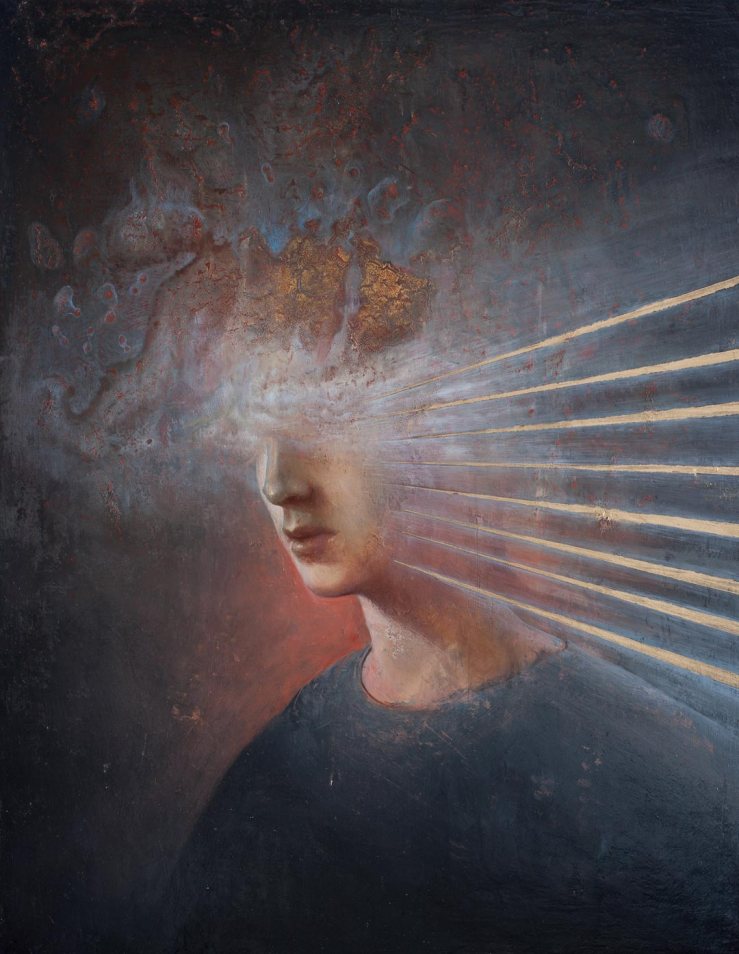
Coffee, 2006 by Christian Brandl (b. 1970)

Nervous and excitable persons need to talk a great deal, by way of letting off their steam | Nathaniel Hawthorne’s journal entry for December 13th, 1853

December 13th.—Chill, frosty weather; such an atmosphere as forebodes snow in New England, and there has been a little here. Yet I saw a barefooted young woman yesterday. The feet of these poor creatures have exactly the red complexion of their hands, acquired by constant exposure to the cold air.

At the ferry-room, this morning, was a small, thin, anxious-looking woman, with a bundle, seeming in rather poor circumstances, but decently dressed, and eying other women, I thought, with an expression of slight ill-will and distrust; also, an elderly, stout, gray-haired woman, of respectable aspect, and two young lady-like persons, quite pretty, one of whom was reading a shilling volume of James’s “Arabella Stuart.” They talked to one another with that up-and-down intonation which English ladies practise, and which strikes an unaccustomed ear as rather affected, especially in women of size and mass. It is very different from an American lady’s mode of talking: there is the difference between color and no color; the tone variegates it. One of these young ladies spoke to me, making some remark about the weather,—the first instance I have met with of a gentlewoman’s speaking to an unintroduced gentleman. Besides these, a middle-aged man of the lower class, and also a gentleman’s out-door servant, clad in a drab great-coat, corduroy breeches, and drab cloth gaiters buttoned from the knee to the ankle. He complained to the other man of the cold weather; said that a glass of whiskey, every half-hour, would keep a man comfortable; and, accidentally hitting his coarse foot against one of the young lady’s feet, said, “Beg pardon, ma’am,”—which she acknowledged with a slight movement of the head. Somehow or other, different classes seem to encounter one another in an easier manner than with us; the shock is less palpable. I suppose the reason is that the distinctions are real, and therefore need not be continually asserted.

Nervous and excitable persons need to talk a great deal, by way of letting off their steam.

On board the Rock Ferry steamer, a gentleman coming into the cabin, a voice addresses him from a dark corner, “How do you do, sir?”—”Speak again!” says the gentleman. No answer from the dark corner; and the gentleman repeats, “Speak again!” The speaker now comes out of the dark corner, and sits down in a place where he can be seen. “Ah!” cries the gentleman, “very well, I thank you. How do you do? I did not recognize your voice.” Observable, the English caution, shown in the gentleman’s not vouchsafing to say, “Very well, thank you!” till he knew his man.

What was the after life of the young man, whom Jesus, looking on, “loved,” and bade him sell all that he had, and give to the poor, and take up his cross and follow him? Something very deep and beautiful might be made out of this.

Nathaniel Hawthorne’s journal entry for December 13th, 1853. From Passages from the English Note-Books.

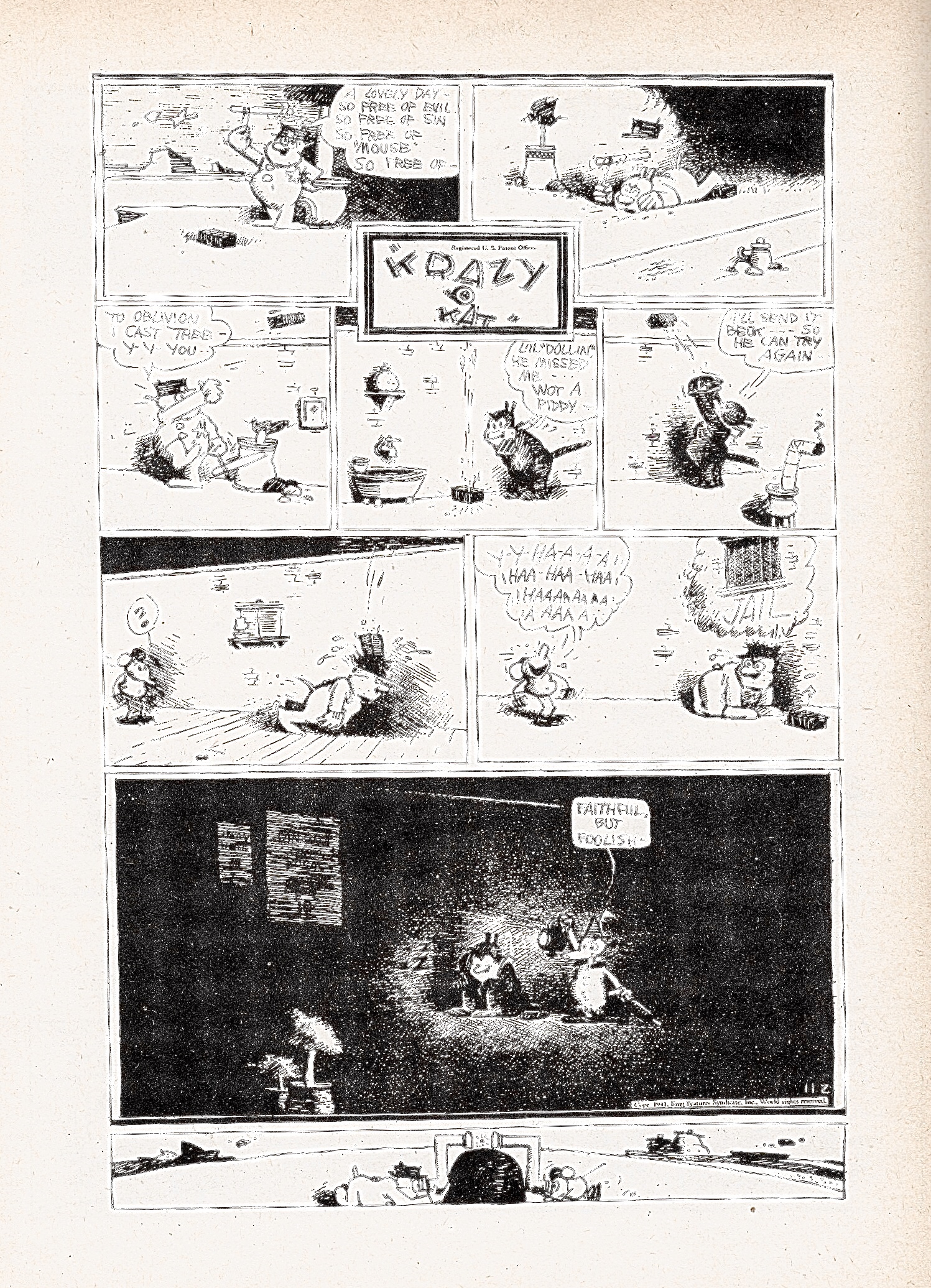
Faithful but foolish (George Herriman’s Krazy Kat)

2019-12-13_171555

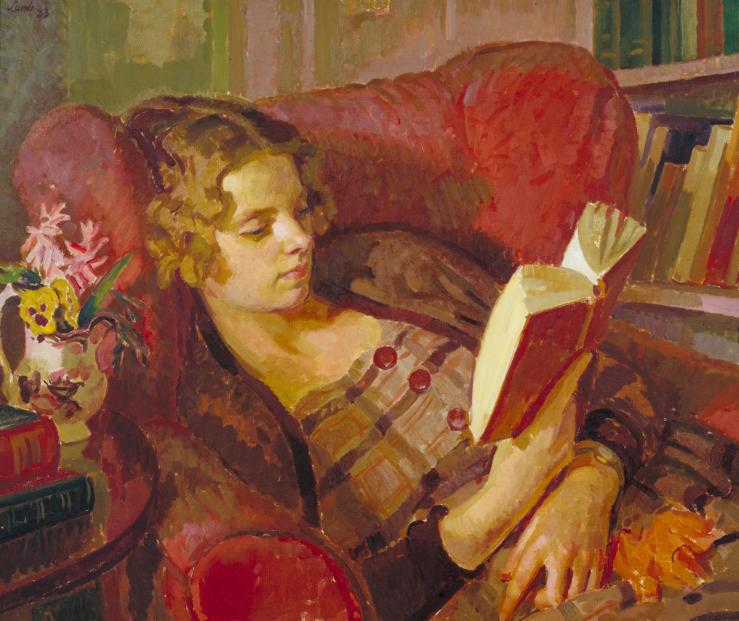
The Artist’s Wife — Henry Lamb

The Artist's Wife 1933 by Henry Lamb 1883-1960

The Artist’s Wife, 1933 by Henry Lamb (1883–1960)

John Barth’s Giles Goat-Boy (Book acquired, 30 Nov. 2019)

img_4536

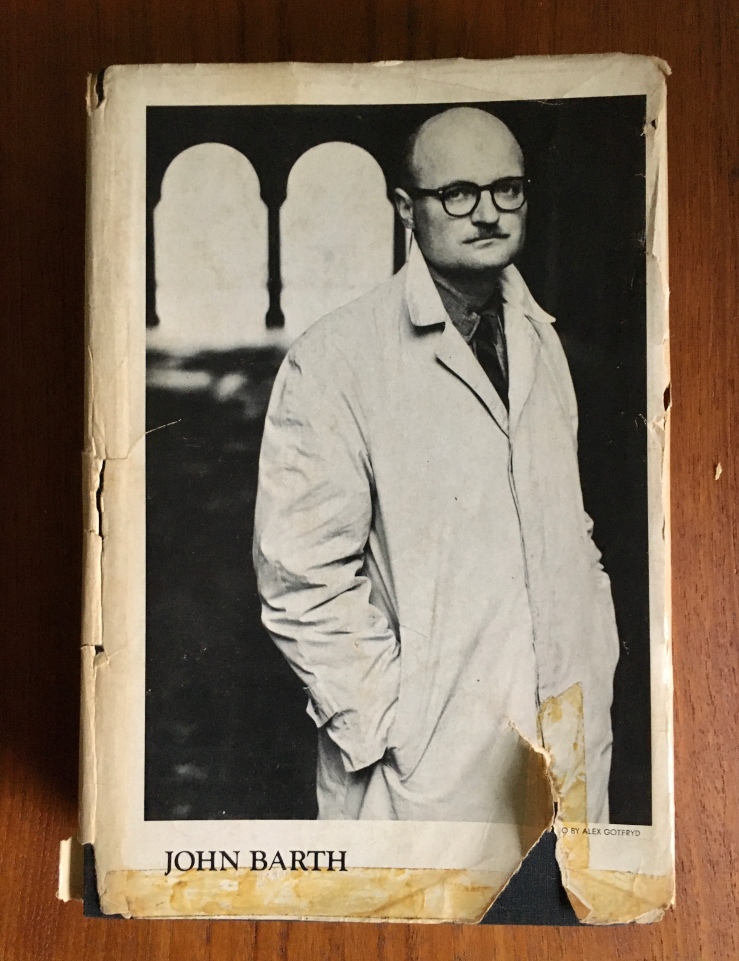
I couldn’t pass up on this used first edition of John Barth’s 1966 novel Giles Goat-Boy when I visited Haslam’s Book Store in downtown St. Petersburg over the Thanksgiving break. Here’s the back cover:

img_4537

From Eliot Fremont-Smith’s 1966 review of Giles Goat-Boy in The New York Times:

There follows the novel proper, which tells how George Giles was born (possibly a computer accident) into a goat herd, made his way into New Tammany College (the world of men), became Grand Tutor and prophet of the West Campus (the Western world as opposed to the Eastern) and, like Don Quixote, Candide, Leopold Bloom, etc., sought the meaning of good and evil, innocence and existence, action and identity, passion and thought.

The message of the syllabus is ambiguous — except perhaps that absolutes are noncognizable, that thinking is a passion and most passionately expressed in humor, and that, except for these, the world is going to hell. Fortunately, it won’t get there because — Mr. Barth proves once more — old jokes never die, they just lie in wait for resurrection. The jokes here — sexual, scatological, gastronomical, existential, political, linguistic, literary conventions and parodies — can be traced to Rabelais, “Tristram Shandy,” Lewis Carroll, Joyce, Nabokov, the Beatles and Bennett Cerf, among others, which should given an idea of the truly astonishing flavor of this lemon meringue pie of a book.

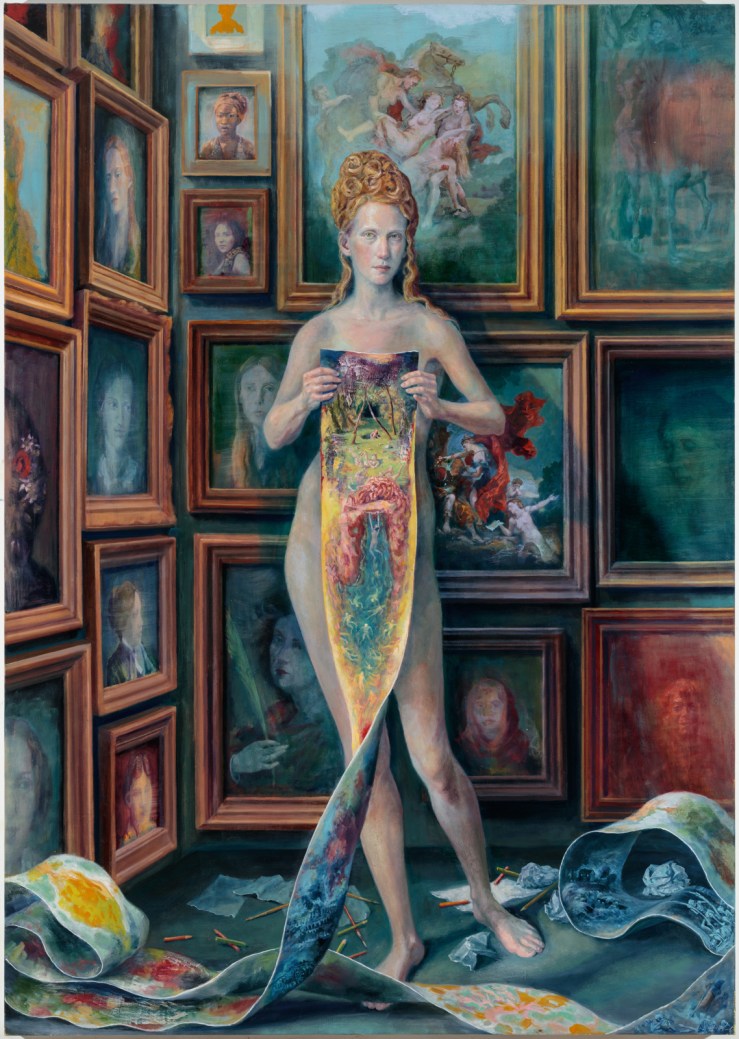
Self-Portrait with Daughters — Julie Heffernan

58225ec1e19140cc-_spwdaughters

Self-Portrait with Daughters, 2019 by Julie Heffernan (b. 1956)

Unmitigated Blackness (Paul Beatty)

There should be a Stage IV of black identity—Unmitigated Blackness. I’m not sure what Unmitigated Blackness is, but whatever it is, it doesn’t sell. On the surface Unmitigated Blackness is a seeming unwillingness to succeed. It’s Donald Goines, Chester Himes, Abbey Lincoln, Marcus Garvey, Alfre Woodard, and the serious black actor. It’s Tiparillos, chitterlings, and a night in jail. It’s the crossover dribble and wearing house shoes outside. It’s “whereas” and “things of that nature.” It’s our beautiful hands and our fucked-up feet. Unmitigated Blackness is simply not giving a fuck. Clarence Cooper, Charlie Parker, Richard Pryor, Maya Deren, Sun Ra, Mizoguchi, Frida Kahlo, black-and-white Godard, Céline, Gong Li, David Hammons, Björk, and the Wu-Tang Clan in any of their hooded permutations. Unmitigated Blackness is essays passing for fiction. It’s the realization that there are no absolutes, except when there are. It’s the acceptance of contradiction not being a sin and a crime but a human frailty like split ends and libertarianism. Unmitigated Blackness is coming to the realization that as fucked up and meaningless as it all is, sometimes it’s the nihilism that makes life worth living.”

From Paul Beatty’s novel The Sellout


Androginos — Agostino Arrivabene

androginos

Androginos, 2016 by Agostino Arrivabene (b. 1967)

Three Books

2019-12-08_113541_2

Mulata by Miguel Ángel Asturias; English trans. by Gregory Rabassa. 1982 mass market paperback from Avon-Bard. The Boschian cover art isn’t credited; neither is the designer credited, although my assumption is that it is Sidney Feinberg, who is credited as designer on Avon-Bard’s edition of Gabriel García Márquez’s novel In Evil Hour.

2019-12-08_113541

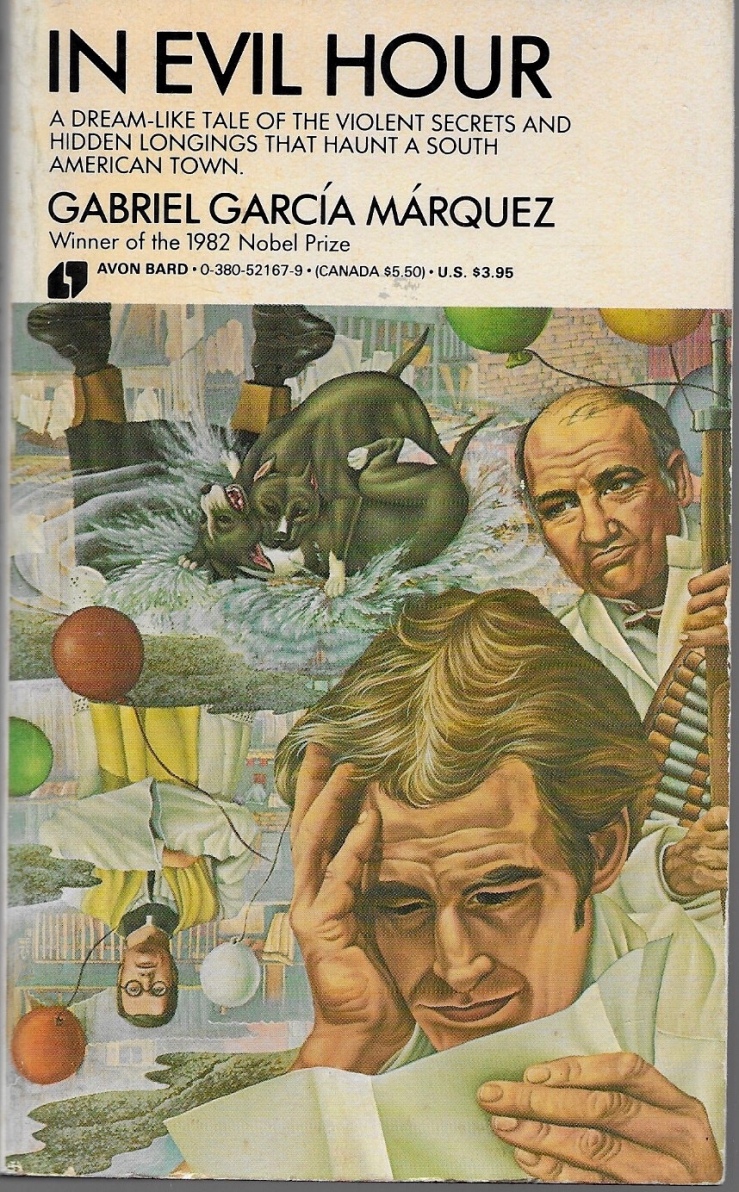
In Evil Hour by Gabriel García Márquez; English trans. by Gregory Rabassa. 1980 mass market paperback from Avon-Bard. The cover artist is not credited; book design by Sidney Feinberg,

2019-12-08_113541_1

The Ex-Magician and Other Stories by Murilo Rubião; English trans. by Thomas Colchie.  1984 mass market paperback from Avon-Bard. No cover artist or designer is credited, but my hunch is the design is by Sidney Feinberg.

Three Holes — Hans Georg Rauch

21913_h960w1600gt.5

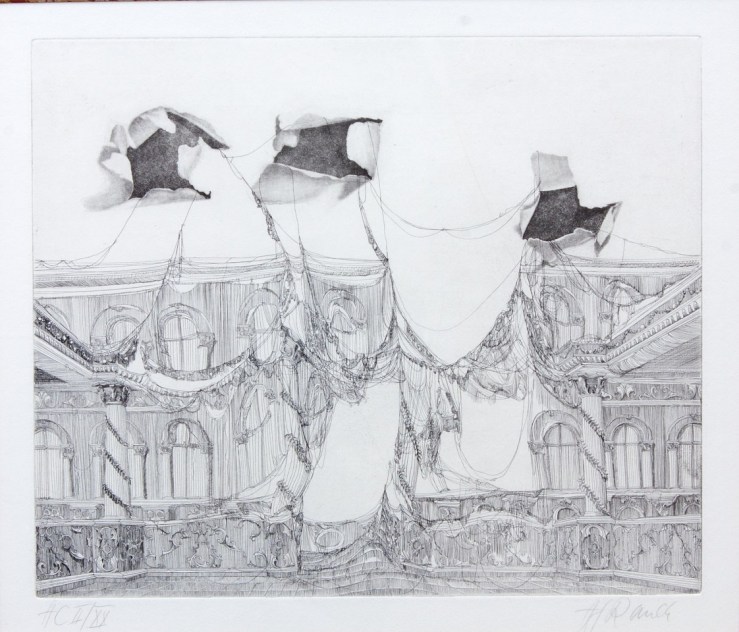
Three Holes by Hans Georg Rauch (1939-1993)

Read “A Little Something for Us Tempunauts,” a short story by Philip K. Dick

“A Little Something for Us Tempunauts”

by

Philip K. Dick


Wearily, Addison Doug plodded up the long path of synthetic redwood rounds, step by step, his head down a little, moving as if he were in actual physical pain. The girl watched him, wanting to help him, hurt within her to see how worn and unhappy he was, but at the same time she rejoiced that he was there at all. On and on, toward her, without glancing up, going by feel. . . like he’s done this many times, she thought suddenly. Knows the way too well. Why?

“Addi,” she called, and ran toward him. “They said on the TV you were dead. All of you were killed!”

He paused, wiping back his dark hair, which was no longer long; just before the launch they had cropped it. But he had evidently forgotten. “You believe everything you see on TV?” he said, and came on again, haltingly, but smiling now. And reaching up for her.

God, it felt good to hold him, and to have him clutch at her again, with more strength than she had expected. “I was going to find somebody else,” she gasped. “To replace you.”

“I’ll knock your head off if you do,” he said. “Anyhow, that isn’t possible; nobody could replace me.”

“But what about the implosion?” she said. “On reentry; they said –”

“I forget,” Addison said, in the tone he used when he meant, I’m not going to discuss it. The tone had always angered her before, but not now. This time she sensed how awful the memory was. “I’m going to stay at your place a couple of days,” he said, as together they moved up the path toward the open front door of the tilted A-frame house. “If that’s okay. And Benz and Crayne will be joining me, later on; maybe even as soon as tonight. We’ve got a lot to talk over and figure out.”

“Then all three of you survived.” She gazed up into his careworn face. “Everything they said on TV. . .” She understood, then. Or believed she did. “It was a cover story. For — political purposes, to fool the Russians. Right? I mean, the Soviet Union’ll think the launch was a failure because on reentry –”

“No,” he said. “A chrononaut will be joining us, most likely. To help figure out what happened. General Toad said one of them is already on his way here; they got clearance already. Because of the gravity of the situation.”

“Jesus,” the girl said, stricken. “Then who’s the cover story for?”

“Let’s have something to drink,” Addison said. “And then I’ll outline it all for you.”

“Only thing I’ve got at the moment is California brandy.”

Addison Doug said, “I’d drink anything right now, the way I feel.” He dropped to the couch, leaned back, and sighed a ragged, distressed sigh, as the girl hurriedly began fixing both of them a drink.

The FM-radio in the car yammered, “. . . grieves at the stricken turn of events precipitating out of an unheralded. . .”

“Official nonsense babble,” Crayne said, shutting off the radio. He and Benz were having trouble finding the house, having been there only once before. It struck Crayne that this was somewhat informal a way of convening a conference of this importance, meeting at Addison’s chick’s pad out here in the boondocks of Ojai. On the other hand, they wouldn’t be pestered by the curious. And they probably didn’t have much time. But that was hard to say; about that no one knew for sure. Continue reading “Read “A Little Something for Us Tempunauts,” a short story by Philip K. Dick”

The Key — Mark Tansey

brh4w5nekff21

The Key, 1984 by Mark Tansey (b. 1949)

The Cocktail Hour — Charles Griffin Farr

97cf20e1c417dd9b5238c5d5f5045afa

The Cocktail Hour by  Charles Griffin Farr (1908-1997)

Blog about some recent reading

img_4404

Bottom and then top:

I’ve been enjoying reading the imperative surreal poems in Jiří Kolář’s’s A User’s Manual (translated by Ryan Scott). I’ve been reading them slowly, one or two every other day.

I got Anna Kavan’s Machines in the Head a few weeks ago and have read the first few stories. These are unsettling little parables. The work Kafkaesque is much overused, but it applies here: Kavan’s stories are cryptic, often pulsing with vague menace and surreal flourishes, much like her masterpiece Ice.

Middle: Anne Boyer’s The Undying will likely end up one of the best books published in 2019 that I actually read in 2019 (I don’t read a lot of contemporary fiction, but I’ve read more this year than in the past few years). An aphoristic memoir-essay, The Undying is a discursive dive into Boyer’s diagnosis of, treatment of, and recovery from breast cancer. It’s an angry, smart book, with little bursts of mean humor, and it rips apart the ways that neoliberal late capitalism have made health care inhuman and inhumane.

I also really dug Carl Shuker’s slim novel A Mistake. Set in Wellington, New Zealand, A Mistake is the story of Elizabeth Taylor, the only female surgeon at her hospital. Like The Undying, Shuker’s novel is in some ways a critique of neoliberalism’s attempt to quantify every aspect of medical care. The novel is set against “the minister’s mistake,” a plan to publicize each surgeon’s results. And at the beginning of the novel, well, there’s a mistake, one which Elizabeth is involved with. Although the blurb describes A Mistake as a “procedural thriller,” I found it closer to a character study of an outsider who finds herself increasingly alienated by her peers and friends alike. Shuker conveys his hero edging into paranoia and depression in sharp, precise prose which occasionally recalls Don DeLillo.

I absolutely love love love Paul Beatty’s novel The Sellout so far. I recall its being hyped quite a bit a few years ago, after it won the Man Booker Prize (I think it was the first US book to do so), and hype often puts me off, but a short story I read a few months ago by Beatty at Granta made me seek out The Sellout. Beatty’s playful prose and zany plotting readily recalls the work of Thomas Pynchon and Ishmael Reed. The story focuses on a farmer who grows watermelons and weed in the strange farm town of Dickens, which is ensconced in urban Los Angeles. Dickens is erased, but the narrator seeks to bring it back. He somehow ends up keeping a slave, a former Little Rascals star named Hominy. I’m doing a bad job describing the plot. The book is energetic and very, very funny, and Beatty’s satirical take on race in America is scathing.

I’d love to get proper reviews of these books out over the winter break, but for now, I’ll simply say they’re all Good Stuff.

“To a Chameleon” — Marianne Moore

chameleon

Red Rabbit — Jean-Michel Basquiat

2018_nyr_15968_0033b_000jean-michel_basquiat_red_rabbit

Red Rabbit, 1982 by Jean-Michel Basquiat (1960-1988)

Knowing has two poles (William H. Gass)

Knowing has two poles, and they are always poles apart: carnal knowing, the laying on of hands, the hanging of the fact by head or heels, the measurement of mass and motion, the calibration of brutal blows, the counting of supplies; and spiritual knowing, invisibly felt by the inside self, who is but a fought-over field of distraction, a stage where we recite the monotonous monologue that is our life, a knowing governed by internal tides, by intimations, motives, resolutions, by temptations, secrecy, shame, and pride.

From “The Art of Self” by William H. Gass.