Big Mouth — James Rieck 

d76acca418263049bf94750802f8a6a9

Big Mouth, 2018 by James Rieck (b. 1965)

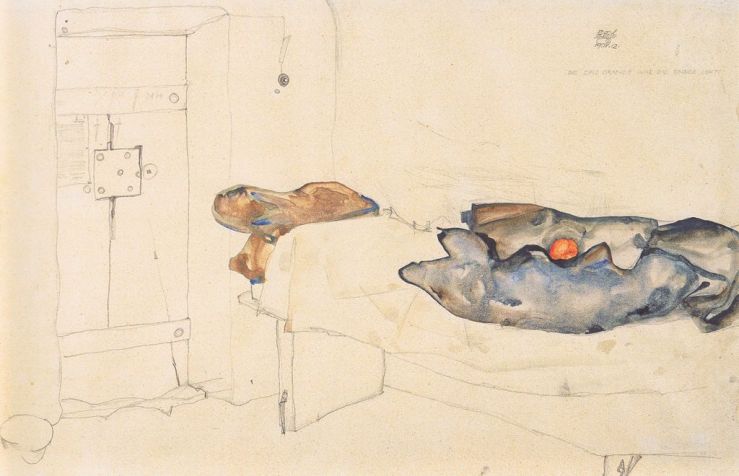
The Single Orange Was the Only Light — Egon Schiele

1024px-egon_schiele_-_die_eine_orange_war_das_einzige_licht19-4-1912

The Single Orange Was the Only Light, 1912 by Egon Schiele (1890-1918)

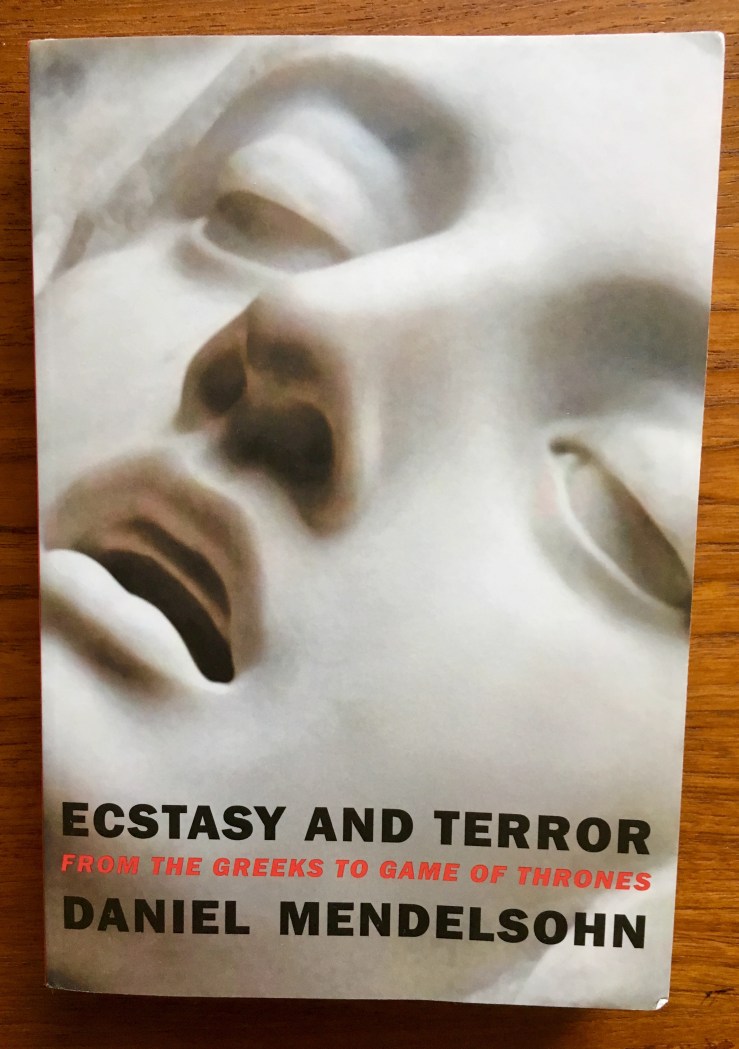
Daniel Mendelsohn’s Ecstasy and Terror (Book acquired, some time last week)

img_3918

I got a review copy of Daniel Mendelsohn’s collection Ecstasy and Terror some time early last week. I’ve read a few of the pieces in here before (“A Critic’s Manifesto” is one that I recalled in particular). Ecstasy and Terror is out in October from NYRB. Their blurb:

This collection of essays exemplifies the range, depth, and erudition that have made Daniel Mendelsohn “required reading for anyone interested in dissecting culture” (The Daily Beast). Here Mendelsohn once again casts an eye at literature, film, television, and the personal essay, filtering his insights through his training as a scholar of classical antiquity in surprising and illuminating ways.

Many of these essays examine how we continue to look to the Greeks and Romans as models: some argue for the surprising modernity of canonical works (Bacchae, the Aeneid), while others detect a “Greek DNA” in our responses to the Boston Marathon bombings and the assassination of JFK. Modern topics are treated, too, from the “aesthetics of victimhood” in Hanya Yanagihara’sA Little Life to the novels of Karl Ove Knausgaard, and from Game of Thrones to recent films about artificial intelligence—a subject, Mendelsohn reminds us, that was already of interest to Homer.

The collection also brings together for the first time a number of Mendelsohn’s personal essays, including his “critic’s manifesto” and a touching memoir of his boyhood correspondence with the historical novelist Mary Renault.

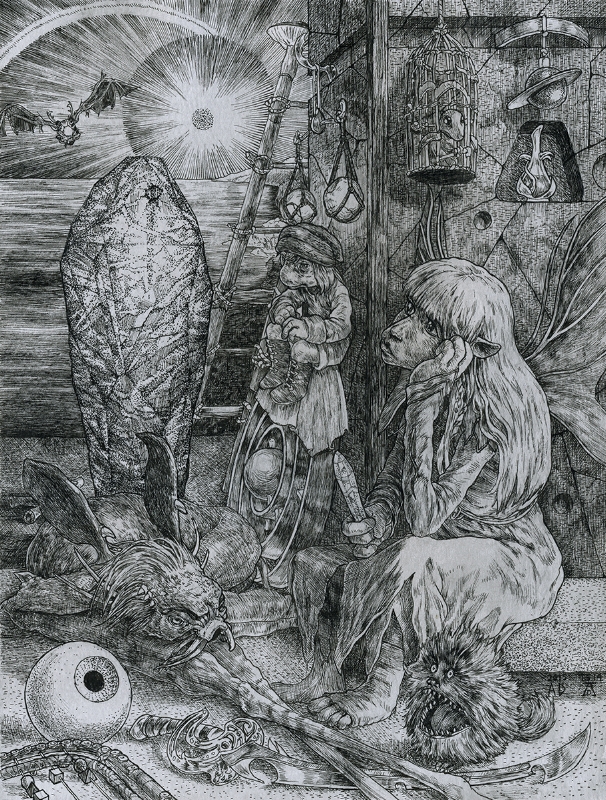
Simulacra — Agostino Arrivabene

simulacra

Simulacra, 2015 by Agostino Arrivabene (b. 1967)

Blog about some recent reading, some books acquired, Hurricane Dorian, etc.

img_3908-1

I am on my second or maybe third dark and stormy and I have cleaned the house twice from top to bottom two days in a row now and I am ready for my kids to go back to school, which was cancelled through Thursday for Hurricane Dorian. My own school, by which I mean my employer, cancelled classes throughout the week, but I’ve been emailing students and trying to maintain some kind of continuity after this weird disruption. We have power here in NE Florida and all seems well. This ride has been a lot easier than Irma.

img_3910-1

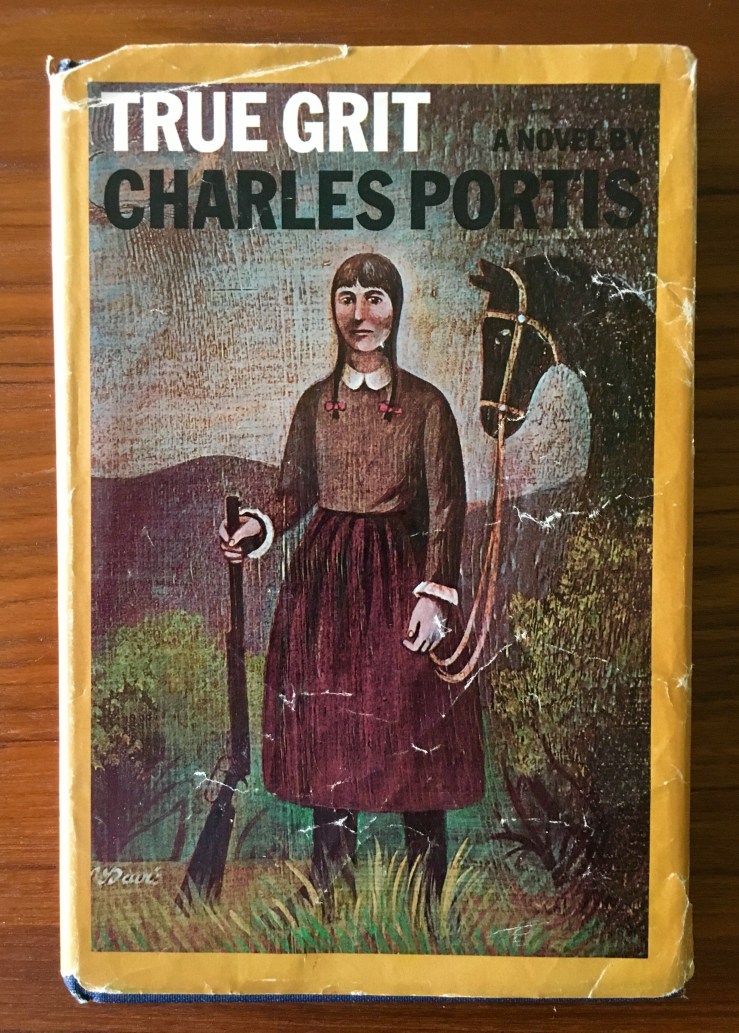
I finished Charles Portis’s famous novel True Grit this afternoon and I must confess it might be my favorite of the four I’ve read by the maestro. I shed a little tear for Little Blackie at the end, and also maybe for Rooster Cogburn. My thought is that I wish I’d read the book years ago, before I’d seen the two film adaptations, both of which are, like, fine, but neither of which capture the pure voice of Mattie Ross. Great stuff. I need to read Gringos next, but maybe I’ll wait a bit.

I have been switching between True Grit and Sylvia Townsend Warner’s nuns-in-the-English-fens-in-the-age-of-the-Black-Death The Corner That Held Them and I love both—both are funny, dry (and wet when they need to be). The Corner That Held Them packs in so much storytelling; pages go on for decades with a sprightly and imaginative and droll clip. I’ve been enjoying it so much I went up to my favorite used bookstore, big box of old books in tow, to find more. I picked up Lolly Willowes, which I understand is excellent, and which I will get to posthaste.

I had burned up most of my credit at this particular bookstore, but the box I done brung afforded me enough trade to not only pick up Lolly Willowes but also a first-edition hardback of Kurt Vonnegut’s Slaughterhouse Five.

img_3909-1

I also got copies of Antoine Volodine’s Writers and Bardo or Not Bardo in the in the mail this week. I don’t rightly recall buying them online, but I know that after finishing In the Time of the Blue Ball by Volodine’s pseudo-pseudonym Manuela Draeger, I went through my Volodines for references to Draeger. I found references in Post-Exoticism in Ten Lessons, Lesson Eleven, but couldn’t find my copy of Writers and then remembered that I gave it to a friend who seemed to promptly move a hundred miles away afterward. (He said he thought it was good.) Anyway: Bardo soon or not soon.

I read Keiler Roberts’ graphic memoir Rat Time yesterday and loved it so much I wrote about it immediately.

Screenshot 2019-09-03 at 3.52.37 PM

The hurricane is not so bad for us.

A review of Keiler Roberts’ Rat Time

Screenshot 2019-09-03 at 3.34.45 PM

Let’s start with the title. Rat Time is a great title.

What is Rat TimeRat Time is a graphic novel—or graphic autofiction, or graphic discursive memoir—I’m not really sure what genre it fits into, nor does that matter—Rat Time is a very funny and often moving book by cartoonist Keiler Roberts.

And so what is “rat time”? Rat time is the time that Keiler shares with her daughter Xia and their rats Sammy and Mateo Too. “We eat dinner, then rat time, then bed time,” Xia explains to her classmates during show and tell.

Screenshot 2019-09-03 at 3.40.35 PM

When poor Sammy dies though, “rat time” takes on a different meaning. “It’s not a time of day,” Xia declares. “It’s the time when had rats.” Keiler optimistically points out that “We still have Mateo Too.” (Care to guess what happened to Mateo One?)

The early vignettes in Rat Time intersplice rat time with riffs from Keiler’s therapy sessions, calls and visits with her parents, and child memories. Although Rat Time’s structure might be at times oblique and discursive, Roberts’ pacing and pages are often surprisingly traditional and darkly comic, as in this little episode, in which Keiler recalls a pet’s death:

Screenshot 2019-09-03 at 12.00.14 PM

Initially, Rat Time appears to have an elliptical structure. Vignettes and riffs and one-pagers succeed each other without the usual narrative linking devices we might expect from a traditional graphic novel. Roberts’ humor is so dry too that for the first few pages the tone of Rat Time may be difficult to comprehend. The more I read though, the more I laughed, and the more I cared about Keiler and her daughter.

Roberts’ mines her life for material, and the material is often painful, coming out in unexpected ways. We learn that rat time originated as a coping mechanism, a response to a recent diagnosis of multiple sclerosis:

Screenshot 2019-09-03 at 3.44.08 PM.png

Rat Time features scenes of Keiler going to the hospital for blood work, or visiting a chiropractor for treatment, all with a wonderfully droll humanity that resonates with just how damn specific the moments are. We also see Keiler in her therapist’s office, and see how her friends and family react to her bipolar disorder, as well as how she manages it. Making oatmeal seems to provide Keiler a lot of comfort, and while I’m not a fan of oatmeal myself, I deeply relate to her feelings on breakfast:

Screenshot 2019-09-03 at 12.22.04 PM

Some of my favorite parts of Rat Time hover around Keiler’s experiences as an art instructor. There’s an intense pathos to Keiler-as-teacher, even when she seems mean:

Screenshot 2019-09-03 at 4.00.28 PM

Keiler’s teaching vignettes are balanced with her own memories of teachers past. Roberts frames these moments with the clarity of detail that telegraphs raw honesty. There’s the gym teacher who humiliated her on the bus to the bowling alley, the art teacher who showed the class a cadaver, and the political science professor who earned Keiler’s admiration for “stating a truth so plainly” (namely, “I know this would be more interesting if I were entertaining, but it’s worse if I try.”)

Screenshot 2019-09-03 at 4.19.43 PM

Roberts’ spare, plain style is effective in achieving her punchlines, but it can also affect the reader with a strange poignancy:

Screenshot 2019-09-03 at 1.03.02 PM

At one point, Roberts includes a polished piece in Rat Time, which creates a wonderful moment of narrative dissonance, a strange reverberation between Keiler the hero-narrator of Rat Time and Roberts the author-illustrator of Rat Time.

Screenshot 2019-09-03 at 4.22.59 PM

Indeed, a major theme of Rat Time is storytelling itself. Keiler wants to be a writer of fiction, but it seems like her own life is far more interesting than the ideas she brainstorms. Rat Time is perhaps Roberts’ way of sussing out why her genre is ultimately autobiographical.

Screenshot 2019-09-03 at 4.35.53 PM

Rat Time, like any good autobiography, is crammed with life, brimming with vivid moments that feel authentic and real. Often funny and sometimes painful, Roberts’ book is sweet without sentimentality, sour without caustic meanness, and generous to both its subjects and its readers. Highly recommended.

Rat Time is new from Koyama Press.


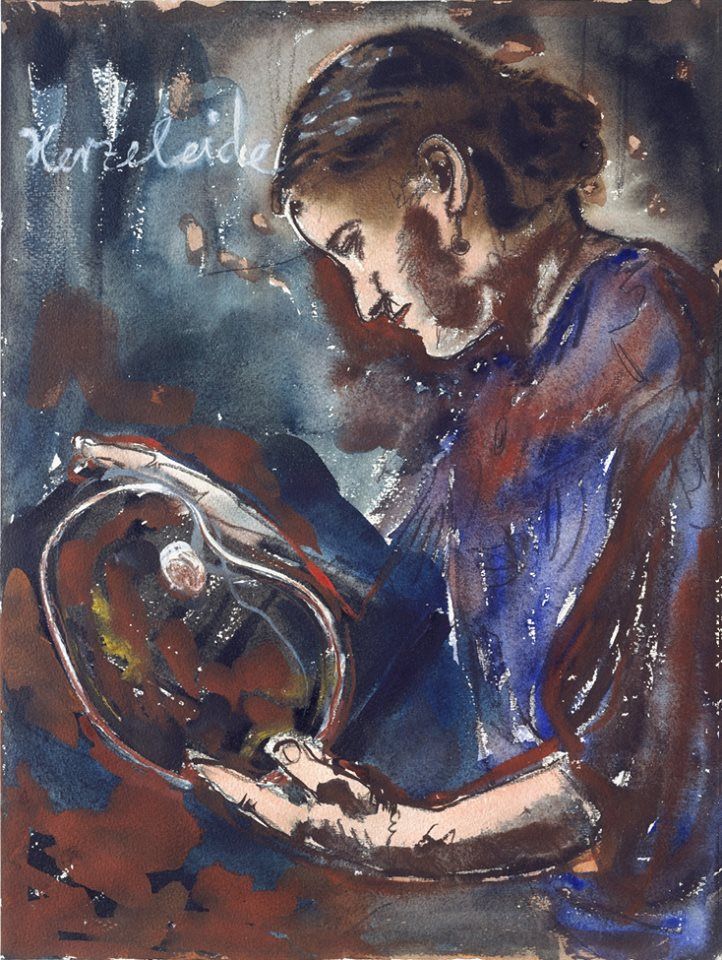
Herzeleide — Anselm Kiefer

a8b5a4a46601df5547244daf3a4c585e

Herzeleide,1979 by Anselm Kiefer (b. 1945)

Read “Damn!” an early short story by Charles Portis

“Damn!”

by

Charles Portis


If Sanford T.’s daddy hadn’t got killed that night I guess we’d still be with the carnival. What we was doing was hauling old man McClerkin around the country claiming he was Jesse James and charging fifty cents a head to come in and see him. We had to pay Mr Mooney thirty per cent of the take to travel around with his carnival but we was making good money anyway. That all come to an end the night Jesse got drunk and fell out of the Ferris wheel on top of a cotton candy stand. We tried for awhile having Sanford T. billed as Bob Ford but he wasn’t old enough to fool anybody and we had to close up. Mr Mooney kept us on to bark for the freak show but you talk about some hard folks to get along with, that’s freaks. We was about ready to quit anyhow when the alligator boy busted Sanford T.’s leg with a crow bar, something you might or might not expect out of a alligator boy. The carnival left us stranded in Montezuma, Arkansas, where Sanford T. was in the hospital and I guess that was the best thing that ever happened to us. The reason for that initial is that he’s got an older brother named Sanford too. His folks just liked the name I guess.

I was setting on a bench in front of the courthouse reading Billboard when this old, weasel-eyed man comes up and sets down beside me.

“I hear you’re a carny,” he said.

“Well, you hear right, old man. Only I’m not working right now.”

“You got any money?”

I reached in my pocket and held out a half-dollar.

“Naw, naw,” he said, “I didn’t mean nothing like that. I’m the one what ought to be giving you a half. I want to talk business.”

“All right, start talking.”

“You innarested in making some money?”

“Now look, if you’re some kind of con man you ain’t talking to no farmer.’’

I finally pulled it out of him. He had a little place just outside of town where he bottled patent medicine and he wanted to sell out because his health was failing him and his doctor told him he better move out west if he wanted to live.

“How come you don’t take this medicine and save yourself a trip?” I asked him.

“Well, you see, that’s what’s wrong with me now. This is liver emulsifier, that’s what I call it, ‘Bethel Liver Emulsifier’, and my liver is so stout now that it’s overworking my other organs. I’ve got the liver of a 21-year-old boy, believe it or not. Of course you’re a layman and wouldn’t understand all about how it works. Has to do with bile flow and all that.”

“You got me there all right,” I said.

“And besides, my daughter out in California is about to worry me to death to move in with her. I’m willing to take a big loss on a quick deal.”

Read the rest of “Damn!” at Bookanista

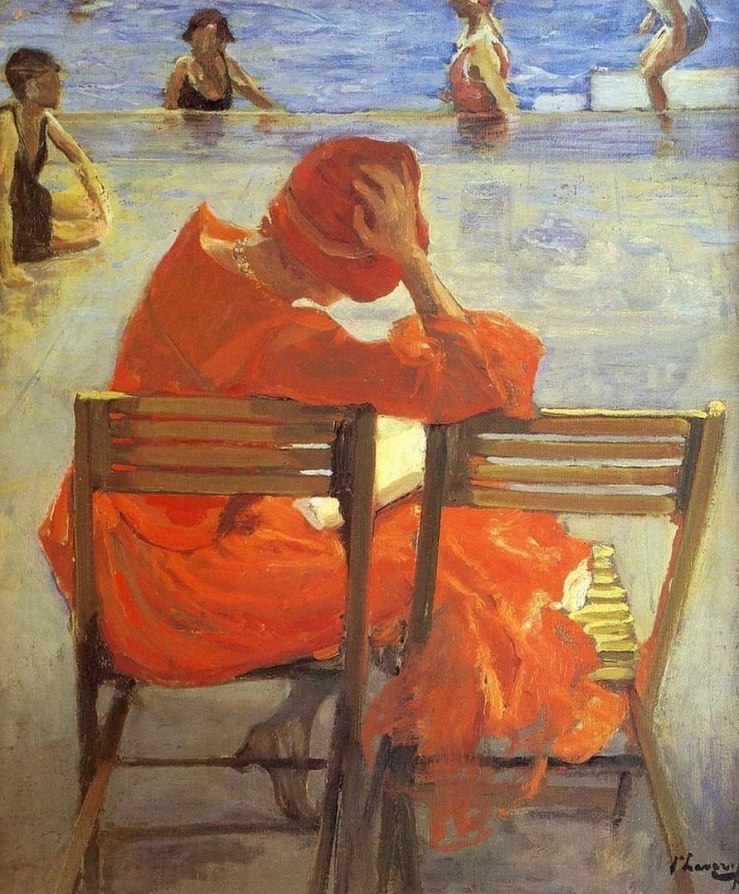
Girl in a Red Dress Reading by a Swimming Pool — John Lavery

64575156_321670722042429_6261493289650389959_n

Girl in a Red Dress Reading by a Swimming Pool, 1887 by John Lavery (1856–1941)

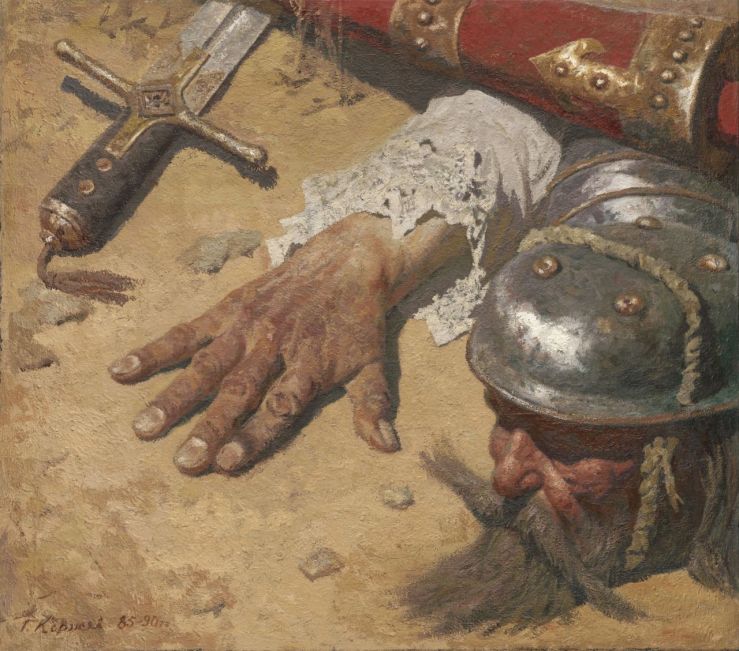
Don Quixote — Gely Korzhev

dcf0fc9e10c6b900ef6fb8176d54bb6e

Don Quixote, 1990 by Gely Korzhev (1925-2012)

Formae (Lithos) — Judy Nimtz

formae_lithos_web

Formae (Lithos) by Judy Nimtz

Melancrystalia I — Andrew DeGraff

melacrystaliai2web

Melancrystalia I, 2015 by Andrew DeGraff

The Memory Room — Lola Gil

the-memory-room

The Memory Room, 2017 by Lola Gil (b. 1975)

“Civics” — David Berman

2019-08-29_161741

From Actual Air (Open City, 1999).

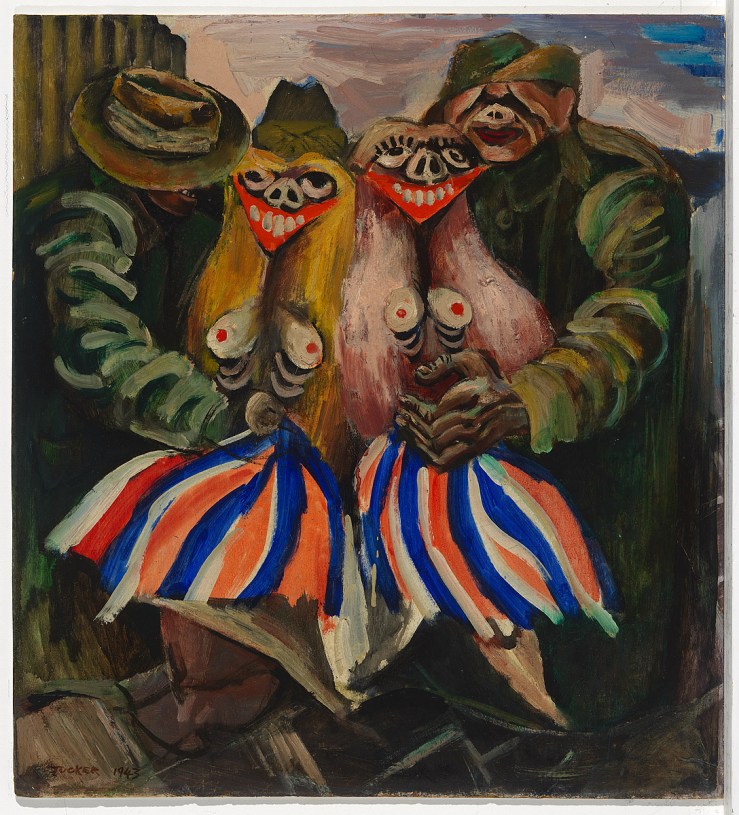
Victory Girls — Albert Tucker

82187

Victory Girls, 1943 by Albert Tucker (1914-1999)

In 1349 the Black Death came to Oby | An excerpt from Sylvia Townsend Warner’s novel The Corner That Held Them

In 1194 a wandering scholar, very old and shrill, came begging for a meal. As he sat munching his bread and a salt herring he talked to the wicket-nun about the properties of numbers, and of how Abbot Joachim, analysing the arithmetic of the prophecies, had discovered that the end of the world was at hand. He himself expected much of the year 1221, a date whose two halves each added up to three. In such a year, he said, one might look for the reign of Antichrist to be fulfilled, or else it might betoken the coming of the kingdom of the Holy Ghost, as the number six expressed a completion of two-thirds of the Trinity. Something, at any rate, he said, might be expected. Under his arm he carried a monochord. To make himself clearer to the nuns (for several of them had gathered to pity the old man, so wise and so witless), he explained to them about the Proportion of Diapason, the perfect concord which is at once concord and unity, and showed them how, by placing the bridge of the monochord so as to divide the string into a ratio of one and two, the string will sound the interval of the octave. Thus, he mumbled, was the nature of the Godhead perceptible to Pythagoras, a heathen; for it lies latent in all things. He sat on a bench in the sun, but overhead the wind howled, tormenting the willows along the Hog Trail and clawing the thatch, and the nuns could scarcely hear his demonstration of how the Godhead sounded to Pythagoras. It was really no loss, for his hand, shaking with cold and palsy, had failed to place the bridge correctly, and the diapason of the Trinity was out of tune. Then, brushing the crumbs out of his beard and plucking a sprig of young wormwood to stick behind his ear, he sang a lovesong to entertain the ladies and went on his way toward Lintoft. The lovesong had a pretty, catchy tune: for some days every nun and novice was humming it. Then Dame Cecilia began to have fits and to prophesy. This infuriated Richenda de Foley, to whom any talk of the end of the world after she had worked so hard and successfully to put the convent on a good footing for the next century seemed rank ingratitude. But the itch is not more contagious than illuminations, and throughout that summer Oby resounded with excited voices describing flaming bulls, he-goats of enormous size floating above the lectern, apparitions of the founder and shooting pains. In a fury of slighted good intentions and outraged common sense Richenda de Foley packed up and went away, but as she was generous as well as authoritarian she left a great deal of household stuff and provisions behind her. The community, after one universal gasp at finding itself unclasped from that strong and all-arranging hand, settled down to enjoy an unregulated prosperity and comfort; and prosperity and comfort wielding their usual effect, the spirit of prophecy flickered out, and by the close of the year they were looking for nothing more remarkable than improvements to the fish-pond.

In 1208 came the Interdict.

In 1223 lightning set fire to the granary.

In 1257 the old reed and timber cloisters fell to bits in a gale. It was decided that the masons who came to build the new should also build on a proper chapter-house. When it was half-built a spring rose under it. Rather than throw money away, the head mason suggested, why not finish the new building as a dovecot, a wet floor being no inconvenience to doves, and convert the old dovecot, so solid and weatherproof, into a chapter-house? This suggestion, too hastily accepted, led to discomfort all round. The pigeons refused to settle in their new house. Some flew away for good, the others remained in the lower half of the old dovecot, whose upper storey, remodelled with large windows and stone benches, made a very unpersuasive place of assembly. However, the arrangement was allowed as a temporary expedient, and as such it became permanent.

In 1270 there were disastrous floods, and this happened again seven years later. In 1283 hornets built in the brewhouse roof and the cellaress was stung in the lip and died. In 1297 the convent’s bailiff was taken in the act of carnality with a cow. Both he and the cow were duly executed for the crime, but this was not enough to avert the wrath of heaven. That autumn and for three autumns following there was a murrain among the cattle. After the murrain came a famine, and the bondwomen of the manor broke through the reed-fence into the orchard where the nuns were at recreation and mobbed them, snatching at their wimples and jeering at such plump white breasts and idle teats. For this a fine was laid on the hamlet, and the last remnants of the pax Richenda broke down. Tithes and dues were paid grudgingly or not at all, and going along the cloisters to sing the night office the nuns would strain their ears for the footsteps of marauders or the crackle of a fired thatch.

In 1332 a nun broke her vows and left the convent for a lover. Misfortunes always go in threes, was the comment of the prioress: they might expect two more to play the same game. But after a second apostasy there was a painful Visitation by the bishop, when the prioress was deposed and Dame Emily, the novice-mistress, a better disciplinarian, nominated to be her successor. Unfortunately Dame Emily was unpopular, being both arrogant and censorious. Dreading the rule of such a prioress, the nuns refused to elect her and chose instead, out of bravado, Dame Isabella Sutthery, the youngest and silliest nun among them. The young and silly can become great tyrants. Dame Isabella proved fanatically harsh and suspicious, scourging the old nuns till they fainted for anguish and inventing such unforeseeable misdemeanours that no one could steer clear of offending. The convent waited, languishing, for the next Visitation, when each nun in her private interview with the bishop could make her report. But though the bishop came and heard, he was still nursing his wrath about their rejection of Dame Emily whom he had nominated, and though Dame Emily herself was the greatest sufferer under Prioress Isabella he answered every plea for a fresh election by saying that the convent having chosen must abide by its choice. It was not till 1345, when Prioress Isabella choked on a plum-stone, that peace and quiet returned, followed by four ambling years of having no history, save for a plague of caterpillars.

In 1349 the Black Death came to Oby.

From the first chapter of Sylvia Townsend Warner’s 1948 novel The Corner That Held Them, newly reissued by NYRB.

img_3738

Untitled (Playground) — Kerry James Marshall

playground_artsy_web

Untitled (Playground), 2015 by Kerry James Marshall (b. 1955)