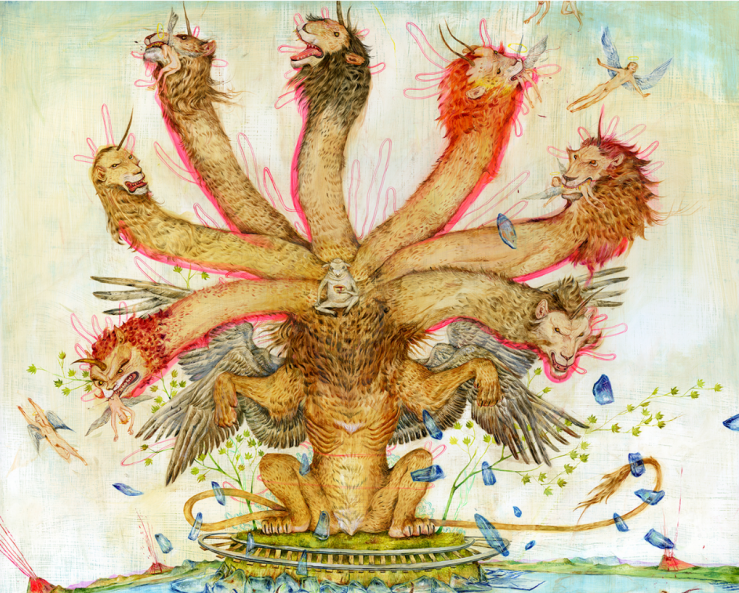
Mu Pan’s Garden of Earthly Delights (detail) — Mu Pan

mupan.PNG

Mu Pan’s Garden of Earthly Delights (detail), 2019 by Mu Pan (b. 1976)

Posted in Art

The papers of Gass seemed immaculate, each box like a freshly dug pool

The papers of Gass seemed immaculate, each box like a freshly dug pool. By comparison, the papers of Whitman and Woolf and David Foster Wallace are filled with scraps and sheets that bear the odor from yesterday’s hands. I had already done my due diligence with The Reader, weeks of close reading and margin scribbling through its nine hundred pages; I had read a good portion of the secondary scholarship; and now here was a chance to sight some of Gass’s unresolved thoughts written overleaf.

I began by casually picking over the correspondence—incoming letters and postcards and telegrams. In the sixties, following the publication of his first novel, Omensetter’s Luck, there was Susan Sontag dishing up high praise (and slyly complimenting herself in the same stroke), Robert Silvers at The New York Review of Books begging again and again for another tipple of his prose (remarkable considering how remote the Midwestern Gass was from the flame of literary New York), and Stanley Elkin prodding “Bill” to leave Indiana for an open philosophy professorship in Saint Louis (the job he would ultimately hold for the rest of his working life). There was also a small scrap of torn notebook paper, a request for an out-of-print edition of a book by Gass—a subtle sort of fan letter written tenderly by a twenty-three-year-old man, now a sexagenarian who presides over the books section of a major American publication. Gass’s silence, the lack of corresponding responses in the archive, was odd, like a refrigerator that stops humming one afternoon. Gass, the ever-voluble (the—how to avoid it—ever-gassy), is a quiet center in the letters, a silhouette whose contours are limned only in the words of others.

I extracted box 66 from a cart and dipped into the late late juvenilia—college essays and his 1954 philosophy dissertation at Cornell—waxen pages that amounted to an incidental encyclopedia of fields, concepts, and fascinations that held sway over Gass’s writing for the next sixty years. The subject of the dissertation, “A Philosophical Investigation of Metaphor,” was importantly not a grad-school penance but the idée fixe that Gass fitted on mantels and stashed under rugs and cushions of every story and essay. For Gass, the ultimate metaphor was the relationship between the world and written language. Just as chairs could be moved around a house, words could be arrayed and rearranged in the syntactic space of a sentence—untold combinations of selfsame units, accommodating varieties of mood and meaning.

Gass suggested that literary language, specifically, required an additional metaphor. Proustian prose had a more exalted status than the demotic word-stuff on the back of soup cans. It was not made of chairs; it was conscious. In a riff on Cartesian dualism, Gass argued that a book was a body and a literary text was a conscious mind. When great writers fashioned a world of words, they supplanted the consciousness of the reader with another one, a self-sustaining construction of rich sound and sense, a new mind “musiked deep with feeling.” This conceit, the book as a “container of consciousness,” was a metaphor—Gass wasn’t a paranoid animist—but nonetheless it was a metaphor underwritten by what Gass believed was a genuine ontological shift. From soup can to Proust, words were transmogrified into literature.

From Zachary Fine’s essay “In Search of William Gass.” Full essay at The Paris Review.

“What Kind of Times Are These” — Adrienne Rich

“What Kind of Times Are These”

by

Adrienne Rich


There’s a place between two stands of trees where the grass grows uphill

and the old revolutionary road breaks off into shadows

near a meeting-house abandoned by the persecuted

who disappeared into those shadows.


I’ve walked there picking mushrooms at the edge of dread, but don’t be fooled

this isn’t a Russian poem, this is not somewhere else but here,

our country moving closer to its own truth and dread,

its own ways of making people disappear.


I won’t tell you where the place is, the dark mesh of the woods

meeting the unmarked strip of light—

ghost-ridden crossroads, leafmold paradise:

I know already who wants to buy it, sell it, make it disappear.


And I won’t tell you where it is, so why do I tell you

anything? Because you still listen, because in times like these

to have you listen at all, it’s necessary

to talk about trees.

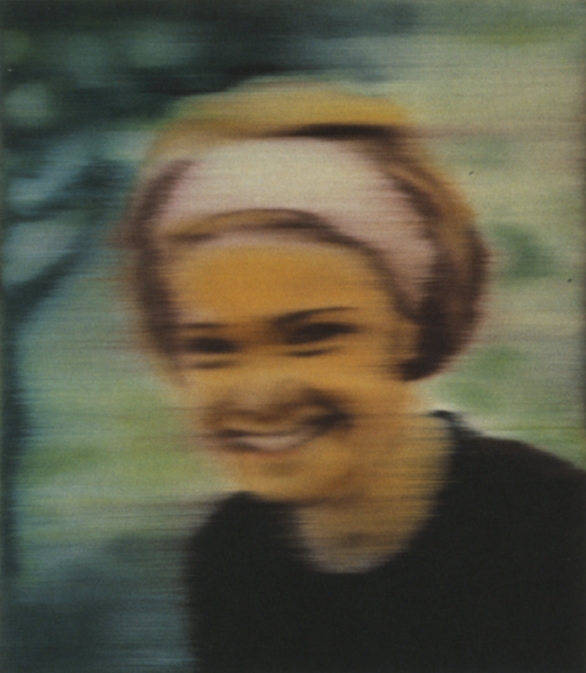
Inge — Gerhard Richter 

9074

Inge, 1965 by Gerhard Richter (b. 1932)

Big Girls — Dan Lydersen

big-girls

Big Girls, 2014 by Dan Lydersen (b. 1980)

Mu Pan’s Garden of Earthly Delights (detail) — Mu Pan

mupan

Mu Pan’s Garden of Earthly Delights (detail), 2019 by Mu Pan (b. 1976)

“The Disk,” a very short story by Jorge Luis Borges

“The Disk”

by

Jorge Luis Borges

Translated by Andrew Hurley


I am a woodcutter. My name doesn’t matter. The hut I was born in, and where I’m soon to die, sits at the edge of the woods. They say these woods go on and on, right to the ocean that surrounds the entire world; they say that wooden houses like mine travel on that ocean. I wouldn’t know; I’ve never seen it.

I’ve not seen the other side of the woods, either. My older brother, when we were boys he made me swear that between the two of us we’d hack away at this woods till there wasn’t a tree left standing. My brother is dead now, and now it’s something else I’m after, and always will be. Over in the direction where the sun goes down there’s a creek I fish in with my hands. There are wolves in the woods, but the wolves don’t scare me, and my ax has never failed me. I’ve not kept track of how old I am, but I know I’m old—my eyes don’t see anymore. Down in the village, which I don’t venture into anymore because I’d lose my way, everyone says I’m a miser, but how much could a woodcutter have saved up?

I keep the door of my house shut with a rock so the snow won’t get in. One evening I heard heavy, dragging footsteps and then a knock. I opened the door and a stranger came in. He was a tall, elderly man all wrapped up in a worn-out old blanket. A scar sliced across his face. The years looked to have given him more authority than frailty, but even so I saw it was hard for him to walk without leaning on his stick. We exchanged a few words I don’t recall now. Then finally the man said:

“I am without a home, and I sleep wherever I can. I have wandered all across Saxony.”

His words befitted his age. My father always talked about “Saxony”; now people call it England.

There was bread and some fish in the house. While we ate, we didn’t talk. It started raining. I took some skins and made him a pallet on the dirt floor where my brother had died. When night came we slept.

It was toward dawn when we left the house. The rain had stopped and the ground was covered with new snow. The man dropped his stick and he ordered me to pick it up.

“Why should I do what you tell me to?” I said to him.

“Because I am a king,” he answered. I

thought he was mad. I picked up the stick and gave it to him. With his next words, his voice was changed.

“I am the king of the Secgens. Many times did I lead them to victory in hard combat, but at the hour that fate decreed, I lost my kingdom. My name is Isern and I am of the line of Odin.”

“I do not worship Odin,” I answered. “I worship Christ.”

He went on as though he’d not heard me.

“I wander the paths of exile, but still I am king, for I have the disk. Do you want to see it?”

He opened his hand and showed me his bony palm. There was nothing in it. His hand was empty. It was only then that I realized he’d always kept it shut tight. He looked me in the eye.

“You may touch it.”

I had my doubts, but I reached out and with my fingertips I touched his palm. I felt something cold, and I saw a quick gleam. His hand snapped shut. I said nothing.

“It is the disk of Odin,” the old man said in a patient voice, as though he were speaking to a child. “It has but one side. There is not another thing on earth that has but one side. So long as I hold it in my hand I shall be king.”

“Is it gold?” I said.

“I know not. It is the disk of Odin and it has but one side.”

It was then I felt a gnawing to own the disk myself. If it were mine, I could sell it for a bar of gold and then /would be a king.

“In my hut I’ve got a chest full of money hidden away. Gold coins, and they shine like my ax,” I told the wanderer, whom I hate to this day. “If you give the disk of Odin to me, I will give you the chest.”

“I will not,” he said gruffly.

“Then you can continue on your way,” I said. He turned away. One ax blow to the back of his head was all it took; he wavered and fell, but as he fell he opened his hand, and I saw the gleam of the disk in the air. I marked the place with my ax and I dragged the body down to the creek bed, where I knew the creek was swollen. There I dumped his body.

When I got back to my house I looked for the disk. But I couldn’t find it. I have been looking for it for years.
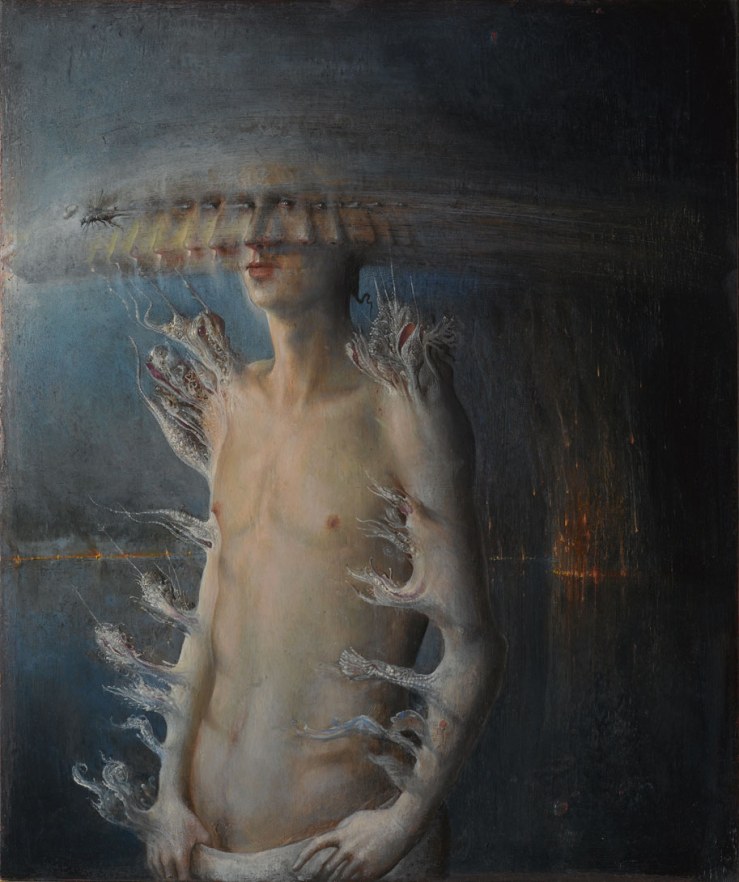
Flowering Man II — Agostino Arrivabene

uomo-fiorente-2c2b0

Uomo Fiorente II (Flowering Man II), 2011 by Agostino Arrivabene (b. 1967)

War — Patrick William Adam

tumblr_mvrh56hrfe1soqrhbo1_1280War, 1915 by Patrick William Adam (1854–1929)
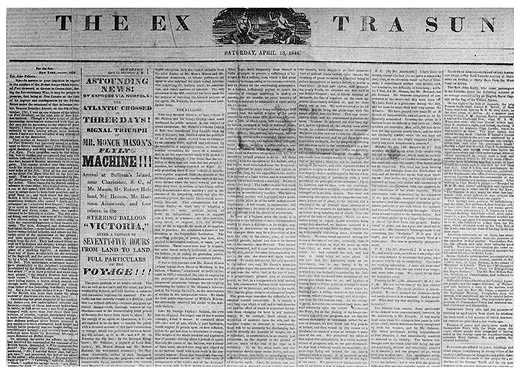
“The Balloon-Hoax” — Edgar Allan Poe

1844_sun_newspaper_story

“The Balloon-Hoax”

by

Edgar Allan Poe


THE great problem is at length solved! The air, as well as the earth and the ocean, has been subdued by science, and will become a common and convenient highway for mankind. The Atlantic has been actually crossed in a Balloon! and this too without difficulty—without any great apparent danger—with thorough control of the machine—and in the inconceivably brief period of seventy-five hours from shore to shore! By the energy of an agent at Charleston, S.C., we are enabled to be the first to furnish the public with a detailed account of this most extraordinary voyage, which was performed between Saturday, the 6th instant, at 11, A.M., and 2, P.M., on Tuesday, the 9th instant, by Sir Everard Bringhurst; Mr. Osborne, a nephew of Lord Bentinck’s; Mr. Monck Mason and Mr. Robert Holland, the well-known æronauts; Mr. Harrison Ainsworth, author of “Jack Sheppard,” &c.; and Mr. Henson, the projector of the late unsuccessful flying machine—with two seamen from Woolwich—in all, eight persons. The particulars furnished below may be relied on as authentic and accurate in every respect, as, with a slight exception, they are copied verbatim from the joint diaries of Mr. Monck Mason and Mr. Harrison Ainsworth, to whose politeness our agent is also indebted for much verbal information respecting the balloon itself, its construction, and other matters of interest. The only alteration in the MS. received, has been made for the purpose of throwing the hurried account of our agent, Mr. Forsyth, into a connected and intelligible form. Continue reading ““The Balloon-Hoax” — Edgar Allan Poe”

April / Fools

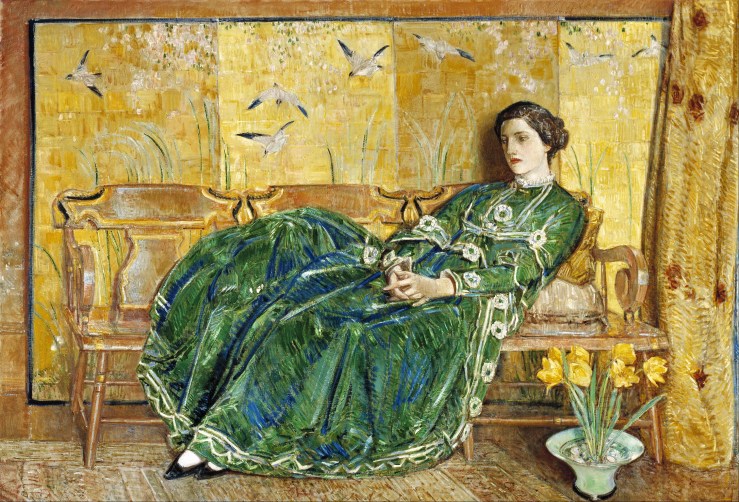
Childe_Hassam_-_April_-_(The_Green_Gown)_-_Google_Art_Project

April (The Green Gown), 1919 by Childe Hassam (1859–1935)

the-ship-of-fools-1500(1)

Ship of Fools, c. 1490–1500 by Hieronymus Bosch (c. 1450-1516)

Reviews, March 2019 (and an unrelated wombat)

Links to and brief excerpts from reviews I mustered this month (and an unrelated wombat):

I reviewed João Gilberto Noll’s short novel Lord, writing,

Lord is an abject and surreal tale of madness. Madness is perhaps not the correct term, although it does point towards Lord’s gothic and abject modes. Perhaps it’s more accurate to say that in Lord, Noll gives us a consciousness dissolving and reconstituting itself, a first-person voice shifting from one reality to the next with absurdly picaresque energy.

I also wrote about Ishmael Reed’s novel The Last Days of Louisiana Red. First grafs—

Ishmael Reed’s 1974 novel The Last Days of Louisiana Red is a sharp, zany satire of US culture at the end of the twentieth century. The novel, Reed’s fourth, is a sequel of sorts to Mumbo Jumbo (1972), and features that earlier novel’s protagonist, the Neo-HooDoo ghost detective Papa LaBas.

In Mumbo Jumbo, Reed gave us the story of an uptight secret society, the Wallflower Order, and their attempt to root out and eradicate “Jes’ Grew,” a psychic virus that spreads freedom and takes its form in arts like jazz and the jitterbug. The Last Days of Louisiana Red also employs a psychic virus to drive its plot, although this transmission is far deadlier. “Louisiana Red” is a poisonous mental disease that afflicts black people in the Americas, causing them to fall into a neo-slave mentality in which they act like “Crabs in the Barrel…Each crab trying to keep the other from reaching the top.”

I really dug Joy Williams’ debut short story Taking Care. From my review:

…enduring, patient love is unusual in Taking Care, where friendships splinter, marriages fail, and children realize their parents’ vices and frailties might be their true inheritance. These are stories of domestic doom and incipient madness, alcoholism and lost pets. There’s humor here, but the humor is ice dry, and never applied as even a palliative to the central sadness of Taking Care. Williams’ humor is something closer to cosmic absurdity, a recognition of the ambiguity at the core of being human, of not knowing. It’s the humor of two girls eating chips on a beach, unable to decide if the people they are gazing at are drowning or just having a good time.

I also reviewed Octavia Butler’s Parable of the Sower. First paragraph of the review:

Octavia Butler’s 1993 novel Parable of the Sower imagines what a radical affirmation of life might look like set against a backdrop of impending extinction. Set between 2024 and 2027, Parable of the Sower conjures  a crumbling America. Hyperinflation abounds, infrastructure is falling apart, water is scarce, environmental collapse is imminent, and the social institutions that bind the nation have all but frayed.

And I reviewed Jon McNaught’s graphic novel Kingdom for The Comics Journal.

First two paragraphs:

Not much happens in Jon McNaught’s latest graphic novel Kingdom. A mother takes her son and daughter to Kingdom Fields Holiday Park, a vacation lodge on the British coast. There, they watch television, go to a run-down museum, play on the beach, walk the hills, and visit an old aunt. Then they go home. There is no climactic event, no terrible trial to endure. There is no crisis, no trauma. And yet it’s clear that the holiday in Kingdom Fields will remain forever with the children, embedded into their consciousness as a series of strange aesthetic impressions. Not much happens in Kingdom, but what does happen feels vital and real.

“Life, friends, is boring,” the poet John Berryman wrote in his fourteenth Dream Songbefore quickly appending, “We must not say so / After all, the sky flashes, the great sea yearns.” In Kingdom, McNaught creates a world of flashing sky and yearning sea, natural splendor populated by birds and bats, mice and moths. In Kingdom Fields, waves crash in gorgeous dark blues, the sun rises in golden pinks, rain teems down in violet swirls, and the wind breezes through meadows of grass. It’s all very gorgeous, and the trio of main characters spend quite a bit of the novel ignoring it. The narrator of John Berryman’s fourteenth Dream Song understood the transcendental promise of nature’s majesty, yet also understood that “the mountain or sea or sky” alone are not enough for humans—that we are of nature and yet apart from it.

Promised wombat:

The Invalid – Cheyne Walk 1869, 2017 by Walton Ford (b. 1960)

pk_24007-image

(About Ford’s painting).

The Duel — Norbert Schwontkowski

b675c1fa585b49c8

The Duel, 2011 by Norbert Schwontkowski (1949-2013)

The Tree of Tongues — J.R.R. Tolkien

15tolkien4-superjumbo

The Tree of Tongues, c. 1930-37 by J.R.R. Tolkien (1892–1973).

From The Morgan Library & Museum’s exhibition “Tolkien: Maker of Middle-earth.”

Triptych — Sonia Delaunay

Triptych 1963 by Sonia Delaunay 1885-1979

Triptych, 1963 by Sonia Delaunay (1885–1979)

I wanted to film freedom and filth | Agnès Varda on making Vagabond

RIP Agnès Varda, 1928-2019

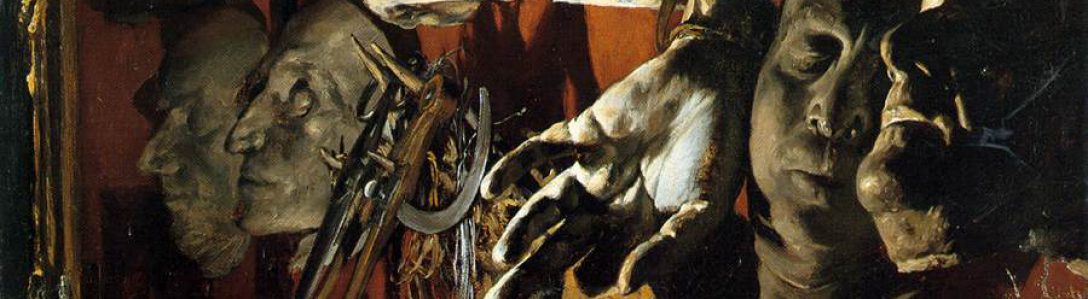
The Visionary — Serafino Macchiati

a85bce0bfda674e47375c39b9eacc7ce

The Visionary, 1904 by Serafino Macchiati (1861-1916)