AV: Yes, what’s important in post-exoticism is that it does away with exoticism. You suggested anti-exoticism, and it could just as well have been anti-exoticism, in as much as what characterizes exoticism is the absolute distinction between the metropolis and the margin, between the center and the periphery. With exoticism, there is an interest in the margins–the writer lives on the margins–but it’s all for the sake of the center. In exoticism, one describes the margins with ideas that come from the center, whereas in our books, the characters—who are dying, or perhaps already dead, who are birds, or animals, or insane—have no center, or rather it is their margin that is the center—the center no longer exists. For us, mental derangement doesn’t refer to a discourse of normality outside of it. In the books, it is present, and it is the center, it is what’s creating the world. In Lisbon, Last Frontier, it’s Ingrid Vogel who creates the world. The reader might think she’s completely mad, schizophrenic, paranoid, but, in fact, the book never refers to an outside normality, from which one could judge Ingrid’s experience. Yes, the book enters her imaginary; yes, it creates imaginary spaces for her to inhabit, but it never refers to a normality outside of her. And it’s through this precise mechanism that the books are on the margins, in the dustbin (to borrow an expression from Lisbon, Last Frontier); it’s in this way that they are dustbin literature, a literature from elsewhere, and that’s what comes into being with post-exoticism. That’s what’s important I think: a literature that doesn’t refer to normality, that doesn’t refer to the center. In that sense it’s more anti-exoticism… but of course I’m not going to change it now. It’s too late; it’s post-exoticism until the end!
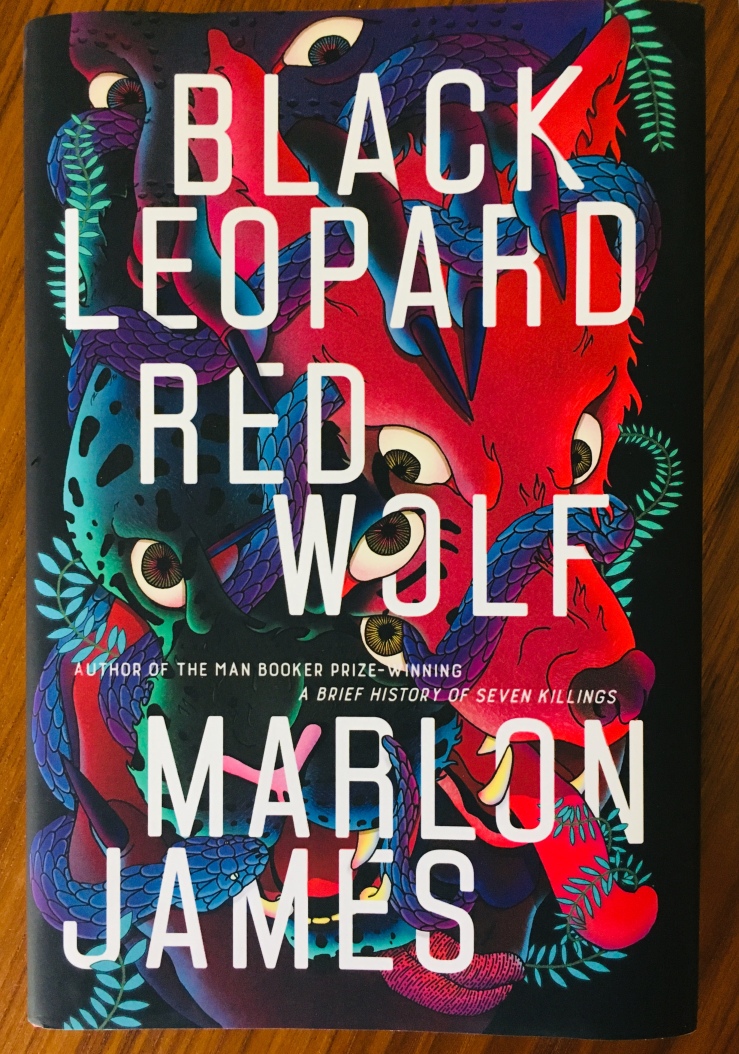
I was skeptical about Marlon James’s new novel Black Leopard, Red Wolf when it came out earlier this year in hardback. The novel had plenty of buzz and a big blurb from Neil Gaiman on the back—two things that often turn me off. I was also a bit skeptical about some of the novel’s marketing hype. James referred to his novel as an “African Game of Thrones,” and a lot of folks ranwith that tag. James has since professed in an interview that this comparison was a joke.
Just look at that! Amazon stats for big publisher/big buzz books tend to be suspiciously positive, but here I saw a sign of something that intrigued me—a book that a lot of people either loved or hated. And some of those one-star reviews?
Filled with gratuitous and rampant cursing, sexuality, violence and brutality. Too much even for fans of dark fantasy. I could not finish it.
…Confusing, nasty, all-over-the-place, just plain LOST. Sorry, but this needs a particular kind of person to stomach or understand.
…If you don’t mind being confused and unsure of the direction of a story, this book is for you. You must have patience to read this book.
…sounds like it was written by someone on hallucinogens.
I knew at this point I wouldn’t wait for the paperback.
If James’s comparing Black Leopard, Red Wolf to Game of Thrones was a joke, it’s a pretty good one, the kind of joke that could sell a lot of copies of his novel to fantasy fans who want a plot-driven tale. From the four baffling, surreal, vivid (and often lurid) chapters I’ve read so far, Black Leopard, Red Wolf isn’t really like Game of Thrones at all. There’s an opaqueness to James’s prose, a distancing effect to the language that alienates the reader in the most wonderful way. It’s all so terribly strange! Fans of plot-centric fantasy where the author explains and explicates what’s happening will likely be very quickly bothered by what James is doing here.
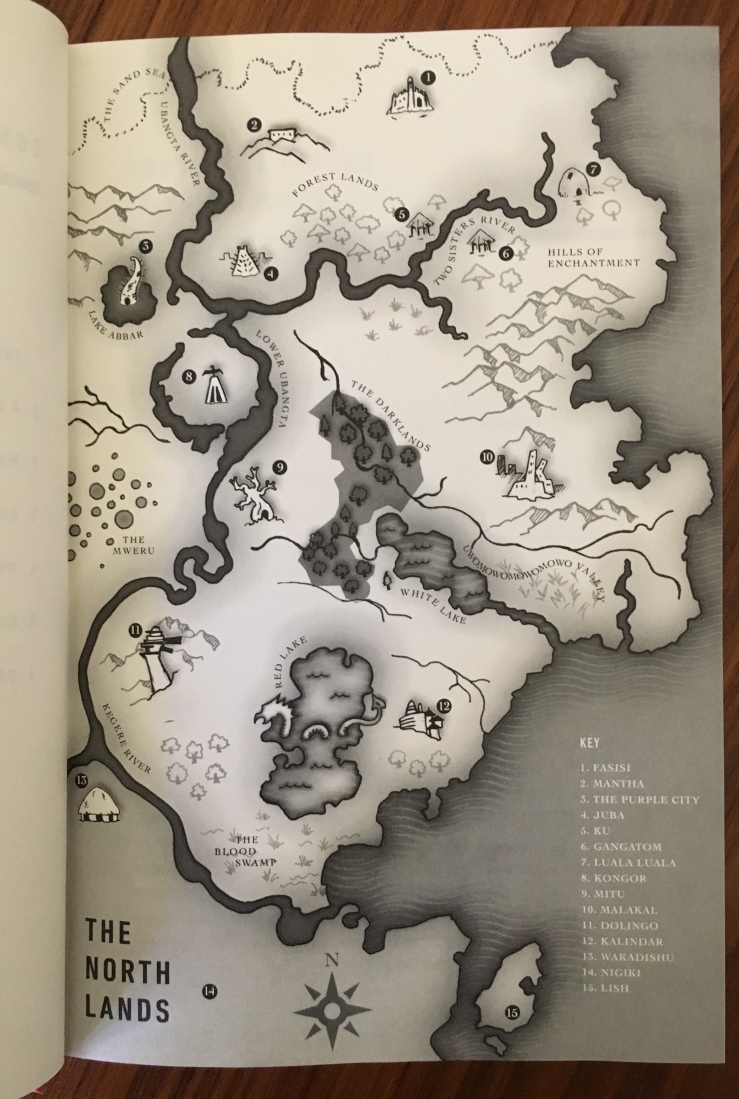
So far, Black Leopard, Red Wolf is first-person narrative of a man who may or may not be named Tracker, who is telling his story—or rather, many, many stories—to someone called Inquisitor (shades of One Thousand and One Nights?). These stories flow and roil into and out of each other. The minute James lets us find our bearings a bit, we’re out into new territory—one moment fighting “Omoluzu…Roof walkers” who seem to exist on a tangential plane to our own, and not long after running through a jungle of giant trees with a shapeshifting Leopard who leads us to a village of cursed children. Black Leopard, Red Wolf overflows with energy: the novel is kinetic, bright, and sharp, but also dark, eerie, and upsetting—it’s abject, puzzling, slippery. I love it so far.
The novel completely won me over on its tenth page, with this wild episode:
I kept walking until I came to an old woman by a river with a tall stick sitting at the banks. Her hair white at the sides, her head bald at the top. Her face had lines like paths in the forest and her yellow teeth meant her breath was foul. The stories say she rises each morning youthful and beautiful, blooms full and comely by midday, ages to a crone by nightfall, and dies at midnight to be born again the next hour. The hump in her back was higher than her head, but her eyes twinkled, so her mind was sharp. Fish swam right up to the point of the stick but never went beyond.
“Why have you come to this place?” she asked.
“This is the way to Monono,” I said.
“Why have you come to this place? A living man?”
“Life is love and I have no love left. Love has drained itself from me, and run to a river like this one.”
“It’s not love you have lost, but blood. I will let you pass. But when I lay with a man I live without dying for seventy moons.”
So I fucked the crone. She lay on her back by the bank, her feet in the river. She was nothing but bones and leather, but I was hard for her and full with vigor. Something was swimming between my legs that felt like fishes. Her hand touched my chest and my white clay stripes turned into waves around my heart. I thrust in and out of her, unnerved by her silence. In the dark I felt she was getting younger even though she was getting older. Flame spread inside me, spread to the tips of my fingers and the tip of me inside her. Air gathered around water, water gathered around air and I yelled, and pulled out, and rained on her belly, her arms, and her breasts. A shudder ran through me five times. She was still a crone, but I was not angry. She scooped my rain off her chest and flicked it off in the river. At once fish leapt up and dived in, leapt up again. This was a night when dark ate the moon, but the fishes had a light within them. The fishes had the head, arms, and breasts of women.
“Follow them,” she said.
I followed them through day and night, and day again. Sometimes the river was as low as my ankle. Sometimes the river was as high as my neck. Water washed all the white from my body, leaving just my face. The fish- women, womenfish, took me down the river for days and days and days until we came to a place I cannot describe. It was either a wall of river, which stood firm even though I could push my hand through it, or the river had bent itself downward and I could still walk, my feet touching the ground, my body standing without falling.
Not much happens in Jon McNaught’s latest graphic novel Kingdom. A mother takes her son and daughter to Kingdom Fields Holiday Park, a vacation lodge on the British coast. There, they watch television, go to a run-down museum, play on the beach, walk the hills, and visit an old aunt. Then they go home. There is no climactic event, no terrible trial to endure. There is no crisis, no trauma. And yet it’s clear that the holiday in Kingdom Fields will remain forever with the children, embedded into their consciousness as a series of strange aesthetic impressions. Not much happens in Kingdom, but what does happen feels vital and real.
“Life, friends, is boring,” the poet John Berryman wrote in his fourteenth Dream Song, before quickly appending, “We must not say so / After all, the sky flashes, the great sea yearns.” In Kingdom, McNaught creates a world of flashing sky and yearning sea, natural splendor populated by birds and bats, mice and moths. In Kingdom Fields, waves crash in gorgeous dark blues, the sun rises in golden pinks, rain teems down in violet swirls, and the wind breezes through meadows of grass. It’s all very gorgeous, and the trio of main characters spend quite a bit of the novel ignoring it. The narrator of John Berryman’s fourteenth Dream Song understood the transcendental promise of nature’s majesty, yet also understood that “the mountain or sea or sky” alone are not enough for humans—that we are of nature and yet apart from it.
Cover art for Parable of the Sower by John Jude Palencar
Octavia Butler’s 1993 novel Parable of the Sower imagines what a radical affirmation of life might look like set against a backdrop of impending extinction. Set between 2024 and 2027, Parable of the Sower conjures a crumbling America. Hyperinflation abounds, infrastructure is falling apart, water is scarce, environmental collapse is imminent, and the social institutions that bind the nation have all but frayed.
When we first meet our narrator Lauren Olamina, she is one of the lucky few who has a life of moderate comfort, stability, and security. Lauren lives in a gated community in a sort of compound with her brothers, stepmother, and father, an academic/preacher. Lauren’s father is the ersatz leader of this community, He leads the neighborhood’s shooting practices, trains them in survival skills, and organizes a perimeter watch against the thieves and arsonists that constantly threaten their survival. He is the central role model for Lauren, who takes his lessons to heart. When the community finally fragments under an attack it can’t endure, Lauren is the only one of her family to survive. She even has the presence of mind to grab her bug-out bag.
After this initial staging of events, Parable of the Sower turns into a road novel. Lauren and two other survivors of the compound head north along the California freeways, slowly gathering followers. Lauren’s leadership drives the novel and inspires those around her. She offers her followers an alternative to the predation around them, a predation most strongly figured in the roving bands of arsonists that prey on travelers and communities alike. She offers her followers the prospect of belonging to a We—an interracial, inter-generational collective.
Lauren’s leadership capability derives from two strands. The first strand is the religion she is creating, an idea she calls “Earthseed.” The basic premise of Earthseed (one that the novel repeats ad nauseum) is that “God is Change.” Another tenet is that people are the seeds of the earth (like, uh, Earthseed—get it?). Lauren’s long-term vision is that humanity might seed a new planet. The post-WW2 dream of NASA and the futurity of exploration—a Manifest Destiny of the stars—glows in the background of Sower, and often points to a more interesting conclusion than the novel finally musters.
The second source of Lauren’s drive comes from a condition she suffers called hyperempathy or “sharing,” a mutation that’s the result of her birth-mother’s drug addiction during pregnancy. Simply put, when Lauren witnesses another person’s injury, she feels their pain. This affliction is a devastating weakness in a predatory, violent (non)society: for Lauren, self-defense entails self-harm. At the same time, Lauren’s hyperempathy is a strength—it makes her understand, at the most visceral level, the need for a community to work together in order to thrive in a world that seems to be dying.
Perhaps the greatest strength of Butler’s novel is that she shows her readers what Lauren can never quite see—namely that Lauren’s hyperempathy is a strength. Sower assumes the form of a journal, Lauren’s first-person recollections scrawled out in rare moments of respite from the terrors of the road. While her first-person perspective is generously broad (she seems to see a lot), she still never quite realizes that her hyperempathy contributes to her strength as a leader. Lauren’s hyperempathy necessitates imaginative forethought; it also entails a need to act decisively in times of crisis. And Parable of the Sower is all crisis, all the time.
Lauren’s journal style mixes the high with the low. She cribs the poetry of her Earthseed religion from the King James Version of the Bible, with often corny results. (I am pretty sure the corniness is unintentional). She’s also occasionally psychologically introspective, going through thought experiments to better understand those around her.
Despite its Earthseed flights into poetical musings and boldly-declared profundities, most of Lauren’s narrative is strangely mundane in its accounting of a slow apocalypse though. There are seemingly-endless lists of supplies to be bought or scavenged, survival chores to be checked off, and California roads to be traversed (sections of Parable of the Sower often reminded me more of the SNL recurring sketch “The Californians” than, say, Cormac McCarthy’s The Road). The bulk of Butler’s book hovers around disaster prepping, finding temporary shelter, and looting bodies, motifs that won’t seem strange to contemporary audiences reared on cable television and addicted to battle royale video games.
Lauren is 15 at the novel’s outset in 2024, yet she seems fully mature. If this was a coming-of-age novel, I missed it—Lauren, while far from perfect, is generally self-assured in her powers of decision making. At a quite literal level, she commands the narrative, propelling it forward without any of the wishy-washiness we might get from the narrator of, say, The Handmaid’s Tale. If Lauren second-guesses herself, she doesn’t bother to second-guess her second guesses. Butler seems to envision her rather as a hero-model for the coming disaster the novel anticipates. Much of Parable of the Sower reads like a checklist of What To Do After the End of Civilization.
The novel’s biggest weakness is that it can’t quite articulate just how bad things have gotten. Is this actually The End of Civilization? Butler paints a bleak picture. Drought is the new norm. Most Americans are illiterate. Work is hard to find. The roads are too dangerous to travel at night. Packs of feral dogs hunt down humans. Packs of feral children eat humans. Women live with the constant threat of rape. Overt racism is fully normalized. Company towns make a comeback, issuing scrip instead of currency, leading to indentured servitude. Water is a commodity to literally kill for, the police are essentially an organized gang, and a large portion of the population are addicted to a drug that makes setting fires better than sex. Murder is an open business, and there is no recourse to any established justice.
And at the same time that it evokes all of these apocalyptic images and themes, Butler’s novel points to tinges of normalcy—a presidential election carried out sans violence, the sense that a university system is still in play, various notations of different regulatory bodies. Parable of the Sower often reads like The Walking Dead or The Road, but then it might turn a weird corner to uncanny normalcy, where characters shop in a Walmart-like (if hyperbolized) superstore. As one character puts it,
Federal, state, and local governments still exist— in name at least— and sometimes they manage to do something more than collect taxes and send in the military. And the money is still good. That amazes me. However much more you need of it to buy anything these days, it is still accepted. That may be a hopeful sign— or perhaps it’s only more evidence of what I just said: We haven’t hit bottom yet.
Perhaps what I perceive here is simply Butler showing her narrator’s essential naivete, a naivete that doesn’t evince on the surface of the first-person narration. Lauren doesn’t know what she doesn’t know. She doesn’t fully understand how bad things have gotten because she doesn’t fully understand the potential in America that existed before her own life. But she does intuit how bad things are. Despite her intuition, she’s hopeful. This hope, and the despair that foregrounds it, evinces strongly in the final moments of the book. Lauren has finally made it to a kind of promised-land, a frontier-space where she can create a new life with a new love, a much-older man named Bankole. Bankole was a doctor in his old life, but now he’s a survivor. At the end of the novel, he mourns the American dream, the American we, and mourns that Lauren cannot mourn it with him:
He said nothing for a while. Then he stopped and put his hand on my shoulder to stop me. At first he only stood looking at me, almost studying my face. “You’re so young,” he said. “It seems almost criminal that you should be so young in these terrible times. I wish you could have known this country when it was still salvageable.”
“It might survive,” I said, “changed, but still itself.”
“No.” He drew me to his side and put one arm around me. “Human beings will survive of course. Some other countries will survive. Maybe they’ll absorb what’s left of us. Or maybe we’ll just break up into a lot of little states quarreling and fighting with each other over whatever crumbs are left. That’s almost happened now with states shutting themselves off from one another, treating state lines as national borders. As bright as you are, I don’t think you understand—I don’t think you can understand what we’ve lost. Perhaps that’s a blessing.”
Banokole’s summary of America in the late 2020s seems like a dire if hyperbolic prognostication of our current trajectory. More than a quarter century ago, Butler knew what was up. Butler also offered an answer to the problem in her mouthpiece Lauren, who replies to her (way-too-much older) lover Bankole, “We’ve got work to do.”
Parable of the Sower is not a particularly fun novel, although of course, it never intends to be. The dour tone is appropriate to its subject matter, I suppose, but that grim tone can become exhausting. The novel’s trajectory and moral vision keep it from falling into an exercise in nihilism or apocalypse porn, like, say, The Walking Dead. But like The Walking Dead, Butler’s novel often plods along. Maybe this is a rhetorical feature—maybe Butler intends her reader to feel just as weary and depressed as Lauren.
Parable of the Sower was published just a year after a superficially-similar novel, Neal Stephenson’s Snow Crash, which also presciently envisions a fragmenting America where like-groups seal themselves off from each other. In contrast though, Stephenson’s novel is zany and vibrant, a cartoon world devoid of any hyperempathy that might get in the way of anarchic fun. Over 25 years old now, many of the tropes in both Snow Crash and Parable of the Sower have so fully infiltrated our media—books and video games, films and television shows—that their initial vital strangeness is hard to detect.
The dystopian tropes of Parable of the Sower don’t feel particularly fresh in 2019, but the novel’s prescience still has an alarming bite. (Her sequel, Parable of the Talents, features a right-wing Presidential candidate who runs on the promise to “Make America great again”). Sower works best as an extended thought experiment on what might happen to society—to democracy in particular—when impending ecological collapse threatens our very existence. And Butler proposes a solution to the problems posed in her thought experiment: “We’ve got work to do.”
“We’ve got work to do” not only summarizes Parable of the Sower’s central message, it also describes current zeitgeist. Lauren would have been born in 2009; my daughter was born in 2007 and my son in 2010. She could be one of their classmates; she could be my own daughter. The novel’s vision of hyperempathy in the face of brutality and creeping fascism points back to that phrase — “We’ve got work to do” — which of course, requires a We. The we here is a radical affirmation, an echo even of the We the People that so boldly engendered a U.S. America. But Butler’s vision, conveyed through Lauren, is far more pluralistic and diverse than the We the framers evoked in the Preamble to the Constitution. Butler’s we names the namelessness of a coming society, a society that seems impossible and yet is possible, its possibility instantiated in the simple proof that it can be imagined. Parable of the Sower ultimately points toward the seeds of that imagining.
[Editorial note: The following citations come from one-star Amazon reviews of various Flannery O’Connor short story collections and novels. To be clear, I’m a big O’Connor fan. I’ve preserved the reviewers’ own styles of punctuation and spelling. More one-star Amazon reviews.].
I wanted to burn it.
I like happy endings.
100 per cent not for me.
I did not finish the book.
This story was agonizing.
I do not like the words used.
To me it was very depressing.
I really, truly hated this book.
The plot was as much a mystery.
They barely even seemed human.
I would not recommend this to anyone.
I had to force myself to finish this book.
I didn’t understand the characters at all.
Not only that, but I really didn’t like them either.
I would never have guessed that the author was female.
I didn’t understand, and I’m fairly certain that I never will.
I think this is the only book I’ve ever felt that I really hated.
One finds it impossible to symapthize or identify with them.
O;Connor is a gifted writer. However this book is dark in tone.
This story just stopped, no solutions to the problems involved.
I think it was a failing of the author to make the character believable.
After reading this book I really need some sunshine and happy voices.
Perhaps most disurbing is the brutal portrayal of violence against children.
Flannery O’Connor is the most depressing writer I have ever had the misfortune to read.
I can’t understand an author who could treat her characters with such callous disregard!
There is little here that resonates with my life’s experiences or my understanding of them.
Unless we are willing to accept our artists as they are, the answer to the question, “Who speaks for America today?” will have to be: the advertising agencies. They are entirely capable of showing us our unparalleled prosperity and our almost classless society, and no one has ever accused them of not being affirmative. Where the artist is still trusted, he will not be looked to for assurance. Those who believe that art proceeds from a healthy, and not from a diseased, faculty of the mind will take what he shows them as a revelation, not of what we ought to be but of what we are at a given time and under given circumstances; that is, as a limited revelation but revelation nevertheless.
From Flannery O’Connor’s essay “The Fiction Writer and His Country,” collected in Mystery and Manners.
Under the orders of the Great Master, they’re embroidering the earth’s mantle, seas, mountains, and living things. Only the girl has woven a ruse in which she is seen beside her beloved.
Remedios Varo’s description of her painting The Embroidering of the Earth’s Mantle (1961). From the collection Letters, Dreams & Other Writings. Translated by Margaret Carson. From Wakefield Press.
Here’s the section on “The Inedible,” which includes notes on two of my favorite scenes from Gravity’s Rainbow—–
The Inedible
“A lot of people who think they’re cooks but are clinically deluded,” says a mess hall manager in Vineland. Pynchon includes a lot of their misguided creations in his books, relishing the gross and inedible—the places where “even [the] Jell-O salads have scum on them.”
Maybe the most memorable example is the “English Candy Drill,” in which a parade of disgusting sweets are sampled, unwillingly, by Tyrone Slothrop, the protagonist (sorta) in Gravity’s Rainbow: rhubarb creams, cherry-quinine petit fours, eucalyptus-flavored fondant, and pepsin-flavored nougat, licorice drops with a “dribbling liquid center, which tastes like mayonnaise and orange peels” and “a hard sour gooseberry shell into a wet spurting unpleasantness of, he hopes it’s tapioca, little glutinous chunks of something all saturated with powdered cloves.”
Gravity’s Rainbow includes another scene that’s hard to stomach: As a culinary prank, Bodine and Roger hold a dinner party with an intentionally revolting menu: “snot soup,” “sum soufflé,” “vomit vichyssoise” and “wart waffles.” Needless to say, “A general loss of appetite reigns, not to mention overt nausea.”
It’s a fun article, like I said, but there are a few things missing. It notes Against the Day’scult of mayonnaise but leaves out all the ketchup (ketjap) stuff in Mason & Dixon, as well as Mason & Dixon’s important core distinction between Grape People and Grain People:
“If this is as bad as it gets, why I can abide thah’. As long as the Spirits don’t run out.”
“Nor the Wine.”
“Wine.” Dixon is now the one squinting. Mason wonders what he’s done this time. ” ‘Grape or Grain, but ne’er the Twain,’ as me Great- Uncle George observ’d to me more than once,— ‘Vine with Corn, beware the Morn.’ Of the two sorts of drinking Folk this implies, than’ is, Grape People and Grain People, You will now inform rne of Your membership in the Brotherhood of the, eeh, Grape…? and that You seldom, if ever, touch Ale or Spirits, am I correct?”
“Happily so, I should imagine, as, given a finite Supply, there’d be more for each of us, it’s like Jack Sprat, isn’t it.”
“Oh, I’ll drink Wine if I must…?— and now we’re enter’d upon the Topick,— ”
“— and as we are in Portsmouth, after all,— there cannot lie too distant some Room where each of us may consult what former Vegetation pleases him?”
Dixon looks outside at the ebbing wintry sunlight. “Nor too early, I guess…?”
“We’re sailing to the Indies,— Heaven knows what’s available on Board, or out there. It may be our last chance for civiliz’d Drink.”
“Sooner we start, the better, in thah’ case…?”
Again, a fun article—but what other food bits are missing? (We can leave the coprophagia and urolagnia in Gravity’s Rainbow out, though).
In Reno, among the colored folks of the town, there are two main social classes: those who came to the city on a freight train, and those who did not. The latter, or cushion-riders, are sometimes inclined to turn flat noses high at those who rode the rods by way of entry to the city. Supercilious glances on the part of old settlers and chair-car arrivals toboggan down broad Negro noses at the black bums who, like white bums, both male and female, stream through Nevada on their way to or from the Coast, to remain awhile, if the law will let them in THE BIGGEST LITTLE CITY IN THE WORLD—RENO—according to the official sign in electric lights near the station.
But, of course, the rod-riders get off nowhere near the station. If they’re wise, bums from the East get off at Sparks, several miles from the famous mecca of unhappy wives, then they foot it into Reno. (Only passengers with tickets, coaches or Pullmans, can afford the luxury of alighting directly in front of any station, anywhere.)
Terry and Sling came in on a fast freight from Salt Lake. Before that they had come from Cheyenne. And before that from Chicago—and then the line went south and got lost somewhere in a tangle of years and cotton fields and God-knows-what fantasies of blackness. Continue reading ““Slice ’em Down,” a short story by Langston Hughes”→






 Biblioklept