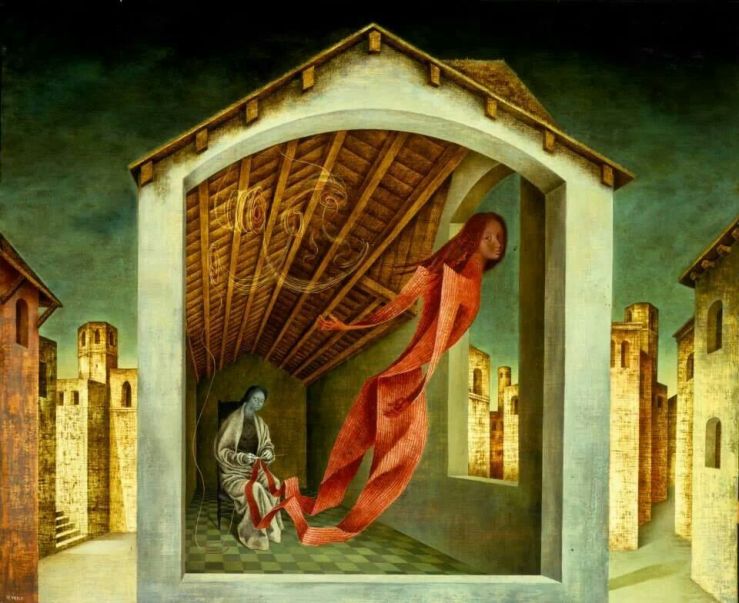
What is happening here is obvious: that lady who is knitting fisherman’s rib is making animated characters who leave through the window.

1626b8e5d94a5f4016cb8a169ae53428

What is happening here is obvious: that lady who is knitting fisherman’s rib is making animated characters who leave through the window.

Remedios Varo’s description of her painting The Knitting Woman of Verona (1956). From the collection Letters, Dreams & Other Writings. Translated by Margaret Carson. From Wakefield Press.

Too much plasticity (From Gaddis’s The Recognitions)

 — Where were you all day? Mr. Yak asked again, when they bumped the second time.

—The Prado.

—The art museum? Mr. Yak shrugged. —What did you do there? He glanced up at the face beside him, and said, —You don’t look like you liked it much. The art there.

—Well they . . . the El Greco, his companion began, as though called upon to comment, and he drew his hand across his eyes.

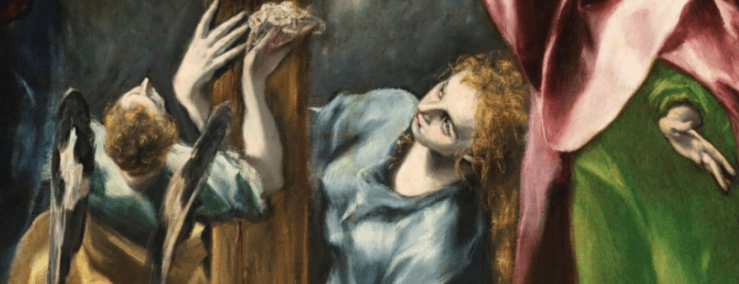
—They have so many in one room, they’re almost hung on top of each other and it’s too much, it’s too much plasticity, there’s too much movement there in that one room . . . He suddenly looked up at Mr. Yak, holding a hand out before them which appeared to try to shape something there. —Do you … do you see what I mean? With a painter like El Greco, somebody called him a visceral painter, do you see what I mean? And when you get so much of his work hung together, it … the forms stifle each other, it’s too much. Down where they have the Flemish painters hung together it’s different, because they’re all separate . . . the compositions are separate, and the . . . the Bosch and Breughel and Patinir and even Dürer, they don’t disturb each other because the . . . because every composition is made up of separations, or rather … I mean … do you see what I mean? But the harmony in one canvas of El Greco is all one . . . one . . . He had both hands out before him now, the fingers turned in and the thumbs up as though holding something he was studying with a life which Mr. Yak had not seen in his face before. But he broke off abruptly, and his hands came down to his sides.

From William Gaddis’s The Recognitions. 

Screenshot 2018-12-26 at 5.10.20 PM
Detail from The Crucifixion, El Greco, 1600

“It was Christmas night and the proper things had been done” (The Once and Future King)

It was Christmas night and the proper things had been done. The whole village had come to dinner in hall. There had been boar’s head and venison and pork and beef and mutton and capons—but no turkey, because this bird had not yet been invented. There had been plum pudding and snap-dragon, with blue fire on the tips of one’s fingers, and as much mead as anybody could drink. Sir Ector’s health had been drunk with “Best respects, Measter,” or “Best compliments of the Season, my lords and ladies, and many of them.” There had been mummers to play an exciting dramatic presentation of a story in which St. George and a Saracen and a funny Doctor did surprising things, also carol-singers who rendered “Adeste Fideles” and “I Sing of a Maiden,” in high, clear, tenor voices. After that, those children who had not been sick from their dinner played Hoodman Blind and other appropriate games, while the young men and maidens danced morris dances in the middle, the tables having been cleared away. The old folks sat round the walls holding glasses of mead in their hands and feeling thankful that they were past such capers, hoppings and skippings, while those children who had not been sick sat with them, and soon went to sleep, the small heads leaning against their shoulders. At the high table Sir Ector sat with his knightly guests, who had come for the morrow’s hunting, smiling and nodding and drinking burgundy or sherries sack or malmsey wine.

After a bit, silence was prayed for Sir Grummore. He stood up and sang his old school song, amid great applause—but forgot most of it and had to make a humming noise in his moustache. Then King Pellinore was nudged to his feet and sang bashfully:

“Oh, I was born a Pellinore in famous Lincolnshire. Full well I chased the Questing Beast for more than seventeen year. Till I took up with Sir Grummore here In the season of the year. (Since when) ’tis my delight On a feather-bed night To sleep at home, my dear.

“You see,” explained King Pellinore blushing, as he sat down with everybody whacking him on the back, “old Grummore invited me home, what, after we had been having a pleasant joust together, and since then I’ve been letting my beastly Beast go and hang itself on the wall, what?”

“Well done,” they told him. “You live your own life while you’ve got it.”

William Twyti was called for, who had arrived on the previous evening, and the famous huntsman stood up with a perfectly straight face, and his crooked eye fixed upon Sir Ector, to sing:

“D’ye ken William Twyti

With his Jerkin so dagged? D’ye ken William Twyti

Who never yet lagged? Yes, I ken William Twyti,

And he ought to be gagged With his hounds and his horn in the morning.”

“Bravo!” cried Sir Ector. “Did you hear that, eh? Said he ought to be gagged, my dear feller. Blest if I didn’t think he was going to boast when he began. Splendid chaps, these huntsmen, eh? Pass Master Twyti the malmsey, with my compliments.”

The boys lay curled up under the benches near the fire, Wart with Cavall in his arms. Cavall did not like the heat and the shouting and the smell of mead, and wanted to go away, but Wart held him tightly because he needed something to hug, and Cavall had to stay with him perforce, panting over a long pink tongue.

“Now Ralph Passelewe.”

“Good wold Ralph.”

“Who killed the cow, Ralph?”

“Pray silence for Master Passelewe that couldn’t help it.”

At this the most lovely old man got up at the furthest and humblest end of the hail, as he had got up on all similar occasions for the past half-century. He was no less than eighty-five years of age, almost blind, almost deaf, but still able and willing and happy to quaver out the same song which he had sung for the pleasure of the Forest Sauvage since before Sir Ector was bound up in a kind of tight linen puttee in his cradle. They could not hear him at the high table—he was too far away in Time to be able to reach across the room—but everybody knew what the cracked voice was singing and everybody loved it. This is what he sang:

“Whe-an/Wold King-Cole/was a /wakkin doon-t’street, H-e /saw a-lovely laid-y a /steppin-in-a-puddle. / She-a /lifted hup-er-skeat/ For to / Hop acrorst ter middle, / An ee /saw her /an-kel. Wasn’t that a fuddle? / Ee could’ernt elp it, /ee Ad to.”

There were about twenty verses of this song, in which Wold King Cole helplessly saw more and more things that he ought not to have seen, and everybody cheered at the end of each verse until, at the conclusion, old Ralph was overwhelmed with congratulations and sat down smiling dimly to a replenished mug of mead.

It was now Sir Ector’s turn to wind up the proceedings. He stood up importantly and delivered the following speech:

“Friends, tenants and otherwise. Unaccustomed as I am to public speakin’—”

There was a faint cheer at this, for everybody recognized the speech which Sir Ector had made for the last twenty years, and welcomed it like a brother.

“Unaccustomed as I am to public speakin'” it is my pleasant duty—I might say my very pleasant duty—to welcome all and sundry to this our homely feast. It has been a good year, and I say it without fear of contradiction, in pasture and plow. We all know how Crumbocke of Forest Sauvage won the first prize at Cardoyle Cattle Show for the second time, and one more year will win the cup outright. More power to the Forest Sauvage. As we sit down tonight, I notice some faces now gone from among us and some which have added to the family circle. Such matters are in the hands of an almighty Providence, to which we all feel thankful. We ourselves have been first created and then spared to enjoy the rejoicin’s of this pleasant evening. I think we are all grateful for the blessin’s which have been showered upon us. Tonight we welcome in our midst the famous King Pellinore, whose labours in riddin’ our forest of the redoubtable Questin’ Beast are known to all. God bless King Pellinore. (Hear, hear!) Also Sir Grummore Grummursum, a sportsman, though I say it to his face, who will stick to his mount as long as his Quest will stand up in front of him. (Hooray!) Finally, last but not least, we are honoured by a visit from His Majesty’s most famous huntsman, Master William Twyti, who will, I feel sure, show us such sport tomorrow that we will rub our eyes and wish that a royal pack of hounds could always be huntin’ in the Forest which we all love so well. (Viewhalloo and several recheats blown in imitation.) Thank you, my dear friends, for your spontaneous welcome to these gentlemen. They will, I know, accept it in the true and warmhearted spirit in which it is offered. And now it is time that I should bring my brief remarks to a close. Another year has almost sped and it is time that we should be lookin’ forward to the challengin’ future. What about the Cattle Show next year? Friends, I can only wish you a very Merry Christmas, and, after Father Sidebottom has said our Grace for us, we shall conclude with a singin’ of the National Anthem.”

The cheers which broke out at the end of Sir Ector’s speech were only just prevented, by several hush-es, from drowning the last part of the vicar’s Grace in Latin, and then everybody stood up loyally in the firelight and sang:

“God save King Pendragon,

May his reign long drag on,

God save the King.

Send him most gorious,

Great and uproarious,

Horrible and Hoarious,

God save our King.”

The last notes died away, the hall emptied of its rejoicing humanity. Lanterns flickered outside, in the village street, as everybody went home in bands for fear of the moonlit wolves, and The Castle of the Forest Sauvage slept peacefully and lightless, in the strange silence of the holy snow.

—From T.H. White’s The Once and Future King.


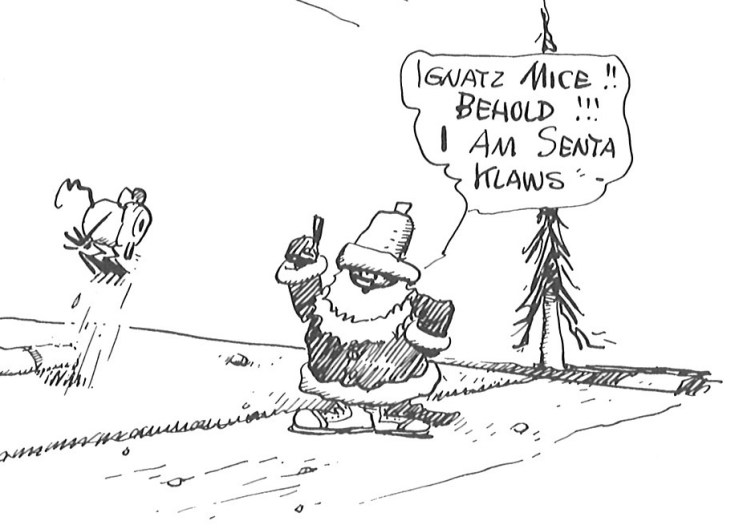
Behold!!! I am Senta Klaws (George Herriman)

Santa-Kat-1

(Via/more).

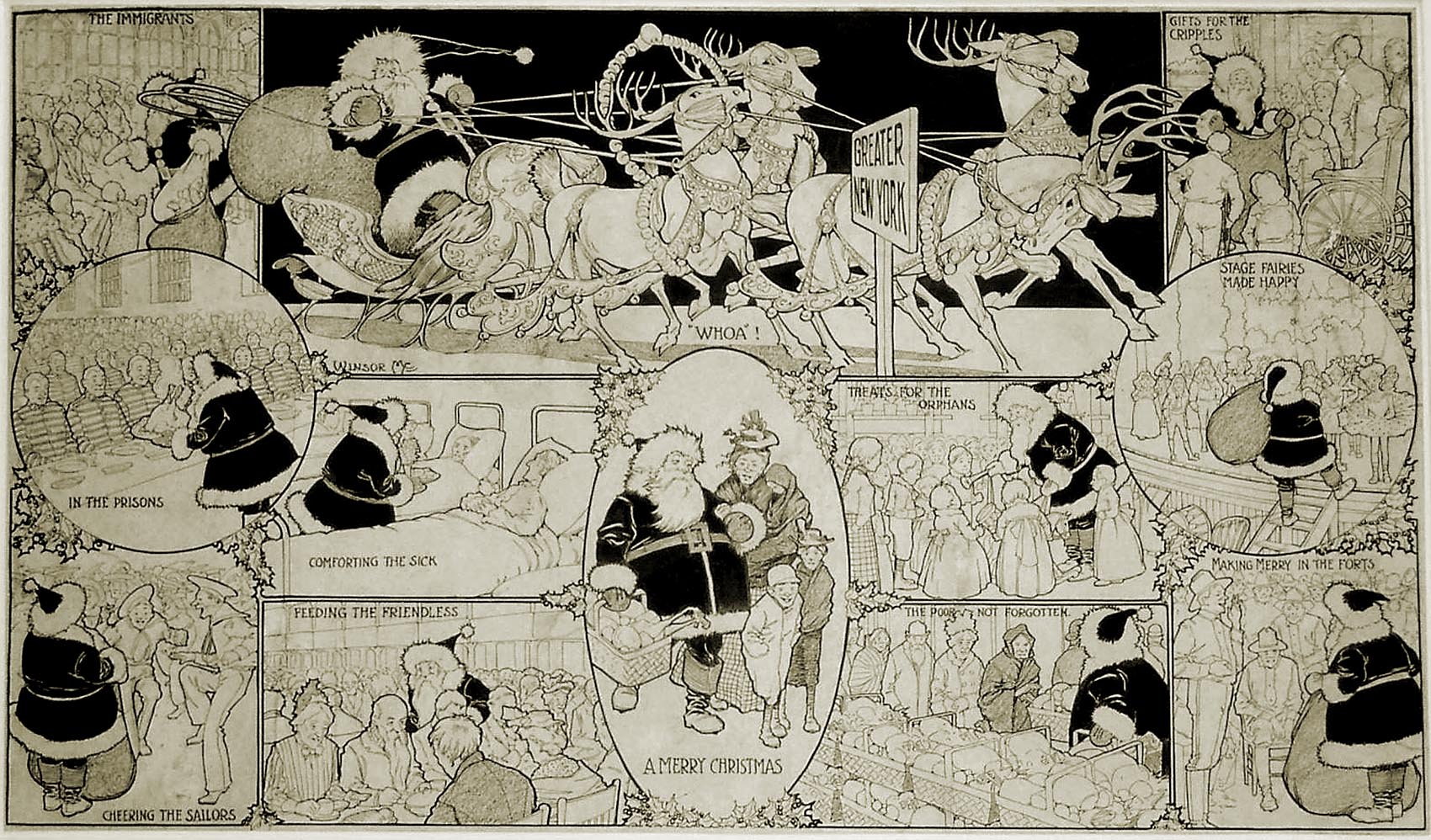
“A Merry Christmas” — Winsor McCay

“Merry Christmas” (Moby-Dick)

“Merry Christmas”

from Herman Melville’s Moby-Dick

At length, towards noon, upon the final dismissal of the ship’s riggers, and after the Pequod had been hauled out from the wharf, and after the ever-thoughtful Charity had come off in a whale-boat, with her last gift- a nightcap for Stubb, the second mate, her brother-in-law, and a spare Bible for the steward- after all this, the two Captains, Peleg and Bildad, issued from the cabin, and turning to the chief mate, Peleg said:

“Now, Mr. Starbuck, are you sure everything is right? Captain Ahab is all ready- just spoke to him- nothing more to be got from shore, eh? Well, call all hands, then. Muster ‘em aft here- blast ‘em!”

“No need of profane words, however great the hurry, Peleg,” said Bildad, “but away with thee, friend Starbuck, and do our bidding.”

How now! Here upon the very point of starting for the voyage, Captain Peleg and Captain Bildad were going it with a high hand on the quarter-deck, just as if they were to be joint-commanders at sea, as well as to all appearances in port. And, as for Captain Ahab, no sign of him was yet to be seen; only, they said he was in the cabin. But then, the idea was, that his presence was by no means necessary in getting the ship under weigh, and steering her well out to sea. Indeed, as that was not at all his proper business, but the pilot’s; and as he was not yet completely recovered- so they said- therefore, Captain Ahab stayed below. And all this seemed natural enough; especially as in the merchant service many captains never show themselves on deck for a considerable time after heaving up the anchor, but remain over the cabin table, having a farewell merry-making with their shore friends, before they quit the ship for good with the pilot.

But there was not much chance to think over the matter, for Captain Peleg was now all alive. He seemed to do most of the talking and commanding, and not Bildad.

“Aft here, ye sons of bachelors,” he cried, as the sailors lingered at the main-mast. “Mr. Starbuck, drive aft.”

“Strike the tent there!”- was the next order. As I hinted before, this whalebone marquee was never pitched except in port; and on board the Pequod, for thirty years, the order to strike the tent was well known to be the next thing to heaving up the anchor.

“Man the capstan! Blood and thunder!- jump!”- was the next command, and the crew sprang for the handspikes.

Now in getting under weigh, the station generally occupied by the pilot is the forward part of the ship. And here Bildad, who, with Peleg, be it known, in addition to his other officers, was one of the licensed pilots of the port- he being suspected to have got himself made a pilot in order to save the Nantucket pilot-fee to all the ships he was concerned in, for he never piloted any other craft- Bildad, I say, might now be seen actively engaged in looking over the bows for the approaching anchor, and at intervals singing what seemed a dismal stave of psalmody, to cheer the hands at the windlass, who roared forth some sort of chorus about the girls in Booble Alley, with hearty good will. Nevertheless, not three days previous, Bildad had told them that no profane songs would be allowed on board the Pequod, particularly in getting under weigh; and Charity, his sister, had placed a small choice copy of Watts in each seaman’s berth. Continue reading ““Merry Christmas” (Moby-Dick)”

A Mason & Dixon Christmastide (Thomas Pynchon)

They discharge the Hands and leave off for the Winter. At Christmastide, the Tavern down the Road from Harlands’ opens its doors, and soon ev’ryone has come inside. Candles beam ev’rywhere. The Surveyors, knowing this year they’ll soon again be heading off in different Directions into America, stand nodding at each other across a Punch-bowl as big as a Bathing-Tub. The Punch is a secret Receipt of the Landlord, including but not limited to peach brandy, locally distill’d Whiskey, and milk. A raft of long Icicles broken from the Eaves floats upon the pale contents of the great rustick Monteith. Everyone’s been exchanging gifts. Somewhere in the coming and going one of the Children is learning to play a metal whistle. Best gowns rustle along the board walls. Adults hold Babies aloft, exclaiming, “The little Sausage!” and pretending to eat them. There are popp’d Corn, green Tomato Mince Pies, pickl’d Oysters, Chestnut Soup, and Kidney Pudding. Mason gives Dixon a Hat, with a metallick Aqua Feather, which Dixon is wearing. Dixon gives Mason a Claret Jug of silver, crafted in Philadelphia. There are Conestoga Cigars for Mr. Harland and a Length of contraband Osnabrigs for Mrs. H. The Children get Sweets from a Philadelphia English-shop, both adults being drawn into prolong’d Negotiations with their Juniors, as to who shall have which of. Mrs. Harland comes over to embrace both Surveyors at once. “Thanks for simmering down this Year. I know it ain’t easy.”
“What a year, Lass,” sighs Dixon.
“Poh. Like eating a Bun,” declares Mason.”

The last paragraphs of Ch. 52 of Thomas Pynchon’s novel Mason & Dixon.

Santa’s bones (Umberto Eco)

ue

From the essay “Treasure Hunting” by Umberto Eco; collected in Inventing the Enemy (translation by Richard Dixon).

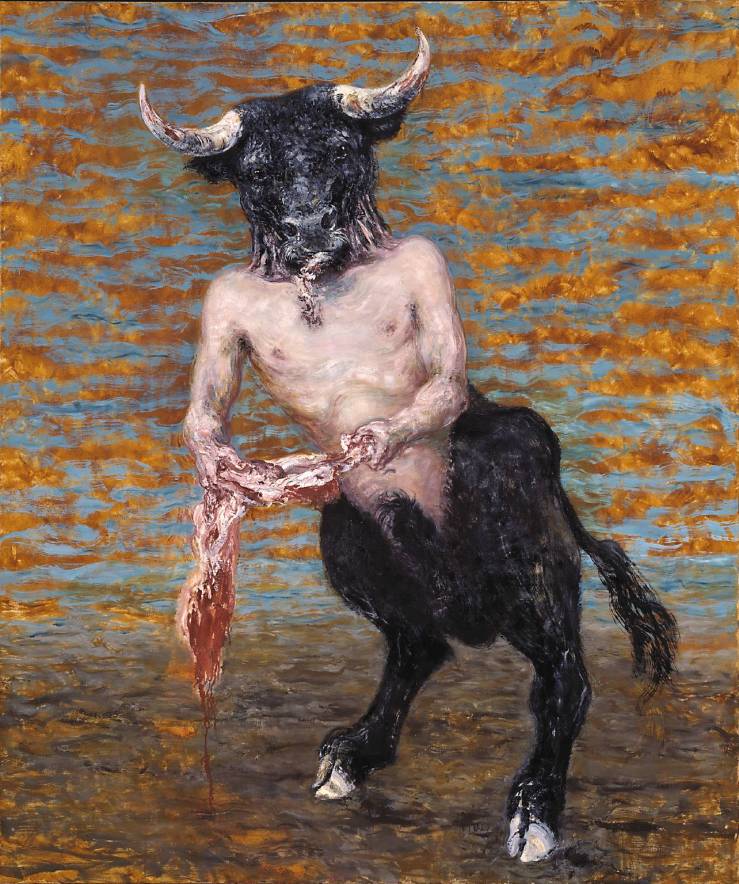
Minotaur Surprised while Eating — Maggi Hambling

Minotaur Surprised while Eating 1986-87 by Maggi Hambling born 1945

Minotaur Surprised while Eating, 1987 by Maggi Hambling (b. 1945)

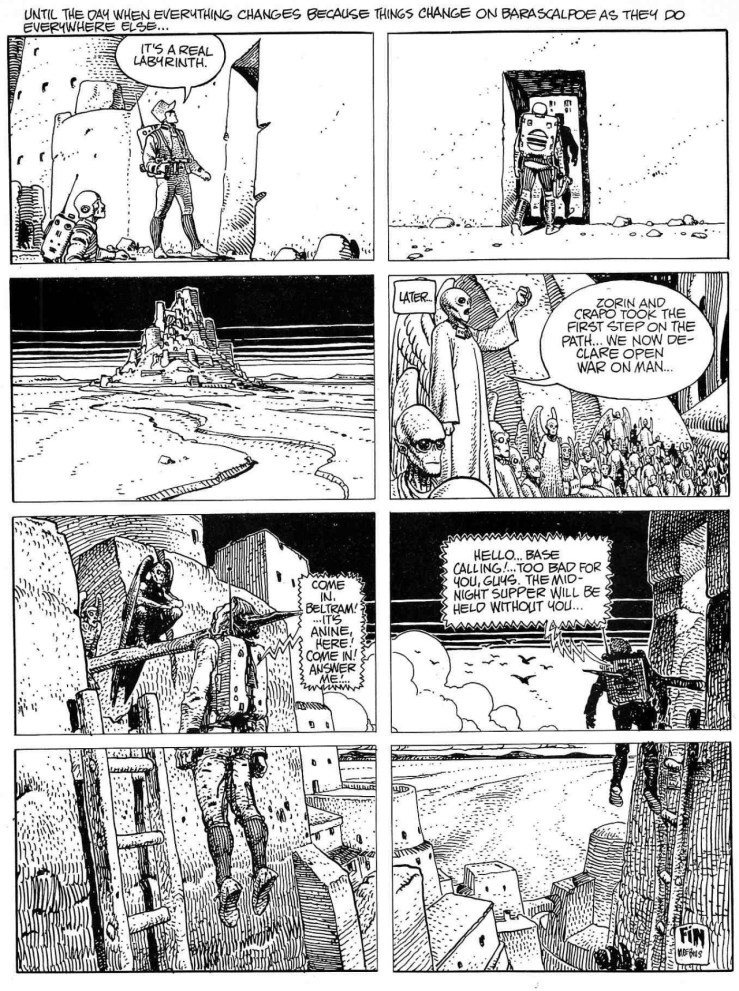
“A Tale of Christmas” — Moebius

tumblr_nh5dkjptau1rhjbado3_1280tumblr_nh5dkjptau1rhjbado2_1280tumblr_nh5dkjptau1rhjbado1_1280

“A Tale of Christmas” by Moebius. Published in Heavy Metal, December 1979. Via the Bristol Board.

Mirage — Bridget Tichenor

196720Espejismo

Mirage, 1967 by Bridget Tichenor (1917-1990)

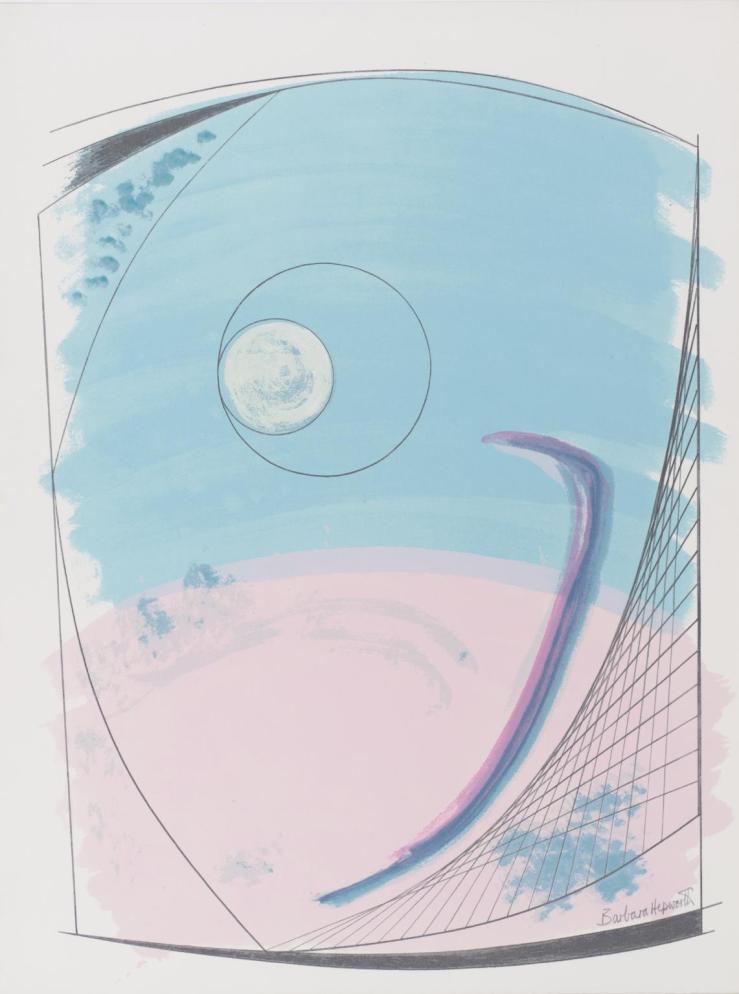
Winter Solstice — Barbara Hepworth

Winter Solstice 1970 by Dame Barbara Hepworth 1903-1975

Winter Solstice, 1970 by Barbara Hepworth (1903-1975)

“The Ghost Ships: A Christmas Story” by Angela Carter

“The Ghost Ships: A Christmas Story”

by

Angela Carter


Therefore that whosoever shall be found observing any such day as Christmas or the like, either by forebearing of labor, feasting, or any other way upon any such account aforesaid, every person so offending shall pay for every offense five shillings as a fine to the county.

Statute enacted by the General Court of
Massachusetts, May 1659, repealed 1681

‘Twas the night before Christmas. Silent night, holy night. The snow lay deep and crisp and even. Etc. etc. etc.; let these familiar words conjure up the traditional anticipatory magic of Christmas Eve, and then — forget it.

Forget it. Even if the white moon above Boston Bay ensures that all is calm, all is bright, there will be no Christmas as such in the village on the shore that now lies locked in a precarious winter dream.

(Dream, that uncensorable state. They would forbid it if they could.)

At that time, for we are talking about a long time ago, about three and a  quarter hundred years ago, the newcomers had no more than scribbled their signatures on the blank page of the continent that was, as it lay under the snow, no whiter nor more pure than their intentions.

They plan to write more largely; they plan to inscribe thereon the name of God.

And that was why, because of their awesome piety, tomorrow, on Christmas Day, they will wake, pray and go about their business as if it were any other day.

For them, all days are holy but none are holidays.

New England is the new leaf they have just turned over; Old England is the dirty linen their brethren at home have just — did they not recently win the English Civil War? — washed in public.

Back home, for the sake of spiritual integrity, their brothers and sisters have broken the graven images in the churches, banned the playhouses where men dress up as women, chopped down the village Maypoles because they welcome in the spring in altogether too orgiastic a fashion.

Nothing particularly radical about that, given the Puritans’ basic premises. Anyone can see at a glance that a Maypole, proudly erect upon the village green as the sap is rising, is a godless instrument. The very thought of Cotton Mather, with blossom in his hair, dancing round the Maypole makes the imagination reel. No. The greatest genius of the Puritans lay in their ability to sniff out a pagan survival in, say, the custom of decorating a house with holly for the festive season; they were the stuff of which social anthropologists would be made!

And their distaste for the icon of the lovely lady with her bonny babe — Mariolatry, graven images! — is less subtle than their disgust at the very idea of the festive season itself. It was the festivity of it that irked them.

Nevertheless, it assuredly is a gross and heathenish practice, to welcome the birth of Our
Saviour with feasting, drunkenness, and lewd displays of mumming and masquerading.

We want none of that filth in this new place.

No, thank you.


As midnight approached, the cattle in the byres lumbered down upon their knees in homage, according to the well-established custom of over sixteen hundred English winters when they had mimicked the kneeling cattle in the Bethlehem stable; then, remembering where they were in the nick of time, they hastily refrained from idolatry and hauled themselves upright.

Boston Bay, calm as milk, black as ink, smooth as silk. And suddenly, at just the hour when the night spins on its spindle and starts to unravel its own darkness, at what one could call, elsewhere, the witching hour —

I saw three ships come sailing in,
Christmas Day, Christmas Day,
I saw three ships come sailing in
On Christmas Day in the morning.

Three ships, silent as ghost ships; ghost ships of Christmas past.

And what was in those ships all three? Continue reading ““The Ghost Ships: A Christmas Story” by Angela Carter”

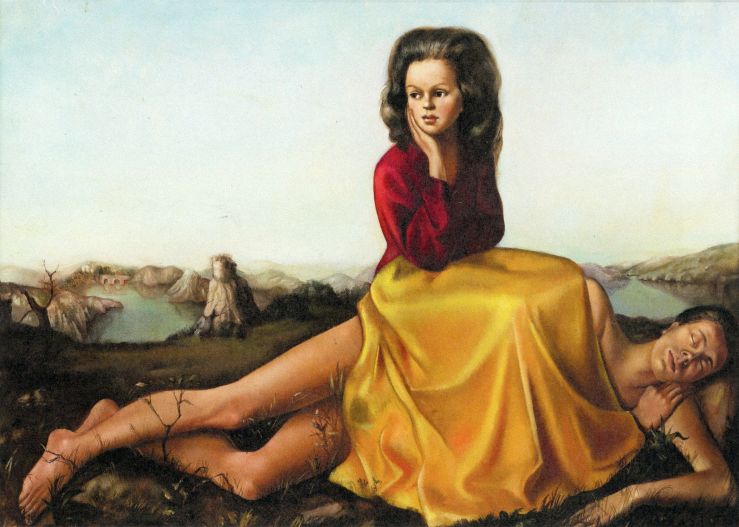
Woman Seated on a Naked Man — Leonor Fini

4e1c2ca36f43bd232e043c7677fd4a84

Woman Seated on a Naked Man, 1942 by Leonor Fini (1908-1996)

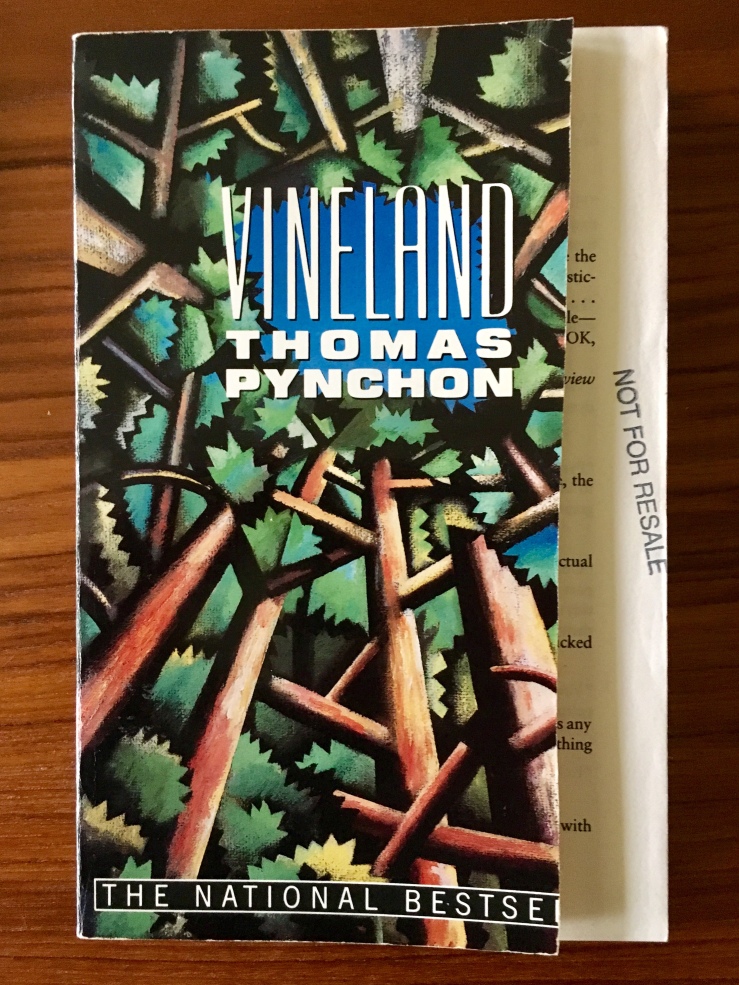
(Another copy of) Thomas Pynchon’s Vineland (Book acquired, 18 Dec. 2018)

img_1899

I’m not exactly sure why I picked up a hardback first edition of Thomas Pynchon’s 1990 novel Vineland the other day. I was killing a spare hour in a used bookstore, and I started handling the thing—started skimming again. I’ve made a few attempts at Vineland but it’s never fully hooked me. I can’t get past page 92. But so well anyway I ended up getting it (for five bucks), perhaps as a means to motivate myself to finally finishing it next year. Vineland and Bleeding Edge are the only Pynchon novels I haven’t finished—I still don’t own Bleeding Edge, actually, having checked it out from the library twice and failed to make anything like a dent in it. The copy of Vineland I tried on before a few times is Penguin’s 1991 paperback. The cover is ugly as hell, and my copy is cut cover remainder; I found it in an inventory room in the high school I used to work at. There were at least a dozen remaindered copies of Vineland there. I doubt anyone misses this one:

img_1900

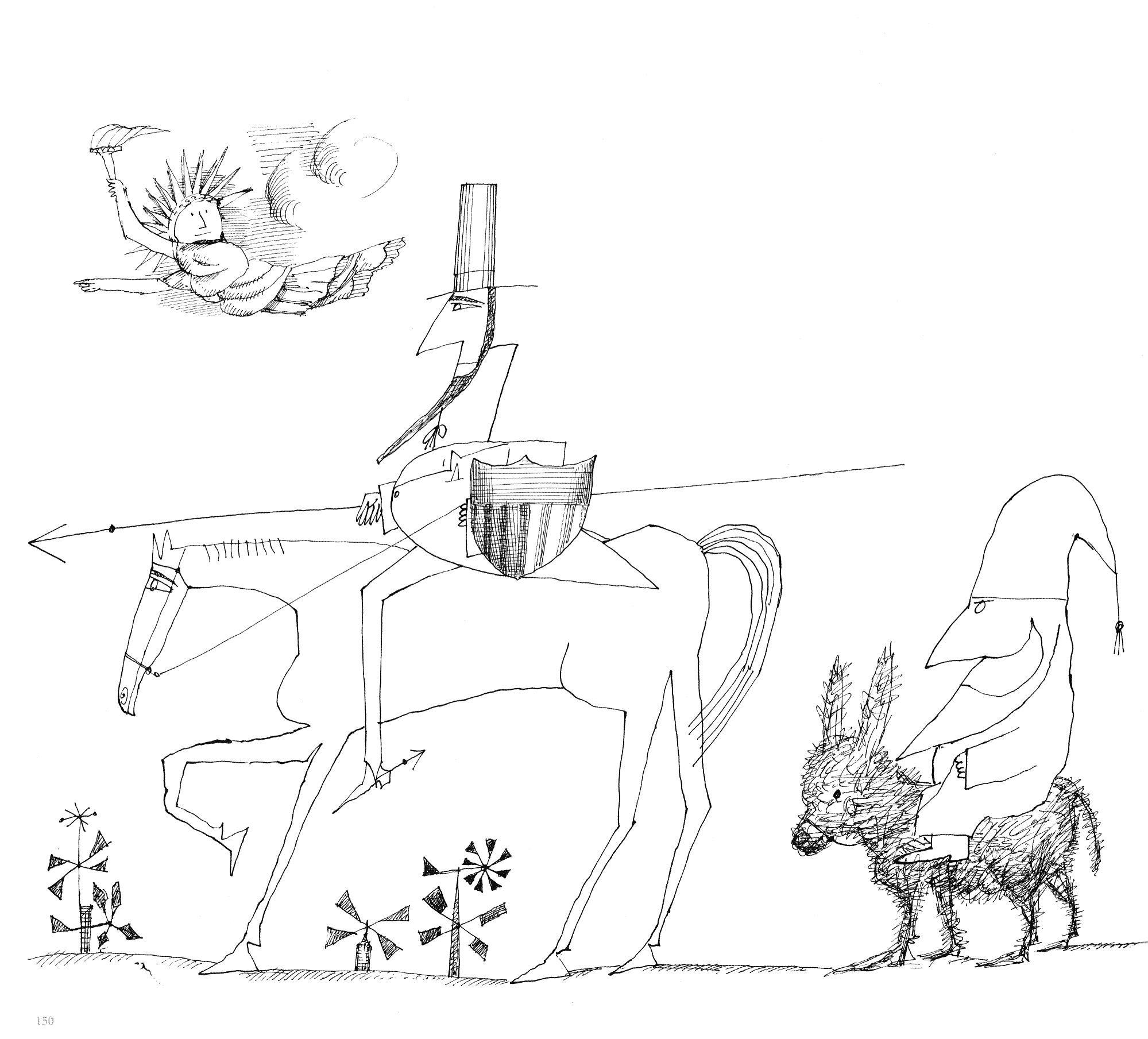
Untitled (Abraham Lincoln and Santa Claus as Don Quixote and Sancho Panza) — Saul Steinberg

ss2

Untitled, 1959 by Saul Steinberg (1914-1999). From The Labyrinth.

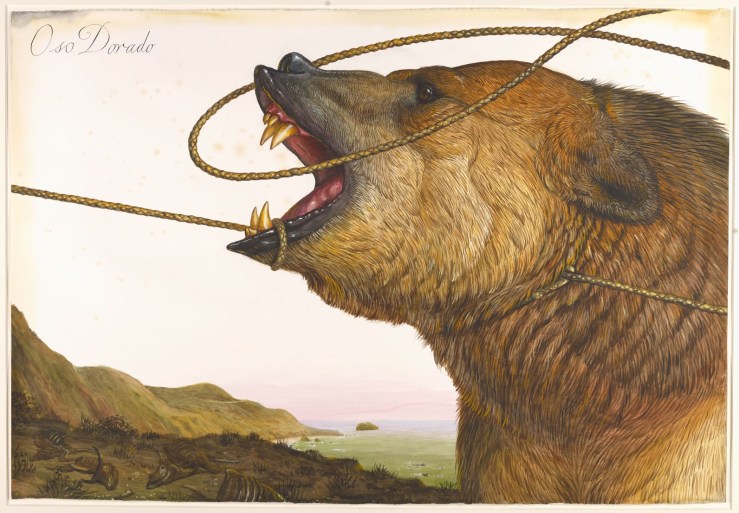
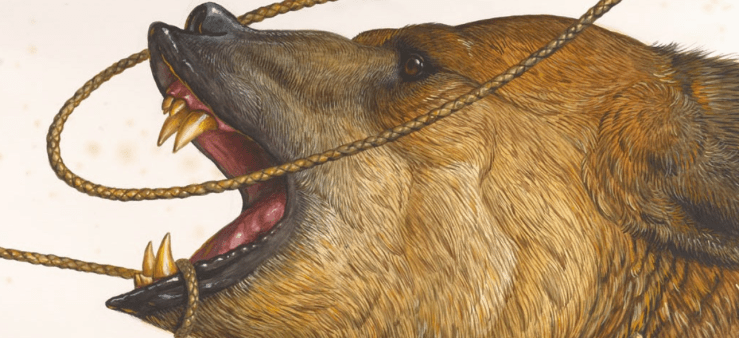
Oso Dorado — Walton Ford

04139331-db1f-4000-8763-a07535ed9a28

Oso Dorado (Golden Bear), 2013 by Walton Ford (b. 1960)

Screenshot 2018-12-19 at 6.37.26 PM.png