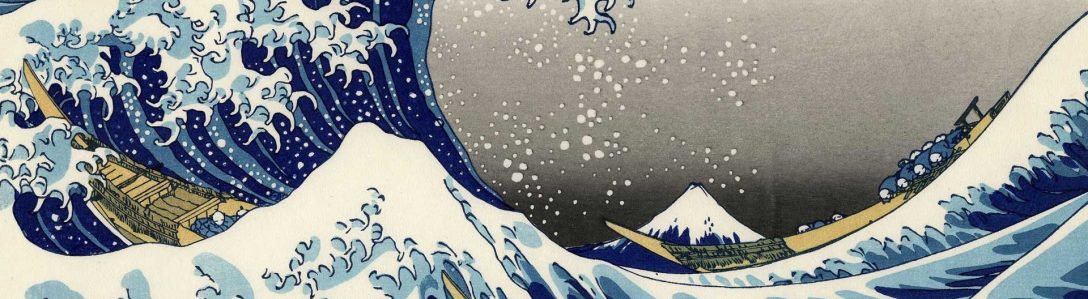
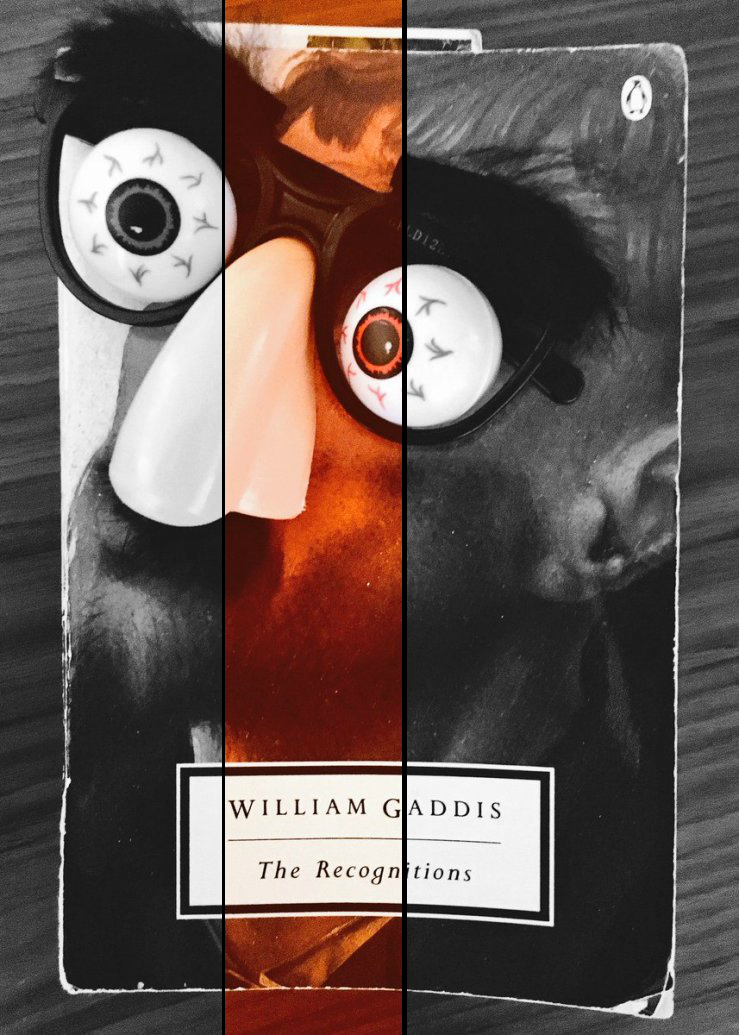
Blog about a metatextual moment at the end of William Gaddis’s novel The Recognitions

dqx3nv9u0aaq8m4

In the epilogue of his 1955 novel The Recognitions, William Gaddis checks in on the book’s enormous background cast, tying up loose ends, but also leaving many of the characters frayed, burned out, or destroyed. There’s a remarkable metatextual moment in this epilogue in which two minor characters are revealed to be carrying copies of a book that bears more than a passing resemblance to The Recognitions itself. These characters are both literary counterfeiters—Mr. Feddle, a faker who forges book jackets with his name in the author’s position and slips them over classic novels, and “the critic in the green wool shirt,” who doesn’t bother to read the books he reviews.

Meeting at a tailor’s shop, Feddle and the critic peer at each other, “fix[ing] the book the other was carrying with a look of myopic recognition.” The passage continues with the following acerbically ironic exchange:

—You reading that? both asked at once, withdrawing in surprise. —No. I’m just reviewing it, said the taller one, hunching back in his green wool shirt.

—A lousy twenty-five bucks. It’ll take me the whole evening tonight. You didn’t buy it, did you? Christ, at that price? Who the hell do they think’s going to pay that much just for a novel. Christ, I could have given it to you, all I need is the jacket blurb to write the review.

The exchange here accurately anticipates exactly how The Recognitions would be received by its contemporary critics—or “hacks,” as Jack Green repeatedly calls them in his infamous 1962 screed Fire the Bastards! For almost 80 pages, Green details the failures of the 55 critics who reviewed the book upon its release. Some of these major failures include—

failing to recognize the greatness of the book

failing to convey to the reader what the book is like, what its essential qualities are

counterfeiting this with stereotyped preconceptions—the standard cliches about a book that is “ambitious,” “erudite,” “long,” “negative,” etc

counterfeiting competence with inhuman jargon

Green’s repeated use of the word “counterfeit” not just here but throughout his tract demonstrates the essential realism of The Recognitions: Gaddis conceived how his novel of counterfeiters, poseurs, plagiarists, and hacks would be misread, misremembered, and misrecognized by counterfeiters, poseurs, plagiarists, and hacks. The green-wool-shirted critic’s declaration that all he needs “is the jacket blurb to write the view” transcends its original satirical contours—it is a prophecy that comes true.

This satirical metatextual prognostication finds fruition in the review of The Recognitions published in The Louisville Courier-Journal. In Fire the Bastards!, Green details how the reviewer plagiarized his review of The Recognitions from the novel’s jacket blurb. The metatextuality here is magical: Gaddis conjures the character of an unnamed counterfeiter critic who will (not-)review a book that appears to be The Recognitions itself; this character becomes real by (not-)reviewing the book in an unsigned review in The Louisville Courier-Journal that plagiarizes the book’s blurb.

But perhaps I’ve neglected to demonstrate that the book that Feddle the faker and the critic in the green wool shirt are both not reading is in fact a version of The Recognitions itself. Here is the next paragraph in the episode:

It was in fact quite a thick book. A pattern of bold elegance, the lettering on the dust1M5vpxx wrapper stood forth in stark configurations of red and black to intimate the origin of design. (For some crotchety reason there was no picture of the author looking pensive sucking a pipe, sans gêne with a cigarette, sang-froid with no necktie, plastered across the back.)

In his invaluable work A Reader’s Guide to William Gaddis’s The Recognitions, Steven Moore gives the following annotation to these lines:

 the description is of the first edition of R [The Recognitions]. Martin Dworkin’s photograph of Gaddis “sans gêne with a cigarette, sang-froid with no necktie” appeared in both the Time and Newsweek reviews.

Jack Green is more succinct in Fire the Bastards!: “the book the stubby
poet [Feddle] has is the recognitions [sic] itself.” And what is “the stubby poet” doing with such a bigass book? Reading it?

—Reading it? Christ no, what do you think I am? I just been having trouble sleeping, so my analyst told me to get a book and count the letters, so I just went in and asked them for the thickest book in the place and they sold me this damned thing, he muttered looking at the book with intimate dislike.

At least Feddle’s dislike is “intimate.” If he’d bothered to read it he might have gotten some weird alarming joy from this (meta)Recognitions. Or, even better, he might reread it—which is really the only way to read The Recognitions, I’m convinced, after my second full read. The book is more precise, more artfully constructed—more stuffed with motifs and symbols, doubled, tripled, quadrupled—than I had realized on first reading.

Jack Green made rereading The Recognitions a significant part of his life. He was an evangelist for the text, going so far as to take out a full page ad in The Village Voice in 1962 when the book was reprinted in paperback. His advertisement is five short paragraphs. The second paragraph is a proper, original blurb. The second paragraph is an argument for rereading. Here they are:

“The Recognitions” is a 956-page novel whose main theme is vanity or forgery—of Old Masters, $20 bills, slings, personality, everything. It is like a painting with a few primary figures presented in depth and an army of caricatures in the background. The main characters are unforgettable and, as is usually true, give the book most of its greatness. The minor characters, including the author himself who has a bit part, are very funny.

Like “Ulysses,” Gaddis’s book can be read the first time with enjoyment (my advice: don’t work at it) and then reread for years with increasing fascination. It has an intricate network of thousands of cross-references which give it a unique time-sense: as the connections are gradually recognized on rereading, the book appears to grow like a living being.

“Grow like a living being.” I think that’s about right.
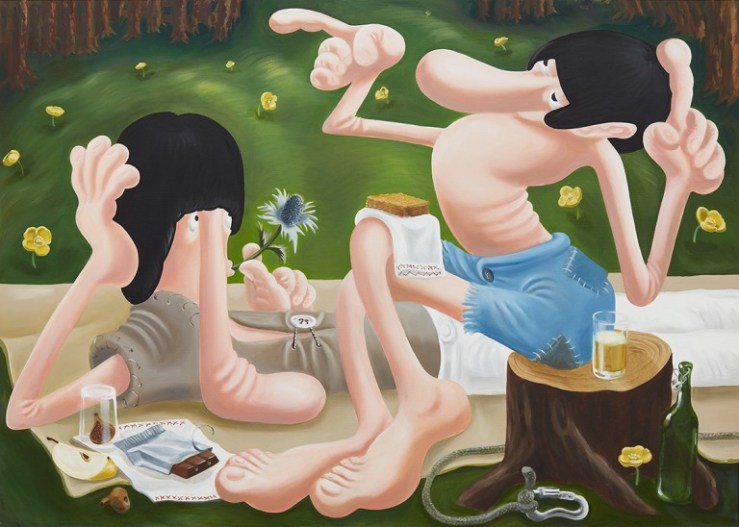
Beggar’s Banquet — Louise Bonnet

LB16.027_crop-768x548

Beggar’s Banquet, 2016 by Louise Bonnet (b. 1970)

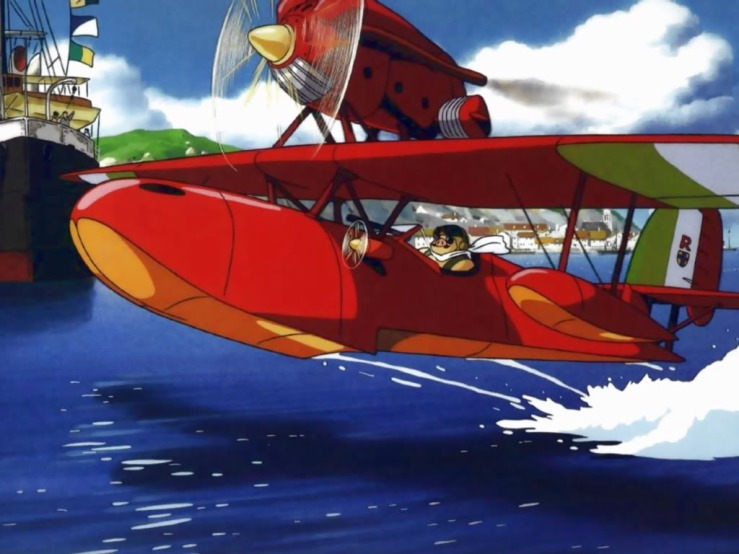
A review of Hayao Miyazaki’s film Porco Rosso

porco-rosso

Hayao Miyazaki’s Porco Rosso (1992) is one of my favorite films, and I was able to see it this summer for the first time on the big screen thanks to Studio Ghibli Fest 2018. Although I’ve seen Porco Rosso maybe a dozen times, seeing its rich, deep, bold animation on an enormous screen felt like seeing it for the first time.

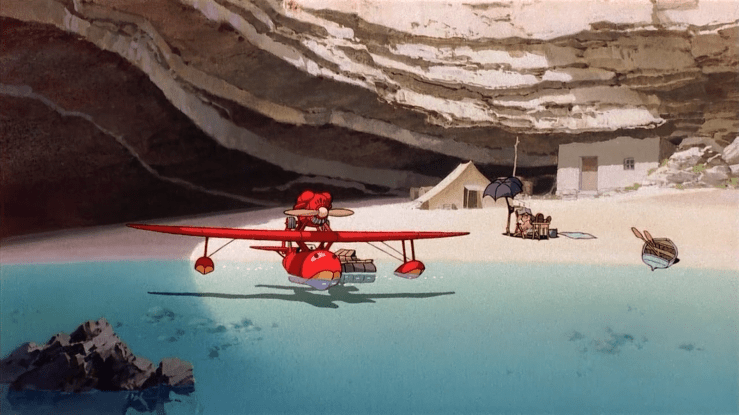
Porco Rosso takes place in and around various islands in the Adriatic Sea during the thin slice of years between the First and Second World Wars. Italy, like much of the world, is in the midst of a severe economic depression, and is slowly sliding into fascism. World War II is clearly on the horizon. Miyazaki pushes these problems to the margins of his film, conjuring instead a romanticized Mediterranean. However, this romantic space is always under the pressure of a coming disaster—fascism and a new war.

porcorosso5

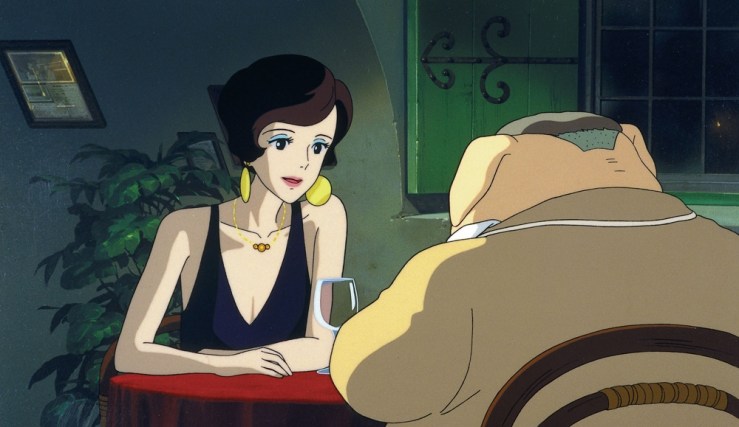
The hero of Porco Rosso is Marco Pagot (called Marco Rossolini in the American dub). Marco is an ex-military pilot, an aviation ace who fought with honor for the Italian air force in the Great War. He now spends his days drinking red wine and smoking cigarettes on a beautiful deserted island, occasionally taking jobs as a bounty hunter, retrieving hostages and other stolen goods from the nefarious and unwashed air pirates who plunder the ships of the Adriatic. Marco makes occasional concessions to civilization by taking a meal at the Hotel Adriano, a charming resort run by his oldest friend Gina. Gina is love with Marco and we come to realize Marco is in love with Gina, but he cannot come out and say this. Marco is a pig.

20130812-161255

Marco is literally a pig. He is the victim of a curse that the film never explicitly names or addresses, although a late scene late in which Marco essentially survives an attack that should have killed him—an event that gives him a dramatic glimpse of a heaven of pilots—may be a clue to the origins of Marco’s porcine curse. In any case, Marco’s pigman existence is the film’s only concession to the kind of mythical and magical fantasy that otherwise permeates Miyazaki’s canon (with the notable exception of The Wind Rises (2013), which in some ways is a sequel to Porco Rosso).

This isn’t to say that Porco Rosso isn’t a fantasy though. Miyazaki’s world of air pirates and bounty hunters, attractive hoteliers and hotshot engineers, and seaplanes dueling in a radiant sky, brims with an effervescent energy that counterbalances the grim specter of the Great War that preceded the film’s narrative action and the Second World War—and a Fascist Italy—that the narrative’s “real” time must eventually intersect. Ever the lone pig, Marco seeks to fly away from the social and historical forces that would constrain him.

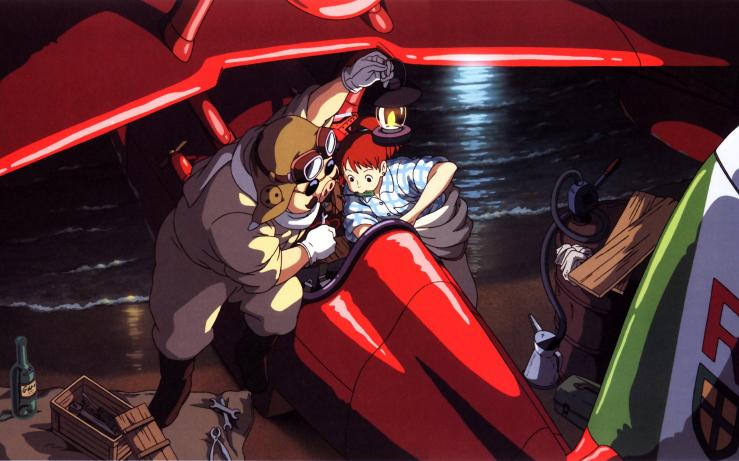
Unfortunately for Marco, luxurious isolation remains an impossibility. The air pirates hire a hotshot American to take out the damned Crimson Pig once and for all. Donald Curtis (hailing from Alabama in the Japanese version and Texas in the American) exemplifies American cockiness. His enormous jaw precedes the rest of his swaggering body, he falls in love at first sight with any beautiful woman he sees, and he’s brash and impetuous. He wants to transition to Hollywood and eventually become the President of the United States! Curtis shoots up Marco’s plane early in the film, but our porcine hero escapes to Milan, where he rebuilds his plane with the help of a whiskered mechanic named Piccolo and his charming granddaughter Fio. Fio redesigns the plane and eventually becomes Marco’s sidekick, traveling with him back to the Adriatic and helping him face Curtis and the air pirates.

2_porco_rosso

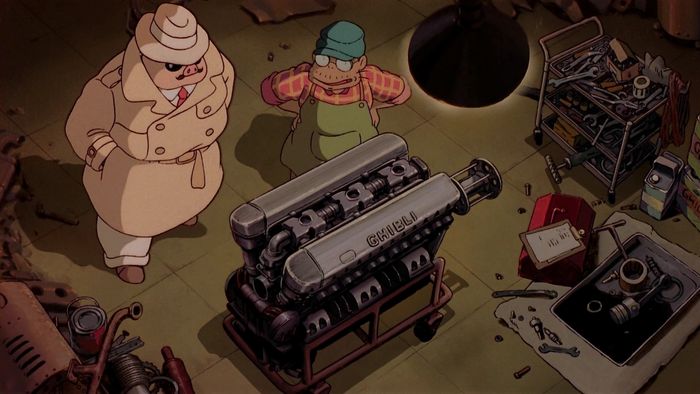
Fio, whose character design recalls Nausicaa of Nausicaä of the Valley of the Wind (1984), is another of Miyazaki’s prominent female protagonists. In some ways she is the secret hero of the film; she takes over the narration at the end, implicitly assuming Porco Rosso’s mantle. Fio has earned Marco’s trust after he is initially dubious of her ability because of her age and his sexism. Fio leads an all-female team of builders and engineers to recreate a superior version of Marco’s plane. This workshop sequence is one of the film’s finest. Miyazaki often foregrounds labor in his films, but Porco Rosso explicitly shows how a complex work—whether it’s a plane, or, y’know, a film—is never the singular work of a gifted genius, but rather the concentrated effort of a team. Miyazaki underscores the connection between the creative process of plane-building and film-making, stamping his studio’s name on Marco’s new engine. (Studio Ghibli was named after an Italian war plane, the Caproni Ca.309, which was nicknamed Ghibli—“Desert Wind”).

85268fc75512cda8cc331109c81ec95c

While in Milan, Marco realizes that the fascist secret police are after him. The Fascists in Porco Rosso (who want to conscript Marco—or take his plane) are far more ominous than Curtis. Curtis serves as an actual antagonist for Marco to face, and the fight between the two at the end of Porco Rosso, although violent, plays with a light comic touch. Miyazaki references the “gentlemen pilots” of World War I here. The Fascists, in contrast, are a spectral force lurking behind the narrative, threatening Marco’s individuality and autonomy. The film affirms itself as a comedy that resists encroaching fascism in a conclusion that sees Marco, Fio, Gina Curtis, the air pirates, and every other member of this strange Adriatic paradise working together to escape their approaching air force.

The film’s denouement is a retreat into the romantic Adriatic community, a kind of gauzy, rosy vision of an isolated paradise untouched by war or fascism. The fantasy reminds one of an island from some lost book of The Odyssey, a tranquil paradise unbothered by Trojans or Greeks. Marco—Porco—too feels like a figure from the margins of The Odyssey, a hero transfigured into a pig. The end of Porco Rosso refuses to give us a direct answer as to what happens to Porco. Does he regain his human form? Or, perhaps more importantly, is there a happy ending for Porco and Gina? The film offers a number of clues, some explicit and some implicit, but a first viewing may feel ambiguous for many viewers. However, subsequent viewings reveal a clearer picture as to what happens to Gina and Marco. Why the ambiguity then? Porco Rosso is (apart from The Wind Rises) the Miyazaki film with the strongest historicity. The historical reality of a looming World War II threatens to devour the romance of Gina and Porco—so Miyazaki and the inhabitants of his secret Adriatic world conspire to hide it. Lovely stuff.


[Ed. note–Biblioklept ran a version of this review in the summer of 2018].

Problems begin the moment we’re born (Hayao Miyazaki)

Happy birthday to Hayao Miyazaki. From The Kingdom of Dreams and Madness. 

My entry in The Comics Journal’s “Best Comics of 2018” article

tumblr_pkia4f9hzi1u3qyk4o1_1280

The editors of The Comics Journal have put together an extended feature called “The Best Comics of 2018.”  The full feature is pretty cool (and pretty enormous), and is a great place for anyone looking for a diverse concentration of new comix to read. Here’s my entry:

  1. Slum Wolf by Tadao Tsuge (English translation by Ryan Holmberg, NYRC) This collection of “alternative manga” (from The New York Review of Books’ NYRC imprint) showcases nine rough and seedy stories focused on the kimin, the “abandoned people” who live on the margins of Japanese society. Under Tsuge’s mean humor is a diamond-sharp kernel of pathos for all humanity, rendered in spare, even rushed art. Tsuge draws as if his ink and paper might be snatched away at any moment by some civilizing agent who would keep his slum wolves away from respectable eyes. His world isn’t pretty but it is somehow beautiful.
  1. Hieronymus & Bosch by Paul Kirchner. (Tanibus) Paul Kirchner continues his late career renaissance with Hieronymus & Bosch, a collection of over eighty comic strips set in Hell. The plot of most of these one-pagers is pretty straightforward: Hieronymus and his wooden toy duck Bosch try to escape—either Hell itself, or the boredom of Hell—and fail. Kirchner’s Hell is a slapstick paradise, and if Hieronymus is eternally doomed, at least he finds some solace in his own creative prowess.
  1. Samplerman, January 2018-December 2018 by Yvan Guillo. (Self-published) In a profile a few years back, the artist Yvan Guillo (who works under the name Samplerman) declared: “I am half the artist and half in the audience, exploring all these pages, picking the things I want to use, making a template and watching the composition being made nearly by itself.” Guillo perfectly describes his techniques of collage, amalgamation, and transformation—and also describes the pure joy that teems through his work. The Samplerman strips synthesize the history of cartooning into something transcendent and energetic, a reining-in of visual entropy into a strange new order.
  1. The Labyrinth by Saul Steinberg. (NYRB) First published in 1960 and back in print again from the NRYB this year, Saul Steinberg’s The Labyrinth condenses the modern and the mythic. “Steinberg was a lyricist of the metal nib—a twirler of nonverbal non sequiturs,” notes novelist Nicholson Baker in his introduction to the new volume. Steinberg’s lyrical non sequiturs evince in squiggles and dots, tangles and loops which turn into well-dressed men and staid women, cityscapes and night scenes, cocktail parties and art shows. Steinberg turns Abraham Lincoln into Don Quixote, with Santa as his Sancho Panza. He takes us out of urbane New York and into midcentury America, land of motor courts and baseball parks, a knotty chaotic chorus of life. Steinberg could seemingly do anything with ink, as the range of styles in The Labyrinth shows, but what he ultimately did was utterly-Steinbergian. The Labyrinth echoes Whitman’s Leaves of Grass, which sought a century earlier, to find a new language to describe a new country. Steinberg looked at America through new eyes, and, like Whitman before him, found a new language of expression—the language of labyrinthine lines on paper.
  1. Nancy by Olivia Jaimes. (GoComics/United Feature Syndicate) I ♥ Nancy.

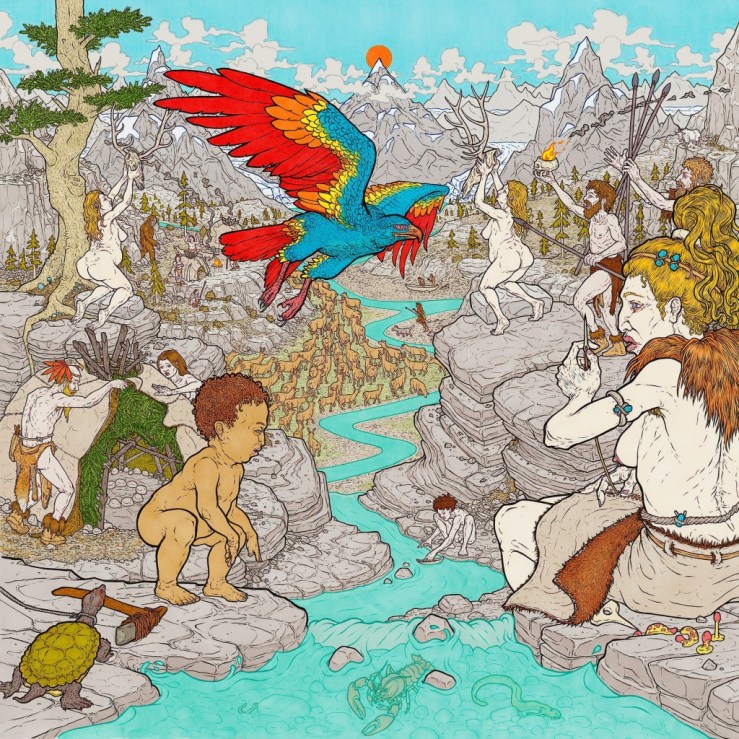
Paleo I — Mat Brown

mat-brown-paleo-1-2014-ink-on-illustration-board-10.5x10.5og-1024x1024

Paleo I, 2014 by Mat Brown (b. 1980)

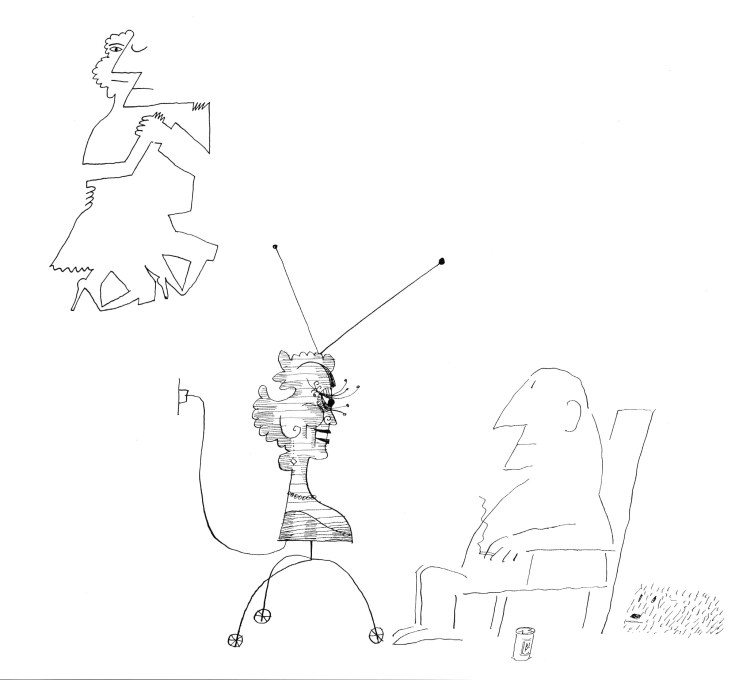
A review of Saul Steinberg’s The Labyrinth

My review of NYRB’s reissue of Saul Steinberg’s Labyrinth is up at The Comics Journal. First paragraph:

First published in 1960 and back in print again from the New York Review of Books, Saul Steinberg’s The Labyrinth condenses the modern and the mythic into 250 pages of strange and wonderful cartoons. The fourth of Steinberg’s seven major compilations, The Labyrinth covers his work between 1954 and 1960, loosely distilling the state of American mid-century cartooning. Quirky, obliquely intellectual, cosmopolitan, and deeply ironic, Steinberg’s modernist approach addresses many of the major cultural changes in America during the 1950s. The Labyrinth touches on urbanization and suburbanization, the expansion of ready-made mass culture, the post-War shift in the relationship between men and women, the advent of televisual mass media, and the zany paranoia of the Cold War zeitgeist.

Floating Nude — Xi Pan

s-Floating-Nude

Floating Nude, 2008 by Xi Pan

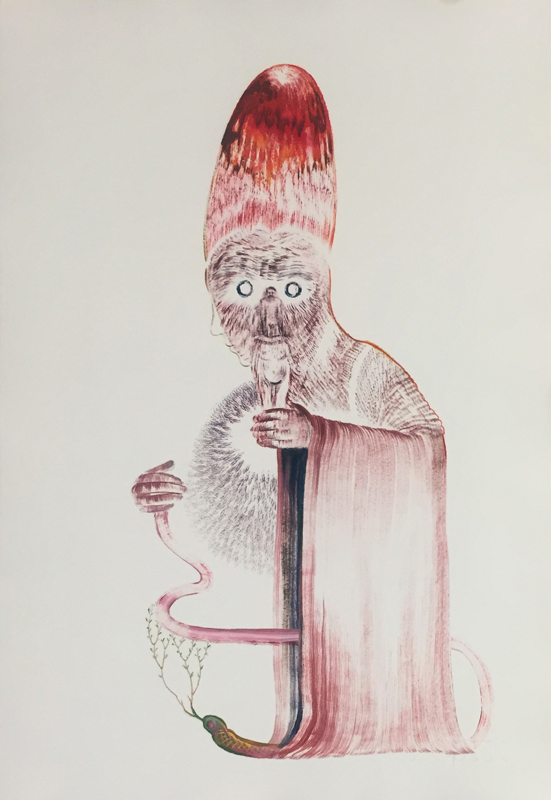
Goya’s Ghost — Veronika Holcová 

VERONIKA-HOLCOVA-Goyas-Ghost-2016-17x11.75

Goya’s Ghost, 2016 by Veronika Holcová (b. 1973)

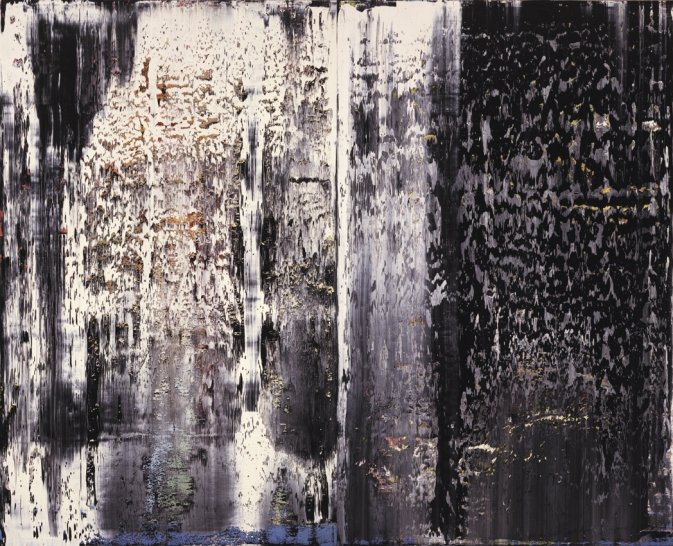
January — Gerhard Richter 

3748

January, 1989 by Gerhard Richter (b. 1932)

Blog about some 2019 reading plans

img_2010

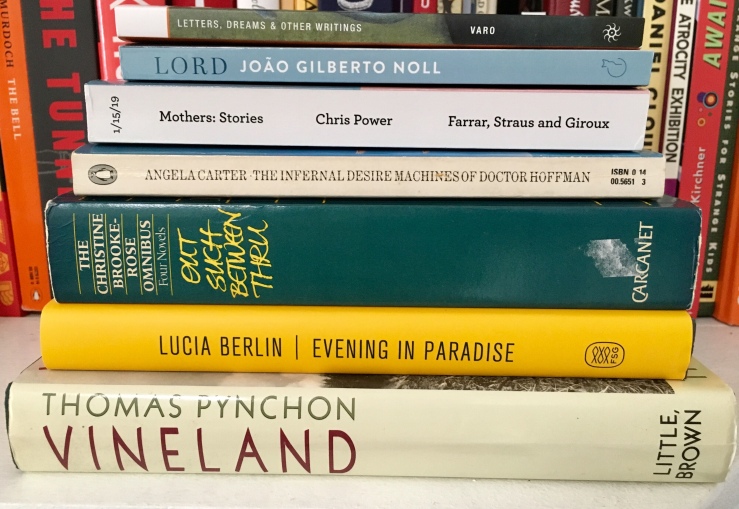
Here are some books I aim to read in 2019, sooner rather than later:

Letters, Dreams & Other Writings by Remedios Varo (translated by Margaret Carson). I’m really digging this so far—I got it a week ago and have been skimming around in it. Varo is one of my favorite modern painters, and I love that we’re getting some of her prose now—it seems to trend with the recent revival of the writings of her friend and fellow painter Leonora Carrington.

Lord by João Gilberto Noll (translated by Edgar Garbeletto). I hope this as surreal and upsetting as Noll’s Quiet Creature on the Corner.

Mothers by Chris Power. The US release for Power’s collection of subtle stories is later this month, and the book has already been very well-received in the UK. I’ve read the first four stories and dig what Power is doing.

The Infernal Desire Machines of Doctor Hoffman by Angela Carter. I picked this up late last year and stalled after the first fifty pages—I was reading three other books at the same time. I’ll make a proper commitment though in 2019.

The Christine Brooke-Rose Omnibus: Four Novels by Christine Brooke-Rose. Brooke-Rose wasn’t really on my radar until I read this intriguing essay about her “difficult” novels a few weeks ago.

Evening in Paradise by Lucia Berlin. A Manual for Cleaning Women was one of my favorite books of the past few years. Should I gobble all of these stories up at once? Or pace myself?

Vineland by Thomas Pynchon. I will finally read Vineland. (Although I got a real hankering to reread Gravity’s Rainbow as I was finishing up The Recognitions—but maybe that project is best saved for later in the year).

Happy New Year!

A year in reading | Annotations on a probably incomplete list of books I read or reread in full in 2018

img_2002

Boring preamble you’ll likely skim if not outright skip:

I was never going to get a full year end list thing together. Yesterday I put together a list of books I read in full this year, or at least books I remember reading in full. In full and books are terms that should be placed under suspicion. For example, it took me far longer to get eighty pages into William H. Gass’s The Tunnel—a novel I soon after abandoned—than it did to read Robert Coover’s micronovella The Enchanted Prince or Dave Cooper’s graphic novel Mudbite. Etc. As usual I abandoned more novels than I finished, and read more short stories than I could or should bother listing.


Annotations on a probably incomplete list of books I read or reread in full in 2018:

Barracoon by Zora Neale Hurston (2018)

A sad and important book, too long unpublished. I reviewed it here.

Conversations with Gordon Lish edited by David Winters and Jason Lucarelli (2018)

One of the best things I read in 2018. Lish performing Lish throughout the end of the twentieth century and the beginning of the twenty-first. As good, if not better, than his short fiction.

Dreamverse by Jindřich Štyrský (2018 English translation by Jed Slast; original Czech-language publication in 1970)

Abject horny surrealist art and poetry. I wrote about it here.

The Enchanted Prince by Robert Coover (2018)

Going for a Beer: Selected Short Fictions by Robert Coover (2018)

The Enchanted Prince is a quick read, and wouldn’t be out of place in an extended edition of Going for a Beer. I failed to write about Going for a Beer, after mucking around with several drafts. I had a big thing on “The Babysitter” that I was working on—it being a perfect nexus of horror and comedy, a writhing, icky pop opera of channel changing. I kept thinking of “The Babysitter” during the Brett Kavanaugh hearing, and managed to write absolutely nothing in my disgust. Going for a Beer is a perfect starting place for Coover, although some of the moves in it grow tiresome. The metamagician takes us aside a bit too often to show us how he did the trick, only to tell us that his showing us how he did the trick was actually the trick itself.

Hieronymus & Bosch by Paul Kirchner (2018)

The Labyrinth by Saul Steinberg (2018; originally published in 1960)

Both wonderful “graphic novels,” or not really “novels,” but something else. I should have reviews of these posted at The Comics Journal in early 2019.

The Largesse of the Sea Maiden by Denis Johnson (2018)

A perfect farewell to Johnson. I read it twice, and wrote about the title story,  second story, “The Starlight on Idaho,” and the third,“Strangler Bob.”

Letter to the Author of the Letter to the Father by Tristan Foster (2018)

Great stuff. I finished a bigass novel yesterday so now I can reread Foster’s strange fictions and write a proper review.

Moderan by David R. Bunch (2018; originally published in incomplete form in 1971)

I’ll admit I’d never heard of Bunch’s dystopian cult Moderan stories until NYRB reprinted them in a complete volume this year. Moderan works as a post-nuke dystopian satire on toxic masculinity. The tropes here might seem familiar—cyborgs and dome homes, caste systems and ultraviolence, a world of made and not born ruled by manunkind (to steal from E.E. Cummings)—it’s the way that Bunch conveys this world that is so astounding. Moderan is told in its own idiom; the voice of our narrator Stronghold-10 booms with a bravado that’s ultimately undercut by the authorial irony that lurks under its surface. The book seems equal to the task of satirizing the trajectory of our zeitgeist in a way that some contemporary satirists have failed to.

Mudbite by Dave Cooper (2018)

Lurid, abject, horny, gross. I dug it. I reviewed it at The Comics Journal.

Narcotics by Stanisław Ignacy Witkiewicz (2018 English translation by Soren Gauger)

Another oddball from the good folks at Twisted Spoon Press. I reviewed it here.

On Doing Nothing by Roman Muradov (2018)

Muradov’s riffs on literature, art, and philosophy to add to the American tradition of leaning and loafing at one’s ease, observing a summer spear of etc.

Provisional Biography of Mose Eakins by Evan Dara (2018)

An overlooked work by an overlooked writer, Provisional Biography isn’t quite as persuasive as its predecessor, Flee, but it’s nevertheless a strong argument for communication in/against the age of late capitalism. I reviewed it here.

Slum Wolf by Tadao Tsuge (2018 English translation by Ryan Holmberg)

This collection of “alternative manga” (from The New York Review of Books’ NYRC imprint) showcases nine rough and seedy stories focused on the kimin, the “abandoned people” who live on the margins of Japanese society. Under Tsuge’s mean humor is a diamond-sharp kernel of pathos for all humanity, rendered in spare, even rushed art. Tsuge draws as if his ink and paper might be snatched away at any moment by some civilizing agent who would keep his slum wolves away from respectable eyes. His world isn’t pretty but it is somehow beautiful.

The Snail on the Slope by Arkady and Boris Strugatsky (2018 English translation by Olena Bormashenko; original Russian-language translation, 1972)

An impossibly strange book, an utter revelation, just so astoundingly weird. I wrote about it here.

Stream System by Gerald Murnane (2018)

Murnane made a dent into an American mainstream audience this year with Stream System (complete with a fascinating feature in The New York Times). The early stories are particularly affecting. I wrote about one here.

Pond by Claire-Louise Bennett (2015)

Pond was one of the best things I read this year. I wrote about it here.

The Truce by Mario Benedetti (2015 English translation by Harry Morales; original Spanish-language publication, 1960)

Benedetti’s The Truce is good old fashioned mannered modernism. I couldn’t really get into it, although the novel’s voice is authentic. It reminded me of Williams’ Stoner a bit.

Post-Exoticism in Ten Lessons, Lesson Eleven by Antoine Volodine (2015 English translation by J. T. Mahany; original French-language publication, 1998)

Definitely Maybe by Arkady and Boris Strugatsky (2014 English translation by Antonina Bouis; original Russian-language translation, 1974)

Writers by Antoine Volodine (2014 English translation by Katrina Rogers; original French-language publication, 2010)

Minor Angels by Antoine Volodine (2008 English translation by Jordan Stump; original French-language publication, 2004)

I’ve arranged this list by year, and the Volodines are almost grouped together, with the Strugatskys interposing. Definitely Maybe is okay but not excellent—it’s a fun and ultimately tense read, evocative of hot drunken times and philosophical murders.

Antoine Volodine wrote some of the best stuff I read this year. Post-Exoticism or Writers would make excellent starting places for anyone interested in his grim, stark (and often unexpectedly funny) world. I wrote about Writers here and here.

The Last Samurai by Helen DeWitt (2000)

I didn’t really like Lightning Rods and I wished I hadn’t paid twenty bucks for Some Trick in hardback, but enough people I respect have been telling me (directly and indirectly) to read DeWitt’s cult novel debut that I didn’t hesitate to pick up a copy when I found it used in my favorite bookshop. I read The Last Samurai faster than any book I can remember. For a book often described as “experimental” or “formally challenging” it’s extraordinarily accessible and very “readable.” DeWitt’s rhetoric teaches the reader how to read the book; she creates a formula, essentially (Lighting Rods did the same, come to think of it). The Last Samurai has moments that are as transcendent as any of the other great books I read this year, but I’m not sure that it adds up to more than the sum of its parts. I enjoyed the reading experience though.

Carpenter’s Gothic by William Gaddis (1985)

I had never read Carpenter’s Gothic until this year (I still need to read A Frolic of His Own). I reread The Recognitions, and while its certainly a richer, denser, and frankly more overwhelming work, it isn’t as formally neat as Carpenter’s Gothic, which I think is ultimately the better book. I wrote about it here, here, and here.

The Names by Don DeLillo (1982)

Only a few fragments stick with me now—the end in particular—but also, the general impression that Don DeLillo wrote the first post-9/11 novel way back in 1982. I wrote about it here.

The Plains by Gerald Murnane (1982)

The first fifty or so pages of The Plains was as good as anything I read this year. I felt like I was hungry for more at the end though, but good authors sometimes leave us unsatisfied.

77 Dream Songs by John Berryman (1964)

I needed these.

The Bell by Iris Murdoch (1958)

This book has some excellent sentences, and Dora Greenfield is one of the more memorable characters I read this year. The Bell also prompted me to reread Hawthorne’s The Blithedale Romance, and I’m thankful to it for that. My first Murdoch. I’ll read more of hers in 2019. I wrote about The Bell here.

The Recognitions by William Gaddis (1955)

Reread the thing in tandem with an audiobook recording; the audiobook is pretty good, but mostly useful in the sense that it allows you to reread (or first read) as you go through. I think The Recognitions can’t be read—it can only be reread. I wrote about it here and here and here and here and here.

Middlemarch by George Eliot (1871)

A reading highlight of 2018. Dorothea Brooke is the most memorable character of my 2018 reading. I wrote about Middlemarch here and here.

Silas Marner by George Eliot (1861)

I liked this one a lot. I reviewed it here.

The Confidence-Man by Herman Melville (1857)

Benito Cereno by Herman Melville (1855)

The Confidence-Man remains a novel that I think I won’t ever fully “get.” Rereading it this year it seemed as puzzling as ever. We’ll see what happens when I read it again. Benito Cereno might have been my favorite reread of 2018; I wrote a long thing on it here. 2019 seems like a good year to go through Moby-Dick again.

The Blithedale Romance by Nathaniel Hawthorne (1852)

Another really enjoyable reread, with correspondences to Middlemarch and The Bell. I wrote a lot about Blithedale, including this post.


A probably incomplete list of books I read or reread in full in 2018

Barracoon by Zora Neale Hurston (2018)

Conversations with Gordon Lish edited by David Winters and Jason Lucarelli (2018)

Dreamverse by Jindřich Štyrský (2018 English translation by Jed Slast; original Czech-language publication in 1970)

The Enchanted Prince by Robert Coover (2018)

Going for a Beer: Selected Short Fictions by Robert Coover (2018)

Hieronymus & Bosch by Paul Kirchner (2018)

The Labyrinth by Saul Steinberg (2018; originally published in 1960)

The Largesse of the Sea Maiden by Denis Johnson (2018)

Letter to the Author of the Letter to the Father by Tristan Foster (2018)

Moderan by David R. Bunch (2018; originally published in incomplete form in 1971)

Mudbite by Dave Cooper (2018)

Narcotics by Stanisław Ignacy Witkiewicz (2018 English translation by Soren Gauger)

On Doing Nothing by Roman Muradov (2018)

Provisional Biography of Mose Eakins by Evan Dara (2018)

Slum Wolf by Tadao Tsuge (2018 English translation by Ryan Holmberg)

The Snail on the Slope by Arkady and Boris Strugatsky (2018 English translation by Olena Bormashenko; original Russian-language translation, 1972)

Stream System by Gerald Murnane (2018)

Pond by Claire-Louise Bennett (2015)

The Truce by Mario Benedetti (2015 English translation by Harry Morales; original Spanish-language publication, 1960)

Post-Exoticism in Ten Lessons, Lesson Eleven by Antoine Volodine (2015 English translation by J. T. Mahany; original French-language publication, 1998)

Definitely Maybe by Arkady and Boris Strugatsky (2014 English translation by Antonina Bouis; original Russian-language translation, 1974)

Writers by Antoine Volodine (2014 English translation by Katrina Rogers; original French-language publication, 2010)

Minor Angels by Antoine Volodine (2008 English translation by Jordan Stump; original French-language publication, 2004)

The Last Samurai by Helen DeWitt (2000)

Carpenter’s Gothic by William Gaddis (1985)

The Names by Don DeLillo (1982)

The Plains by Gerald Murnane (1982)

77 Dream Songs by John Berryman (1964)

The Bell by Iris Murdoch (1958)

The Recognitions by William Gaddis (1955)

Middlemarch by George Eliot (1871)

Silas Marner by George Eliot (1861)

The Confidence-Man by Herman Melville (1857)

Benito Cereno by Herman Melville (1855)

The Blithedale Romance by Nathaniel Hawthorne (1852)


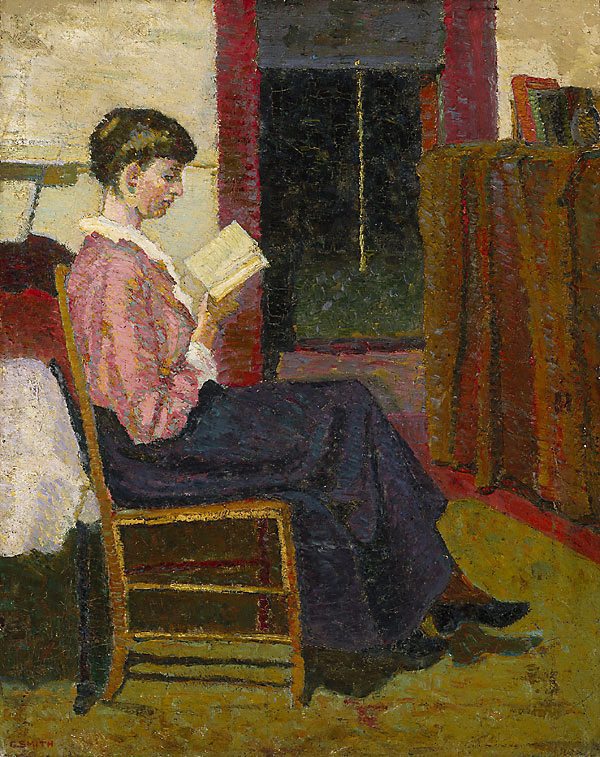
The Reader — Grace Cossington Smith

22-19742323s

The Reader, 1916 by Grace Cossington Smith (1892–1984)

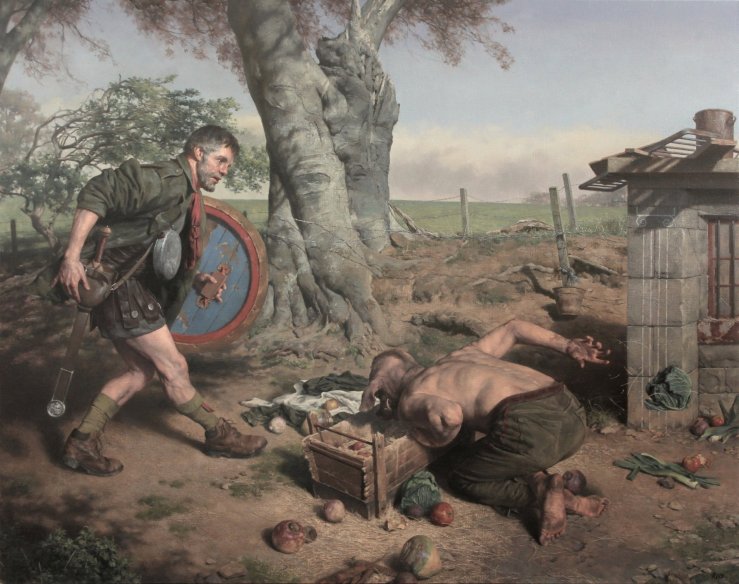
Odysseus on the Island of Circe — Paul Reid

OdysseusontheIslandofCirce2C20172Coiloncanvas2C95x120cm

Odysseus on the Island of Circe, 2018 by Paul Reid (b. 1975)

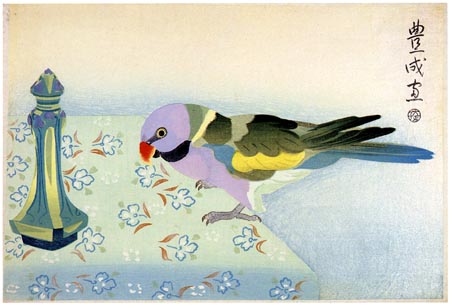
Parakeet on Table — Yamamura Toyonari

parakeet-on-table-1924

Parakeet on Table, 1924 by Yamamura Toyonari (1885-1942)

Siblings — Eva Švankmajerová

DSC03675

Siblings by Eva Švankmajerová (1940 –  2005)