“Columbus in Chains” — Jamaica Kincaid

“Columbus in Chains”

by

Jamaica Kincaid


Outside, as usual, the sun shone, the trade winds blew; on her way to put some starched clothes on the line, my mother shooed some hens out of her garden; Miss Dewberry baked the buns, some of which my mother would buy for my father and me to eat with our afternoon tea; Miss Henry brought the milk, a glass of which I would drink with my lunch, and another glass of which I would drink with the bun from Miss Dewberry; my mother prepared our lunch; my father noted some perfectly idiotic thing his partner in housebuilding, Mr. Oatie, had done, so that over lunch he and my mother could have a good laugh.

The Anglican church bell struck eleven o’clock—one hour to go before lunch. I was then sitting at my desk in my classroom. We were having a history lesson—the last lesson of the morning. For taking first place over all the other girls, I had been given a prize, a copy of a book called Roman Britain, and I was made prefect of my class. What a mistake the prefect part had been, for I was among the worst-behaved in my class and did not at all believe in setting myself up as a good example, the way a prefect was supposed to do. Now I had to sit in the prefect’s seat—the first seat in the front row, the seat from which I could stand up and survey quite easily my classmates. From where I sat I could see out the window. Sometimes when I looked out, I could see the sexton going over to the minister’s house. The sexton’s daughter, Hilarene, a disgusting model of good behavior and keen attention to scholarship, sat next to me, since she took second place. The minister’s daughter, Ruth, sat in the last row, the row reserved for all the dunce girls. Hilarene, of course, I could not stand. A girl that good would never do for me. I would probably not have cared so much for first place if I could be sure it would not go to her. Ruth I liked, because she was such a dunce and came from England and had yellow hair. When I first met her, I used to walk her home and sing bad songs to her just to see her turn pink, as if I had spilled hot water all over her.

Our books, A History of the West Indies, were open in front of us. Our day had begun with morning prayers, then a geometry lesson, then it was over to the science building for a lesson in “Introductory Physics” (not a subject we cared much for), taught by the most dingy-toothed Mr. Slacks, a teacher from Canada, then precious recess, and now this, our history lesson. Recess had the usual drama: this time, I coaxed Gwen out of her disappointment at not being allowed to join the junior choir. Her father—how many times had I wished he would become a leper and so be banished to a leper colony for the rest of my long and happy life with Gwen—had forbidden it, giving as his reason that she lived too far away from church, where choir rehearsals were conducted, and that it would be dangerous for her, a young girl, to walk home alone at night in the dark. Of course, all the streets had lamplight, but it was useless to point that out to him. Oh, how it would have pleased us to press and rub our knees together as we sat in our pew while pretending to pay close attention to Mr. Simmons, our choirmaster, as he waved his baton up and down and across, and how it would have pleased us even more to walk home together, alone in the “early dusk” (the way Gwen had phrased it, a ready phrase always on her tongue), stopping, if there was a full moon, to lie down in a pasture and expose our bosoms in the moonlight. We had heard that full moonlight would make our breasts grow to a size we would like. Poor Gwen! When I first heard from her that she was one of ten children, right on the spot I told her that I would love only her, since her mother already had so many other people to love.

Our teacher, Miss Edward, paced up and down in front of the class in her usual way. In front of her desk stood a small table, and on it stood the dunce cap. The dunce cap was in the shape of a coronet, with an adjustable opening in the back, so that it could fit any head. It was made of cardboard with a shiny gold paper covering and the word “DUNCE” in shiny red paper on the front. When the sun shone on it, the dunce cap was all aglitter, almost as if you were being tricked into thinking it a desirable thing to wear. As Miss Edward paced up and down, she would pass between us and the dunce cap like an eclipse. Each Friday morning, we were given a small test to see how well we had learned the things taught to us all week. The girl who scored lowest was made to wear the dunce cap all day the following Monday. On many Mondays, Ruth wore it—only, with her short yellow hair, when the dunce cap was sitting on her head she looked like a girl attending a birthday party in The Schoolgirl’s Own Annual.

It was Miss Edward’s way to ask one of us a question the answer to which she was sure the girl would not know and then put the same question to another girl who she was sure would know the answer. The girl who did not answer correctly would then have to repeat the correct answer in the exact words of the other girl. Many times, I had heard my exact words repeated over and over again, and I liked it especially when the girl doing the repeating was one I didn’t care about very much. Pointing a finger at Ruth, Miss Edward asked a question the answer to which was “On the third of November 1493, a Sunday morning, Christopher Columbus discovered Dominica.” Ruth, of course, did not know the answer, as she did not know the answer to many questions about the West Indies. I could hardly blame her. Ruth had come all the way from England. Perhaps she did not want to be in the West Indies at all. Perhaps she wanted to be in England, where no one would remind her constantly of the terrible things her ancestors had done; perhaps she had felt even worse when her father was a missionary in Africa. I could see how Ruth felt from looking at her face. Her ancestors had been the masters, while ours had been the slaves. She had such a lot to be ashamed of, and by being with us every day she was always being reminded. We could look everybody in the eye, for our ancestors had done nothing wrong except just sit somewhere, defenseless. Of course, sometimes, what with our teachers and our books, it was hard for us to tell on which side we really now belonged—with the masters or the slaves—for it was all history, it was all in the past, and everybody behaved differently now; all of us celebrated Queen Victoria’s birthday, even though she had been dead a long time. But we, the descendants of the slaves, knew quite well what had really happened, and I was sure that if the tables had been turned we would have acted differently; I was sure that if our ancestors had gone from Africa to Europe and come upon the people living there, they would have taken a proper interest in the Europeans on first seeing them, and said, “How nice,” and then gone home to tell their friends about it. Continue reading ““Columbus in Chains” — Jamaica Kincaid”

Riff on some books I’m reading, have read, and should really review

Hurricane Milton passed far enough south last night to leave our city relatively untroubled. There were power outages here but not the expected flooding. Most of my anxiety was focused on my family in the Tampa Bay area, all of whom are safe; we’re just not sure about the material conditions of the things they left behind.

Milton seemed to suck the summer air out of Northeast Florida; when I got out of bed and went outside to investigate the loud THUNK that woke me up at four a.m., I was shocked at how cold the air felt. It was only about 66°, but all the humidity seemed gone, even in the cold sprinkling rain. (The THUNK was our portable basketball hoop toppling over.)

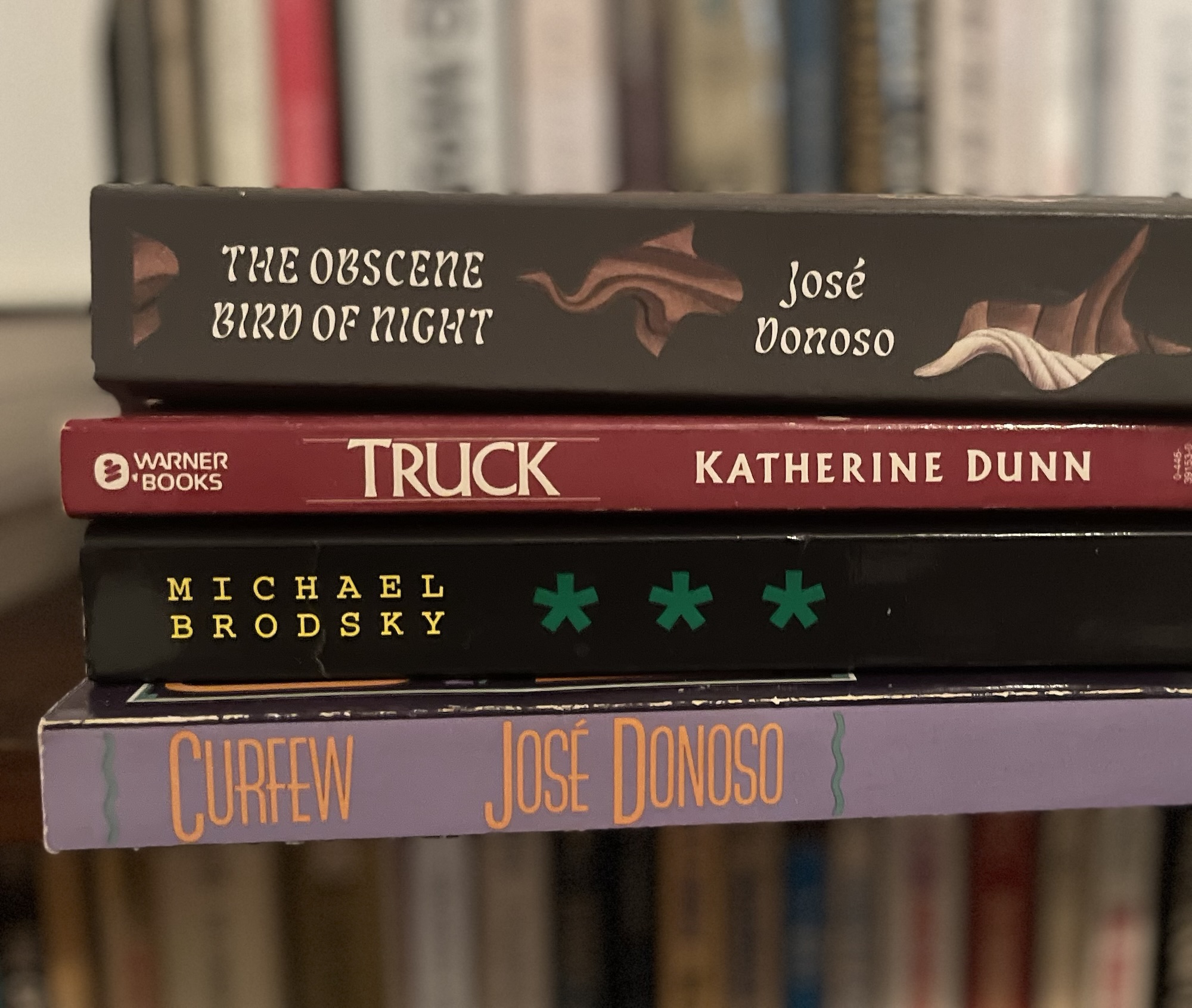
I thought I might try to knock out a review or a write-up of one of the many books I’ve finished that have stacked up as the summer has slowly transitioned to autumn. College classes have been canceled through to Tuesday. I have, ostensibly a “free” week; maybe some words, harder to cobble together for me these days, would come together, no? For the past few years I’ve focused more on reading literature with the attempt to suspend analysis in favor of, like, simply enjoying it. I realized I’d gotten into the habit of reading everything through the lens of this blog: What was I going to say about the book after reading it? I’ve been happier and read more sense freeing myself from the notion that I need to write about every fucking book I read. But the good books stack up (quite literally in a little place I have for such books); I find myself simply wanting to recommend, at some level, however facile, some of the stuff I’ve read. So forgive this lazy post, organized around a picture of a stack of books. From the top down:

Forty Stories, Donald Barthelme

A few years ago, I read Donald Barthelme’s collection Sixty Stories in reverse order. A few days ago, a commenter left me a short message on the final installment of that series of blogs: “Now do Forty Stories.” I think I have agreed–over the past week I’ve read stories forty through thirty-five in the collection. More to come.

Waiting for the Fear, Oğuz Atay; translation by Ralph Hubbell

A book of cramped, anxious stories. Atay, via Hubbell’s sticky translation, creates little worlds that seem a few reverberations off from reality. These are the kind of stories that one enjoys being allowed to leave, even if the protagonists are doomed to remain in the text (this is a compliment). Standouts include “Man in a White Overcoat,” “The Forgotten,” and “Letter to My Father.”

Graffiti on Low or No Dollars, Elberto Muller

Subtitled An Alternative Guide to Aesthetics and Grifting throughout the United States and Canada, Elberto Muller unfolds as a series of not-that-loosely connected vignettes, sketches, and fully-developed stories, each titled after the state or promise of their setting. The main character seems a loose approximation of Muller himself, a bohemian hobo hopping freights, scoring drugs, and working odd jobs—but mostly interacting with people. It kinda recalls Fuckhead at the end of Denis Johnson’s Jesus’ Son (a book Graffiti spiritually resembles) praising “All these weirdos, and me getting a little better every day right in the midst of them.” Muller’s storytelling chops are excellent—he’s economical, dry, sometimes sour, and most of all a gifted imagist.

American Abductions, Mauro Javier Cárdenas

If I were to tell you that Mauro Javier Cárdenas’s third novel is about Latin American families being separated by racist, government-mandated (and wholly fascist, really) mass deportations, you might think American Abductions is a dour, solemn read. And yes, Cárdenas conjures a horrifying dystopian surveillance in this novel, and yes, things are grim, but his labyrinthine layering of consciousnesses adds up to something more than just the novel’s horrific premise on its own. Like Bernhard, Krasznahorkao, and Sebald, Cárdenas uses the long sentence to great effect. Each chapter of American Abductions is a wieldy comma splice that terminates only when his chapter concludes—only each chapter sails into the next, or layers on it, really. It’s fugue-like, dreamlike, sometimes nightmarish. It’s also very funny. But most of all, it’s a fascinating exercise in consciousness and language—an attempt, perhaps, to borrow a phrase from one of its many characters, to make a grand “statement of missingnessness.”

Body High, Jon Lindsey

I liked Jon Lindsey’s debut Body High, a brief, even breezy drug novel that tries to do a bit too much too quickly, but is often very funny, gross, and abject. The narrator, who telegraphs his thoughts in short, clipped sentences (or fragments cobbled together) is a fuck-up whose main income derives from submitting to medical experiments. He dreams of scripting professional wrestling storylines though, perhaps one involving his almost-best friend/dealer/protector/enabler. When his underage-aunt shows up in his life, activating odd lusts, things get even more fucked up. Body High is at its best when it’s at its grimiest, and while it’s grimy, I wish it were grimier still.

Garbage, Stephen Dixon

I don’t know if Dixon’s Garbage is the best novel I’ve read so far this year, but it’s certainly the one that has most wrapped itself up in my brain pan, in my ear, throbbed a little behind my temple. The novel’s opening line sounds like an uninspired set up for a joke: “Two men come in and sit at the bar.” Everything that unfolds after is a brutal punchline, reminiscent of the Book of Job or pretty much any of Kafka’s major works. These two men come into Shaney’s bar—this is, or at least seems to be, NYC in the gritty seventies—and try to shake him down to switch up garbage collection services. A man of principle, Shaney rejects their “offer,” setting off an escalating nightmare, a world of shit, or, really, a world of garbage. I don’t think typing this description out does any justice to how engrossing and strange (and, strangely normalGarbage is. Dixon’s control of Shaney’s voice is precise and so utterly real that the effect is frankly cinematic, even though there are no spectacular pyrotechnics going on; hell, at times Dixon’s Shaney gives us only the barest visual details to a scene, and yet the book still throbs with uncanny lifeforce. I could’ve kept reading and reading and reading this short novel; it’s final line serves as the real ecstatic punchline. Fantastic stuff.

Magnetic Field(s), Ron Loewinsohn

I ate up Loewinshohn’s Magnetic Field(s) over a weekend. It’s a hypnotic triptych, a fugue, really, with phrases sliding across and through sections. We meet first a burglar breaking into a family’s home and learn that “Killing the animals was the hard”; then a composer, working with a filmmaker; then finally a novelist. Magnetic Field(s) posits crime and art as overlapping intimacies, and extends these intimacies through imagining another life as a taboo, too-intimate trespass.

Making Pictures Is How I Talk to the World, Dmitry Samarov

Making Pictures spans four decades of Samarov’s artistic career. Printed on high-quality color pages, the collection is thematically organized, showcasing Samarov’s different styles and genres. There are sketches, ink drawings, oils, charcoals, gouache, mixed media and more—but what most comes through is an intense narrativity. Samarov’s art is similar to his writing; there isn’t adornment so much as perspective. We get in Making Pictures a world of bars and coffee shops, cheap eateries and indie clubs. Samarov depicts his city Chicago with a thickness of life that is better seen than written about. Some of my favorite works include interiors of kitchens, portraits of women reading, and scribbly but energetic sketches of indie bands playing live. What I most appreciate about this collection though is that it showcases how outside of the so-called “art world” Samarov’s work is–and yet this is hardly the work of a so-called “outsider” artist. Samarov trained at the School of the Art Institute of Chicago, and yet through his career he has remained an independent, “not associated with an institution such as an art gallery, college, or museum,” as he writes in his book.

Beth, Dmitry Samarov, 2000

Final Cut, Charles Burns

I don’t know anything about Charles Burns’s upbringing, his youth, his personal life, and I don’t mean to speculate. However, it’s impossible not to approach Final Cut without pointing out that for several decades he’s been telling the same story over and over again—a sensitive, odd, artistic boy who is out of place even among others out of place. This is in no way a complaint—he tells the story with difference each time. And with more coherence. Final Cut is beautiful and sad and also weird enough to fit in neatly to Burns’s oeuvre. But it’s also more mature, a mature reflection on youth really, intense, still, but without the claustrophobia of Black Hole or the mania of his Last Look trilogy. There’s something melancholy here. It’s fitting that Burns employs the heartbreaking 1971 film The Last Picture Show as a significant motif in Final Cut.

Image from Final Cut, Charles Burns, 2024

RIP Robert Coover, Prince of American Metafiction

RIP Robert Coover, 1932-2024

Robert Coover passed away a few days ago at ninety-two years old. In his decades-spanning career, Coover published twenty-one novels, four plays, and four short story collections. He also published dozens of (as-yet) uncollected stories, essays, and a host of so-called “electronic fiction.” A fifth short story collection, 2018’s Going for a Beer, collected some of Coover’s greatest hits, and is generally an excellent starting place for those interested in Coover’s metatextual fabulism.

Coover didn’t start out as a metatextual fabulist. His first novel, 1966’s The Origin of the Brunists, is vivid, humanist realism with the slightest tinges of magic brightening its edges. 1968’s follow-up, The Universal Baseball Association, Inc., J. Henry Waugh, Prop., strays much deeper into the pop-myth fantasies that Coover would perfect in his mature career.

Coover’s 1969 collection Pricksongs & Descants shows a remarkable shift into postmodern metafiction. Pricksongs features some of his better stories, like “The Brother” (told from the point of view of the biblical Noah’s brother), “The Elevator,” and “The Magic Poker,” which begins with the sentence “I wander the island, inventing it” — a tidy encapsulation of Coover’s growing motif of the self-creating story. At times, this metatextual motif can exhaust the reader, as in Pricksongs’ capper “The Hat Act.” However, the collection features one of Coover’s best stories, “The Babysitter,” in which the titular character serves as a locus for a mundane suburban community’s collective repressed anxieties of sex and violence.

Coover would continue to explore such themes throughout his career, refining and sharpening his metatextual hat act in standout novels like Spanking the Maid (1982), Gerald’s Party (1986), and 1977’s The Public Burning—arguably Coover’s most important novel. It’s easy to think of The Public Burning as the last part of a loose postmodern American trilogy of large daring novels, the first two parts comprised of Pynchon’s Gravity’s Rainbow (1973) and William Gaddis’s J R (1975).

Indeed, Coover was regularly grouped with a (very white, very male) clique of postmodern American writers. In his 1980 essay “The Literature of Replenishment,” John Barth halfheartedly counted up the members: “By my count, the American fictionists most commonly included in the canon, besides the three of us at Tubingen [William H. Gass, John Hawkes and Barth himself], are Donald Barthelme, Robert Coover, Stanley Elkin, Thomas Pynchon, and Kurt Vonnegut, Jr.”

There was some chatter on social media that Coover’s passing left just Pynchon–and maybe Don DeLillo and Joseph McElroy–as the last living luminaries of twentieth-century US American postmodernist fiction. Of course, Pynchon really wasn’t a member of this or any other clique (he declined an invitation to Donald Barthelme’s so-called “postmodernists dinner“), and, as is too often the case with such groupings, Ishmael Reed’s contribution to American postmodernist fiction continues to be marginalized.

Let it stand then that Robert Coover, despite whatever connections and friendships he held with other writers and artists, was his own special self-made creation. He was prolific, especially later in life, publishing nine novels in the twenty-first century. One of these was The Brunist Day of Wrath (2014), a sequel to his debut; he also collaborated with comix artist Art Spiegelman on the graphic novelette Street Cop (2021) and even found a sliver of mainstream readers with Huck Out West, his wonderful 2017 “sequel” to Adventures of Huckleberry Finn. Coover’s latest novel Open House was published just over a year ago.

Clearly, Coover leaves behind a large body of work, and we’ll likely see more of his work collected and published over the next decade. I won’t pretend to have read most of what he’s written, but I’ve loved a lot of it—particularly Pricksongs & DescantsHuck Out WestSpanking the Maid, and Briar Rose, which, as far as I can recall, is likely the first thing I read of his (my girlfriend at the time’s sister had to read it in college; she professed that she hated it but thought I’d like it). The aforementioned 2018 collection Going for a Beer is a nice starting place for Coover; those more interested in novels might like Spanking the Maid. Or jump into one of his later short novels, like 2004’s Stepmother or 2018’s The Enchanted Prince, both of which exemplify his metamagicianist mode. Or hell, just go for the big boy, The Public Burning. Ultimately, Coover leaves behind a trove of trembling, writhing, vividly-living words, an oeuvre that will continue to engage readers fascinated by a certain stamp of so-called experimental literature–and for that I thank him.


“A Polemical-Poetical Oration in the Narrative-Dramatic-Cinematic Mode” — Peter Michelson

Robert Coover reads “The Fall Guy’s Faith”

“The Fall Guy’s Faith”

by

Robert Coover


Falling from favor, or grace, some high artifice, down he dropped like a discredited predicate through what he called space (sometimes he called it time) and with an earsplitting crack splattered the base earth with his vital attributes. Oh, I’ve had a great fall, he thought as he lay there, numb with terror, trying desperately to pull himself together again. This time (or space) I’ve really done it! He had fallen before of course: short of expectations, into bad habits, out with his friends, upon evil days, foul of the law, in and out of love, down in the dumps—indeed, as though egged on by some malevolent metaphor generated by his own condition, he had always been falling, had he not?—but this was the most terrible fall of all. It was like the very fall of pride, of stars, of Babylon, of cradles and curtains and angels and rain, like the dread fall of silence, of sparrows, like the fall of doom. It was, in a word, as he knew now, surrendering to the verb of all flesh, the last fall (his last anyway: as for the chips, he sighed, releasing them, let them fall where they may)—yet why was it, he wanted to know, why was it that everything that had happened to him had seemed to have happened in language? Even this! Almost as though, without words for it, it might not have happened at all! Had he been nothing more, after all was said and done, than a paraphrastic curiosity, an idle trope, within some vast syntactical flaw of existence? Had he fallen, he worried as he closed his eyes for the last time and consigned his name to history (may it take it or leave it), his juices to the soil (was it soil?), merely to have it said he had fallen? Ah! tears tumbled down his cheeks, damply echoing thereby the greater fall, now so ancient that he himself was beginning to forget it (a farther fall perhaps than all the rest, this forgetting: a fall as it were within a fall), and it came to him in these fading moments that it could even be said that, born to fall, he had perhaps fallen simply to be born (birth being less than it was cracked up to be, to coin a phrase)! Yes, yes, it could be said, what can not be said, but he didn’t quite believe it, didn’t quite believe either that accidence held the world together. No, if he had faith in one thing, this fallguy (he came back to this now), it was this: in the beginning was the gesture, and that gesture was: he opened his mouth to say it aloud (to prove some point or other?), but too late—his face cracked into a crooked smile and the words died on his lips . . .

“The Brother” — Robert Coover

“The Brother”

by

Robert Coover


right there right there in the middle of the damn field he says he wants to put that thing together him and his buggy ideas and so me I says “how the hell you gonna get it down to the water?” but he just focuses me out sweepin the blue his eyes rollin like they do when he gets het on some new lunatic notion and he says not to worry none about that just would I help him for God’s sake and because he don’t know how he can get it done in time otherwise and though you’d have to be loonier than him to say yes I says I will of course I always would crazy as my brother is I’ve done little else since I was born and my wife she says “I can’t figure it out I can’t sec why you always have to be babyin that old fool he ain’t never done nothin for you God knows and you got enough to do here fields need plowin it’s a bad enough year already my God and now that red-eyed brother of yours wingin around like a damn cloud and not knowin what in the world he’s doin buildin a damn boat in the country my God what next? you’re a damn fool I tell you” but packs me some sandwiches just the same and some sandwiches for my brother Lord knows his wife don’t have no truck with him no more says he can go starve for all she cares she’s fed up ever since the time he made her sit out on a hillside for three whole days rain and everything because he said she’d see God and she didn’t see nothin and in fact she like to die from hunger nothin but berries and his boys too they ain’t so bright neither but at least they come to help him out with his damn boat so it ain’t just the two of us thank God for that and it ain’t no goddamn fishin boat he wants to put up neither in fact it’s the biggest damn thing I ever heard of and for weeks wees I’m tellin you we ain’t doin nothin but cuttin down pine trees and haulin them out to his field which is really pretty high up a hill and my God that’s work lemme tell you and my wife she sighs and says I am really crazy r-e-a-1-l-y crazy and her four months with a child and tryin to do my work and hers too and still when I come home from haulin timbers around all day she’s got enough left to rub my shoulders and the small of my back and fix a hot meal her long black hair pulled to a knot behind her head and hangin marvelously down her back her eyes gentle but very tired my God and I says to my brother I says “look I got a lotta work to do buddy you’ll have to finish this idiot thing yourself I wanna help you all I can you know that but” and he looks off and he says “it don’t matter none your work” and I says “the hell it don’t how you think me and my wife we’re gonna eat I mean where do you think this food comes from you been puttin away man? you can’t eat this goddamn boat out here ready to rot in that bastard sun” and he just sighs long and says “no it just don’t matter” and he sits him down on a rock kinda tired like and stares off and looks like he might even for God’s sake cry and so I go back to bringin wood up to him and he’s already started on the keel and frame God knows how he ever found out to build a damn boat lost in his fog where he is Lord he was twenty when I was born and the first thing I remember was havin to lead him around so he didn’t get kicked by a damn mule him who couldn’t never do nothin in a normal way just a huge oversize fuzzyface boy so anyway I take to gettin up a few hours earlier ever day to do my farmin my wife apt to lose the baby if she should keep pullin around like she was doin then I go to work on the boat until sundown and on and on the days hot and dry and my wife keepin good food in me or else I’d of dropped sure and no matter what I say to try and get out of it my brother he says “you come and help now the rest don’t matter” and we just keep hammerin away and my God the damn thing is big enough for a hundred people and at least I think at least it’s a place to live and not too bad at that at least it’s good for somethin but my wife she just sighs and says no good will come of it and runs her hands through my hair but she don’t ask me to stop helpin no more because she knows it won’t do no good and she’s kinda turned into herself now these days and gettin herself all ready and still we keep workin on that damn thing that damn boat and the days pass and my brother he says we gotta work harder we ain’t got much time and from time to time he gets a coupla neighbors to come over and give a hand them sucked in by the size and the novelty of the thing makin jokes some but they don’t stay around more than a day or two and they go away shakin their heads and swearin under their breath and disgusted they got weaseled into the thing in the first place and me I only get about half my place planted and sec to my stock as much as I can my wife she takes more care of them than I can but at least we won’t starve we say if we just get some rain and finally we get the damn thing done all finished by God and we cover it in and out with pitch and put a kinda fancy roof on it and I come home on that last day and I ain’t never goin back ain’t never gonna let him talk me into nothin again and I’m all smellin of tar and my wife she cries and cries and I says to her not to worry no more I’ll be home all the time and me I’m cryin a little too though she don’t notice just thinkin how she’s had it so lonely and hard and all and for one whole day I just sleep the whole damn day and the rest of the week I work around the farm and one day I get an idea and I go over to my brother’s place and get some pieces of wood left over and whaddaya know? they are all livin on that damn boat there in the middle of nowhere him and his boys and some women and my brother’s wife she’s there too but she’s madder than hell and carpin at him to get outa that damn boat and come home and he says she’s got just one more day and then he’s gonna drug her on the boat but he don’t say it like a threat or nothin more like a fact a plain fact tomorrow he’s gonna drug her on the boat well I ain’t one to get mixed up in domestic quarrels God knows so I grab up the wood and beat it back to my farm and that evenin I make a little cradle a kinda fancy one with little animal figures cut in it and polished down and after supper I give it to my wife as a surprise and she cries and cries and holds me tight and says don’t never go away again and stay close by her and all and I feel so damn good and warm about it all and glad the boat thing is over and we get out a little wine and we decide the baby’s name is gonna be either Nathaniel or Anna and so we drink an extra cup to Nathaniel’s health and we laugh and we sigh and drink one to Anna and my wife she gently fingers the little animal figures and says they’re beautiful and really they ain’t I ain’t much good at that sorta thing but I know what she means and then she says “where did you get the wood?” and I says “it’s left over from the boat” and she don’t say nothin for a moment and then she says “you been over there again today?” and I says “yes just to get the wood” and she says “what’s he doin now he’s got the boat done?” and I says “funny thing they’re all living in the damn thing all except the old lady she’s over there hollerin at him how he’s gettin senile and where does he think he’s sailin to and how if he ain’t afraid of runnin into a octypuss on the way he oughta get back home and him sayin she’s a nut there ain’t no water and her sayin that’s what she’s been tellin him for six months” and my wife she laughs and it’s the happiest laugh I’ve heard from her in half a year and I laugh and we both have another cup-of wine and my wife she says “so he’s just livin on that big thing all by hisself?” and I says “no he’s got his boys on there and some young women who are maybe wives of the boys or somethin I don’t know I ain’t never seen them before and all kinda damn animals and birds and things I ain’t never seen the likes” and my wife she says “animals? what animals?” and I says “oh all kinds I don’t know a whole damn menagerie all clutterin and stinkin up the boat God what a mess” and my wife laughs again and she’s a little silly with the wine and she says “I bet he ain’t got no pigs” and “oh yes I seen them” I says and we laugh thinkin about pigs rootin around in that big tub and she says “I bet he ain’t got no jackdaws” and I says “yes I seen a couple o£ them too or mostly I heard them you couldn’t hardly hear nothin else” and we laugh again thinkin about them crows and his old lady and the pigs and all and my wife she says “I know what he ain’t got I bet he ain’t got no lice” and we both laugh like crazy and when I can I says “oh yes he does less he’s took a bath” and we both laugh til! we’re cryin and we finish off the wine and my wife says “look now I fyiow what he ain’t got he ain’t got no termites” and I says “you’re right I don’t recollect no termites maybe we oughta make him a present” and my wife she holds me close quiet all of a sudden and says “he’s really movin Nathaniel’s really movin” and she puts my hand down on her round belly and the little fella is kickin up a terrific storm and I says kinda anxious “does it hurt? do you think that—?” and “no” she says “it’s good” she says and so I says with my hand on her belly “here’s to you Nathaniel” and we drain what’s left in the bottom of our cups and the next day we wake up in each other’s arms and it’s rainin and than God we say and since it’s rainin real good we stay inside and do things a round the place and we’re happy because the rain has come just in time and in the evenin things smell green and fresh and delicious and it’s still rainin a little but not too hard so I decide to take a walk and I wander over by my brother’s place thinkin I’ll ask him if he’d like to take on some pet termites to go with his collection and there by God is his wife on the boat and I don’t know if he drug her on or if she just finally come by herself but she ain’t sayin nothin which is damn unusual and the boys they ain’t sayin nothin neither and my brother he ain’t sayin nothin they’re just all standin up there on top and gazin off and I holler up at them “nice rain ain’t it?” and my brother he looks down at me standin there in the rain and still he don’t say nothin but he raises his hand kinda funny like and then puts it back on the rail and I decide not to say nothin about the termites and it’s startin to rain a little harder again so I turn away and go back home and I tell my wife about what happened and my wife she just laughs and says “they’re all crazy he’s finally got them all crazy” and she’s cooked me up a special pastry with £rcsh meat and so we forget about them but by God the next day the rain’s still comin down harder than ever and water’s beginnin to stand around in places and after a week of rain I can see the crops is pretty well ruined and I’m havin trouble keepin my stock fed and my wife she’s cryin and talkin about our bad luck that we might as well of built a damn boat as plant all them crops and still we don’t figure things out I mean it just don’t come to our minds not even when the rain keeps spillin down like a ocean dumped upsidedown and now water is beginnin to stand around in big pools really big ones and water up to the ankles around the house and Icakin in and pretty soon the whole damn house is gettin fulla water and I keep sayin maybe we oughta go use my brother’s boat till this blows over but my wife she says “never” and then she starts in cryin again so finally I says to her I says “we can’t be so proud I’ll go ask him” and so I set out in the storm and I can hardly see where I’m goin and I slip up to my neck in places and finally I get to where the boat is and I holler up and my brother he comes out and he looks down at where I am and he don’t say nothin that bastard he just looks at me and I shout up at him I says “hey is it all right for me and my wife to come over until this thing blows over?” and still he don’t say a damn word he just raises his hand in that same sillyass way and I holler “hey you stupid sonuvabitch I’m soakin wet goddamn it and my house is fulla water and my wife she’s about to have a kid and she’s apt to get sick all wet and cold to the bone and all I’m askin you—” and right then right while I’m still talkin he turns around and he goes back in the boat and I can’t hardly believe it me his brother but he don’t come back out and I push up under the boat and I beat on it with my fists and scream at him and call him ever name I can think up and I shout for his boys and for his wife and for anybody inside and nobody comes out “Gowdamn you” I cry out at the top of my lungs and half sobbin and sick and then feelin too beat out to do anythin more I turn around and head back for home but the rain is thunderin down like mad now and in places I gotta swim and I can’t make it no further and I recollect a hill nearby and I head for it and when I get to it I climb up on top of it and it feels good to be on land again even if it is soggy and greasy and I vomit and retch there awhile and move further up and the next thing I know I’m wakin up the rain still in my face and the water halfway up the hill toward me and I look cut and I can see my brother’s boat is fioatin and I wave at it but I don’t see nobody wave back and then I quick look out towards my own place and all I can see is the top of it and of a sudden I’m scared scared about my wife and I go tearin for the house swimmin most all the way and cryin and shoutin and the rain still comin down like crazy and so now well now I’m back here on the hill again what little there is left of it and I’m figurin maybe I got a day left if the rain keeps comin and it don’t show no signs of stoppin and I can’t see my brother’s boat no more gone just water how how did he know? that bastard and yet I gotta hand it to him it’s not hard to see who’s crazy around here I can’t see my house no more I just left my wife inside where I found her I couldn’t hardly stand to look at her the way she was

Mass-market Monday | Robert Coover’s The Origin of the Brunists

The Origin of the Brunists, Robert Coover. Banatm Books Edition (1978). No cover designer credited. 534 pages.

This Bantam reprint of Coover’s first novel coincided with their mass-market paperback publication of The Public Burning.

I wrote a bit on The Origin of the Brunists a few years back. From that riff:

Coover’s metafiction always points back at its own origin, its own creation, a move that can at times take on a winking tone, a nudging elbow to the reader’s metaphorical ribs—Hey bub, see what I’m doing here? Coover’s metafictional techniques often lead him and his reader into cartoon landscapes, where postmodernly-plastic characters bounce manically off realistic contours. The best of Coover’s metafictions (like “The Babysitter,” 1969) tease their postmodern plastic into a synthesis of character, plot, and theme. However, in  large doses Coover’s metafictions can tax the reader’s patience and will—the simplest example that comes to mind is “The Hat Act” (from Pricksongs & Descants, 1969), a seemingly-interminable  Möbius loop that riffs on performance, trickery, and imagination. (And horniness).

I’m dwelling on Coover’s metafictional myth-making because I think of it as his calling card. And yet Origin of the Brunists bears only the faintest traces of Coover’s trademark metafictionalist moves (mostly, so far anyway, by way of its erstwhile hero, the journalist Tiger Miller). Coover’s debut reads rather as a work of highly-detailed, highly-descriptive realism, a realism that pushes its satirical edges up against the absurdity of modern American life. It reminds me very much of William Gass’s first novel Omensetter’s Luck (1966) and John Barth’s first two novels, The Floating Opera (1956) and The End of the Road (1958). (Barth heavily revised both of the novels in 1967). There’s a post-Faulknerian style here, something that can’t rightly be described as modern or postmodern. These novels distort reality without rupturing it in the way that the authors’ later works do. Later works like Barth’s Chimera (1973), Gass’s The Tunnel (1995), and Coover’s The Public Burning (1977) dismantle genre structures and tropes and rebuild them in new forms.

Riff on some Friends of the Library Sale acquisitions

I ducked out of work maybe a little bit early on Friday and filled a brown paper bag with books at a Friends of the Library sale.

I picked up some hardback first editions of books I already own in cheaper formats–Lucia Berlin’s A Manual for Cleaning Women, Denis Johnson’s The Laughing Monsters, P.D. James’s The Children of Men, and Ben Marcus’s Leaving the Sea. I also got hardcover editions of Rachel Cusk’s Second Place, Amy Hempel’s Sing to It, Atticus Lish’s The War for Gloria, and Eugenio Corti’s The Red Horse.

I also grabbed some duplicates or alternate paperback editions of books I already own, including an academically-oriented edition of Gertrude Stein’s Three Lives, Italo Calvino’s If on a winter’s night a traveler, and William Faulkner’s Light in August. I gave the Calvino to my son; the Stein is for a colleague. I’ll give Light in August to a student. (I got the same edition of the Faulkner at the last Friends of the Library sale I went to; my son claimed it.) I’ll also probably offer the Bourdain memoir to a student. I’m pretty sure we have a copy of Kitchen Confidential somewhere around the house. I couldn’t pass up on the cheap mass-market copy of Melville’s White Jacket. I mean, just look at this cover—dude’s wearing a white jacket

The book also bears a stamp claiming it originated (in a sense) at the old Melville Manse, Arrowhead:

I also couldn’t resist letting a paperback copy of Lucy Ellmann’s Ducks, Newburyport take up a lot of real estate in my paper grocery bag. The hype has died down enough for me to perhaps eventually sink into it. The edition of Alan & John Lomax’s American Ballads & Folk Songs is kinda beat up, but it’s got a lovely cover:

I was also attracted to this strange edition of Nikolai Gogol’s Dead Souls. It’s a 1987 hardback from the Soviet house Raduga Publishers, featuring a full-color portrait of Gogol and blue (?) page headings. The translation is by Christopher English and the book was printed in the U.S.S.R.—I’m not really sure who the intended audience was.

Albert Cullum’s The Geranium in the Window Sill Just Died But Teacher You Went Right On was another oddity I came across. Ostensibly a children’s book, The Geranium ultimately seems aimed at teachers. It features illustrations on every other page, each one by a different artist; many are remarkable, like this one by Stanley Mack–

There were a few titles, not pictured in the image at the top of this post, that I grabbed to cram into my bag simply because I had extra room at the end. I can usually offset the ten dollar bag fee by identifying a handful of pristine trade paperbacks that my local used bookstore will take for trade credit. So maybe I’m not, like, really offsetting the ten dollar fee so much as redirecting it toward obtaining more books.

There were plenty of titles at this particular sale that I would’ve crammed into the bag maybe ten or fifteen years ago—lots of books by Haruki Marukami, who has never been my guy, Jonathan Lethem (who I once really loved), Michael Chabon, Irvine Welsh, and even Chuck Palahniuk (there was a time when I was younger and had a broader range of friends that I could’ve given Palahniuk titles away easily). But I ended up imagining some younger person showing up to the sale, maybe today, Saturday, filling up a bag with titles that promised something beyond the YA formula stuff that makes up their current literary diet.

And if I imagined a younger person growing their library, I also imagined some of the older people whose collections had clearly ended up at the sale. Beyond the obvious airport thrillers and glut of titles by fiction factory Authors™, there were sets of strange, off-brand looking fantasy series in hardback, a seemingly-full run of Agatha Christie mysteries (also in hardback), Westerns no one will read again. Other people’s oddities ended up here; their children had no place for them, having subscribed to their own burdensome addictions.

I’ll have to give away all these books I’ve acquired at some point. But there’s joy in that too.


“Samuel Delany’s Babel-17 only looks like a traditional space opera…” — Moebius

October — Karoly Ferenczy

October, 1903 by Karoly Ferenczy (1862-1917)

Mass-market Monday | Angela Carter’s Heroes and Villains

Heroes and Villains, Angela Carver. Pocket Books Edition (1972). No cover artist credited. 176 pages.

While no cover designer or artist for this edition of Angela Carter’s 1969 novel Heroes and Villains, I’m pretty certain that the work is by Gene Szafran.

I wrote briefly on the novel in 2020:

One of Carter’s earlier novels, Heroes and Villains takes place in a post-apocalyptic world where caste lines divide the Professors, the Barbarians, and the mutant Out People. After her Professor stronghold is raided, Marianne is…willingly abducted?…by the barbarian Jewel. Marianne goes to live with the Barbarians, and ends up in a weird toxic relationship with Jewel, marked by rape and violence. Heroes and Villains throws a lot in its pot—what is consent? what is civilization? what is language?—but it’s a muddled, psychedelic mess in the end.

“Marmosets,” a very short story by Clarice Lispector

“Marmosets”

by

Clarice Lispector

translated by Elizabeth Bishop


The first time we had a marmoset was just before New Year’s. We were without water and without a maid, people were lining up to buy meat, the hot weather had suddenly begun—when, dumfounded, I saw the present enter the house, already eating a banana, examining everything with great rapidity, and with a long tail. It looked like a monkey not yet grown; its potentialities were tremendous. It climbed up the drying clothes to the clothesline, where it swore like a sailor, and the banana-peelings fell where they would. I was exhausted already. Every time I forgot and absentmindedly went out on the back terrace, I gave a start: there was that happy man. My younger son knew, before I did, that I would get rid of this gorilla: “If I promise that sometime the monkey will get sick and die, will you let him stay? Or if you knew that sometime he’d fall out the window, somehow, and die down there?” My feelings would glance aside. The filthiness and blithe unconsciousness of the little monkey made me responsible for his fate, since he himself would not take any blame. A friend understood how bitterly I had resigned myself, what dark deeds were being nourished beneath my dreaminess, and rudely saved me: a delighted gang of little boys appeared from the hill and carried off the laughing man. The new year was devitalized but at least monkey-less.

A year later, at a time of happiness, suddenly there in Copacabana I saw the small crowd. I thought of my children, the joys they gave me, free, unconnected with the worries they also gave me, free, and I thought of a chain of joy: “Will the person receiving this pass it along to someone else,” one to another, like a spark along a train of powder. Then and there I bought the one who would be called Lisette.

She could almost fit in one hand. She was wearing a skirt, and earrings, necklace, and bracelet of glass beads. The air of an immigrant just disembarking in her native costume. Like an immigrant’s, too, her round eyes.

This one was a woman in miniature. She lived with us three days. She had such delicate bones. She was of such a sweetness. More than her eyes, her look was rounded. With every movement, the earrings shook; the skirt was always neat, the red necklace glinted. She slept a lot, but, as to eating, she was discreet and languid. Her rare caress was only a light bite that left no mark.

On the third day we were out on the back terrace admiring Lisette and the way she was ours. “A little too gentle,” I thought, missing the gorilla. And suddenly my heart said harshly: “But this isn’t sweetness. This is death.” The dryness of the message left me calm. I said to the children: “Lisette is dying.” Looking at her, I realized the stage of love we had already reached. I rolled her up in a napkin and went with the children to the nearest first-aid station, where the doctor couldn’t attend to her because he was performing an emergency operation on a dog. Another taxi—”Lisette thinks she’s out for a drive, mama”—another hospital. There they gave her oxygen.

And with the breath of life, a Lisette we hadn’t known was revealed. The eyes less round, more secretive, more laughing, and in the prognathous and ordinary face a certain ironic haughtiness. A little more oxygen and she wanted to speak so badly she couldn’t bear being a monkey; she was, and she would have had much to tell. More oxygen, and then an injection of salt solution; she reacted to the prick with an angry slap, her bracelet glittering. The male nurse smiled: “Lisette! Gently, my dear!”

The diagnosis: she wouldn’t live unless there was oxygen at hand, and even then it was unlikely. “Don’t buy monkeys in the street,” he scolded me; “sometimes they’re already sick.” No, one must buy dependable monkeys, and know where they came from, to ensure at least five years of love, and know what they had or hadn’t done, like getting married. I discussed it with the children a minute. Then I said to the nurse: “You seem to like Lisette very much. So if you let her stay a few days, near the oxygen, you can have her.” He was thinking. “Lisette is pretty!” I implored.

“She’s beautiful!” he agreed, thoughtfully. Then he sighed and said, “If I cure Lisette, she’s yours.” We went away with our empty napkin.

The next day they telephoned, and I informed the children that Lisette had died. The younger one asked me, “Do you think she died wearing her earrings?” I said yes. A week later the older one told me, “You look so much like Lisette!”

I replied, “I like you, too.”

Imagine Buster — Samplerman

Imagine Buster, 2024 by Samplerman (Yvan Guillo)

The Oceans of Cruelty (Book acquired, 23 Sept. 2024)

This is an interesting one: The Oceans of Cruelty: Twenty-Five Tales of a Corpse Spirit: A Retelling by Douglas Penick: I think I’ll just keep using the colon the way I use garlic: The book will be out in October, in time for Halloween: Here is publisher NYRB’s blurb: (No colons in their blurb):

One of the oldest books in the world, The Oceans of Cruelty is a sequence of twenty-five tales from India whose central theme is the dark power of storytelling. At the start, a young king falls into the hands of a wicked sorcerer, who orders him to find a vetala, or corpse spirit, to serve him; the young king must do as he is told, and soon enough he is also under the sway of the no less malevolent spirit. Like a bat, the spirit hangs from the branches of a tree, and the king is condemned to bear it on his back through a dark forest as it whispers a riddling story in his ear. These are tales of suicidal passion, clever deceit, patriarchal oppression, and narrow escapes from death, and as long as the king can resolve the problems they pose, his bondage continues; the vampiric creature goes on commanding his attention in the dark. Only when the king is out of answers will he at last be free, though when that comes to pass—well, that’s when the whole story takes a new turn.

Douglas Penick’s re-creation of this ancient work brings out all its humor and horror and vitality, as well its unmistakable relevance in a world of stories gone viral.

“My heart, being hungry” — Edna St. Vincent Millay

Nude Reader — Greg Burak

Nude Reader, 2023 by Greg Burak (b. 1986)

Palestine — Walid Ebeid


Palestine, 2018 by Walid Ebeid (b. 1970)