Mass-market Monday | Chester Himes’ A Rage in Harlem

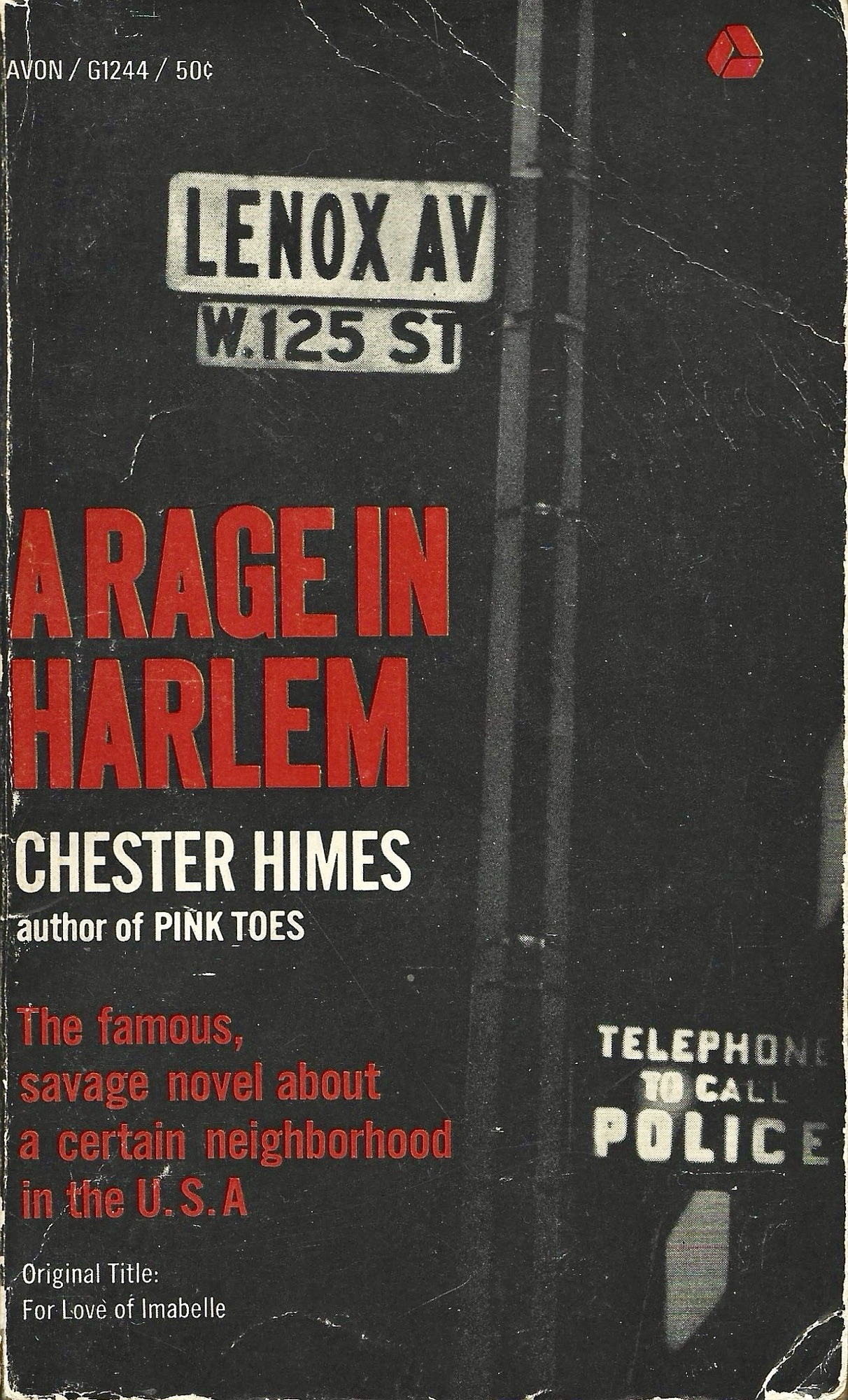
A Rage in Harlem, Chester Himes. Avon Books (1965). No cover artist or designer credited. 192 pages.

Himes’ A Rage in Harlem is a quick, mean, sharp read. I came to Himes via Ishmael Reed, who wrote of the author in a 1991 LA Times review of Himes’ Collected Stories,

James Baldwin, another proud and temperamental genius, said that if he hadn’t left the United States he would have killed someone. The same could be said of Chester Himes, the intellectual and gangster who left the United States for Europe in the 1950s. He achieved fame abroad with his Harlem detective series, which are remarkable for their macabre comic sense and wicked and nasty wit so brilliantly captured in Bill Duke’s A Rage in Harlem.

“Fifth Session,” a chapter from G. Cabrera Infante’s novel Three Trapped Tigers

“Fifth session”

a chapter from Three Trapped Tigers

by G. Cabrera Infante

translated by Donald Gardner and Suzanne Jill Levine with collaboration by Infante


I remember when I was my husband’s fiancée. No, I’m lying, I wasn’t engaged yet, but he used to come and invite me out to the movies or take a walk and the day came when he invited me home to meet his family. It was Christmas Eve and it was already late, about eight o’clock, when he came to pick me up, and I was already beginning to think he wouldn’t come and everybody in the building rushed to their balconies to see us and my mother didn’t go to the balcony, because she knew they were all looking and she was very proud of me because my fiancé was rich and because he’d come to pick me up in a convertible to take me to dinner in his home and she told me, “Everybody in the neighborhood has seen him, child. He’ll have to marry you now. See that you don’t disappoint us” and I remember how disgusted I felt with my mother. It was Christmas Eve but it was very hot and I felt very distracted because I had put on the only presentable dress I had, a very summery one, and to show I had put it on for a purpose I said to my fiancé as soon as I got to the car, “It’s really hot, Ricardo,” and he said, “Yes, extremely. Would you like the top down?” He was very considerate and courteous and so kind.

When we got to his house I felt very good, because everyone was dressed informally, although the house was a very snazzy one in the Country Club and his father was delighted to have me and wanted to teach me to play golf the next day and we decided to eat in the garden though we drank our cocktails indoors. I felt very good with Arturo too, that’s Ricardo’s brother who was studying medicine, and with their mother who was very young and beautiful, a bit like a Cuban Myrna Loy, very distinguished-looking, and with Ricardo’s father who was tall and handsome and never stopped looking at me the whole evening. I had had a little to drink and we were sitting in the living room, talking and waiting for the turkey to be golden roasted, and Ricardo’s father invited me to go on a tour of the kitchen. I remember I didn’t feel well and that Ricardo’s father gripped me tightly by the arm as we went to the kitchen and as the house was half in darkness because of the Christmas tree the brilliant, almost white, light of the kitchen bothered me. I went and looked at the turkey and then I saw the girl who had brought us our drinks and who helped the chef (they were very rich and had a chef instead of a woman to cook for them) and then I saw she wasn’t old and I remembered that Ricardo’s mother had said something about her not being very experienced and I saw her in the light of the kitchen, as she was moving between the table and the sink and the refrigerator with the salads and she never once looked at us and I thought that her face was familiar and I saw that she was quite young and it was then that I realized she was a girl who had been at school with me in my pueblo before I came with my family to Havana and whom I hadn’t seen for ten years. She was so old, doctor, so worn out and she was the same age as me, exactly the same age and we had played together when we were girls and we were very good friends and both of us had a crush on Jorge Negrete and Gregory Peck and we used to sit out at night on the steps of my house and make plans for when we were grown up and I felt so uncomfortable that I couldn’t say hello to her, because it would make her feel so bad, and I had to leave the kitchen. Then, when I was in the living room again, I just about went back to the kitchen to say hello, because I thought I hadn’t said hello to her because I was afraid Ricardo’s family would see that I was from the country and had been very poor. But I didn’t go.

The meal took a very long time coming, I don’t know how long: something had happened to the turkey and we went on drinking and then Ricardo’s brother wanted to show me all around the house and first of all I went to see Ricardo’s room and then his brother’s room and I don’t know why but I went into the bathroom and the curtain of the shower was drawn and Ricardo’s brother said, “Don’t look,” and I was so curious I opened the curtain and looked and there in the shower, drenched in dirty water, was a skeleton that still had bits of flesh on it, a human skeleton, and Ricardo’s brother said, “I’m cleaning it!” I don’t know how I managed to get out of the bathroom nor how I went down the stairs nor how I managed to sit at the table in the patio to eat. All I remember is that Ricardo’s brother took me by the hand and kissed me and I kissed him and then he helped me across the dark room.

In the patio everything was very pretty, very green because of the lawn and beautifully lit up and the table was very well arranged with a very expensive tablecloth and they served me first because Ricardo’s mother insisted on it. And what I did was to look at the meat, the pieces of turkey, very well cooked, almost burnt-looking in the brown gravy, and put my knife and fork across my plate, lower my hands and start crying. I spoiled their Christmas for them, these people who were so kind and friendly, and I returned home worn out and so sad and quiet that not even my mother heard me come in.

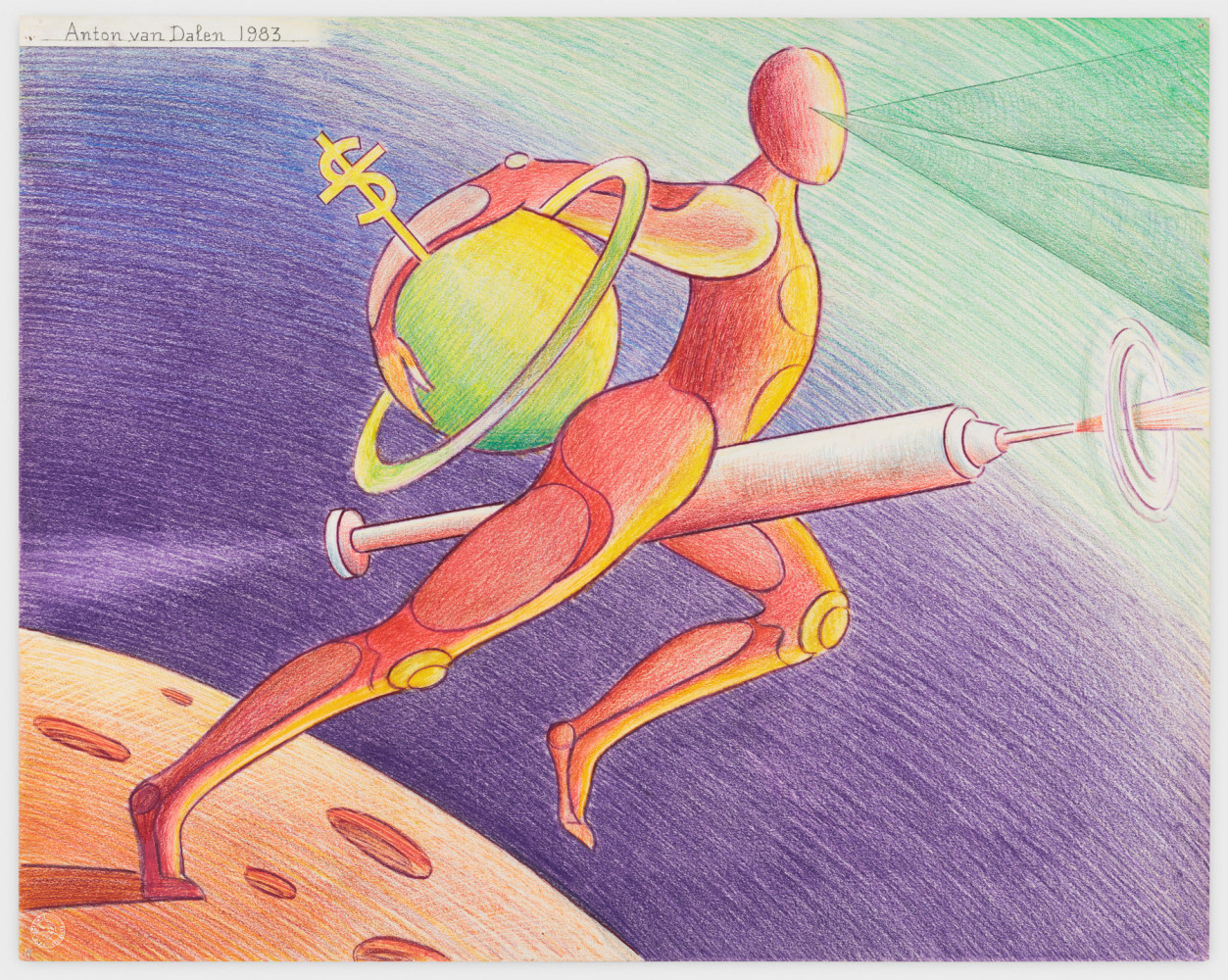
Science Fiction #2 — Anton van Dalen

Science Fiction #2, 1983 by Anton van Dalen (1938-2024)

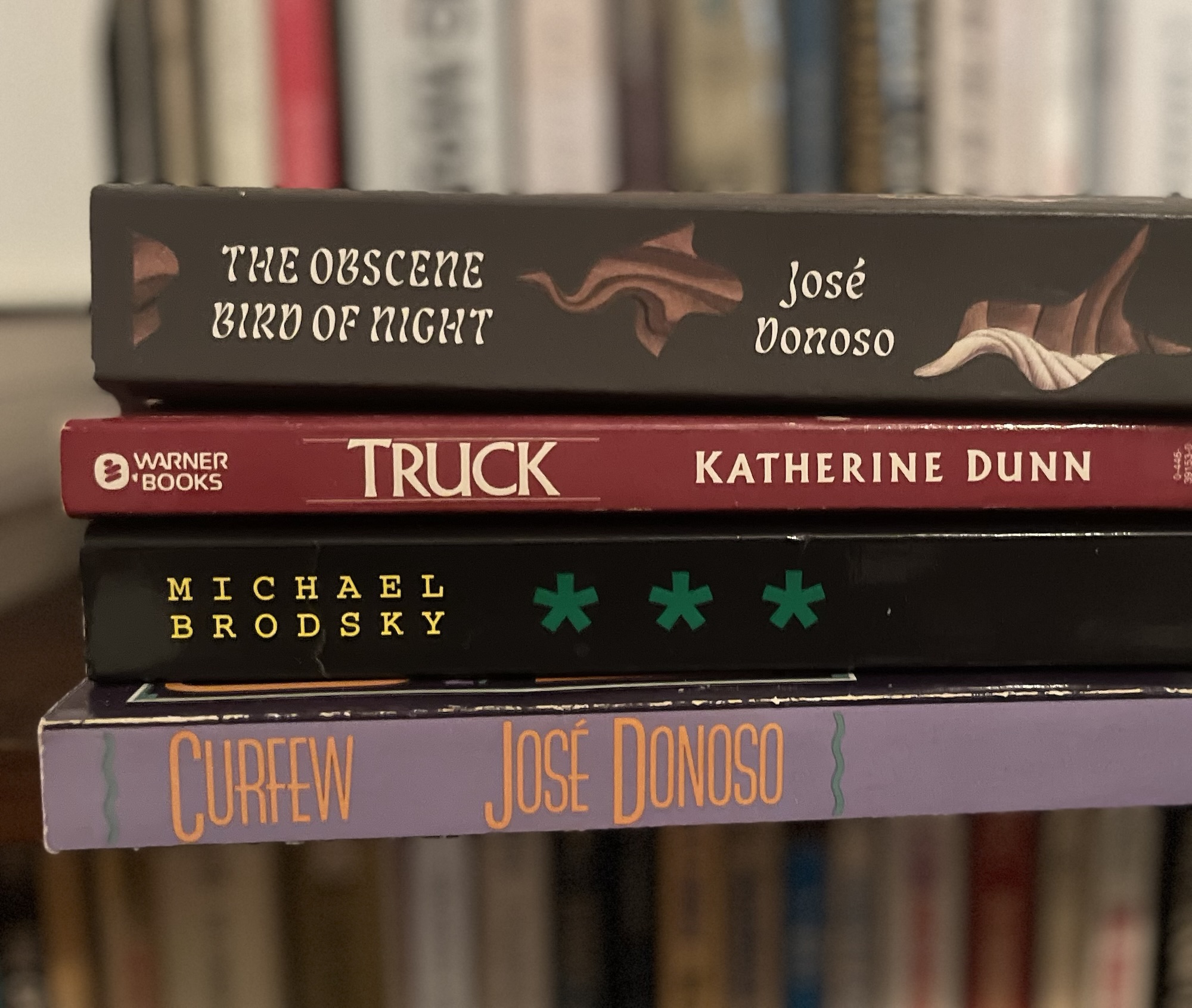
Brodsky Donoso Donoso & Dunn (Books acquired, first weekend of Dec. 2024)

Picked up some books this weekend: Two from José Donoso: Megan McDowell’s “revision” of Hardie St. Martin and Leonard Mades’ translation of The Obscene Bird of Night, and Alfred MacAdam’s translation of Curfew: the first I had to order, the second was a lucky find. As was Michael Brodsky’s *** (send me a copy of Xman, someone), and Katherine Dunn’s Truck, which can twin with the copy of Attic I found this summer.

Vogue Gorilla with Miss Harper — Eduardo Paolozzi

Vogue Gorilla with Miss Harper, 1972 by Eduardo Paolozzi (1924–2005)

To insist on the miraculous is to deny to the machine at least some of its claims on us, to assert the limited wish that living things, earthly and otherwise, may on occasion become Bad and Big enough to take part in transcendent doings. By this theory, for example, King Kong (?-1933) becomes your classic Luddite saint. The final dialogue in the movie, you recall, goes: ”Well, the airplanes got him.” ”No . . . it was Beauty killed the Beast.”

–Thomas Pynchon, “Is It O.K. To Be a Luddite?”


Mass-market Monday | Guillermo Cabrera Infante’s Three Trapped Tigers

Three Trapped Tigers, G. Cabrera Infante. Translated by Donald Gardner and Suzanne Jill Levine with Guillermo Cabrera Infante. Avon Bard (1985). No cover artist or designer credited. 473 pages.

A busy buzzy book honking and howling and hooting, I am loving loving loving Three Trapped Tigers—it sings and shouts and hollers. The novel starts with a  polyglossic emcee announcing the parade of honorable horribles who will strut through the novel (if it is indeed a “novel”). Very funny, very engrossing, grand stuff, love it.

Here’s Salman Rushdie, reviewing the novel in the LRB back in 1981 (he’s just fumbled around answering “What is this crazy book actually about?”:

So much for the plot. (Warning: this review is about to go out of control.) What actually matters in Three Trapped Tigers is words, language, literature, words. Take the title. Originally, in the Cuban, they were three sad tigers, Tres tristes tigres, the beginning of a tongue-twister. For Cabrera, phonetics always come before meaning (correction: meaning is to be found in phonetic associations), and so the English title twists the sense in order to continue twisting the tongue. Very right and improper. Then there is the matter of the huge number of other writers whose influence must be acknowledged: Cabrera Infante calls them, reverently, Fuckner and Shame’s Choice. (He is less kind to Stephen Spent and Green Grams, who wrote, as of course you know, Travels with my Cant.) Which brings us to the novel’s most significant character, a sort of genius at torturing language called Bustrofedon, who scarcely appears in the story at all, of whom we first hear when he’s dying, but who largely dominates the thoughts of all the Silvestres and Arsenios and Codacs he leaves behind him. This Bustromaniac (who is keen on the bustrofication of words) gives us the Death of Trotsky as described by seven Cuban writers – a set of parodies whose point is that all the writers described are so pickled in Literature that they can’t take up their pens without trying to wow us with their erudition. Three Trapped Tigers, like Bustrofedon’s whole life, is dedicated to a full frontal assault on the notion of Literature as Art. It gives us nonsense verses, a black page, a page which says nothing but blen blen blen, a page which has to be read in the mirror: Sterne stuff. But it also gives us Bustrolists of ‘words that read differently in the mirror’: Live/evil, drab/bard, Dog/God; and the Confessions of a Cuban Opinion Eater; and How to kill an elephant: aboriginal method ... the reviewer is beginning to cackle hysterically at this point, and has decided to present his opinion in the form of puns, thus: ‘The Havana night may be dark and full of Zorro’s but Joyce cometh in the morning.’ Or: ‘Despite the myriad influences, Cabrera Infante certainly paddles his own Queneau.’

“Nail Soup (A Depression Recipe)” — M.F. Beal

“Nail Soup (A Depression Recipe)” by M. F. Beal


Go up to a house which is pretty untidy and look around the back door until you find a nail. Then knock, and when the lady of the house comes take off your hat and ask her could she spare the ingredients for a nail soup. When she asks how you make that, show her the nail and tell her you take a nail and some water and ask her what else she’s got around. Usually she’ll be shamed enough to give you at least an onion and some potatoes.

To finish the soup: Go down to where everybody’s hanging out, and while you wait for your nail soup to cook, read in the newspaper about how they’re shoveling day-old chicks into the local dump, or pouring fresh cow’s milk down the sewer. When you get to the bottom of the pot, take a good long look at the nail and decide what to do with it.

Ubik — Bob Pepper

Cover art for Philip K. Dick’s Ubik, 1982 by Bob Pepper (1938-2019). Via/more.

Read “Red Rubber Gloves,” a short story by Christine Brooke-Rose

“Red Rubber Gloves”

by

Christine Brooke-Rose


From this position on my high balcony, the semi-detached beyond the garden looks more squat than it ought to in such a prosperous suburb, forming with its Siamese twin a square inverted U that faces me and boxes a wide inverted T of a back-yard, neatly divided by a hedge of roses and hydrangeas. On the left of the hedge there is a bit of lawn. On the right, only a small paved yard. The house on the left seems devoid of life, devoid, that is, of the kind of life liable to catch the eye and stop it in its casual round, mutating its idle curiosity through momentary fascination and hence, inexorably, by the mere process of reiteration, to a mild but fixed obsessiveness. As does the right-hand house.

In the angle of the square U, outside the french windows of the right-hand house, the girl sits on the edge of the red canvas bed in a pale pink bikini, carefully oiling inch after inch of her thin white body. She looks, from up here, totally naked, the pink bikini being so pale, and she sits on the edge of the red canvas bed which is set obliquely in the paved yard to face the morning sun. She has oiled the arms, the shoulders, the chest and the long midriff. Now she is doing the right leg, starting with the foot, the ankle, then the shin, as if to meet her upper oily self half way. She is oiling the right thigh. Inside the thigh. The left foot. If the heat-wave holds out she will perhaps become brown enough to contrast with the pink and so look less totally naked on the red canvas bed. The inside of the left thigh. She lies now framed in the red canvas bed, chin up, eyes closed to face the hot June sun. Round the corner from her naked body, at the square end of the inverted U, the red rubber gloves lie quiet on the kitchen window-sill.

In the morning the large rectangular windows of the house tend to reflect the sun in some at least of their thirty-two small black squares framed in cream-painted wood. And in the afternoon they are quite cast into the shade as the sun moves round to face me on my high balcony, immobilised in convalescence. I cannot therefore see much further than the beginning of the pink wash-basin in the bathroom or, in the kitchen below it, the long and gleaming double-sink unit. And the red rubber gloves, moving swiftly apart and together, vanishing and reappearing, moving apart and down. All the windows of both houses, those of the kitchen and of the bathroom above it, at each end of the square inverted U, and those of each bedroom inside the U above the french windows, are rectangular and divided into four panels, each of eight black squares, two over two over two over two, all in cream-painted frames.

The thin girl has melted away into the sun, the red canvas bed is empty. Continue reading “Read “Red Rubber Gloves,” a short story by Christine Brooke-Rose”

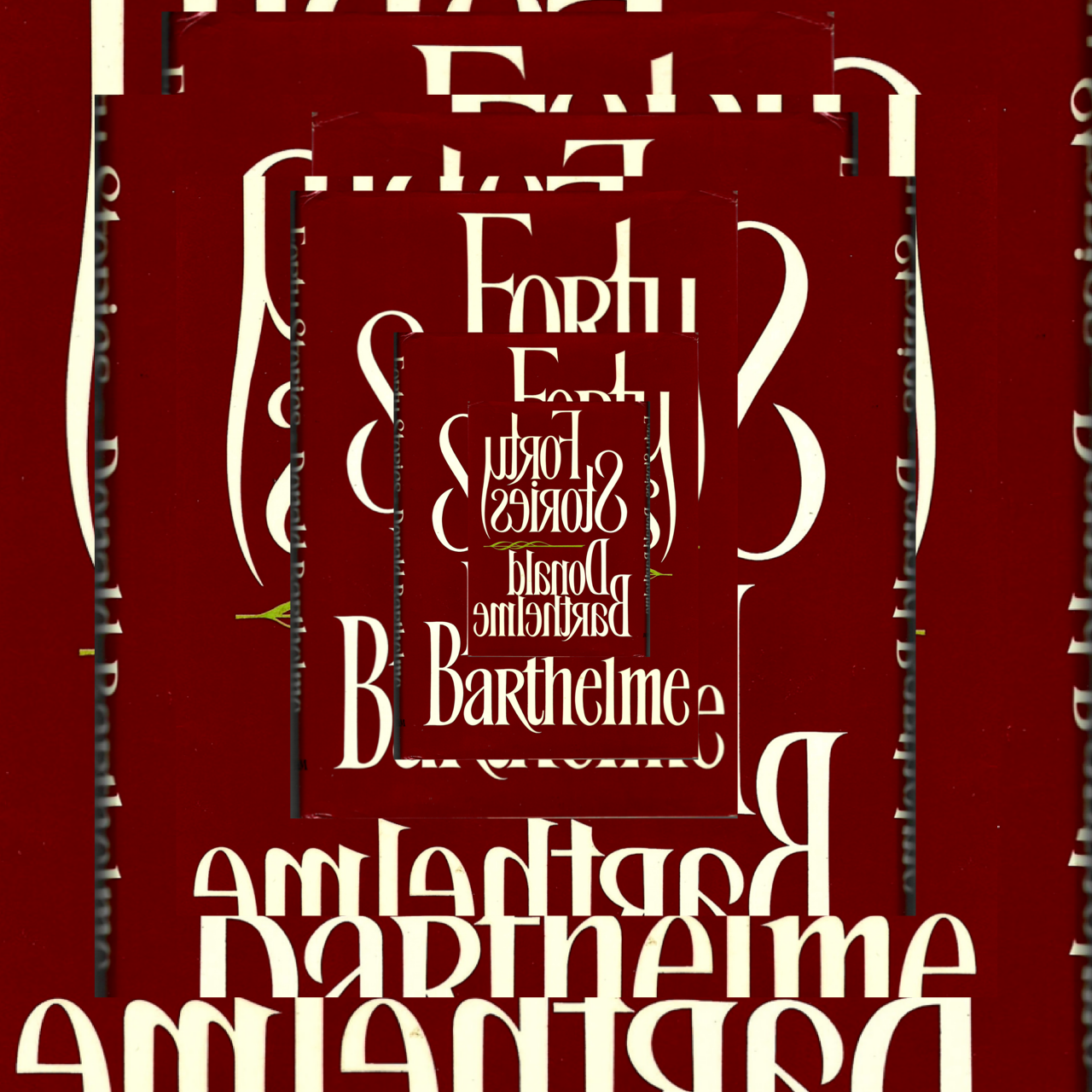
Donald Barthelme’s Forty Stories in reverse, Part IV

Previously,

Stories 40-36

Stories 35-32

Stories 31-28

27. “Some of Us Had Been Threatening Our Friend Colby” (Amateurs, 1976)

This is probably the first essential story in Forty Stories—maybe at the end of this silly project I’ll put together something like Fifty Stories, whittling down Sixty Stories and Forty Stories. Here are the first few sentences:

Some of us had been threatening our friend Colby for a long time, because of the way he had been behaving. And now he’d gone too far, so we decided to hang him. Colby argued that just because he had gone too far (he did not deny that he had gone too far) did not mean that he should be subjected to hanging. Going too far, he said, was something everybody did sometimes. We didn’t pay much attention to this argument. We asked him what sort of music he would like played at the hanging. He said he’d think about it but it would take him a while to decide.

Colby finally settles on Ive’s Fourth Symphony.

“Some of Us” showcases in a non-showy way the best of Barthelme—absurdity balanced by syntactic restraint; surreal humor weighted in the visceral specter of impending violence. It’s a very, very funny story, and while I think it resists simple allegorical interpretation, it’s nevertheless a little parcel of domestic fascism in practice. Great stuff. Read “Some of Us Had Been Threatening Our Friend Colby”  here.

26. “Pepperoni” (first published in The New Yorker, 23 Nov. 1980)

Published over four decades ago, “Pepperoni” is a depressingly prescient riff on what happens when capital decides to take over journalism. Newspapers become just another widget, a slice of pepperoni, a trifle, a nothing to sell and sell and resell:

Financially, the paper is quite healthy. The paper’s timber-lands, mining interests, pulp and paper operations, book, magazine, corrugated-box, and greeting-card divisions, film, radio, television, and cable companies, and data-processing and satellite-communications groups are all flourishing, with overall return on invested capital increasing at about eleven percent a year.

Despite the vertical integration, all is not well: “But top management is discouraged and saddened, and middle management is drinking too much.” Barthelme’s hyperbole is jaunty in 1980, where the paper’s “editorials have been subcontracted to Texas Instruments, and the obituaries to Nabisco, so that the staff will have ‘more time to think.'” But in 2024 it reads as a grim warning about the gross intersection of capital and journalism. Read “Pepperoni” here.

25. “Sentence” (City Life, 1970)

I mean what if I just…

Or a long sentence moving at a certain pace down the page aiming for the bottom-if not the bottom of this page then some other page-where it can rest, or stop for a moment to think out the questions raised by its own (temporary) existence, which ends when the page is turned, or the sentence falls out of the mind that holds it (temporarily) in some kind of embrace, not necessarily an ardent one, but more perhaps the kind of embrace enjoyed (or endured), by a wife who has just waked up and is on her way to the bathroom in the morning to wash her hair, and is bumped into by her husband, who has been lounging at the breakfast table reading the newspaper, and doesn’t see her coming out of the bedroom, but, when he bumps into her, or is bumped into by her, raises his hands to embrace her lightly, transiently, because he knows that if he gives her a real embrace so early in the morning, before she has properly shaken the dreams out of her head, and got her duds on, she won’t respond, and may even become slightly angry, and say something wounding, and so the husband invests in this embrace not so much physical or emotional pressure as he might, because he doesn’t want to waste anything-with this sort of feeling, then, the sentence passes through the mind more or less, and there is another way of describing the situation too, which is to say that the sentence crawls through the mind like something someone says to you while you are listening very hard to the FM radio, some rock group there, with its thrilling sound, and so, with your attention or the major part of it at least already rewarded, there is not much mind room you can give to the remark, especially considering that you have probably just quarreled with that person, the maker of the remark, over the radio being too loud, or something like that, and the view you take, of the remark, is that you’d really rather not hear it, but if you have to hear it, you want to listen to it for the smallest possible length of time, and during a commercial, because immediately after the commercial they’re going to play a new rock song by your favorite group, a cut that has never been aired before, and you want to hear it and respond to it in a new way, a way that accords with whatever you’re feeling at the moment, or might feel, if the threat of new experience could be (temporarily) overbalanced by the promise of possible positive benefits, or what the mind construes as such, remembering that these are often, really, disguised defeats (not that such defeats are not, at times, good for your character, teaching you that it is not by success alone that one surmounts life, but that setbacks, too, contribute to that roughening of the personality that, by providing a textured surface to place against that of life, enables you to leave slight traces, or smudges, on the face of human history-your mark) and after all, benefit-seeking always has something of the smell of raw vanity about it, as if you wished to decorate your own brow with laurel, or wear your medals to a cookout, when the invitation had said nothing about them, and although the ego is always hungry (we are told) it is well to remember that ongoing success is nearly as meaningless as ongoing lack of success, which can make you sick, and that it is good to leave a few crumbs on the table for the rest of your brethren, not to sweep it all into the little beaded purse of your soul but to allow others, too, part of the gratification, and if you share in this way you will find the clouds smiling on you, and the postman bringing you letters, and bicycles available when you want to rent them, and many other signs, however guarded and limited, of the community’s (temporary) approval of you, or at least of it’s willingness to let you believe (temporarily) that it finds you not so lacking in commendable virtues as it had previously allowed you to think, from its scorn of your merits, as it might be put, or anyway its consistent refusal to recognize your basic humanness and its secret blackball of the project of your remaining alive, made in executive session by its ruling bodies, which, as everyone knows, carry out concealed programs of reward and punishment, under the rose, causing faint alterations of the status quo, behind your back, at various points along the periphery of community life, together with other enterprises not dissimilar in tone, such as producing films that have special qualities, or attributes, such as a film where the second half of it is a holy mystery, and girls and women are not permitted to see it, or writing novels in which the final chapter is a plastic bag filled with water, which you can touch, but not drink: in this way, or ways, the underground mental life of the collectivity is botched, or denied, or turned into something else never imagined by the planners, who, returning from the latest seminar in crisis management and being asked what they have learned, say they have learned how to throw up their hands; the sentence meanwhile, although not insensible of these considerations, has a festering conscience of its own, which persuades it to follow its star, and to move with all deliberate speed from one place to another, without losing any of the “riders” it may have picked up just being there, on the page, and turning this way and that, to see what is over there, under that oddly-shaped tree, or over there, reflected in the rain barrel of the imagination, even though it is true that in our young manhood we were taught that short, punchy sentences were best (but what did he mean? doesn’t “punchy” mean punch-drunk? I think he probably intended to say “short, punching sentences,” meaning sentences that lashed out at you, bloodying your brain if possible, and looking up the word just now I came across the nearby “punkah,” which is a large fan suspended from the ceiling in India, operated by an attendant pulling a rope-that is what I want for my sentence, to keep it cool!) we are mature enough now to stand the shock of learning that much of what we were taught in our youth was wrong, or improperly understood by those who were teaching it, or perhaps shaded a bit, the shading resulting from the personal needs of the teachers, who as human beings had a tendency to introduce some of their heart’s blood into their work, and sometimes this may not have been of the first water, this heart’s blood, and even if they thought they were moving the “knowledge” out, as the Board of Education had mandated, they could have noticed that their sentences weren’t having the knockdown power of the new weapons whose bullets tumble end-over-end (but it is true that we didn’t have these weapons at that time) and they might have taken into account the fundamental dubiousness of their project (but all the intelligently conceived projects have been eaten up already, like the moon and the stars) leaving us, in our best clothes, with only things to do like conducting vigorous wars of attrition against our wives, who have now thoroughly come awake, and slipped into their striped bells, and pulled sweaters over their torsi, and adamantly refused to wear any bras under the sweaters, carefully explaining the political significance of this refusal to anyone who will listen, or look, but not touch, because that has nothing to do with it, so they say; leaving us, as it were, with only things to do like floating sheets of Reynolds Wrap around the room, trying to find out how many we can keep in the air at the same time, which at least gives us a sense of participation, as though we were Buddha, looking down at the mystery of your smile, which needs to be investigated, and I think I’ll do that right now, while there’s still enough light, if you’ll sit down over there, in the best chair, and take off all your clothes, and put your feet in that electric toe caddy (which prevents pneumonia) and slip into this permanent press hospital gown, to cover your nakedness-why, if you do all that, we’ll be ready to begin! after I wash my hands, because you pick up an amazing amount of exuviae in this city, just by walking around in the open air, and nodding to acquaintances, and speaking to friends, and copulating with lovers, in the ordinary course (and death to our enemies! by and by)-but I’m getting a little uptight, just about washing my hands, because I can’t find the soap, which somebody has used and not put back in the soap dish, all of which is extremely irritating, if you have a beautiful patient sitting in the examining room, naked inside her gown, and peering at her moles in the mirror, with her immense brown eyes following your every movement (when they are not watching the moles, expecting them, as in a Disney nature film, to exfoliate) and her immense brown head wondering what you’re going to do to her, the pierced places in the head letting that question leak out, while the therapist decides just to wash his hands in plain water, and hang the soap! and does so, and then looks around for a towel, but all the towels have been collected by the towel service, and are not there, so he wipes his hands on his pants, in the back (so as to avoid suspicious stains on the front) thinking: what must she think of me? and, all this is very unprofessional and at-sea looking! trying to visualize the contretemps from her point of view, if she has one (but how can she? she is not in the washroom) and then stopping, because it is finally his own point of view that he cares about and not hers, and with this firmly in mind, and a light, confident step, such as you might find in the works of Bulwer-Lytton, he enters the space she occupies so prettily and, taking her by the hand, proceeds to tear off the stiff white hospital gown (but no, we cannot have that kind of pornographic merde in this majestic and high-minded sentence, which will probably end up in the Library of Congress) (that was just something that took place inside his consciousness, as he looked at her, and since we know that consciousness is always consciousness of something, she is not entirely without responsibility in the matter) so, then, taking her by the hand, he falls into the stupendous white puree of her abyss, no, I mean rather that he asks her how long it has been since her last visit, and she says a fortnight, and he shudders, and tells her that with a condition like hers (she is an immensely popular soldier, and her troops win all their battles by pretending to be forests, the enemy discovering, at the last moment, that those trees they have eaten their lunch under have eyes and swords) (which reminds me of the performance, in 1845, of Robert-Houdin, called The Fantastic Orange Tree, wherein Robert-Houdin borrowed a lady’s handkerchief, rubbed it between his hands and passed it into the center of an egg, after which he passed the egg into the center of a lemon, after which he passed the lemon into the center of an orange, then pressed the orange between his hands, making it smaller and smaller, until only a powder remained, whereupon he asked for a small potted orange tree and sprinkled the powder thereupon, upon which the tree burst into blossom, the blossoms turning into oranges, the oranges turning into butterflies, and the butterflies turning into beautiful young ladies, who then married members of the audience), a condition so damaging to real-time social intercourse of any kind, the best thing she can do is give up, and lay down her arms, and he will lie down in them, and together they will permit themselves a bit of the old slap and tickle, she wearing only her Mr. Christopher medal, on its silver chain, and he (for such is the latitude granted the professional classes) worrying about the sentence, about its thin wires of dramatic tension, which have been omitted, about whether we should write down some natural events occurring in the sky (birds, lightning bolts), and about a possible coup d’etat within the sentence, whereby its chief verb would be-but at this moment a messenger rushes into the sentence, bleeding from a hat of thorns he’s wearing, and cries out: “You don’t know what you’re doing! Stop making this sentence, and begin instead to make Moholy-Nagy cocktails, for those are what we really need, on the frontiers of bad behavior!” and then he falls to the floor, and a trap door opens under him, and he falls through that, into a damp pit where a blue narwhal waits, its horn poised (but maybe the weight of the messenger, falling from such a height, will break off the horn)-thus, considering everything very carefully, in the sweet light of the ceremonial axes, in the run-mad skimble-skamble of information sickness, we must make a decision as to whether we should proceed, or go back, in the latter case enjoying the pathos of eradication, in which the former case reading an erotic advertisement which begins, How to Make Your Mouth a Blowtorch of Excitement (but wouldn’t that overtax our mouthwashes?) attempting, during the pause, while our burned mouths are being smeared with fat, to imagine a better sentence, worthier, more meaningful, like those in the Declaration of Independence, or a bank statement showing that you have seven thousand kroner more than you thought you had-a statement summing up the unreasonable demands that you make on life, and one that also asks the question, if you can imagine these demands, why are they not routinely met, tall fool? but of course it is not that query that this infected sentence has set out to answer (and hello! to our girl friend, Rosetta Stone, who has stuck by us through thick and thin) but some other query that we shall some day discover the nature of, and here comes Ludwig, the expert on sentence construction we have borrowed from the Bauhaus, who will-“Guten Tag, Ludwig!”-probably find a way to cure the sentence’s sprawl, by using the improved way of thinking developed in Weimer-“I am sorry to inform you that the Bauhaus no longer exists, that all of the great masters who formerly thought there are either dead or retired, and that I myself have been reduced to constructing books on how to pass the examination for police sergeant”-and Ludwig falls through the Tugendhat House into the history of man-made objects; a disappointment, to be sure, but it reminds us that the sentence itself is a man-made object, not the one we wanted of course, but still a construction of man, a structure to be treasured for its weakness, as opposed to the strength of stones

Is good if not great.

24. “The Temptation of St. Anthony” (Sadness, 1972)

After rereading this one, the thought that dominated my stupid brain was, How the fuck did an editor allow DB to use the word “ineffable” four times in this short story? He uses a version of the word here, in this nice little excerpt in which one of the things that St. Anthony did was the passive doing of being mugged:

 There was the ineffableness I’ve already mentioned, and there were certain things that he did. He was mugged, for example. That doesn’t happen too often here, but it happened to him. It was at night, somebody jumped on him from behind, grabbed him around the neck and began going through his pockets. The man only got a few dollars, and then he threw St. Anthony down on the sidewalk (he put one leg in front of the saint’s legs and shoved him) and then began to run away. St. Anthony called after him, held up his hand, and said, “Don’t you want the watch?” It was a good watch, a Bulova. The man was thunderstruck. He actually came back and took the watch off St. Anthony’s wrist. He didn’t know what to think. He hesitated for a minute and then asked St. Anthony if he had bus fare home. The saint said it didn’t matter, it wasn’t far, he could walk. Then the mugger ran away again.

If not essential, “St. Anthony” is a robust and colorful example of DB riffing in his prime. Read “The Temptation of St. Anthony” here.

Augusto Monterroso’s The Rest Is Silence (Book acquired, some time early Nov. 2024)

So I finally made some time to dig into Augusto Monterroso’s lone novel, 1978’s The Rest Is Silence (trans. Aaron Kerner). It’s hardly a conventional novel (and seems very much of a piece with the other novel I’m reading right now, Cuban author Guillermo Cabrera Infante’s 1967 novel Tres tristes tigres (in its 1971 translation as Three Trapped Tigers by Donald Gardner and Suzanne Jill Levine). Both novels eschew traditional novelistic forms—no central narrator, no conventional plot, per se, polyglossia given rein over a controlling and unifying voice. I read the first fifty or so pages of The Rest Is Silence and look forward to digging in deeper.

From Dustin Illingworth’s introduction

Augusto Monterroso’s The Rest Is Silence, a fictional Festschrife for a provincial Mexican Intellectual, teems with invented texts, imaginary writers, dubious footnotes, possible pseudonyms, and unreliable memories. The novel’s constituent parts reveal the social, culeural, and literary life of one Eduardo Torres, a writer and elder statesman of the fictional town of San Blas, Mexico, Its four sec-tions— grouped loosely into tributes, selected writings, aphorisms, and “impromptu collaborations” —make a case for compilation as a natural handmaiden to farce. The opening remarks from friends and family are largely hatchet jobs born of petty jealousy or long acquain-tance. The selections from Torres’s oeuvre—incredible misreadings, all-are bathetic, anodyne, lacking in sense, and almost invariably wrong. Yet the vivisection is marked by compassion as much as it is by savagery. Ferried by the risible figure of Torres, avatar of vanity and misjudgment, Monterroso smuggles a pocket autobiography within his deflation of Mexico’s literati. In the process, he forges one of the sublime fools of literature, a man whose commitment to delusion is itself a kind of glorious art.

Read “The Pedestrian,” a short story by Ray Bradbury

“The Pedestrian”

by

Ray Bradbury

To enter out into that silence that was the city at eight o’clock of a misty evening in November, to put your feet upon that buckling concrete walk, to step over grassy seams and make your way, hands in pockets, through the silences, that was what Mr Leonard Mead most dearly loved to do. He would stand upon the corner of an intersection and peer down long moonlit avenues of sidewalk in four directions, deciding which way to go, but it really made no difference; he was alone in this world of 2053 A.D., or as good as alone, and with a final decision made, a path selected, he would stride off, sending patterns of frosty air before him like the smoke of a cigar. Continue reading “Read “The Pedestrian,” a short story by Ray Bradbury”

Nineteen Literary Recipes for Thanksgiving (Or Any Other Time)

Breakfast

Zelda Fitzgerald’s Special Breakfast

Vladimir Nabokov’s Eggs à la Nabocoque

Lunch

Thomas Pynchon’s European Pizza

Hunter S. Thompson’s Open-Face Cigarette-Special Hot-and-Cold Sandwich with Artichoke Appetizer

Soup

Ishmael Reed’s Texas Gumbo

Denise Levertov’s Black Bean Soup

Donald Barthelme’s Fine Homemade Soups

Sides

Ursula K. Le Guin’s Crab Nebula

John Cage’s Homemade Bread

Biblioklept’s Oven Rice

Mains

John Brunner’s Squid with Pine Nuts

Marjorie Kinnan Rawlings’ Recipes for Coot Surprise, Jugged Rabbit, and Jellied Tongue

Ernest Hemingway’s Campfire Trout

William Faulkner’s Cured Ham

Libations

Thomas Pynchon’s Crocodile (A Traditional Anarchist Favorite)

Walker Percy’s Mint Julep

Poul Anderson’s All My Own Invention

Dessert

Anita Loos’ Kitten’s Tongue

Elizabeth Bishop’s Brownies

Elizabeth Bishop’s Brownies

Elizabeth Bishop’s brownie recipe:

4 squares bitter chocolate (or about a cup of cocoa)
4 eggs
1/2 cup butter
2 1/2 cups white sugar
1 cup flour
2 teaspoons vanilla
2 cups chopped nuts

Melt the chocolate and butter together – or, if you use cocoa, melt along with half the sugar and a little water. Cool slightly and beat in eggs and rest of sugar.

Sift in flour, add vanilla and nuts and beat. The batter is fairly stiff – doesn’t run much. Spread about <——————> this thick in square pan.

Bake in a slow oven – about 45 minutes to an hr., depending on pan, thickness, etc. They should be dry on top, just pulling away from edges, but still rather damp in the middle. Cut in squares in pan and remove with spatula.

This makes chewy brownies – for a harder kind, use brown sugar and an extra egg – or half brown sugar – Can be made thicker and used hot with whipped cream on top for a desert [sic] –

Via the excellent blog Paper and Salt, whose author Nicole acquired it via Bishop’s at Vassar College.

Thomas Pynchon’s Recipe for the Crocodile, a Traditional Anarchist Cocktail

“I’ll be in the bar,” said Reef. Yzles-Bains was in fact one of the few places on the continent of Europe where a sober Anarchist could find a decent Crocodile—equal amounts of rum, absinthe, and the grape spirits known as trois-six—a traditional Anarchist favorite, which Loïc the bartender, a veteran of the Paris Commune, claimed to have been present at the invention of.

A cocktail recipe from Thomas Pynchon’s novel Against the Day. (More on trois-six here; good luck finding real absinthe).

Bonus recipe: Kit Traverse’s drink invention:

“‘Love in the Shadows of Pera,’ ” Kit said. “It’s just Creme de Menthe and beer.”

Anita Loos’ Recipe for Kitten’s Tongue

Anita Loos’ recipe for kitten’s tongue:

Take 2 eggs and not quite a cup of sugar. Whip them just a little, then add not quite a cupful of melted butter and a cup of flour. Stir the mixture, spread it on a tin in small quantities, bake them. Roll in nuts and sugar.

From Famous Recipes of Famous Women (ed. Florence Stratton, 1925).

Poul Anderson’s Cocktail All My Own Invention

Poul Anderson’s cocktail “All My Own Invention” is collected in collected in Cooking Out of This World (ed. Anne McCaffrey, 1973).

All My Own Invention

2 oz. dark rum, 2 oz. dry vermouth, 1 oz. fresh lemon juice, stirred over ice. Sneaky.