Drugs won’t change you / Religion won’t change you

“Doña Faustina” — Paul Bowles

“Doña Faustina”

by

Paul Bowles


NO ONE COULD UNDERSTAND why Doña Faustina had bought the inn. It stood on one of the hairpin curves in the old highway leading up from the river valley to the

town, but the route had been made useless by the building of the new paved road. Now it was impossible to reach the inn except by climbing up a stony path over the embankment and walking several hundred feet down the old road which, no longer kept in repair, already was being washed away by the rains and strangled by the shiny vegetation of that lowland region.

On Sundays the people used to walk out from the town, the women carrying parasols and the men guitars (for this was before the days of the radio, when almost everyone knew how to make a little music); they would get as far as the great breadfruit tree and look up the road at the faded façade of the building, more than half hidden by young bamboo and banana plants, stare a few seconds, and turn around to go back. “Why does she leave the sign up?” they would say. “Does she think anyone would ever spend the night there now?” And they were quite right: no one went near the inn anymore. Only the people of the town knew that it existed, and they had no need of it.

There remained the mystery of why she had bought it. As usual when there is something townspeople cannot understand, they invented a whole series of unpleasant explanations for Doña Faustina’s behavior. The earliest and most common one, which was that she had decided to transform the place into a house of ill-repute, soon fell to pieces, for there was absolutely nothing to substantiate such a theory. No one had been seen to go near the inn for weeks, except Doña Faustina’s younger sister Carlota who arrived from Jalapa, and the old servants José and Elena, who went to market each morning and minded their business strictly enough to satisfy even the most vicious gossips. As for Carlota, she appeared occasionally at Mass, dressed in black. It was said that she had taken their father’s death very much to heart, and would probably not remove the mourning, ever.

The other suppositions evolved by the people of the town in their effort to bring light to the mystery proved as unlikely as the first. It was rumored that Doña Faustina was giving asylum to Chato Morales, a bandit whom the police of the region had been trying for months to capture, but he was caught soon afterward in a distant part of the province. Then it was said that the inn was a depository for a drug ring; this also proved to be false. The leaders of the ring, having been arrested, divulged their secrets, and the cache proved to be in a room above the Farmácia Ideal. There were darker hints to the effect that Carlota might be luring lone voyagers to the inn, where they met the fate that traditionally befalls such solitary visitors to lonely inns. But people did not take such suggestions seriously. The opinion grew that Doña Faustina had merely gone a little mad, and that her madness, having taken an antisocial turn, had induced her to retire to the outskirts of town where she could live without ever seeing anyone. To be sure, this theory was contested by certain younger members of the community who claimed that she was no more crazy than they, that on the contrary she was extremely crafty. They said that having a great deal of money she had bought the inn because of the ample lands which surrounded it, and that there in the privacy of the plant-smothered gardens and orchards she had devised all kinds of clever ways of hiding her riches. The older citizens of the town took no stock in this, however, since they clearly remembered both her husband and her father, neither of whom had evinced any unusual prowess in collecting money. And she had bought the inn for practically nothing. “Where would she have got the pesos?” they said sceptically. “Out of the trees, perhaps?” Continue reading ““Doña Faustina” — Paul Bowles”

John Berger or The Art of Looking

John Berger or The Art of Looking is a documentary biography of the late John Berger. Directed by Cordelia Dvorák and released in November, 2016.

Without publicity capitalism could not survive (John Berger)

img_4840

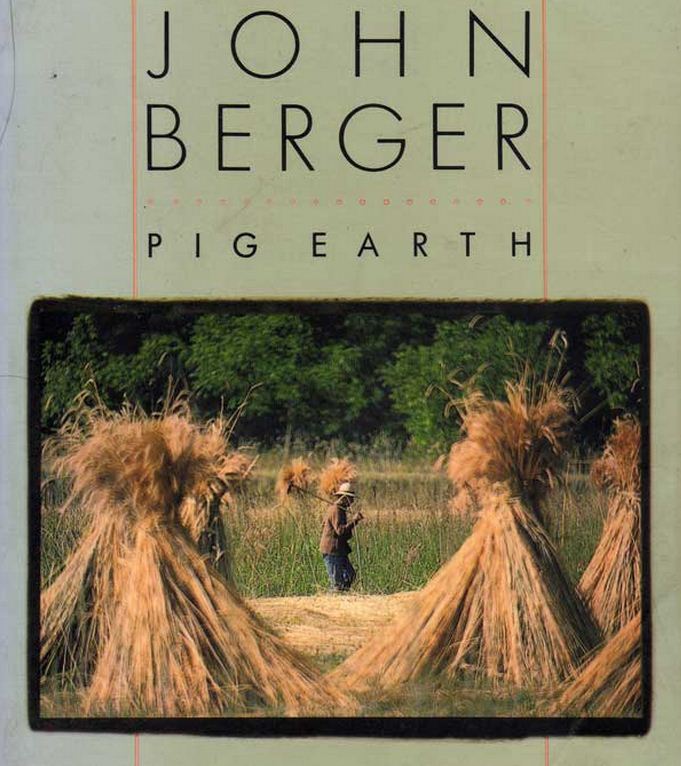
A review of John Berger’s Pig Earth

People exaggerate the changes in nature so as to make nature seem lighter. Nature resists change. If something changes, nature waits to see whether the change can continue, and it it can’t, it crushes it with all its weight!  Ten thousand years ago the trout in the stream would have been exactly the same as today.

Stasis and disruption and the relation between people and their natural and urban surroundings are the themes John Berger writes about in his 1979 collection of essays, poems and short stories, Pig Earth.  Having moved from England, where he enjoyed considerable renown as an art critic and fiction writer, to the peasant villages of the French Alps, Berger settled into his role as an active participant in rural life, not only turning hay but observing and documenting the disappearance of a way of a once-pervasive mode of life.  Pig Earth was one result of his labors, the first book of a trilogy that took some fifteen-odd years to complete, a moving but not uncritical account of humanity’s struggle to conquer nature by symbiosis.

Maybe symbiosis isn’t the proper term if we agree that humanity is part of nature’s whole, but Berger juxtaposes the frailty of humanity with the earth’s uncaring and often violent strength.  Survival for the family of the subsistence farmer depends upon that family’s ability to tend to the needs of the plant and animal world (as well as more than a little bit of luck).  In the collection’s first true story, “A Calf Remembered,” a baby cow is delivered on a dark winter’s night. Here, Berger stresses the protections that nature and man have designed to ensure the survival of a young, vulnerable animal:  mucus, barn, salt, and sense.  The human spends his night in the barn protecting his property because it provides him not only with sustenance in the forms of milk and meat, but also companionship and a sense of duty.  When daily living requires acts that might mean life or death, the conscious and the instinct converge.

He sat on a milking stool in the dark.  With his head in his hands, his breathing was indistinguishable from that of the cows. The stable itself was like the inside of an animal.  Breath, water, cud were entering it:  wind, piss, shit were leaving.

Pig Earth is a book worth studying as people attempt to make sense of a world transitioning from one type of living to another and fuss over the sources of their own limited strength and vitality. Berger may not have been looking to pioneer a slow-living locavore lifestyle, but his subjects worry about their increasing isolation from the circles of power and industry.  They fret over the pointlessness of passing their knowledge to their children who need entirely different skills to survive in the rapidly encroaching urban wage economy.  In “The Value of Money” a father refuses a tractor, branded “The Liberator” by the manufacturer, that his son has purchased for him because it will render his faithful work-horse obsolete.  This same farmer kidnaps local tax officials because they want to confiscate the products of his labor without compensation for value that he exclusively created.  Unable to make them understand their wrongdoing, he sets them free because “you can only take revenge on those who are your own.”

The final story, “The Three Lives of Lucy Cabrol,” is the lengthiest and perhaps most poignant narrative in the book. It follows the life of a bright, tenacious, physically stunted woman as she grows from young girl to town outcast.  While Berger admired much of the life in the peasant village, he would fail in his duty as critic and chronicler if he ignored its darker sides. Berger often sets the title character’s pluck against the resignation and superstition endemic to village life. When life requires struggle, most people choose to hoard.  When poor choices may lead to death or family hardship, capitulation to those in power, whether those rulers be the town’s big man or Nazi collaborators, can often seem the only obvious choice.  Lucy shows us that cowardice, no matter the circumstances, only seems easy. Pig Earth is highly recommended.

[Ed. note—Biblioklept originally published this review of Pig Earth in 2011. We run it again in appreciation of John Berger, who died today at the age of 90].

“Last Year” (Live) — Jim O’Rourke

Sunday Comics

new-year

New Year’s Eve Fox-fires at the Changing Tree, Ōji — Utagawa Hiroshige

dp151598

Three Books (or, My three favorite reading experiences in 2016)

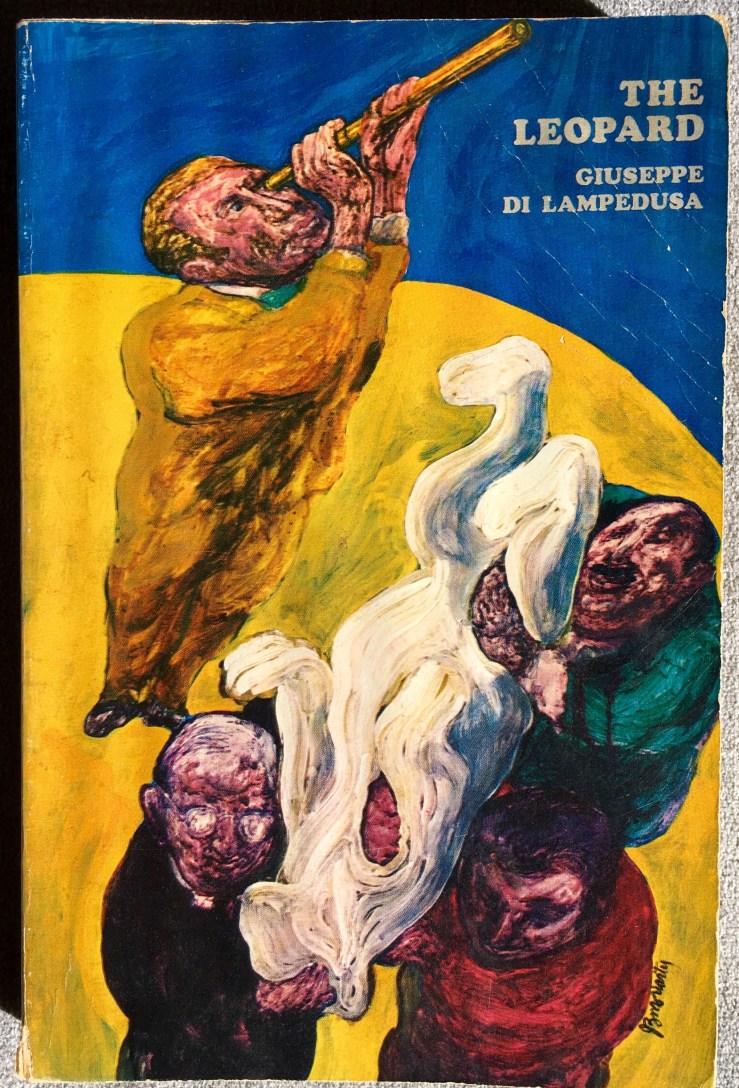
After years of false starts, I finally read Giuseppe Tomasi di Lampedusa’s 1958 novel The Leopard this August. Then I read it again, immediately. (It’s one of only two novels I can recall rereading right away—the other two were Blood Meridian and Gravity’s Rainbow). The Leopard tells the story of Prince Fabrizio of Sicily, who witnesses the end of his era during the Risorgimento, the Italian reunification. Fabrizio is an enchanting character, by turns fiery and lascivious, intellectual and stoic, and The Leopard takes us through his mind and through his times. He’s thoroughly complex, unknown even to himself, perhaps. The novel is impossibly rich, sad, electric, a meditation on death, sex, sensuality—pleasure and loss. More mood than plot, The Leopard glides on vibe, its action framed in rich set pieces: fancy balls and sumptuous dinners and games of pleasure in summer estates. But of course there is a plot—several strong plots, indeed (marriage plots and death plots, religious plots and political plots). Yet the narrative’s viewpoint characters keep the plots at bay, or mediate them, rather than propel them forward. Simply one of the better novels I’ve read in years, its final devastating images inked into my memory for as long as I have memory. (English translation by Archibald Colquhoun, by the way).

img_3290

The 43 stories that comprise Lucia Berlin’s excellent collection A Manual for Cleaning Women braid together to reveal a rich, dirty, sad, joyous world—a world of emergency rooms and laundromats, fancy hotels and detox centers, jails and Catholic schools. Berlin’s stories jaunt through space and time: rough mining towns in Idaho; country clubs and cotillions in Santiago, Chile; heartbreak in New Mexico and New York; weirdness in Oakland and Berkeley; weirdness in Juarez and El Paso. (Full Biblioklept review).

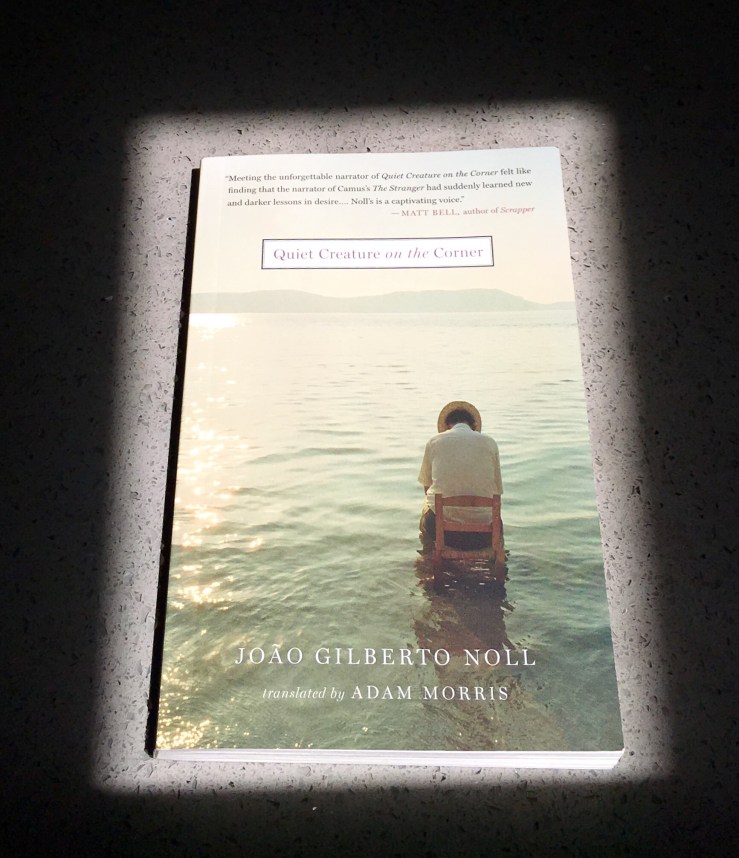
Brazilian writer João Gilberto Noll’s 1991 novella Quiet Creature on the Corner (English translation by Adam Morris; Two Lines Press) is probably best read without any kind of foregrounding or forewarning. The book is a nightmarish, abject, kinetic, surreal, picaresque read, a mysterious prose-poem that resists allegorical interpretation.  Quiet Creature on the Corner is like a puzzle, but a puzzle without a reference picture, a puzzle with pieces missing. The publishers have compared the novella to the films of David Lynch, and the connection is not inaccurate. Too, Quiet Creature evokes other sinister Lynchian puzzlers, like Roberto Bolaño’s 2666 (or Nazi Literature in the Americas, which it is perhaps a twin text to). It’s easy to compare much of postmodern literature to Kafka, but Quiet Creature is truly Kafkaesque. It also recalled to me another Kafkaesque novel, Alasdair Gray’s Lanark—both are soaked in a dark dream logic. Other reference points abound—the paintings of Francis Bacon, Leon Golub, Hieronymus Bosch, Goya’s etchings, etc. But Noll’s narrative is its own thing, wholly. (Full Biblioklept review).

A (probably incomplete) list of books I read in 2016

The Telling, Ursula K. Le Guin

Four Ways to Forgiveness, Ursula K. Le Guin

J R, William Gaddis*

The Inheritors, William Golding

American Candide, Mahendra Singh

Crossing the Sea with Syrians on the Exodus to Europe, William Bauer

Collected Stories, William Faulkner

A Temple of Texts, William H. Gass

Cow Country, Adrian Jones Pearson

Ancillary Justice, Ann Leckie

Ancillary Sword, Ann Leckie

Ancillary Mercy, Ann Leckie

Extinction, Ashley Dawson

My Brilliant Friend, Elena Ferrante

The Story of a New Name, Elena Ferrante

Those Who Leave and Those Who Stay, Elena Ferrante

The Story of the Lost Child, Elena Ferrante

Quiet Creature on the Corner, João Gilberto Noll

The Last Gas Station and Other Stories, Tom Clark

The Weight of Things, Marianne Fritz

The Transmigration of Bodies, Yuri Herrera

Miserable Miracle, Henri Michaux

The Franchiser, Stanley Elkin

Hell, Henri Barbusse

White Mythology, W.D. Clarke

The Dick Gibson Show, Stanley Elkin

The Charterhouse of Parma, Stendhal

Marketa Lazarova, Vladislav Vančura

A Manual for Cleaning Women, Lucia Berlin

Hildafolk series, Luke Pearson

The Leopard, Giuseppe di Lampedusa

There Is a Tree More Ancient Than Eden, Leon Forrest

Bear, Marian Engel

Jacob Bladders and the State of the Art, Roman Muradov

Gravity’s Rainbow, Thomas Pynchon*

The Absolute GravediggerVítězslav Nezval

Beyond the Blurb, Daniel Green

Last Evenings on Earth, Roberto Bolaño*

The Missing Books, Scott Esposito

Woodcutters, Thomas Bernhard

Flow My Tears, The Policeman Said, Philip K. Dick

* indicates a reread

Three Books (or, My three favorite rereading experiences in 2016)

img_4662

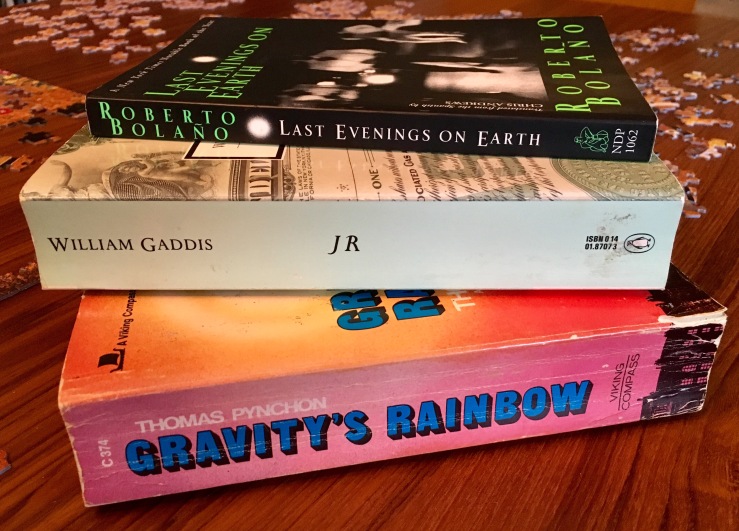
I prefer rereading to reading. Rereading an old favorite can often offer comfort. A week or so after the US presidential election, I picked up Roberto Bolaño’s Last Evenings on Earth and reread its fourteen stories over a few mornings and afternoons. I’m not sure why, but somehow Bolaño’s sinister vibes and dark humor worked to alleviate my own post-election dread in some small measure. “Life is mysterious and vulgar,” after all, as one of his narrators points out. (I reviewed the book seven years ago).

I’m not really sure what impelled me to reread William Gaddis’s great grand gargantuan novel J R in 2016, but I found the experience incredibly rewarding—richer, sadder, funnier, more bitter. Most of J R is composed as unattributed dialogue, so one of the great challenges for a first reading is simply figuring out who is speaking to whom; additional readings help flesh out the narrative’s colors and tone. I wrote about rereading J R, noting

Only a handful of novels are so perfectly simultaneously comic and tragic. Moby-Dick? Yes. Gravity’s Rainbow? Absolutely. (G R and J R, a duo published two years apart, spiritual twins, massive American novels that maybe America hardly deserves (or, rather: theses novels were/are totally the critique America deserves).

This little note offers me an easy bridge to the reread that dominated the second half of 2016, a slow read of Gravity’s Rainbow. I finally read Gravity’s Rainbow in full in 2015—and then immediately reread it. Which is sort of like, y’know, actually reading it. To put it plainly, the only way to read Gravity’s Rainbow is to read it twice. Reading it a third time was fascinating—not just in seeing all the stuff I’d missed, but also in experiencing the novel’s radical coherence, its sublime plotting, its real depth—and most of all, Pynchon’s prose. Critics and commenters tend to foreground Pynchon’s humor and themes, perhaps overlooking his prowess as a sentence-shaper. I also had fun annotating sections of the novel, a project I’ll be continuing next year, when I read Gravity’s Rainbow again.

A Camelia for Anima — Leonora Carrington

Sloth — James Ensor

Equality Before Death — William-Adolphe Bouguereau

Waking — Torii Kotondo

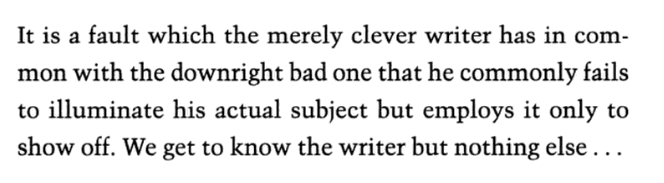
The merely clever writer (Georg Christoph Lichtenberg)

screenshot-2016-12-29-at-4-04-38-pm

From Georg Christoph Lichtenberg’s The Waste Books. English translation by R.J. Hollingdale. NYRB.

Wandering — Leonora Carrington