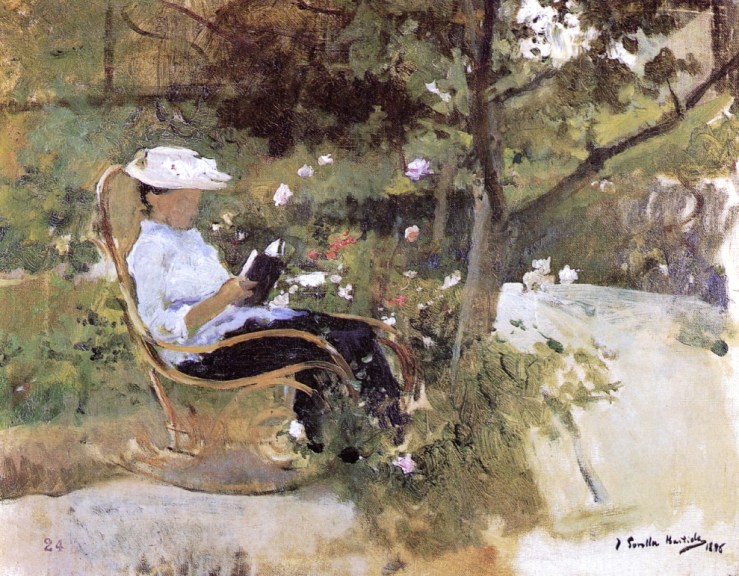
In the Garden — Joaquín Sorolla

in-the-garden-1896

Hide-and-seek; whips (From Lampedusa’s The Leopard)

….Then silence would fall again, except for the scuffle of rats in the ceilings above, or the rustle of some centuries-old and forgotten letter sent wandering by the wind over the floor: excuses for pleasant frights, for the reassuring contact of flesh with flesh. And with them always was Eros, malicious and tenacious, drawing the young couple into a game full of risk and fun. Both of them were still very near childhood, and they enjoyed the game in itself, enjoyed being followed, being lost, being found again; but when they touched each other their sharpened senses would overwhelm them, and his five fingers entwined in hers with that gesture dear to uncertain sensualists, the gentle rub of fingertips on the pale veins of the back of the hand, confusing their whole being, preluding more insinuating caresses.

Once she had hidden behind an enormous picture propped on the floor, and for a short time Arturo Corbera at the Siege of Antioch formed a protection for the girl’s hopeful anxiety; but when she was found, with her smile veined in cobwebs and her hands veiled in dust, she was clasped tight, and though she kept on saying again and again, “No, Tancredi, no,” her denial was in fact an invitation, for all he was doing was staring with his blue eyes into her green ones. One luminous cold morning she was trembling in a dress that was still summery; he squeezed her to him, to warm her, on a sofa covered in tattered silk, her odorous breath moved the hair on his forehead; they were moments ecstatic and painful, during which desire became torment, restraints upon it a delight.

The rooms in the abandoned apartments had neither a definite layout nor a name, and like the explorers of the New World, they would baptize the rooms they crossed with the names of their joint discoveries. A vast bedroom in whose alcove stood the ghost of a bed adorned with a canopy hung with skeleton ostrich feathers was remembered afterward as “the feather room”; a staircase with steps of smooth crumbling slate was called by Tancredi “the staircase of the lucky slip.” A number of times they really did not know where they were; all this twisting and turning, backing and following, and pauses full of murmuring contact, made them lose their way so that they had to lean out of some paneless window to gather from an angle of the courtyard or a view of the garden which wing of the palace they were in. But sometimes they could not find their way even so, as the window did not give on to one of the great courts but on to some inner yard, anonymous itself and never entered, marked only by the corpse of some cat or the usual little heap of spaghetti and tomato sauce either vomited or flung there; and from another window they would find themselves looking into the eyes of some pensioned-off old maidservant. One afternoon inside a cupboard they found four chimes, that music which delighted the affected simplicity of the eighteenth century. Three of these, buried in dust and cobwebs, remained mute; but the last, which was more recent and shut tighter into its dark wooden box, started up its cylinder of bristling copper and the little tongues of raised steel suddenly produced a delicate tune, all in clear, silvery tones: the famous Carnival of Venice; they rhymed their kisses with those notes of disillusioned gaiety; and when their embrace loosened they were surprised to notice that the notes had ceased for some time and that their action had left no other trace than a memory of ghostly music.

Once the surprise was of a different kind. In one of the rooms in the old guest wing they noticed a door hidden by a cupboard; the centuries-old lock soon gave way to fingers pleasantly entwined in forcing it: behind it a long narrow staircase wound up in gentle curves of pink marble steps. At the top was another door, open, and covered with thick but tattered padding; then came a charming but odd little apartment, of six small rooms gathered around a medium-sized drawing room, all, including the drawing room, with floors of whitest marble, sloping away slightly toward a small lateral gutter. On the low ceilings were some very unusual reliefs in colored stucco, fortunately made almost indecipherable by damp; on the walls were big surprised-looking mirrors, hung too low, one shattered by a blow almost in the middle, and each fitted with contorted rococo candle brackets. The windows gave on to a segregated court, a kind of blind and deaf well, which let in a gray light and had no other openings. In every room and even in the drawing room were wide, too wide sofas, showing nails with traces of silk that had been torn away; spotty armrests; on the fireplaces were delicate intricate little marble intaglios, naked figures in paroxysms but mutilated by so’ me furious hammer. The damp had marked the walls high up and also low down at a man’s height, where it had assumed strange shapes, an odd thickness, dark tints. Tancredi, disturbed, would not let Angelica touch a cupboard on the wall of the drawing room, which he shut up himself. It was deep but empty, except for a roll of dirty stuff standing upright in a corner; inside was a bundle of small whips, switches of bull’s muscle, some with silver handles, others wrapped halfway up in a charming old silk, white with little blue stripes, on which could be seen three rows of blackish marks, and metal instruments for inexplicable purposes. Tancredi was afraid of himself too. “Let’s go, my dear, there’s nothing interesting here.” They shut the door carefully, went down the stairs again in silence, and put the cupboard back where it was before; and all the rest of that day Tancredi’s kisses were very light, as if given in a dream and in expiation.

From Giuseppe di Lampedusa’s 1958 novel The Leopard. English translation by Archibald Colquhoun.

Who Killed Walter Benjamin? — Ged Quinn

quinn-81-who-killed-walter-benjamin

Saturn Devouring His Child — Giulia Lama

saturn-devouring-his-child

Pacifique Mysterieux, Mers du Sud — Paul Jacoulet

5507b8f4c132d938ec4ca4ac1dd6d8fe

Three Books (Possibly Cult Novels)


img_3324

Trans-Atlantyk by Witold Gombrowicz. English translation by Carolyn French and Nina Karsov. Trade paperback by Yale University Press, 1994. Cover design by Lorenzo Ottaviani. I reviewed Trans-Atlantyk here.

img_3326

Steps by Jerzy Kosinski. Another Vintage Contemporaries edition, 1988. Cover design by Lorraine Louie; illustration by Chris Moore.

I reviewed Steps here.

img_3325

The Adventures and Misadventures of Maqroll by Álvaro Mutis. English translation by Edith Grossman. NYRB, 2002. Cover design by Katy Homans; cover photograph by Sally Mann.

Biblioklept reviews here, here, and here.

These three books may or may not be cult novels.

I’ve been thinking a bit about the term cult novel, a term which used to fascinate me in my twenties, but one which I’m beginning to suspect doesn’t really mean anything, or seems to have a different value, anyway, now.

I’ve been thinking about cult novels because I’m nearing the end of Giuseppe di Lampedusa’s excellent excellent excellent 1958 novel The Leopard, which someone somewhere (who? where?) told me was a cult novel. I have no idea why The Leopard should be a cult novel. Where is its cult? By cult do we just mean “underread” or “underappreciated”?

It seems that the internet has dramatically changed what a cult novel might be/mean. (I wrote a bit about cult novels on this blog years ago, and I would expand the rough list I outlined were I to update that lousy post, which I won’t). The three books I picked today might be cult novels in the sense that they might be underappreciated/underread—although that statement strikes me as absurd somehow! (Steps won the National Book Award).

I guess a real cult novel would be a novel, or perhaps author, who inspires a cultishly devoted base of readers (is this what the kids call a fandom? Jesus Christ). And because of the internet, cults can be big now: Pynchon, Ballard, Cormac McCarthy, David Foster Wallace, Philip K. Dick. Such writers and their novels have inspired obsessive fans. But the works of these novelists are hardly samizdat. Look at PK Dick—think of how much of his work, his writing, his ideas have seeped into mainstream culture? So is it cult then?

Or am I really just stuck on an older connotation of “cult,” of cult classic, I guess, which was just a way of saying odd + underappreciated + hard to find? Which is to say in modes both literal and figurative: Inaccessible

And so well then when I say that the internet has changed what a cult novel is/isn’t, I suppose I’m simply noting access—access to the material books, access to fellow readers, access to forums, access to analysis, etc. And I suppose that’s, uh, good.

I considered hammering out a list of cult novels here at the end of this pointless little riff, but it would be too long. Besides, I really have no idea what a cult novel is anymore. I threw the question out there on Twitter, asking for examples, and got a wonderful wild range of responses, but the best response came almost immediately:

Hurrah for more intense pocket universes than ever before.

Netherlandish Proverbs (detail) — Pieter Bruegel the Elder

Screenshot 2016-06-26 at 12.12.00 PM

Ocean Waves — Katsushika Hokusai

ocean-waves

Nathaniel Hawthorne’s journal entry for Saturday, August 13th, 1842


Saturday, August 13th.–My life, at this time, is more like that of a boy, externally, than it has been since I was really a boy. It is usually supposed that the cares of life come with matrimony; but I seem to have cast off all care, and live on with as much easy trust in Providence as Adam could possibly have felt before he had learned that there was a world beyond Paradise. My chief anxiety consists in watching the prosperity of my vegetables, in observing how they are affected by the rain or sunshine, in lamenting the blight of one squash and rejoicing at the luxurious growth of another. It is as if the original relation between man and Nature were restored in my case, and as if I were to look exclusively to her for the support of my Eve and myself,–to trust to her for food and clothing, and all things needful, with the full assurance that she would not fail me. The fight with the world,–the struggle of a man among men,–the agony of the universal effort to wrench the means of living from a host of greedy competitors,–all this seems like a dream to me. My business is merely to live and to enjoy; and whatever is essential to life and enjoyment will come as naturally as the dew from heaven. This is, practically at least, my faith. And so I awake in the morning with a boyish thoughtlessness as to how the outgoings of the day are to be provided for, and its incomings rendered certain. After breakfast, I go forth into my garden, and gather whatever the bountiful Mother has made fit for our present sustenance; and of late days she generally gives me two squashes and a cucumber, and promises me green corn and shell-beans very soon. Then I pass down through our orchard to the river-side, and ramble along its margin in search of flowers. Usually I discern a fragrant white lily, here and there along the shore, growing, with sweet prudishness, beyond the grasp of mortal arm. But it does not escape me so. I know what is its fitting destiny better than the silly flower knows for itself; so I wade in, heedless of wet trousers, and seize the shy lily by its slender stem. Thus I make prize of five or six, which are as many as usually blossom within my reach in a single morning;–some of them partially worm-eaten or blighted, like virgins with an eating sorrow at the heart; others as fair and perfect as Nature’s own idea was, when she first imagined this lovely flower. A perfect pond-lily is the most satisfactory of flowers. Besides these, I gather whatever else of beautiful chances to be growing in the moist soil by the river-side,–an amphibious tribe, yet with more richness and grace than the wild-flowers of the deep and dry woodlands and hedge-rows,–sometimes the white arrow-head, always the blue spires and broad green leaves of the pickerel-flower, which contrast and harmonize so well with the white lilies. For the last two or three days, I have found scattered stalks of the cardinal-flower, the gorgeous scarlet of which it is a joy even to remember. The world is made brighter and sunnier by flowers of such a hue. Even perfume, which otherwise is the soul and spirit of a flower, may be spared when it arrays itself in this scarlet glory. It is a flower of thought and feeling, too; it seems to have its roots deep down in the hearts of those who gaze at it. Other bright flowers sometimes impress me as wanting sentiment; but it is not so with this.

Well, having made up my bunch of flowers, I return home with them. . . . Then I ascend to my study, and generally read, or perchance scribble in this journal, and otherwise suffer Time to loiter onward at his own pleasure, till the dinner-hour. In pleasant days, the chief event of the afternoon, and the happiest one of the day, is our walk. . . . So comes the night; and I look back upon a day spent in what the world would call idleness, and for which I myself can suggest no more appropriate epithet, but which, nevertheless, I cannot feel to have been spent amiss. True, it might be a sin and shame, in such a world as ours, to spend a lifetime in this manner; but for a few summer weeks it is good to live as if this world were heaven. And so it is, and so it shall be, although, in a little while, a flitting shadow of earthly care and toil will mingle itself with our realities.

Nathaniel Hawthorne’s journal entry for August 13th, 1842. From Passages from the American Note-Books.

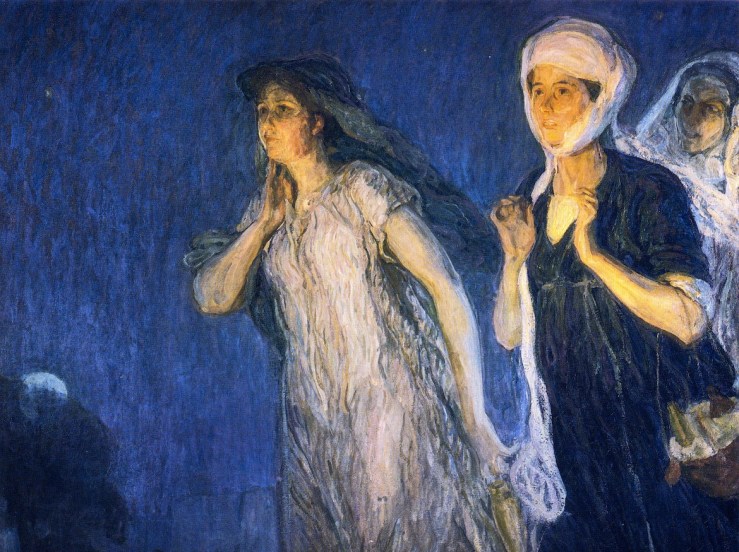
The Three Marys — Henry Ossawa Tanner

display_image (5)

Two Reclining Figures — Egon Schiele

800px-egon_schiele_1890_-_1918_zwei_liegende_figuren

Literary criticism (From Lampedusa’s The Leopard)

Now that Don Fabrizio felt serene again, he had gone back to his habit of evening reading. In autumn, after the Rosary, as it was now too dark to go out, the family would gather around the fire waiting for dinner, and the Prince, standing up, would read out to his family extracts from modern novels, exuding dignified benevolence from every pore. Those were years when novels were helping to form those literary myths which still dominate European minds today; but in Sicily, partly because of its traditional impermeability to anything new, partly because of the general ignorance of any language whatsoever, partly also, it must be said, because of a nagging and strict Bourbon censorship which worked through the Customs, no one had heard of Dickens, Eliot, Sand, Flaubert, or even Dumas. A couple of Balzac’s volumes had, through various subterfuges, it is true, reached the hands of Don Fabrizio, who had appointed himself family censor; he had read them and then lent them, in disgust, to a friend he didn’t like, saying that they were by a writer with a talent undoubtedly vigorous but also extravagant and “obsessed” (today he would have said “monomaniacal”): a hasty judgment, obviously, but not without a certain acuteness. The level of these readings was therefore somewhat low, conditioned as it was by respect for the virginal shyness of the girls, the religious scruples of the Princess, and the Prince’s own sense of dignity, which would have energetically refused to let his united family hear any “filth.”

From Giuseppe di Lampedusa’s 1958 novel The Leopard. English translation by Archibald Colquhoun.


Netherlandish Proverbs (detail) — Pieter Bruegel the Elder

Screenshot 2016-06-26 at 12.04.03 PM

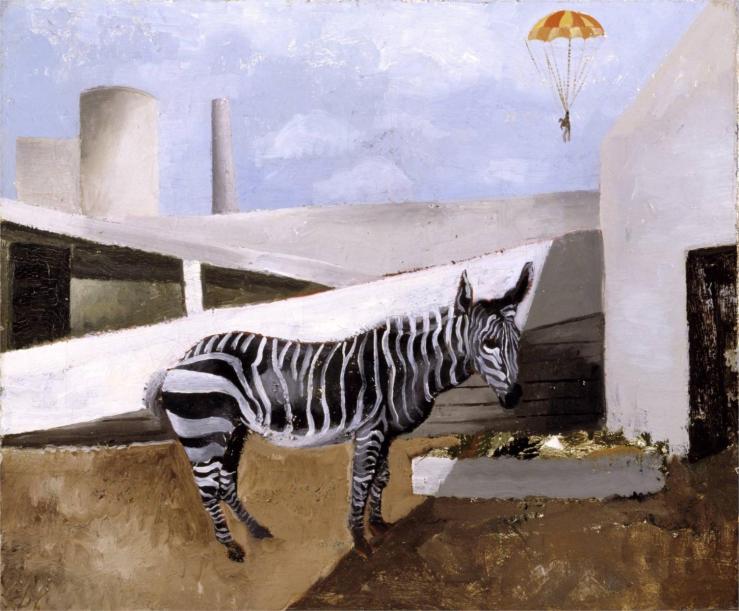
Zebra and Parachute — Christopher Wood

zebra-and-parachute-1930hd

Job — Francis Gruber

Job 1944 by Francis Gruber 1912-1948

A review of Lucia Berlin’s excellent short story collection, A Manual for Cleaning Women

img_3290

The 43 stories that comprise Lucia Berlin’s excellent collection A Manual for Cleaning Women braid together to reveal a rich, dirty, sad, joyous world—a world of emergency rooms and laundromats, fancy hotels and detox centers, jails and Catholic schools. Berlin’s stories jaunt through space and time: rough mining towns in Idaho; country clubs and cotillions in Santiago, Chile; heartbreak in New Mexico and New York; weirdness in Oakland and Berkeley; weirdness in Juarez and El Paso.

The center of this world—I’ll call it the Berlinverse, okay?—the center of the Berlinverse is Lucia Berlin herself. “Her life was rich and full of incident, and the material she took from it for her stories was colorful, dramatic and wide-ranging,” writes Lydia Davis in her foreword to Manual. (You can read Davis’s foreword at The New Yorker; it’s a far more convincing case for Berlin than I can manage here). Yes, Berlin’s life was crammed with incident—-so perhaps the strangest moment in A Manual for Cleaning Women is the three-page biography that appends the volume. The bio is strange in how un-strange it is, how it neatly lays out in a few paragraphs the information of Berlin’s life, information we already know as real, as true, from reading the preceding stories. She’s large, she contains multitudes.

Truth is a central theme in these stories. In “Here It Is Saturday,” a version of Berlin teaches fiction writing to prison inmates. She tells them, “you can lie and still tell the truth.” (As I describe the scenario for “Here It Is Saturday” I realize how hokey it sounds—I suppose there are lots of potentially-hokey moments in Berlin’s stories, yet her cruelty and humor deflate them).

In a crucial moment in the late short story “Silence,” the narrator tells us,

I exaggerate a lot and I get fiction and reality mixed up, but I don’t actually ever lie.

The narrator of “Silence” is, of course, a version of Berlin—fictionalized, sure, a persona, yep, an exaggeration, maybe—but she’s utterly believable.

“Silence” is one of many stories that repeat aspects of Berlin’s biography—we get little Lu’s childhood, a father away at the big war, a drunkenly absent mother, a bad drunk grandfather. A Syrian friend betrayed. Nuns. A good drunk uncle. A hit and run. Am I rushing through it? Sorry. To read Berlin is to read this material again and again, in different ways, through different perspectives and filters. “Silence” is particularly interesting to me because it combines material from two earlier stories not collected in Manual: “Stars and Saints” and “The Musical Vanity Boxes,” both published in Black Sparrow Press’s 1990 collection Homesick. These earlier stories are sharper, rawer, and dirtier; the later story—and Berlin’s later stories in general—strike me as more refined. Wiser, perhaps, sussing grace from abject memory.

Berlin’s recollections of the different figures in her life drive these stories, and it’s fascinating to see how key memories erupt into different tales. Berlin’s narrator’s alcoholic grandfather, a famous Texan dentist, sometimes emerges as a sympathetic if grotesque comedic figure, only to appear elsewhere as an abusive monster. Cousin Bella Lynn is a comedic foil in “Sex Appeal,” but an important confidante in “Tiger Bites” (a story of a visit to an abortion provider in Juarez). Several stories center on sister Sally, dying of cancer.

Berlin’s narrator’s four sons (Berlin had four sons) are often in the margins of the stories, but when she mines material from them the results are painful and superb. I note “her sons” in the previous line, but what I really want to note is the friend of one of her sons, a boy she calls Jesse. He shows up in the short “Teenage Punk,” where he’s our narrator’s date to go look at some cranes in a ditch at sunrise. That’s pure Lucia Berlin—weird abject unnatural natural beauty.:

We crossed the log above the slow dark irrigation ditch, over to the clear ditch where we lay on our stomachs, silent as guerrillas. I know, I romanticize everything. It is true though that we lay there freezing for a long time in the fog. It wasn’t fog. Must have been mist from the ditch or maybe just the steam from our mouths.

That brief paragraph showcases much of her technique: Inflation-deflation-resolution-hesitation. The high, low, the in-between. Jesse shows up again in one of the volume’s lengthier (and more painful) tales, “Let Me See You Smile,” a story of police brutality, scandal, and alcoholism.

Most of the stories in Manual are in some way about alcoholism, with the ur-narrator’s mother’s alcoholism haunting the book. In the near-elegy “Panteón de Dolores,” the narrator finds her mother drunk and weeping. When she tries to comfort her mother, she’s rejected; the mother wails, “…the only romance in my life is a midget lamp salesman!” The narrator-daughter reflects, “this sounds funny now, but it wasn’t then when she was sobbing, sobbing, as if her heart would break.” Berlin often punctures her punchlines. In “Mama,” Berlin consoles her dying sister Sally by weaving a fictional ditty about their mother, a paragraph that ends, “She has never before known such happiness.” The story assuages some of her sister’s grief by transmuting it into a realization of love, but the narrator? — “Me…I have no mercy.”

And yet a search for some kind of mercy, some kind of grace propels so many of the stories in A Manual for Cleaning Women. The three-pager “Step,” set in a half-way house, details the residents watching a boxing match between Wilfred Benitez and Sugar Ray Leonard. The recovering (and not-so-recovering) drunks “weren’t asking Benitez to win, just to stay in the fight.” He stays in to the last round before touching his right knee to the canvas. Berlin’s stand-in whispers, “God, please help me.” In “Unmanageable,” the alcoholic narrator finds some measure of grace from others. First from the NyQuil-swilling drunks who share saltine crackers with her in a kind of communion as they wait, shaking, for the liquor store to open at six a.m. And then, from her children. Her oldest son hides her car keys from her.

The same sons are on the narrator’s mind at the end of “Her First Detox,” in which Berlin’s stand-in’s plan for the future takes the form of a shopping list. She’ll cook for her boys when she gets home:

Flour. Milk. Ajax. She only had wine vinegar at home, which, with Antabuse, could throw her into convulsions. She wrote cider vinegar on the list.

Berlin’s various viewpoint characters don’t always do the best job of taking care of themselves, but taking care of other people is nevertheless a preoccupation with the tales in Manual. “Lu” takes care of her dying father in “Phantom Pain”; there’s sick sister Sally; the four sons, of course; a heroin-addicted husband; assorted strays, sure; an old couple in failing health in “Friends”; and the disparate patients who wander in and out of these tales, into doctor’s offices, into emergency rooms, into detox clinics.

And the cleaning women. Caretakers too, of a sort. Laundromats and washing machines are motifs throughout A Manual for Cleaning Women, and it’s no surprise that “Ajax” made the shopping list from “Her First Detox” that I quoted above. An easy point of comparison for Berlin’s writing is the so-called “dirty realism” of Raymond Carver, Denis Johnson, and Carson McCullers. But if Berlin’s realism is dirty, what are we to make of her concern with cleaning, with detox?

As a way of (non-)answering this question, here’s the entirety of the shortest tale in A Manual for Cleaning Women, “Macadam”:

When fresh it looks like caviar, sounds like broken glass, like someone chewing ice.

I’d chew ice when the lemonade was finished, swaying with my grandmother on the porch swing. We gazed down upon the chain gang paving Upson Street. A foreman poured the macadam; the convicts stomped it down with a heavy rhythmic beat. The chains rang; the macadam made the sound of applause.

The three of us said the word often. My mother because she hated where we lived, in squalor, and at least now we would have a macadam street. My grandmother just so wanted things clean — it would hold down the dust. Red Texan dust that blew in with gray tailings from the smelter, sifting into dunes on the polished hall floor, onto her mahogany table.

I used to say macadam out loud, to myself, because it sounded like the name for a friend.

There’s so much in those four paragraphs. Berlin collapses geography and genealogy into ten sentences: daughter, mother, grandmother. Texas, “squalor,” convicts. A road—a new road. Berlin’s narrator converts crushed stone into caviar, then the ice left over after sweet lemonade—and then into the magic of a friend. There’s a lot of beauty in dirt.

I could go on and on about A Manual for Cleaning Women—about how its loose, sharp tales are far more precise than their jagged edges suggest, about its warmth, its depth, its shocking humor, its sadness, its insight. But all I really mean to say is: It’s great, it’s real, it’s true—read it.

A Manual for Cleaning Women is new in trade paperback from Picador. You can read the first story in the collection, “Angel’s Laundromat,” at Picador’s website.



A Fight — Adriaen van Ostade

a-fight