A few years ago, spurred by a conversation with a colleague, I decided to blog about the best books from half a century ago. I enjoyed riffing on the possible “Best Books of 1972” so much that I did repeated the project last year with the possible “Best Books of 1973.”
As in the previous two posts, I’m again primarily interested in novels here, or books of a novelistic/artistic scope. I’ve also focused on books published in English in 1974, and will not be including books published in their original language in 1974 that did not appear in English translation until years later. (For example, while Georges Perec’s excellent Species of Spaces was first published in 1974, it was not published in English translation until the late nineties, and thus will not appear in this blog post, other than in this parenthetical example.)
I also will not be counting English-language books published before 1974 that were published that year in the U.S. So, for example, Richard Adams’s wonderful novel Watership Down dominated The New York Times bestsellers list in the summer of 1974, when it was released in U.S.—but the book was first published in the U.K. in 1972 (and thus appears in my “Best Books of 1972” post). Richard Adams’s follow-up Shardik was released in 1974 though. I tried reading it in my teens and never finished.
I brought up the NYT bestsellers list. I think it’s an interesting barometer to consider a book’s value fifty years after publication. Just four titles dominated the 1974 list: Gore Vidal’s Burr (published in the previous year), followed by Watership Down, then John le Carré’s Tinker, Tailor, Soldier, Spy, and finally James Michener’s Centennial. Two of these titles I think have made their case over the decades.
While the four novels essentially split the NYT fiction bestsellers list by season, the nonfiction list was dominated by Carl Bernstein and Bob Woodward’s All the President’s Men, a work that still remains culturally important (despite Woodward’s best efforts to ruin his legacy).
In their year-end round up of 1974, the editors of The New York Times include plenty of titles that didn’t sniff the bestsellers list, like John Hawkes’s Death, Sleep & the Traveler, Donald Barthelme’s collection Guilty Pleasures (“Barthelme’s easiest book,” the editors suggest), Grace Paley’s collection Enormous Changes at the Last Minute. The English translation of Italo Calvino’s Invisible Cities makes the list, but translator William Weaver is left out. James Baldwin’s If Beale Street Could Talk makes the cut, as do Patrick White’s The Eye of the Storm, Iris Murdoch’s The Sacred and Profane Love Machine, and Joseph Heller’s Catch-22 follow-up, Something Happened. My favorite pick from their list is Robert Stone’s Dog Soldiers. (The editors also include Toni Morrison’s Sula, which was actually published in 1973—likely a make-up call for its absence from the previous year’s round-up.)
Some of the strongest entries from the NYT 1974 notables list come in the “Young Readers” section, which boast three bona fide classics: Robert Cormier’s The Chocolate War, Virginia Hamilton’s M.C. Higgins the Great, and Shel Silverstein’s Where the Sidewalk Ends.
In his personal round-up at the NYT, critic John Leonard discusses how the book review section came to their selections before adding some of his favorites, including works by his critical brethren (Elizabeth Hardwick’s Seduction and Betrayal, Irving Howe’s The Critical Point, and Dwight Macdonald’s Discriminations). For fiction, Leonard includes heavy hitters like Vladimir Nabokov (Look at the Harlequins) and Philip Roth’s My Life as a Man, two novels I haven’t ever heard of until now. He also praises James Welch’s Winter in the Blood and Gail Godwin’s The Odd Woman.
Godwin’s The Odd Woman also appears on the American Library Associations’s list of notable books for 1974, along with other titles duplicated in the NYT list. The ALA list also includes Wendell Berry’s The Memory of Old Jack in their slim fiction selection, and Robert M. Pirsig’s Zen and the Art of Motorcycle Repair in their nonfiction selection. (I don’t think we would count Zen as a work of nonfiction today, right?)
The Booker Prize winners and finalists for 1974 offer a less USAcentric list: Nadine Gordimer (The Conservationist) and Stanley Middleton (Holiday) split the prize for the first time ever. The shortlist included Kingsley Amis’s Ending Up, Beryl Bainbridge’s The Bottle Factory Outing, and C.P. Snow’s In Their Wisdom.
In other literary prize news of the day, Michael Shaara’s 1974 Civil War novel The Killer Angels won the Pulitzer for Fiction in 1975. In 1974, no Pulitzer was awarded; infamously, the Pulitzer board opted not to follow the jury’s recommendation to give the prize to Thomas Pynchon’s 1973 novel Gravity’s Rainbow.
Like the Booker, the 1975 National Book Award split its fiction prize as well: Robert Stone’s Dog Soldiers shared the prize with Thomas Williams’ The Hair of Harold Roux. Virginia Hamilton’s M.C. Higgins, The Great won the NBA for children’s literature. Hamilton’s book also won the Newberry Medal that year.
The Nebula Awards short list for the best novels of 1974 included Philip K. Dick’s Flow My Tears, The Policeman Said, T.J. Bass’s The Godwhale, and Ursula K. Le Guin’s The Dispossessed—which won top honors. (I am likely to give The Dispossessed top honors too by the time I get to the end of this post.)
J.G. Ballard’s 1974 novel Concrete Island did not make Nebula’s short list, but to be fair it’s not really sci-fi. But it is pretty good. (Also, not a sci-fi, but an island book, Gary Snyder’s Turtle Island was published in 1974). Leonora Carrington’s excellent surrealist novel The Hearing Trumpet also is sci-fi adjacent, but is again overlooked. Oddball novels in general I suppose have to find their way to a cult—fifty years later, novels like Gerald Murnane’s Tamarisk Row, Ishmael Reed’s The Last Days of Louisiana Red, and Fran Ross’s Oreo have all found wider and more dedicated audiences in the last half century.
Speaking of cult books: Vincent Bugliosi’s Helter Skelter: The True Story of the Manson Murders was published in 1974. Bugliosi’s book was part of a select library we passed surreptitiously around in high school (along with Stephen Davis’s Led Zeppelin biography Hammer of the Gods, William Burroughs’ Naked Lunch, Go Ask Alice, and Thompson’s Fear and Loathing in Las Vegas—the aforementioned Zen and the Art of Motorcycle Repair and Kerouac’s On the Road were part of the underground informal book loan, but I never really cottoned to them). Eve Babitz’s Eve’s Hollywood—published too in 1974—could have been in that secret library if we had known about it.
And 1974 spit out some books would-be hipsters would likely eschew, Peter Benchley’s beach read Jaws and Stephen King’s Carrie. (Both novels spawned fantastic films.)
As I mentioned above, 1974 was a standout year it seems for children and adolescent literature–Robert Cormier’s The Chocolate War, Virginia Hamilton’s M.C. Higgins the Great, and Shel Silverstein’s Where the Sidewalk Ends, of course, but also James Lincoln Collier’s My Brother Sam Is Dead, Madeleine L’Engle’s A Wind in the Door, and Judy Blume’s Blubber. I loved all of these.
A few other books of note: J. M. Coetzee’s debut Dusklands (haven’t read it), Muriel Spark’s The Abbess of Crewe by Muriel Spark (read it when I was devouring Spark in 2020), Annie Dillard’s Pilgrim at Tinker Creek (haven’t read it), and James Herbert’s The Rats (guess who read their mom’s copy of this novel in secret when he was about ten years old?).
I have undoubtedly missed many, many books of note that were published in 1974. I wonder how available, say in 1999 at the 25-year mark, a novel like Ross’s Oreo or Carrington’s The Hearing Trumpet might have been. Again, my fun in this project comes down to a basic idea I have about literature—we really don’t know what books will retain their importance (or gain importance) until decades after their publication. None of this is to discount year-end lists of new books—I had four on my list this year!—I just aim to say something like: Books aren’t time capsules, they are time machines.
My list of the best books of 1974:
Blubber, Judy Blume
The Chocolate War, Robert Cormier
Concrete Island, J.G. Ballard
The Dispossessed, Ursula K. Le Guin
Dog Soldiers, Robert Stone
Enormous Changes at the Last Minute, Grace Paley
Flow My Tears, The Policeman Said, Philip K. Dick
Guilty Pleasures, Donald Barthelme
The Hearing Trumpet, Leonora Carrington
Invisible Cities, Italo Calvino, trans. William Weaver
In some cases, I’ve self-plagiarized some descriptions and evaluations from my old tweets and blog posts.
Night Business, Benjamin Marra
Sleazy, crude violent fun cribbed from the best seventies and eighties action flix you vaguely remember watching in a closet-sized room with six other kids you didn’t know while the adults drank themselves into merriment.
Terror Assaulter: O.M.W.O.T., Benjamin Marra
One of the better satires on The War on Terror™ I’ve read, Marra’s comic assaults the flimsy veil of morality that the neocons threw over their two-front Near Eastern misadventures in mass death.
Benjamin Marra, from Terror Assaulter: O.M.W.O.T.
A Funny Little Dirty War, Osvaldo Soriano, trans. Nick Caistor
A Funny Dirty Little War will in no way explain the Dirty War to those unfamiliar with its history. The causes and effects here unfold in the most basic way (all in a neat Aristotelian unity of action, place, and time). There is no introspection, no analysis—the violence just escalates. Absurd farce hurtles into absurd tragedy. Yet for all their outlandish, grotesque contours, Soriano’s characters are ultimately sympathetic. Or at least pathetic. In any case, this short novel will reward those who don’t mind their black humor extra bitter, with a heavy dose of violence.
The Crossing, Cormac McCarthy☉☆
Cormac McCarthy published his last two novels in the Fall of 2022 and died in the Summer of 2023. Over the last twelve months I’ve reread pretty much all of his novels (going through a fourth or fifth reread of Suttree just a few weeks ago). The Crossing is one of his best, and it might be understood as the bridge piece of a literary career from the acme of Suttree to the capstone of The Passenger. I also think that The Crossing is the perfect starting place for those interested in McCarthy’s oeuvre. I wrote about rereading it here.
A.V. Marraccini’s book is generative, creative, fruitful, a hybrid that points to something beyond the lyric essay. It is stuffed with art and poetry and life; it is erudite and frequently fun; it is moody and sometimes melodramatic, but tonally consistent.
CardinalNumbers, Hob Broun☆
I picked up Hob Broun’s underread, underappreciated 1988 collection Cardinal Numbers a few years ago, ate up most of the stories, and then shelved it with just two tales left, a move I’ve done many times in the past for reasons I can’t fully explain. I guess that I want to leave something in the bag, so to speak. Anyway, I read the whole thing straight through earlier this year—Broun is one of the funniest writers I’ve ever read. Fans of Barry Hannah, David Berman, and Charles Portis will appreciate his stuff.
Cities of the Plain, Cormac McCarthy☉
About thirty pages into the final book of his so-called “Border Trilogy,” McCarthy devotes two entire pages to a description of changing a tire. Beautiful.
The Road, Cormac McCarthy☉
Blood Meridian, Cormac McCarthy☉☆
Child of God, Cormac McCarthy☉
The Orchard Keeper, Cormac McCarthy☉
Like I mentioned above, I spent a lot of the last year rereading McCarthy. I did not find his death a shock or especially sad, or even really, a loss, I think, because of this fact: I was so grounded in all that he’d given us. The man really left all that he had out there, I believe. In an appreciation written after his death, I wrote that I had recently reread so much McCarthy because
The Passenger left me wanting more McCarthy–not in an unsatisfied way, but rather to confirm my intimations about its status as a career capstone. I reread All the Pretty Horses in the lull before Stella Maris arrived. I went on to reread The Crossing (much, much stronger than I had remembered), Cities of the Plain (weaker than I had remembered), The Road (about exactly as I remembered), Child of God (ditto), and The Orchard Keeper (as funny as I had remembered but also much sadder than I had remembered).
Gina Siciliano, from I Know What I Am
I Know What I Am, Gina Siciliano☆
Siciliano’s comix biography of Artemisia Gentileschi is a wonderful achievement—a rich, evocation of genius at work, genius in defiance against the social dicta that sought to suppress her light. Lovely stuff.
The Letters of William Gaddis, William Gaddis, ed. Steven Moore
I read most of the Dalkey edition a few years back; NYRB’s updated edition prompted a full read. I had initially planned to cover the book in a series of posts, but only managed one, covering our man’s youth. The Letters prompted me to finally read A Frolic of His Own, which I’d been “saving” for over a decade now.
Solenoid, Mircea Cărtărescu, trans. Sean Cotter
Unwieldy, uneven, wonderfully surreal and gross at times, simultaneously encyclopedic and introspective, plodding and thrilling, abject and ecstatic. The conclusion splits the elect from the preterite in a literary trick ultimately made ambiguous by everything that’s preceded it. It’s satisfying unless you think too hard about it.
Our Band Could Be Your Life, Michael Azerrad☉
An entire generation passed between my first reading of Azerrad’s well-researched semi-oral history of 1980s American indie rock and listening to a newish audiobook recording of it, read primarily by people inspired these bands. The conceit for the audiobook is gimmicky but works: a different musician reads a chapter on bands they love (Dirty Projectors’ Dave Longstreth reads the Black Flag chapter; Jeff Tweedy does The Minutemen; Jon Wurster does The Replacements, etc.) What most fascinated me was how my tastes have changed—mellowed maybe? I still love Sonic Youth, Fugazi, and Hüsker Dü, but I’m more inclined to listen to The Replacements these days.
Blood and Guts in High School, Kathy Acker☉☆
Fever dreaming holds up.
The Stronghold, Dino Buzzati, trans. Lawrence Venuti
…takes place in an unidentified time in an unidentified country. The novel’s eerie, fable-like quality—a quality that resists historicity—is what most engages me. Buzzati’s book captures the paradox of a modern life that valorizes the pursuit of glory (or at least happiness) while simultaneously creating a working conditions that crush the human spirit. We can find this paradox in Herman Melville’s Bartleby or Mike Judge’s Office Space; we can find it in Antonio di Benedetto’s Zama or Mike Judge’s Enlightened; we can find if in David Foster Wallace’s The Pale King or Dan Erickson’s recent show Severance. I could go on of course.
My Stupid Intentions, Bernardo Zannoni, trans. Alex Andriesse☆
Absolutely loved My Stupid Intentions. It’s a coming-of-age novel narrated by a stone marten, a picaresque howl that seeks to find meaning in being a creature. It’s full of cruelty and heroism and humor and pathos, and, like I said, I absolutely loved it.
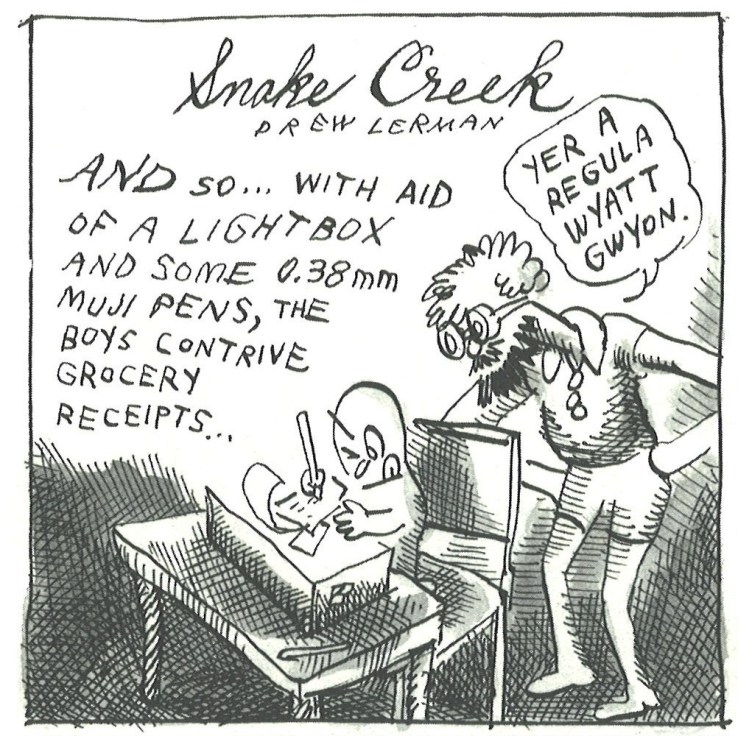
Escape from the Great American Novel, Drew Lerman☆
Escape from the Great American Novel is the latest collection of Drew Lerman’s Snake Creek strips, and the most cohesive collection to date. The strips collected here span August 2019 through August 2021; it ends up being an unintentional pandemic novel (while not about the Covid-19 pandemic at all, to be clear). In my review, I wote:
The strips collected in Escape from the Great American Novel span two years that often felt in “real time” like an eternity. Many of us were separated from friends and family over these months. Lerman’s gambit, intentional or otherwise, is to keep his central characters separated, which adds real tension to a comic novel that otherwise might be a loose collection of funny riffs. As I stated before, Roy and Dav are the heart of Snake Creek, so when Lerman finally reunites them the moment is not just cathartic, it’s literarily metaphysical. For all its sardonic jags, ribald japes, and erudite allusions, Escape from the Great American Novel is in the end a sweet, even heartwarming read (Dav and Roy would find a way to mock this sentiment, I’m sure). I loved it. Highly recommended.
Drew Lerman, from Escape from the Great American Novel
The Books of Jacob, Olga Tokarczuk, trans. Jennifer Croft ☆
I’d been interested in Tokarczuk’s historical fiction 900-pager since hearing about it in English translation a few years ago (via Fitzcarraldo Editions). The US edition came out in 2022, but I never came across it used. I have a habit of browsing my campus library before the end of each term though, and at the end of our Spring session there it was, big and fat and propped outward. I didn’t expect to sink into the book the way I did, but quickly gave into its many characters, its simultaneous alienating qualities and deep humanity. Fantastic stuff.
Platitudes, Trey Ellis
Ishmael Reed praised Ellis’s 1988 debut as “delightfully rad,” noting that he was zapped by it. I felt the same. My review here.
Great Expectations, Kathy Acker☉
Bits and bobs, bites and pieces, unpeaceful, savage, a splatterpunk recapitulation of Dickens’ classic.
The River and the Child, Henri Bosco, trans. Joyce Zonana☆
If someone were to have described the simple plot of Henri Bosco’s 1945 novel The River and the Child to me, I might have passed on it—too rustic, too naive, too tender. But, having been sent a review copy of Joyce Zonana’s new translation, I opened it, began reading, and just kept reading. From my review:
I loved reading The Child and the River; I loved the feeling of reading it. It took me back to books I’d loved as a child: Arthur Ransome’s Swallows and Amazons, abridged and bowdlerized versions of Moby-Dick and Huckleberry Finn, and countless Robinsades. In a letter to a friend, Bosco suggested that The Child and the River was “a novel very good, I think, for children, adolescents, and poets.” Is there a better audience?
Inside the Dream Palace, Sherill Tippins☆
This summer, my wife and I celebrated our anniversary by staying at the venerable Hotel Chelsea in Manhattan. There, we were lucky to enjoy a visit and brief tour of room 629, the former residence of the artist Vali Myers. The current resident, photographer Tony Notarberardino was hosting a party later that night, and the theater curtains outside of his door, accompanied by ethereal music, attracted us to peer in as we were looking around the hotel. Tony graciously invited us for a brief peek before his party, and the rooms are simply otherworldy, covered in murals by Myers along with beautiful paintings, furniture, and other sundries. Among other books, he recommended Sherill Tippins’ history of the hotel, Inside the Dream Palace. Tippins’ book can be read as a history 20th c. modernism focused around one locale. Heroes include Harry Smith, Patti Smith, and Andy Warhol. Fantastic stuff.
This Is Not Miami, Fernanda Melchor
This is not to say that I was disappointed by This Is Not Miami, but in my not review of the collection, I wrote that
This Is Not Miami reads like a minor work, but one nonetheless vital to its creator’s artistic maturation. For me, This Is Not Miami is most appreciable as an apprenticeship work that points toward the Bigger Thing to come. And of course I want more.
Excellent and slight. Did Williams mean to mix Kafka and David Markson, or just arrive at her own place? (She arrived at her own place.) From her collection, a piece called “Nevertheless”:
At some point, Kafka became a vegetarian.
Afterwards, visiting an aquarium in Berlin, he spoke to the fish through the glass.
“Now at last I can look at you in peace, I don’t eat you anymore.”
I saw a very interesting-looking person reading an actor’s edition of Philip Ridley’s play Mercury Fur on a train. The title of the play was interesting too, so I picked it up and read it (not the interesting-looking person’s edition.) The play was fine; perhaps actors might have enlivened its dystopian hysterics. Maybe my inner-voice was a poor director. I worked with the script I had.
Mockingbird, Walter Tevis
Tevis’s dystopian novel, published in 1980 and set centuries in the future, posits a future where humanity has basically forgotten everything, letting cyborgs and robots run the world for them. The premise and sentiment exceed the prose and execution.
Rubicon Beach, Steve Erickson
Three strange strands tangle together in a surreal mess. The parts together do not synthesize, exactly; the whole is not greater than the parts. But Rubicon Beach is vital and odd and singular.
A Frolic of His Own, William Gaddis☆
After a few years of false starts, I finally finished the last Gaddis I hadn’t yet read. I wrote a kinda long riffed onA Frolic, concluding that,
Many contemporary reviewers suggested that A Frolic of His Own was Gaddis’s most accessible novel to date, and it might be. Whereas J R and Carpenter’s Gothic are composed almost entirely in dialogue, Gaddis provides more stage direction and connective tissue in A Frolic. There are also the fragments of other forms: legal briefs, depositions, TV news clips, Oscar’s play… A Frolic of His Own is not the best starting point for anyone interested in William Gaddis’s fiction, although I don’t think that’s where most people start. It is rewarding though, especially read contextually against his other works, in which it fits chaotically but neatly, underscoring the cranky themes in a divergent style that still feels fresh three decades after its original publication. Highly recommended.
Stone Junction, Jim Dodge☆
I just went back and read the review of Stone JunctionI wrote this summer. I put the little star guy up there, because my impression of the novel was that it was one of the best things I read this year—I remember the plot, the imaginative contours that it opened up; I remember the paths it took me on—rereading The Once in Future King, in particular, as well as Riddley Walker. But my actual review hedges a bit more: “In its strongest moments, Stone Junction reads like a YA Pynchon novel; in its weakest moments, it reminded me of Tom Robbins,” I wrote. I think it’s stronger than YA Pynchon, I think I think! But I continued:
The stronger moments prevail, however—Stone Junction is a fun, flighty, and at times unexpectedly heavy summer read. The novel might also be read in (stoned) conjunction with Pynchon’s 1990 twin Vineland. Both novels diagnose the fallout of the 1960s counterculture wave crashing against the Reagan eighties; both seem attempts to, at least in the world of letters, check the burgeoning nostalgic romanticization of that turbulent decade. Pynchon’s is the more flawed, sillier, and better-written effort; Dodge’s is likely his magnum opus… I called Stone Junction “YA Pynchon” above, but I didn’t mean it as an insult—it’s YA in an older sense, in the sense of the novels handed me when I was young, hardly adult, novels that etched their own versions of reality onto our own banal reality; realities more real: Adventures of Huckleberry Finn, The Outsiders, The Once and Future King, The Lord of the Rings, Hatchet…Stone Junction is about youth, but it’s also about maturation, and the ache and melancholy of aging out of the game…
The Wind’s Twelve Quarters is not a great starting place for anyone interested in Le Guin’s worlds. Interested parties would do better to start with The Dispossessed, The Lathe of Heaven, or The Left Hand of Darkness—but interested parties are probably aware of that. The book is better suited for folks like me—folks who tore through the Hainish cycle and the Earthsea books and collections, and still wanted a little more. The Wind’s Twelve Quarters is ultimately most interesting as a document of a writer coming into the prime of her powers, and, as such, is indispensable for hardcore Le Guin fans.
Family Lexicon, Natalia Ginzburg, trans. Jenny McPhee
Listened to the audiobook; great stuff, my first Ginzburg.
The Once and Future King, T.H. White☉☆
A perfect book, made perfectly imperfect when capped with its posthumous footnote, The Book of Merlyn—a didactic screed tacked on to a grand Modernist epic, which I hadn’t previously read. It’s probably been thirty years since I’d read The Once and Future King in full; I’d read the first book, The Sword in the Stone, to both of my children when they were young, and before that in my teens, and before that as a kid (big thank you to my cousin Tripp who gave me a paperback copy for Christmas decades ago). But reading the four + one epic (I don’t think Merlyn counts) as a “real” adult was a different matter—I missed so much of what makes The Ill-Made Knight so tragic and what makes the final moments of The Candle in the Wind so unbearably sad and moving. I urge anyone who remembers the contours of this book to return to its rich prose.
Beasts is little big: each of its nine chapters might be read as a short story in which we get a glimpse from one perspective at a balkanized, dystopian post-USA. A species of genetic hybrid called leos are corralled on reservations or outright hunted by the militant Union for Social Engineering; what remains of the Federal Government vies for control with various Autonomous zones; utopian cultists try to hide from the world; slavery has returned under the guise of contractual indentured servitude. A mutant fox, the trickster Reynard, plays kingmaker behind the scenes. The nine chapters refuse to explicitly connect the pieces of the world the present; that is the job of the reader.
Episode in the Life of a Landscape Painter, César Aira, trans. Chris Andrews☆
A perfect little book, which ends, or nearly ends, with this lovely little line: “The artist, as artist, could always be already dead.”
My Death, Lisa Tuttle
A creepy, cozy literary mystery that blooms into an abyssal loop. I reviewed it here.
Based on a True Story, Norm Macdonald☆
I was not expecting Norm Macdonald’s fake-not-fake-memoir-cum-novel Based on a True Story to be as good as it was. I listened to Norm read his book, which in its finest moments is painfully funny and terribly sad, and in its worst, just goofy—the kind of self-sabotage one might expect from a genius who made sure to derail every track he was otherwise sailing along.
I love how it’s written; I love its themes, its layering, its construction. It’s a dense book that feels light; it’s serious and erudite but also psychologically drawn. Ford eschews exposition. In fact, at times he even sets the reader up to look the wrong way. And this fits with a lot of the themes and motifs and bits of the novels—illusionists, forgers, secret agents, disguises, spies, thieves, and so on. So it’s not just happening in the plot; it’s also happening at the rhetorical level.
Schattenfroh, Michael Lenz, trans. Max Lawton ☆
…
….
…..
…….
…
…
Sonic Life, Thurston Moore☆
“I really loved reading Sonic Life. It’s not a perfectly-written or balanced book, but it feels real,” I wrote in my review of Moore’s memoir.
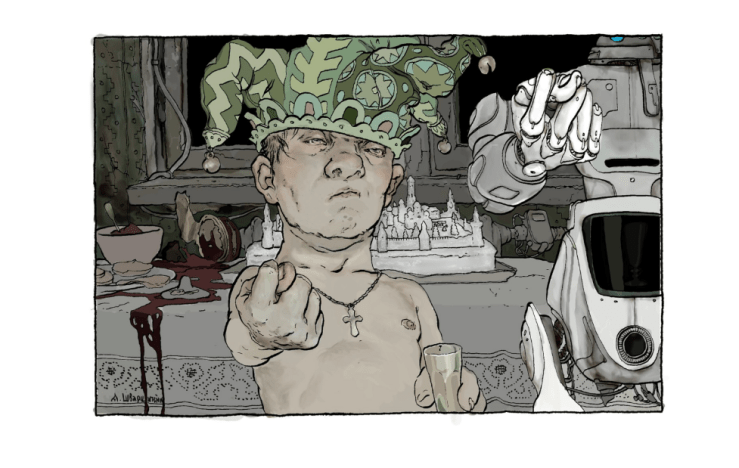
Yaroslav Schwarzstein, from The Sugar Kremlin
The Sugar Kremlin, Vladimir Sorokin, trans. Max Lawton
This forthcoming collection of Sorokin’s novel-in-stories unfolds like a horror-comedy on power, coercion, and Russian soul.
Atticus Lish, from Life Is with People
Life Is with People, Atticus Lish
Doodles.
Poor Things, Alasdair Gray☉
A nice reread. Still haven’t seen the film. My review here.
Aladair Gray, from Poor Things
Suttree, Cormac McCarthy☉☆
Possibly the best book.
(Or at least the best book by an American published in 1979.)
A late year reread—I can’t believe how many connections to The Passenger I’d missed (for example, Sutt has an Aunt Alice he visits in a mental ward). Such a rich, fertile thing, this novel, especially in the way it refuses to be grander than it is, but also is much, much grander than it pretends not to be.
Lapvona, Ottessa Moshfegh
I listened to the audiobook of Moshfegh reading her 2022 novel over my Xmas break. I hadn’t read anything by Moshfegh before; I was aware of her hit novel My Year of Rest and Relaxation though. A colleague had suggested I read Lapvona though, promoting it in the most enticing way: “I really, really hated this, Ed, but I think you’d like it a lot.” She was right—Lapvona is a grimy mix of faux-medieval evil fabulism and insane comedy (I think?) — and wholly abject. A story where Nothing Good Happens—except that’s not right. I loved the end.
The Norm, Vladimir Sorokin, trans. Max Lawton ☆
An intense abject antitotalitarian antiauthoritarian howl against language itself. Fun, funny, gross, grand.
Inside the bowl, the two goldfish are making a Pisces sign, head-to-tail and very still. Penelope sits and peers into their world. There is a little sunken galleon, a china diver in a diving suit, pretty stones and shells she and her sisters have brought back from the sea.
Aunt Jessica and Uncle Roger are out in the kitchen, hugging and kissing. Elizabeth is teasing Claire in the hallway. Their mother is in the W.C. Sooty the cat sleeps in a chair, a black thundercloud on the way to something else, who happens right now to look like a cat. It’s Boxing Day. The evening’s very still. The last rocket bomb was an hour ago, somewhere south. Claire got a golliwog, Penelope a sweater, Elizabeth a frock that Penelope will grow into.
The pantomime Roger took them all to see this afternoon was Hansel and Gretel. Claire immediately took off under the seats where others were moving about by secret paths, a flash of braid or of white collar now and then among the tall attentive uncles in uniform, the coat-draped backs of seats. On stage Hansel, who was supposed to be a boy but was really a tall girl in tights and smock, cowered inside the cage. The funny old Witch foamed at the mouth and climbed the scenery. And pretty Gretel waited by the Oven for her chance. . . .
Then the Germans dropped a rocket just down the street from the theatre. A few of the little babies started crying. They were scared. Gretel, who was just winding up with her broom to hit the Witch right in the bum, stopped: put the broom down, in the gathering silence stepped to the footlights, and sang:
Oh, don’t let it get you,
It will if they let you, but there’s
Something I’ll bet you can’t see—
It’s big and it’s nasty and it’s right over there,
It’s waiting to get its sticky claws in your hair!
Oh, the greengrocer’s wishing on a rainbow today,
And the dustman is tying his tie . . .
And it all goes along to the same jolly song,
With a peppermint face in the sky!
“Now sing along,” she smiled, and actually got the audience, even Roger, to sing:
With a peppermint face in the sky-y,
And a withered old dream in your heart,
You’ll get hit with a piece of the pie-ie,
With the pantomime ready to start!
Oh, the Tommy is sleeping in a snowbank tonight,
And the Jerries are learning to fly—
We can fly to the moon, we’ll be higher than noon,
In our polythene home in the sky. . . .
Pretty polythene home in the sky,
Pretty platinum pins in your hand—
Oh your mother’s a big fat machine gun,
And your father’s a dreary young man. . . .
(Whispered and staccato):
Oh, the, man-a-ger’s suck-ing on a corn-cob, pipe,
And the bank-ers are, eat-ing their, wives,
All the world’s in a daze, while the orchestra plays,
So turn your pockets and get your surprise—
Turn your pockets and get-your surpri-ise,
There was nobody there af-ter all!
And the lamps up the stairway are dying,
It’s the season just after the ball . . .
Oh the palm-trees whisper on the beach somewhere,
And the lifesaver’s heaving a sigh,
And those voices you hear, Boy and Girl of the Year,
Are of children who are learning to die. . . .
From Thomas Pynchon’s 1973 novel Gravity’s Rainbow.
IT WAS in Jingle-Bell weather that Little Sister came across the white yard, the snow between her toes all gray and packed and starting to ball up like the beginnings of two snowmen. For clothing she had nothing, her tiny rump sticking out red-cold, and blue-cold, and her little-jewel knees white almost as bones. She stuck up ten stiff fingers, and she said, “Daddy! Something is wrong at my place! Come see!” She lisped a little perhaps and did not say it all as precisely as grownups, because she was just past four.
He turned like a man in the bottom third of bad dreaming; he pointed two bored eyes at her. Damn the kid, he thought. “What the hell deal has Mox got us into now?” he said. And he sang the little rhyme that made the door come open. Then as she stepped toward him he saw the snowballs on her feet. They were melting now, making deep furrows in the green rug spread across his spacious thinking room. The tall nap, like flooded grass now along little canals bending away from her feet, was speckled white here and there with crumpled paper balls. His trial plans and formulas peeped out like golf balls.
Coming back across the iron fields of nightmare that always rose to confront him at such times, he struggled to make the present’s puzzling moment into sense. Damn the kid, he thought, didn’t wipe her feet. All flesh, as yet—her own—and bone and blood, and didn’t wipe her feet. The snow melts!
He motioned her to him. “Little Sister,” he began in that tired dull-tinny voice that was his now, and must be his, because his larynx was worked all in gold against cancer, “tell me slowly, Little Sister. Why don’t you stay in your plastic place more? Why don’t you use the iron Mox more? Why do you bother me at all? Tell me slowly.”
“Daddy!” she cried and started to jig up and down in the fits that he hated so, “come over to my place, you old boogie. Something needs fixing.”
So they went across the big white yard to her place, past Mother’s place, past Little Brother’s place, with her snow-hurt limping and naked, and him lumbering in strange stiff-jointedness, but snug in a fire-red snuggie suit of fine insulation with good black leather space high-tops. Arrived at her place he whistled at the door the three sharp notes. The door moved into the wall and Mox the iron one stood sliding the iron sections of his arms up into one another until he had only hands hanging from shoulders. It was his greeting way. He ogled with bulb eyes and flashed his greeting code. Continue reading ““A Little Girl’s Xmas in Moderan” — David R. Bunch”→
If the fable of “The grasshopper and the ants” was amended so that the world ended before the turn of winter, then the grasshopper would have been wiser and the moral would have vindicated him. In a story, the location of the ending is very deliberate.
It was Christmas Eve in the studio. By eleven o’clock in the morning, Santa Claus had called on most of the huge population according to each one’s deserts.
Sumptuous gifts from producers to stars, and from agents to producers arrived at offices and studio bungalows; on every stage one heard of the roguish gifts of casts to directors or directors to casts; champagne had gone out from publicity office to the press. And tips of fifties, tens and fives from producers, directors and writers fell like manna upon the white collar class.
In this sort of transaction there were exceptions. Pat Hobby, for example, who knew the game from twenty years’ experience, had had the idea of getting rid of his secretary the day before. They were sending over a new one any minute—but she would scarcely expect a present the first day.
Waiting for her, he walked the corridor, glancing into open offices for signs of life. He stopped to chat with Joe Hopper from the scenario department.
“Not like the old days,” he mourned, “Then there was a bottle on every desk.”
“There’re a few around.”
“Not many.” Pat sighed, “And afterwards we’d run a picture—made up out of cutting-room scraps.”
“I’ve heard. All the suppressed stuff,” said Hopper.
Pat nodded, his eyes glistening.
“Oh, it was juicy. You darned near ripped your guts laughing—”
He broke off as the sight of a woman, pad in hand, entering his office down the hall recalled him to the sorry present.
“Gooddorf has me working over the holiday,” he complained bitterly.
“I wouldn’t do it.”
“I wouldn’t either except my four weeks are up next Friday, and if I bucked him he wouldn’t extend me.”
Pat’s new secretary was about thirty-six, handsome, faded, tired, efficient. She went to the typewriter, examined it, sat down and burst into sobs.
As he turned away Hopper knew that Pat was not being extended anyhow. He had been hired to script an old-fashioned horse-opera and the boys who were “writing behind him”—that is working over his stuff—said that all of it was old and some didn’t make sense.
“I’m Miss Kagle,” said Pat’s new secretary. She was about thirty-six, handsome, faded, tired, efficient. She went to the typewriter, examined it, sat down and burst into sobs.
Pat started. Self-control, from below anyhow, was the rule around here. Wasn’t it bad enough to be working on Christmas Eve? Well—less bad than not working at all. He walked over and shut the door—someone might suspect him of insulting the girl.
Therefore that whosoever shall be found observing any such day as Christmas or the like, either by forebearing of labor, feasting, or any other way upon any such account aforesaid, every person so offending shall pay for every offense five shillings as a fine to the county.
Statute enacted by the General Court of
Massachusetts, May 1659, repealed 1681
‘Twas the night before Christmas. Silent night, holy night. The snow lay deep and crisp and even. Etc. etc. etc.; let these familiar words conjure up the traditional anticipatory magic of Christmas Eve, and then — forget it.
Forget it. Even if the white moon above Boston Bay ensures that all is calm, all is bright, there will be no Christmas as such in the village on the shore that now lies locked in a precarious winter dream.
(Dream, that uncensorable state. They would forbid it if they could.)
At that time, for we are talking about a long time ago, about three and a quarter hundred years ago, the newcomers had no more than scribbled their signatures on the blank page of the continent that was, as it lay under the snow, no whiter nor more pure than their intentions.
They plan to write more largely; they plan to inscribe thereon the name of God.
And that was why, because of their awesome piety, tomorrow, on Christmas Day, they will wake, pray and go about their business as if it were any other day.
For them, all days are holy but none are holidays.
New England is the new leaf they have just turned over; Old England is the dirty linen their brethren at home have just — did they not recently win the English Civil War? — washed in public.
Back home, for the sake of spiritual integrity, their brothers and sisters have broken the graven images in the churches, banned the playhouses where men dress up as women, chopped down the village Maypoles because they welcome in the spring in altogether too orgiastic a fashion.
Nothing particularly radical about that, given the Puritans’ basic premises. Anyone can see at a glance that a Maypole, proudly erect upon the village green as the sap is rising, is a godless instrument. The very thought of Cotton Mather, with blossom in his hair, dancing round the Maypole makes the imagination reel. No. The greatest genius of the Puritans lay in their ability to sniff out a pagan survival in, say, the custom of decorating a house with holly for the festive season; they were the stuff of which social anthropologists would be made!
And their distaste for the icon of the lovely lady with her bonny babe — Mariolatry, graven images! — is less subtle than their disgust at the very idea of the festive season itself. It was the festivity of it that irked them.
Nevertheless, it assuredly is a gross and heathenish practice, to welcome the birth of Our
Saviour with feasting, drunkenness, and lewd displays of mumming and masquerading.
We want none of that filth in this new place.
No, thank you.
As midnight approached, the cattle in the byres lumbered down upon their knees in homage, according to the well-established custom of over sixteen hundred English winters when they had mimicked the kneeling cattle in the Bethlehem stable; then, remembering where they were in the nick of time, they hastily refrained from idolatry and hauled themselves upright.
Boston Bay, calm as milk, black as ink, smooth as silk. And suddenly, at just the hour when the night spins on its spindle and starts to unravel its own darkness, at what one could call, elsewhere, the witching hour —
I saw three ships come sailing in,
Christmas Day, Christmas Day,
I saw three ships come sailing in
On Christmas Day in the morning.
Three ships, silent as ghost ships; ghost ships of Christmas past.
Maybe an hour ago, browsing in a used bookstore, I opened a worn and some might say dirty copy of Iain Banks’s 1985 novel Walking on Glass. The very first page of this old book was inscribed with the following:
Have a weird Xmas ’90
John
This copy of Iain Banks’s 1985 novel Walking on Glass—a 1990 Abacus trade paperback printed in London, the embossing on its cover yellowed by wear on its cover and back near its spine—this particular copy was addressed to no named person, its inscription signed by a name so anonymous we apply it to unidentified cadavers and prostitute clients.
I take myself to be the unidentified person being addressed by the identified generic John, wishing me weird wellness, a ghost of Xmas past.
Earlier this year I made the tragic mistake of not pulling the trigger on first-edition hardbacks of Banks’s first two novels, The Wasp Factory and Walking on Glass. I hadn’t read Banks at that point, and my familiarity with his work came almost entirely of his proximity to the J.G. Ballard titles I routinely perused. I ended up reading and loving The Wasp Factory this summer (reviewed it here), and the blurb on the back of Walking on Glass promising further perversions intrigues me too, of course.
Today, I also came across a first-edition, first-U.S.-printing of Roberto Bolaño’s opus 2666. It was marked at a third of the original cover price and has never been read. I could not leave it behind.
Maybe a week after that, I was browsing with my son, who wanted a collection of Harlan Ellison short stories. I was shocked that we couldn’t find any—I had given away two mass market collections to some students maybe seven or eight years ago in a purge. Apparently a lot of it is out of print, but a “greatest hits” collection is coming out this spring. Anyway, I ended up finding hardback editions of Robert Coover’s Whatever Happened to Gloomy Gus of the Chicago Bears? Denis Johnson’s novel Fiskadaro.
The Johnson is a British edition, Chatto & Windus, and while it’s hardly my favorite novel by him, I found its form too attractive to pass (and it was, like, cheaper than a beer in the same bookstore). I also picked up a book by Lewis Nordan, a slim collection of short stories called Welcome to the Arrow-Catcher Fair. I picked it up because I love those horrid lovely wonderful gross stylish Vintage Contemporaries editions, and then acquired it based on the blurb, which compared it to Flannery O’Connor, Ellen Gilchrist, and Harry Crews. Here it is next to my Vintage Contemporaries copy of Denis Johnson’ Fiskadaro:
I hope you have a weird Xmas. And I hope that John, wherever they are, has a weird Xmas too.















 Biblioklept