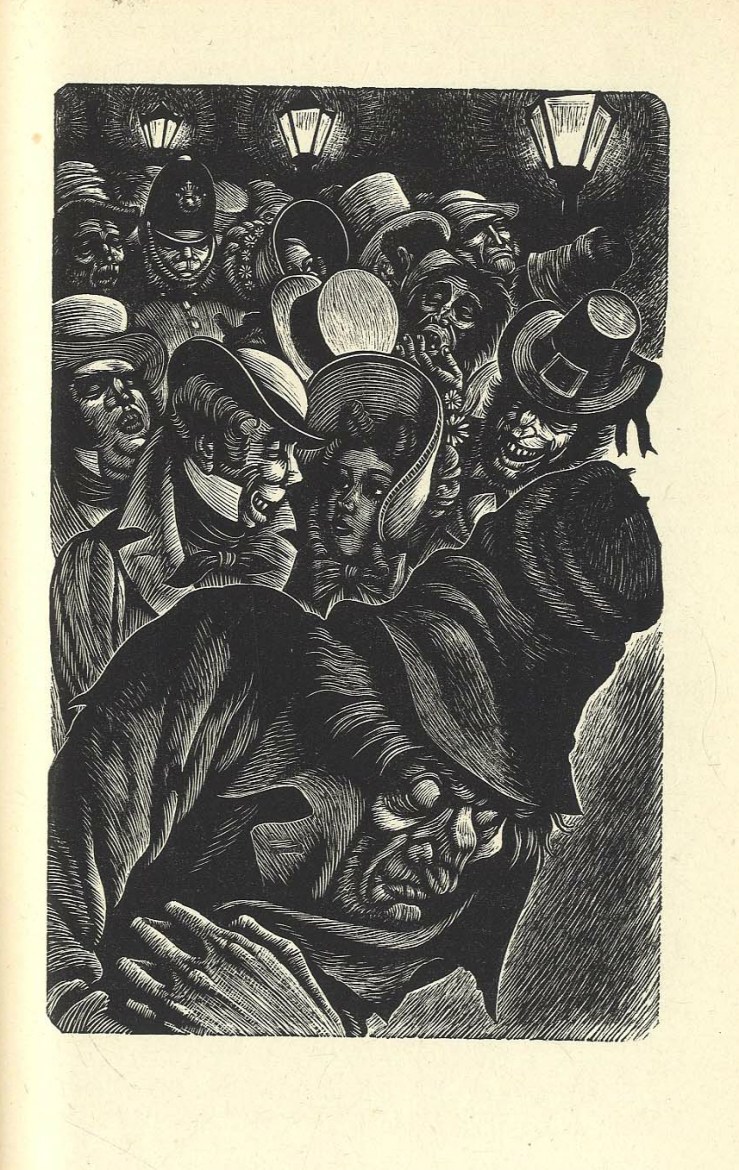
Wonderful Fritz Eichenberg illustration to one of my favorite Poe stories, “The Man of the Crowd,”. Via a gorgeous gallery at Full Table.

Wonderful Fritz Eichenberg illustration to one of my favorite Poe stories, “The Man of the Crowd,”. Via a gorgeous gallery at Full Table.


‘How can you tell if somebody’s sad?’A quick smile. ‘You mean whether someone’s sad.’
A smile back, but still earnest: ‘That improves it a lot. Whether someone’s sad, how can you tell so you’re sure?’
Her teeth are not discolored; she gets them cleaned at the dentist all the time for the smoking, a habit she despises. Hal inherited the dental problems from Himself; Himself had horrible dental problems; half his teeth were bridges.
‘You’re not exactly insensitive when it comes to people, Love-o,’ she says.
‘What if you, like, only suspect somebody’s sad. How do you reinforce the suspicion?’
‘Confirm the suspicion?’
‘In your mind.’ Some of the prints in the deep shag he can see are shoes, and some are different, almost like knuckles. His lordotic posture makes him acute and observant about things like carpet-prints.”
“How would I, for my part, confirm a suspicion of sadness in someone, you mean?’
‘Yes. Good. All right.’
‘Well, the person in question may cry, sob, weep, or, in certain cultures, wail, keen, or rend his or her garments.’
Mario nods encouragingly, so the headgear clanks a little. ‘But say in a case where they don’t weep or rend. But you still have a suspicion which they’re sad.’
She uses a hand to rotate the pen in her mouth like a fine cigar. ‘He or she might alternatively sigh, mope, frown, smile halfheartedly, appear downcast, slump, look at the floor more than is appropriate.”
“But what if they don’t?’
‘Well, he or she may act out by seeming distracted, losing enthusiasm for previous interests. The person may present with what appears to be laziness, lethargy, fatigue, sluggishness, a certain passive reluctance to engage you. Torpor.’
‘What else?’
‘They may seem unusually subdued, quiet, literally “low.”
—From David Foster Wallace’s novel Infinite Jest.
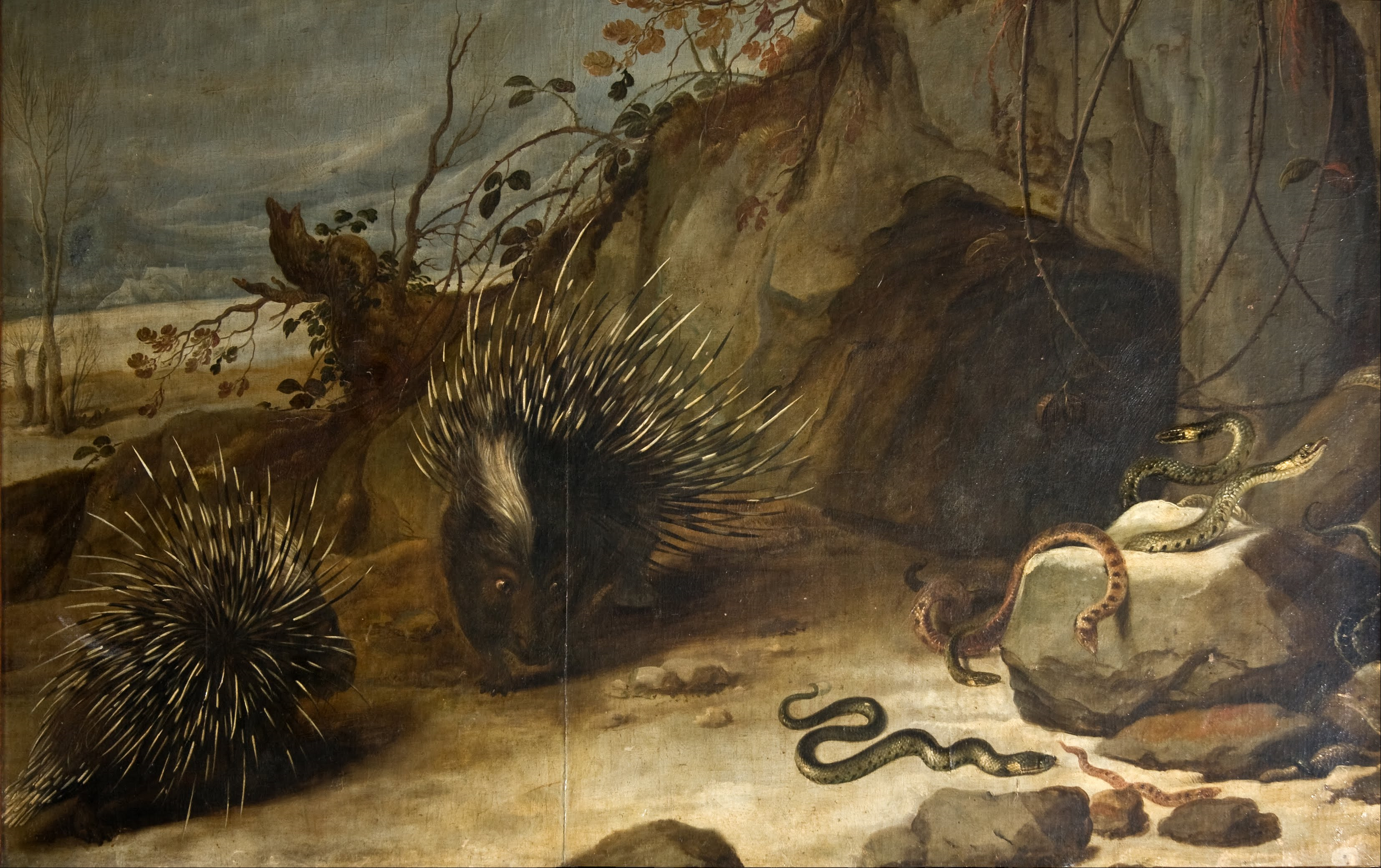
The aim of the artist ought to be to bring into the world objects which do not already exist there, and objects which are especially worthy of love. We meet people, grow to know them slowly, settle on some to companion our life. Do we value our friends for their social status, because they are burning in the public blaze? do we ask of our mistress her meaning? calculate the usefulness of our husband or wife? Only too often. Works of art are meant to be lived with and loved, and if we try to understand them, we should try to understand them as we try to understand anyone—in order to know them better, not in order to know something else.
–More from William H. Gass’s essay “The Artist and Society” (1968). Collected in Fiction and the Figures of Life.


It’s of some interest that the lively arts of the millennial U.S.A. treat anhedonia and internal emptiness as hip and cool. It’s maybe the vestiges of the Romantic glorification of Weltschmerz, which means world-weariness or hip ennui. Maybe it’s the fact that most of the arts here are produced by world-weary and sophisticated older people and then consumed by younger people who not only consume art but study it for clues on how to be cool, hip — and keep in mind that, for kids and younger people, to be hip and cool is the same as to be admired and accepted and included and so Unalone. Forget so-called peer-pressure. It’s more like peer-hunger. No? We enter a spiritual puberty where we snap to the fact that the great transcendent horror is loneliness, excluded encagement in the self. Once we’ve hit this age, we will now give or take anything, wear any mask, to fit, be part-of, not be Alone, we young. The U.S. arts are our guide to inclusion. A how-to. We are shown how to fashion masks of ennui and jaded irony at a young age where the face is fictile enough to assume the shape of whatever it wears. And then it’s stuck there, the weary cynicism that saves us from gooey sentiment and unsophisticated naïveté. Sentiment equals naïveté on this continent (at least since the Reconfiguration). One of the things sophisticated viewers have always liked about J. O. Incandenza’s The American Century as Seen Through a Brick is its unsubtle thesis that naïveté is the last true terrible sin in the theology of millennial America. And since sin is the sort of thing that can be talked about only figuratively, it’s natural that Himself’s dark little cartridge was mostly about a myth, viz. that queerly persistent U.S. myth that cynicism and naïveté are mutually exclusive. Hal, who’s empty but not dumb, theorizes privately that what passes for hip cynical transcendence of sentiment is really some kind of fear of being really human, since to be really human (at least as he conceptualizes it) is probably to be unavoidably sentimental and naïve and goo-prone and generally pathetic, is to be in some basic interior way forever infantile, some sort of not-quite-right-looking infant dragging itself anaclitically around the map, with big wet eyes and froggy-soft skin, huge skull, gooey drool. One of the really American things about Hal, probably, is the way he despises what it is he’s really lonely for: this hideous internal self, incontinent of sentiment and need, that pules and writhes just under the hip empty mask, anhedonia.
—From David Foster Wallace’s novel Infinite Jest.


“The Egg”
by
Sherwood Anderson
My father was, I am sure, intended by nature to be a cheerful, kindly man. Until he was thirty-four years old he worked as a farmhand for a man named Thomas Butterworth whose place lay near the town of Bidwell, Ohio. He had then a horse of his own and on Saturday evenings drove into town to spend a few hours in social intercourse with other farmhands. In town he drank several glasses of beer and stood about in Ben Head’s saloon–crowded on Saturday evenings with visiting farmhands. Songs were sung and glasses thumped on the bar. At ten o’clock father drove home along a lonely country road, made his horse comfortable for the night and himself went to bed, quite happy in his position in life. He had at that time no notion of trying to rise in the world.
It was in the spring of his thirty-fifth year that father married my mother, then a country schoolteacher, and in the following spring I came wriggling and crying into the world. Something happened to the two people. They became ambitious. The American passion for getting up in the world took possession of them.
It may have been that mother was responsible. Being a schoolteacher she had no doubt read books and magazines. She had, I presume, read of how Garfield, Lincoln, and other Americans rose from poverty to fame and greatness and as I lay beside her–in the days of her lying-in–she may have dreamed that I would someday rule men and cities. At any rate she induced father to give up his place as a farmhand, sell his horse and embark on an independent enterprise of his own. She was a tall silent woman with a long nose and troubled grey eyes. For herself she wanted nothing. For father and myself she was incurably ambitious.
The first venture into which the two people went turned out badly. They rented ten acres of poor stony land on Griggs’s Road, eight miles from Bidwell, and launched into chicken raising. I grew into boyhood on the place and got my first impressions of life there. From the beginning they were impressions of disaster and if, in my turn, I am a gloomy man inclined to see the darker side of life, I attribute it to the fact that what should have been for me the happy joyous days of childhood were spent on a chicken farm. Continue reading ““The Egg,” a short story by Sherwood Anderson”
 Biblioklept