…the consciousness contained in any text is not an actual functioning consciousness; it is a constructed one, improved, pared, paced, enriched by endless retrospection, irrelevancies removed, so that into the ideal awareness that I imagined for the poet, who possesses passion, perception, thought, imagination, and desire, and has them present in amounts appropriate to the circumstances-just as, in the lab, we need more observation than fervor, more imagination than lust-there are introduced patterns of disclosure, hierarchies of value, chains of inference, orders of images, natures of things.
From William H. Gass’s essay “The Book as a Container of Consciousness,” published in his collection Finding a Form and available online as a pdf at Wilson Quarterly.
What you felt stirring across the land… it was the equinox… green spring equal nights… canyons are opening up, at the bottoms are steaming fumaroles, steaming the tropical life there like greens in a pot, rank, dope-perfume, a hood of smell… human consciousness, that poor cripple, that deformed and doomed thing, is about to be born. This is the World just before men. Too violently pitched alive in constant flow ever to be seen by men directly. They are meant only to look at it dead, in still strata, transputrefied to oil or coal. Alive, it was a threat: it was Titans, was an overpeaking of life so clangorous and mad, such a green corona about Earth’s body that some spoiler had to be brought in before it blew the Creation apart. So we, the crippled keepers, were sent out to multiply, to have dominion. God’s spoilers. Us. Counterrevolutionaries. It is our mission to promote death. The way we kill, the way we die, being unique among the Creatures. It was something we had to work on, historically and personally. To build from scratch up to its present status as reaction, nearly as strong as life, holding down the green uprising. But only nearly as strong.
Only nearly, because of the defection rate. A few keep going over to the Titans every day, in their striving subcreation (how can flesh tumble and flow so, and never be any less beautiful?), into the rests of the folksong Death (empty stone rooms), out, and through, and down under the net, down down to the uprising.
In harsh-edged echo, Titans stir far below. They are all the presences we are not supposed to be seeing—wind gods, hilltop gods, sunset gods—that we train ourselves away from to keep from looking further even though enough of us do, leave Their electric voices behind in the twilight at the edge of the town and move into the constantly parted cloak of our nightwalk till
Suddenly, Pan—leaping—its face too beautiful to bear, beautiful Serpent, its coils in rainbow lashings in the sky—into the sure bones of fright—
Don’t walk home at night through the empty country. Don’t go into the forest when the light is too low, even too late. Don’t go into the forest when the light is too low, even too late in the afternoon—it will get you. Don’t sit by the tree like this, with your cheek against the bark.
From Thomas Pynchon’s Gravity’s Rainbow, pages 720-21.
In an early scene in “Person to Person,” the series finale of Mad Men, Joan Holloway tries cocaine for the first time. “I feel like someone just gave me very good news,” she beams, offering an advertising tag. The coke-sniffing detail seemed odd to me at first—perhaps it was another way for the series to signal the end of the sixties, to introduce the next drug, the next product to fuel future decades.
The final moments of “Person to Person,” however, show that the cocaine scene is an early reading rule. Joan’s testimony of the “Good News” comes from artificial inducement. Impermanent, intoxicating, and addictive, the coke here prefigures the Coke at the show’s end. Fittingly, Mad Men ends with a television commercial, the 1971 “I’d Like to Buy a the World a Coke” Coca-Cola ad.
The ad itself is a genius piece of propaganda: Buy a Coke, become a better person. Not feeling so good? Buy some more Coke. This ad strikes me as a prototypical example of what Slavoj Žižek would critique a few decades later as “the ultimate form of consumerism,” products that allow us “to be a consumerist, without any bad conscience, because the price for the countermeasure, for fighting consumerism, is already included into the price of a commodity.”
What’s the countermeasure, the counterforce then? All those supposed-values of the 1960s, which Don plunders for his career-restoring campaign. He cribs this vision of peace, love, and understanding from the New Age hucksters who are only too happy to take what’s left of our ad man’s money.
Don’s insight comes through a (purposefully facile?) moment of catharsis. In group therapy, a man takes the empty chair that Don’s counselor would have liked Don to fill himself. Don is spared testifying; the stranger will perform in his stead. He tells a story about feeling like a product on a shelf in a fridge, isolated, alienated. The core of his little monologue is about not understanding love, not knowing how to love or be loved. In a rare moment of empathy, Don has his big important cathartic release, and hugs the man, who has reminded Don of what Don already knew, but had been ignoring: People want to feel loved.
Earlier in the season, Don shot down an ad idea that had to do with love — “Love again? We always use that,” he says (or something close to that). But here, disconnected (almost all meaningful conversations in the episode are mediated through telephones), he’s reminded that what people want is touch, the sensation or feeling of love. And he can sell them that: The feeling of the feeling of love.
Here’s the show’s last moments:
The pat montage ties an unusually neat bow on the series’ major storylines. I’d argue that it’s best read ironically, something of a send-up of our desires, our wish for the characters we “love” to experience “love.”
This ironic reading bears out in light of the notes that punctuate the conclusion. The meditation-leader promises “new lives…a new you,” words that might be used to sell almost anything, from soap to hope. A chime then initiates om meditation, and the series ends with three notes: The chime, a smile on Don’s face, and the opening bars of “I’d Like to Buy a the World a Coke.” The chime recalls a ringing cash register, and Don’s smile is an epiphany of how to sell love. Matthew Weiner ends his seven season project with an ad, a cynical joke on the audience. I loved it.
Or maybe my ironic reading is wrong. Maybe there isn’t a cynical joke on the audience here. Maybe the simple resolutions were the best Weiner et al could do. Maybe the show is just a really good-looking glossy prime-time soap opera (it is), and like all soap operas it was designed to sell soap.
19 May. He feels more deserted with a second person than when alone. If he is together with someone, this second person reaches out for him and he is helplessly delivered into his hand. If he is alone, all mankind reaches out for him – but the innumerable outstretched arms become entangled with one another and no one reaches to him.
Franz Kafka’s diary entry of 19 May 1922. From The Diaries of Franz Kafka.” Schocken Books. Translation by Martin Greenberg.
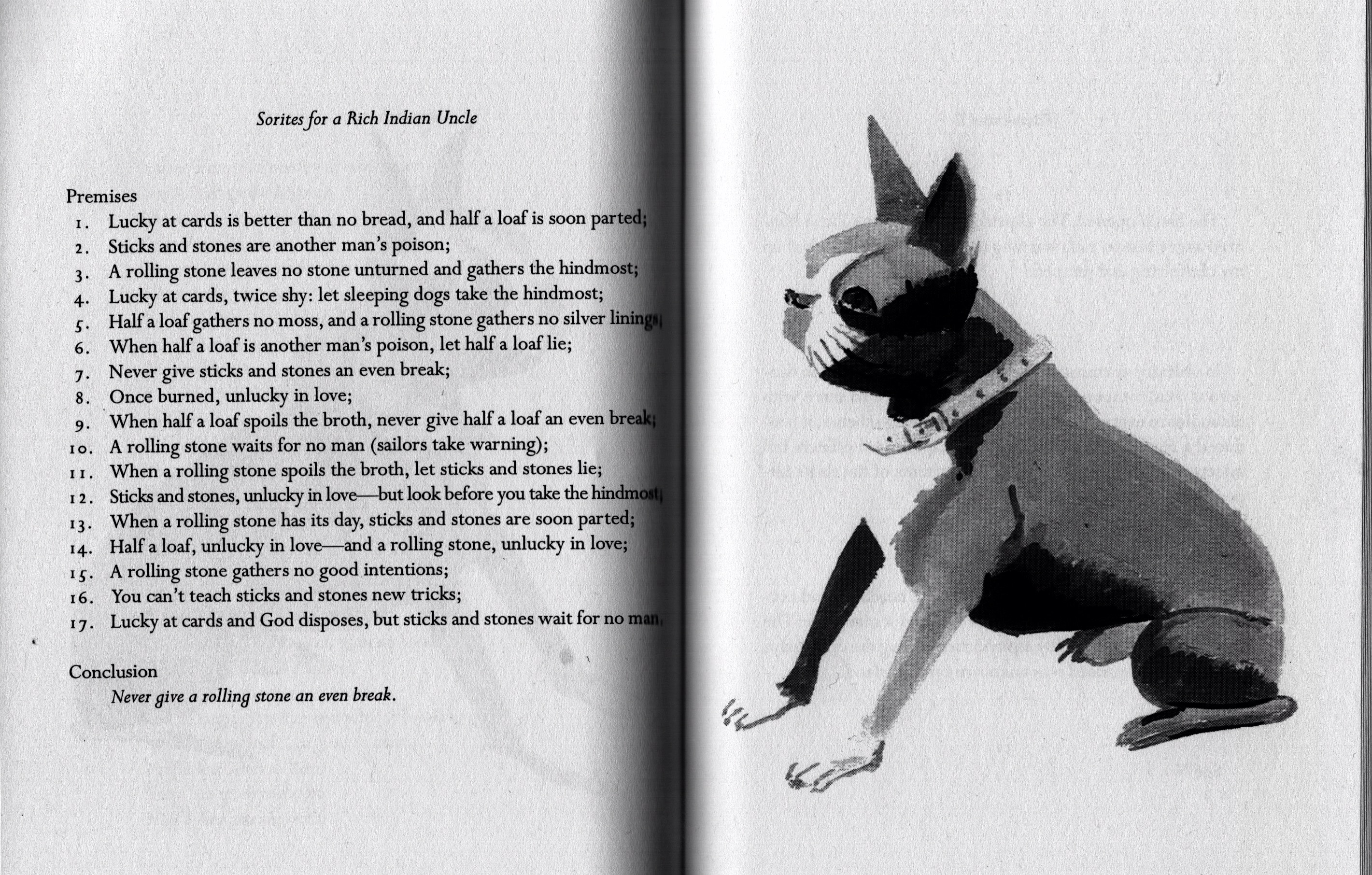
Click on the damn image to make it much bigger so you can read Mathews’ list (or sorites/stories/sorties). From Selected Declarations of Independence. The illustration is by Alex Katz.
An African fairy tale retold by Alena Benesova and translated into English by Ruth Shepherd. The marvelous illustration is by Karel Franta. From Animal Fairy Stories.






 Biblioklept