I took my daughter to the bookstore today—she has the day off school—and let her pick out almost as many books as she wanted. (She had trouble carrying more than six, so that’s where we stopped).
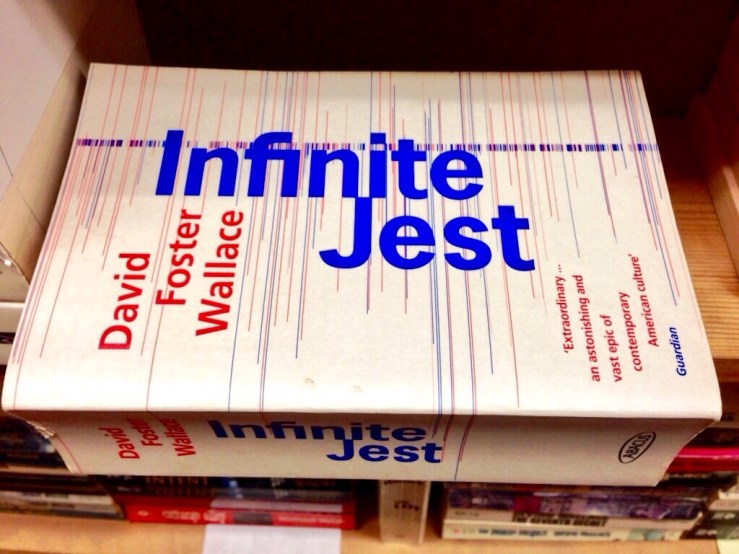
Meandering out, I spied this 1997 paperback printing of David Foster Wallace’s Infinite Jest (I love how UK trade paperback editions often seem blockier, denser, more squarish than US editions). Anyway, the book isn’t particular rare, even for a first edition, but I hadn’t seen it before (even a pic). I took a quick pic and walked away.
And then walked back of the copy of IJ after purchasing my daughter’s books—only to say to myself in a reasonable voice, No, you already own a copy, no, no, you don’t need another book, especially one you’ve already read, already own. So I walked out of the store with my daughter.
And then went back inside to buy it (or rather use my trade credit—swollen from unasked-for review copies of books I have no interest in—to acquire it).
I have no sentimental attachments to the ubiquitous beclouded-covered copy I bought a few years ago (purchased to replace a copy I did like (one with annotations, one I actually wished I still had) that I had lent to a friend who never read it or returned it (and then moved))—so maybe I’ll give it away or take it to my office or something.
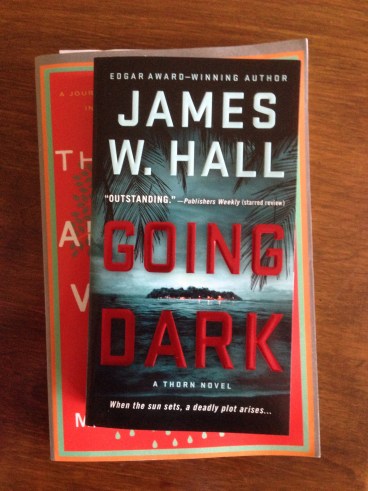
James W. Hall’s Going Dark. Got a review copy last month and somehow got shoved to the bottom of another pile. Mea culpa. Publisher Macmillan’s blurb:
Earth Liberation Front is a loosely-knit national organization of radical environmental activists who take a “by any means necessary” approach to defending the planet. In the last decade, ELF has been responsible for almost a hundred million dollars in damage mainly through arson. The FBI ranks them, along with other eco-radicals, as the number one homegrown terrorist threat. And Flynn Moss—Thorn’s newly discovered son—appears to be among ELF’s members. “no-holds-barred action…A fine thriller on every level.” —Booklist Flynn has naively fallen in with an ELF cell in Miami, where he’s engaged in non-violent protest against one of Florida’s largest nuclear power plants. But soon Flynn uncovers another, darker plot among ELF operatives—one that involves a radioactive catastrophe rivaling Chernobyl or Fukushima. With a growing sense of dread about his involvement in such a scheme, Flynn summons Thorn to help him escape from Prince Key, the remote island off the shores of Miami where the ELF group is camped. But just as soon as Thorn leads the fight to save Flynn, he reaches a frightening realization: In order to protect his son, he must join the eco-terrorists and help them complete their deadly mission. And time is running out in Going Dark…
Denis Johnson’s new novel The Laughing Monsters is excellent.
Okay: Too short a review? Well. Look, I read it over the weekend, and got a copy of the audiobook version to listen to this week, and then I’ll write a proper review, but here’s publisher FS&G’s blurb, followed by a few quick impressions:
Denis Johnson’s The Laughing Monsters is a high-suspense tale of kaleidoscoping loyalties in the post-9/11 world that shows one of our great novelists at the top of his game.
Roland Nair calls himself Scandinavian but travels on a U.S. passport. After ten years’ absence, he returns to Freetown, Sierra Leone, to reunite with his friend Michael Adriko. They once made a lot of money here during the country’s civil war, and, curious to see whether good luck will strike twice in the same place, Nair has allowed himself to be drawn back to a region he considers hopeless.
Adriko is an African who styles himself a soldier of fortune and who claims to have served, at various times, the Ghanaian army, the Kuwaiti Emiri Guard, and the American Green Berets. He’s probably broke now, but he remains, at thirty-six, as stirred by his own doubtful schemes as he was a decade ago.
Although Nair believes some kind of money-making plan lies at the back of it all, Adriko’s stated reason for inviting his friend to Freetown is for Nair to meet Adriko’s fiancée, a grad student from Colorado named Davidia. Together the three set out to visit Adriko’s clan in the Uganda-Congo borderland—but each of these travelers is keeping secrets from the others. Their journey through a land abandoned by the future leads Nair, Adriko, and Davidia to meet themselves not in a new light, but rather in a new darkness.
The Laughing Monsters is not the plot-driven spy novel it pretends to be. The novel’s plot is a shaggy dog story, an excuse for Johnson to riff on how adventure tips into madness, how conflicting identities jam up against loyalties.
Johnson is clearly following Conrad’s Heart of Darkness, sure, but there are also heavy hints of Moby-Dick here, and even Blood Meridian (McCarthy clearly is the descendant of Melville and Conrad, of course). But mostly Denis Johnson is following Denis Johnson in The Laughing Monsters.
The Laughing Monsters is also very-much about writing itself: Nair is a writer, and much of the novel takes the form of emails he sends (or writes without sending), notes he scratches on lined paper in dull pencil, and half-mad confessions. Ultimately, the voice that narrates the novel is Nair’s internal composer. The driving force of the story though is Michael Adriko, the charismatic trickster who seems to be creating the plot as he goes along.
More to come, but again, short version: Great stuff.
If you haven’t yet seen Too Many Cooks, Casper Kelly’s short film for Adult Swim, here it is:
Too Many Cooks compels and rewards/punishes its audience not because of its comedic elements, but rather for its horror. Kelly has made one of the finest little horror films I’ve ever seen.
The central techniques of Too Many Cooks–repetition, collage, and genre parody—are fairly obvious and wonderfully synthesized. The film relies on an understanding that its audience has a particular way of seeing. The intended audience of Too Many Cooks has:
1) An understanding and acceptance of the postmodern tradition of repeating a punchline (or set-up) past the point of humor. And–
2) A particular ironic vision that delights in seeing commercial TV genre conventions of yore skewered.
Too Many Cooks succeeds by disrupting both ways of seeing. Its audiovisual repetitions (oh my lord the song!) become insane tics in a horror story that the viewer did not expect to happen—despite a number of early clues.
In his essay “The Philosophy of Composition,” Edgar Allan Poe suggests that when “men speak of Beauty, they mean, precisely, not a quality, as is supposed, but an effect.” Let us substitute “Horror” for “Beauty” (Poe would not mind, I think) and we have a fair description of what the filmmakers behind Too Many Cooks have created: A short piece of art that, by its arrangement, editing, of particulars—including its audience’s preconceptions—creates the effect of horror.
That horror emanates from the secret protagonist of Too Many Cooks, a mad-eyed killer who haunts the film first from its peripheries before eventually overtaking it. (He bears a slight resemblance to the philosopher Slavoj Žižek).
The Killer is the organizing principle of Too Many Cooks. He’s right there from the beginning, a specter whose agency throughout the piece subverts audience expectations. It’s not the uber-Father (who begat too many Cooks) who is the film’s central figure, but the infanticidal Killer.
Here is the first time we see The Killer, just 20 seconds in. He’s there on the right, sweater-vested (like a dad):
And then a few seconds later, lurking on the Brady/Cosby/Bundy stairs, still obscure:
The Killer next shows up about 90 seconds in; this is, unless I’m wrong, the first time we see his visage. It’s also the moment when Too Many Cooks’s early joke on corny nineties sitcom intros really starts to wear thin—the filmmakers offer us repeated images of cooks as if to underscore the tedious point.
And there’s The Killer in the second family photo:









 Biblioklept